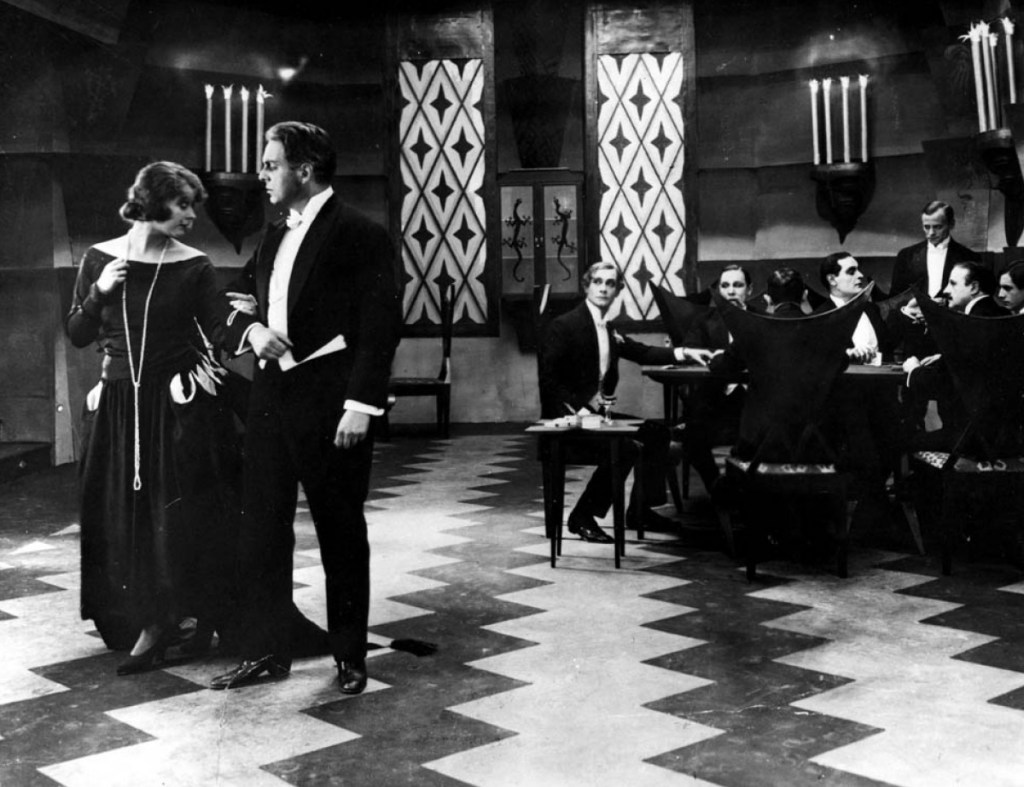
Silent film pantomime: a scene from the German film “Dr. Mabuse, der Spieler” (1922), directed by Fritz Lang (1890-1976), cinematography by Carl Hoffmann (1885-1947), with at left Gertrude Welcker (1896-1988) as Countess Told and Rudolf Klein-Rogge (1885-1955) as Dr. Mabuse; at the piano: Alfred Abel (1879-1937) as Count Told.
Pantomime is a deeply misunderstood and marginalized art, largely because for so long people have had such limited experience of it. Yet when they encounter it, pantomime can exert a fascination on spectators by allowing them to see the narrative power of the body more vividly than any other form of performance. But the marginal cultural status of pantomime is not due to any inherent cognitive or semiotic deficiency within the art that justifies a society deeming as “unnatural” the construction of performances in which characters act without speaking. In other words, the politics governing cultural institutions are responsible for a society’s marginalization of pantomime. A marginalization of pantomime arises from ideologically formed attitudes toward relations between speech and bodily signification. The ideological shaping of these attitudes becomes apparent by examining the long history of pantomime within Western civilization. When and why do societies encourage pantomime? How do societies define pantomime? Why or under what circumstances do audiences favor pantomime over spoken performance or dance?
The chief purpose of this book is therefore to create a new understanding of pantomime and to establish an importance for the art that previous writings on it have severely underestimated. Achieving this goal entails writing a larger history of pantomime than has yet existed to show 1) the varieties of pantomimic performance that have appeared across different eras of Western civilization and across different media; 2) the peculiar socio-political circumstances that have allowed Western societies to encourage pantomimic performance; 3) the qualities that separate pantomime from dance and other forms of speechless performance; and 4) the ideological pressures within a society that encourage an inclination to favor dance over pantomime to “regulate” speechless performance. But these motives are subsidiary to the larger aim of showing how bodies construct narratives or “tell” something otherwise hidden when the performers have no need for speech or the movement devices of dance. In its clearest manifestation, pantomime builds narratives entirely and exclusively out of “unregulated” physical actions. Actions are verbs, a narrative is the sequencing of verbs to reveal an otherwise “invisible” relation between them. The performance of the actions is unique to the performer, unlike in dance, where the movements of the performer are unique to an external system of kinetic signs imposed upon the performer and derive from steps, positions, and movement tropes that have aesthetic value in themselves and do not depend on a larger narrative logic to justify their use. The pantomime performer moves from one action to the next according to a unique narrative logic. Pantomime does not “translate” words into gestures. In its clearest manifestation, pantomime is not the glorification of a semiotic system or gestural technique; it is the bodily performance of “other” identities that tell a story without speaking. Pantomimic action is “unregulated” in the sense that the performer determines how to perform it in relation to the unique goal of the narrative. Both dance and speech “regulate” bodily signification insofar as they compel the perception that the body needs the voice or a movement “vocabulary” to “make sense” of the actions it performs. Speech filters and even stunts perception of what the body “tells,” because the minds of both spectator and performer require so much space to process linguistic signifiers, as opposed to musical or sound effect signifiers. On the other hand, dance subordinates action to movement derived from a system of steps, positions, or kinetic tropes that define performance as “dance.” For dance, especially ballet, narrative exists to provide opportunities for dances, but the dances are always “free” of the narratives that contain them. Dance tends to integrate the spectator into the ideology of bodily “discipline” that forms the steps, positions, and kinetic tropes; pantomime tends to estrange the spectator from the ideology of semantic logic or “sense” that justifies the need to consume performed narratives.
In recent years, pantomime has been the subject of several excellent scholarly books. However, all of these books focus on a narrow segment of pantomime history and avoid looking at its larger historical scope as a Western cultural phenomenon. In the imperial era, the Romans adopted the Greek term “pantomime,” used as early as 80 BCE, to designate a form of performance they considered an invention of imperial taste (Webb 2012: 222). Although prototypes of pantomime performance originated in Greece, the Romans regarded pantomime as something uniquely fashioned according to their wishes, according to an ideology of “metamorphosis” that was fundamental to the imperial consciousness. Recent books on Roman pantomime have thoroughly compiled the literary-historical textual references to the art, and this book, too, makes use of these references. Important recent books dealing with Roman pantomime have come from Hartmut Leppin (1992), Charlotte Roueche (1993), Margaret Malloy (1996), Ismene Lada-Richards (2007), Marie-Hélène Garelli (2007), Edith Hall and Rosie Wyles (2008), Ruth Webb (2009: 58-94), and Katherine Dunbabin (2016: 85-113). These works interpret and evaluate the ancient sources from different perspectives. But they tend to see pantomime as a largely static art that remained unchanged in the early sixth century from what it was in the first century CE. They underestimate the extent to which competition, political pressures, and economic circumstances encouraged dynamism and innovation in pantomime. This book integrates the evidence of pantomime from ancient textual sources with the evidence from archeological, iconographic, musical, and political sources to produce an understanding of Roman pantomime more from a theatrical than a classical studies perspective. Perhaps this approach can provide a more persuasive answer to a question that the classical studies approach has so far not addressed with much clarity: why did pantomime dominate imperial Roman theater culture for half a dozen centuries? A more dynamic conception of Roman pantomime performance, its narrative structure, and its production process is necessary to answer this question. The idea here is to complement the mythic-philological preoccupations of classical studies with attention to political-ideological ambitions that shaped the course of pantomime history in the Roman Empire and in the Western civilization that emerged after the Empire. The implication of this approach is that the ramifications of Roman pantomime extend far beyond the Empire because the Romans saw pantomime as their invention, as a socially destabilizing phenomenon, as a thing that superseded Greek-originated performance “traditions” and physicalized most economically and persuasively a pervasive, imperial anticipation of change, of transformation, or, as they themselves might have called it, of metamorphosis. Roman imperial society encouraged a more volatile and unruly pantomime culture than is often implied in histories that stress the continuity of the art with Greco-ritual origins, with other sectors of Roman culture, or even with supposedly analogous Asian forms of theater.
Pantomime in the modern era has inspired admirable monographs by Ariane Martinez (2008), Gilles Bonnet (2014), Arnaud Rykner (2014), and Pinok et Matho (2016). However, these authors focus almost entirely on pantomime as it developed in France, especially in the period 1880 to 1930. France has made huge contributions to pantomime history, but, especially since World War II, the whiteface, romantic, melancholy, nineteenth century figure of Pierrot has dominated perception of these contributions to such an extent that many people equate pantomime with Pierrot and Pierrot-like variants such as Marcel Marceau’s Bip and with French control or ownership of pantomime. But the fixation on Pierrot as the basis for defining the French contribution to pantomime history has seemed dependent on not only ignoring pantomime outside of France but even large sectors of French pantomime history without Pierrot. Pantomime has enjoyed a much busier existence in the West, including France, than the Pierrot cult implies. Hartmut Vollmer (2011; 2012a) has produced a detailed, revelatory reclamation of the ambitious experiments of the Austro-German literary pantomime between 1895 and 1920. Although he acknowledges briefly the Roman concept of pantomime, Vollmer confines his project to the Austro-German scene of a particularly auspicious era for pantomimic imagination cultivated by suave literary personalities. A much larger history is necessary to comprehend the scale of the pantomimic imagination released by modernist ideology and the diversity of pantomimic performance strategies arising from different cultural milieu, from elsewhere in Western and Eastern Europe, from the United States, from motion pictures, and from early modern dance. Germanic pantomime, Eastern European pantomime, silent film pantomime, and pantomime experiments from the pioneer modern dancers brought an emotional intensity, complexity or darkness to pantomime that the art had avoided since the early nineteenth century. Pantomime has always reserved a large space for comedy, but the perception persists among many contemporary practitioners of pantomime and among dramatic writers that pantomime is only about comic effects, that acting without speaking is inherently ridiculous. The perception persists probably because comic effects do not create nearly as much ambiguity or uncertainty of signification as “serious” voiceless performance and therefore produce a much more stable (and usually affectionate) relation between performer and spectator. But a widespread distrust and even hostility to pantomime results from the perception that pantomime is not “serious,” that it is a childish entertainment, that it relies on “charming” evocations of a human sweetness otherwise obscured by talk (the Pierrot archetype), that it is an art of caricature and stereotyped identities, that it is too limited in its capacity to destabilize relations between performance and audience. This book thus focuses largely, though by no means exclusively, on “serious” or emotionally and intellectually intense forms of pantomime from the Roman Empire until the present. It is not a history of clowns, the circus, or the traditional English Christmas pantomime, for other books have already covered these subjects effectively, especially by Janina Hera (1981), John O’Brien (2004), and Jeffrey Richards (2015). But the main point here is that ideological, rather than economic, pressures shaping performance institutions rather than audiences or societies are what create such large presumption that pantomime should be comic rather than “serious.”
Étienne Decroux was a major architect of the French “mime culture” that flourished internationally from the 1950s to the 1980s. His ideas concerning mime were quite serious, and this book devotes much attention to them. But his seriousness did not produce much in the way of serious performance, in part because of his aversion to any sort of public performance. His disciples have nevertheless published many books on mime. However, these books focus obsessively on the theme of how to be a mime. They identify attitudes, techniques, exercises, rules, and schools that prepare readers to live as mimes, which, as will be evident, is not the same thing as preparing readers to construct pantomimic performances for audiences who are not also mimes. Such books pay little attention to the history of pantomime outside of its descent from Pierrot, and they place almost no weight at all on the study of actual pantomimic performances. I will, of course, examine the reasons for these biases of the mime culture. At the moment, though, I will simply assert that mime culture is school culture; it equates mime above all with the teaching of techniques, exercises, the execution of small-scale “episodes” or sketches. None of the Decroux-influenced books on mimes provides any guidance about how one constructs narratives out of physical actions. They teach the reader how to live as a mime, not how to think pantomimically. Since the eighteenth century, French culture for various reasons has struggled to impose a system of signification on pantomime, to regulate it, to put it in a school, to contain it within some kind of gestural or bodily “language.” The implications of this philosophy inspire some scrutiny in this book. The mime culture emerged from ideological pressures issuing from an existential anxiety about what the body “tells.” A large-scale history of pantomime reveals that pantomime achieves its most powerful manifestations when it is “unregulated,” when it is not the product of a technique or school, when it builds narratives and “other” identities out of physical actions rather than affirms the authority of a technique for shaping the narrative of one’s life. Pantomime itself reveals the limit of the mind to allow the body to act without speaking, to tell a story without the “help” of spoken words. This limit of the mind, of the pantomimic imagination, is the work of ideology.
I began work on this book when in 1996 I participated in a National Endowment for the Humanities Summer Seminar on “The Art of Ancient Roman Spectacle.” The Seminar enabled me to spend nine weeks in Italy researching the ancient Roman pantomime. It was one of the happiest times in my academic career. The Seminar was the project of Bettina Bergmann, Mount Holyoke College, and Christine Kondoleon, Boston Museum of Fine Arts, whose joint leadership was the most imaginative, satisfying, and inspiring of any academic enterprise in which I have been fortunate to participate. I am profoundly grateful to both of them for revealing to all of us in that splendid Seminar the wonder, scope, and complexity of ancient Roman spectacle. And I am equally grateful to the NEH for making such opportunities as this Seminar available to me and to thousands of other scholars. It is impossible to overestimate the extent to which these Seminars have transformed for better the thinking and study of the humanities in higher education.
The College of Humanities and the Arts, San Jose State University, guided by dean Carmen Sigler, supported this book with a sabbatical in Spring 1999 that enabled me to do further research in Italy. Students from the Department of TV, Radio, Film, and Theater assisted me in performing experiments in ancient Roman pantomime performance, including Erika Yanin Perez, Donna Vonjo-Tournay, Kathy White, Laura Long, Tim Garcia, and several others who joined the team without ever identifying themselves. Technical Director and scene designer Jim Culley helped me to test and photograph indoor Roman pantomime performance using oil lamps in an indoor stage. The enthusiasm of students for knowledge of ancient Roman pantomime surprised me, but they clearly wanted to understand how bodies could communicate in ways that our society seemed to have forgotten.
I first became aware of ancient Roman pantomime through a Seminar on Tragedy that I took as a graduate student at San Jose State University. Professor Lou Waters invited me to give a presentation on the dramas of Seneca, and in researching this theme, I learned of a strange form of performance, the pantomime, which the Romans preferred to all other forms of theater. But at that time (1978), it was very difficult to access information about the ancient pantomime, and very little scholarship existed on the subject, in spite of the huge proliferation of books on mime back then. Through Dr. Waters, I realized that this marginalization of Roman pantomime was a defect of scholarship, not of the Romans. However, the task of investigating the pantomime was a long, slow process requiring more time and patience than I was able to afford for many years, distracted as I was by other scholarly projects, heavy teaching loads, and then extensive administrative responsibilities. For years, the Inter-Library Loan office of the Martin Luther King University Library provided invaluable access to many publications related to my project. The libraries of Stanford University and the University of California Berkeley also provided me with important texts.
But the nature of the project changed. Originally I planned only to write a monograph on the ancient Roman pantomime. Yet I felt I could not complete that goal without addressing the question: What was the “aftermath” of the Roman pantomime? How has the idea of pantomime evolved since Roman times? But answering these questions entailed writing a work of far greater scale than I ever thought possible. Indeed, a purpose in writing this huge book is to show that the history of Roman pantomime and its “aftermath” requires a book that is far larger than most readers can consume—that is, a book that makes it difficult to treat pantomime as it has been for so long, as an incidental, obscure category of the performing arts with a history that can be summarized in slender monographs, if not in a few paragraphs. But the scale of pantomime history has become so large because of the advent of digital technologies in the twenty-first century. These digital technologies have made it possible to access materials related to pantomime history that in the pre-digital era would have taken many years to read or see in libraries and archives scattered across many countries and cities. Lack of time and resources most likely would have made this book unimaginable less than a decade ago. I therefore must express my gratitude to manifold digital resources that provided access to a history of pantomime that otherwise would have remained buried in local archives. The Google search engine is of course an inescapable resource in locating documents. But the search engine connects one to other digital resources, especially the digitizing projects of many libraries and museums, such as: Gallica, the Internet Archive, the Gutenberg Project, the digital archives for innumerable newspapers and magazines, Google Books, the Estonian Broadcasting Archives, Perseus, YouTube, Vimeo, the universities digitally distributing dissertations produced within the European Union, and the universities in the United States, Canada, Australia, Russia, and South Africa digitally distributing research produced by their students or faculty. Google Translate gave me access to many documents in otherwise unintelligible foreign languages. While Google Translate still betrays frustrating limitations, it nevertheless proves increasingly effective in opening up texts rather than obfuscating them. The benefits of Google Translate far outweigh its limitations. But my larger acknowledgment is that these digital technologies transform the scope and scale of historical writing.
I am also extremely grateful to Hartmut Vollmer for his detailed excavations of Germanic pantomime in the early modernist era and for retrieving these works from undeserved obscurity.
Over the years, several people have provided important support or encouragement for this book: Jo Todd, Susan Manning, Claire Wu, Laurence Senelick, Joshua Dorchak (who was also a participant in the NEH Seminar), Janet Van Swoll, Barbara Sparti, Nancy Ruyter, Keithy Kuuspu, Sandra Rudman, Eija Kurki, Janet Curtis, Kalle Kurg, Adolf Traks, John Hirschhorn-Smith, Valdis Majevskis, and Heide Lazarus. David Wilson, of the Early Dance Circle in England, also provided valuable assistance.
Heili Einasto, of Tallinn University, has been a patient and tirelessly enthusiastic supporter of this project since she first became aware of it in 2014. Her enthusiasm inspired me to achieve much more than I ever thought I was capable, and the scope of this book expanded in part because she felt that so much history of pantomime should not be forgotten, ignored, or diminished. She provided and translated many documents related to Estonian pantomime and conducted oral interviews with key figures of Estonian pantomime during the Cold War. Her assistance was invaluable in revealing the political-aesthetic complexity of pantomime. She also helped with the translation of Russian-language pantomime documents. Because of her, I understood how important and exciting it is to examine student performances in relation to a national political performance aesthetic.
I have dedicated this book to the memory of Claudia Gitelman and Barbara Palfy because they believed in this book from its earliest days, believed that a new history of pantomime might do much to bring about an important new understanding of the body in performance. Their deaths cast a shadow of sorrow over this history.
Title: Pantomime: The History and Metamorphosis of a Theatrical Ideology
Subjects: Non-fiction—Pantomime history (22 BCE-2019), acting history, dance history, film acting
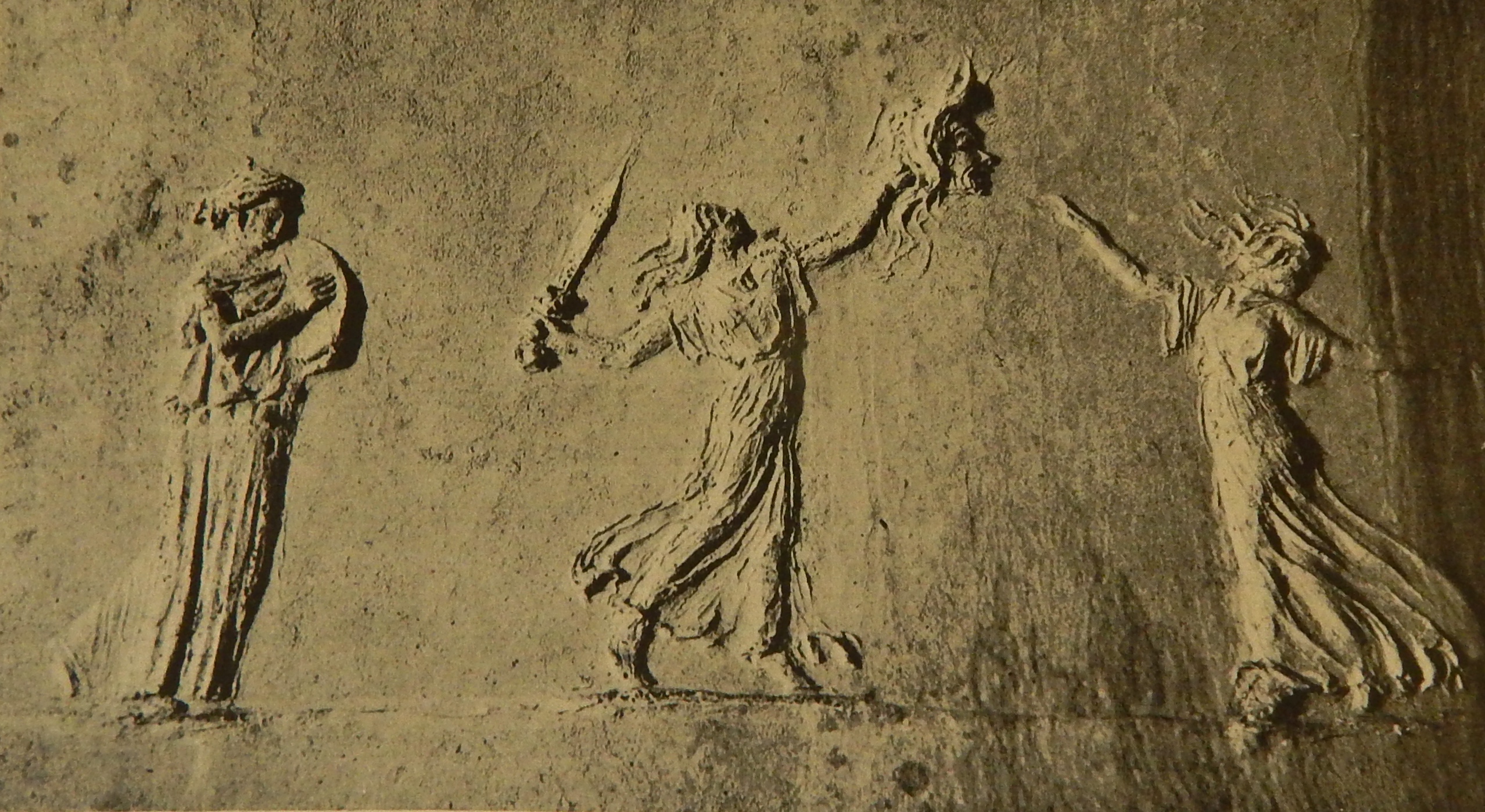
Cover: Stucco frieze from the underground vault of Porta Maggiore in Rome depicting a pantomimic performance of Agave displaying the head of Pentheus, with musician accompanying the scene. Photo from Weege (1926).
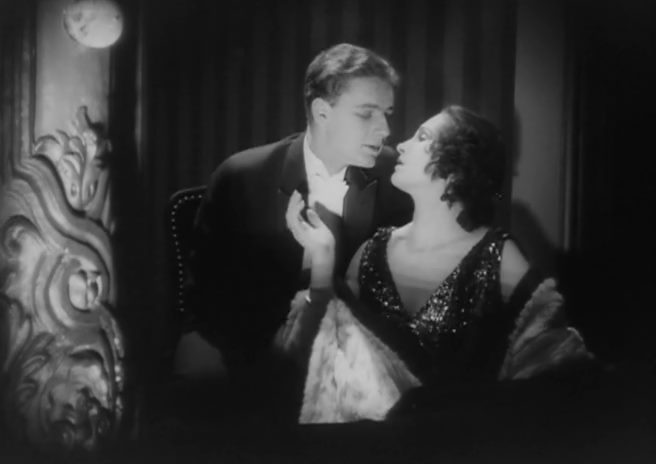
Frontispiece: Image of Walter Slezak (1902-1983) and Nora Gregor (1901-1949) as Michael and Princess Zamikoff from the German silent film Michael (1924), directed by Carl Dreyer (1889-1968).
ISBN: 978-1-7332497-4-4
Pantomime: The History and Metamorphosis of a Theatrical Ideology
Dedicated to the Memory of Claudia Gitelman and Barbara Palfy
The pantomime, as it evolved during the Roman Empire, was a mysterious form of theatrical performance whose aesthetic qualities now seem far stranger and thus perhaps much more “modern” than other forms of ancient performance. The Latin pantomimus derives from the Greek pantomimos, “imitator of all.” The pantomime has assumed a “mysterious” identity because of the density of ambiguity associated with its performance practices. These practices blurred distinctions between genres, between sexualities, between audiences, between performance contexts, between dance and drama, between text and enactment, between actor and character, between singing and speaking, between the mythic and the pseudo-mythic, and between cultures of the Mediterranean. The ambiguities of signification created by the pantomime indicate fascinating problems of perception. For audiences in imperial antiquity, the pantomime embodied a highly complex and sophisticated way of looking at the world and especially at the body’s freedom to act within the world. For these spectators, this pantomimic power of the body to convolute perception of itself was the source of an intense, enduring, and unstable emotional attachment. Pantomime transmitted an imperial ideology that helped to sustain public confidence in the Empire.
But both ancient and modern commentators on the pantomime have faced an even deeper problem of perception: what exactly did the pantomimes do to produce such an enigmatic representation of the body’s relation to space, time, and language? In 1930, the philologist Louis Robert argued persuasively that pantomime performance, on a professional level, existed throughout much of the eastern Mediterranean at least as early as 80 BCE, the date of the earliest epigraphic evidence referring to a pantomime performer, and probably emerged as a distinct category of performance during the early Hellenistic period of the previous century (Robert 1930). In 1944, Otto Weinreich, another philologist, proposed that fragmentary evidence from Varro (116 BCE-27 BCE) indicated that pantomime as the Greeks produced it was a pervasive mode of performance in the eastern Mediterranean by 280 BCE and in Rome by about 60 BCE (cf. Zanobi 2008: 6). Moreover, as Weinreich further observed, if the pantomime had its origins in the pyrrhic dance described by Xenophon in the Anabasis, which dates from around 370 BCE, then pantomime probably originated in Greece, not Egypt, during the earlier half of the Fourth Century BCE (Weinrich 1948). Evidence of the pantomime and its immense popularity persists until the advent of the sixth century CE. Knowledge of pantomime as the Greeks fashioned it scarcely exists beyond obscure epigraphic references, and whatever the Greeks called pantomime the Romans redefined in accordance with ideological objectives that Hellenistic theater was unable to imagine let alone accommodate.
But although the pantomime was the dominant form of theater entertainment in the ancient Mediterranean world for at least six hundred years, the accumulated discourse on it has succeeded in adding to rather than diminishing the uncertainty regarding the nature of this performance mode. Since Renaissance times, the Greek model of theater performance developed in Athens during a fifty-year span of the fifth century BCE has dominated perception of “classical” theater in antiquity, primarily because this model evolved in very close relation to the production of literary dramas that projected an existence, as literature, independently of its performance in the theater. One supposedly “sees” theater more effectively by reading dramas, and this assumption, sanctified entirely by the controlling authority bestowed on literary texts to determine the value or significance of theater, has long urged people toward a serious misperception and devaluation of the cultural and historical significance of the pantomime. Compared with the achievements of the great Greek theater of the fifth century BCE, the pantomime always appears in cultural histories as marginal, corrupt, a debasement of a once great theatrical aesthetic, evidence of an almost interminable decay in literary, philosophical, and aesthetic values in relation to public pleasures. But from the perspective of the audience for the pantomime, quite the opposite was more likely the case: the pantomime was the monumental summation or distillation of an already venerable theatrical consciousness, for which the fifth century Greek theater was simply an innovative interlude or prototypical, tentative phase of development.
The pantomime that flourished between 280 BCE and 600 CE was a theatrical performance in a tragic key in which narrative elements in a mythic vein manifested themselves through the movements of an actor or actors accompanied by a singer/narrator (interpellator), chorus, and musicians. This is the definition that Ernst Wüst offered in his excellent 1932 Real Encyclopedie article on the pantomime, and no one has seriously questioned it, even if it has not produced any accurate or even particularly vivid image of pantomime performance. But while the definition seems bland, it nevertheless subtly indicates by its deceptive precision and congenial opacity not only the extraordinary power of the pantomime as performance but the basis for the difficulties of perception provoked by the performance. For one thing, the definition describes a mode of performance that other performance contexts besides the conventionally designated theaters accommodated: the circus stadiums, the banquet-symposium milieu of the great villas, the ritual processions to the temples, and, eventually, the ancient forms of nightclub entertainment. Moreover, the definition describes performances given by star pantomimes. The star pantomimes, however, tended to appear as the outstanding attractions within a program of spectacles provided by a company of entertainers. While the conventions of pantomimic performance remained quite stable over the centuries, the conventions defining the program of spectacles in which it appeared were not only less stable, they were and remain much more difficult to define than even the pantomime itself. The physical, material ambiguity of the pantomime performance world invested it with considerable, and often volatile, political, moral, and cultural ambiguity. Furthermore, its ambiguous, uncertain relation between the performing body and the space of performance allowed the pantomime aesthetic to construct a complex, innovative, richly enigmatic, and hitherto completely underestimated relation to narrative, language, speech, sound, and visual sensation. The power of the pantomime aesthetic to elude vivid definition or provide a stable image of itself was what made it such an enduring and seductive embodiment of an imperial consciousness or attitude toward the freedom of bodies in a reality defined as much by the cosmic concept of fate and the pressure of mythic imagery as by the evidence of sensory perception.
The ancient literary evidence for the pantomime is largely Greek rather than Latin, which has the effect of amplifying the perception of the pantomime as a fundamentally Greek art form imported by the Romans rather than adapted and integrated by them into a complex cultural program with a distinctly Roman agenda. In the Latin sources, pantomimusis virtually interchangeable with saltatio(dancer) and histrio(actor); histriomay derive from the Etruscan hister(dancer). In the nineteenth century, some historians proposed that the dance theater was of Etruscan invention. The Romans adopted it in 364 BCE, when a plague afflicted the city and nothing the citizens did could please the angry gods. The skill of the Etruscans at performing dramatic dances to the accompaniment of a flute urged the Romans to call upon them for help. Etruscan dancers then appeared regularly in Rome. Roman youth “not only imitated these dancers, but also recited crude and jocose verses, adapted to the movements of the dance and the melody of the flute” (Schmitz 1875: 612). Leonhard Schmitz further contended that the freedman Livius Andronicus (285-204 BCE), author of numerous dramas of which only a few fragments remain, introduced the idea of the singing interpellator, a slave, who “carried on a dialogue” with the dancer accompanied by the flute. More likely, however, is that the Roman pantomime was the result of manifold influences from Greece, Egypt, and Etruria. Latin authors tend to be perfunctory and often highly ambivalent in their comments on pantomime, especially in regard to performance itself. But the incidental character of the Latin commentary seems absurdly inadequate to the task of accounting for the pervasive authority of pantomime as a preferred mode of performance throughout Roman imperial civilization. In any case, both Greek and Latin authors assume their readers already know what pantomime is, and the task of the commentary is to clarify an effect of performance without explaining the circumstances of the performance itself.
The most famous of the ancient commentaries, Lucian’s “On the Dance” (ca. 165 CE), is so informal and chatty and permeated with displays of ironic rhetoric that it almost seems like an elaborate effort to disguise a serious inability to articulate in words the material manifestation of pantomime performance. His discussion of the pantomime remains almost entirely on a generic level, punctuated only occasionally by anecdotes that merely stress the quaintness of his subject. Although he claims that pantomime “rouses the mind to respond to every detail of its performance,” he himself provides hardly any evidence of such detail (Lucian 1936 V: 289). Lucian (ca. 125-ca. 180 CE) prefers instead to wander genially through the history of dance, with inventories of subject matter and reasons for appreciating the dance, in the manner of a connoisseur affably conducting an excursion through the various pleasures associated with an underestimated and unfairly maligned entertainment (cf., Anderson 1977). “In general, the dancer undertakes to present and enact characters and emotions, introducing now a lover and now an angry person, one man afflicted with madness, another with grief, and all this within fixed bounds. Indeed, the most surprising part of it is that within the selfsame day at one moment we are shown Athamas in a frenzy, at another Ino in terror; presently the same person is Atreus, and after a little, Thyestes; then Aegisthus, or Aerope; yet they are all but a single man” (271). While this language does give a sharper image of the pantomime than the definition examined above, Lucian’s defense of the dance theater never achieves any greater precision about what he actually saw in the theaters (even his anecdotes are second-hand stories) and certainly no deeper insight into its significance. His text is important because of its articulation of an urbane attitude toward the pantomime. But this urbanity, with its dinner-table affability and lavish display of “curious” erudition, is primarily a pose designed to obscure and neutralize the justification for the defense in the first place. The pantomime emerges here as a pretext for showing the capacity of rhetoric to construct an image of a sophisticated spectator rather than a sophisticated image of the performance that attracts this spectator. Nevertheless, a major consequence of Lucian’s text is that from the Renaissance on, readers of it have treated Roman pantomime as a form of dance as people since that time have understood the word, even though the Roman idea of dance was broader insofar as pantomime referred to a speechless performance that was sometimes dancelike, but not a dance, because the body did not move according to prescribed or even codified steps or movements.
Around 361 CE, Libanius (ca. 314-ca. 393 CE), a rhetorician, also composed a relatively lengthy defense of the pantomime (LXIV), ostensibly a response to a now lost attack on the pantomimes by Aristides nearly two hundred years earlier. In his 1908 edition of Libanius, Richard Foerster noted so many similarities to Lucian’s dialogue that both he and Josef Mesk considered the possibility that Libanius used Lucian’s text to formulate his own argument (Mesk 1909: 65-69). Scholars of the pantomime tend to make little use of Libanius’s text, partly because the difficult text remained untranslated into any language until Margaret Molloy translated it into English in 2014. For Libanius, the pantomime was primarily an opportunity to display the authority of rhetoric to transform perceptions and attitudes. The pantomimes have a widely assumed reputation for bad morals. The task of rhetoric, then, is to show how skillful deployments of words can get the listener to believe that bad people can produce beautiful actions and that some actions are expressions of goodness even if only corrupt people can perform them. With this objective, it is not necessary to focus much on the details of pantomime performance; rather, the focus is consistently on the details of argumentation logic: “For who is unaware that we spend entire days in the theaters because of the number and variety of spectacles, where it is possible to see boxers, others fighting in single combat or matched against wild beasts, and still others doing acrobatics? So then do we go straight from the viewing into a state of being just like what we see? Do the boxers make us stronger? Do we love killing through [seeing] men dressed in armor? Do the beast-baiters inspire us to take on a lion? Do we become more nimble at leaping thanks to the acrobats?” (Libanius 1908: Paragraph 60, 458-459; Dorchak 2000, n.p.; Malloy 2014: 158). Libanius here suggests that people do not imitate actions just because they enjoy watching them. But this point muddles his other point, that the beauty of pantomimic actions is independent of the moral character of those who perform them. Indeed, the implication of the passage is that the pantomimes perform actions which the spectator should not desire to imitate for apparently moral (rather than technical) reasons, such as men impersonating women, in which case it is necessary to discuss performance values in greater detail. Yet Libanius’s defense remains an important document of pantomime scholarship insofar as it dramatizes so suavely the central problem haunting practically all thinking about the pantomime in a literary mode: to what extent, if any, did the moral consternation associated with the pantomimes explain the nature and significance of pantomime performance and its audience? This question looms over the assumption of modern sensibilities that the pantomime culture signifies a protracted period of “decay” in the public theater of the ancient world. But from Libanius’s perspective, it was difficult and perhaps absurd to equate pantomime performance with a “decay” of dramatic imagination, so it was not necessary to discuss performance values to construct a defense of them.
However, in his Table-Talk (Quaestiones convivales), IX, 15, composed around 100 CE, Plutarch (46 CE-120 CE), a scholar and aesthete, purports to describe to the Roman consul, Sossius Senecio, a banquet lecture by Ammonius, Plutarch’s teacher, on the subject of narrative dancing, in which Ammonius claims that “today nothing enjoys the benefits of bad taste so much as dancing,” for dancing, “having tyrannously brought almost all music under her sway […] is mistress of caprice and folly of the theaters, but has lost her honour among men who have intelligence and may properly be called divine” (Plutarch 1961: 297-299). In other words, Plutarch does associate the pantomime with a “decayed” art form, but he implies that this decay results from the corrupt taste of audiences rather than from the bad morals of dancers. Aesthetic decadence is for Plutarch primarily a problem of inferior “intelligence,” which marked the pantomime culture when the poetic voice became detached from the dancing body. Yet this supposed detachment may have occurred as much as three hundred years before Plutarch commented on it, and it may well be the case that the voice of the interpellator became a supplement to pyrrhic dancing without pantomime ever experiencing a phase in which the voice issued from the dancer.
The complex relation between bodily movement, language, and voice in the pantomime, which Plutarch only very lightly touches upon, is the fundamental source of controversy regarding the ancient literary evidence for this entertainment. The Latin commentary on the pantomime, while scattered over a wide assortment of incidental fragments, is perhaps even more mysterious than the Greek in its comprehension of the pantomime. Indeed, the most complete ancient description of any pantomime performance appears in Book X of Apuleius’s The Golden Ass, written around 150 CE, wherein appears an elaborate account of an enactment of The Judgment of Paris at a theater in Corinth. But since this is a work of fiction, an underlying message of the account is that pantomime performance possesses a peculiar power to transform itself into something more imagined than actually seen: pantomime performance, like the transformation of the narrator into a donkey, is about metamorphosis, about the mutability and relativity of any activity designated as “real.” Moreover, Apuleius’s description of the pantomime is in tension with Wüst’s definition of it as the work of a soloist. The donkey narrator, having been condemned to copulate with a murderous woman as part of her public humiliation, must participate in a “triumph” celebrating the punishment. He is brought to a theater to attend festivities preceding the triumph. These include a pyrrhic dance performed by “gorgeously attired” boys and girls, who move in a “comely order,” and these performers, as William Adlington’s 1566 translation puts it, “would trip round together, sometime in length obliquely, sometime divide themselves in four parts, and sometime loose hands and group them on every side.” When the curtain rises on the stage, a young man appears, “a shepherd representing Paris, richly arrayed.” A second young man soon appears, “all naked,” and gives Paris a golden apple as commanded by Jupiter. Then three women enter, representing Juno, Minerva, and Venus, all attended by waiting servants, including Castor and Pollux. Juno plays the flute; Minerva is accompanied by Terror and Fear, followed by another flute player; Venus, the favorite of the audience, appears attended by a “great number of little boys” representing Cupids. After them arrives “a great multitude of fair maidens” impersonating the “comely Graces” and the “beautiful Seasons.” It is difficult to see how this elaborate passage, involving nine separately performed characters and “a great number” of others, describes a pantomime, when virtually all other ancient texts treat the genre as the work of a solo performer. But of course, the point of pantomime for the Romans was to produce a performance that escaped the control or even definition by words.
Because the ancient literary evidence is so vague on details of pantomime performance, the bulk of modern scholarship has dealt mostly with the status or social significance of pantomime performers. The aim of scholarship has been to show how the dubious moral reputation of the pantomimes discloses insight into the social, political, or moral fabric of the imperial Roman civilization, and most of the epigraphic evidence which has surfaced in this century generally serves to support an argument about the ambiguous social status assigned to the pantomimes and how this status clarifies relations or tensions between social classes. Latte (1913), Bier (1920), Robert (1930), Weinreich (1941, 1948), Rotolo (1957), and Bonaria (1959) initiated a trend, supported entirely by epigraphic and philological evidence, of focusing on the pantomimes rather than on pantomimic performance, of dwelling on the problematic social-political identity of the pantomime performer rather than on the historical-aesthetic significance of the pantomime performance. Jory (1970, 1984, 1996), Leppin (1992), and Slater (1994) have pursued this literary perspective to produce a highly complex and enigmatic perception of the ambiguous, shadowy social identity ascribed to the pantomimes. But to build upon this impressive chain of scholarship, one must acknowledge that the extraordinary power the pantomimes exerted on public imagination, especially in the realm of political feeling, depended on their art. It depended on their mastery of a performance aesthetic whose function, for centuries, was to articulate the “mystery” or strangeness of human identity in a world that was much less certain of its relation to the gods, nature, and fate than one might suppose by focusing on the pantomimes as “disruptive” emblems of a precarious social hierarchy. How was it possible for pantomimes to acquire “influence” over audiences and publics if not through the seductive power of their performances? Regardless of their particular moral reputations, pantomime performers complicated perception of social identity in Roman culture by their association with a way of acting and moving, with a specific way of dramatizing and theatricalizing bodily expressivity that was distinct from other entertainers, such as mimes, gladiators, charioteers, and reciters. Kokolakis (1959, 1960) attempted to correlate a huge assortment of references and allusions (in Lucian) to pantomime and to theater in the ancient literature (especially Aristotle) in an effort to construct a detailed picture of pantomime culture as a profession, a vocation, a way of life. But the performance dimension still remained occluded or obscured by debate over the authenticity or credibility of statements. The significance of the pantomime as a cultural phenomenon, as a disclosure of complex attitudes toward identity, the body, action, power, freedom, space has never seemed to preoccupy the discourse. In any case, Kokolakis’s discussion of performance values, which relies too much on the authority of Lucian, projects an excessively static view of the pantomime as a form of entertainment that changed little over the course of centuries. The history of an art, in this case, becomes synonymous with its definition.
It seems obvious that pantomime scholarship could supplement the many limitations of the ancient literary sources with iconographical and archeological evidence. But this approach entails peculiar difficulties that remain unresolved. Because the pantomime was a mode of dance theater, it makes sense to examine the imagery of ancient dance to get a serious understanding of how the pantomime exploited bodily movement to dramatize mythic scenes, especially when ancient writers themselves sometimes tangle up their discussion of the pantomime with references to other forms of dance. However, the relation between dance imagery and dance performance is by no means clear, even in modern times, and it is easy to underestimate the degree to which the pantomime complicated the dance culture of the ancient world if one overvalues the evidence of artworks to explain theatrical performance. The composer-scholar Maurice Emmanuel (1862-1938) produced a perhaps unsurpassed treatise on ancient Greek dancing (1896) that has served as a model for subsequent, excellent French scholarship on the subject by Prudhommeau (1965) and Delavaud-Roux (1993, 1994). Emmanuel systematically catalogued nearly six hundred ancient images of dance and categorized them according to numerous signifying practices: movements of particular body parts, steps, positions, rhythms, group movements, and combinations of movements. He further supplemented the ancient iconography with his own sequential photographs of a woman (sometimes in ancient costume) performing some of the movements to give an idea of the kinetic dimension to the ancient dance vocabulary. The overwhelming majority of images came from a time (before the Third Century BCE) that preceded the advent of pantomime culture and the professionalization of dance art. But Emmanuel contended that the movement vocabulary available in the pre-Hellenistic era differed little from that deployed in the ensuing centuries of Roman civilization; indeed, it was pretty much the same as the movement vocabulary available to Western civilization in the twentieth century. But a vocabulary of movement tropes is not the same thing as a performance culture. We have a dictionary of admissible movements, but no clear idea of how the ancient cultures constructed “sentences,” ideas, which we can call performances out of the vocabulary.
Germaine Prudhommeau (1965) built upon Emmanuel’s work to produce a huge, encyclopedic description of the ancient Greek dance vocabulary using over 800 photographic reproductions of ancient Greek and Roman artworks; and she correlated the imagery with literary sources to a greater degree than Emmanuel. Like Emmanuel, she concluded that the movement vocabulary of the ancient world was quite similar to that of Europe in the twentieth century, except that ballet possessed several positions that the Greeks never seemed to have discovered. Moreover, the visual evidence urged her to contend that ancient dance did not add anything significant to its vocabulary after the third century BCE, which implies that the pantomime, if considered a type of dance, relied entirely on a movement rhetoric that not only preceded it but remained unchanged during the centuries of its cultural prominence. While Prudhommeau made abundant reference to pantomime evidence in constructing the ancient movement vocabulary, she did not clarify how the pantomime mobilized the vocabulary on behalf of an objective that differed from those of other forms of dance, such as folk dancing, ritual dancing, and ceremonial dancing. Indeed, following Emmanuel, she acknowledged that the ancient peoples did not make a clear distinction between dance, gymnastics, and acrobatics. In an article on ceramic representations of the pyrrhic dance, which was the foundation of pantomimic movement, Poursat (1968: 560) asserts that art historians are reluctant to describe actions in an image as a “dance” unless the image contains the presence of a flute player, so easy is it to confuse representations of dance with representations of athletic prowess or merely decorative posing. Furthermore, Emmanuel (1896: 283) contended that “always, always the Greek dancer acted,” an observation that helps link the Greek movement vocabulary to the histrionic impulse dominating the pantomime. Acting involves the concept of an impersonated “character,” and a body becomes a character because it appears within specific narrative contexts that allow audiences to read signifying practices as constructs of characters. But neither Emmanuel nor Prudhommeau theorized relations between bodily movement and narrative, so it’s difficult to see which movement tropes, beyond the pyrrhic step, were especially efficacious in establishing the superior power of dramatic dancing in the public imagination. The mere fact that the pantomime performer wears an extravagant costume will shape the choice of movements. But costume choices do not naturally subordinate the expressive value of movement in creating characterizations, particularly in a genre that focused on the skill of the performer in designating characters through bodily gesture rather than through speech. On a higher theoretical plane, the failure to theorize relations between movement and narrative leaves completely obscure why the pantomime achieved unique professional status within the realm of “dance” and why the pantomime was a preferred mode of theatrical entertainment in the ancient world for nearly six centuries. This lack of theorization between movement and narrative has pretty much the same consequence as the lack of theorization between speech and movement in theater history of the same period. It creates the misleading impression that the “great” moments of dance in the ancient world occurred before the third century BCE and that the pantomime was a marginal deployment of a movement “language” which achieved maximum expressive power before the imperialistic rise of Roman control over Mediterranean cultures.
In numerous articles published across three decades, Lillian Lawler (1898-1990) explained the historical evolution of ancient dance culture from a localized, cultic phenomenon to an international, professional art. Her work suggested that this transformation resulted from changed attitudes toward the expressive power of the body. In ritual dancing with a religious objective, the movement vocabulary of the body implied strong constraints on bodily movement to produce an “austere” or in any case appropriately serious expression of feeling (Lawler 1943), signified primarily by continual repetitions of a basic set of movements (Lawler 1946). Steps controlled the identity of the dance, and the effect of movement on the dancer, rather than on a spectator, determined the expressive power of the dance (Lawler 1927, regarding, especially, female bacchant dancing). By contrast, the expressive authority of pantomime, as a professional activity, depended above all on its effect on an audience. The pantomimes sustained the attention of audiences by continual and “surprising” variations of movements and through precisely calculated efforts to construct an exciting “image” of the body. Pantomimic action became a beautiful visual experience for spectators instead of an intense (and often exhausting) emotional adventure for the dancer (and village community). Of course, ritual or ceremonial dancing did not disappear with the rise of pantomime, but Lawler observed that ancient writers tended to view the difference between the two modes in terms of a “degeneration” or “corruption” of the “austere” mode by dancers with professional ambitions (Lawler 1943: 60-61). Pantomime associated bodily movement with voluptuous or erotic display of the body, and such display was apparently a constant sign of “degeneration” from the time of Horace to that of sixth century Christian ideologues.
To heighten voluptuousness, the pantomime did not locate the identity of dance in steps or in footwork but in the upper body, especially the hands, arms, and head. The pyrrhic step remained the basic source of propulsion, while innovation focused almost exclusively on the upper body. It was probably the virtuoso use of hands that above all differentiated the professional performer from the occasional ceremonial dancer. Folk dances innovated, if at all, in the deployment of steps. But complexity of footwork does little to intensify the dramatic, visual qualities of dance, because increased complexity of steps tends to be dominated by rhythmic patterns that do not increase the emotional complexity of the spectator’s response to the movement. (Tap dancing, for example, often contains elaborately complex steps, but it seldom conveys more than a mood of cheerful, spirited “friendliness”; and in any case, professional tap dancers usually supplement their steps with precise and often contradictory upper body movements to make the body “say more” than any combination of foot movements or purely rhythmic structures alone seems capable of saying.) But because the iconographical evidence does not successfully clarify when the shift to upper body expressivity occurred, one relies on the “evidence,” confused and polemical as it is, of a “degeneration” in the performance culture of the ancients to determine the advent of the pantomimic aesthetic. In the Poetics(ca. 335 BCE), Aristotle (384-322 BCE) discusses tragedy in the theaters as if it were firmly under the control of literary texts and authors. He doesn’t even allude to the pantomime aesthetic as a threat to the performance of this genre: dance and musical elements remain strictly subordinate to the literary values that define the tragic performance culture. If we assume the Poetics is a late work in Aristotle’s career, then it seems unlikely that the pantomime, whose expressive power emerged within the institutionalized performance of tragic literary drama, did not gain control of the theater until after the death of Alexander and the stabilization of a new political order in the eastern Mediterranean. This order pursued an imperial vision of civilization at the expense of localized economies and cultural identities. The rise of pantomime coincided with the decay of the city-state as a model for the political organization of society.
Lawler’s prolific research focused on the localized nature of ancient dance and its relation to cult religions. Ancient dances, she argued, were expressions of and responses to religious myths within a comprehensive religious cult system that encouraged the fragmentation of Mediterranean civilization into small, localized political units. Religious beliefs, when manifested chiefly through cult activities, lack the power to unify localized cultures into a large-scale, transcultural political apparatus. In two books (1993, 1994), Marie-Hélène Delavaud-Roux has examined the extent to which religious dances survived (or did not survive) the historical pressures exerted upon the originating, localized cultures. The ancient religious dances, she implies, generally did not survive intact beyond the Hellenistic era. Rather, elements of dances survived into modern times (as Emmanuel and Prudhommeau had already suggested) as a result of an ambiguous signifying practice that allowed them to communicate a secular meaning outside of their cult context. Delavaud-Roux’s research concentrated on the migratory expressive value of the “pyrrhic” movement (1993), which was a fundamental component of the pantomime aesthetic, and on the degree to which the performance of Greek literary drama incorporated dance elements, especially in choral passages. She tends to emphasize ancient dance as a group rather than individual activity (1994: 23, 145-179). In setting up a distinction between male-driven “armed dances” in the pyrrhic mode and female-driven “pacific dances” in a gestural mode, she furthermore revealed the authority of sexual difference to shape the secular institutionalization of bodily expressivity in the civic theater. In the theater, the male body became the locus for a synthesis of the pyrrhic and gestural modes of movement, women being forbidden to perform there. But this synthesis had the effect of heightening the association of dancing with masking, with the signification of multiple, conflicted, and concealed identities within the body. Because she focused on the shift from cultic to theatrical dance performance, Delavaud-Roux’s research did not extend much beyond the Hellenistic era. She greatly marginalized the later shift from literary-vocal to pantomimic-bodily expressivity in theatrical performance; indeed, she treated the pantomime as but a remote echo of the pre-Hellenistic dance culture rather than as an art which had superceded that culture and rendered it remote for audiences in the imperial political environment.
Fritz Weege’s Der Tanz in der Antike (1926) had the great advantage of integrating the pantomime (considered as a distinctly Roman art form) into a wide, international cultural perspective that included not only the substantial contributions of the Greeks to dance culture, but those of the Egyptians, the Etruscans, the Minoans, the Jews, and various ancient Middle Eastern cultures. Weege insightfully viewed the pantomime as a refined art form feeding off a complex cultural heritage. But he nevertheless regarded it as a minor, almost incidental achievement. In comparison with the other cultures that preceded it, what above all marked the Roman contribution to dance art (or rather, marked the pantomime during the Roman Empire) was its “poverty” of imagination and lack of “fullness” in the appreciation of dance. For the Romans failed to value the dance as “a splendid instrument for the harmonic education of the body” (147). Because of a presumed suspicious, Roman attitude toward dancing bodies pervading the Empire, the pantomime, despite its considerable aesthetic complexity, became a symptom of decay or decline in the fortunes of ancient dance. A “full” appreciation of ancient dance apparently manifested itself more appropriately in some mysterious cult context, where, however, the sexual identities of dancers, at least in iconic representations, were less ambiguous than in the professional milieu of the theater. Weege’s book contains a curious tension. On the one hand, he presents the “ancient dance” as a panorama of intersecting cultures. On the other hand, he marginalizes the pantomime as a decadent, over-refined phenomenon because it was in a sense too international, too lacking in a specific (localized) cultural identity. And this internationalism resulted apparently from an “unharmonic” Roman perception of the body as a fundamentally theatrical manifestation constantly capable of provocative (and often disturbing) transformation, metamorphosis, and instability of identity, not least of all in the realm of sexual difference.
A more precise image of the historical significance ascribed to the pantomime now emerges. In modern histories, the pantomime appears as a marginal or “decadent” phenomenon. It is decadent for a variety of reasons.
Some ancient writers, even defenders of the pantomime, refer to a time when dramatic dance embodied cherished values that have waned during the time they are writing.
Male dancers impersonated female roles in a manner that was apparently excessively voluptuous compared with the impersonations of female roles by tragic actors in the pre-Hellenistic theater.
The social status of pantomimes was much lower than that of tragic actors in the pre-Hellenistic theater, and because they lacked social prestige (which somehow negated their star appeal for often huge audiences), they were vulnerable to lives of dubious moral repute that somehow tarnished their artistry in the theater.
The pantomime detached language and speech from the body of the dancer and made the body the dominant source of expressive value in theatrical performance.
The pantomime aesthetic displayed little respect for literary texts and authors, for all language, music, and decorative effects took their cues from and remained subordinate to the expressive values emanating from the body of a star pantomime. This aesthetic therefore produced no important literary texts, no “life” independent of its performance context.
Because star performers rather than educated literary minds controlled the theater, pantomime performance was much more about acting as a pervasive reality than about characters in an imaginary (and remote) world. Imperial audiences for centuries clearly favored a sort of deconstructive treatment of ancient mythic material rather than efforts to construct the illusion of a mythic world that inspired enduring belief in its repertoire of heroic images, ideals, or spiritual ideologies.
But when was this (mythic) time in which dramatic dance was not decadent? It was that time, apparently, when theatrical performance entailed a superior unity of mind and body–that is to say, it was that time when text and speech dominated and indeed regulated bodily expressivity. No one provides anything resembling a precise date when dramatic dance was not decadent. In the Ars Poetica, written around 12-8 BC, Horace (65 BCE-8 BCE) condemned the “lasciviousness” of dancers in the theater and the enthusiasm of audiences for bodily spectacle (ll. 212-222), but he clearly assumed that it was still possible for authors of dramatic texts to reclaim the theater and move it to a “higher” level of achievement, provided they followed correct rules of dramatic composition which were by no means original to himself. Horace himself acknowledged that his model was archaic, not only for dramatic composition but for the relation between author and performance. That the fifth century Athenian theater of Aeschylus, Sophocles, and Euripides scarcely described the reality of Roman theater in his time did not trouble his attachment to an ideal that had survived for so long on paper rather than on the stage. This model was also Aristotle’s in the Poeticsover three hundred years earlier, for while he did not write with Horace’s stern determination to restore order and sobriety to an overly sensuous theater, he obviously preferred examples of drama from the previous century rather than from his own time. Laws of dramatic composition preoccupied him less than principles for appreciating elements of tragic performance that justified the writing of dramas in the first place. For Aristotle, it was only necessary to remind audiences of Alexander’s time of powerful social-philosophical values embedded in the authority of literary language; such authority already resided in the great dramas of the previous century. By Horace’s time, it was necessary to impose strict laws and rules of composition to establish the authority of a literary language (Latin) in a theater culture that, even before the comedy writer Plautus (ca. 254 BCE-184 BCE), consistently evaded and even repudiated such authority. But the authority of language is a political matter, a resource through which a culture articulates and circulates power, control over consciousness. Yet no one could argue persuasively that the authority of the Latin language in general decayed during either the Republic or the Empire. Nor for that matter did the authority of the Greek language decay, even though it failed to produce any tragic drama comparable to the achievements of fifth century Athens. Nor can one truthfully say that theater culture failed to attract serious literary work because it lacked the “authority” authors sought for language. If anything, the authority of theater was never greater than when the pantomimes controlled it, and the phenomenon of “decadence” may actually operate according to a different principle. The decline of literary drama coincided with the rise of a spectacular theater architecture and with a monumental expansion of public investment in and enthusiasm for theater, for the Empire provided theatrical performance spaces on a scale unprecedented for any civilization.
The focus of so much pantomime scholarship on the dubious social status or diminished social prestige of performers has created the impression that the pantomimes are interesting, not because of what they did in performance, but because their curious political identity encourages the formation of critical perspectives on the limitations of power and authority held by emperors, governments, ideologies, and audiences. The pantomimes appear as strange figures of popular culture whose function was to mediate underlying tensions between various political “factions,” between imperial elites and broad public sentiments, and in this role they contributed to the evolution of an expanding authority of popular sentiment within imperial-authoritarian political systems. But such scholarship tends to assign this mediating role to a generic (marginalized, stigmatized) class status imposed upon the pantomimes, not to semiotic values identified with pantomime performance. The effect in the end is to affirm the sovereign power and authority of class structures rather than to reveal the power and authority of a unique mode of bodily performance. Moreover, deeply embedded in the discourse on the social status of the pantomimes lies a largely implied attitude toward the professionalization of theatrical art. The decline of the literary drama also coincides with the rise of professionalism in theatrical performance and the desire for an all-year-long theater culture free of confinement within the localized, cultic notion of an annual dramatic festival or contest that kept performances strictly regulated during only a two-week period. Popular demand for constant theatrical entertainment depended on performers who devoted their lives to performance and whose livelihood depended on performance. The social status of performers declined because they appeared in the theater for money or favors and not for the honors, trophies, and hallowed laurels bestowed mostly on the very privileged, aristocratic men who performed in the cultic milieu. Professional performers understood the appetite of audiences for the performance of exciting personalities rather than for the effacement of personalities behind the masks of imaginary mythic characters. Performers found themselves obligated to audiences, to the fickle reality of human desires; audiences seldom felt themselves obligated to pay humbling respect to any sort of heroic ideal that lived more in words than in the body. With the expansion of Roman power in the Mediterranean, the status of performers sank even further, to the point that many performers were slaves, whose pursuit of freedom dominated their motives for performance and their desire to acquire the favor of audiences. The Romans hugely amplified the physical scale of theater in cultural life, but the monumental scale always worked to create an aura of tremendous power in the audience to decide the fate and fortunes of the performer, a living body. It did not create an aura of tremendous power in literary language or authors to articulate the fate and fortunes of audiences, whose identities in any case invariably seem less real than those of performers and sometimes even literary characters.
Such circumstances were responsible for the corruption of public veneration for serious literary drama, or so one can easily infer from the way the pantomime aesthetic has been marginally situated within ancient cultural history. But a further political complication arises from the perception that dance, as well as literary, studies tend to venerate the pre-Hellenistic era–or rather, the pre-imperial period, since the imperial world view emerged with Hellenism, with the Macedonian invasion of Greece and the ensuing ambitions of Alexander. The decadence of theater culture then appears to coincide with the ascent of imperial politics, which definitely subordinate the authority of local cultures to a transcultural concept of power rooted, essentially, in a centralized organization of military and economic resources. With their small scale of power, local cultures seem more “democratic” because it is easier to see in them how representations “speak for” the society as a whole and constitute a basis for generalizations. Democracy means “common people” having a “voice.” And when voice achieves the complexity of public utterance ascribed to literary drama, democratic ideals achieve affirmation. Even if modern ideas about democracy are remote from the reality of democracy in pre-Hellenistic Greece (Athens), the modern world still regards the Athenian example as the hallowed origin of an infinitely greater modern reality. Sophisticated literary language connects people to a complex metaphysical reality. But as the Greeks apparently discovered by the end of the fifth century, it does not connect people to a more intense or enlarged awareness of physical reality, because it is always trying to get people to see something hidden behind physical reality. In theatrical performance, a larger and more intense sense of the physical reality in which culture articulates itself occurs when perception focuses on the movement of the body in space and time, especially when bodily movement operates in different performance contexts, as the pantomime aesthetic did. The preoccupation with the body (rather than with the voice) as the dominant sign of expressive value in theatrical performance belongs to an imperial view of culture. An imperial perspective favors communication systems that transcend linguistic boundaries and make the body (rather than language, nature, or supernatural forces) the defining element of physical reality. The authority of law depends on the bodies that enforce the law, and the authority of bodies (above all military bodies) to define the physical reality of law depends on the skill of bodies to command space and perception. Such is the logic supporting the long, imperial-era preoccupation with bodily performance and the pantomime aesthetic. Conventional modern views of imperial politics tend to suppose that the concept of empire is antithetical to democratic sentiment. Powerful elites or oligarchies, according to conventional thinking, impose imperial ambitions on huge masses of people, and theater history informed by democratic ideals pursues the task of showing how these ambitions constrain perception, squander opportunities for more truthful representations of reality, or disclose unfortunate tensions between rulers and ruled. That broad masses of people should assume responsibility for the creation of imperial ambitions obviously contradicts the democratic belief that they are not important beneficiaries of these ambitions. Yet large and diverse audiences were indeed responsible for the shift from a language-oriented to a body-oriented performance culture, not lawmakers and certainly not authors. The preoccupation with bodily expressivity entailed a larger appreciation of the physical rather than mythic nature of identity, which in turn entailed an enduring disillusionment with the power of literary language to release the body (and identity) from the oppressive constraints imposed upon it by highly localized cultures. Pantomime glorified the authority of the body to move with greater freedom and independence in the world rather than in a community.


 Karl Toepfer