Roman Politics and Pantomime Evolution: Pantomime and Christianity

Pantomime: The History and Metamorphosis of a Theatrical Ideology: Table of Contents

PDF version of the entire book.
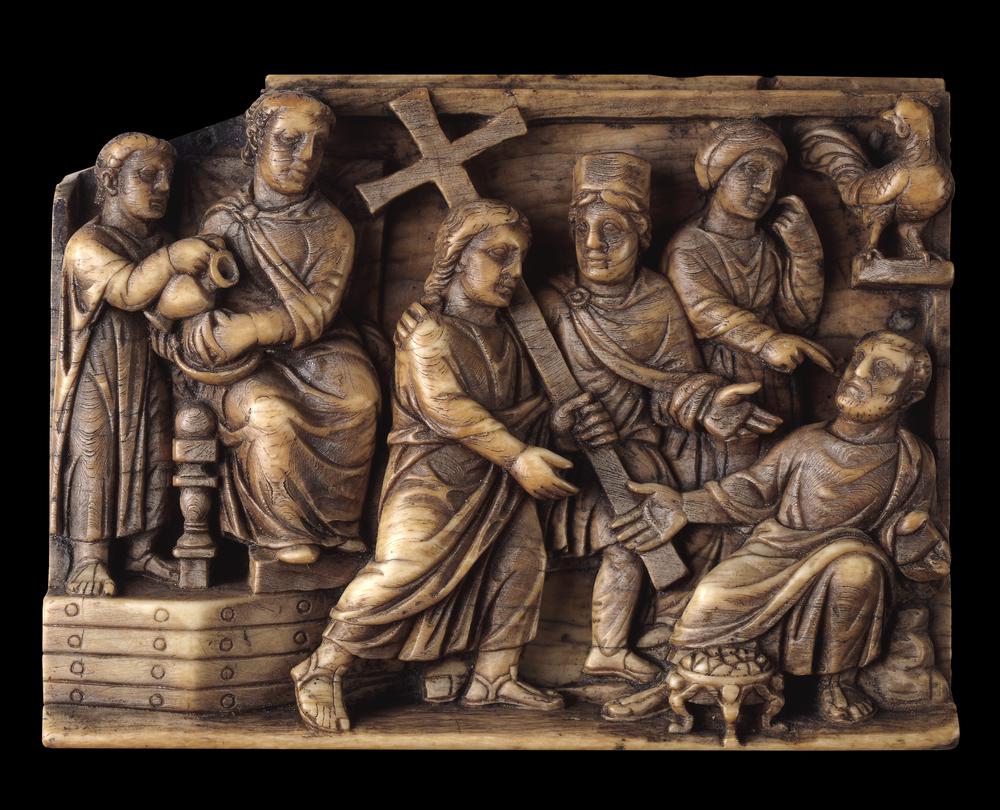
Figure 76: Theatrically imagined scene of Jesus carrying the cross, watched by Pilate on the throne behind him and by Peter seated before him; a Roman soldier guides Jesus forward, while a female servant points at Peter (“the Denial of St. Peter”), from an ivory panel of a sarcophagus made in Rome 420-430 CE. Photo: British Museum.

“He had seen at the theater in Alexandria a very beautiful actress named Thaïs. This woman showed herself in the public games, and did not scruple herself to perform dances, the movements of which, arranged only to cleverly, brought to mind the most horrible passions. Sometimes she imitated the horrible deeds which the Pagan fables ascribe to Venus, Leda, or Pasiphaë. Thus she fired all the spectators with lust, and when handsome young men, or rich old ones, came, inspired with love, to hang wreaths round her door, she welcomed them. So that, whilst she lost her own soul, she also ruined the souls of many others.” From Thaïs (1890), by Anatole France (1844-1924), translated by Robert B. Douglas (1848-?), New York: Gabriel Wells, 1924, pp. 9-10. This is a nineteenth century, courtesan-inflected, Christianized view of female pantomimes. In reality, most female pantomimes, like their male counterparts, led rather proletarian lives.

Pantomime and Christianity

The integration of the pantomimes with the hippodrome culture apparently worked well enough for about two centuries, insofar as the imperial government considered it fundamental to its survival and the public as a whole was unable or unwilling to develop alternate systems for integrating the many discrete and competing factions within it. But the entertainment apparatus nevertheless encountered great challenges to its stability and seductive power. The imperial government began the integration sometime in the late third or early fourth centuries. Emperor Constantine had established the Empire as a Christian state by 330, even though most of its citizens were not Christian or “completely” Christian. Throughout most of the fourth century, emperors promoted Christianity while pursuing a policy of toleration toward older religious traditions. The Emperor Julian (reigned 361-363) attempted to restore the authority of the pagan network of gods, but this project died with him, and the policy of toleration resumed as the most effective way to maintain harmony within the Empire. However, the leaders of the Christian Church believed that the policy of toleration prevented Christianity from achieving the full measure of its power to bring salvation to humanity. Toleration allowed competing interpretations of scripture to create uncertainty about the true path to salvation and about who had control over religious doctrine. As long as the Empire pursued the policy of toleration, Christianity would remain as splintered as the manifold forms of pagan worship, and it would never achieve the power to transform the whole of society. It was evident to the clergy leadership that sermons denouncing the sinfulness of the theater and the hippodrome, no matter how scathing or threatening the language, did not keep people from attending these entertainments and thus did not compel them to accept completely the word of the Church. In the second century, Tertullian had condemned the circus and the theater because of their idolatry, their glorification of statues, images, monuments, performances, and myths that polluted the soul and morality of the spectator, for “the demons, predetermining in their own interests from the first, among other evils of idolatry, the pollutions of the public shows, with the object of drawing man away from his Lord and binding him to their own service, carried out their purpose by bestowing on him the artistic gifts which the shows require” (De Spectaculis 10.13). Around the middle of the third century, Cyprian of Carthage (ca. 200-258) condemned the pantomimes because their enactments of perverse erotic behavior gave permission for spectators to emulate these polluting pleasures:

[W]hat a degradation of morals it is, what a stimulus to abominable deeds, what food for vice, to be polluted by histrionic gestures, against the covenant and law of one’s birth, to gaze in detail upon the endurance of incestuous abominations! Men are emasculated, and all the pride and vigour of their sex is effeminated in the disgrace of their enervated body; and he is most pleasing there who has most completely broken down the man into the woman. He grows into praise by virtue of his crime; and the more he is degraded, the more skilful he is considered to be. Such a one is looked upon— oh shame! And looked upon with pleasure. And what cannot such a creature suggest? He inflames the senses, he flatters the affections, he drives out the more vigorous conscience of a virtuous breast; nor is there wanting authority for the enticing abomination, that the mischief may creep upon people with a less perceptible approach. They picture Venus immodest, Mars adulterous; and that Jupiter of theirs not more supreme in dominion than in vice, inflamed with earthly love in the midst of his own thunders, now growing white in the feathers of a swan, now pouring down in a golden shower, now breaking forth by the help of birds to violate the purity of boys. And now put the question, Can he who looks upon such things be healthy-minded or modest? Men imitate the gods whom they adore, and to such miserable beings their crimes become their religion (Ad Donatus1.8; Cyprian 1868: 7).

Perhaps realizing that such arguments had not succeeded in diminishing the appeal of the circus and the theater for so many who professed to be Christian, John Chrysostom (349-407), while acknowledging that the theater is “the Devil’s show,” actually placed the weight of his condemnation on the spectators rather than on the performers, because the spectators went to the theater or the circus to engage in sinful activities and associate with unsavory people rather than to watch enactments or races. He focused particularly on the presence of “harlots” in the theater, where a Christian will encounter “a woman, a prostitute, entering bareheaded and with a complete lack of shame, dressed in golden garments, flirting coquettishly and singing harlots’ songs with seductive tunes, and uttering disgraceful words.” Just seeing this woman will corrupt the Christian, “For even if you did not have intimate relations with the prostitute, in your lust you coupled with her, and you committed the sin in your mind,” and then, “saturated with that woman, you return home as her captive, your wife appears more disagreeable, your children more burdensome, and your servants troublesome, and your house superfluous” (Chrysostom 2012: [274]). But in relation to his prodigious output of sermons, Chrysostom actually made less reference to the “satanic assemblies” that convened in the hippodrome and the theater than one might expect in such a vast compilation of preaching. One reason for this restraint is that he apparently found theater too alluring if described in detail, even if presented completely as the devil’s work. In Homily I in On the Gospel of John, he proposed that God has made “all heaven his stage, his theater, the habitable world; his audience all angels.” In other sermons, Chrysostom developed the idea that the Church should function as a powerful alternative to theater, because it provides a greater spectacle of “truth” than anything conjured up by Satan in the theater, and he employed highly dramatic language to distinguish Christian and Satanic spectacle:

For the son of thunder, the beloved of Christ, the pillar of the Churches throughout the world, who holds the keys of heaven, who drank the cup of Christ, and was baptized with His baptism, who lay upon his Master’s bosom with much confidence, this man comes forward to us now; not as an actor of a play, not hiding his head with a mask, (for he hath another sort of words to speak,) nor mounting a platform, nor striking the stage with his foot, nor dressed out with apparel of gold, but he enters wearing a robe of inconceivable beauty. For he will appear before us having “put on Christ,” having his beautiful “feet shod with the preparation of the Gospel of peace” (Eph. vi. 15); wearing a girdle not about his waist, but about his loins, not made of scarlet leather nor daubed outside with gold, but woven and composed of truth itself. Now will he appear before us, not acting a part, (for with him there is nothing counterfeit, nor fiction, nor fable,) but with unmasked head he proclaims to us the truth unmasked; not making the audience believe him other than he is by carriage, by look, by voice, needing for the delivery of his message no instruments of music, as harp, lyre, or any other the like, for he effects all with his tongue, uttering a voice which is sweeter and more profitable than that of any harper or any music (Homily I in On the Gospel of John; Chrysostom 1848: 2). 

Chrysostom further deepened the idea of the Church as a placecompeting with the theater for the time and attention of Christians by comparing theaters to synagogues and accusing Jews, around 386, of being in the grip of demons, for “these Jews are gathering choruses of effeminates and a great rubbish heap of harlots; they drag into the synagogue the whole theater, actors and all. For there is no difference between the theater and the synagogue” (Homily I.2.7 Against the Jews). From his perspective, theater, because of its use of masks, possesses exceptionally dark power to threaten the authority of the Church to control sexual identity, gender roles, and sexual behavior. As Blake Leyerle remarks: “Whereas church fathers in the west condemned theater as idolatrous because of its pagan imagery, Chrysostom indicts it because of its satanic excitation of internal urges” (2001: 45). She contends that his thinking about theater is clearest in his sermon  Against Those Men Cohabiting with Virgins (ca. 390), sometimes referred to as  Against Spiritual Marriage. In this homily, he denounced Syneisaktism, yet another issue that threatened the unity of the Church, whereby men, usually priests, and women purportedly lived together chastely and never engaged in any sexual acts, a circumstance that Canon 3, promulgated at the Council of Nicea in 325, had already forbidden. Here Chrysostom focused his condemnation not on theatrical performers or on the satanic assemblies sitting in the theater or on the lurid stories performed in the theater, but on an abstract concept of theater, whose essence, he claimed, is masking, the concealment of “real” identities and feelings behind false or imaginary identities. He doesn’t try to prove that men and women hide behind a mask of chastity while practicing spiritual marriage; instead, he argues that sexual urges can never be suppressed or absent when men and women live together without being married—they can only pretend to be chaste, and their “spiritual marriage” is a theatrical masquerade. By this logic, “lustful” urges require masking, and masking in itself entails the concealment of lustful urges, so that theater and sexual desire construct each other and are mutually dependent phenomena. It is doubtful, though, that Chrysostom’s argument persuaded either theatergoers or church-goers, much less practioners of Syneisaktism; the sermon was designed for the ears of the clergy. In relation to the failure of the Council of Nicea Canon to suppress Syneisaktism, Chrysostom’s homily sixty-five years later functions more seriously as an exhortation to consolidate power and authority within the Church. From his perspective, the survival of the Church (as opposed to Christianity) depended on its authority to control sexuality, and controlling sexuality meant controlling—and, indeed, suppressing—theater and all salient attributes of theater, especially masking. 

            The Church, however, could not consolidate its power or prevent new schisms from further dividing it by building some sort of popular consensus through sermonizing, pastoral activities, doctrinal councils, and impressive charities. These things encouraged more people to become Christian, but they didn’t clarify who was leading a Christian life and who wasn’t. Chrysostom didn’t attack specific pantomimes or charioteers as agents of Satan, because by the time he composed his sermons (ca. 390), probably all pantomimes and charioteers were Christians. After several years (381-388) of Christian persecution of pagans, the co-emperors Theodosius (reigned 379-395) and Valentinian II (reigned 375-392) banned all blood sacrifices and decreed that “no one is to go to the sanctuaries, walk through the temples, or raise his eyes to statues created by the labor of man,” even though most of the Western Empire still remained pagan, and consequences were severe for those who violated the decrees (Theodosian Code 16.10.10). Schisms, heresies, doctrinal disputes, and competing religious systems strained the ability of the Church to construct a unified identity for itself. From the standpoint of the clergy, it was necessary for the Church to gain decisive influence over “secular” domains of governance and access to resources for enforcing Church laws. To gain this influence, various factions of the Church intimidated the imperial government by inciting their followers in different parts of the Empire to considerable acts of violence and persecution against pagans, Jews, Arians, and other “heretical” branches of Christianity during the 380s, with perhaps the most spectacular act of persecution being the destruction of the Serapeum in Alexandria in 391. The success of Saint Ambrose (340-397), Archbishop of Milan, in managing and then suppressing in 385-388 the Arian schism favored by Germanic sectors demonstrated the skill of a charismatic Church leader in solving problems at the behest of emperors (Valentinian and Theodosius). But the violence of the Church-led persecution against pagans, Jews, Manicheans, and schisms like the Arians caused many people to claim they were Christians, even if sermons and biblical references did not directly inspire them. For Chrysostom, such persons concealed themselves behind a “mask” of Christianity, and a very troubling manifestation of this dubious type of Christian identity would be pantomimes claiming to be Christians. It was therefore necessary, from Chrysostom’s perspective, to attack the concept of theater itself, of masking, to establish the authority of the Church to control imperial activities like the theater and the hippodrome. 

            The question then arises: If by 391 it was illegal in the Empire to practice pagan beliefs openly, and if during the previous decade, the imperial government, pressured by myriad outbreaks of Church-led violence, displayed a progressively diminishing inclination to maintain the policy of toleration toward all religious systems other than what it regarded as “the Church,” then what was the impact on pantomime performance in the theater and the hippodrome? It could well be that on occasion pantomimes continued to perform the ancient mythic scenes in the houses and villas of aristocrats, who, as a class, tended to cling more ardently to the pagan belief system than other classes (Cameron 2010: 3). These pantomimes, however, would declare themselves Christians, if they hoped to have careers performing in theaters or hippodromes. In doing so, they perfectly embodied Chrysostom’s idea of wearing a “mask” of Christianity. The Theodosian decree of 391 had loopholes: it forbade sacrifices, the entering of temples, and the worship of “statues”; it did not specifically forbid representations of mythological figures. After all, Procopius, in the Secret History, claims that Theodora performed her Leda and the Swan act in a theater almost 130 years after the decree (9.9).  Nevertheless, in the context of public theaters and hippodromes, it is difficult to believe that as a result of the decree the imperial government continued to subsidize, as an element of its policy of toleration, processions and performances featuring pagan themes, images, and statues, especially since under the Emperor Gratian (reigned 375-383) the government in 382 had already ceased to provide subsidies to any pagan cults and even confiscated property that had no Christian heirs (Symmachus Relationes3). What instead did the government subsidize? 

            In a 1964 article, Ramsay MacMullen ventures a way of approaching this question. He proposes that in the fourth century, life itself became more theatrical and symbolic (452-454). Under the influence of the theater, barbarians, and eastern fashions, the dress of people throughout the Empire became self-consciously ornamental, presumably because more efficient manufacturing and distribution systems, combined with government subsidies, particularly in support of the enormous imperial army, made the new fashions affordable to large sectors of the population (cf. Ammianus Res gestae 22.4; 1986: 237-238). Soldiers, seeking to wear more decorative uniforms, were significant in stimulating public appetite for ornamented dress (MacMullen 1964: 440). Clothing appeared in manifold colors, with elaborately embroidered hems, cuffs, and collars (Norris 1924: 117-118). Fabrics became richer and finer; the use of cosmetics and raiments proliferated. People became less inhibited about wearing jewelry, medallions, “badges,” brooches, and ornate belts, fibulae, cloaks, helmets, and caps. Banners, standards, shields, swords, scabbards, and insignia, like crosses and animal images, became richer in color and detail, to amplify the symbolic values associated with the wearer’s identity. In terms of hippodrome processions, idols, images of gods, and references to mythological themes disappeared, replaced completely, probably by 382, with grandiose and glamorous appreciations of the emperor and the guardians of the Empire, mixed with powerful Christian symbols like the cross. The procession became like a tableau vivant, depicting, in quasi-allegorical style, the achievements and beneficial attributes of the emperor and marvels brought from the provinces (MacMullen 1964: 454). The emphasis was on displaying the splendors of a unified, contemporary social order rather than on celebrating the fusion of diverse and capricious powers defining a pagan cosmos. Processions and interludes became abstract spectacles, focused on achieving emotional excitement through optimum ceremonial design, through stirring colors, shimmering banners, shields and palm leaves, carefully contrived chants and fanfares, parades of synchronized movements and poses, and scenes of acrobatic virtuosity. By the end of the fourth century, performances in the hippodromes probably bore some similarity to fashion shows, with spectators themselves dressing more self-consciously, more “colorfully,” than in previous eras, under the assumption that their “role” in the spectacle had become much more complex and scripted than in the preceding centuries. Spectators and performers alike saw their voices, movements, clothes and the bodies under them as symbolic of a higher and greater organization of power than any mythological iconography could capture, a power symbolized above all, less by the sign of the cross or Christ, than by the remote, resplendent figure of the emperor.      

            In the theaters, mythological themes also disappeared after 382. Pantomimes seemed to have continued the practice of structuring their performances around a sequence of discrete scenes that displayed their skill at embodying different identities and masks. But they replaced mythological figures with archetypal or allegorical figures, and situated these figures within intensely erotic scenes. In his Confessions (III.2), St. Augustine describes the corrupting impact of stage-plays he saw in Carthage, probably in the late 370s, but he makes no reference to pagan themes in the shows. Instead, he explains how the “tragical passages” depicting “feigned and scenical passions” made him “unclean,” inciting lustful feelings and then inciting pity on the characters and on himself for submitting to lustful feelings. At the time he attended the theater, most of the audience, including himself, was Christian, and pantomimes, who were likely also Christians, felt their performances achieved higher entertainment value if they removed all references to either pagan mythology or Christian symbolism, so that the Church would not have reason to castigate spectators for enjoying pagan sinfulness or theatrical desecrations of holy figures. In The City of God, written about 410, Augustine explained why Christianity was not responsible for the decay of the Roman Empire and the invasion of Rome by the Visigoths. He therefore referred to “theatrical exhibitions” and “licentious entertainments” as phenomena belonging to a remote, pre-Christian and sometimes even pre-imperial era in which the gods “extorted from the Romans these solemnities and celebrations in their honor” to obscure from humans the power to recognize the true God; and he dismissed “the [pagan—that is, pre-Christian] dramas which poets write for the stage” as merely literary objects, lacking “the filthiness of language which characterizes many other performances,” and things that “boys are obliged by their seniors to read and learn as a part of what is called a liberal and gentlemanly education” (I.32; II.8). It would not help his argument if he referred to contemporary theatrical spectacles performed by Christians primarily for Christians under a Christian government that failed to protect Christians from pagan invaders. Still, he does insinuate that “some of those who fled from the sack of Rome and found refuge in Carthage” were pagans seized by “the voluptuous madness of stage-plays,” which so infected them that “day after day they seemed to contend with one another who should most madly run after the actors in the theaters” (I.32). Augustine uses this ambiguous language, because the “voluptuous” theater, the “filthy” performances that were “recently” seen in Carthage were neither pagan nor, from his perspective, Christian, even if the performers were Christian. But it is not clear how pantomime retained its reputation for “voluptuousness” shorn of its mythological heritage while being still too seductive for Augustine to describe in any detail. Ismene Lada-Richards (2008: 309-310) tries to bring some clarity to fourth century pantomime performance by referring to Themistius (317-390), a pagan stateman, orator, and philosopher, who, in his Oration 28, written about 388, criticizes sophists in Constantinople who “often bring their eloquence out to theaters and festive assemblies, where it is arrayed in gold and purple, reeking of perfume, painted and smeared with cosmetics, and crowned with garlands of flowers.” In this luxurious environment, “they emit a whole range of sounds and, like Sirens, sing songs full of pleasure” and “their audiences salute and praise them in turn” (Themistius 2000: 175). Lada-Richards contends that fourth century philosophers “dressed luxuriously and ostentatiously, as if measuring themselves up against alluringly attired pantomimes” (2008: 308-309). Their purpose in doing so was to explore the “treacherous notions of sensual over-refinement, androgynous grace and the erotic excitement associated with a doubly gendered performing body” (309). But Lada-Richards’s point in bringing up Themistius and the sophists is to support a perception of pantomime detached from particular historical circumstances: “Pantomime’s roaring success must have made it abundantly clear [to the sophists] that the unsettling of gender-norms through the practice of corporeal dialects of sexual ambiguity as well as the eroticisation of the male body were not so much ‘high risk’ investments for the astute performer as potentially high earners” (311). She follows her reference to Themistius with a reference to Lucian, writing over two centuries earlier, who commented on the habit of rhetoricians to adopt “soft” and “womanish” qualities (311-312). From its beginning, however, pantomime focused on themes of sexual and gender ambiguity. The quotation from Themistius would be more helpful if placed in relation to the disappearance of mythic themes from the public theaters by the time he made his remarks. Lada-Richards implies, without ever referring to the turbulent Chrisitianization of the Empire, that “the practice of corporeal dialectics of sexual ambiguity” in pantomime continued unperturbed in the fourth century, just as it had in Lucian’s time. The implication is true insofar as a phrase like “the practice of corporeal dialectics of sexual ambiguity” is vague enough to cover what pantomime generally was across five centuries. But she can go further: the quotation from Themistius suggests that pantomime continued to dwell intensely on erotic themes, even though pagan mythic themes had disappeared, because the Church had condemned the mythic themes for their corrupting erotic content. By the time Themistius made his remarks, the Church castigated theater as a whole, not because of its pagan content or because it presented Christian imagery in an unacceptable manner, if at all, but because theater presented an idea of human identity as a variety of “masks” or “other selves” that are in tension with the Christian theological doctrine of a single, “true” self in which God resides. Yet the Church, faced with managing the constant threat of schisms, found it more practical to condemn theater abstractly than to seek to suppress it altogether. How, then, did pantomime maintain its focus on “deviant” erotic performance, as Lada-Richards puts it, without a pagan rationale?
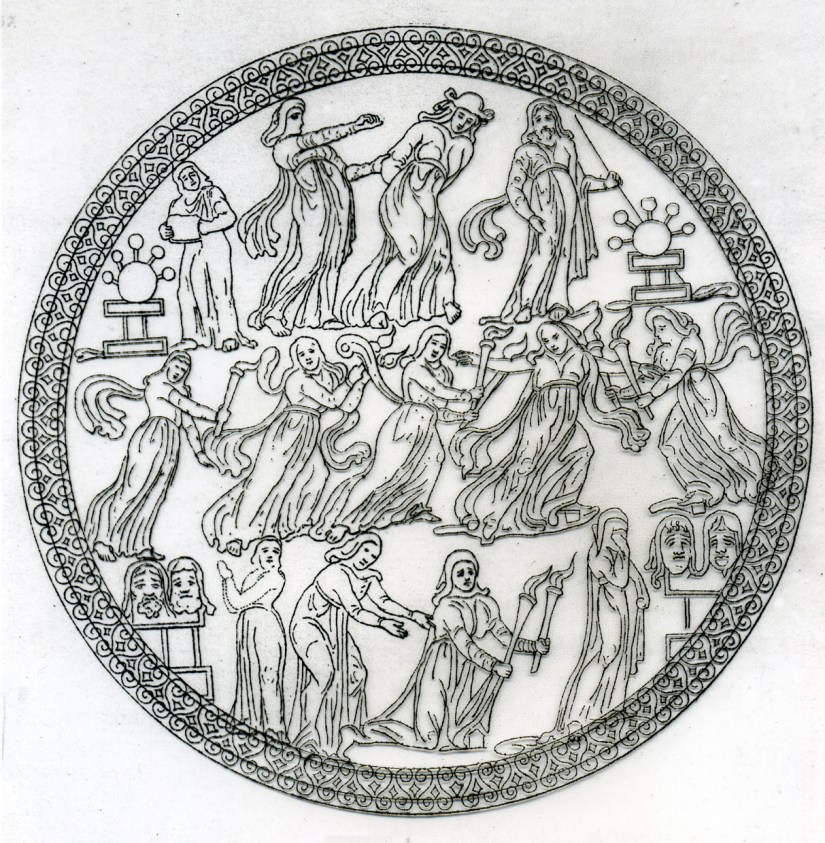
Figure 39: Engraving of an enigmatic performance on a silver plate described by Otto Jahn in 1867 displaying masks in uncertain relation to the performers, late fourth century.

               Perhaps pantomimes maintained their repertoires and traditions of voluptuous movements and poses but no longer wore masks that depicted mythic figures; instead, they wore masks that portrayed “neutral” but theatrically engaging identities. In this regard, the drawing of the fourth century plate or lid discussed by Otto Jahn in 1867 is provocative [Figure 39]. Jahn observes that it is difficult to determine which of the thirteen figures depicted are wearing masks, and only the bearded figure in the upper right clearly wears a mask similar to one of the masks depicted in the lower left corner. If, indeed, an aim of the image is to obscure distinctions between masks and faces, then it is possible a feature of late fourth century theatrical performance was the use of highly realistic masks that did not evoke recognizable mythic figures but some kind of mysterious, “other,” contemporary person inhabiting the body of the performer. Jahn says that Luigi Lanzi (1732-1810) was wrong to claim that the disk shows a Bacchic rite (1867: 74). He proposes, rather, that the image depicts three separate “tragic scenes” of a theatrical performance (75). The upper row, like the bottom row, presents four figures, with the leftmost female looking over her shoulder at the scene before or behind her. The middle pair in each row features one female urging another toward the right, apparently toward the rightmost figure, who is male in the top row and female in the bottom. The rightmost female in the bottom row covers her face with her hand, and it may be that, in theatrical performance, the same person played this figure and the rightmost male figure in the top row, and this may also be the case with the other figures in those two rows. Two pairs of masks flank the figures on the bottom, while a strange device flanks the figures on the top. Jahn supposes that this device is a musical instrument, possibly a water organ, although this conjecture requires more argumentation than he provides (76). What is more evident is that the top row echoes the bottom row, although it is not clear if the right pair of masks is male or female. All of the figures wear long-sleeved garments, an attribute associated with eastern (“Palmyrene”) rather than western imperial fashions (cf. Sebesta 1994: 164, 168). In the middle row, four women carrying torches swarm around a woman running or dancing without torches; the leftmost figure brandishes only one torch while the other three women hold a torch in each hand. All of the women have cloth sashes or capes attached to their dresses, and these flutter to create a dancelike movement. Jahn says the torchbearers are “pursuing” the woman without the torches, although the artist dramatically complicates this perception by having the torchless woman extend her arms between the pairs of torches held by the figures on her left and right. In the theater, a dance with torches would be a fascinating acrobatic stunt: for Jahn, the dancers vaguely evoke Errinyes, but he acknowledges that nothing in the imagery connects to any “known mythological scene” (76). The inscrutable symbolism of the picture may remind other viewers of the alluring crypticity of the murals at the Villa of Mysteries in Pompeii, except that the plate projects a more personal than cultic symbolism, as if the viewer witnesses episodes from the life of a unique female character, who perhaps experiences a sacrificial fate. But the drawing provides a glimpse of what a non-pagan, not explicitly Christian tragic theatrical performance might have looked like in the late fourth century, a performance involving highly refined realism of masks, idiosyncratically symbolic poses, pantomiming of “dark” or mysterious movements (such as urging a bound or kneeling person toward someone more powerful), acrobatic stunt dancing, and a fragmented narrative in which scenes “echo” or compare with each other rather than grow out of each other. Even though it depicts no overt sexual actions or nudity, the image nevertheless exudes a powerful, eerie erotic aura in its depiction of so many female figures (possibly played by men in a theatrical performance) implicated in sadomasochistic tensions, magnified further by the contrast between the woman kneeling while raising her torches and the dancers swirling with torches. 

            The image suggests how pantomime could move in a new direction, adapt to the ascending Christian reality, and prosper, after 391, for over a hundred more years. It was necessary for pantomime to move away from the pagan mythology that had sustained it for nearly four centuries and which by the end of the fourth century found its vast decadence best represented, perhaps, by the death-haunted scraps of fussy versification by Ausonius (310-395) and the tedious, extravangantly picturesque inventory of mythic escapades in the now very remote fantasy lands of Nonnos’s never-finished Dionysiaca (ca. 400). The relation between Ausonius and Nonnos is somewhat analogous to the relation between pantomime and its mythic source material. Pantomime presented fragments, scenes, mere moments from an enormous repository of mythic identities, a seemingly endless network of connections between gods and humans that no single, coherent narrative could contain. Or rather: pantomime demonstrated that the only way humans could shape the mythic cosmos into a narrative was through an equally enormous compilation of performance fragments. The mythic cosmos was too big for any performance or performer. The cosmic “story” of human interaction with divine forces unfolded through each pantomime choosing selected scenes from the enormous repository in competition with other pantomimes choosing selected scenes. As more pantomimes appeared, the range of mythic scenes expanded. Over the years, over decades, over centuries, more and more scenes of the cosmic “story” got told through manifold performers throughout the Empire. But no single performer, no single spectator, no single audience, no single generation, no single era, and no single place could ever see or even know the whole story. Christianity, of course, provided a simpler or more compact narrative of God’s relation to humans, but it was a story only the Church allowed to be told. 

            By the end of the fourth century, paganism had sunk into an engulfing decadence from which it could never recover, but it took a long time to die out. In spite of the imperial ban on sponsoring any pagan entertainments after 382, in some more remote regions of the Empire, it seems that pantomime still relied on pagan imagery to attract audiences, even though audiences proclaimed themselves Christians. Over a hundred years later, around 500, the Syrian theologian and bishop Jacob of Serugh (451-521) delivered several homilies condemning pagan themes in the performances of mimes and pantomimes. In Homily 3 of “Against the Spectacles,” he lists the evil attributes of theater: “dancing, amusement and music, the miming of lying takes; Teaching which destroys the mind; responses (or choruses, chants) which are not true; troublesome and confused sounds; melodies which attract children; ordered and cherished songs, skillful chants, lying canticles (composed) according to the folly which the Greeks invented” (Moss 1935: 105). Pantomime, he adds, is the “mother of all lasciviousness,” “a spring of licentiousness,” “a sport which encourages children to forget admonition; a net which ensnares boys in the ways of a vicious life. It is a disordered foster-mother who teaches her sons to commit fornication; a teacher who instructs her pupils in the stories of idols. It is a mimer of wanton sights concerning the bands of the goddesses; the preceptor in whose stories there are many gods” (Moss 1935: 105-106). In Homily 4, in a passage deemed corrupt, he asks, in whom does Truth find its most confident representative, “he who is the preacher in the house of God or he who is the mimer of idols?” (107). He goes on to ask rhetorically of his Christian audience: “Ought we then to believe in female goddesses? Dost thou consent to cherish gods who love adultery? Is thine ear willing that the report of the house of Zeus the adulterer should fall on it? Is it well for thee when thou seeest the depravity of female idols? Canst thou endure, being the servant of Jesus, to take delight in Apollo?” (108). These remarks, among many others like it in the Homilies, might incline one to believe that pagan themes were still very much alive on the stage, at least in Syria, even though the imperial government had ceased to fund public spectacles featuring pagan themes for well over a century. Were there any pagan aristocrats by this time, even in Syria, who cared to spend money sponsoring public performances featuring the adventures of pagan gods? Charlotte Roueché observes that Jacob’s linking of theater to pagan mythology was “a topos of Christian criticisms” of it, and it “would therefore be rash to assume that the stories presented to the people of the towns of Syria—whether by mimes or pantomimes—were limited to the pure canon of Greek mythology” (2009: 178-179). But perhaps the issue is not so much the extent to which pantomime performance was “limited to the pure canon of Greek mythology” but the extent to which pantomime performance even included it. Jacob complains about scenes or characters that the readers might presume he had seen performed on Syrian stages. He condemns Zeus, who “became famous through adultery, and committed fornication with many women,” which then compels the bishop to describe the “various forms” by which Zeus was “seeking a stratagem for his lust” (1935: 110). He uses the phrase “they say” to describe the scenes he blames the pantomimes for performing. “This adulterer, they say, begat all the gods” (110). “Once, they say, he became a bird, and committed fornication with one woman, as he desired” (110). “They say another god made himself like unto a he-goat that he might commit fornication in that very form […].” (110). “And another, they say, had a sweet-toned harp […]” (110). “And the god, they say, was running, but was not overtaking the girl […]” (111). “According to their tale, a damsel was conquering the gods in running […]” (111). “And afterwards, they say, the earth overthrew the god” (111). “Another, they say, the daughter of the gods, on account of lust overflowed in sleep, and she was received in a shell-fish […]” (111). “The father of all the gods, they say, was committing immorality with men and women […]” (112). Does Jacob mean that pantomimes “say” these things or spectators of the shows say these things or that anyone with knowledge of Greek mythology says them? He does make more explicit connections between the mythic stories and pantomime: “For if he, the flute of Satan (sc. the actor) does not take his origin from paganism, why then does he introduce the story of Artemis? If he is not the friend of the idols and the lover of dead images, wherefore by his gestures does he call to mind the goddess of the Ephesians? […] But if he is certain there is only one God, wherefore (does he praise) many gods by means of crowds of spectacles? […] he mimes the stories of the gods, and burns perfumes at the plays, in order that he may do great honour for tales that are true for him” (106). “The mimer of spectacles meditates on the gods” (109). “Shall these things be called virtuous? But if not wherefore are they mimed?” (111). “He who maddens you with dancing makes use of these tales; from here (sc. these tales) are his mimings […].” “These are his plots which, even though he is silent he makes manifest. He is veiled and mimes and ye exult with shouting” (112). Moreover, Jacob does “not circle over all the tales of mimings, so that I might not waste the time with empty and loathsome inventions.” “By means of these outward gestures, these stories are made manifest […]” (112). However, it was necessary for Jacob to connect pantomime with pagan mythology because any attachment to pagan images that his Christian audience pursued was proof that it had failed to achieve a true Christian identity, which would probably not be the case if he connected what the pantomimes performed to life itself, with all of its adulteries and sexual peculiarities. The real reason for his hostility toward theater is not the pagan “stories” but that which he presumes the stories have inspired: adulterous, perverse, or brazen eroticism. Pagan mythology and theater are merely part of a “plot” devised by “Satan” to corrupt human souls, and imperfect Christians fail to see the paganism embedded even in the performance of a pantomime who “is certain there is only one God.” Most likely, though, pantomimes adapted mythic scenes to accommodate audience expectations arising from pantomime’s reputation for producing an intensely erotic atmosphere. Like Theodora performing Leda and the Swan in Constantinople, the pantomimes in Syria performed variants of mythic scenes, not to stimulate belief in a mythic cosmos, but as pretexts for showing what the audience wanted to see—strange, passionate, or glamorous forms of sexual behavior. The sexual spectacle on the stage was the basis for sustaining the auxiliary business of pantomime ensembles: providing sexual favors, access to sexual opportunities, in exchange for money, privileges, or appointments. In Constantinople and other large cities, this auxiliary business operated in conjunction with the factions attached to the pantomimes. But Jacob makes no reference to factions, and it appears from Jacob’s homilies that the “lascivious” shows he complains about were not the result of factional sponsorship. It therefore is likely that Jacob describes shows put on by pantomime ensembles touring Syrian towns like Edessa and Batnae (Serugh), where Jacob became bishop in 519. 

It was evident, however, that denunciations of pantomime by Church leaders like Jacob of Serugh and John Chrysostom did little to undermine the enthusiasm of Christians for pantomime performance. Richard Lim has explained how fifth century imperial managers of public spectacles in Carthage and Milan struggled to recruit actors to sustain a complex and demanding schedule of theatrical entertainments that sometimes consumed over a quarter of the days in the year. Even by the end of the fourth century, “the dearth of actors and actresses was already a problem,” because so many, in converting to Christianity, had abandoned the stage. The shortage of female actors was especially acute. To recruit more actors, the Emperors Honorius and Theodosius in 414 issued a decree to recall female actors and introduced policies to prevent actors from leaving their profession; a tribune, the tribunus voluptatum, oversaw the operation of the shows in a way that would protect the actors from censure or stigmatization from the Church. This strategy was apparently successful. Much later (509), Theodoric appointed a tribunus voluptatum to act as a “guardian” of the actors, “for the exhibition of the ‘pleasures of the people’ must be administered with a certain discipline. […] For the stage actors do not seek their own enjoyment so much as they compel their souls to serve the happiness of others while they surrender the control over their own bodies to a perverted way of life” (Lim 1996: 165, 169, 172). Pantomime challenged the authority of the Church to define a healthy Christian morality and to exert control over the lives of Christians. Any challenge to the authority of the Church contained within it the potential for producing schism within Christianity. Schisms prevented the Church from consolidating power great enough to compel broad social change throughout the Empire, which for Church leaders meant the enactment and enforcement of laws that expanded the resources of the Church and created a “holy” condition of existence for Christians. For the Church patriarchs, it was not enough to have Christians running the imperial government; it was necessary to have a government aligned with the Church’s goals and hierarchy, even if it was, in the fourth century, not yet clear who was in control of the Church or indeed what constituted the “true” Church. As long as the imperial government pursued a policy of religious toleration, it was possible to have a vast empire of Christianity without a Church at all, and then Christianity would become just as diffuse and limited in its power to bring salvation or remptive metamorphosis as the paganism it replaced. In the fourth century, the Church consolidated its power through its efforts to rid the Empire of paganism and other non-Christian doctrines (Manicheanism, Zoroastrism, Judaism), which by the latter half of the century meant ending altogether anything that might resemble a policy of religious toleration. In his Historia Ecclesiastica (ca. 439), Socrates Scolasticus (ca. 380-440) described the strife, after Constantine had died, within the Church, between the Church and non-Christians, between the imperial government and the Church, between Christians and the Church, and between Christians and the government. Violence apparently flared up as much in relation to conflict within the Church over Arianism as in relation to conflict between Christians and pagans, even before most citizens considered themselves Christian. In 341, when Bishop Athanasius returned to Alexandria from a synod in Antioch in which “confederates of Eusebius” had denounced him, “a tumult had been excited on his entrance and many were killed in the riot,” “a tumult raised by partisans of George the Arian” (1886: 83, 90). The same year, in Constantinople, violence erupted when Arian bishops had designated Macedonius I to replace Eusebius, while the orthodox congregations had selected Paul. Holding court in Antioch, the Emperor Constantius sent his genral, Hermogenes, to subdue the tumult and send Paul into exile. Instead, “the people became exasperated as is usual in such cases; and making a desperate attack upon him, they set his house on fire, and after dragging him through the city, they at last put him to death” (88). The Emperor, however, refused to appoint Macedonius as Bishop of the Church, because of the cleric’s involvement in the death of Hermogenes and other violent activities. But the conflict was not over. The following year, in Constantinople, the orthodox congregations again selected Paul to become head of the Church, a decision that enraged the Arian Emperor Constantius, who by this time favored the Arian Macedonius. Constantius sent his Praetorian Prefect Philip to install Macedonius as head of the Church. Philip sent Paul into exile and organized a spectacular procession that brought Macedonius to the church, an event that attracted a huge crowd. But then, “an irrational panic seized the multitude and even the soldiers themselves; for as the assemblage was so numerous and no room to admit the passage of the prefect and Macedonius was found, the soldiers attempted to thrust aside the people by force.” The carnage was monstrous: “about 3150 persons were massacred on this occasion” (91). As Bishop of Constantinople from 342 to 346 and then from 351 to 360, Macedonius was not averse to using violence to suppress his many enemies: “Many were punished with exile; some died under the torture; and others were put to death while they were being led into exile. These atrocities were exercised throughout all the eastern cities, but especially at Constantinople” (110). He initiated vast persecutions against not only Catholics but Novations as well and employed horrifying tortures to compel people to become Arians (130). “Such were the exploits of Macedonius on behalf of Christianity, consisting of murders, battles, incarcerations, and civil wars: proceedings which rendered him odious not only to the objects of his persecution, but even to his own party. He became obnoxious also to the emperor on these accounts [. . .]” (132).   

In 361, Christians retrieved bones excavated from the ruins of a pagan temple and displayed them in “a kind of triumphal procession,” which enraged pagans, who attacked the Christians: “some they killed with the sword, others with clubs and stones; some they strangled with ropes, others they crucified, purposely inflicting this last kind of death in contempt of the cross of Christ.” Then the pagans “dragged George [the Arian] out of the church, fastened him to a camel, and when they had torn him to pieces, they burnt him together with the camel” (151). In 366, following the death of Liberius, Bishop of Rome, violence broke out when supporters of Bishop Damasus clashed with supporters of the Arian Bishop Ursinus over who would become Pope, and “many lives were sacrificed in this contention; and many of the clergy as well as laity were punished on that account by Maximin, the prefect of the city” (211). In 391, Alexandria experienced intense religious violence when Christians destroyed the Serapeum, and “The pagans of Alexandria, and especially the professors of philosophy, were unable to repress their rage at this exposure, and exceeded in revengeful ferocity their outrages on a former occasion: for with one accord, at a preconcerted signal, they rushed impetuously upon the Christians, and murdered every one they could lay hands on” (234). Socrates describes numerous other incidents in the fourth and early fifth centuries of public “tumult” and disorder arising from hostility between religious factions in, among yet other places, Rome (129), Seleucia (135), Constantinople again (194, 231, 265, 277), Milan (211), Ephesus (268), and Alexandria (286), including the murder in 415 of the female philosopher Hypatia by a Christian mob, incited by monks, who accused her of paganism and of conspiring with the city prefect, Orestes, who refused to acknowledge Cyril as the new Patriarchate of Alexandria (292-294) because of the bishop’s efforts to wrest control of secular authority. 

But Alexandria, which “never ceases from its turbulence without bloodshed,” experienced even greater religious violence in 415, when Orestes announced, in the theater, new laws regarding “theatrical amusements,” which the Jews opposed, because of their enthusiasm on the Sabbath for indulging that “evil that has become very popular in almost all cities, a fondness for dancing exhibitions.” Although the Jews were, Socrates says, “always hostile toward the Christians they were roused to still greater opposition against them on account of the dancers.” Cyril’s agent in the audience, Hierax, applauded the laws. “When the Jews observed this person in the theater, they immediately cried out that he had come there for no other purpose than to excite sedition among the people.” Orestes seized Hierax and subjected him to torture in the theater, and when “Cyril, on being informed of this, sent for the principal Jews, and threatened them with the utmost severities unless they desisted from their molestation of the Christians. The Jewish populace on hearing these menaces, instead of suppressing their violence, only became more furious, and were led to form conspiracies for the destruction of the Christians.” The Jews “therefore sent persons into the streets to raise an outcry that the church named after Alexander was on fire. Thus many Christians on hearing this ran out, some from one direction and some from another, in great anxiety to save their church. The Jews immediately fell upon and slew them.” The Christians responded the next day when Cyril, “accompanied by an immense crowd of people,” went to the synagogues “and took them away from [the Jews], and drove the Jews out of the city, permitting the multitude to plunder their goods” (291-292). Although Socrates blames pantomime for offending Christian feeling and for inflaming religious hostilities, he does not say that the pantomimes of Alexandria incited either Christians or Jews to violence, nor does he accuse the pantomimes of being non-Christian. 

The reason for recounting all these incidents of religious violence is to clarify the role of the pantomimes and the factions attached to them in the religious issues that shaped Christian identity in the late Empire. Socrates refers to “tumults” and public violence involving crowds, “partisans,” mobs, and “many” who were Christians or pagans or Arians, but he is hardly specific about the demographic composition of these throngs beyond general sectarian affiliations. Cameron contends that the hippodrome factions were not significant in stirring up religious violence: “the factions did not either initiate or even dominate the sort of violent behavior for which they became so conspicuous. They merely indulged in it for its own sake, in pursuance of their own petty and pointless rivalries” (1976: 291). Rather, he says, “it was the monks, not the factions, who elevated urban violence into one of the major problems of the late Roman world. Above all, perhaps, it was the monks who accustomed both the inhabitants and the authorities of late Roman cities almost to expect a certain level of violence during popular disorders” (1976: 291). But Cameron doesn’t actually say that the hippodrome factions were not involved in religious violence. Instead, he argues that 1) the hippodrome factions never espoused or represented a particular religious affiliation, at least throughout the fourth and fifth centuries; 2) the factions did not necessarily share the same religious affiliation as the emperors; 3) the factions never fought with each other over religious issues; and 4) by about 500, the factions were all aligned with the Orthodox doctrine, “since one of the main purposes of the religious side of the hippodrome ceremonial was to serve as an incentive to religious solidarity,” although the Blues displayed a bias toward the Monophysitism favored by Theodora (1976: 140-153). Cameron regards the factions as similar to today’s soccer hooligans, but actually they seem more like quasi-gangster organizations, which doesn’t mean that they weren’t useful to people with political agendas. To reprise: The factions were powerful social networks that provided access to opportunities for members, including some appointments by the emperor, most likely in relation to aspects of the entertainment industry (Malalas 1986: 202). The motives for joining one faction or another depended on the values, friends, and affiliations associated with the faction, which, as a social network, brought members access to sex, rackets, and business enterprises operated by the faction. At best, emperors had an ambivalent attitude toward the factions. On the one hand, factions were useful in generating exciting acclamations and arranging appealing entertainments in the hippodromes and theaters. On the other hand, the Blue and Green factions engaged in criminal activities and public disorders that severely challenged the power of emperors to control them, especially by the beginning of the sixth century. While religious riots, incited largely by fanatical monks and bishops, occurred throughout the fourth and fifth centuries, turbulent activities by the hippodrome factions occurred most evidently toward the end of the fifth century and into the sixth. Cameron rejects the idea of a connection between religious and hippodrome violence. Nevertheless, around 489 in Antioch the Greens, who were “responsible for many riots and murders in the city at that time,” “began a fight with the Blues” in the hippodrome, which escalated to an attack on the governor, who resigned. The Greens then burned down a synagogue, “because the Jews were on the side of the Blues” (Malalas 1986: 218). A monk, who “had shut himself in a tower on the wall” of the city and “spoke through a window to those who came to pay their respects,” urged the Greens to attack the Jews—“they rioted because of the monk.” When the Emperor Zeno heard of these actions, which included digging up corpses in the Jewish cemetery and burning them, he is said to have replied, “They ought to have burned live Jews, too” (Malalas: 1986: 218-219). In 495, again in Antioch, the Greens attacked the governor in the hippodrome: “there were many fatalities and serious fires, and the four dancers were exiled” (Malalas 1986: 220). Meanwhile, in Constantinople, around 505, the Greens appealed to Emperor Anastasius in the hippodrome to release several of their members whom the city prefect had arrested for throwing stones. When one of the Greens threw a stone at the Emperor, the bodyguard hacked him to death, which caused “the crowd” to become violent, setting fires and destroying much property. “After many had been arrested and punished,” the Emperor appointed “a patron of the Greens” to become city prefect (Malalas 1986: 221-222). Then in 507, yet again in Antioch, the Greens plundered and burned down a Jewish synagogue “and massacred many people.” Anastasius sent a high official (comes Orientem) to restore order. One of his deputies attempted to arrest members of the Greens, who started to riot. The rioters fled into a church, but the deputy pursued them there and stabbed and then beheaded the leader of the rioters, “with the result that the holy sanctuary was drenched with blood.” The Greens amassed and attacked both the police and the Blues who were supporting the police. The Greens prevailed and invaded the basilica of Rufinus and the basilica of Zenodotos, which they burned down with other buildings. They murdered the deputy in a gruesome manner and drove the comes Orientem out of Antioch. The Emperor then appointed an Antiochene to deal with the violence, and “this man brought vengeance and fear to the city” (1986: 222-223). In 523, with Justin as emperor, the Blues “rioted in all the cities” of the Empire, committing murders and attacking government officials “in each city,” including the slaying of Hypatius, “a man of no mean station,” “in the sanctuary of Sophia” (Procopius, Secret History IX.35; 1935: 115). Apparently the appointment of special prefects in Constantinople and Antioch restored order “in all the cities” and punished many of the participants. The Constantinople prefect executed the wealthy ringleader of the violence, which displeased Justin, who replaced the prefect. The major consequence of this incident was the prohibition of “spectacles” and the banishment of pantomimes from all areas of the Empire except Alexandria (Malalas 1986: 235). Procopius contends that the Emperor’s nephew, Justinian, had a hand in organizing the violence as part of his plan to intimidate all those who might challenge Justin’s designation of him as heir to the throne, while the Blues assumed that “it was destined that before long they themselves should rise to the control of the affairs of the Romans” (Secret History IX.35-39; 1935: 115-117). Regardless of whether this is true or not, both the Blues and the Greens apparently expected more of Justinian when he became emperor than what he gave them. In January 532, when Justinian refused to release prisoners from the Greens and the Blues who had been condemned in Byzantion for terrible crimes, possibly murder, both factions rioted in Constantinople, “killing indiscriminately” and burning many buildings, including the hippodrome, and attempted to overthrow Justinian and replace him with the reluctant Hypatius. As discussed earlier, the so-called Nika riot was the largest ever public disorder instigated by the factions. Justinian (reigned 527-565) felt that imperial power no longer had any credibility unless he destroyed the Blues and Greens and almost annihilated them altogether in Constantinople; so, with Theodora’s encouragement, he ordered his general, Belsarius, to deal appropriately with the rioters who had gathered in the hippodrome, and perhaps as many as 30,000 people were killed (Malalas 1986: 275-280; Procopius, History of the Wars I.24; 1914: 219-239). But when this event occurred, the pantomimes had already been proscribed throughout the Empire and no longer held appointments to any hippodrome factions. The idea that the pantomimes ever directly incited the factions to violence is at the very least questionable, as is the idea, proposed by Cameron, that a theatrical contingent brought violence into the factions when the imperial government merged the theater factions with the hippodrome factions. That integration took place long before the factional riots of the late fifth century. That is not to say that the pantomimes did not have a connection to factional violence, but rather, that the connection requires a different explanation. 

Thoughout the fourth and into the fifth centuries, religious riots regularly troubled the imperial government. The hippodrome factions were “quiet” during this period—the sources do not identify them as responsible for any major public disorders. During the fourth and into the fifth centuries, the great majority of riots motivated by religious feeling arose out of the conflict between Arianism and Orthodoxy. A doctrine developed by Arius of Alexandria (ca. 256-336), Arianism preached that Jesus, “the Son,” was subordinate and obedient to God the Father, for “there was a time when the Son was not,” (Socrates Scolasticus, Ecclesiastical History, V; 1886: 23). Jesus therefore had a beginning and an end, was not eternal, and therefore was a human messenger of God rather than the embodiment of God. Orthodox theologians denounced this doctrine and declared that the Son was “the same being” or “of the same being” as God and the Holy Spirit. Jesus is an eternal being, who appeared as a human but has always lived without beginning or end. Emperor Constantine (reigned 306-337) initially was hostile to Arianism and ordered the destruction of all Arian’s theological writings and the execution of anyone harboring such writings. But having underestimated the strength of Arian sentiment among Christians, he introduced the policy of toleration. Upon his death, his three sons agreed to divide the Roman Empire between themselves, but they were not able to agree on how to do that nor did they share the same view of Christian doctrine. Constantine II (reigned 337-340), who was the co-emperor of the Western Empire, supported trinitarianism as promulgated by the controversial Athanasius, Bishop of Alexandria (ca. 296-373), while Constans (reigned 337-350), who was co-emperor over Italy, Dalmatia and North Africa, before also assuming control over the Western Empire upon the death of Constantine II, favored the trinitarian doctrine sanctioned by the Council of Nicea in 325. However, his brother, Constantius (reigned 337-361), co-emperor of the Eastern Empire and then sole emperor of the entire Empire, adopted the doctrine of semi-Arianism, which basically eliminated the concept of the Holy Spirit while admitting the eternal identity of the Son, although this attempt at a compromise position, which he sought to impose upon the Church through councils he convened, actually intensified conflict within the Church. But all three brothers wound up pursuing some variation of the policy of toleration insofar as they did not forbid altogether particular religious creeds. Constantius’s successor, Julian (reigned 361-363), who repudiated his Christian upbringing in favor of restoring paganism, expanded the policy of toleration, but of course he tried to use the imperial government to the advantage of those he assumed shared his complicated, Neo-Platonist paganism. Jovian (reigned 363-364) restored Christianity as the state religion, while his successors, the co-emperors Valentinian (reigned 364-375) and Valens (reigned 364-378) represented contradictory theological perspectives, with Valentinian favoring trinitarianism and Valens a supporter of Arianism. Facing huge, manifold threats to the Empire, the co-emperors indifferently or clumsily maintained some semblance of the eroding policy of toleration, probably because they assumed such a policy would prevent religious conflicts from becoming as much a menace to the Empire as the escalating series of invasions, usurpers, and rebellious tribes they were struggling to subdue. Gratian (reigned 375-383) at first struggled to strengthen the policy of toleration (Socrates Scolasticus, Ecclesiastic History V.2; 1886: 220). But he soon perceived that the policy of toleration exacerbated rather than dissipated conflicts within the Church; he therefore convened a synod of Orthodox bishops who repudiated Arianism and issued decrees that allowed for the confiscation of Arian properties and the expulsion of Arians at least from the East, although at that time (382) a majority of the Eastern population may not even have been Orthodox (Socrates Scolasticus, Ecclesiastic History V.2, V.7; 1886: 220, 224-226). At the same time, Gratian (and Theodoisus) forbade any further expenditure on spectacles or entertainments featuring pagan themes or iconography. The Eastern Empire was now completely under the control of persons professing Orthodoxy, while Arianism migrated westward, reversing the situation that prevailed when the sons of Constantine divided the Empire among themselves forty-five years earlier. 

 During all this time, the Empire, especially in the east, regularly experienced religious riots, as described previously, as well as numerous, sometimes murderous conspiracies by religious factions against each other, while factions pronounced anathemas, excommunications, expulsions, exiles, confiscations, and condemnations upon each other with almost maniacal zealousness. The numerous councils convened by emperors or the clergy to resolve the conflict between Trinitarians and Arians had failed to unify the Church, in large part because neither faction, having no army or police under its control, could not effectively enforce decrees issued at the councils on those who rejected the decrees. Intense, powerful, but contradictory feelings in relation to the nature of God and Christ divided the entire Empire. Assailed by various military threats to the Empire, emperors did not want to send armies away from border regions to quell religious unrest within their own subjects. Emperors favored the policy of toleration insofar as it kept the Church weak, regardless of whether Arians or Trinitarians ran the imperial government. Clergy on either side might incite their followers to violence and shameful acts, but no side could completely destroy the other or defeat a prefect with a well-trained, armed police unit. A divided Church meant that the public saw the imperial government rather than the Church as the primary power shaping the lives and affairs of citizens. The Arians, as the “heretical” sect, displayed less inclination than orthodox Christians to see the necessity of a unified Church. Orthodox clergy realized even before the Council of Nicea that it was not enough to have orthodox believers running the Empire as long those serving the emperor regarded the imperial government as a “higher power” than the Church. From the perspective of the orthodox clergy, a unified Church entailed compulsion, the enactment of imperial laws that regulated and enforced theological doctrines. The unity of the Church was synonymous with the unity of a religious doctrine and imperial power. To achieve this goal within a heterodox Christian environment that was constantly vulnerable to schism, violence was unavoidable—the hyper-intense feeling of belonging to no higher power than the Church must be released and its destructive consequences understood as a sign of God’s profound displeasure with those who failed to embrace the supreme power of the Trinity. Monks and bishops grasped that it was easier to deliver sermons that inflamed their followers to violence against their opponents than it was to deliver sermons that persuaded their opponents to become followers. The monks did not need an alliance with hippodrome factions to launch riots. Indeed, it was not to their advantage to develop any partnership with the hippodrome and pantomime cultures they so fervently denounced in their sermons as the work of Satan. In any case, the sources do not connect the hippodrome factions to a religious element in a riot until the incident of 489, in Antioch, when the Greens, attacking the Jews for their support of the Blues, consulted the monk in the wall. But in this incident, the Greens had already begun their riot, and this visit with the monk merely served to sanction their violence against the Jews. In regard to the incident at the theater in Alexandria in 415, in which a riot broke out in response to the prefect’s edicts about theatrical amusements and pantomimes, hippodrome factions receive no mention at all in Socrates or Malalas. The orthodox clergy measured and amplified its power to pressure the imperial government into unity with Orthodoxy by the extent to which it regularly initated violence against Arians, Jews, pagans, and heretical sects with impunity, with insuperable ferocity, and without the help of morally compromised partners like the hippodrome factions, whom emperors never trusted anyway. Like the martyrs they glorified, orthodox clergy displayed a much greater willingness to die for their Trinitarian beliefs than any other religious group was willing to die for its doctrine. 

In 378, an invading army of Goths destroyed the Roman army at the Battle of Adrianople, about 200 miles from Constantinople. This catastrophe signified that the policy of toleration no longer allowed the imperial government to strengthen its forces against invaders. The very young Emperor Gratian saw total imperial commitment to Orthodoxy as necessary to recovering the confidence and determination to defeat the invaders of the Empire and all those who would undermine faith in the imperial government. He and his successor Theodosius enacted laws in 382 and 391 that persecuted Arians, Jews, pagans, and heretics. Such laws did not end religious rioting incited by monks and controversial bishops, especially in Alexandria, but they did assure that the hippodrome administration, the pantomimes, and most likely also the factions associated with public spectacles adhered to Trinitarianism or at least professed Orthodoxy. For nearly a century, the hippodrome factions focused their energies on expanding their activities in the hippodrome, on building their shadowy business enterprises, and on collecting appointments, opportunities, and favors from the emperors, including protection from the Church, which never ceased to denounce the immorality of pantomime. They do not appear in the chronicles as significant sources of public violence. However, by the 480s, competition between the Blues and the Greens escalated into bitter conflicts beyond the realm of the hippodrome. In 489, the Greens in Antioch, feeling disfavored by the Emperor Zeno or perhaps by the governor, attacked the Blues and then the governor; six months later they “killed many” in the hippodrome before burning down a synagogue (Malalas 1986: 218). This was the beginning of a series of major riots involving hippodrome factions in Antioch, Alexandria, Constantinople, and then “all cities,” as have been described already and which culminated in the monster Nika riot of 532 in Constantinople that decimated the Blues and Greens and resulted in the loss of many thousands of others. The Greens seemed to have been the more aggressive faction; they nurtured grievances against the emperor or the emperor’s appointed governor, whom they believed favored the Blues in relation to whatever opportunities they expected from the imperial government, even though Zeno and Anastasius did make gestures of accommodating the Greens in response to violence the Greens had initiated. The imperial bias toward the Blues is perhaps most evident in the fascinating hippodrome dialogue from 531 between the representatives of the Greens and the Blues and Emperor Justinian’s Mandator, a complete translation of which appears in Cameron (1976: 319-322). In this dialogue, the Greens complain that the emperor is shutting them out of imperial appointments, allowing murderous conspiracies against the Greens to go unpunished, and accusing the Greens of having committed murders that are the work of others. But the Greens apparently had similar complaints and resentments well before 531, and they had released their discontent in mob violence and criminal plots that nevertheless had not succeeded in extorting a more profitable relation to the imperial government. The Blues, however, according to Procopius, were no less corrupt. They mostly and constantly engaged in criminal activities, and because “no attention was paid to the offenders by the city Government, the boldness of these men kept steadily rising to a great height” as people outside of the factions paid to avoid being killed by the Blues or bribing the Blues to kill enemies who sometimes did not even have a connection with the Greens. “And these things took place no longer in darkness or concealment, but at all hours of the day and in every part of the city, the crimes being committed, it might well be, before the eyes of the most notable men. For the wrongdoers had no need to conceal their crimes, for no dread of punishment lay upon them, nay, there even grew up a sort of zest for competitions among them, since they got up exhibitions of strength and manliness, in which they shewed that with a single blow they could kill any unarmed man who fell in their way, and no man longer dared to hope that he would survive among the perilous circumstances of daily life” (Secret History, 7.22-28; 1935: 85-87). Procopius describes other criminal schemes perpetrated by the Blues “at this time” (that is, 525-530), but his main point is that under Justinian the Blues enjoyed an expanding sense of impunity which the Greens also expected to enjoy, although he claims that Justinian owed the Blues their impunity because under Justin they intimidated those who might have challenged Justin’s decision to make Justinian (reigned 527-565) his heir to the throne. But this gangster-style mode of civic disorder, though seemingly detached from religious issues that inflamed people to violence, should be seen in the larger framework of Late Empire sectarian power politics that includes other public turbulences in the early sixth century that wereemphatically religious in nature and the two failed rebellions of general Vitalian in 514. A religious motive sparked the rebellions. In 511, Emperor Anastatius announced his intention to add the phrase, “He who was crucified for us,” which was a feature of some “eastern” churches, to the Trisagion prayer that includes the words, “Holy God, Holy Mighty, Holy Immortal, have mercy on us.” The new phrase indicated that Christ was mortal and suffered “for us,” which contradicted the Trinitarian doctrine that Christ was eternal and transcended all suffering. The population of Constantinople “rioted violently,” thinking that a Syrian official was responsible for inspiring Anastasius’s announcement, and sought to replace Anastasius with a new emperor of their choosing. The hippodrome factions appear not to have played a role in the violence. In the hippodrome, Anastasius addressed the public with humility and succeeded in pacifying the crowd. But soon after, he ordered the arrest of persons responsible for murders and destruction caused by the riot, “and after countless numbers had been executed, excellent order and no little fear prevailed in every city of the Roman state” (Malalas 1986: 228). Vitalian saw the riot as an opportunity for a more systematic attempt to overthrow Anastasius, and in gathering the support of large military and popular forces, he denounced Anastasius’s failure to uphold the Chalcedonean creed. But Anastasius was always skillful at disarming his opponents with gifts, generous offers, and suave rhetoric, and his deceptions proved disastrous for Vitalian. The religious riots of the fourth and fifth centuries demonstrated that Orthodoxy, even if it was a minority sector of the population in the Eastern Empire, could gain control of the Church and the imperial government if monks and their allies persisted in aligning their uncompromising beliefs with violent public activities that pressured the government to accommodate Orthodoxy and severely compromised the government’s inclination to pursue conciliatory agreements between contentious sectors of the public. Riots were a successful strategy for asserting power, for compelling “unity” within the society and its political, religious, and cultural institutions. But this strategy depended on adherents who believed unto death in the absolute authority of a doctrine. The riots and rebellions that afflicted the Empire in the late fifth century and culminated in the Nika riot were in large part the work of new power-seekers—Vitalian, the Blues and the Greens. They believed that by creating havoc in public on a larger and larger scale, they could extort from the government greater privileges and resources than they would otherwise ever receive from emperors whose preferred ambition was to curtail and indeed reduce the factions to at best an ornamental auxiliary status within the elaborate imperial ceremonial apparatus. The public disturbances of the late fourth and early fifth centuries were a reaction to the advent of a series of emperors—Zeno, Anastasius, Justus, and Justinian—who showed a rising determination to avoid any repetition of the turbulent Church strategy for asserting transforming power without imperial authority or without clear popular consensus. The hippodrome factions did not and could not have “faith” in the Emperor the way the Orthodox monks had faith in the doctrine of the absolute unity of God and Christ. This lack of faith, engineered by the emperors with treacherous cunning, doomed the undisciplined factional grasp for power in 532, even if at the time Justinian was not sure he had enough faith in himself to quell the unrest. In this sense, the sectarian and factional violence that wracked the Late Empire all arose from the schismatic conflict over the nature of Christ’s identity. This conflict structured the organization of power within the society. It was not the factional violence itself that ended the pantomime culture; it was the destructive power of schism within the doctrine of Christ’s identity that put an end to pantomime.    

 Schism, rather than mere sectarianism, is built into the doctrine that the Son is “of the same being” as the Father, because it is language that purposely prevents any unity of meaning, even though it explicitly constructs a unity of identity for the Father and the Son. It is a test of faith to believe in this unique power of God to create a being, Christ, who could assume a human form without being human, who could be “the same as the Father” without being the Father, and who could be the Son without being subordinate to the Father. Arianism taught that the Son is subordinate to the Father, he was a human being who “was begotten,” lived, and then died, and he was a human who embodied God or His divinity rather than signified the eternal being of God, having no beginning or end. It is perhaps difficult nowadays to see how dangerous this doctrine seemed to the Trinitarian branch of Christianity, but in the fourth and fifth centuries Arianism represented an obstacle to the realization of a new concept of worldly power built around the unity of state and Church, which, as a manifestation of God’s power, were, so to speak, “of the same being.” Trinitarianism taught that no human can ever be or become God and that God is beyond any possible “embodiment.” Belief in Trinitarianism or Arianism defined one’s identity and legitimized or sanctified power to control other lives. As long as Arianism in its manifold variations persisted, it was always possible for another human being to become God, for God to “beget” another Son, or indeed for God to construct an “alternative” path to salvation. The pantomimes had a long history of embodying gods and showing how humans carried within themselves the conflicts and passions of deities and external, “cosmic” powers beyond the control of those in whom the gods resided. A pleasure of pagan pantomime was seeing the beautiful metamorphosis of bodies when they “begat” gods and obscured the distinction between gods and humans. By the late fourth century, however, pantomime had adapted to the Christian reality and had abandoned pagan themes in favor of an extravagantly voluptuous eroticism that purported to embody what might now be called the divine mysteries of “nature.” The Church therefore condemned pantomime for the deviant sexuality of its themes and performers, which nevertheless received state sponsorship because of pantomime’s unique power to magnetize public attraction to the emperor and his generosity. With their mysterious, agitating performances of metamorphoses, pantomimes became experts at organizing glamourous imperial acclamations, which entailed attaching the pantomimes to hippodrome factions and mobilizing the factions in relation to the imperial ceremonial agenda. However, as long as the emperor sanctioned and sponsored pantomime performances, the public could still perceive the body as a site of a metamorphosis that enhanced one’s access to imperial power, if not to God Himself. Imperial pantomime carried wthin it a residue of Arianism, a sense that the body contained more power or aspiration to power or connection to some “cosmic” power than the Church deemed healthy for its own good in its perpetual struggle to prevent schisms from fracturing Christianity and turning Christians against each other. Perhaps this idea of the body’s power through theatrical metamorphosis encouraged the hippodrome factions to believe they were stronger than they proved to be. In this way the pantomimes had an oblique relation to the factional violence that supposedly led to the demise of pantomime culture, even though no evidence exists that directly links the pantomimes to the violence and even though factional violence continued after the suppression of pantomime culture. But the Nika riot arose because the factions felt Justinian was stripping away their privileges, appointments, and status, and none of his efforts to placate them included restoring the pantomimes. For pantomime did not belong to the factions, the people, the aristocracy, or the Church; it belonged to the emperor, and the emperor decided the fate of pantomime according to his ambitions, not the Church’s or anyone else’s. This situation intersects with yet another variable: in 525, two years after the Blues rioted “in all the cities,” Justinian, who was by then virtually co-emperor with Justin, married the former pantomime porn queen Theodora, a perfect example of how a humble and even stigmatized body could metamorphose into a figure of immense power. The banishment of the pantomimes coincided with the marriage, not with the riots of 522-523. A special law was necessary to permit the marriage, but more importantly, an imperial decree banning the pantomimes was necessary to foreclose any repetition of Theodora’s metamorphosis, any belief that a person could dance his or her way to imperial power and thus become a threat to the emperor. Justinian could lose the pantomimes if he gained through marriage to one of them a long and successful reign, which indeed he did. This confluence of factors put an end to pantomime that was sudden and even violent to the extent that pantomime performance did operate autonomously within imperial society or outside of the turbulent schismatic struggles to control human identity, the violent relations of the hippodrome factions to the emperor and to the civic populations, and the emperor’s almost absolute power to impose the “death” of a now ancient but now also potentially subversive art at a time when belief in the metamorphosis of the body had given way to a belief in its immutable “authenticity.” Pantomime did not disappear because of Church hostility to it or because audiences no longer appreciated it. Pantomime disappeared because the Emperor decided through his marriage to signify a new kind of imperial authority over sexuality, which perhaps achieved further manifestation through his quite vicious persecution of homosexual clergy in 528 (Malalas 1986: 251), through Theodora’s efforts to release prostitutes from brothels (Procopius, Secret History, 17.5), and through his and his wife’s complex relation to the equally strange and powerful marriage of his great general Belisarius (505-565) and Antonia (484-567?). 

After 525, nothing more is heard about the pantomimes except for a curious and very lonely remark in the Eccelsiastical History (ca. 589) written by John of Ephesus. John claims that in 588, Gregory, the Patriarch of Antioch from 571 to 593, traveled to Constantinople to answer “long deferred” charges concerning his luxurious life, his sexual indiscretions, his supposed pagan inclinations, and his unpopularity with the citizens. Gregory brought with him many expensive gifts for “the whole senate, every man and woman of rank, and all churchmen,” with the result that he was acquitted of all charges and instead treated with “great honour.” “With the view of appeasing and quieting his people,” Gregory asked the Emperor Maurice (reigned 582-602) to build a hippodrome in Antioch, and “he even took with him from the capital a troop of pantomimists,” “wherewith to erect this church of Satan” (John of Ephesus, Ecclesiastical History, V.17; 1860: 225-227). John, however, was intensely biased against Gregory and perhaps eager to believe much of the scandalous conduct ascribed to Gregory by the many enemies he had gained while making his diocese the largest property owner in Antioch. Evagrius Scolasticus, in his Ecclesiastical History (ca. 593), presents a different version of Gregory’s visit to Constantinople, on which Evagrius accompanied him. He describes Gregory as a man “in intellect and spiritual virtue absolutely supreme among all, most energetic in whatever he embarked on, invulnerable to fear, and most unsusceptible to yielding or cowering before power” (Evagrius 2000: 262). He ascribes the charges against Gregory to the governor, Asterius, who in Antioch gathered supporters among the upper class, “the popular element, and those who practiced trades in the city,” as well as the Blues and the Greens. The Emperor replaced Asterius and summoned Gregory to a synod in Constantinople. Gregory presented his defense before “the patriarchs of each place,” “the sacred senate, and many of the most holy metropolitans.” This tribunal acquitted him “after many conflicts” (Evagrius 2000: 296-297). Evagrius does not mention Gregory receiving any pantomimes, nor does he even refer to Maurice building a hippodrome in Antioch at Gregory’s request. But Evagrius is also intensely biased: he worked for Gregory and he writes panegyrically about him and Maurice. Whether or not Gregory brought pantomimes to Antioch therefore remains maddeningly unverifiable, and the assertion that he did may simply have been a further attempt to impugn a man who seemed exceptionally skillful at outwitting his many resentful adversaries. If it is true that he brought a pantomime troop to Antioch, then somehow vestiges of pantomime culture survived through the decades in Constantinople under the clandestine protection of the emperors and, most ironically, an upper clergy that was somehow immune to any damage from their association with or pleasure in this art. But the pantomimes would have been a gift from the Emperor. 

Previous Section

Next Section

References

Table of Contents

Roman Politics and Pantomime Evolution: Pantomime in the Hippodrome

Pantomime: The History and Metamorphosis of a Theatrical Ideology: Table of Contents

PDF version of the entire book.

Pantomime in the Hippodrome

Figure 73: Nineteenth century engraving of the Hippodrome, Rome, with pulvinar (kathisma) on the left. 

Chariot racing and its factions continued in Constantinople and possibly a few other cities in the East until the early eleventh century, immune, apparently to the Church’s condemnation of all pagan entertainments (Cameron 1976: 297-308). However, without the pantomimes attached to it, chariot racing never recovered the cultural-political importance it enjoyed in the Roman Empire even before the integration with the pantomimes. Indeed, after the fall of the Gothic Kingdom, chariot racing seems to have disappeared altogether from Italy and probably from the regions in the West as well as North Africa. What made the performances of the pantomimes in the hippodromes so exciting and so capable of stirring up disruptive emotions in audiences? One cannot answer this question without becoming entangled in a great deal of speculation, because of the paucity of evidence regarding pantomime performance in the hippodrome. It is necessary to examine the structure of hippodrome races to identify the opportunities for pantomime activities. An afternoon in the hippodrome involved 12 to 24 races. Each race involved seven laps. Each lap in the Circus Maximus in Rome was about a mile altogether, so each race probably lasted about 11 minutes, if chariots averaged about 40 miles per hour, and although this circus served as model for circuses elsewhere in the Empire, many circuses outside Rome were smaller. Prior to the first race, a great procession entered the circus through the carcares (starting gates) and proceeded counter clockwise once around the spina, returning to the starting gates. The procession probably usually included the following: a set of female dancers, a set of musicians (trumpeters and aulos players), a group of officials responsible for organizing the circus, sponsoring the factions, and managing the chariot teams, and the teams themselves. The teams would at best only number as many as the number of drivers available to drive them, for in an afternoon at the circus, there would be more teams than drivers, who participated in more than one race and drove more than one team. It is not clear where or if the pantomimes appeared in the procession. If they did participate in the procession, they probably marched with the colors and banners representing each team and faction. It is more likely that the factions themselves did not participate in the procession but merely sat in their designated sections of the stadium, from where they could cheer the passage of their teams and faction standards. Madigan’s discussion (2012: 42-43) of processions related to ludi Romani suggests that in the circus the procession paused at the shrine or shrines on the spina to make ritual gestures of “thanksgiving for victory”: “Statues of the gods and exuviae—their robes, attributes and perhaps masks—were brought into the Circus on fercula (stretchers) and tensae (carriages) respectively” (Humphrey 1986: 78; Brown 1915: 17). The procession on occasion could be even more spectacular with the display of silver statues, festooned elephants, and luxurious litters and carriages carrying senatorial figures. The order in which procession participants appeared does not seem to have followed any rule or convention, and the evidence suggests that procession organizers enjoyed some freedom to improvise in relation to the resources available to them. Dionysius of Halicarnassus (ca. 60 BCE-7 BCE), writing in the early years of the Empire, describes a procession from the Forum into the Circus Maximus in ancient times: “Those who led the procession were, first, the Romans’ sons who were nearing manhood and were of an age to bear a part in this ceremony, who rode on horseback if their fathers were entitled by their fortunes to be knights, while the others, who were destined to serve in the infantry, went on foot, the former in squadrons and troops, and the latter in divisions and companies, as if they were going to school; this was done in order that strangers might see the number and beauty of the youths of the commonwealth who were approaching manhood” (Roman Antiquities VII, 72; Dionysius of Halicarnassus 1940: 361-363). But this level of participation by the aristocracy in the procession occurred only rarely and only in relation to momentous occasions in which the emperor was in attendance to commemorate a major victory. In Rome and Constantinople, a shrine stood on the spinadirectly before the emperor’s box, the pulvinar (kathisma in the East), so the appropriate officials would make gestures of thanksgiving to both the god and the emperor [Figure 55]. The emperor was not in the procession; he reached the pulvinar through a special route that directly linked the stadium with the imperial palace. The exact location of the pulvinar is not certain, although it is possible that when Trajan renovated the Circus Maximus built by Augustus he moved the pulvinar from a high elevation in the stadium to a position nearer the track itself so that it was easier for the audience to see the emperor (Humphrey 1986: 80-81). In Rome, chariot racing could occur up to 66 days in a year (Kyle 2007: 304). It is very doubtful that the emperor would or even could attend every day races were given; it is also doubtful that the procession for each racing day, even in Rome or Constantinople, involved as much display of grandeur or luxury as appears from historical accounts. To produce a distinctive, grandiose procession every week for a year is a logistical nightmare. Most processions, especially away from the imperial capitals, were probably exciting without relying on spectacular emblems of luxury and splendor. A papyrus from Egypt, dated about 552, lists a circus program, presumably for a racing day in Oxyrhynchus,in which the procession followsthe first race (Oxyrhynchus 2707). The procession was perhaps exciting to the extent that dancers moved in different, intriguing ways each day they participated. Dionysius of Halicarnassus describes the movements of dancers in a monumental procession:

The contestants were followed by numerous bands of dancers arranged in three divisions, the first consisting of men, the second of youths, and the third of boys. These were accompanied by flute-players, who used ancient flutes that were small and short, as is done even to this day, and by lyre-players, who plucked ivory lyres of seven strings and the instruments called barbita. The use of these has ceased in my time among the Greeks, though traditional with them, but is preserved by the Romans in all their ancient sacrificial ceremonies. The dancers were dressed in scarlet tunics girded with bronze cinctures, wore swords suspended at their sides, and carried spears of shorter than average length; the men also had bronze helmets adorned with conspicuous crests and plumes. Each group was led by one man who gave the figures of the dance to the rest, taking the lead in representing their warlike and rapid movements, usually in the proceleusmatic rhythms (Roman Antiquities VII, 72; 1940: 365-367).

The author, himself a Greek, then explains that these “proceleusmatic rhythms” invoke “the armed dance called the Pyrrhic,” which arises from  “a very ancient Greek institution,” and he quotes passages from Homer about dance that he associates with the heroic Roman motivation to appropriate Greek mythology into the processional ritual of pleasing the gods. Following the dancers were bands of men “impersonating satyrs and portraying the Greek dance called sicinnis [Sileni],” which “mocked and mimicked the serious movements of the others, turning them into laughter-provoking performances,” which Dionysius claims is “an ancient practice native to the Romans.” Then:

After these bands of dancers came a throng of lyre-players and many flute-players, and after them the persons who carried the censers in which perfumes and frankincense were burned along the whole route of the procession, also the men who bore the show-vessels made of silver and gold, both those that were sacred owing to the gods and those that belonged to the state. Last of all in the procession came the images of the gods, borne on men’s shoulders, showing the same likenesses as those made by the Greeks and having the same dress, the same symbols, and the same gifts which tradition says each of them invented and bestowed on mankind. These were the images not only of Jupiter, Juno, Minerva, Neptune, and of the rest whom the Greeks reckon among the twelve gods, but also of the son of still more ancient from whom legend says the twelve were sprung, namely, Saturn, Ops, Themis, Latona, the Parcae, Mnemosynê, and all the rest to whom temples and holy places are dedicated among the Greeks; and also of those whom legend represents as living later, after Jupiter took over the sovereignty, such as Proserpina, Lucina, the Nymphs, the Muses, the Seasons, the Graces, Liber, and the demigods whose souls after they had left their mortal bodies are said to have ascended to Heaven and to have obtained the same honours as the gods, such as Hercules, Aesculapius, Castor and Pollux, Helen, Pan, and countless others (Roman Antiquities VII, 73; 1940: 368-373). 

But the author describes a procession that he himself never saw, for the votive games that the procession inaugurated took place hundreds of years earlier, under the dictator Aulus Postumius Albus Regillensis (ca. 497 BCE). Nevertheless, the description is useful in showing how the procession into the Circus Maximus functioned in the mythic-historical imagination of audiences over the centuries as a visceral embodiment of a large-scale communal connection to a cosmic power of victory that builds a superior civilization. In reality, processions into the Circus Maximus or into any other hippodrome during the imperial era were never so monumental as the one Dionysius describes, nor did they have to be in a society that was able to provide exciting chariot races, among other entertainments, almost every week rather than once in a long lifetime. In the imperial era, it was absurd to honor as many gods as consumed the procession for the votive games under Aulus Postumius: the main thing was to honor the emperor who provided the games and presided over a vast civilization that was the consequence of great victories bestowed upon and by emperors, and emperors streamlined the procession to reinforce this point. The Emperor Constantine established in Constantinople an annual, May 11th ceremony in the hippodrome he constructed: he had a “statute made of himself made of gilded wood, bearing in its right hand the tyche of the city, itself gilded, which he called Anthousa. He ordered that on the same day as the Anniversary race meeting this statue should be brought in, escorted by soldiers wearing cloaks and boots, all holding candles; the carriage should march around the turning post and reach the pit opposite the imperial kathisma, and the emperor of the time should rise and make obeisance as he gazed at this statue of Constantine and the tyche” (Malalas 1986: 175). From week to week, the procession should be dramatic without being costly; it should honor the emperor without the distractions of honoring many other persons or gods. From week to week, the procession could differ by honoring different gods or persons without honoring everybody all at once. On some occasions, the procession (or an interlude) might even include scenes that nowadays seem fantastically grotesque. In 271, the Emperor Aurelian (reigned 270-275) supposedly paraded the captured Queen Zenobia on a camel in the Antioch hippodrome, while the Emperor Zeno (reigned 474-491) in 490 is said to have paraded on poles the heads of the conspirators Leontius and Illus in the Constantinople hippodrome when those heads were brought to him from Antioch (Malalas 1986: 164, 218). Moreover, under the emperors, the great majority of the participants in the procession were slaves and freedmen, not the aristocratic “youths of the commonwealth who were approaching manhood” that Dionysius imagined, which from the imperial audience perspective was probably much more interesting than a parade of members of a privileged boys club. 

With the introduction of female pantomimes in the late second century, and with the integration of pantomimes into the circus during the Crisis of the Third Century, an even more dramatic change in the procession could occur: by the early fourth century at the latest, female dancers replaced male dancers, and apparently the female dancers led the procession. This is the implication of iconography on the base of the Theodosian obelisk placed on the spina in the hippodrome in Constantinople, where it may have functioned as a sun dial and cast its shadow over the kathisma (Safran 1993: 427). Theodosius had the obelisk, built by the pharaoh Thutmose III for the temple at Karnak around 1450 BCE, transported from Alexandria to Constantinople in 390. The pedestal built to support the obelisk depicts the Emperor watching the spectacle unfold before him in the hippodrome on all four sides of the monumental block [Figure 73]. The southeast side of the block, which “has both the greatest number and the highest degree of individualized figures and faces,” shows Theodosius, standing in the kathisma, holding a laurel wreath and flanked by members of his administration (Safran 1993: 422). (In the other three panels, Theodosius sits in the kathisma.) Below Theodosius appear the heads of 42 men, in two rows, who presumably represent either spectators (factions?) or the men responsible for organizing the races and driving the teams. Under these two rows, at the bottom of the panel, is a row of eleven dancers and musicians. All the dancers are female; the musicians are male: one holds a Pan flute, one holds an aulos, another holds either an aulos or a horn, and the fourth operates a water organ. The three dancers to the left of the flute player adopt a different movement configuration from the four dancers to the right. 

Figure 74: The base of obelisk in the Hippodrome at Constantinople, ca. 390, showing the Emperor Theodosian in the kathisma surrounded by high officials, below him the faces of chariot sponsors or faction leaders, and below them dancers and musicians associated with the Hippodrome entertainments supervised by pantomimes. Photo: Public domain. 

The dancers to the left undulated with their arms splayed, while three of the dancers to the right move in unison holding hands; the fourth dancer performs a variation of the pose assumed by the three dancers to the left of the flute player. The sculpture has suffered considerable damage, but it appears that the women wear extravagant headgear or hairstyles with their flowing chitons. The whole panel constructs a complex image of the Emperor in the stadium, but probably it does not represent a particular scene or moment in the circus protocol; rather, the image is a composite of the Emperor reviewing the procession, awarding the laurel leaf, and acknowledging an honor. The image conveys the impression of the dancers “in front” of everyone else or leading the procession to the Emperor. But why are three of the dancers moving differently from the other four? It may be that the artist wants to develop the idea of movement by altering the poses, but it may also be that the artist intends to show that the dancers perform different dances at different moments in the circus schedule. In any case, the artist associates the dancers with the Emperor and the kathisma, even if it is not clear if he also associates the dancers with the factions, if indeed the two rows of male heads represent factions. It is not evident that pantomimes appear anywhere on the panels of the pedestal, so presumably pantomimes were never in the vicinity of the kathisma, but stationed with the factions they represented. Safran (1993: 416-417) contends that the factions sat opposite the kathisma on the other side of the spina and that they sat next to each other, which however, is difficult to believe. If they sat next to each other, their chanting, during interludes between races and as chariots passed them during races, would drown out each other unless they reached some kind of agreement to “take turns” chanting at specific moments. But the factions agreed about almost nothing related to anything in the hippodrome. The excitement of factional activity would be greater if the factions sat in different sections of the stadium, where it was possible for the audience as a whole to differentiate the chants and movements of the factions and to experience the factions in a sort of dialogue with each other. It could be that hippodrome administrators rotated different sections of the stadium among the factions, which would allow the audience as a whole to be closer to a different faction on different racing days. If factions sat in different sections of the stadium, their commotions would have greater impact when separated according to the moments when the procession passed by them or when the chariots rushed passed them. Moreover, by placing the factions in different sections of the stadium, it was possible for pantomimes and other circus artists to perform simultaneously during intervals between races. If all the factions sat in the same section of the huge stadium, it would have been very difficult for the majority of spectators to see the interlude performances sponsored by each faction, even if these performances occurred simultaneously, although it is possible that if the factions did sit together, they somehow agreed to alternate responsibility for presenting performances during the interludes. If the factions sat separately, of course, they would have to produce more interlude performances than if they agreed to share the responsibility, but if they rotated their positions in the stadium from week to week, they could present the same interlude performances from week to week under the assumption that different sectors of the audience would be closer to them from week to week. Malalas observes that the Emperor Theodosius (401-450), who openly favored the Greens, made this faction sit opposite him, for “Those whom I support I wish to watch opposite me,” and “he transferred the garrison troops who used to watch from opposite the kathisma to the Blue section,” which apparently was on the same side as the kathisma, which itself was a pretty large section, although the distinction between “to the left” of the emperor and “opposite” the emperor is hard to decipher. He also instructed the Greens to sit “to the left” of governors in all other hippodromes in the Empire (Malalas 1986: 191). Nevertheless, it is evident that moving the factional sections from one place to another in the hippodrome was something the emperor could do easily, though not every week, and that in any case the factional sections were not next to each other. 

It is also difficult to believe that the big hippodromes in Rome and Constantinople reached their capacity of 150,000 or more spectators week after week. But even if audiences were at 50% of capacity, it is still a very large audience, and it would be to the benefit of factions to remain separated from each other so that the many spectators near them could at least differentiate their chants from the roars emanating from elsewhere in the stadium. Moreover, the dancers on the obelisk panel belonged to the emperor, not to the factions, and so, presumably, they took seats in a lower section under the kathisma. Perhaps they performed a brief dance when the emperor awarded the laurel wreath to the victor. Perhaps their dance after each victory award was part of the interlude entertainment. Perhaps the different movement configurations of the dancers on the obelisk panel indicate that two sets of dancers performed different dances during the interlude on each side of the spina. Whatever the interpretation, the dancers assume an importance in the pedestal commemoration of the emperor that was not granted the pantomimes or possibly even the factions. The dancers in the panel bestow an erotic aura on the Emperor and remind the viewer that he provided not only the chariot races but entertainments in the hippodrome that were just as exciting as the chariots races—not that anyone sitting in the hippodrome could see the figures carved onto the pedestal placed on the spina. (The inscriptions in Latin and Greek on the pedestal refer only to the emperors Theodosius and Proclus, not to any gods, and commemorate them for raising the obelisk.) But audiences saw the procession, and the procession was worth watching from week to week because of the dancers, whose choreographies could vary from performance to performance, guided, probably, by a pantomime. Though it was a routine ritual, the procession would be consistently dramatic, even when the emperor was not in attendance, because it showed the authority of the emperor to make everything move about the great track with power, efficiency, and glamor.  

During the races themselves, the factions chanted encouraging phrases to spur their chariot teams to victory, and these chants resounded with, according to Dio Cassius, writing about events surrounding the downfall of the Emperor Pertinax in 193, “a rhythmic swing” (Roman History 74.2.3; 1927: 126-127). Dio may have been referring to the chants of theater claques, but the chanting techniques developed in the theaters were probably the basis for chanting in the hippodrome when the pantomimes became integrated with the hippodrome factions. In the theaters, the factions probably chanted in response to the poses of their pantomime, and these chants—such as Dio’s quote, “Huzza! Huzza! You are saved! You have won!”—were significant mostly, if not entirely, in relation to public contests between pantomimes at occasional festivals starting in the latter half of the second century (Cameron 1976: 236 makes a more hesitant reference to theater). The idea is that the chant is about ten or twelve syllables long and delivered with a distinct rhythm that differentiates the exhortation from that of other factions. In the hippodrome, the faction as a whole would deliver the chant with choreographed bodily movements somewhat similar to cheerleading sections of American college football games. The faction’s pantomime would lead the faction and train it, guided by the assumption that the faction’s performance in the hippodrome had to be competitive with that of other factions. This can be an exhausting performance for the faction if the faction performs a chant every time a chariot passes by: in a day at the hippodrome, the faction would chant seven times in each of 24 races, for a total of 168 times. This tally excludes chants in response to the procession, to the awarding of victory wreaths to factional teams, and to interlude entertainments. No doubt the chants varied from race to race by calling the names of different charioteers or different slogans, but even so, the faction would have to sustain an exceptional amount of energy. Nevertheless, such a grandiose scale of commotion was probably necessary for the factions to achieve the power to “intimidate” audiences, as Cameron supposes the factions exerted, especially after the pantomime claques became integrated with the circus claques (1976: 236-237). However, the failure of factions to intimidate audiences in the hippodromes, particularly in relation to issues outside of the hippodromes, was a major reason why the factions resorted to violence inside and outside of the hippodromes. It may well be that the entertainments provided by the state were much more engaging for hippodrome audiences than the commotions of the factions and perhaps even the races themselves, and these entertainments included the pantomimes, who, unlike the factions, were on the imperial payroll.

Entertainments occurred in the intervals between races. These intervals lasted several minutes. The emperor awarded a victory wreath to the winning charioteer, accompanied by fanfares or chords on the water organ and movements of dancers. Following the awarding of the wreath, spectators might witness any of a range of performing artists, including pantomimes, dancers, acrobats, tightrope artists, singers, or trained animals. The circus program included in the Oxyrhynchus papyrus 2027, which dates from around 552, lists performances between each of the six races presented. The procession and a performance by “the singing rope dancers” followed the first race; the rope dancers appeared again after the second race. Following the third race appeared a “gazelle and hounds”; mimes appeared after the fourth race and a “troupe of athletes” after the fifth. A “Farewell” took place after the sixth and final race. The program obviously documents a very provincial event with only six races in what was probably the small hippodrome located near Oxyrhynchus, about a hundred miles south of Cairo on a tributary of the Nile. The papyrus was apparently submitted to officials for approval. Other, less detailed papyrus circus programs from Oxyrhynchus (six altogether) list mimes, “hoop artists,” “vocalists,” or gymnasts as interlude entertainers (Mountford 2012: 128-140). Mimes performed instead of pantomimes because by this time, pantomimes were banned throughout the Byzantine Empire. In the Secret History (9.2), Procopius mentions that Acacius, the father of Theodora, was “Master of the Bears” for the Green faction in Constantinople, and then when Acacius died, Theodora’s mother, in the hippodrome, petitioned the Greens to make her new husband Master of the Bears; when the Greens refused the petition, the Blues made her new husband their Master of Bears. Presumably the title “Master of the Bears” was generic and referred to the manager of a menagerie that supported entertainments attached to the factions, and presumably the new husband was qualified to assume the title because he had worked with Acacius. Procopius makes clear that pantomimes supervised this position, which means, in effect, that the emperor (Justin) accepted the appointment, even if Procopius implies that it was the Blues (supposedly the faction favored by the emperor according to the Greens and others, including Procopius, hostile to Theodora) who welcomed the petition from Theodora’s mother. Pantomimes supervised all of the entertainments in the hippodrome, which is why, when factional riots broke out, emperors banned or exiled the pantomimes. It was not that pantomimes instigated or incited the factions; it was that without the pantomimes, the factions lost considerable entertainment value in the hippodrome, and without the interlude entertainments organized by the pantomimes, large sections of the hippodrome audience disappeared, and with them disappeared also the ability of the factions to rally popular support for their petitions or efforts to “intimidate” the emperor. 

The evidence of the Oxyrhynchus papyri suggests that each interlude contained a different type of entertainment. However, in an afternoon offering up to 24 races, it would have been a very challenging task to present 24 distinct entertainments in one day, let alone from week to week and in competition with the entertainments presented by other factions. It could be that interlude entertainments rotated from one faction (pantomime) to another, which means that the whole circus program was under the control of hippodrome administrators rather than under the factions. Some kinds of interlude entertainments were easier for the audience to see in a large hippodrome than others, such as gazelle hunts and tightrope dancers, or the African funambulist from around 533 celebrated in item 101 of the Anthologia Latina (Kay 2008: 141-145). But even these acts are difficult to place in their hippodrome context. Gazelles chased by dogs around the track don’t seem particularly difficult for spectators throughout the stadium to enjoy, but what kinds of things could bears perform that most of the audience could see in the vast stadium? Perhaps they simply paraded around the track accompanied by dancers. Elephants appeared only occasionally: after the third century, when the elephant population of North Africa declined precipitously, the cost of securing and maintaining these creatures was too high for the state to provide a menagerie containing them. More likely was the use of equestrian acts to entertain hippodrome audiences, although the nature of these acts remains very obscure because the evidence of them is so frail. In mosaics of the third and fourth centuries, horses, horses and their riders, and riders on horses are recurrent themes, but the representation of equestrian stunts is extremely rare and mostly focused on the theme of nereids riding creatures that are half-horse and half-dolphin. It’s possible that in the third century and the first half of the fourth century pantomimes staged stunts like a parade of Amazons on horseback or Bellerophon riding a winged horse or invited the imperial cavalry to circle the track [Figure 75].

Figure 75: Fourth century mosaic from Rhodes of Bellerophon killing the chimera, possible stunt for pantomimes in the Hippodrome. Photo: Archeological Museum of Rhodes. 

But when the Empire became pervasively Christian, mythological themes probably gave way to more abstract, acrobatic equestrian stunts. Other animals such as giraffes, bulls, lions, tigers, panthers, and camels probably made an appearance when they had been imported for use in venationes held in amphitheaters; Bomgartner (2002: 219) asserts that the circus factions managed the animals assigned to venationes in the amphitheater, although by the end of the fourth century it is evident that the cost of securing, maintaining, and presenting such animals made the provision of venationes an infrequent rather than regular event until they finally disappeared in both eastern and western parts of the Empire in the early sixth century. It is possible that pantomimes and hippodrome administrators attempted to stage mythical scenes involving wild animals and bring to life spectacular images like the “Triumph of Bacchus,” with the god in a chariot pulled by four tigers, as in the famous third century mosaic in the Sousse Museum in Tunisia [Figure 65]. Such a stunt would require considerable expertise on the part of the “Master of the Bears” and his assistants. No modern circus has presented such a stunt, although the Soviet lion tamer Irina Bugrimova (1910-2001) trained her beasts to walk a tight rope in the 1950s. In 1897, according to an article in the New York Evening World (February 7), the Barnum and Bailey circus planned to present in Madison Square Garden a race between a chariot led by lions and one led by tigers, with the lion chariot driven by a female chimpanzee. The article describes the training and difficulties involved in producing the stunt, but it is not clear if the circus ever presented it. The lion tamer Joe Arcaris (1909-2002) in the 1940s at the Benson Animal Park in New Hampshire managed to get a pair of lions to pull a wagon driven by a human (Burck 2012). But the main point is that, as organizers of hippodrome interlude entertainments, pantomimes had to exercise considerable imagination in creating engaging spectacles week after week in the vast stadium, which means that the skill of the artists who produced these entertainments probably greatly exceeded the capacity of modern circus artists (and scholars) to replicate such spectacles or even imagine them. Over many decades, the pantomimes, in competition with each other, must have built a very large repertoire of stunts and spectacular scenes that could bear repetition every once in a while, but which also had constantly to expand to sustain the appeal of hippodrome entertainments as manifestations of imperial power. It was when these interludes became stagnant or ritualized and lacking in sufficient “entertainment value” that in the early sixth century emperors began to see that effective representations of imperial power no longer depended on the popular appeal of any public entertainments or on the clamor or acclaim of any faction. They now could do without the pantomimes and so could the public.

Tightrope walkers or “singing rope dancers” also appeared during hippodrome interludes. But how did these stunts take place? Was a rope or ropes stretched from a pillar on the spina to a distant point in the stadium above the audience? Or was the rope stretched between two pillars on the spina? The poem “De funambulo” in the Anthologia Latina conveys the impression of a rope rising toward a point higher than the position from which the dancer began to “ascend […] along a path scarcely easy for birds” (Kay 2008: 141); in the hippodrome setting, this scene would imply a rope stretched from a pillar or pole on the spinato a pole somewhere in the upper sections of the audience, which would indeed be quite a difficult and spectacular feat. But perhaps it was more practical to stretch a rope between two poles on the spina. In either case, it was a performance that could be seen by everyone in the audience. The Oxyrhynchus 2027 circus program refers to the appearance during interludes of “singing rope dancers.” This little phrase implies a group of performers who during interludes a) sang songs or choruses; b) performed dances; c) walked a tightrope or perhaps more than one tightrope; d) sang and/or danced while walking on a tightrope. It is therefore possible that the same group of performers was responsible for four different types of interlude performances and maybe more if different acts featured different individual members within the group of singing rope dancers. As for the interlude dances, these might include a pyrrhic dance, perhaps with shields and javelins, as indicated by the “De pyrrhica” item (No. 104 [No. 115R]) in the Anthologia Latina, in which: 

[…] the battles of Mars are simulated when the two sexes move against each other. For the war dance pitches the female group against the males and makes weapons move as in military fashion, though the weapons are not tipped with any hard steel, but, being made of boxwood, only give off sound. Thus do they aim their javelins, turn and turn about and protect themselves with their shields, nor is man or woman hurt in coming together. The display has fighting, but the contests bring peace, for the pleasant sounds of the organ command them back to their places on equal terms (Kay 2008: 151-155).

The pyrrhic or corybantic dance might in another interlude be contrasted with a maenadic dance. A satyr dance might appear in conjunction with a parade of animals or with the maenads. Other interlude dances might feature acrobatic use of cymbals, balls, hoops, swords or wreathes. Or dances might include movements in which dancers linked arms or held hands to create swirling effects. Oxyrhynchus circus programs refer to “gymnasts” or “athletes” performing interlude stunts. What sort of singing took place during the interludes is more difficult to imagine. Presumably, for acoustic reasons, the singing was choral, and we may recall the appearance of a large female chorus at the Secular Games of 204. Most likely, though, choruses in the hippodrome were much smaller and consisted of persons who also danced (“singing rope dancers”) or performed musical instruments, as was the case in the organization of pantomime ensembles. These choirs perhaps sang songs praising the emperor, chariot teams, the seasons, or the virtues of different arts and pleasures. It is, however, difficult to believe that anything they sang could be heard without a great hush filling the hippodrome, which implies that the pantomimes gave some sort of visual cue for spectators to be silent—surely a startling contrast to the roar of the factions elsewhere during the program. Perhaps on some occasions, a chorus sang a song of sufficient familiarity that allowed the audience to sing along, although it is not clear that ancient songs, with their tendency toward elaborate flexibility of rhythm and pitch and melismatic improvisation, ever achieved the standardization necessary for a song to become “popular” enough for audiences to know it well enough to sing it. 

            Pantomimes themselves performed during the interludes, if we assume, on the basis of the Oxyrhyncus circus programs, that mimes replaced pantomimes after pantomimes had been banned throughout the eastern Empire in the early sixth century. Pantomimes performed, not so much because the tragic, mythic themes that defined the pantomime repertoire resonated so well in the circus atmosphere. More likely what captivated audiences was the theme of metamorphosis, the deployment of masks, the transition from movement to pose, the transformation from one identity to another, from one sex to another, as indicated in Item 100 (111R), “De pantomimo” of the Anthologia Latina: “Declining a male physique with a feminine inflection and adapting his subtle frame to both sexes […]” (Kay 2008: 136). Pantomimes could adapt easily to the interlude situation, for the performance of a couple of transformations could occur within a few minutes, and pantomimes would have “character” repertoires large enough to generate a sense of variety or surprise from week to week. But it is difficult to see how any pantomime performance in the hippodrome could be seen by most of the audience. Even in the largest theaters, pantomime performance entailed a very compact use of space. In the hippodromes, pantomimes could not achieve the concentrated tension between movement and pose, face and mask, if they had to spread their performances across the length of the track. The interlude would never be long enough for a pantomime to perform a sequence of scenes or transformations around the track, although it is possible that at different interludes, the pantomime moved along the track to perform a different set of transformations. But the question remains: how were those sections of the audience that could not see well the performance entertained? A possible solution to the perceptual problem is that during interludes featuring pantomime performance, the pantomimes for each of the factions performed before the section in which each faction sat. If factions were distributed in different areas of the hippodrome, then spectators in those different areas would be able to view at least one pantomime performance (along with the accompanying musicians and singer) with greater clarity than a single pantomime performance in only one section of the stadium. If factions rotated their section in the stadium from week to week, then audiences were likely to see a wider range of pantomime performances. Otherwise, for any individual pantomime performance to be seen within the interlude on all sides of the hippodrome would require some sort of deus ex machinaapparatus that suspended the performer above the crowd and perhaps moved the hoisted performance platform from one side of the stadium to the other, although such a technology, while hardly beyond the engineering skills of the Romans or Greeks, probably would have somehow received mention in surviving sources if it had actually existed.

Another interlude activity appears to have been petitions or addresses by spectators to factions, to the emperor or his deputy, or to imperial administrators like governors. In the Secret History (9.6), Procopius describes how the mother of Theodora, when (ca. 507) she “saw the whole populace gathered in the Circus, she put garlands on the heads and in both hands of the three girls and caused them to sit as suppliants. And though the Greens were by no means favourable to receiving the supplication, the Blues conferred this position of honour upon them, since their Master of the Bears also had recently died” (1935: 104-105). The idea that spectators could “sit as suppliants” suggests that particular sections of the hippodrome or particularly identified spectators enjoyed a designated opportunity to address a mediating representative of the imperial government. This scene seems related to the theme of public “acclamations,” which, after 330, coincided with the spread of Christianity throughout the Empire and with the consolidation of imperial power at the expense of local councils and curiae. Most public acclamations, which usually took place in theaters, primarily consisted of praise for emperors or governors, appeals to the emperor to resolve disputes concerning religious doctrine (which had the potential to incite violence), or petitions to address grievances (Liebeschuetz 2001: 209ff; Maxwell 2006: 58-64; Karantabias 2015: 129-131). However, the inclusion of acclamations added another layer to the administration of the circus programs. Not every petition to present a panegyric, to seek clarification on a matter of religious doctrine, or to pursue a grievance could find a place in the hippodrome schedule. So a petition had to undergo a vetting process before it could be fitted, if at all, into the interlude schedule for a particular circus program. Most likely, acclamations in the hippodrome focused on matters related to the factions, to the races, to hippodrome behaviors and practices, and to opportunities to participate in processions or interludes. Yet the acclamations were not entirely formal events that closely followed a script. They provided an opportunity for the emperor, the emperor’s deputy, or a governor to hear directly from spectators, factions, or other persons with interests in the circus, so that the event was a public dialogue in which the imperial government could, after open discourse, respond to appeals for its help. It is likely, though, that hippodrome administrators were wary of petitions that in such a public context might embarrass the imperial government. The emperor (or governor) and his advisers had to calculate the political consequences of a decision that did not favor the petitioner, the factions or a particular faction, or a particular constituency within or without the hippodrome. On the other hand, the credibility of the petition process sank if the government’s response was overly predictable. Yet the evidence for public displeasure toward imperial responses to acclamations in the hippodrome is actually quite scant across two hundred years. 

Even so, as Christianity strengthened and doctrinal conflicts intensified, the hippodrome became an increasingly dangerous place until the aftermath of the 532 Nika riot. Malalas reports that in 370, the Emperor Valentinian, having learned that a tribunal had found his palace administrator, the eunuch Rhodanos, guilty of confiscating the property of a widow by filing fraudulent charges against her, became angry when Rhodanos refused to make restitution. Valentinian instructed the widow “to approach him while he was watching the races, and the woman went up to him at the time of the fifth race in the morning. While the praepositus Rhodanos was standing next to him on his right, the emperor gave the order and he was dragged from the kathisma before the whole city, and was taken to the curved end of the hippodrome and burned.” The Emperor gave the widow all of Rhodanos’s property, for which “he was acclaimed by the whole people” (Malalas 1986: 185). In 378, the eastern Emperor Valens (reigned 364-378), facing public discontent for his failure to suppress barbarian tribes invading Thrace, ran into difficulties “at the exhibition of the sports of the Hippodrome,” where the spectators “all with one voice clamored against the emperor’s negligence of the public affairs, crying out with great earnestness, ‘Give us arms, and we ourselves will fight.’ The emperor provoked at these seditious clamors, marched out of the city, on the 11th of June; threatening that if he returned, he would punish the citizens not only for their insolent reproaches, but for having previously favored the pretensions of the usurper Procopius; declaring also that he would utterly demolish their city, and cause the plough to pass over its ruins, he advanced against the barbarians, whom he routed with great slaughter” (Socrates 1890: 117). It is reported that in 383, the Emperor Theodosius, while on his way from Constantinople to Rome, visited Thessalonika, where the public “rioted and insulted” him about the billeting of his soldiers. “While watching the races in the city with the hippodrome full, he ordered his archers to shoot at the crowd and as many as 15,000 were killed” (Malalas 1986: 188). A less adversarial interaction between emperor and hippodrome audience apparently took place during the reign of Theodosius II, “when the circus was filled with spectators” during a storm, the violence of which “increased and there was heavy fall of snow. Then the emperor made it very evident how his mind was affected towards God; for he caused the herald to make a proclamation to the people to this effect: ‘It is far better and fitter to desist from the show, and unite in common prayer to God, that we may be preserved unhurt from the impending storm.’ Scarcely had the herald executed his commission, when all the people, with the greatest joy, began with one accord to offer supplication and sing praises to God, so that the whole city became one vast congregation; and the emperor himself in official garments, went into the midst of the multitude and commenced the hymns” (Socrates 1890: 165). Opportunities to see the emperor interact with the public during the acclamations interludes provided a powerful motivation to attend the hippodrome spectacles, at least in Constantinople. In the late Roman Empire, acclamation interludes constituted the most dynamic and engaging interface between imperial power and public sentiment. In these interludes imperial power manifested itself most vividly as a highly volatile “performance” and not as a highly stabilizing ritual. I have tried to show here that the hippodrome shows formed a monumentally complex entertainment apparatus, and the faction pantomimes assumed major responsibilities in the operation of the apparatus. But the acclamations interludes were at the heart of the apparatus, sometimes the most exciting feature of it. The idea that the shows functioned as escapism, as a “distraction” from the problems of living, is misleading. For hippodrome audiences, entertainment was an intensely political experience, a way of becoming activated or awakened by imperial power. The relation between the emperor and the audience (especially the factions) was always ambiguous, and thus open to surprise, to startling and sometimes fantastic gestures, and to violent surges of excitement. Even when only the emperor’s deputy (the so-called “Mandator” in later times) or a governor presided in the kathisma, the spectator could go to the hippodrome with the expectation that the representatives of imperial power would make some unforeseen or unanticipated gesture, statement, decision, or stillness that ignited the spectator’s feelings about his or her relation to the imperial government. This was the basis for “excitement” about being in the hippodrome from week to week, even if the races disappointed or the interludes were not sufficiently innovative. The entertainment apparatus did not anesthetize the spectator’s political sensibility; it amplified it and compelled it to reveal itself as yet another aspect of performance in the hippodrome. Spectator excitement in this context implied physical agitation, and agitation probably achieved its most intense political expression during the acclamations interludes, as an index, so to speak, of favor bestowed upon the imperial government. This favor was volatile and not always or even mostly aligned with any faction. It was aligned with the imperial ideology of metamorphosis, with movement toward a condition of being, more or less, stronger, happier, richer, or freer, from race to race, interlude to interlude, week to week, month to month. By integrating the pantomime and hippodrome cultures, the imperial government greatly magnified the performance of the metamorphosis ideology. The circus program was a monumental transformation of the pantomime aesthetic structure. Pantomime performance structured the idea of metamorphosis through a sequence of abrupt shifts from movement to pose, from character to character, from mask to mask, from one sex to the other, to show how the body of the performer contained multiple identities who incarnated dynamic, living mythic figures. Hippodrome performance structured the idea of metamorphosis through a sequence of abrupt shifts from race to race and interlude to interlude, to accommodate the belief that “the crowd,” the populi, contained within it multiple moods or sentiments as well as multiple identities (Romans, Greeks, Jews, pagans, barbarians, Syrians, Egyptians, and so forth) whose emotional responses to powers governing their lives shifted from moment to moment, from race to race, from interlude to interlude, from acclamation to acclamation, and from one political issue to another, such as taxes, the fate of prisoners, the appointment or corruption of officials, the price of food, the protection of the poor, the management of public works, or interpretations of religious doctrine. The imperial elite did not see the crowd or the public as embodying a unified identity that evolved in relation to a single, unified narrative of its destiny, as national societies tend to do. They saw the crowd as a conglomeration of competing and shifting identities and sentiments that could be best served through a complex, centralized program of diverse and often competing narratives of metamorphosis. The hippodrome provided a single vast space in which the public could gather, but the circus program, the entertainment apparatus, fragmented public sentiments across a huge series of discrete scenes, all capable of agitating and thus transforming the spectator’s relation to external powers, not just from one race or interlude to the next, but from week to week, month after month, year after year, in an almost cosmic sense of rhythm toward an evermore “exciting” state of being. If you disliked the emperor’s decision to increase, for example, the tax on olive oil, then you might feel better if, in the seventh race, you won your bet on the Green team in a race after all that the emperor provided. Something new or at least different would happen “next,” and your mood would change, you would see that the general situation in which “everyone” finds themselves will change abruptly, because you are not part of one big, shared story; rather, to get at the symbolic significance of the hippodrome experience, you constructed your life from fragments of an imperial narrative or program consisting of discrete competitions, of which the outcome was never certain, and of equally discrete, but “agitating” interludes. This was the public structure of the pantomime aesthetic, in which the “story” is not of a controlling myth wherein one finds oneself but of the transition from one identity to another, from one state of being to another. 

Previous Section

Next Section

References

Table of Contents

Roman Politics and Pantomime Evolution: Pantomime in Gothic Italy

Pantomime: The History and Metamorphosis of a Theatrical Ideology: Table of Contents

PDF version of the entire book.

Figure 72: Romulus Augustus (465-511 CE), the last emperor of the Western Roman Empire, submits to Odoacer (431-493 CE) in Ravenna, Italy, 476 CE, thereby ceding control over Italy to the federation of Germanic tribes led by Odoacer. Photo: Wikimedia Commons.

Pantomime in Gothic Italy

In the Western Empire, a murkier fate befell pantomime culture, which seemed to thrive at least in Italy as long as the Goths controlled the region from their capital in Ravenna. According to the historian Cassiodorus (ca. 485-585), Theodoric, King of the Goths in Italy from 493 to 526, in a letter to his minister Speciosus in 509, remarks that senators should not bother to respond to insults heaped upon them by raucous circus spectators: “For where shall we look for moderation, if violence stains the Patricians? […] [Y]ou must distinguish between deliberate insolence and the licence of the theater. Who expects seriousness of character at the spectacles? It is not exactly a congregation of Catos that comes together at the spectacles. The place excuses some excesses. And besides it is the beaten party that vents its rage in insulting cries. Do not let the Patricians clamour what is really the result of a victory for their own side, which they greatly desired” (Variae I.27; Cassiodorus 1894: 29; Cassiodorus 1886: 159-160). In the same year, Theodoric addressed his officers Albinus and Albienus, as well as “illustrious men and patricians,” regarding a “Petition of the Green party [informing] us that they are oppressed and that the factions of the circus are fatal to public tranquility” (Cassiodorus, Variae, I.20; Cassiodorus 1894: 25). He therefore instructs his audience “to assume patronage of the Green party, which our father of glorious memory paid for.” (Hodgkin, in Cassiodorus 1886: 155, thinks Theodoric “alludes to Theodoric’s adoption by Zeno.”) Theodoric then instructs: “So let the spectators be assembled, and let them choose between Helladius and Theodorus which is fittest to be Pantomimist of the Greens, whose salary we will pay” (Cassiodorus 1886: 155-156). Then the Emperor makes a very mysterious remark that Hodgkin does not include in his translation of the address: “For this is what I would call the higher level of music, namely the hands speak for the closed mouth, making something understood by gestures that are scarcely recognizable in texts or scriptures.” (“Hanc partem musicae disciplinae mutam nominavere maiores, scilicet quae ore clauso manibus loquitur et quibusdam gesticulationibus facit intellegi, quod vix narrante lingua aut scripturae textu possit agnosci.”) Theodoric’s enthusiasm for pantomimes may have resulted from his lack of confidence in using Latin; Hodgkin says he was illiterate or at least “unable to speak or write Latin with fluency” (Cassiodorus 1886, 15; Hodgkin 1891: 145). As the chief legal counsel for the Emperor, Cassiodorus actually wrote the memos, letters, and addresses ascribed to Theodoric, which probably explains why Cassiodorus felt it was important to include Theodoric’s cryptic but otherwise irrelevant (or “digressive,” as Hodgkin puts it) remark about the skill of pantomimes to make clear what texts make “scarcely recognizable.” Indeed, in a letter to a patrician, Symmachus, from around 511, Theodoric praises the grandeur of theater in ancient times and Symmachus for his efforts to restore glory to theaters near Rome. While the Emperor remarks that the “respectable arts” of ancient Greece “gradually withdrew their association with modesty,” the panegyric contains a large paragraph on pantomime, which has superseded the Tragedy and Comedy of Greek invention:  

To these were added the speaking hands of dancers, their fingers, their clamorous silence, their silent exposition. The Muse Polymnia is this, showing that humans could declare their meaning even without speech. Human Muses, according to the Greeks, are virtues to each other. Light and pointed feathers are on the foreheads [of pantomimes] since their perceptions are swift thoughts of the loftiest matters. The pantomime actor, who derives his name from manifold imitations as soon as he comes on stage, is lured by the ensemble of musicians, skilled in various instruments. Then the hand of meaning expounds the song, and, by the eyes of melody, as if by letters, it instructs the spectator’s sight, in the essence of things, declaring not by writing what is written. The same body portrays Hercules and Venus, of a woman in the sea, the king and a soldier; it renders an old man and a young, imagines that in one there are many in such a variety of impersonations (Variae IV.51; Cassiodorus 1894: 138).

The attitude toward spectacles and pantomime disclosed in these documents of the Variae are clearly different from the darkening mood of suspicion and suppression toward factions and theater in the imperial court of Constantinople, where the struggle for control over Christian religious dogma and instituions was perhaps more intense than in Ravenna. Theodoric, like most Goths, was an Arian who nevertheless pursued a policy of toleration toward his largely non-Gothic, Nicene/Catholic subjects in Italy. It seems that in regions of the Western Empire controlled by Germanic kings adhering to Arianism pantomime was able to thrive. Arianism, which postulated that Jesus was a human subordinate to God rather than equal to God in the Trinity, appealed to the Germans because they converted to Christianity through the teachings of the Cappodocian Greek bishop Ulfilas (311-383), who translated the Bible into Gothic and was an adherent of the Arian creed; in his youth he had been a prisoner of the Goths (Hodgkin 1891: 179). A further feature of Arianism that made it controversial was that it did not stigmatize its followers if they referred in a positive manner to pagan gods and goddesses. In his letter to Symmachus, Theodoric invokes Polymnia, the goddess of sacred music and dance, who assumes some responsibility for the “virtue” of “showing that humans could declare their meaning even without speech,” and he indicates delight that in pantomime performance the “same body performs Hercules and Venus.” However, in the same letter, he also observes that “the succeeding age” (presumably the period when the theaters Symmachus repaired fell into decay—that is, the fourth century) “corrupted the inventions of the ancients by mingling obscenties, so that pleasure was found by driving minds recklessly toward bodily lusts,” a phenomenon that “the Romans uselessly imported.” The passage vaguely insinuates that the era of intense eroticism in pantomime is over now that distinguished patricians like Symmachus are restoring glory to theaters, or it may be that Theodoric is implying that pantomime in the Gothic Kingdom no longer embodies the hyper-eroticism of pantomime in the Eastern Empire and therefore does not deserve the fanatical denunciation of it that it receives from the clergy in the East. Theodoric always sought to maintain harmonious relations between Arians and Catholics, and in his rhetoric and policies, abundantly documented in the Variae, he actively and sometimes forcefully discouraged fanatical clergy from exercising influence he regarded as excessive or subversive.

When he died in 526, the Gothic Kingdom began to disintegrate. His grandson, Athalaric (516-534), succeeded him, but because he was only ten years old, his mother, Amalasuntha (495-535), became queen regent. Under her, Ravenna remained the capital of the Gothic kingdom. Like her father, Amalasuntha sought to create a synthesis of Gothic and Roman culture that would provide a powerful alternative to the elaborately mysterious, Greek-dominated bureaucracy of the Eastern Empire. Amalasuntha tried to educate her son to embody refined Roman qualities, but the Gothic nobility were deeply suspicious of a woman as their leader, and she was unable to prevent Athalaric from capitulating, fatally, to the violent excesses of the Gothic warrior elite. As regent, she was the author of many, perhaps most, letters ostensibly signed by Athalaric. In a letter to the Senate in Rome, written around 533, Athalaric complained that teachers of grammar and rhetoric in Rome had not received sufficient or even any compensation for their work, and he commanded the Senate to correct the injustice: “For, if I bestow my wealth on actors for the pleasure of the people, and men who are not thought so essential are meticulously paid, how much more should payment be made without delay to those through whom good morals are advanced, and the talent of eloquence is nurtured to serve my palace!” (Cassiodorus IX, 21; Vitiello 2017: 52). Even if she did not have a high regard for the pantomimes, Amalasuntha nevertheless saw them as worthy of subsidy and an important element in her ambition to assimilate the Goths into Roman culture. With the death of Athalaric, however, she found herself surrounded by enemies in the Gothic aristocracy. She consequently planned to move to Constantinople with the Gothic treasury, but Gothic nobles intercepted her, imprisoned her at Lake Bolseno, then assassinated her in her bath (Jordanes, Gothic War LIX; Procopius, Secret History 16; Cassiodorus, Variae, X; Bury 1958 [1889]: 159-166). In her murder, Justinian had an excellent justification for launching the Gothic War that decimated the Gothic Kingdom and restored Italy to Byzantine rule. The end of Gothic rule meant the end of Arianism in Italy and the complete triumph of the Nicene doctrine that dominated the imperial court in Constantinople and the Eastern Empire. The spectacular mosaics of Justinian and Theodora, completed in 547 in the Basilica San Vitale in Ravenna, dramatically symbolize the triumph of the Byzantine Christian world view in Italy, which spelled the end of pantomime culture in Italy and probably elsewhere in the West, as it was now evident that Arianism had weakened its followers. In any case, after Cassiodorus, references to pantomime cease to appear in the historical record. Even the clergy falls silent in regard to a dangerous art that has now vanished. But it is also clear that pantomime did not vanish in the West because it had lost its audience or lacked relevance in a new political environment. It vanished because, unlike Amalasuntha, neither the Gothic aristocracy in Italy nor the Imperial Byzantine government saw pantomime as useful in reconciling their differences.

Previous Section

Next Section

References

Table of Contents

Roman Politics and Pantomime Evolution: The Merging of the Pantomime and Chariot Racing Factions

Pantomime: The History and Metamorphosis of a Theatrical Ideology: Table of Contents

PDF version of the entire book.

Figure 71: Empress Theodora (500-548) depicted in a mosaic from the Basilica of San Vitale, Ravenna, Italy, 547 CE. The Empress was a pantomime in her youth. Photo: Art Resource.

The Merging of the Pantomime and Chariot Racing Factions

Most of Alan Cameron’s 1976 book about the circus factions deals with the fifth and sixth centuries. He does not assign a specific date for the merger of the pantomime and circus factions, but he does suggest that a prefect or general superintendent for “actors and charioteers” existed “as early as 362,” under Emperor Julian (1976: 220), which the Theodosian Code (6.4.13) apparently affirms from a cryptic decree of 361: “Out of the three praetors who, being formally designated, are wont to produce a show, three are to devote themselves to the needs of the show and the pleasures of the people, while two are to provide the funds to be available in sufficient amount for the workshops of the said city” (Csapo 1995: 330). I have presented evidence to propose that imperial consolidation of pantomime and hippodrome entertainments took place much earlier, during the Crisis, although the path toward consolidation had begun even earlier, with Verus, and assumed some kind of enlarged administrative status with the Secular Games of 204, which entailed a complex coordination and scheduling of entertainments sponsored by the emperor. Charlotte Roueché doubts that the emperors ever achieved total control over the public entertainment apparatus, which she contends received “provision from other sources even into the sixth century” (Roueché 1993: 46, also 49-60). 

 But while the emperors began coordinating the scheduling of pantomime entertainments with other forms of imperially sponsored spectacles in the third century, the attachment of pantomimes to circus entertainments probably did not occur until well into the fourth century, and probably also occurred only in particular areas of the Empire. Chariot racing and its basic “rules” have their origins of course in ancient Greek and Etruscan cultures, but it was the emperors, starting with Julius Caesar, who saw in the sport an effective instrument for dramatizing the emperor’s relation to his subjects and for institutionalizing the idea (or myth, perhaps) of Victory achieved through intense competition between talented contestants as the dominant sign of a powerful civilization and its people. Innovations in hippodrome entertainments came almost entirely from emperors, as Humphrey has explained (1986: 73-82, 102-106, 126-131, 635-638). Emperors transformed an informal sport into a grandiose emblem of imperial power; they introduced the monumental architecture of the Circus Maximus, which became the model for subsequent large-scale hippodromes throughout the Empire; and they shaped the concept of the Circus as a vast monument to imperial power. Under imperial initiative, hippodrome construction expanded, especially after the beginning of the third century in North Africa, the Eastern Empire, and Spain; Gaul and Britain show far less development of the sport, at least based on archeological evidence, although a sophisticated hippodrome operated near Trier (Humphrey 1986: 295ff.). Hippodromes developed in relation to imperial residences in various cities and in relation to the residences of high officials in the government. As with the Circus Maximus, hippodromes appeared in close proximity to the emperor’s residence to show that the stadium functioned as an extension of the emperor’s personal living space. Trajan introduced around 103 the idea of putting the pulvinar or imperial box “at the same absolute elevation as the people, so that they could see him as well as he could see them” (Humphrey 1986: 80), whereas previously the emperor viewed the race from a highly elevated pulvinar or even more remote distance, although it is not clear if subsequent emperors followed Trajan’s example. The organization of races and teams was the work of men, investors, closely affiliated with the upper levels of the imperial government and its offices. Men invested in chariot teams as a measure of their status and access to power rather than as the basis for developing a constituency or political power base. Winning chariot races could secure very lucrative prizes for drivers and teams, but so many variables shaped the winning of a race that it was not easy to predict the winner of a race on the basis of the horses or the driver. 

The Libyan-born charioteer Porphyrius (480-ca. 540) achieved huge fame for winning so many races, even winning races for opposing factions on the same day, which at least demonstrated that the race was not about which horses were superior to their competitors. But Porphyrius was able to win for two opposing teams (factions) on the same day (diversium) only twice in his career, and was the only charioteer to achieve this peculiar feat, which suggests that no matter how skillful the driver, the outcome of a race was far from predictable. Possibly the noise of the factions could contribute to the winning of a race. However, only a few major cities—Rome, Constantinople, Antioch, Carthage, perhaps Milan—maintained circus factions; none operated in the hippodromes of Greece, according to Humphrey (1986: 441), and he further contends that the construction of hippodromes in the East preceded the introduction of factions (1986: 439). The monumental circuses of Rome, Constantinople, and Antioch could accommodate, respectively, 150,000, 100,000, and 80,000 spectators, while Cameron (1976: 311) observes that a faction contained “at best a thousand or two.” With each racing day containing from 12 to 25 races and with each race involving seven long laps, it is difficult to believe that any faction in itself could maintain the vocal energy to spur their horses and drivers to victory throughout the long day, especially if the factions had to compete with each other to achieve that goal. Moreover, Pliny the Younger contended (ca. 80 CE) that members of factions did not care so much about horses and drivers as they cared about the color of their faction, for horses and drivers could switch colors even on the same day: “If, indeed, they were attracted by the swiftness of the horses or the skill of the men, one could account for this enthusiasm. But in fact it is a bit of cloth they favour, a bit of cloth that captivates them. And if during the running the racers were to exchange colours, their partisans would change sides, and instantly forsake the very drivers and horses whom they were just before recognizing from afar, and clamorously saluting by name” (Letters 9.6; 1915: 185). Cameron argues that the factions did not represent the “voice of the crowd” or any popular constituency (1976: 293), although that does not mean that they lacked considerable political significance. Indeed, as Cameron has explained, the hippodrome factions were fairly tame and inauspicious until, in the fourth century, the emperors began to assign pantomimes to circus factions and merged the pantomime factions with the circus factions. It is therefore not altogether clear what the function of the hippodrome factions was other than to serve as social clubs, and this uncertainty probably contributed to the decision of the emperors to assign pantomimes and their more volatile factions to the hippodrome factions, in the belief that pantomimes could engage audiences more emotionally in the total hippodrome experience, especially when it was so difficult to predict the outcome of races and determine betting odds. Pantomimes constructed the impression that “the total hippodrome experience” was much larger than a contest between teams of horses. It was about how the competitive conditions of Victory or Fortune depended as much on the excitement of spectators, the public as a whole, as on the favor of the gods, as symbolized by statues of the son-god (Apollo) or obelisks on the spina,or on the strength of horses or the unique skills of drivers. The outcome of “the total hippodrome experience” had to be of direct benefit to the spectator, regardless of who won the races, and one benefit was to movewith excitement in response to urgings from pantomimes to compete with other sections of the audience as a whole to claim the attention of the entire crowd and the emperor. At the same time, the emperor presided over this vast spectacle as a detached, god-like figure whose attachment to any faction was variable, never fixed, so that he could intervene “fairly” in resolving the disputes, sometimes quite violent, that arose between factions when the pantomimes became fixtures of hippodrome entertainment. In a sense, pantomimes made the movements or noise of sections of the crowd, not just a faction, surge with intimations of victory or good fortune that, through imperial favor or mediation, could befall those so deeply stirred, inspired, or awakened by the spectacle of imperial generosity. 

            The circus never had more than four factions—only the Blues, the Greens, the Reds, and the Whites—and these names for the factions long preceded the establishment of the Empire; John Malalas (ca. 491-578), writing around 535, even claimed that the four factions date from the time of Romulus (Malalas 1831: 176). When the emperors assigned pantomimes and their factions to the circus, they did not create new factions. The old factions remained, with the pantomime factions absorbed or subsumed under the circus factions. The Reds and the Whites never appear to have been as strong, at least in the major cities, as the Blues and the Greens, in terms of numbers and involvement in often violent activities beyond the hippodrome, and Cameron suggests that the Reds and the Whites functioned, in the major cities, as shifting subsidiaries or adjuncts of the Blues and Greens (1976: 61-68), presumably to create greater competition between teams and greater uncertainty about the outcome of races. He further contends that the factions did not represent larger political aspirations or sentiments circulating within sectors of the population as a whole: “The circus factions deserve no prominent mention in any history of popular expression” (1976: 311). Some scholars challenge Cameron’s position. Michael Whitby (1999) has argued that the factions were fronts designed to protect the elite aristocrats who subsidized them: the factions functioned somewhat like organized crime syndicates that, at the behest of elites, engaged in clandestine illegal activities profitable to their sponsors in return for some measure of immunity from prosecution achieved through the influence of the elites. However, it is not clear what sort of illegal activities necessitated over many decades the sponsorship of publically flamboyant hippodrome clubs as disguises for corruption or why elites would “tolerate” the rioting of factions as a way to intimidate emperors in relation to a policy or action over which they otherwise had no “influence” or why it was necessary to have at least two factions, so often hostile to each other, to achieve this goal. Liebeschuetz (2001: 251ff.) proposes that the factions operated as lobbies for public political sentiments as the imperial government centralized bureaucracy and limited local access to levers of power; the hippodrome was the primary and possibly even exclusive public zone in which the emperor interfaced with the public. But the issues that require such lobbying remain obscure as do the differences between the factions in determining which public sentiments they would “represent” in lieu of official representation. Citing religious sources, Bryk (2012) suggests that the factions may have represented religious affiliations (Greens: Monophysites; Blues: Chalcedonians), while Parnell (2013) proposes that the factions functioned somewhat like political parties that voiced popular discontent with imperial decisions or social decay. Roberto (2010) contends that the factions were imperial auxiliaries that served to keep social discontent distracted or stifled (although it is not clear, then, why the emperor would need more than one faction); they were powerful enough to make or break emperors, as supposedly demonstrated by the role of the Greens and Blues in unmaking and making the emperors Phocas (602-610) and Heraclius (610-641) or threatening the emperors Anastasius and Justinian (in relation to the Nika riot of 532). The evidence for these theories of faction function comes largely from the sixth and seventh centuries. In 502, however, Emperor Anastasius (491-518) banned pantomimes from the hippodrome in Constantinople and possibly from hippodromes elsewhere in the Empire, as a result of factional rioting in 501 connected to the Brytae festivals, in which 3000 people died (John of Antioch, frag. 309; Malalas 1986: 222 [Excerpta de insidiis 39]; Joshua the Stylite, 46.1; Marcellinus Comes (501) VIIII). The scope of Anastasius’s ban is unclear. Joshua the Stylite says the Emperor decreed that, “the dancers should not dance any more, not even in a single city throughout his empire.” But the Malalas Chronicle says that the Emperor exiled the four dancers attached to the four factions. Brooks (1911: 484) contended that the Emperor banned the dancers as a result of Green-instigated disturbances provoked by the Brytae festival. Nicks (1998: 247-256) contends that Anastasius banned the pantomimes in an effort to drain the power of factions to cause social disorder, with the Green faction, a strong supporter of the Brytae festival, the chief culprit in the instigation of public violence. Greatrex and Watt (1999: 3) assert that the Brytae riot led to the “wholesale abolition of pantomime dancing.” Anastasius had banned venationes in 498, presumably as part of his vigorous effort to reduce state expenditures and taxes (Bomgardner 2002: 219; Meier 2009: 225-229), so perhaps the 501 riot was an excuse to reduce state expenses in regard to theatrical entertainments, which can hardly have pleased the factions, even if Anastasius’s tax reduction schemes were popular with the public as a whole. But Greatrex and Watt contend that Christian morality shaped the suppression of the orgiastic Brytae festival, which involved nude and apparently nocturnal swimming by the dancers in the pool provided by the theater orchestra, especially when this festival is linked elsewhere in the Empire to the Maiuma festival, which also experienced periodic suppression since the late fourth century (1999: 17-19). 

In any case, Procopius describes the lascivious theatrical performances of the Empress Theodora in her youth, and these occurred after the ban on pantomimes or Brytae dancers, when Theodora was only about one year old. Her father, Acacius, was the “keeper of wild beasts” for the Greens, but Procopius says the beasts “were used in the amphitheater in Constantinople,” not the hippodrome, so it seems that the Greens maintained a kind of circus that put on performances in the amphitheater without killing the animals as in the venationes (see Meier 2009: 228). Furthermore, Procopius says that when Acacius died, his wife requested that the pantomime for the Greens, Asterius, make her new husband the keeper of wild beasts, because “the dancing masters had the power of distributing such positions as they wished.” But Asterius had accepted a bribe to hire another man for the job. Theodora’s mother then presented her daughters in the amphitheater “in the attitude of suppliants.” The Greens remained unmoved, but the Blues decided to “bestow on the children an equal office, since their own animal-keeper had just died” (9.2-7; 1927: 98-99). This passage makes clear that after Anastasius’s ban of 501, pantomimes continued, during Anastasius’s reign, to have close connections with the factions, but not apparently in the hippodromes, and to hold important offices, now paid probably by the factions instead of the state. Procopius designates Theodora as a mime, a comedienne, a performer of pornographic skits, “for she was not a flute or harp player, nor was she even trained to dance” (1927: 100). But then he describes her apparently public performance (“in sight of all the people”) of Leda and the Swan, which with its mythological theme and pornographic choreography, aligns with the pantomime aesthetic. Procopius constructs a rather blurry image of Byzantine theater when Theodora performed: theater people seem integrated with amphitheater circus spectacles involving animals; actors project hybrid identities, neither mimes nor pantomimes but perhaps something like revue performers; the pantomimes, “the dancing masters,” exert power in the amphitheater but no longer have any relation to the hippodrome; both the animal circus and the theater apparently operate through the factions and the state is no longer the controlling sponsor of these entertainments. The blurry image of theater was the result of factions and performers attempting to comply with Anastasius’s ban while maintaining, within their talents and resources, opportunities to entertain large audiences and uphold the complex social network provided by the factions. After 501, pantomimes ceased to have any connection with the hippodromes in the East; nevertheless, the factions continued to engage in violent activities; in 507, when in Antioch, the Green faction, incited by the champion charioteer Porphyrios, attacked a synagogue and killed many Jews, because the Jews tended to favor the Blues (Malalas 1986: 222-223; Van der Horst 2006: 55-57); in 512 in Constantinople, the factions again rioted, possibly in relation to conflicts between Blue and Green partisans of the Nestorian and Monophysite doctrines (Malalas 1986: 225), and then again in 514 when Anastasius closed the hippodrome while dealing with the insurrection of Vitalian. 

Then in 520, early in the reign of Emperor Justin (518-527), the hippodrome in Constantinople was again the site of factional violence: “When the chariot races had been held, the faction members created a disturbance in the afternoon. The soldiers came out and killed many of them,” after which, amazingly, “the factions were reconciled, while the prefect Theodoros was watching the afternoon session, and both left the hippodrome, joining in revelry. The next day they assembled in the hippodrome and asked the emperor to watch the races, and the factions chanted requests for dancers. The Greens called for Karamallos, the Blues for a certain Porphyrios from Alexandria, the Reds and Whites for their favourites. The emperor granted each faction what it asked for. After this they rushed with their cloaks through the city and the hippodrome, and paraded in celebration over nearly all the city. Members of the factions joined together and dragged around some of the riff-raff […] and threw them into the sea” (Malalas 1986: 232-233 [Excerpta de insidiis 43]). However, it is not clear if Justin restored the pantomimes to the hippodrome or if he restored the pantomimes to the factions for use in the amphitheater and in theater ensembles operated by the factions, if, under Anastasius, the factions had lost their pantomimes because of earlier disturbances. Though the request for the pantomimes came in the hippodrome, an imperial institution, it occurred the day after the races, so it is likely that the Emperor and the factions treated the occasion as a matter of a general petition rather than as a hippodrome-specific agenda. After 501, pantomimes receive no mention from historical sources in connection with violence perpetrated by the factions or in relation to the hippodrome. Marcellinus Comes mentions that in 521, Justinian, then Consul for the East, “published his generosity” by sponsoring lavish “spectacles” and “machine shows” involving numerous wild beasts and decorated horses, but he makes no reference to pantomimes or actors or dancers (Chronicon 521, XIIII. Justiniani et Valerii). Further violence by the factions occurred in 522-525, instigated by the Blues, who “rioted in all the cities of the east, attacking officials in every city,” although the motive for the disturbancs remains obscure (Malalas, 17.12. 27-30; cf. Main 2013: 15-20). In 525, Justin enacted a law that allowed a man of senatorial rank to marry a courtesan who had repudiated her morally dubious way of life. The law enabled Justinian to marry Theodora (Procopius 1927: 110), but it is not clear if the law had any application beyond this one instance, and it may have been enacted in conjunction with another decree issued the same year, ostensibly in response to disturbances caused by the Blues in Antioch, that “prohibited spectacles” and banished “all dancers throughout the East,” except Alexandria (Malalas 1986: 236). It may be that, as a condition for passing the marriage law, Justinian and Theodora agreed to eliminate any further possibility of women from theatrical backgrounds becoming members of the senatorial class, which meant eliminating from existence an entire category of professionals, although why Alexandria should remain exempt from the decree is somewhat obscure: it was probably the place to which “all the dancers” were banished; it was also where Theodora embraced the Monophysite doctrines that released her from the world of theater and prostitution. 

On January 13, 532, the infamous Nika riot took place in Constantinople, the most destructive event in the history of factional violence. The rioting began in the hippodrome, during races, when both Blues and Greens pleaded with Justinian to “show mercy” regarding members of their factions whom the city prefect had condemned for crimes. When the races concluded without any response from the Emperor, the factions united and began rampaging throughout the city, setting fires and attacking the prefect’s office. Rioting continued for five days as the factions collaborated to overthrow Justinian and install a new emperor. The insurrection came to an end when Belisarius, with a force of Heruli soldiers at his command, laid siege to the rioters gathered in the hippodrome and slaughtered them all, perhaps as many as 30,000 (Malalas 1986: 275-281; Procopius 1914: 219-230). No account of the event mentions the involvement of pantomimes or dancers, nearly all of whom, presumably, worked then in Alexandria. However, as a former pantomime, the Empress Theodora’s motive for urging Justinian to crush the rebellion rather than flee is fundamental in understanding the destruction of pantomime culture in the East. She was probably instrumental in getting Narses to bribe some members of the Blues to turn against the Greens. Theodora realized that her own ambitions as well as her husband’s remained stunted as long as the factions resisted imperial efforts to control them and their sense of impunity before the law. She also understood that the power of the factions depended in large measure on their provision of hybrid spectacles and “dancers” in the factional networks of theaters and amphitheaters throughout the Empire—that is, on the sex industry that operated in conjunction with the entertainments and from which Theodora herself came. In spite of the 501 and 525 bans on dancers and spectacles, the factions managed to perpetuate their unsavory and often criminal enterprises; Procopius devotes an entire chapter (VII) to chronicling the criminal activities of the factions with special attention to the “outrages” of the Blues, supposedly favored by the detested Theodora. The factions by 532 were looking for an emperor who “owed” them more than Theodora or Justinian cared to acknowledge. Theodora’s power depended on acknowledging what she “owed” to a larger public constituency than whatever small sector of the public the factions purported to represent. Her credibility as an empress rested on her ability to embody the power of Christianity to bring about her “metamorphosis” from courtesan-actress to imperial wife, especially if she was to act as protector of the controversial Monophysites, whom she credited for her salvation and repudiation of her immoral life. At the time of the Nika riot, it was necessary, from the imperial perspective, to show the complete triumph of the Christian idea of metamorphosis over the old, orgiastic, libidinous idea of metamorphosis attached to the seductive movement of bodies. That triumph entailed the destruction of the factions. Justinian immediately set about rebuilding the city destroyed in the rioting, but it took a number of years to rebuild the factions and even to restore the chariot races. In the East, however, pantomime was extinct. It had largely disappeared before the Nika riot, not because it had lost its audience, but because it was too costly, financially, politically, and morally, to sustain. After the riot, no one thought it was even possible for it to come back. In her personality and life story, Theodora most dramatically incarnated or “performed” this ideological shift in the way people in a now less ancient world thought about the transformation of their identities. It was not an irony that a former pantomime incarnated this shift; rather, her incarnation of “metamorphosis” was so powerful, so capable of shaping reality, that theatrical representations of it were no longer necessary. 

Previous Section

Next Section

References

Table of Contents

Roman Politics and Pantomime Evolution: Pantomime and the Third Century Crisis

Pantomime: The History and Metamorphosis of a Theatrical Ideology: Table of Contents

PDF version of the entire book.

Figure 70: Battle between Romans and Goths from the Luodivisi Battle Sarcophagus, 250-260 CE, in the Palazzo Altemps, Museo Nazionale Romano.

Pantomime and the Third Century Crisis

With the murder of Alexander Severus in Germany, the Empire entered a protracted period of deep uncertainty about who should be emperor—the so-called “Crisis of the Third Century.” For the next forty years, numerous men battled to become emperor and the Empire fractured into rival territories engaged in almost perpetual civil and foreign wars. But the pantomime culture adapted well to this dark metamorphosis of the Empire. Although references to it are scant, it is nevertheless evident that pantomime never lost its appeal and apparently, at least in the imperial court, adopted some interesting refinements. The elderly Gordian I ruled, along with his son, Gordian II, for only thirty-six days (238 CE), but when he was, among numerous other appointments, a Consul of Italy, under Alexander Severus, he “gave stage plays and Juvenalia [wild beast hunts] in all the cities of Campania, Etruria, Umbria, Flaminia, and Picenum, for four days at his own expense” (HA, “The Three Gordians,” 4.6; 1924: 388-389). This event recalls the Secular Games sponsored by Septimius Severus in 204 in which public pantomime performances took place in conjunction with wild animal hunts and gladiatorial combats. Gordian’s production, however, if the Historia Augusta is credible here, was on a much larger scale than the Secular Games, and in line with his previous efforts, as an aedile, to impress the Roman public with his generosity in presenting spectacular gladiatorial and wild beast shows involving hundreds of gladiators and exotic animals each month for the entire year he served his term of office (“The Three Gordians,” 3.6; 1924: 385-386). These “surpassed the imperial games themselves” and caused other ambitious politicians to resent him as much as admire him. Thus, when he and his son became co-emperors, they lacked sufficient friends when they needed them. When his grandson, Gordian III, another teenager, became emperor in 238, he amassed a huge army in Rome to march against the usurper, Maximinus, in Aquileia. To celebrate the departure of this army, Gordian hosted “a solemn ritual,” during which “sacred rites were performed, stage-plays [“ludi scenae,” the term used to described the pantomime performances at the 204 Secular Games] and sports in the Circus given, [and] a gladiatorial show was presented” (“Maximus and Balbinus,” 8.5; 1924: 462-463). The Historia Augusta attempts to connect this large-scale public entertainment to a Roman “custom” of preparing the population for war by evoking “the avenging power of Fortune” through spectacles of killing under the assumption that “to behold fighting and wounds and steel and naked men contending among themselves” meant “that in war they might not fear armed enemies or shudder at wounds and blood” (“Maximus and Balbinus,” 8.7; 1924: 464-465). However, the need of the HA to explain this occasion for spectacles actually suggests that the “solemn ritual” was an innovation on the part of Gordian III and his advisors: the shows functioned to awaken a drive to victory in the population rather than to celebrate a triumph over adversaries. As the emperor aligned pantomime with other forms of entertainment in a festival organization modeled after the Secular Games format of performances, the festivals themselves functioned to change public attitudes rather than to simply affirm them. Imperial festivals rallied people to a cause, to some larger, political idea regarding the future of the people themselves rather than merely to a favorable view of the emperor. In this period of perpetual struggle between claimants to the throne, emperors, even if they came from the nobility, could not trust the Senate to support them, nor could they trust the Army to subordinate its ambition to decide who would be emperor. Delivering speeches and harangues to power-anointing constituents was not sufficient to awaken a public feeling of commitment, not so much to the emperor himself, but to a decision made by the emperor, such as to take up arms against Maximinus. Once a man became emperor, it also became incredibly difficult for him to project an aura of triumph over manifold adversaries, foreign and domestic, even if he did defeat rivals and invaders. Emperors therefore depended heavily on the implementation of large-scale public works to demonstrate the legitimacy or strength of imperial power. The integration of entertainments into huge, festival organizations of performances was a category of public works requiring elaborate administrative skill and logistics. These events showed, perhaps more vividly or viscerally than other, less dramatic public works, that the imperial bureaucracy functioned efficiently and steadfastly, no matter how perilous were the internal and external threats to the Empire. Imperial power really lay in the control of a vast, complex bureaucratic system for distributing public benefits and not so much in the distributing of favors to those who were “loyal,” for this was a time in which it was not possible to reward loyalty as generously as in previous generations, even if it was possible to feel, let alone display too quickly or too ardently, loyalty to any of the numerous camps that emerged during the Crisis purporting to resolve it. In 248, Marcus Julius Philippus (“Philip the Arab”) staged even more spectacular Secular Games than Septimius Severus had presented in 204 when, to commemorate the thousandth anniversary of the founding of Rome, he arranged for a thousand pairs of gladiators to combat in the Circus along with chariot races; a huge number of wild animals apparently died in the Coliseum as objects of spectacular hunts. But the HA says that before Philip had him murdered, Gordian III planned to use these entertainment resources to celebrate his triumph over the Persians (33.2; 1924: 445), even though he had died four years previously. However, Philip’s effort to use the Secular Games to strengthen his popularity in Rome failed to consolidate his power within the Empire: Gothic invasions and a military revolt in Pannonia brought an end to his regime and life in 249. 

Presumably the Secular Games in 248 followed the model established by Septimius Severus and included pantomime performances, but the HA is silent on this. Nor is it at all clear to what extent, during a year, the imperial government or politicians sponsored integrated or unique public entertainments involving pantomimes. How often in a year could a public spectator in Rome watch a pantomime performance, assuming the government budgeted such entertainment in relation to the calendar? Perhaps the answer to this question is unknowable. In the earlier years of the Empire, when pantomime was mostly a private entertainment of aristocrats, public performances as “gifts” occurred in relation to the diverse political ambitions of individual sponsors and the schedules they developed to pursue their ambitions. In the late second century, as the emperors tightened their grip on the aristocracy, gifts of public performances became increasingly the responsibility of consortiums of sponsors acting through municipal councils and in tandem with imperial construction of theaters throughout the Empire, so that these “gifts” came in part from the emperors, especially if public pantomime performances operated as competitions for prizes. With the Crisis of the Third Century, however, this system may have frayed. The concept of competition is worth pondering. Imperial pantomimes may have set the standard for accomplishment in the art. But from our perspective in the twenty-first century, a peculiar feeling of incongruity emerges at the idea of the non-violent spectacle of pantomime competing for public enthusiasm with intensely violent entertainments like gladiatorial combats, wild beast killings, and chariot races. It may well be that pantomime never really competed directly with these other entertainments, that the scheduling of pantomimes during a year, along with the scheduling of other entertainments, never placed potential spectators in a position of having to choose one entertainment over another, even when the schedule was as complex as was evidently the case in the organization of the Secular Games in 204. Moreover, the Games program indicates that the emperor had at least three pantomimes at his disposal. During the year, did these pantomimes compete with each other for audiences? Or did one perform in Rome for public audiences, while the others performed elsewhere in Italy? Did the imperial cult support three claques, one for each pantomime—or one claque for all three imperial pantomimes? Did the imperial court schedule its public pantomime performances in collaboration with aristocrats who also wanted to sponsor public pantomime performances? Or were aristocrats compelled to schedule their shows around imperial control over the reservation of theaters in Rome? Indeed, with Rome having at least three theaters, was it nevertheless even permissible for the three theaters to offer pantomime entertainments at the same time? If rival or even different pantomimes performed at the same time and day, could each performance be expected to fill theaters accommodating 15,000 spectators? To get even three thousand spectators into a public theater, how much time did one need to promote the event? Even if a claque had five hundred members, could one expect all members of the claque always to attend every performance by the star pantomime? Though pantomime was not a commercial enterprise, how did sponsors of pantomime performances calculate the impact of performances on subsidiary commercial activities, such as taverns, vendors of food and beverages, vendors who sold or rented cushions, and persons hired to serve spectators or protect them? To what extent was a spectator conflicted about which performance to attend or indeed about attending any performance at all? What motivated a spectator to attend a pantomime performance rather than a chariot race, a wild beast hunt, or a gladiatorial combat? Did membership in a pantomime claque preclude membership in a chariot team claque? While it may never be possible to answer such questions accurately, these were nevertheless questions that guided organizers of pantomime performances, including the emperor. The answers, when they became evident to the organizers, bear upon the decision of the emperors in the fourth century to attach the pantomimes and their claques to the chariot racing teams throughout the Empire. But in the turbulent third century, questions about pantomime performance appear to have centered on how to “integrate” it into other forms of performance or at least into a larger idea of metamorphosis than had sustained the art in previous centuries.

In an article on pantomime competitions, Ruth Webb contends, largely on the basis of evidence from epitaphs, that pantomime entered public performance contests occasionally or selectively during the reign of Trajan (98-117 CE), beginning in Naples (Webb 2012: 230). The concern of public officials about the influence of claques probably motivated hesitation about including pantomime in contests, although Webb refers to scholars who speculate that pantomimes nevertheless performed at contests, as they sometimes did at festivals, as paid entertainers and received “special honors” for their performances. Impresarios or magistrates hired these pantomimes, apparently as a way to increase public interest in the contests without generating the controvery that might ensue when a jury named a pantomime the “victor” (cf., Webb 2012: 238). But Webb herself then speculates on how, when pantomime entered official competition, juries or audiences judged the performances. She suggests that pantomimes may have engaged in “danced dialogues” involving improvised “alternating gestures”: “One possibility might be purely technical: a sequence of difficult movements which the other dancer had to surpass” (248). She further proposes that, “on a more general level, competitive performances in both mime and pantomime imply a fixed form with recognised rules and norms. The spectators who judged the dancers were therefore using shared criteria and were not simply expressing personal preferences” (248-249). But this contention assumes that some sort of academy or school established “rules and norms” that performers and even spectators learned systematically. This is how modern ballet dancers think about competitions: as a virtuoso display of techniques learned in school; it is not how acting competition works. As discussed earlier, pantomime academies, such as they were, disappeared from the Empire when the Senate in effect forbade aristocrats from hiring professionally trained pantomimes and motivating them instead to own their own pantomime ensembles. One then did not become a pantomime by going to school but by becoming attached to a pantomime ensemble, by becoming a protégé of a pantomime with an aristocratic sponsor. Pantomimes became competitive, but not because they learned all sorts of “rules and norms” that all other pantomimes learned from some credible, academic authority. Epitaph evidence commemorates pantomimes as young as nine, twelve, and fourteen years old; they practiced their roles guided by mentors, but they did not spend time going to a school. Innovative performance skill was much more important to pantomime competitiveness than virtuoso mastery of a “fixed form with recognised rules and norms.” Pantomimes found favor with audiences or judges by coming up with new movements, new poses, mysterious costumes and masks, introducing less familiar mythic themes, strange erotic moods, and voluptuous glamor. It was this emphasis on innovation in performance as the basis of competitiveness that made pantomime such an “unruly” category for public contests and inflamed the passions of audiences or those assigned to judge the performances. In this respect, pantomimic innovation furthered the goal of the art to embody the ideology of metamorphosis.

Pantomime was always an embodiment of competitiveness; it was always about the competitive power of masks, poses, and movements, so that even individual performers externalized the competition between the masks and identities that resided within themselves. After Verus, public competitions between pantomimes apparently appealed to audiences throughout the Empire. Yet the idea of pantomime competing against other forms of entertainment perhaps did not inspire enthusiasm, at least from an imperial perspective, considering how carefully the Secular Games scheduled pantomime performances in such as way as not to conflict with other entertainments. Indeed, the process of “integrating” pantomime performances in relation to other forms of entertainment, culminating, in the fourth century, with the attachment of pantomimes and their claques to chariot racing factions, suggests that pantomime was too competitive, in the sense that, faced with having to choose entertainments, large sectors of the public preferred pantomime to chariot races, wild beast hunts, and gladiatorial combats. Why, in the fourth century, did the emperors attach the pantomimes and their claques to the chariot factions? If pantomime was not competitive against other forms of entertainment, at least in relation to the general public, why not simply allow aristocrats to sponsor pantomime performances for the villa audiences, with occasional “gifts” to the public, as happened originally? Pantomime shows did not cost nearly as much money to produce as chariot races, wild beast hunts, and gladiatorial contests, all of which required numerous personnel to manage people and animals, facilities, and, as with the gladiators, schools and dormitories. Pantomime shows were bizarrely small in scale compared with other popular entertainments, yet these other entertainments were unable to overshadow pantomime—whereas the appetite for spoken or text-driven drama had largely disappeared altogether even before pantomime came to Rome. In fact, pantomime endured well beyond the end of the chariot races, the wild beast hunts, and the gladiatorial combats. 

One might argue that pantomime prospered so long and so competitively due to the powerful sway of the claques attached to the art. But then the question arises: what made pantomimes so attractive as venerated objects of claques? To answer this question effectively, it is best to acknowledge that the claques operated within a larger system of communication than was embedded within the unique performance aesthetic of a star pantomime. Claques acquired power or “influence” insofar as they expanded the scope of the concept of metamorphosis that pantomimes embodied. Pantomimes died, retired, or lost their appeal, but claques did not disappear because their star pantomimes had disappeared. Claques attached themselves to new pantomimes; people could join a claque or leave it regardless of whether the star pantomime was the “best” representative of the art or the idea of metamorphosis, even if, as the emperors after Verus hoped, pantomime contests could decide the matter “objectively.” Claque members may have moved from one claque to another, although probably not from a pantomime claque to a chariot faction. Cameron (1976: 225-226) asserts that before the “amalgamation” of pantomime and chariot racing claques in the fourth century, chariot racing claques were never as “rowdy” or disruptive as pantomime claques and only became so after the amalgamation, which suggests that before the amalgamation chariot racing claques were more exclusive in their membership and followed some sort of behavior code associated with a more well-mannered, prudent, and stable sector of the public. From the imperial perspective, the primary motive for merging the pantomime and chariot racing claques was not to make pantomime claques more docile, but to consolidate imperial control over the entertainment industry. A more centralized organization of resources for entertainment allowed the imperial government to allocate more revenue for other things than entertainment and to constrain the ability of aristocratic sponsors of claques to invest too strongly in potentially threatening political power bases. Claques outside Rome had to become the responsibility of municipal consortiums rather than individual aristocrats if the aristocrats (town councilors) were to meet the financial obligations of their class. From the standpoint of the pantomime, the merger of the claques opened up opportunities for performance in previously excluded spaces (hippodromes) and perhaps more importantly expanded opportunities for the pantomime to connect with a larger set of sponsors who could facilitate his advancement, through political appointments, beyond and after his career in the theater. From the perspective of a pantomime claque member, the merger presumably implied access to a grander claque hierarchy and thus allowed the claque member to rise higher and faster within the faction hierarchy and within the society. For the member of the chariot-racing claque, the merger probably facilitated greater or happier access to homosexual and heterosexual experiences, insofar as the ambiguous sexual culture of pantomime ensembles and their associates offered off-stage pleasures that were otherwise not so rewarding elsewhere. 

The claques functioned as social networks that provided unique opportunities for members to improve their sexual, economic, and social identities—to achieve some measure of “metamorphosis” or, as might be said nowadays, upward mobility. It is possible that in the early Empire, members of chariot racing claques paid dues, whereas sponsors hired members of pantomime claques. But as the imperial government exerted greater control over the entertainment industry, this distinction may have disappeared, and the pantomime claques, in collaboration with the town council consortiums, may have themselves, with revenues from dues, become sponsors of pantomime performances. If so, then, with the merger of the claques, the cost of producing chariot races, though probably not pantomime shows, was distributed across a larger set of sponsors, easing the financial burdens of aristocratic and imperial sponsors. This view aligns with the recognition that by the middle of the fourth century much of the aristocracy throughout the Empire was retreating from engagement with city building and responsibility for public culture and instead amassing enormous, self-sufficient estates, like Piazza Armerina, where pantomimes might be guest performers but the hosts, lacking the incentives or even the ambitions to pursue imperial political careers propelled by power bases, no longer felt much motivation to provide “gifts” of performances to potential constituents. The aura of sexual ambiguity cast by pantomime culture was central to the art’s power to embody the concept of metamorphosis—or rather, the concept of metamorphosis achieved its most persuasive representation through the pantomimic embodiment of sexual ambiguity. This component of the pantomime culture was the driver of change (and volatility) within the art and in relation to the political-social functions attached to the art. It was, indeed, this component that was an obsessive target of criticism from those seeking to Christianize the ancient world even after the Empire became a Christian state. Nevertheless, despite the practical economic and political reasons for bringing pantomimes into the circus, it remains peculiar that pantomime became part of the overtly “masculine” entertainment of chariot racing. Perhaps the imperial government believed that associating pantomime with chariot racing would make the art more masculine. More likely, though, it was the other way around: the public did not look upon pantomimes as less masculine or “effeminate” because they played female roles or because they accommodated homosexual and heterosexual pleasures. Pantomimes infused the circus with a potent erotic atmosphere that made chariot racing more exciting, more than a competition between teams of horses. It was also a contest between competing modes of desirability within the crowd: pantomimes charged their factions with an intensified sense of sexual vibrancy, of being, not just thrilled, but thrilling, in an ardently visceral way. The pantomimes got their factions to move in highly competitive, choreographed discharges of excitement that did not depend on the success of the faction’s chariot team for their motivation or pleasure in thrilling the crowd. More will be said about the relation of the pantomimes to the circus. The point here is that a peculiar set of historical circumstances arising out of the Crisis of the Third Century allowed the pantomime claques to function differently from the fan clubs attached in modern times to movie stars, rock stars, and sports teams.   

    The Crisis of the Third Century brought about a fundamental metamorphosis of the Empire as a whole, to which pantomime made a peculiar contribution that was more significant than one might assume from reading the Historia Augusta as its authors probably expected it to be read. In the manner of other mandarin ancient histories, the HA,when it bothers to mention it at all, tends to regard pantomime as a distracting pleasure of emperors, as evidence of a luxurious taste that interferes with wise imperial governance, rather than as the instrument of larger ideas of imperial cultural policy. The HA treats pantomime as something that reveals the “character” of emperors in a generally unflattering way, but in doing so it inadvertently implies that emperors revealed and even helped shape the “character” of pantomime as a phenomenon that survived numerous regimes and calamities far more successfully than other arts or entertainments with which it co-existed throughout its long life in the ancient world. Pantomime adapted well to complicated and stressful historical realities, because of the flexibility of its performance conditions and because of its focus on metamorphosis as the motivation for performance: adaptation was above all a matter of skill at releasing and manipulating multiple identities within a body, at devising masks and presenting movements, poses, and bodies themselves as masks. This durable ideology was evidently of great value in organizing and sustaining the imperial state apparatus, even if it contradicted the Christian ideology that there is only one true God in the universe and every human being can only have one “true” body or identity. 

The Historia Augusta, however, sees the affection of the emperor for pantomime as an affliction or vice that undermined his ability to lead the Empire out of the Crisis. During the almost fantastically turbulent reign of Gallienus (253-268), when the Empire suffered from manifold invasions, insurrections, and secessions in Egypt, Pannonia, Gaul, Bithynia, Italy, Sicily, Anatolia, Illyricum, Mesopotamia, and Macedonia, the Emperor apparently maintained a keen enthusiasm for pantomimes. Upon the death of Macrianus and his son, who attempted a coup in 261, Gallienus “gave spectacles in the circus, spectacles in the theater, gymnastic spectacles, hunting spectacles, and gladiatorial spectacles” and “surrendered himself to lust and pleasure” (HA, “The Two Gallieni,” 3.6-7). After suppressing a revolt of Byzantine troops, in 262, the Emperor “celebrated a decennial festival with new kinds of spectacles, new varieties of parades, and the most elaborate sort of amusements,” including “wagons bearing pantomimists and actors of all sorts,” among numerous other “marvelous and astonishing” performances (HA, “The Two Gallieni,” 7.4-8.7). Moreover, “concubines frequently reclined in his dining-halls, and he always had near at hand a second table for the jesters and actors” (HA, “The Two Gallieni,” 17.7), further evidence of how Gallienus had “wasted his days and nights in wine and debauchery and caused the world to be laid waste” (HA, “The Two Gallieni,” 16.1). The HA includes several passages that describe in detail Gallienus’s pleasure in luxurious clothing, his appetite for sexual orgies, his devotion to fastidious grooming and bathing, his culinary extravagances, his love of poetry and scholarship, and his inclination to go “forth to the sound of the pipes and [return] to the sound of the organ” (HA, “The Two Gallieni,” 11, 16, 17), all of which lead to the final summation: he “spent his life with pimps and actors and jesters” (HA, “The Two Gallieni,” 21.6).  Obviously the HA presents these salacious details to discredit Gallienus, presumably in an effort to demonstrate the salvational identity of the emperor who succeeded him, Claudius, who may have borne some responsibility for the murder of Gallienus but was also an ancestor of Emperor Constantius II, for whom the author possibly wrote the history, although it may well be the case that for the author a more positive evaluation of Gallienus’s complicated leadership style was not acceptable to a somewhat later imperial audience.

Twentieth century historians are much more respectful of Gallienus’s exceptional accomplishments during a time of continuous catastrophe; indeed, the Emperor’s amazing skill in holding the Empire together for nine years is even discernable through the grotesquely hostile filter of the language the HA uses to describe his regime. But historians of the modern era tend to detach a revised and more positive assessment of Gallienus from almost every reference to the salacious details of his personality and enthusiasm for theater in the HA, as if these were either irrelevant to a discussion of Gallienus’s political and military achievements or exaggerations and fabrications so extreme as to be useless as “evidence” of serious imperial leadership. Lukas De Blois (1976) is perhaps the most glaring example of this dismissal of the salacious details in the HA, but others have followed his path: Mennen (2011: 31-45), and Geiger (2013), although even other ancient historians of Gallienus’s reign—Zosimus, Zonaras, Aurelius Victor—avoid affirming the voluptuous qualities ascribed to Gallienus by the HA. Perhaps, for these historians, a more “impartial” history emerges without such details of “private” life under the assumption that these details are complete fabrications, whereas other details of Gallienus’s career are verifiable insofar as they appear in other texts or are at least “believable.” The interminable and labyrinthine scholarly debates about the authorship, accuracy, date, language, and motive for writing the HAmake it difficult indeed to know what to do with any references in the text related to pantomime and theater. But the chapter on Gallienus is an especially grandiose mess, because it contains so many vivid details purporting to describe the Emperor’s love of spectacle, particularly regarding the processions he staged following the death of Macrianus and then following the suppression of the Byzantine revolt (HA 3.6; 8-9), as well as his enthusiasm for theatrical effects in his personal life. Are the details fabrications because the author presents them in a severely disapproving tone? If the point of the chapter is a satire or even a parody of historical writing, as Syme (1968) argued, then the writing should be much more exaggerated and extravagantly fabricated, for as it is the language creates such deep uncertainty about what is true, what could be true, and what is not true is so convoluted that it is very hard to discern where the humor lies, even for an erudite imperial or senatorial audience, in details that supposedly took place long before the composition of the text. At any rate, the text presents such an unstable image of Gallienus’s identity (as well as that of other emperors) that it is as if the author has inscribed a kind of pantomimic impersonation of him, has fashioned, not only the emperor’s, but his own identity out of various masks that completely obscure the distinction between the emperor himself and the man performing him, a phenomenon that the author’s audience might have appreciated more than a historiographical satire or a propagandistic agenda. TheHAin this sense presents a “truth” about the lives of the emperors that bears some similarity to the “truth” that pantomime embodies in the presentation of mythic figures and their performers. 

In his 1997 biography of Gallienus, John Bray attempted to excavate some of this “truth” in the HA by looking beyond the author’s motive in writing the text and seeing under the masking language a more enigmatic man than the HA cared to acknowledge. For Bray, Gallienus, aside from his innovative reforms of the military and the imperial administration, introduced a remarkably liberal “sexual politics” into the ancient world. The Emperor consulted with a “council of matrons”; he was deeply devoted to his wife, who accompanied him on campaigns, and they shared an enthusiasm for Greek philosophy; he nevertheless also loved at the same time a German (Marcomanni) princess, Pippara, whose integration into the imperial court enabled him to recruit the Marcomanni tribe to assist the Romans against the barbarian invasions; he allowed non-aristocratic women to socialize with persons of his own class at state banquets; he treated Queen Zenobia’s attempt in 267 to secede from the Empire to create her own Palmyrene Empire as a lesser priority than repulsing German invaders from Northern Italy (Bray 1997: 171-230). Bray asserts that Gallienus’s approach to sexuality stemmed directly from his acutely theatrical sensibility, which in the distorted idiom of the HA translates as a “life spent with pimps and actors and jesters,” even though he actually spent most of his life surrounded by military men (21.5). Then there is the curious matter of the coin issued (ca. 265-266) under Gallienus, which depicts his head in profile with his name inscribed in the feminine gender, “Galliena Augusta.” MacCoull (1999) contends that the coin, which he says depicts the bearded Gallienus in a “feminine” manner (because of the hairstyle), inscribes a “bisexual” identity for the Emperor in that the purpose of the coin was to commemorate the victories of Odaenathus over the Persians by “visually representing” Gallienus as becoming “assimilated” to the sexually ambiguous Palmyrene goddess Allat, who was similar to the Roman goddess Minerva. According to Van den Hengel (2005) the emperor sought to reduce sexual difference to a single “masculine power” to absorb feminine otherness, and he rejects MacCoull’s interpretation, arguing that the coin instead depicts the patriarchal authority of the Emperor to conquer sexual otherness, although if this was the point the coin was supposed to make it is hard to see why the government bothered to assign a feminine name to the emperor. Neither interpretation is satisfying, but it is quite a challenge to come up with better explanations. What is nevertheless evident from the coin is that the Emperor saw a political advantage in attaching a feminization of his name to his image, and this advantage intersects with the advantage of pantomime in representing imperial power: It is not so much that imperial power resides in the capacity of the emperor to reduce all sexual otherness to a single “masculine power.” Rather, imperial power resides in the ideology of metamorphosis, which manifests itself most clearly in the ability of a body to change its sex and, from Gallienus’s perspective, in the emperor’s capacity to make what is feminine masculine and what is masculine feminine, like a pantomime.

The Emperor Aurelian (reigned 270-275) receives credit, as “Restitutor Orbis,” for ending the Crisis and restoring the Empire to its pre-Crisis borders. He was a severe military man who spent most of his career leading campaigns against Rome’s many enemies, but, like Gallienus, he understood the supreme value of spectacle as an emblem of imperial power. According to the HA, when Aurelian celebrated in a single triumph in Rome in 273 his victories over Zenobia and the barbarian invaders, he introduced some astonishing theatrical effects: in addition to “two hundred tamed beasts of divers kinds from Libya and Palestine, the procession featured eight hundred pairs of gladiators, and the captives from the barbarian tribes,” including Blemmyes, Axomitae, Arabs, Indians, Bactrians, Hiberians, Saracens, Persians, Egyptians, Goths, Alans, Roxolani, Sarmatians, Franks, Suebians, Franks, Germans, and Vandals, “all captive with their hands bound fast,” and ten women, dressed as warriors, who “had been captured among the Goths after many others had fallen”; four opulent chariots, “adorned with gold and silver and jewels,” led the procession, one of which displayed the captive Zenobia in “golden chains, the weight of which was borne by others,” and this chariot she designed herself when she imagined herself entering Rome in triumph; Aurelian appeared in a chariot, pulled by four stags, that “once belonged to the King of the Goths”; “[t]hen came the Roman people itself, the flags of the guilds, the mailed cuirassiers, the wealth of the kings, the entire army, and, lastly, the senate” (HA, “The Deified Aurelian,” 33-34; 1932: 258-262).  Following this enormous triumph, Aurelian hosted several days of chariot races, plays, wild beasts hunts, and gladiatorial contests, as well as a naval battle (HA, “The Deified Aurelian,” 34.3; 1932: 261-262). Aurelian was a man of austere tastes, who imposed regulations on the extent to which citizens could display wealth through their dress or gold or silver ornamentation, “but he took marvelous pleasure in actors [mimis]” (HA, “The Deified Aurelian,” L.4; 1932: 292-293), which Crevier/Mill (1814: 175 [Crevier 1754: 108]) understood to mean as “Pantomimes were what pleased him most,” which seems correct. Though he is most famous for his huge military and diplomatic victories, a curious feature of Aurelian’s reign was his attention to dress codes and his willingness to incorporate innovations in attire:

He furthermore granted permission to commoners to have coaches adorned with silver, whereas they had previously had only carriages ornamented with bronze or ivory. He also allowed matrons to have tunics and other garments of purple, whereas they had had before only fabrics of changeable colours, or, as frequently, of a bright pink. He also was the first to allow private soldiers to have clasps of gold, whereas formerly they had had them of silver. He, too, was the first to give tunics having bands of embroidery to his troops, whereas previously they had received only straight-woven tunics of purple, and to some he presented tunics with one band, to others those having two bands or three bands and even up to five bands, like the tunics to‑day made of linen (HA, “The Deified Aurelian,” 46.5-6; 1932: 285-287).

The evidence does not exist to connect these fashion details directly to Aurelian’s enthusiasm for pantomime. What is nevertheless evident is that these innovations in fashion design indicate a desire on the part of citizens and soldiers to theatricalize and dramatize their appearances in public spaces, and such innovations arise from and lead to a more self-conscious way of moving and positioning one’s self in relation to others within public spaces, a kind of imperial mode of movement, modeled ostensibly by the emperor himself. It is doubtful, however, that this self-consciousness could have emerged without guidance from the pantomime culture and from the influence of fashion-minded pantomime claques, because so many citizens and soldiers might never see the emperor and his circle very closely or often to gain sufficient knowledge of an imperial mode of movement that escaped representation in statues, mosaics, or coins, but they would see pantomimes project the mythic imperial image and movement as these gave “marvelous pleasure” to the emperor. 

            The salient point here is that pantomime stimulated innovations in public life, and, from the imperial perspective, achieved these innovations with the “permission” of the emperor. While triumphs were a feature of Roman culture long before the founding of the Empire, what made them exciting was not so much their power to connect audiences to a mighty sense of tradition and heritage but their power to immerse audiences in a monumental feeling of confidence about a new direction for Roman society. A triumph was a kind of augury of a great future, a prophetic message of great, liberating opportunities to come. But spectacles most persuasively proclaimed the advent of a new era when they themselves introduced memorable performance innovations. Thus, among other sensations, the Aurelian triumph featured four highly unusual chariots and a group of captive German women displayed as Amazons. When the Emperor Probus (276-282) celebrated his own victories over the Germans and the Blemmyae, he hosted, besides three hundred pairs of gladiators in the Coliseum, a wild beast hunt in the Circus in which he planted a forest of “great trees” uprooted from elsewhere; wild animals—“one thousand ostriches, one thousand stags and one thousand wild-boars, then deer, ibexes, wild sheep, and other grass-eating beasts”—were supposed to roam through the forest while the “populace was then let in, and each man seized what he wished.” Then Probus “brought out one hundred leopards from Libya, then one hundred from Syria, then one hundred lionesses and at the same time three hundred bears; all of which beasts, it is clear, made a spectacle more vast than enjoyable” (HA, “Probus,” 19. 4-7; 1932: 376-378). The HA also remarks on the “novel spectacles” that the emperors Carus, Numerius, and Carinus introduced through the “series of games” that was “the most noteworthy event of [their] rule” (HA, “Carus, Carinus and Numerian,” 19.1; 1932: 448-449). At these games was “exhibited a rope-walker, who in his buskins seemed to be walking on the winds, also a wall-climber, who, eluding a bear, ran up a wall, also some bears which acted a farce, and, besides, one hundred trumpeters who blew one single blast together, one hundred horn-blowers, one hundred flute-players, also one hundred flute-players who accompanied songs, one thousand pantomimists and gymnasts, moreover, a mechanical scaffold, which, however, burst into flames and burned up the stage — though this Diocletian later restored on a more magnificent scale” (HA, “Carus, Carinus and Numerian,” 19.2; 1932: 448-449), although probably most of this description is a fantasia of exaggeration. One thousand “pantomimists and gymnasts”? It is hard to imagine how such a huge ensemble could perform other than as mass choreography involving elaborate coordination of manifold stunts and dance movements. But such coordination would also entail considerable planning and rehearsal, as well as recruitment of performers; the term “pantomimists” must refer to persons attached to pantomime ensembles or to acrobatically talented amateurs invited to participate in the games, for even New York City today, with its immense, year long performing arts schedule, probably does not provide enough performance opportunities to sustain five hundred professional dancers. Nevertheless, what the HAstrives to emphasize is that the future of Rome is bigger and stranger spectacles, that managers and performers of shows exert inordinate influence over the public and emperors, and that “future givers of spectacles may be touched by a sense of shame and so be deterred from cutting off their lawful heirs and squandering their inheritances on actors and mountebanks” (HA, “Carus, Carinus and Numerian,” 21.1; 1932: 450-451). The emperors awarded “Greek artists and gymnasts and actors and musicians both gold and silver and they bestowed on them also garments of silk” (HA, “Carus, Carinus and Numerian,” 21.1; 1932: 450-451); Carinus “filled the Palace with actors and harlots, pantomimists, singers and pimps” (HA, “Carus, Carinus and Numerian,” 21.1; 1932: 450-451); the aristocrat Junius Messalla provokes contempt because he “cut off his natural heirs and bestowed his ancestral fortune on players, giving a tunic of his mother’s to an actress and a cloak of his father’s to an actor,” and he obtained luxurious costumes of “such splendour as never before was seen on the stage” (HA, “Carus, Carinus and Numerian,” 20.4-6; 1932: 450-451). The reign (282-285) of the Emperor Carinus, despite success against another wave of German invaders, was especially odious because his enthusiasm for theater people and luxurious garments somehow grossly strengthened his appetite for homosexual pleasures, “unwonted vices and inordinate depravity” (HA, “Carus, Carinus and Numerian,” 16.2; 1932: 440-441). Zonastras, Eutropius, and Victor do not bother to mention such details related to imperial governance. But even if the HA exaggerates or fabricates the details, it is evident that the author, ending his account of the emperors from what feels like a senatorial perspective, sees spectacles as doing more than proclaiming or symbolizing a new direction for the Empire: they are, for the emperors and the public, the most powerful fulfillment of any vision of the future. 

Previous Section

Next Section

References

Table of Contents

Roman Politics and Pantomime Evolution: The Expansion of Imperial Control over Pantomime Performance

Pantomime: The History and Metamorphosis of a Theatrical Ideology: Table of Contents

PDF version of the entire book.

Figure 70: The Emperor Elagabalus, who supposedly appointed a pantomime as Prefect of the Praetorian Guard, as imagined in 1866 by the British artist Simeon Solomon (1840-1905); private collection. Photo: Public Domain.

The Expansion of Imperial Control over Pantomime Performance

When Verus visited Greece and Antioch in 162 CE, his aristocratic hosts made him aware of their innovations in pantomime culture, and, impressed, he bought up many pantomimes and auxiliary performers and brought them back to Rome. But his purpose was not merely to give Italy more exciting entertainments. He wanted the imperial government to shape the destiny of pantomime and not simply regulate it when its enthusiasts got out of hand or performers misbehaved. Under Verus and Aurelian, Rome would centralize the pantomime culture of the entire empire: the emperor’s pantomimes would represent the greatest and most innovative talents in the art and drive the competitive framework that would make pantomime function, basically, as an industry within the Empire. The guiding assumption for centralizing the art was that the most accurate measure of the power and health of the Empire was the scope and depth of the entertainments enjoyed by imperial citizens, for these could be enjoyed only to the extent that citizens were free of worry about dark intrusions into their lives, such as famine, disease, invasions, civil conflicts, and economic catastrophes. This philosophy embraced other entertainments besides the pantomime, but with pantomime the imperial government could maintain a decisive role in nourishing and propagandizing the concept of metamorphosis, which was fundamental to the “message” of pantomime and to the idea of “freedom” as most inhabitants of the Roman Empire understood the term. Verus died in 169 CE, but his importation of pantomimes from the east was only the initial phase in the process of centralizing the pantomime culture. Subsequent emperors developed an industrialization program through the establishment of pantomime contests and subsidies to local communities for the construction of theaters, the formation of festivals, connected primarily with the imperial cult, featuring pantomimes, and the provision of “gift” performances by stars or contest winners. On the basis of the Apolaustus inscription (CIL VI 10117) and the “Inschrift von Magnesia” (FdD I1L1 551), Slater (1995: 289-290; 1996: 203-204) thinks that Greek pantomime contests under imperial auspices began somewhere between 175 and 180 CE, although possibly as early as 166 CE, at Thyateira, when a pantomime, Ulpius Augustianus (Paris), performed to celebrate the “undefeated emperors” (TAM V. 2 1016; Slater 1996: 204). For emperors, properly adjudicated (official) contests were a better and more accurate way to create pantomime stars than the aggressive promotional activities of claques, although even after 180 they remained infrequent. A pantomime would rise to glory through a hierarchy of contests in the east before receiving an invitation from the emperor to perform in Rome, and, having achieved this distinction, could return to the east as a revered star. Slater (1995: 286-288) published a list of fragmentary inscriptions attached to statues in Greece erected to honor the pantomime Apolaustus and others for victories in contests, and these inscriptions indicate a hierarchy of places and their prizes—Delphi, Pergamum, Athens, Nicomedia, Ephesus, Nicaea, Miletus, Corinth, among many others. To facilitate the industrialization of pantomime culture, emperors did not set up a special ministry of pantomime or even of public entertainments; rather, they appointed pantomimes to official positions or set up the assignment of official positions to pantomimes who performed well on behalf of the emperor or his deputies. According to an inscription from Ephesus, Apolaustus received a “councillorship” at Delphi sometime around 180 CE (Slater 1995: 265-266). Statuary inscription ILS 5186 announces that an imperial freedman, L. Aurelius Pylades, “the leading pantomime of his time,” received appointment, in Puteoli, as a local decurion and priest between 185 and 192 CE. Another statuary inscription, from Lepcis Magna (IRT 606), dated between 211 and 217 CE, honors M. Septimius Aurelius Agrippa, a freedman of Emperor Commodus, and also “the leading pantomime of his time,” and lists his appointments as a town councilor for Verona, Vicetia, and Lepcis Magna; a wealthy friend from Mediolanum, Italy received the approval of the town council of Lepcis Magna to erect the monument. According to Dio Cassius (78.21), a freedman of Caracalla, Theocritus, taught the Emperor dancing, as a result of his friendship with the Emperor’s freedman chamberlain, Saoterus; but Theocritus was not successful as a performer with Roman audiences. He gained greater favor with “rather countrified” audiences in Lugdunam (Lyon). But he soon “advanced to such power under Antoninus that both the prefects were as nothing compared to him.” Commodus made him commander of an army against the Armenians, who defeated him. Nevertheless, he “kept travelling to and fro for the purpose of securing provisions and then hawking them at retail, and he put many people to death in connexion with this business as well as for other reasons. One of his victims was Flavius Titianus. This man, while procurator at Alexandria, offended him in some manner, whereupon Theocritus, leaping from his seat, drew his sword; and at that Titianus remarked: ‘That, too, you did like a dancer.’ This angered Theocritus extremely, and he ordered Flavius to be slain” (1927: 333). 

            In 204, according to a lengthy inscription excavated in Rome, the Emperor Septimius Severus, following the example set by Augustus in 17 BCE, sponsored a revival of the ancient Secular Games in which three different imperial pantomimes (Pylades, Marcus, and Apolaustus) performed each day for three consecutive days (June 4-6) in three different theaters, each pantomime performing each day in a different theater. The inscription does not indicate if the pantomimes performed the same or different scenes for each performance or if the different theaters and performance schedules entailed separate audiences for each theater or separate audiences for each performer or simply different performance times for any audience. Whatever the case, the pantomime performances appeared within a vast, imperially-managed spectacle that placed great weight on nocturnal sacrifices to Jupiter and the Terra Materna and featured, among other ritual ceremonies, a concert by a chorus of 109 aristocratic women, led by the Empress Julia Domna, and all listed in the inscription, while the Emperor himself and his sons, Caracalla and Geta, performed at least in the ritual sacrifice to Terra Materna. On the days when the pantomimes performed, spectators could also attend wild animal hunts (ludi venationes) and chariot races (ludi circenses); so it may be that the scheduling of the pantomime performances over three days allowed spectators to see all of them as well as the races and the hunts (Hülsen 1932: 374; Cumont 1932: 121-122; Romanelli 1931; Rantala 2013), although this does not explain altogether why the performances took place in three separate theaters close to each other, including one built of wood especially for the Games. Probably no one theater or even two could accommodate all the spectators for any one performance of a pantomime. It is clear, however, that in the Severan Secular Games pantomimes provided the only theatrical entertainments; the huge program contained no enactment of stage plays. The Emperor apparently had at least three star pantomimes who could command large audiences in competition with other, more grandiose entertainments. But what is especially engaging about this spectacular event is the scale on which the imperial political imagination envisioned the integration of diverse entertainments and religious rituals into a single, enormous, mysterious festival that defines the greatness of the Empire. Severus aligned his vision with that of Augustus by following the program of the Secular Games in 17 BCE, except that pantomimes completely replaced literary dramas and eliminated any idea of spoken “dialogue” as a necessary component of scenic presentations. But the Secular Games also integrated the sexes into public performance milieu with the large female chorus, and it integrated aristocratic performers, such as the female chorus and the performers of the nocturnal rituals, with freedman performers in the arenas, hippodrome, and theaters. With this integration, pantomime was no longer largely an emblem of aristocratic privilege, autonomy, and power; it was a key component of the imperial propaganda apparatus for controlling public perception of the consolidation of mythic and human power within the emperor. The extensive inscription functioned to remind subsequent generations of a performance whose impact resonated long after all those who witnessed it were gone. Eventually the integrated vision of public performance developed in the Secular Games of 204 provided a basis for the imperial attachment of pantomimes to the chariot racing teams, but the more immediate result was to consecrate, so to speak, the authority of imperial pantomimes within not only the hierarchy of entertainment culture throughout the Empire, but within the mythic-religious framework that justified the Empire.

            Successive emperors further consolidated imperial control of pantomime culture. During the dark reign of Caracalla (211-217), the Emperor extended citizenship to all free persons outside of Italy, so that, according to Dio Cassius (Caracalla 9), he could greatly expand the tax base and thus provide abundant compensation to the Army for its loyalty. But a lot of money went into the construction of entertainment facilities outside of Rome and in municipalities across the Empire, including several theaters in North Africa. Always suspicious of conspiracies against him, he subordinated the aristocracy by compelling wealthy families to construct at their own expense many pleasure buildings outside of Rome, even if he never visited the sites while spending so much of his reign away from Italy (Dio Cassius 1927: 298-299). These claims are helpful in reading the inscription (IRT 606), from the time of Caracalla (211-217), found at Lepcis Magna honoring the pantomime Marcus Septimius Aurelius Agrippa, “the foremost pantomime of his time.” Agrippa received honors from the city councils in Verona and Vicetia (Vicenza), and then received appointment from the Emperor as a councilor in Lepcis Magna.[1]Carolynn Roncaglia (2015: 206-208) contends that the inscription indicates how, in addition to imperial patronage, “local regional networks” aided in the development of a career worthy of the inscription, and she speculates that the Milanese sponsor of the inscription, Publius Albucius Apollonius, facilitated Agrippa’s connection to Verona and Vicetia through the “network” of “connections” to which he belonged. But the network must have functioned in a particular way, if one follows Roncaglia’s reasoning, insofar as the Emperor (which one is not clear), having “educated” one of his own pantomimes in Rome, sent him to Apollonius in Milan. Why? The inscription says that Agrippa was a “friend of a rare kind” to Apollonius, which presumably means that Agrippa was intensely loyal to Apollonius and helped his patron significantly to advance his own political ambitions. Agrippa was more than an entertainer; he was an agent of the Emperor. Apollonius needed a star pantomime to develop a power base in Milan; the Emperor needed a star pantomime to strengthen the imperial cult and its claque in Northern Italy. Agrippa was the “rare kind of friend” in whom Apollonius could share ideas and aspirations that went beyond the details of the pantomime’s performances for the public. It could even be that Agrippa went to Verona and Vicetia before he went to Milan, and that in each of these places, his star performances enabled councilors to meet their responsibilities to the public and to the Empire. The concept of the “local regional network” of “connections” should be considered in relation to an imperial network of connections. Apollonius’s family, the Albucii, lived in Liguria and Piedmont (Roncaglia 2014: 207), and it is by no means obvious that the family’s influence extended beyond these regions. Rather, through his performances in Verona and Vicetia, Agrippa strengthened councilors and their claques in those communities, and he was able to do the same for Apollonius in Milan. Agrippa, rather than Apollonius, facilitated the “connections” between Milan, Verona, and Vicetia, because his task was to strengthen the Emperor’s political base or “network” in Northern Italy. The inscription reinforces this point by observing that the Emperor (Severus?) appointed Agrippa as a councilor for Lepcis Magna.* Moreover, in Milan, Agrippa apparently received no honors but was only “accepted as a member of the youth organization,” which is a curious way of saying he was involved with a claque but perhaps a discreet way of implying that in Milan Apollonius faced serious political difficulties that the pantomime, a “rare kind of friend,” helped him to overcome to a degree that was worth commemorating forever in the inscription. From the time of Severus onward, a goal of emperors was to extract more resources from local communities, which meant that the emperors intensified pressure on town councilors to provide more public services and dissolved distinctions between classes of citizens, so that more persons became responsible for collecting and paying taxes (Jones 1964: 20-21). The inscription indicates the major significance of at least freedmen pantomimes of the Emperor in consolidating imperial power: through the guiding, theatrical-ideological concept of metamorphosis, pantomimes incarnated not only the enduring power of archaic myths; with the reign of Severus, they incarnated the immediate but possibly even more abstract power of the Empire. 

            During his rather short reign (218-222), the teenage Emperor Elagabalus apparently appointed pantomimes to positions more important than town councilor. Herodian (Historia Augustus, “Elagabalus,” Part I, 6) claims that Elagabalus “took from the stage” as “associates” or advisors “many whose personal appearance pleased him” (HA 1924: 117); he appointed a pantomime as prefect of the guards (HA, “Elagabalus,” I, 12.1; HA 1924: 132). But this pantomime, Comazon, gained the favor of the Emperor because he commanded a legion in Syria that supported Elagabalus’s claim to the throne after Macrinus had plotted the assassination of Caracalla, although before he received his Syrian command, Comazon had been “sent to the galleys” for some sort of misbehavior (Dio Cassius, Elagabalus, 3; Dio Cassius 1927: 445). Elagabalus further appointed Comazon the city prefect for three consecutive years, and apparently he even survived the downfall of his master. If these assertions are true, then one can also assert that pantomimes were distinctive figures in the ancient world because of their skill in assuming different roles off stage as well as on stage. Indeed, it is doubtful that a person could even become a pantomime without successfully metamorphosing his identity in real life, for it was no longer the case since at least the pantomime riots of 15 CE that one became a pantomime by going to a school and absorbing a formal, institutionalized curriculum that provided a credential, so to speak, for entering this profession. In this respect, pantomimes strengthened the ideological concept of metamorphosis by dissolving clear distinctions between life and theater in the fluid construction of identity that was a fundamental goal within the Empire. 

            Elagabalus himself cultivated a flamboyantly theatrical personality and vividly embodied the gender ambiguity identified with pantomime performance. The historical sources write disdainfully of his extravagance and fantastic appetite for luxury. Among manifold actions described by the historical sources as depraved and monstrous, Elagabalus sometimes dressed as a woman and “sometimes wore a hair-net, and painted his eyes, daubing them with white lead and alkanet. Once, indeed, he shaved his chin and held a festival to mark the event; but after that he had the hairs plucked out, so as to look more like a woman” (Dio Cassius, Elagabalus, 13. 3; 1927: 467); “and whereas he had appeared before the harlots in a woman’s costume and with protruding bosom, he met the catamites in the garb of a boy who is exposed for prostitution” (HA, “Elagabalus” II, 26.3); he dressed “himself up as a confectioner, a perfumer, a cook, a shop-keeper, or a procurer, and he even practised all these occupations in his own house continually” (HA, “Elagabalus” II, 30.1); “he would go to the taverns by night, wearing a wig, and there ply the trade of a female huckster. He frequented the notorious brothels, drove out the prostitutes, and played the prostitute himself” (Dio Cassius, Elagabalus, 13.3; 1927: 463); “When adultery was represented on the stage, he would order what was usually done in pretence to be carried out in fact” (HA, “Elagabalus,” 25.4); “moreover, he used to have the story of Paris played in his house, and he himself would take the rôle of Venus, and suddenly drop his clothing to the ground and fall naked on his knees, one hand on his breast, the other before his private parts, his buttocks projecting meanwhile and thrust back in front of his partner in depravity” (Herodian, Elagabalus, 5.5; HA 1924: 117); “he would often appear in public after dinner dressed in a Dalmatian tunic, and then he would call himself Fabius Gurges or Scipio, because he was wearing the same kind of clothing which Fabius and Cornelius wore when in their youth they were brought out in public by their parents in order to improve their manners” (HA, “Elagabalus,” 26.2); in addition to having himself circumcised, “he carried his lewdness to such a point that he asked the physicians to contrive a woman’s vagina in his body by means of an incision, promising them large sums for doing so” (Dio Cassius, Elagabalus, 16.7; 1927: 471); “when Aurelius addressed him with the usual salutation, ‘My Lord Emperor, Hail!’ [Elagabalus] bent his neck so as to assume a ravishing feminine pose, and turning his eyes upon him with a melting gaze, answered without any hesitation: ‘Call me not Lord, for I am a Lady.’” (Dio Cassius, Elagabalus, 16.5; 1927: 471). Even if the accuracy of the sources is questionable, in their cumulative effect, these citations serve to demonstrate the determination of the Emperor to treat his identity as malleable thing that he could fashion according to an idea of metamorphosis that the historical and even contemporary sources ascribe to his Syrian origin and worship of the Asian sun god Elagabal. But his enthusiasm for incredibly luxurious banquets, elaborately staged orgies, and spectacular stunts, such as a naval battle in a lake of wine, indicate a boy supremely privileged to indulge his exceptional capacity to treat his own life as well as the lives of others as components of an ostentatiously unrestrained theatrical activity of his own design. Considering how hostile the historical sources are toward what they regard as the Emperor’s almost limitless depravity, it is rather surprising that his reign lasted as long as it did. But it may be that the Emperor’s spectacular strangeness captivated the Roman public more that it or the historical sources cared to acknowledge. It was like witnessing an astonishing experiment in the exercise of power. Modernist writing about the Emperor such as Louis Esteve’s Elagabalou un Lénine de l’androgynat (1933) and Antonin Artaud’s Heliogabale ou l’anarchiste couronne (1934) tends to treat him as a mysterious foreign creature whose subversion of gender norms was the basis for an anarchistic upheaval within Roman society. As Martijn Icks (2011: 200) says of Artaud’s analysis of Elagabalus’s motives: “All his acts are deliberate attempts to break through the superficial order of Roman society and reveal the opposing principles that lie beneath it.” The Emperor was the first to allow a woman, his mother, to enter and address the Senate; he then created an all female senate that passed numerous “absurd” rules regarding the dress and behavior of women (Herodian, Elagabalus, 4.1-3); he married several women, including a Vestal Virgin; he married a man and openly became his wife; he engaged openly in sexual relations with numerous persons of both sexes and of different classes; and “he used to dance, not only in the orchestra, but also, in a way, even while walking, performing sacrifices, receiving salutations, or delivering a speech” (Dio Cassius, Elagabalus, 13.3; 1927: 467). But these actions do not really suggest an anarchist philosophy of social organization; rather, they intimate that Elagabalus introduced an “effeminate,” feminized, and to some extent feminine approach to imperial power insofar as he sometimes (and perhaps not often enough) deferred to his mother and grandmother on matters of governance in addition to following his own transsexual ideas about his role as Emperor. In effect, he embodied at the summit of imperial power the image of mythic sexual ambiguity that was the central feature of pantomime performance. For him, the manifestation of imperial power reached its apex to the extent that he could dissolve all distinction between life and theater, between male and female, so that only death marked the difference between fantasy and reality. He died young and violently, but even the motive for his death at the hands of soldiers remains ambiguous or at least muddled in the accounts of it in the historical sources—it may even be that his own grandmother, Julia Maesa, paid to have him assassinated.

            His successor was his cousin and another teenager, Alexander Severus (208-235), whom Julia Maesa had persuaded Elagabalus to make as his heir. Under the guidance of his mother, Julia Mammaea, Alexander Severus projected an image of imperial identity that strongly contrasted with that of his cousin. He was a figure of modesty, prudence, judiciousness, generosity, affability, refinement, and cowardice, and these qualities eventually destroyed him and his mother. When he ascended the throne, he dismissed from office all those whom Elagabalus had appointed “from the lowest class” (HA, “Alexander Severus,” 15.1), but although “he never had dramatic entertainments at his banquets” (41.5), because he believed “actors… should be treated as slaves… ministers of our pleasures” (37.1), he was enthusiastic about sponsoring entertainments for the public (24.3; 43.4; 44.7). Also: “All the dwarfs, both male and female, fools, catamites who had good voices, all kinds of entertainers at table, and actors of pantomimes he made public property; those, however, who were not of any use were assigned, each to a different town, for support, in order that no one town might be burdened by a new kind of beggars” (33.2). What does it mean that pantomimes were made public property? Presumably the statement means that pantomimes who once performed exclusively for the Emperor now performed exclusively for the public either in shows sponsored by the Emperor or in shows sponsored by citizens who leased or rented the pantomimes from the imperial government; Severus showed a penchant for imposing taxes on all kinds of entertainments, and his mother had a reputation for avarice (Herodian, Alexander Severus, 6.1.8). Perhaps, then, the Emperor converted the imperial pantomimes from an expense to a revenue stream. Most likely, though, the Emperor integrated pantomime entertainers into the imperial administrative apparatus. They were no longer the private property of the Emperor; they were an item in the vast inventory of state-owned properties, like land, buildings, offices, archives, animals, accounts, warehouses, ships, archives, training facilities, and mines, although of course the Emperor retained enormous discretionary power to employ these resources. As pantomime culture became integrated into the imperial bureaucracy, its future depended less on the whims, tastes, and fortunes of emperors and aristocratic sponsors and more on the fate and health of the Empire.


[*]A councilor’s job was to collect taxes for the city and the emperor, to contribute to the maintenance and construction of public buildings such as baths, theaters, libraries, wells, bridges, and docks, to contribute to the sponsoring of entertainments and festivals, and to represent the city in relation to imperial ceremonies and imperial requests for data about the region and its resources. Depending on the size of the municipality, a council could have from a dozen to as many as six hundred members. Originally only aristocrats could serve as councilors, but during the Empire, qualifications for the job broadened: members of the council had to be landowners of a sufficient but never precisely determined magnitude, because one of the tasks of the councilor was to help pay for public services. Usually it was the council that elected persons whom members of the council had nominated. Members served for one year, but many who were qualified to serve because of the amount of land they owned sought to evade the responsibility ofserving by joining the Army or by securing positions within the imperial bureaucracy (Lewin 1999: 397-398). 

Previous Section 

Next Section

References

Table of Contents

Roman Politics and Pantomime Evolution: Pantomime in the Eastern Empire: Female Pantomimes

Pantomime: The History and Metamorphosis of a Theatrical Ideology: Table of Contents

PDF version of the entire book.

Figure 69: Ivory carving found in Trier, Germany depicting what some scholars regard as a female pantomime, ca. Fourth-Fifth Century CE. Photo: Staatliche Museen Berlin.

Pantomime in the Eastern Empire: Female Pantomimes

The eastern sector expanded the pantomime mythic repertoire primarily by focusing on erotic scenes from Greek mythology. As Lucian puts it, referring to the amorous affairs of the gods, “Before all else, however, [the pantomime] will know the stories of their loves, including the loves of Zeus himself […]” (Lucian 1936: 262-263). By the time of Verus, the “influence,” so to speak, of the east was shifting pantomime from a largely tragic to a largely erotic mode of performance. In the following decades and centuries, pantomime content only became more erotic and even pornographic, as one might presume from reading, in the Secret History (9.20-22; ca. 558 CE), Procopius’s description of Theodora’s Leda and the Swan performance in Byzantium (ca. 520 CE). Documentation of pantomime culture during the long Pax Romana is weak because the Church guardians of morality omitted so much of it from the historical record, believing that it was not to their benefit to leave behind evidence indicating that the Roman Empire remained powerful and healthy despite imperial fostering of entertainments that were so contrary to Church dogma. Of course, since the time of its introduction in Rome the pantomime culture had projected an intensely erotic aura. But the documentation largely attributes this aura or notoriety to the supposed sexual availability of pantomimes off stage or to the sexual ambiguity or “effeminacy” of pantomimes or to the power of glamorous star pantomimes to awaken, through their suave movements, disturbing erotic desires in knights or aristocratic female spectators. The claques may have recruited followers by providing access to sexual favors from members of pantomime ensembles. The historical commentary does not contend that the mythic scenes in performance were especially erotic; if anything, commentators introduce a tone of condescension, as if to suggest that because they evoked mythic figures through their bodies rather than through poetic words, pantomimes were unable to project the “heroic” level of identity associated with Greek mythology or with its sculpture, if not its literary language. However, by the time (162 CE) of Verus’s visit to Greece, Apuleius had probably already written Chapter X of The Golden Ass, in which the pantomime performance in Corinth appears as a kind of communal orgy, a pornographic bacchanal. Nudity was commonplace in pantomime programs, justified perhaps by the use of poses to emulate or indeed compete with nude statues of mythological figures. Female pantomimes had become a feature of even provincial ensembles when Apuleius wrote The Golden Ass. A stone epitaph excavated near the Baths of Caracalla and dated in the late second century or early third century CE describes the life and character of a woman who was a pantomime in addition to being a devoted wife and mother (Starks 2008: 138-145). 

However, most evidence of female pantomimes comes from the fourth century CE or later. Aristaenetos, the name ascribed to an otherwise unknown Greek writer from the fifth century CE (Bing 2014: xiii-xiv), wrote a literary letter to a pantomime named Panarete, in which he praised her skill as a “painter of realism”: 

You write down actions, you express all sorts of words, you are absolutely the body image of all nature, using your hands for different formations and varied expressions instead of colours and speech, and like some Egyptian Proteus you appear to change from one character to another to the accompaniment of the artful song of the chorus. The people have risen straight up in amazement […] (Starks 2008: 111; Aristaenetos 1610: 119-120). 

The Greek Anthology contains three epigrams ascribed to Leontius Scholasticus, who, inspired by images of her, writes praise of one Helladia, a Byzantine pantomime in whose “dancing of this goddess of war [‘the lay of Hector’] there was both desire and terror, for with virile strength she mingled feminine grace” (Greek Anthology 1918: 330-331). The North African poet Luxorius, writing at the time of the Vandal occupation (ca. 525 CE), mocked a diminutive pantomime named Macedonia, who “always dances the part of Andromache and of Helen and of others who had a tall figure” because in vain “she thinks she can become like them by playing their roles and she wants her body to grow by her make believe movements” (Rosenblum 1961: 126-127). A small ivory relief, found in Trier and now in Berlin, depicts a pantomime holding a seven string lyre in one hand and three masks in the other hand [Figure 47]. The date of the relief is uncertain. Bieber (1961: 236) proposes “about the fourth century,” while Bell (1978: 262) suggests the early sixth century. Bell also ascribes an Egyptian origin for the relief. The sex of the pantomime has also provoked uncertainty. Hall (2013: 463) claims the figure is male, but others, including Bieber and Bell, assert that the figure is female. As Bell remarks, the face contains “features that recur in ivories of the early sixth century such as the Ariadne in the Cluny Museum.” The torso, furthermore, displays intensely feminine qualities. The hat is a curious item and apparently confers a special status on the pantomime, rather than on any impersonated character; if anything, it adds to the femininity of the figure. At the very least, the relief evokes an atmosphere of sexual ambiguity: the artist creates deep uncertainty about whether the pantomime has a feminine or a feminized identity. This leads to the question: what was the motive for allowing or encouraging women to become pantomimes? 

            Female dancers had been a feature of ancient entertainments long before the introduction of pantomime to Rome. Romans had even celebrated some female dancers before the advent of the pantomime. In his Letters to Atticus (4.15), responding to an inquiry about her from his correspondent, Cicero wrote favorably of Arbuscula, a dancer who was “a great success” at the performance he attended, while Horace, writing of the same dancer in the Satires (I, 10, 76), remarks on her skill at returning hisses to a sector of the audience that had hissed her performance. Cicero also remarked (77 BCE), in his speech For Quintus Roscius the Actor (VIII), that a female dancer of his time, Dionysia, could earn 200,000 sesterces per year (approximately $1,050,000). Pliny, in his Natural History (7.159), while describing persons who lived to a great age, mentions a dancer, Galeria Copiola, who performed at the votive games (9 CE) for Augustus at the age of 104; she had begun her career at the age of eight. But these women were emboliariae, dancers of interludes (embolia) between scenes or sections of larger theatrical programs. Women and girls as dancers, acrobats, singers, or musicians were evidently a feature of Roman entertainments well prior to the pantomime and had their precedent in Etruscan forms of entertainment. It is not clear when women first became mimes, but they seem to have preceded female pantomimes by a considerable span of time. Reich (1903 I: 529) hints that female mimes appeared on the Hellenistic stage, but his earliest evidence is Orelli inscription 4760 (= CIL 6, 10106), a fragment referring to Claudia Hermione, an archmima, “the first to inherit,” from some time in the late Republic. Other inscriptions mention an archmima, Fabia (CIL, 6, 10, 107) and Basilla (CIG, 8, p. 1023) (Henry 1919: 381; Schwabe 1900: 10). Horace, Satire 2, 55, mentions an actress named Origo, for whom one Marsaeus gave up his “paternal estate and seat.” Cicero (Philippics 2, 22) mentions the actress Volumnia (Cytheris), as a mistress of the “profligate” Marc Anthony, who preceded him (49 BCE) on “an open litter” through various Italian towns followed by a “car full of pimps and a lot of debauched companions”; in a letter to Papirius Paetus, Cicero (FIX, 26) even mentions that he dined with her at the home of Volumnius Eutrapelus, although he “had no suspicion she would be there” (Cicero 1900:102). Virgil (Eclogue X), Ovid (Tristia, II, 445), and Martial (Epigrams 8.73. 5-10), and especially Propertius (Elegies, I), who calls her Cynthia while the others refer to her as Lycoris; all of them mention her apparently notorious later significance as the deeply beloved mistress of the politician-poet Gaius Cornelius Gallus (70-26 BCE), prefect of Egypt. Gallus wrote numerous elegies about Cytheris, of which only a few fragments exist (Raymond 2013: 59-67; Gibson 2012: 172-185; Hollis 2007: 219-226). In one fragment, he laments her departure to the Rhine and hopes that Alpine frosts and the icy river will not hurt her (Camden 2004). His affair with her may have begun as early as 45 BCE, and he remained devoted to her until the end of his life, even though she seems to have abandoned him and he even chides her in another fragment for her “misbehavior” (Pap. Qasr. Ibrim inv. 78-3-11/1 (LI / 2). An epitaph (CIL, 6, 10096) for a freedwoman, Eucharis, who died at the age of fourteen, claims that she “was the first woman to appear before the people on the Greek stage,” but although she was “learned and cultivated in all accomplishments,” her most distinctive achievement apparently was that she “lately adorned the games of the nobility with [her] dancing” (Langeveld 2013: 53-54). Langeveld claims that the epitaph comes from the late Republic, but Henry (1919: 380) believed it was “probably from the time of Nero.” However, references to female mimes during the Empire are extremely scarce until the Christian writers began condemning the theater; Juvenal (Satires I, 36) and Martial (Epigrams I, IV) refer to an actress, Thymele, who performed in farces for the emperor. Of course, at least one famous painting excavated from Pompeii depicts a female mime in the first century CE [cf., Figure 43]. 

            If female mimes were a facet of Roman theater culture before the establishment of the Empire and a feature of the culture under the Empire, why, then, did female pantomimes not appear until at the earliest the middle of the second century CE? Perhaps one reason lies in the story of the relationship between Cytheris and Gallus. For Virgil, Ovid, and Propertius, Gallus’s passion for the actress awakened a fatal hunger to write poetry that was as powerful as his political ambitions, although Gallus himself never blamed Cytheris for his downfall and eventual suicide. Because of his love for her, Gallus created a new way of writing about erotic passion, the elegy: a passionate love always ends sadly and can only be remembered elegiacally, even if, as in the case of Gallus, the passion lasts for many years and even if the object of passion is not altogether virtuous. However, from the standpoint of the imperial elite, especially Augustus, Cytheris might well have inspired a sense of confidence or recklessness in Gallus that exceeded his better judgment, causing him to speak too uninhibitedly about his political ambitions and causing the Senate and the Emperor to see him as a dangerous opponent. It was not that Cytheris “influenced” Gallus in the manner of a conspirator plotting her own rise to power in collusion with an equally ambitious ally. Rather, Gallus consorted too openly and happily with a woman who earlier had been the mistress of Marc Anthony, a man catastrophically divided by the claims of his mistress and the claims of state power. The actress had infected Gallus, a man of relatively humble origins, with an excessive estimation of his ability to control his identity. His “metamorphosis” depended too much on her own bewitching power of metamorphosis. This mode of metamorphosis was dangerous for the stability of the new empire: the transformation of a state was not synonymous with the transformation of an individual. The imperial elite could easily assume that, when embodied by actresses, especially ones as notorious as Cytheris, women revealed a dangerous dimension to the concept of metamorphosis, for they had the power to make the metamorphosis of a man depend on the metamorphosis of a woman, which could well lead to deception, betrayal, and catastrophe. At any rate, Augustus, with his amendments to the lex Juliana (18 BCE), among other actions, imposed a moral tone, apparently not popular, that intensely discouraged women from pursuing any roles other than daughters, wives, and mothers. The rise of the pantomime diminished the cultural status and importance of mime. Pantomime incarnated the idea that all mythic identities, male and female, were under the control of a male performer, and thus reinforced the perception of metamorphosis as a concept arising within and governed by a male body. The claques attached to male pantomime stars and their sponsors created a volatile political atmosphere for the emperor. The introduction of female pantomime stars most likely would have intensified the volatility of the claques; even the aristocratic sponsors might have experienced great difficulty in managing their claques if their pantomime stars were female. Perhaps for this reason, no law appears to have been introduced forbidding women to become pantomimes: such a law was unnecessary to keep women from entering the profession, even if women desired to become pantomimes. It was not that women lacked interest in pursuing careers as pantomimes or that audiences had no desire to see female pantomimes; it was more likely that aristocratic sponsors saw no benefit to their political ambitions in building pantomime ensembles around female stars. Educating and elevating to stardom a female pantomime would entail a radical political goal and inaugurate a level of competiveness that was simply unimaginable to the ruling class, the sort of self-destructive action that characterized men like Marc Anthony and Gallus. 

            For at least a hundred and fifty years, then, pantomime was an entirely male form of performance, supported sometimes by female dancers, singers, acrobats, and musicians. By the middle of the second century CE, Rome had understood for some time that the Greek aristocracy believed it served its interests best by enjoying autonomous privileges rather than by struggling to achieve a dominant role in the Empire. The Greek aristocracy simply lacked the resources to build large-scale power bases and to compete with immensely powerful Roman and Western Empire families for control of the Empire. Within Greece, the political goal of pantomime performance was to affirm the autonomy rather than imperial competiveness of the aristocracy. A manifestation of autonomy was a freedom to innovate within a performance environment that was not situated in such a complex political apparatus or hierarchy as in Italy; the Greeks could further claim to possess greater authority over the scope and “authenticity,” so to speak, of the mythic material that was the basis for pantomime performance. Moreover, because the Greek aristocracy lacked the resources of the Roman elites, the organization of public performances of pantomimes apparently unfolded in close collaboration with municipal governments, a relic of the old polis-centered idea of governance—in other words, public performances relied much more on tax revenues than in Italy or elsewhere in the Empire. In this context, the idea that the performance was a “gift” to the public required the sponsors to be more attentive to the diversity and subtlety of audience tastes and enthusiasms than was perhaps the case in Italy. While the claques most likely operated in Greece, too, it was also most likely that they were not so deeply implicated in a huge web of political alliances as they were in Italy, because aristocratic sponsors did not have the money to fund large payrolls of “clients.” It was not until the capital of the Empire shifted to Constantinople that pantomime claques became powerful, disruptive forces, and even then, such claques achieved this distinction in Constantinople and Asia Minor, not in Greece. The claques in Greece were probably much like social clubs that gathered people according to aesthetic tastes rather than the expectations of an employer. That is to say, claques arose in response to unique artistic features of a performer rather than in relation to the performer’s ability to represent a larger social-political perspective outside the mythic world represented in performance. 

            As mentioned already, the Greeks greatly expanded the range of erotic themes performed by the pantomimes; pantomime culture focused largely, perhaps even exclusively, on describing the peculiarities of erotic desire. The expansion of erotic themes enabled male pantomimes to incarnate an ever-increasing repertoire of female identities, so that the scope or limits of the performer’s art rested upon his skill at impersonating different manifestations of the opposite sex. That is a major reason why Pliny, among others, could refer to pantomime as an “effeminate” art. It may be, however, that by the middle of the second century CE Greek audiences had become distrustful or impatient with male pantomimic representations of feminine identities. The autonomy of the Greek aristocracy depended on its power to “reveal” feminine identity in a bolder fashion than Rome encouraged: pantomime culture thus evolved in relation to a struggle for control over the construction of feminine identity. From its beginning, pantomime was about sexual ambiguity and the notion that metamorphosis involved the interaction of masculine and feminine sectors within a single body. But if the performing body is always only male, then as male pantomimes proliferate, it becomes evermore and even extremely difficult for pantomimes to become stars by constructing distinctive representations of both male and female identities. They can expand the range of erotic themes, but eventually the introduction of new characters will require a more elaborate movement vocabulary for all pantomimes, if each pantomime is to achieve sufficient distinction to become or remain a star. The pantomimes would favor standardization or replication of each other’s movements to reduce competition between each other under the philosophy that all benefit when none are better than any other. From the sponsor’s perspective, this attitude undermines both the idea of aristocratic autonomy and the credibility of claque-fronted political powerbases. Indeed, the attitude undermines the very concept of stardom and encourages provincial allocation of pantomime talent. The introduction of female pantomimes would intensify competition between all pantomimes and bring greater diversity to the movement vocabulary for embodying male and female identities within a single body. After all, the whole point of excluding women as pantomimes (but not dancers, acrobats or singers) was that a female body would produce quite different representations of mythic characters, even if female performers replicated the movements of male performers. Female pantomimes would create a different relation of the mythic characters to the audience. It could not escape the thinking of the Greek sponsors that encouraging women to impersonate mythic characters, male and female, connected to heavily erotic themes, would create, in the public spaces of performance, a new relation between the (mostly male) audience and the performance: the sponsors would establish their privileged autonomy as brokers of a sexually permissive milieu in which sexual favors dispensed by agents attached to the theater ensemble received a kind of mythic endorsement through the performance. In his discussion of Empress Theodora’s origins, Procopius indicated this link between promoters of mythic erotic performance in public and pimping (Secret History 9. 8-12), and although he wrote centuries after the introduction of female pantomimes, his writing (ca. 558 CE) does evoke a cultural atmosphere (ca. 510-518 CE) in which “Circus” performers, “Dancing Masters,” and female performers, of whom Theodora was a pantomime, provided entertainments that facilitated sexual transactions off stage:

Now for a time Theodora, being immature, was quite unable to sleep with a man or to have a woman’s kind of intercourse with one, yet she did engage in intercourse of a masculine type of lewdness with the wretches, slaves though they were, who, following their masters to the theater, incidentally took advantage of the opportunity afforded them to carry on this monstrous business, and she spent much time in the brothel in this unnatural traffic of the body (Procopius 1927: 106-107).

The second century CE seems to have ushered in a long period of relaxed sexual morality, perhaps precipitated by the behavior of emperors themselves, who in so many cases consolidated their power by demonstrating their immunity to moral censure. Apuleius’s description of the Corinth public porno-pantomime in The Golden Ass suggests how even in relatively provincial communities an extravagantly libidinous, even orgiastic spirit could grip an entire town. By the end of the second century, the early Christian writer Tertullian had completed his De Spectaculis (ca. 198 CE) condemning the “filthy lewdness” and “immodesty” of the theater “such as finally the pantomime submitteth to in his own body from his childhood, that he may be able to be an actor. The very harlots also, the victims of the public lust, are brought forward on the stage, more wretched in the presence of women, from whom alone they were wont to conceal themselves, and are bandied about by the mouths of every age and every rank: their abode, their price, their description, even in matters of which it is not good to speak, is proclaimed” (Tertullian 1842: 207-208). Subsequent Christian writers would continue this condemnation, but it is clear from De Spectaculis that well before the end of the second century, the Carthaginian pantomime culture had adopted the Greek fixation on erotic themes about which, according to Tertullian, it was impossible for a Christian to speak without becoming “defiled.” Perhaps the identification of pantomime with intensely erotic performance was why Greek artists discouraged the inclusion of pantomimes in competitions (Slater 1995: 289). 

Previous Section

Next Section

References

Table of Contents

Roman Politics and Pantomime Evolution: Pantomime Repertoire and the Performance of Imperial Ideology

Pantomime: The History and Metamorphosis of a Theatrical Ideology: Table of Contents

PDF version of the entire book.

Figure 68: Demeter (left), goddess of agriculture, and her daughter Persephone (right), goddess of the underworld, instructing a boy, possibly Triptolemos, a mortal teacher of agriculture, as depicted in a Roman copy of the Greek Eleusinian Marble Relief made in 27 BCE – 14 CE. Photo: Metropolitan Museum Art, New York, original in National Museum, Athens.

Pantomime Repertoire and the Performance of Imperial Ideology

In the East, pantomimes did two major things to enhance the power of their art to excite audiences. First, they vastly expanded the range of scenes from Greek mythology that were appropriate for pantomimic performance. This is evident from Lucian’s protracted discussion of mythic scenes that he ascribed to the pantomime repertoire as he observed it in Syria, Antioch, and Greece in the middle of the second century CE. He delights in overwhelming his reader with the abundant variety of mythic “moments” that pantomimes were able to embody. 

[…] the castration of Uranus, the begetting of Aphrodite, the battle of the Titans, the birth of Zeus, the stratagem of Rhea, the substitution of the stone, the fetters of Cronus, the casting of lots among the three brothers. Then in order, the revolt of the Giants, the theft of fire, the fashioning of man, the punishment of Prometheus, the power of the two Erotes, and after that, the errancy of Delos, the travail of Leto, the killing of Pytho, the plot of Tityus, and the discovery of earth’s central point by the flight of eagles” (Lucian 1936: 248-251).

But this is merely the beginning of an extensive inventory of mythic scenes that constitute “the dancer’s learning,” for the dancer “must know everything,” “beginning with Chaos and the primal origin of the world […] down to the story of Cleopatra the Egyptian” (248-49). Lucian describes many mythic moments that even in his time were familiar probably only to highly educated audiences and in any case not readily recognizable in performance without help from the interpellator.

[…] the wandering of Demeter, the finding of Core, the visit to Celeus, the husbandry of Triptolemus; the vine planting of Icarius, and the sad fate of Erigone; the story of Boreas, of Oreithyia, of Theseus and Aegus. Also, the reception of Medea and her flight to Persia, the daughters of Erechtheus, and the daughters of Pandion, with what they suffered and did in Thrace. Then Acamas, Phyllis, the first rape of Helen, the campaign of the Dioscuri against the city, the fate of Hippolytus, and the return of the Heracleidae […] (Lucian 1936: 250-253).

Lucian classifies the mythic material according to its geographical origin: Athens, Megara, Corinth, Mycenae, Sparta, Elis, Crete, Thessaly, Thrace, Asia and the “many dramas there,” Phoenicia, as well as “the Ethiopian tale of Cassiopea, Andromeda, and the Cepheus” and “somewhat mystic Egyptian tales”—“Epaphus and Osiris and the transfigurations of the gods into their bestial forms” (262-263). Italy, however, only contributes the myth of “Eridanus, and Phaeton, and the poplars that are his sisters, mourning and weeping amber” (260-261). The idea that a pantomime would have all of these mythic scenes in his performance repertoire is not credible, even if, at best, the cosmic scope of this mythology was part of his consciousness. To enact so many scenes with physical movements that are distinctive and sufficiently competitive in relation to other pantomimes who presumably were also performing this vast repertoire would have entailed a choreographic and scenic imagination or indeed genius of monumental scale, especially at a time when pantomime was becoming a large scale industry, while nevertheless most pantomime performances by stars probably lasted no more than an hour with maybe twelve scenes consuming five minutes each. Even the spectacular Corinthian pantomime described by Apuleius would have involved the elaborate coordination of numerous performers in relation to the enactment of a single mythic scene: The Judgment of Paris. Rather, Lucian’s inventory of mythic themes “selected out of many, or rather out of an infinite number” (264-265) that are fundamental to “the dancer’s learning” is a rhetorical device to drive the point that the whole of Greek mythology is available to pantomime culture, as long as pantomime remains a serious rather than comic art. 

The inventory conveys the impression that spectators of pantomime were able to see an enormous array of mythic figures incarnated by a large, expanding, and diverse class of dancers operating across different geographical zones. The catalogue of mythic themes further reinforces the perception of a grandiose metamorphosis of human identity through pantomimic performances throughout the eastern empire. But this metamorphosis is the work of a plenitude of pantomimes competing with each other by introducing in performance “new” or unexplored sections of the mythic database. The idea that all pantomimes knew how to dance all the mythic scenes in Lucian’s sprawling inventory presupposes a standardization of pantomime performance. But, as discussed earlier, pantomime performances followed conventions that undermined standardization of the art: there was no “code” by which the dancer performed this or that mythic scene. Standardization of performance entails the functioning of an academic pedagogy that implements educational goals assuring that all performers achieve a common level of skill expected of those working professionally. But Lucian does not mention any schools responsible for “the dancer’s learning.” In any case, it is extremely difficult to believe that any school, even with numerous teachers, could provide a curriculum or pedagogic method that enabled all students to master or even devise choreography for such a vast repertoire of mythic scenes. Pantomime schools apparently existed during the Hellenistic period, when theater performances were the work of a socially advantaged professional class, rather than slaves and freedmen. The school in Alexandria, from which came Bathyllus and Pylades, was perhaps the most famous pantomime academy relic of the expired Hellenistic world, but also possibly the last. Instruction probably focused on developing a repertoire of movements, a movement vocabulary, rather than on clarifying the relation between movement vocabulary and the representation of mythic figures. When Bathyllus and Pylades came to imperial Rome, they discovered that the Romans loved rivalries between performers, they encouraged intense competition between performers, and they saw pantomime and the concept of metamorphosis as articulations of power dynamics within their society—that is, pantomime was the articulation of an ideological rather than philosophical world-view. Competition encourages innovation, which is the enemy of standardization and “professionalization” as the Greeks understood it. From the time of Bathyllus and Pylades to the Tiberian legislation of 15 CE, a fairly small number of pantomimes operated in Italy. These pantomimes were professionals familiar with the Alexandrine vocabulary of performance. They could build their careers around a small number of mythic scenes, for what captivated the Romans was the opportunity to compare different dancers in relation to the same mythic scenes. Comparing one actor with another or indeed comparing an actor to the different roles he performed in a single performance established the primacy of the performer over the character and over the mythic material, making the performance above all a narration of enactments rather than the narration of a myth. 

With this mode of comparing performances, audience attention centers on identifying “the better” or “the best” performance of a mythic scene rather than on acknowledging an alternative version of the scene in a presumably less hierarchical cultural environment that is not so preoccupied with the larger themes of winning, triumphing, and conquering. Pylades, with his tragic or serious style approach to the mythic material, apparently triumphed over Bathyllus and his supposedly more light-hearted or perhaps satiric handling of myth. But of course, determining what is “the best” or “better” performance is often highly subjective and even controversial. This uncertainty about what is the best or highest level of performance gives rise to opportunities to exert the levers of “influence” or power within the society; it allows for the politicization of performance to an intense degree. Thus, the greatest or most powerful kind of performance (which replaces the best or highest) is not necessarily the most popular, but the one with the most generous sponsor, the one with the strongest claque, the one with the most passionate constituency, or perhaps the one with the most success in asserting the concept of rivalry. Evaluating pantomime performance involves more than a critique of what happens on a stage or in the villa peristyle; it is necessary also to assess the public persona constructed by the pantomime–his success in advancing the ambitions and political goals of his sponsors, his factions, or his imperial benefactors. Augustus sought to introduce “objectivity” into the evaluation of pantomime performance by initiating a contest in Naples in 2 CE, which then led to the Augustalia games with a category for pantomime competition (Suetonius, Augustus, 98). 

But with the death of Augustus and the pantomime riots that ensued in 14 and 15 CE, sparked by Tiberius’s disinclination to preserve the Augustalia, it was evident to Tiberius and the Senate that pantomime contests had less to do with objective evaluations of pantomime art and a lot more to do with creating opportunities for knights and their pantomime claques to establish in public their “influence” in relation to imperial largesse. The legislation of 15 CE undermined the power of the contests to determine the “influence” of pantomime claques and their sponsors and established pantomime as above all a villa entertainment; indeed, contests disappeared until a sort of revival in Campania around 100 CE. The rivalry between schooled, professional pantomimes evolved into a rivalry between aristocrats to fashion slaves and freedmen into pantomime artists. One learned the art by working with a pantomime attached to an estate to which one “belonged,” rather than from an academic environment that focused on mastering a basic movement vocabulary. This mode of education fostered greater individuality or diversity of performance styles, as pantomimes shaped their art to accommodate the idiosyncratic tastes and goals of their owners and the communities that surrounded the villas. 

At the same time, however, the diversity of themes or scenes could expand only to the extent that pantomimes moved beyond the repertoire of “appropriate” scenes established in Italy by the academically educated artists who introduced the art to the Romans. The freedmen and slaves who entered the pantomime culture following the legislation of 15 CE were not likely to have had an erudite education in Greek mythology, and not likely either to have the resources to improve their education a great deal in this direction. It was to their advantage to develop highly distinct performance styles in relation to a stable set of “appropriate” mythic scenes familiar to Roman audiences, who themselves probably had a fairly circumscribed knowledge of Greek mythology—that was one reason why the Romans invented the role of the interpellator. But when Verus made his trip to the east, he saw that the Greeks did not build their pantomime culture around a core set of “appropriate” mythic scenes. Rather, the eastern pantomime culture developed highly localized connections to Greek mythology, as pantomimes built their repertoires from the geographical origins of the mythic scenes. That is why Lucian makes a point of identifying mythic scenes according to their geographical origins. The repertoire for the whole of the eastern sector was therefore much larger than the Italian repertoire, even if the repertoires of individual pantomimes were no larger than those in Italy. While visiting the eastern sector, Verus grasped the opportunity to expand a stagnating pantomime culture in Italy by bringing back various pantomimes from the east who would introduce a wider range of mythic scenes and infuse the pantomime culture in Rome with a new competitive spirit. Moreover, through his importation into Rome of eastern pantomimes, Verus established the expansion of the mythic repertoire as an imperial initiative, subject to imperial management, consolidation, and centralization. The idea emerged, through Verus and with Aurelius’s consent, that the entire empire would perceive Rome as determining the scope of the mythic imagination and its incarnation through the movements of pantomimes. But the deeper motive for expanding the range of mythic scenes through imperial initiative was to consolidate imperial authority over the concept of metamorphosis and thus create a much greater sense of the pliancy of human identity within the empire, a much greater appreciation of how the empire enabled its citizens to become “someone else” or at least to adopt more complex ways of constructing their identities, which implied a greater condition of freedom. 

Previous Section

Next Section

References

Table of Contents

Roman Politics and Pantomime Evolution: Pantomime and Political Affiliations

Pantomime: The History and Metamorphosis of a Theatrical Ideology: Table of Contents

PDF version of the entire book.

Figure 67: Bust of the Emperor Lucius Verus (130-169 CE), reigned (with his brother Marcus Aurelius) 161-169 CE. Verus brought to Italy pantomimes from the Eastern part of the Empire and in doing so precipitated the shift of pantomime from an aristocratic to an imperial entertainment. Photo: Wikipedia Commons.

Pantomime and Political Affiliations

Another feature of pantomime culture was its involvement with the factions attached to chariot racing teams in various cities, particularly in the eastern part of the empire. This involvement apparently only occurred late in the history of the empire; Alan Cameron (1976: 194-195) cannot find evidence for an earlier date than 490 CE. But the evidence for the involvement focuses on the social disorders that resulted from it. Why this peculiar involvement occurred when and where it did requires some background.

            The legislation of 15 CE regulating pantomime performances did not put an end to troubles attributed to these artists and their sponsors. In 23 CE, according to Suetonius (Tiberius 37, 2), Tiberius exiled leaders of factions and the pantomimes they supported after a bloody incident in a theater, although Dio Cassius (lvii, 21, 3) suggests, with even less clarity, that he banished all actors from Rome because they debauched women and caused “tumult.” It is hard to discern much from these sparse remarks by historians writing long after the event. Did Tiberius ban all pantomimes or all actors or only some pantomimes who had violated the law of 15 CE? Did banishing pantomimes mean that the pantomimes could not perform in public theaters? Or does it mean that they could not live in Rome and perform in villas? Are the “leaders of the factions” different from the sponsors of the factions? Perhaps the most one can take from these remarks is that something involving the pantomimes and their factions happened in a theater, and the emperor, always suspicious of any public entertainment, felt compelled to intervene with a measure of severity. Dio (lix, 2, 3) says that upon the death of Tiberius (37 CE), Caligula “at once” recalled the actors, implying that the actors had not been banished to remote places but could simply be summoned to the stage without difficulties. What had actors been doing for fourteen years that allowed them to restore theater culture to Rome “at once”? Presumably they had performed and educated new actors in provincial towns and in villas located outside Rome. What is clear, though, is that Tiberius never considered pantomimes as a threat to morality or public order outside Rome. Only the attachment of pantomimes to factions within Rome created political turmoil, which the emperor regarded as potentially damaging to his power, even though by 23 CE he was spending more time away from Rome than in it. By 26 CE he had discarded Rome altogether to spend the remaining eleven years of his regime on Capri, and he was determined that in his absence Rome could not use pantomimes to build factions or popular moods of discontent. The mythic content of pantomime performance did not inspire factionalism or discontent. Nor could ambitious politicians build discontent or factions from the emperor’s supposedly unpopular unwillingness to fund public spectacles. For most of the imperial era, the factions attached to chariot racing teams seem not to have worried emperors or the Senate, even though sponsors of pantomimes may well have invested in chariot racing teams and their factions. The factions attached to pantomimes were so volatile because the pantomimes projected such an intense sexual aura on stage and off. Pantomime performance linked erotic feeling to political ambition or “charisma.” The suave movements and poses of pantomimes fostered an atmosphere of highly competitive attractiveness or glamour. They incarnated an erotic and even ecstatic idea of the power of metamorphosis. The incarnation of this idea is inflammatory, awakening and amplifying competitive energies that destabilize societies rather than unify them—which is why it is a valuable, though highly risky, instrument of political power. The violence of the claques against each other and sometimes toward those who belonged to no faction was proof of the power of the pantomimes to infuse their fans with wild and thrilling feelings of transformation into persons free of the constraints by which others must live. But the power of the pantomimes lay not only in their skill at displaying different roles for privileged audiences; it also lay in their success at constructing a seductive personality off stage as well as on stage. Seductiveness of this sort has a contagious effect. Sponsors of pantomimes became themselves seductive insofar as their indulgence in pantomimes led to public perception of them as representatives of a particular political disposition—they appeared as advocates for a more permissive, more indulgent, a “freer” and more luxurious, even voluptuous philosophy of governance, compared with those who perhaps favored a more “disciplined” or austere approach to governance and found the factions attached to the chariot racing teams more congenial to their aspirations, although even these were not above ruthless behavior against each other’s teams in the hippodromes (Futrell 2006: 191). The kinetic-erotic aura of the pantomimes inspired in their followers a desire to perform themselves actionsconsidered of sufficient transformative magnitude because of the clarity with which they revealed that the most exhilarating experience of power entailed the infliction of violence.    

            It is not clear if Caligula, in summoning pantomimes to the stage in Rome, also permitted the restoration of the factions; the ancient sources are silent. Suetonius says (Caligula 55, 1) that Caligula was so fond of the freedman pantomime Mnester that he kissed him openly at the theater and personally whipped any spectator who made the slightest noise while Mnester performed. So, at least in relation to the imperial pantomime Mnester, the strongest faction was the most silent. In the reign of Claudius (41-54 CE), however, the factions again stirred up trouble. In 47 CE, Claudius delivered edicts curtailing the behavior of “the populace” at theaters after spectators had mocked a consul and several others “of rank” (Tacitus, Annals, XI, 13). Meanwhile, the notorious Empress Messalina pursued an adulterous sexual liaison with Mnester, the Emperor’s pantomime. Mnester apparently had a peripheral role in Messalina’s extravagant scheme to replace her husband on the throne with her chief lover and then husband, Caius Silius, “the handsomest of the young nobility of Rome” (Tacitus Annals, XI, 12). When Claudius finally acknowledged the scope of his wife’s debauchery and treachery, he ordered the deaths of many men who belonged to her orgiastic and conspiratorial entourage. His own advisors worried that he would grant clemency to Messalina, whom he nevertheless loved, when she made desperate appeals to him, but he did not, and she died by the sword of a tribune (Annals XI, 37-38). However, the case of Mnester “caused some hesitation.” He explained to the Emperor that he, Claudius, had placed the pantomime in a difficult position when Messalina, so “desperately enamored” of Mnester that she had bronze statues made of him, “found herself unable in any way either by making him promises or by frightening him to persuade him to have intercourse with her, […] had a talk with her husband and asked him that the man should be compelled to obey her, pretending that she wanted his help for some different purpose. Claudius accordingly told Mnester to do whatever he should be ordered to do by Messalina; and thus it came about that he lay with her, in the belief that this was the thing he had been commanded to do by her husband” (Dio Cassius LX, 22, 3). Mnester could not disobey either the Emperor or Empress without risking his life; as he reportedly remarked, “Others had sinned through a bounty of high hope; he, from need; and no man would have had to perish sooner, if Silius gained the empire. The Caesar was affected, and leaned to mercy; but the freedmen decided him, after so many executions of the great, not to spare an actor: when the transgression was so heinous, it mattered nothing whether it was voluntary or enforced” (Tacitus Annals XI, 36). What role, if any, the theater factions played in this scandal is obscure, although many of those executed could well have been sponsors of factions, and the incredibly brazen behavior of Messalina and her entourage was possible because of the many people who saw opportunities for themselves by doing her bidding. Dio Cassius writes (LX, 28) of “people” being “vexed” at Mnester’s “failure to dance” because Messalina was “keeping him with her”; indeed, “the people” protected Mnester by refusing to inform Claudius of “the true state of affairs.” But Claudius was apparently fond of his pantomime, even though Mnester rose to prominence under the despised Caligula. And that was the central problem with pantomime: the same artist could inspire the affections of Caligula, Claudius, and Messalina, and an art that could stir the emotions of three such diverse persons was inherently destabilizing. The Messalina scandal showed that the sexual allure of pantomime possessed the potential to undermine the empire, to cripple the credibility and authority of the imperial leadership, and to link the “metamorphosis” of identity as pantomime incarnated it to fluctuating, untrustworthy loyalties, desires, intimacies, and affections.

            Under Nero (reigned 54-68 CE), problems with the pantomime culture assumed a new form, apparently as a result of the emperor’s own taste for dissolving distinctions between theater and reality. Tacitus explains (Annals XIII, 25) that, during the consuls of Quintus Volusias and Publius Scipio (ca. 56-57 CE), Nero delighted in disguising himself as a slave and venturing at night with an entourage of thuggish pals into the streets of Rome, where he engaged in brawls and deceits with persons who did not know he was the Emperor. “When it was notorious that the emperor was the assailant, and the insults on men and women of distinction were multiplied, other persons too on the strength of a licence once granted under Nero’s name, ventured with impunity on the same practices, and had gangs of their own, till night presented the scenes of a captured city” (Tacitus 1876: 239). Nero then encouraged the rivalry between pantomime claques into “something like a battle by the impunity he allowed, and the rewards he offered, and especially by looking on himself, sometimes concealed, but often in public view […].” The violence soon became a social calamity, the “only remedy” for which was the “expulsion of the offending actors from Italy” and “the presence once more of the soldiery in the theater.” Around 59 CE, however, Nero allowed the banished pantomimes to return to Italy, but he forbade all pantomimes from performing in his newly established Neronia, a huge festival celebrating (60 and 65 CE) competitions in the field of singing, poetry, oratory, gymnastics, and riding (Annales XIV 20; Suetonius, Nero 12). According to Cassius Dio, though, Nero also instituted a Juvenalia to celebrate the sacrifice of his beard to Jupiter, and in these “youth games” he compelled Roman aristocrats to display some kind of performance talent, including pantomime, for in one presentation of the games, a rich noblewoman at least eighty years old, Aelia Catella, “danced in a pantomime” (LXII, 19; also Suetonius, Nero 11). Then, according to Suetonius (Nero 54), Nero shortly before his death planned to study pantomime so that he could perform “Turnus in Virgil”; “and some write” that he ordered the assassination of the pantomime Paris to eliminate comparison with a master rival, although Elaine Fantham (2013: 20) doubts the reliability of this assertion, arguing that Nero’s artistic obsession was always singing, not dancing. Of course, the purpose of all this gossip about Nero’s taste for pantomime in these historical sources is to reinforce the perception that any affinity for pantomime at the highest levels of government only weakens the Empire, only undermines the moral authority necessary for the ruling class to achieve economic and political stability throughout the Empire. These historians, adopting a largely conservative view of state and nation that idealizes a time long before they were born and perhaps even before the Empire, were deeply skeptical of the concept of “metamorphosis” when applied to life beyond the realm of private cults or individual spiritual experiences. They could not see imperial power as itself a manifestation of metamorphosis, a kind of vast theater, a system of masks and shifting identities linked to shifting alliances and allegiances, a huge, dynamic apparatus powered, driven by the idea that identity everywhere was unstable, capable of change and transformation in relation to ever shifting opportunities for advancement, release, or good fortune. The pantomime culture vividly incarnated this imperial ideology and thus established an “intimate,” corporeal relation between subject and emperor, as if this relationship itself were a body fluctuating between movement and pose, between face and mask.

            Great instability certainly befell the Empire after the death of Nero and “the Year of Four Emperors” (68-69 CE). When stability prevailed under Vespasian (69-79 CE), the historical sources found almost no reason to comment on pantomime, even though the emperor was generous in spending on public entertainments (Suetonius, Vespasian, 19). But then, Vespasian was a skillful producer of propaganda. His sponsorship of writers like Tacitus and Josephus, along with his intimidation of anyone who wrote critically of him, assured that historical chronicles would leave a favorable impression of his rule, especially when compared to the reign of Nero, whom many throughout the Empire remembered more fondly than the historical chronicles imply (Ferrill 1965). However, Pliny the Elder, a friend of Vespasian, in the section of his Natural History (ca. 77 CE) on sudden deaths (VII, 54), mentions the case of two knights who died on the same day in the arms of the pantomime, Mysticus, who was “remarkable for his singular beauty.” He classifies the case under “instances of persons dying a happy death” (Pliny 1855, 216). Perhaps, then, under Vespasian, pantomimes and their sponsors enjoyed very good times indeed. 

            But under Domitian, Suetonius observes, pantomimes again contaminated the morality of the imperial capital. The emperor’s wife, Domitia, became infatuated with the pantomime Paris (Domitian 3; cf. Leppin 1992: 272-274), and as a result, he divorced and banished her, but then took her back, although he forbade pantomimes from performing in public (Domitian 7) and he executed a young student of Paris because the boy “resembled his master” in appearance and performance (Domitian 10). Pliny the Younger, in his Pangyriucus Traiani (ca. 106 CE; 46. 2f.), asserts that Nerva recalled pantomimes during his reign (96-98 CE), but that when Trajan succeeded to the throne (98-117 CE), he banished public performances of pantomimes (ca. 100 CE) yet eventually (ca. 107 CE) permitted them to return to the stage. According to Pliny’s logic, “the same populace, having watched and applauded an actor-emperor [Nero], has now turned against the pantomimes and damns their effeminate art as shameful for our time.” Pliny also claims that Trajan “considered praise originating from those effeminate actors a degradation of his name” (Panegyricus 54, 1-2; Vossius 2010: II, 875). However, Marcus Fronto, in one of his letters (41.5 ca. 165 CE) to the Emperor Marcus Aurelius, says that Trajan, “a supreme warrior, nevertheless occasionally took delight in pantomimes” (Fronto 2013: 137). These tiny scraps of evidence about pantomime culture, embedded within voluminous commentaries on poetry, rhetoric, and praise of imperial power, indicate the willingness of the writers to avoid correlating pantomime performances with instability at the highest levels of government. Indeed, after Domitian, when the Empire enjoyed a prolonged period of expansion and great prosperity, efficient management of the pantomime culture appears to have become a commendable skill of the imperial leadership. Both Pliny and Fronto treat the pantomime as a necessary entertainment for the “vulgar crowd” (Pliny), but not as a matter worthy of discussion among aristocratic aesthetes such as themselves, who find literature and rhetoric of much greater value to their class. A point they both emphasize is that pantomime is an effeminate art, an art that “nevertheless” a “warrior supreme” can enjoy “occasionally.” This effeminate art could never be a danger to the empire; its purpose was to affirm the feminine identity of the populace in relation to the patriarchal emperor. By the time (ca. 165 CE) Lucian wrote his defense of pantomime, the main controversy surrounding it was apparently whether it could be taken seriously as an art. When around 200 CE Tertullian condemned pantomimes in De spectaculis, the effeminate and perverse identity of pantomimes constituted a serious threat to Christian morality because it represented the immense seductive power of imperial institutions in the grip of unholy, satanic, feminine spirits.            

            At any rate, the historical sources are silent regarding the activities of the claques in Rome from the reign of Trajan until the Christian era. It is doubtful that these had disappeared from Rome due to strong imperial intervention. More likely, the aristocratic sponsors of public pantomime performances had discovered that imperial regulation of performances in Rome was more effective in advancing political ambitions than the pre-Trajan system, when certain politicians could establish their clout or desire for greater power and office by demonstrating their capacity to cause social disorder. In his treatise on astrology (ca. 155 CE), Vettius Valens describes a complicated series of planetary movements that shaped the life of a pantomime. Valens says that when the pantomime was twenty, he was arrested “during a mob uprising.” But with “the help of his friends,” who defended him before the governor, “he was released through the pleas of the crowd and became even more famous” (Valens 2010: 107). Moreover, “four signs” related to Venus, the moon, Saturn, and the Ascendant” were “indicative of the riot, the quarrelsomeness, and the rivalry throughout the affair.” Valens goes on to remark that when the pantomime was 32, “he lost his office, his rank, and his livelihood, and lived in disgrace,” because he was inattentive to planetary abnormalities that put him at odds with “the Lot of Fortune,” and “as a result he caused his own downfall, being arrogant and boastful” (Valens 2010: 107)—he had no “friends” to help him. This incident, which probably occurred around 140 CE, suggests that the social turmoil caused by pantomime performances and claques—the “rivalry” and “friends” of pantomimes—had shifted to the provinces, while in Rome, some kind of hierarchy of imperial favor inhibited the claques from engaging in bad behavior; they had no incentive for being associated with notions of “riot” and “uprising.” 

            Outside of Rome, outside of Italy, the art of pantomime gradually expanded its function of being an emblem of imperial power rather than of aristocratic luxury. The strongest evidence for this expansion comes from the eastern regions of the Empire. During his reign (117-138 CE), the Emperor Hadrian embarked on a vast program of public works in those regions, including the building of numerous theaters, the founding of cities, and the establishment of festivals (Birley 1997: 166-174, 186-187, 215-228). The idea was to make imperial power more pervasive and palpable throughout the Empire and less dependent on the peculiar political dynamics in Rome. As a result of these extensive imperial investments in the provinces, citizens grasped that their concept of the future, their economic and political opportunities, and their capacity for “transformation” lay in their connection to other parts of the empire, not with unique cultural values and institutions that separated them from Roman hegemony—a goal that the Jews completely underestimated in their catastrophic attempt to rebel against Roman authority in 132-136 CE. The Historia Augusta claims that Hadrian gave “popular entertainments of unbounded extravagance” but “never recalled from Rome a single wild beast hunter or actor”; “in honour of Trajan he caused essences of balsam and saffron to be poured over the seats of the theater. And in the theater he presented all kinds of plays in the ancient manner and had the court-players appear before the public.” He furthermore “often gave the people military exhibitions of Pyrrhic dances” (Hadrian 19.2; HA 1921: 61). Relentlessly inquisitive, the emperor apparently cultivated engagement with artists and philosophers, yet “however ready Hadrian might have been to criticize musicians, tragedians, comedians, grammarians, and rhetoricians, he nevertheless bestowed both honours and riches upon all who professed these arts, though he always tormented them with his questions” (Hadrian16.8; HA 1921: 53). The goal of such engagement was to establish that performing artists could achieve their highest status in the Empire without having to satisfy audiences in Rome. Pantomime might seem an excellent medium for representing the idea of a hegemonic Roman identity built from the metamorphic expressive power of the body, because it did not require as much “translation” as other media in cultures that hesitated to embrace Roman values and expectations. But perhaps it was actually the semantic ambiguity of physical movement that was the key to metamorphosis and “hegemonic body.” Hadrian experienced difficulties with the Jews in Palestine when he initiated a proscription against circumcision and inaugurated a plan to rebuild Jerusalem as a pagan city. A passage in the Hagigah section (5b) of the Babylonian Talmud describes a “pantomimic conversation” in Hadrian’s palace in Palestine (ca. 130 CE) performed for the emperor by a Christian and Rabbi Joshua ben Chanania. “The former showed by gestures that the God of Israel had hidden His face from the Jews; the latter showed, by a movement of the arm, that God still stretched forth His hand to protect Israel” (Hagidah 1891: 22; Graetz 1902: 406; Graetz 1908: 133). The Talmudic passage does not explain the circumstances under which this strange gestural dialogue took place between representatives of alien religions. Although Hadrian asked the Christian and the Jew to “explain” their movements, he does seem to have wanted the performers initially to use only their bodies to describe the Jews’ relation to God. The passage implies that the Christian and the rabbi used different movements to dramatize how God either hid his face from the people of Israel or extended an arm to protect them, but it also implies competing interpretations of similar movements, so that pantomime obfuscates rather than clarifies the body’s relation to God. From the Emperor’s perspective, bodily movement encodes ambiguous messages that political factions “mistranslate” to advance their agendas and diminish uncertainty about significations from God or the gods. That is the point of pantomime: to embody a fundamental ambiguity about the sources of metamorphosis within the body, within human identity. Because of the semantic ambiguity of human movement, it is socially beneficial to integrate the body into a larger (imperial) system of institutions in which a “higher power” (imperial authority) arbitrates conflicting interpretations of what bodies “say” or desire. This logic explains why Hadrian and subsequent emperors established contests in the east that included pantomime, which previously had operated there as an aristocratic entertainment without any official status or association with the imperial cult, although probably Hadrian’s most successful attempt at imperial institutionalization of bodily ambiguity was his creation of the hugely popular Antinous cult, following the death of his beloved boyfriend in 130 CE. 

            Hadrian’s successor, Antonius Pius (138-161 CE), preferred to stay in Rome throughout his long, peaceful, and prosperous reign, but he steadily displayed great generosity, “equanimity,” toward the provinces. The Historia Augusta says that “he was very fond of the stage,” and that he sponsored games involving spectacular displays of wild animals—“all the animals of the whole earth” (HAAntonius Pius, 10.9; 11.2; HA 1921: 129). This was the period in which the pantomime flourished as Lucian (ca. 125-180 CE) had experienced it by the time he wrote his treatise on it around 163-165 CE. It is most likely, also, that Apuleius wrote, in The Golden Ass, his description of the pantomime in Corinth during the reign of Antonius Pius (ca. 150-158 CE). Lucian makes repeated reference to dancers and performance sites in Greece, Asia, and even Egypt, and he constructs the impression that the pantomime has reached its most refined expression in the east. When he wrote his treatise, Antioch, “a very talented city, which especially honours the dance,” was evidently already a major center of pantomime culture (Lucian Vol. 5 1936: 277). 

            The fortunes of the pantomime and the Empire further increased during the strange joint reign of the brothers Marcus Aurelius (161-180 CE) and Lucius Verus (161-166 CE). In his governing style, Aurelius consistently displayed prudence, careful calculation of all options, a highly intellectual mind, and an intense desire to act justly, while Verus became notorious for his love of luxurious, extravagant entertainments, even though, in carrying out instructions from his brother, to whom he always deferred, he largely succeeded in achieving ambitious goals. Fronto, in one of his letters to Aurelius, condescendingly implies that the Emperor is right to support, as Trajan did, pantomime entertainments in Rome as a way of rewarding the public for its civic good behavior, by which he apparently means its willingness to abandon the “vulgar,” rowdy, and insolent activities previously associated with the claques (Fronto 2013: 137). Aurelius sent Verus to the east to conclude a campaign against the troublesome Parthians. But Verus took his time getting there, engaged as he was in hunting expeditions and opulent entertainments in the cities he visited, “accompanied by orchestras and singers” (HA, Verus, 6.9). “And when he came to Antioch, there he gave himself wholly to riotous living” (HA, Verus, 7.1). He was evidently so fond of the pleasures that city offered that “many of the jibes which [the Syrians] uttered against him on the stage are still preserved” (HA, Verus, 7.4). In addition to great enthusiasm for chariot racing and gladiatorial combats, Verus displayed a passion for pantomime. Upon his return to Rome (165 CE) to celebrate his triumph over the Parthians, Verus “brought actors out of Syria as proudly as though he were leading kings to a triumph. The chief of these was Maximinus, on whom he bestowed the name Paris” (HA, Verus, 8.7). The Historia Augusta (Verus 8.10-11) goes on to remark that, “Verus maintained also the actor Agrippus, surnamed Memphius, whom he had brought with him from Syria, almost as a trophy of the Parthian war, and named Apolaustius. He had brought with him, too, players of the harp and the flute, actors and jesters from the mimes, jugglers, and all kinds of slaves in whose entertainment Syria and Alexandria find pleasure, and in such numbers, indeed, that he seemed to have concluded a war, not against Parthians, but against actors.” Following the triumph, Verus built a “notorious villa” outside Rome in which to enjoy his “boundless extravagance,” but he didn’t live long to explore new dimensions to his “debauchery.” The two emperors crossed the Alps to repel barbarian invaders, and when they had accomplished this task, they returned to Aquilea, where soon after, Verus suddenly died of a heart attack while trying to hurry his way back to his villa, leaving Aurelius to govern the Empire alone (HA, Verus, 8.6; 9.7-10). 

            The almost comical partnership between the brother emperors was immensely valuable in demonstrating that Rome could function as a vast, imperial power while cultivating “unbounded” appetites for luxurious pleasures. By bringing so many entertainers from Syria, Verus established the east as a powerful source of innovation and splendor in the art of entertainment, and this was a major reason for defending the east. The Empire had entered a phase in which the idea of itself as a “civilization” could not rest alone on the efficiency and efficacy of its laws, public services, engineering ingenuity, military prowess, and economic ambitions: Aurelius and Verus linked the “happiness,” so to speak, of the Empire’s citizens to an unprecedented magnitude of leisure, to an unprecedented diversity of pleasures or aesthetic experiences. This idea of pleasure as a pervasive, even defining, feature of “civilized” life throughout the Empire—rather than as a luxury distributed arbitrarily or inscrutably by Fortune—was itself an unprecedented development in the evolution of state power, although Christian or moralistic historical perspectives frequently associate it with manifestations of “decadence,” of an inclination toward “excessive” sensual indulgence and loss of focus on some “higher” sense of purpose to justify a vast government. But at the time of Aurelius and Verus, the metamorphosis of the state into something “higher” than a protective shield against famine, pestilence, lawless behavior, and barbaric enemies appears to have meant that the state was powerful and rich enough to regard such dangers, not as crises, but as occasional themes for testing administrative efficiency and ingenuity. Such is an implication one can draw from the entertaining accounts of Verus and Aurelius in the otherwise moralistic Historia Augusta.

            With Aurelius and Verus, a significant shift in the pantomime culture apparently took place. Pantomimes became tightly integrated into the imperial administration. They began to receive something like official positions and titles and were no longer merely hired entertainers. With this elevation in status, pantomimes associated with the emperor dominated the hierarchy of status within pantomime culture. The pantomime ensembles owned or sponsored by aristocrats no longer controlled or defined performance trends or expectations. More precisely, pantomimes associated with the imperial cult enjoyed a distinct advantage in terms of prestige, claque support, and public favor. Such is the implication of the scholarship on Greek inscriptions from Asia Minor related to pantomimes, particularly Tiberius Iulius Apolaustus, a freedman of Trajan, during the reign of Commodus (177-192 CE) (Slater 1995: 280-282, 289-290; 1996: 200-201; Robert 1930: 119-121). Around 180 CE, Greek cities, under imperial auspices, began to hold festivals that included pantomime competitions (Slater 1995: 271-272), and these competitions attracted the most innovative and gifted performers of the art, downgrading the Italian competitions that had operated since the time of Augustus. Inscriptions on monuments for pantomimes identify the prizes won by the pantomime. Styles of pantomime developed in the eastern provinces supplanted the Alexandrian style of pantomime cultivated in Italy and descended from Bathyllus and Pylades. Pantomimes in the east set the standard for excellence in the art, and Antioch became famous, indeed notorious, for its extravagant support of pantomime culture. As a result of imperial encouragement, pressure, or investment, a variety of cities in the east initiated pantomime competitions: Delphi, Eusebia, Sebasta, Epheseia, Pythia, Leukophryneia, Magnesia (Meander), Isthmia, Pergamum (Slater 1995: 266, 269). Public performances of pantomimes in theaters became more common, as municipalities and the imperial cult found it expedient to provide these “gifts” to their constituents, although aristocratic families may have decided that it was more convenient, politically and economically, to operate through public institutions. The Historia Augusta describes how, under Commodus, the freedman Cleander rose to a position of enormous influence in the government (185-190 CE) as a result of the emperor’s desire to devote himself to extravagant pleasures and “debaucheries” (HA, Commodus, 6.4). Dio Cassius echoes the Historia Augusta in asserting that Cleander “amassed more wealth than any who had ever been named cubicularii” by selling “senatorships, military commands, procuratorships, governorships, and, in a word, everything” (Roman History, LXXIII, 12. 3-5). Dio further remarks (12.5) that of this vast wealth Cleander had accumulated through bribery, fees, taxation, and extortion, “A great deal of it he gave to Commodus and his concubines, and he spent a great deal on houses, baths, and other works of benefit either to individuals or to cities” (Dio Cassius 1927: 97). Cleander’s predecessor, Perennis, may have set the example, for he was “driven by an insatiable lust for money” (Herodian, Commodus, 1.8). Seeing how open Rome was to the sale of imperial authority and how focused the emperor was on the pursuit of extravagant entertainments, cities in the east probably petitioned the emperor for subsidies to support pantomime entertainments or bribed the emperor to obtain official recognition for their pantomime contests. Both Perennis and Cleander, brazenly ambitious, could build, for the right price, a popular power base in the east by bestowing imperial favor and protection on innovative civic initiatives, like theaters and the competitions performed in them. It’s possible that by this time, claques in Rome paid the emperor a fee to organize and demonstrate on behalf of their star pantomimes, a complete reversal of the situation in 14-15 CE, when the claques attempted to extort money from the emperor to foster the pantomime rivalries. In the western part of the Empire, however, pantomime culture showed far less inclination to adopt the Italian and Greek enthusiasm for public competitions, prizes, and juries. In Gaul, Hispania-Lusitania, and Britannia, vast estates governed economic life, and military affairs dominated urban centers. Pantomime remained largely an exotic entertainment within the villa culture, and when it was an occasional gift to the public by pantomime owners, it was in relation to the owners’ agenda and schedule rather than in relation to an official, civic calendar of festivals. 

The situation in North Africa seems more muddled. During the second and third centuries, cities and towns in North Africa demonstrated considerable enthusiasm for establishing civic institutions and developing glamorous urban societies, including the construction of the sumptuous theater at Sabratha, begun under Aurelius and completed under Commodus, an opulent theater with attached odeon in Carthage, and numerous other, smaller theaters in Tunisia, Algeria, Libya, and Morocco (cf., Theatrum 2015). It is surprising how many theaters the Romans built in North Africa in the second and third centuries CE in what our time would consider obscure and remote places (Lachaux 1979: 14, 20, 26). Jean Claude Lachaux (1979: 15) identified 31 theaters in “Africa proconsularis,” which consisted mostly of what is now Tunisia, and all of these were apparently built between 114 CE (Carthage) and possibly 305 CE (Ammaedara). While the evidence of extensive theater construction in the region does not necessarily mean that these towns hosted extensive theatrical activity, it is also evident that the hinterlands of the Empire in North Africa were vastly more blessed and prosperous than they are today. The town of Ammaedara (Haidra), with two theaters constructed between 198 and 305 CE, lay considerably inland, on what was then the border between Africa proconsularis and Numidia and what is now the border between Tunisia and Algeria; devoid of military significance, the town was nevertheless “important” and “rich” because of its functions as a gateway to the Empire and as a hub for the processing of foods grown in the valley for transportation to the coast (Pagniol 1912: 70-71). Timgad, in Algeria, was only a little less remote than Ammaedara, yet there was discovered the longest inscription related to pantomime found anywhere in the ancient world, a memorial to the dancer Vincentius, who died at the age of 23 late in the second century, but whose skill at moving his hands could captivate audiences until evening fell (Bayet 1955). In other words, during the second and third centuries CE, North Africa had the audiences and resources to support a sophisticated pantomime culture. Yet it is difficult to discern a distinctly North African approach to the art, even if Rome first embraced pantomime as Bathyllus and Pylades had developed it in Alexandria back in the first century BCE. In the second and third centuries CE, the African sector of the Empire did not pursue the opportunities for closer integration with Rome that occurred in the eastern sector of the Empire. The ruling elites in North Africa apparently considered it to their advantage to maintain a measure of autonomy from Rome, and Rome itself, while investing extensively in North African infrastructure projects throughout the second and third centuries, was never forgetful of the Punic wars, and probably felt that it was wise not to trust any “influence” from a region in which many people still spoke the Punic language, even after Septimius Severus became in 193 CE the first (and only) emperor from Africa (cf. Matthews 1957: 23-25). For these reasons, the African sector did not produce an alternative or counter-Eastern form of pantomime as a manifestation of its “influence” over Rome; instead it appears that the African sector absorbed the Eastern approach to pantomime, judging from St. Augustine’s remarks in the Confessions (III. 2, ca. 400 CE) about his enthusiasm in his youth for shows in Hippo Regius depicting “lovers when they sinfully enjoyed one another.” It was the Eastern sector that saw pantomime as a measure of its influence over its Roman masters, a sign of its ascendency. 

Previous Section

Next Section

References

Table of Contents

Roman Politics and Pantomime Evolution: Pantomime and Religious Procession

Pantomime: The History and Metamorphosis of a Theatrical Ideology: Table of Contents

PDF version of the entire book.

Pantomime and Religious Procession

Images are only somewhat helpful in understanding how pantomimes may have participated in processions. Mosaics from villas and friezes on sarcophagi sometimes depict processions, often in fanciful ways, inspired by mythic ideas of celebration, with Dionysian parades a favorite theme. In the Dionysian images, nude or semi-nude figures ride wild animals, blow horns and bang tambourines, strum harps, brandish a thyrsus, grape cluster or wine jar, assume dancelike poses, or ride in chariots pulled by lions, leopards or centaurs, all combined to convey an ecstatic sense of communal/orgiastic abandonment [Figure 53]. Pantomimes would seem compatible with processions promoting a bacchanalian mood in public. Indeed, Apuleius, in The Golden Ass (ca. 150 CE), describes (X. 46) in great detail the bacchanalian “triumph” that precedes the pantomime in which the ass-protagonist is expected to perform a pornographic scene; actually, it is difficult to separate the procession from the performance itself, as the procession, like the one in which Pompey celebrated his defeat of Tigranes over two hundred years earlier:

When the day of triumph came, I was led with great pompe and benevolence to the appointed place, where when I was brought, I first saw the preamble of that triumph, dedicated with dancers and merry taunting jests, and in the meane season was placed before the gate of the Theater, whereas on the one side I saw the greene and fresh grasse growing before the entry thereof, whereon I greatly desired to feed: on the other side I conceived a great delectation to see when the Theater gates were opened, how all things was finely prepared and set forth: For there I might see young children and maidens in the flowre of their youth of excellent beauty, and attired gorgiously, dancing and mooved in comely order, according to the order of Grecia, for sometime they would dance in length, sometime round together, sometime divide themselves into foure parts, and sometime loose hands on every side: but when the trumpet gave warning that every man should retire to his place, then began the triumph to appeare. First there was a hill of wood, not much unlike that which the Poet Homer called Idea, for it was garnished about with all sort of greene verdures and lively trees, from the top whereof ran downe a cleare and fresh fountaine, nourishing the waters below, about which wood were many young and tender Goates, plucking and feeding daintily on the budding trees, then came a young man a shepheard representing Paris, richly arrayed with vestments of Barbary, having a mitre of gold upon his head, and seeming as though he kept the goates. After him ensued another young man all naked, saving that his left shoulder was covered with a rich cloake, and his head shining with glistering haires, and hanging downe, through which you might perceive two little wings, whereby you might conjecture that he was Mercury, with his rod called Caduceus, he bare in his right hand an Apple of gold, and with a seemely gate went towards him that represented Paris, and after hee had delivered him the Apple, he made a signe, signifying that Jupiter had commanded him so to doe: when he had done his message he departed away. And by and by, there approached a faire and comely mayden, not much unlike to Juno, for she had a Diademe of gold upon her head, and in her hand she bare a regall scepter: then followed another resembling Pallas, for she had on her head a shining sallet, whereon was bound a garland of Olive branches, having in one hand a target or shield: and in the other a speare as though she would fight: then came another which passed the other in beauty, and presented the Goddesse Venus, with the color of Ambrosia, when she was a maiden, and to the end she would shew her perfect beauty, shee appeared all naked, saving that her fine and dainty skin was covered with a thin smocke, which the wind blew hither and thither to testifie the youth and flowre of the age of the dame. Her colour was of two sorts, for her body was white as descended from heaven, and her smocke was blewish, as arrived from the sea: After every one of the Virgins which seemed goddesses, followed certaine waiting servants, Castor and Pollus went behind Juno, having on their heads helmets covered with starres. This Virgin Juno sounded a Flute, which shee bare in her hand, and mooved her selfe towards the shepheard Paris, shewing by honest signes and tokens, and promising that hee should be Lord of all Asia, if hee would judge her the fairest of the three, and to give her the apple of gold: the other maiden which seemed by her armour to be Pallas, was accompanied with two young men armed, and brandishing their naked swords in their hands, whereof one named Terror, and the other Feare; behind them approached one sounding his trumpet to provoke and stirre men to battell; this maiden began to dance and shake her head, throwing her fierce and terrible eyes upon Paris and promising that if it pleased him to give her the victory of beauty, shee would make him the most strong and victorious man alive. Then came Venus and presented her selfe in the middle of the Theater, with much favour of all the people, for shee was accompanied with a great many of youth, whereby you would have judged them all to be Cupidoes, either to have flowne from heaven or else from the river of the sea, for they had wings, arrowes, and the residue of their habit according in each point, and they bare in their hands torches lighted, as though it had beene a day of marriage. Then came in a great multitude of faire maidens [. . .] (X, 46; 1972: 256-258).

Presumably Apuleius exaggerates his description for satiric effect, to expose a public obsession with the fantastic “metamorphosis” of bodies even in or perhaps especially in provincial towns like Corinth. But this lengthy passage makes clear that pantomimes contribute decisively to the fascination with metamorphosis through their performances in public processions as well in villa peristylesand on theater stages, and a remarkable feature of this contribution is that the process of metamorphosis assumes even more powerful representation by the peculiar melding of the procession with the staging of the “Judgment of Paris” pantomime, which the community expects to include a scene where the donkey-hero engages in public sexual intercourse with a condemned woman. Apuleius satirizes the bacchanalian idea of metamorphosis that motivated certain kinds of procession. It is possible, though, that he describes a scene that was familiar to his readers, a fairly accurate representation of a provincial procession, to show how the phenomenon of metamorphosis, as embodied most dramatically by the transformations of the narrator, is so deeply embedded within commonplace pretensions of transformation, such as communal processions, that no one can really recognize it—it is not “familiar” or visible within the mythic masquerades of social unity. This interpretation seems even more possible by considering the startling ending of the book, in which the narrator, having been transformed by a witch from a cynical, pleasure-loving adventurer into an even more cynical donkey before being restored to human form, becomes an adept in a cult of Isis, renouncing altogether the identity with which he began the book to achieve, at the command of the goddess, “great glory by being an advocate in the court” (1972: 282). Apuleius links the participation of pantomimes in a procession to a religious activity, namely a cult of Venus, although the description makes clear that it is difficult to separate religious observance from theatrical enactment and allegorical representation of the world. The nudity of the figures and the luxuriousness of the props and accessories clarify that voluptuousness in the performance of religious rituals was not exclusive to the bacchanalian mood of Dionysian cults. The magnitude of voluptuousness in a religious procession had little to do with the attributes or values ascribed to the god or goddess. Apuleius’s induction into an austere Isis cult at the end of the novel hardly means that Isis somehow cast a shadow of austerity and sobriety over all her worshippers in the Roman world. Roman religious cults did not follow a uniform set of ritual practices. While a unique set of signs identified a god and a cult associated with the god, cults varied in their ways of honoring their gods and interpreting messages from the gods. No hierarchy existed to regulate religious cults; there were only imperial proscriptions against religious activities deemed detrimental to the well being of the empire. Cults emerged in relation to highly local conditions. A god might inspire several cults within the same city, and these cults, having their own temples, priests, and sponsors, might have no connection with each other. As Georges Dumezil explains: “In Rome […] as far back as one goes, each priest, college or sodality, has its own department; cases of pluralism are rare and regulated, and the replacement of one priest, college, etc., by another is exceptional” (1966 II, 578). In the Roman religious cosmos, gods act differently in relation to different places and people: cult activity was an intensely local phenomenon, an attempt to control or understand a god’s mysterious relation to a unique time and place. To obtain the most favorable relations with the gods, people did not worship one god exclusively or above all others, and they shifted their devotion to divinities when portents or auspicious signs indicated that another god might prove more helpful in dealing with an immediate, local problem. Cults attracted followers based on the people who managed the cults, chiefly the priests and sponsors, and not on any power of belief in a presumed, inherent, transcendent authority of the values ascribed to the god or goddess. In comparing Roman religions with Vedic religion in India and Celtic religion, where “priests were essentially equivalent and interchangeable,” Dumezil remarks: “in India every sacrifice requires the combination of several priests holding quite different parts, each articulated with the others. [. . . F]or the Vedic Indians the differentiation lies not in the men, but in the roles which each, indiscriminately, may be called on to fill for the length of the ceremony; while for the Romans it lies with the men, each of whom has his own autonomous specialty” (578). He goes on to observe that each flamens or cult official is “autonomous and solitary” and works in “isolation” from others of his status (580-581). The reason why Roman religions focused on “sacerdotal” men and their personalities rather than on abstract roles is that for the Romans a religious “principle” was credible or efficacious to the extent that humans “embodied” it. A flamens “is valuable as much by reason of his body as by his words and his actions [. . .].” “He is the palpable, human end of a string of mystic correlations [. . .]” (581). This idea that humans “embody” the aura, so to speak, of the gods they worship is what provided an opportunity for a range of persons, including slaves and pantomimes, to participate in religious processions. Embodiment in this sense is alien to Christian doctrine, wherein faith in God entails a transcendence of the body in order to achieve the revelation and perfection of a greater, deeper, immaterial, and metaphysical level of identity: “the soul.” Indeed, from the Christian perspective, pagan rituals are a kind of theater insofar as they encourage the idea that the god has inhabited the body of the worshipper and given the worshipper a new identity. St. Augustine, in The City of God (Book II, Chapters 4, 5, 6, and 8 [413-426 CE]), says that actors are especially knowledgeable about the secret (obscene) rituals of the pagans, that theater began in Rome as a religious response to pestilence, and that cult rituals or “assemblages” pervasively involved the “licentious acting of players,” although, of course, he neglects to mention that the Church incorporated elements of pagan processions into its own processions. Korinna Zamfir bluntly asserts: “Priests of both sexes often enacted the divine drama through ritual, by means of impersonation and mimesis” (2013: 331). At any rate, pantomime owners who were also sponsors of cults and temples could deploy their pantomimes in processions and perhaps even in temple performances to gain the favor of gods and to attract constituencies. 

A Bacchic inscription in Greek, dating from 160-170 CE, unearthed in Tusculum, a suburb of Rome, and now at the Metropolitan Museum reveals the complexity of cult organization. The inscription rested at the base of a lost statue of the Dionysian cult’s founder, Pompeia Agrippinilla, an aristocratic woman whose family had migrated to Rome from Asia Minor, and listed the first names only of about 400 of the cult’s members, their rank, and apparently their order in the procession to the sacred site. Although Dionysian cults appealed strongly to women, this particular cult included numerous male followers, and many of the members bore titles that are quite obscure, such as “bearers of the winnowing fan” ([a kind of cradle] three women), “bearer of the sacred phallus” (one woman), “fire-bearers” (two women), “chest bearers” (three women), a “secretary” (female), as well as various categories of bacchantes (bassaroi and bakchai), initiates, and “silent” novices. At the top of the list are the “hero,” Macrinus, the “torchbearer” Kathegilla, seven priests, three priestesses, the “hierophant” Agathopous, two “bearers of the god” (theophoroi), and some sort of custodian of Silenus (Alexander 1933: 264-270; Vogliano and Cumont 1933: 215ff.; Alföldy 1999: 172-182). Only 70 of the names are Roman; the rest are Greek, and only a third of the names are female. Vogliano contends that the upper leadership of the cult consisted of family members and persons of senatorial families, while many and perhaps most of the other persons listed were part of the family’s entourage (Alexander 1933: 264). But the inscription probably does not list all members of the cult, only those who contributed payment toward the shrine or cave to which the cult had brought the statue. While it does not explicitly indicate the presence of pantomimes, the inscription exposes the scale and intricacy of the procession—it was a large-scale performance entailing manifold components, with ten priests and priestesses and several section leaders involved in the design and management of the project. Agrippinilla may not have owned pantomimes, but even if she did, the inscription would not have identified them as such, for it lists all persons only according to their status within the cult. Pantomime owners who also sponsored cults could assign their pantomimes to enhance processional performances. More likely, pantomimes saw a benefit to themselves by adopting the cult enthusiasms of their owners, as was obviously the case with so many humble men and women recruited into Agrippinilla’s cult. Performances of plays to honor the god would take place outdoors and not in the temple, if the cult even had a temple, for temple architecture, no matter how grand, creates interiors that encourage stillness, awe, and intimacy or solitary encounter with the god. Most private cults probably did not have temples; rather, they designated sacred spots for the performance of their rituals: groves, caves, woodlands, ravines, fields, or maybe beaches. The Greeks shaped the idea of performing plays as a way of gaining the respect and attention of the gods, but the Romans seem to have absorbed the idea via the Etruscans in the fourth century BCE, if we accept Livy’s account (VIII, 2) of how the Romans imported dancers and “scenic representations” from Etruria to “placate the wrath of heaven” during a prolonged pestilence. The government integrated dancers, theatrical spectacles, and gladiatorial games (which the Romans had absorbed from Oscan and Etruscan funeral rites) into public (state) religious rituals with such seriousness that at least from the third century BCE on considerable anxiety arose when a dancer or musician made a mistake, and it was necessary to repeat the entire ritual to avoid offending the god (Cicero De Haruspicum Responsis [57 BCE] III, 23). 

But with the establishment of the Empire, worship of the state gods (chiefly Jupiter, Mars, Venus, Juno, and the Vestae) became increasingly linked to the deification of the emperor—that is, the government encouraged the public to see the state as having a divine power in itself or at least a kind of supernatural identity that put it into a more intimate relation with the gods than during the Republic. In effect, the deification of the emperor deepened the belief that the fate of Rome depended less on accommodating the ambiguous, arbitrary, and often inscrutable messages of the gods and more on adapting to the ambitions and mysterious desires of Rome’s human leaders in a world in which efficient administrative control mattered more than arcane relations between the future and cryptic “signs” or portents. As a result, emperors saw no great supernatural benefit in performing plays as part of state religious rituals; the government supported the performance of plays as part of a secular, political scheme, chiefly through the sponsorship of theatrical contests (like the Augustalia) in Rome—if an emperor, such as Nero, cultivated an appreciation for theater. While Apuleius shows that private cults as late as the second century CE continued to perform plays as part of religious festivities, most private cults followed the state religious practices by dispensing with plays as supernatural communications, preferring instead to make the rituals more dramatic and allowing worshippers a larger role in the performance of rituals that had become more theatrical. With the importation and accommodation of eastern gods into Rome, ritual practices became aesthetically more elaborate and less focused on correct procedure. The ceremonial beauty of the communication with the god took precedence over arcane, “superstitious” organization of detail. Ritual elements, including invocations, auguries or prophecies, the reading of signs, sacrifices, and especially processions, became more dramatic insofar as cults offered a larger sense of the “metamorphosis” of the worshipper than the “old” religious rituals in which worshippers performed, almost mechanically, obscure actions that emphasized their detachment from remote, inscrutable deities. Even Apuleius’s description of the pantomime performed at the Venus festival makes it difficult to separate procession from play, performers from bystanders, and the town from the scenery of the spectacle—for metamorphosis is precisely this dissolution of clear distinctions between identities. 

A prominent example of this alignment of state and private cults is the “mysteries of the Mithra.” Under the Empire, this archaic, eastern, exclusively male cult, composed almost entirely of soldiers, ascended from obscurity in Persia to become a kind of shadowy adjunct to the emperor cult: indeed, worship of Mithras was inseparable from demonstration of loyalty to the emperor (Merkelbach 1998: 154-160). The cult was secretive, conducting its rites in quasi-subterranean chambers and shunning public scrutiny of its activities. Processions in public were not a feature of the cult any more than the performance of plays. Nevertheless, membership in the cult involved the performance of intensely elaborate acts of initiation, invocation, purification, sacrifice, and declarations of loyalty to the emperor as well as pleas to the god for protection in battle. Within the cult, members advanced in “grade” through a series of complex performances or “ordeals” that dramatized the transformation of the worshipper in relation to an esoteric system of mystical powers ascribed to creatures (bull, lion, raven, toad, stag, snake, eagle), objects (diadem, lamp, torches, sword), natural elements (fire, water, rock, tree), and planets. Each of seven grades involved ritual practices that dramatized the transformation of the worshipper’s identity within the cosmic power hierarchy. Purified initiates knelt nude before flaming altars while priests and other members enacted scenes from the mythology of Mithras and the symbolic interaction of the mystical powers. “Caterpillars, pupa, bees, transformation, metamorphosis: it is clear how well these phenomena harmonize into a mystery cult, in which a phased ascension occurred through seven distinct forms” (Merkelbach 1998: 90). Some rites were apparently monumentally complex, judging from the manifold Mithras friezes and reliefs that have been excavated from throughout the ancient world. In some rites or at least in the rites of particular strands of the cult, members wore lion masks, but all rites occurred in narrow caverns (not temples) illuminated only by torches that cast flickering shadows on walls covered with murals depicting the peculiar symbolic images associated with the architecturally segmented sectors of initiation (Merkelbach 1998: 77-108, 283, 288-289, 292). Passage from one grade to the next was an intensely emotional experience, a gripping drama that tested the worshipper’s capacity to abandon parts of his identity for the sake of acquiring a new identity infused with powers from an ethereal world accessible only to members of the cult. This idea of metamorphosis as something achieved through emotionally stirring cult ritual practices that dissolve distinctions performer and spectator is one major reason why the Empire invested so heavily in the building of monumental theaters everywhere without showing much interest at all in the performance or even writing of plays as conventionally understood in our time. Conventional distinctions between performer and spectator, between text and performance, between role and identity or mask and face simply did not offer as powerful an experience of metamorphosis as cult rituals that dissolved these distinctions using effective theatrical devices for allowing worshippers to step “outside” of themselves. Pantomime performance embodied this imperial aesthetic of metamorphosis more concretely, more intimately, and more objectively than any of the other arts, because it showed that the value of metamorphosis was not dependent on a particular configuration of cosmological beliefs; it was an ideology that defined the social consciousness or world view of a hugely diverse civilization seeking to absorb and integrate manifold identities and possibilities for becoming “someone new.”  

Most cults, unlike the Mithras cult, needed to produce public activities to attract followers and to assert their influence over local affairs. An annual or semi-annual festival in honor of the cult’s god was a common feature of cult public activity, and a festival inevitably entailed a procession, although processions might well occur without a festival context. Processions offered the greatest opportunity for a cult to demonstrate in public its power to achieve metamorphosis for its followers, not only because a procession was a communal movement from one place to another, distinctly different place, but also because the organization and “staging” of a procession revealed the skill with which a cult was able to make its followers appear “different” from how the rest of the public usually perceived them, for they wore costumes and sometimes even masks, they sang, and they carried idols, flowers, sacred objects, and images associated with the cult’s mythic domain. Writing around 220 CE, Athenaeus delighted in describing dances related to religious dramatic festivals in Greece at the time of Aeschylus and Sophocles, and he quotes poets or scholars who claim that the gods themselves dance, as when he says that “Eumelus, or Arctinus, the Corinthian, somewhere or other introduces Jupiter himself as dancing, saying [as if conjuring a procession]—

And gracefully amid the dancing throng                                                                         

 The sire of gods and mortals moved along (Deipnosophistae I, 40; Athenaeus 1854: 36).

Athenaeus then names several men who achieved distinction “among the ancients” for their dancing, and presumably (it’s not altogether clear) these men performed in relation to the “ancient” religious festivities. Even less clear is whether Athenaeus is recalling the origins of enduring religious practices involving dance or waxing nostalgic over vanished aesthetic elements in rituals, an uncertainty that is perhaps inescapable when the ultimate purpose of the discourse is the pedantic display of erudition. Visual and textual references to religious processional dances are numerous for the Attic era; Nilsson (1906: 148, 195ff., 242, 246, 303, 380, 415, 420ff., 434) identified much evidence of public choral female dancing for various cults (Demeter, Artemis, Dionysius, Aphrodite, among others) in the Attic-Hellenistic period. Based on document fragments they compiled, the Edelsteins (1945: 196-197) attempted to describe a generic procession of the Asclepius cult “in later centuries,” but their description is still very vague:

[I]t was customary for the pious to carry the statue of the deity with them. In Athens the procession was supervised by the archon (T. 567); in other places other officials were in charge of it. In some cases, it seems, everybody took part in these parades, men and women, and small children, even those under seven years (T. 787). In Epidaurus, the communities which were on friendly terms with the host city had the right to send legations which in an official capacity participated in the pageant, a cause of pride to the smaller neighboring towns. The animals which they intended to sacrifice were taken along with those dedicated by the city of Epidaurus (T. 563). On special occasions, however, the procession was limited to certain groups of citizens, men selected from each tribe, the best of the city; they appeared in white garments, and with flowing hair, holding in their hands garlands of laurel for Apollo and branches of olive for Asclepius (T. 296). Or the procession had to be formed by young people, carrying in their hands suppliant boughs, bright offshoots of the olive (T. 593). In Cos, at the yearly festive assembly of the national god, the “children of Asclepius,” the physicians, staged a very costly procession of their own (T. 568) (Edelstein 1945: 196). 

It is difficult to grasp from this description how processions of the Asclepius cult differed from the processions of other cults or how Asclepius processions changed over time in relation to new political, economic, or social pressures. The scanty textual evidence allows the description to provide only a rudimentary, “timeless” idea of a routine, mediocre procession in which the focus is on who is in the procession rather than on how the procession operates as a performance. The intense competition for glory across the whole of imperial society assured that cult processions in the Empire, even in the poorest zones, were more varied and alluring than the pitiful textual documents beyond Apuleius imply. It is possible, though, that with the ascension of the imperial cult, coinciding with the disappearance of play performances as an element of ritual, cult activities operated much more in the private than the public sphere—that is, processions occurred in relation to the ambitions of local politicians and leaders and not in relation to a specific time of the year associated with a god’s blessing, as happened during the Republic. For that reason, those who chronicled the history of the state and of Rome itself, where the vast majority of state religious rituals took place, perhaps regarded cult rituals as utterly provincial affairs, no matter how alluring they were as spectacles, and thus peripheral to the main story of the emperors’ connections to the gods, even if cults made efforts to align themselves with state religious practices. 

            Indeed, the most vivid textual description of a cult procession is from the Republican era (ca. 55 BCE) in Lucretius’s De rerum natura, wherein the poet “does not imagine a mythological scene [but . . .] has a real, cultic event in mind” (Summers 1996: 337): 

Seated in chariot o’er the realms of air 
To drive her team of lions, teaching thus 
That the great earth hangs poised and cannot lie 
Resting on other earth. Unto her car 
They’ve yoked the wild beasts, since a progeny, 
However savage, must be tamed and chid 
By care of parents. They have girt about 
With turret-crown the summit of her head, 
Since, fortressed in her goodly strongholds high, 
‘Tis she sustains the cities; now, adorned 
With that same token, to-day is carried forth, 
With solemn awe through many a mighty land, 
The image of that mother, the divine. 
Her the wide nations, after antique rite, 
Do name Idaean Mother, giving her 
Escort of Phrygian bands, since first, they say, 
From out those regions’’twas that grain began 
Through all the world. To her do they assign 
The Galli, the emasculate, since thus 
They wish to show that men who violate 
The majesty of the mother and have proved 
Ingrate to parents are to be adjudged 
Unfit to give unto the shores of light 
A living progeny. The Galli come: 
And hollow cymbals, tight-skinned tambourines 
Resound around to bangings of their hands; 
The fierce horns threaten with a raucous bray; 
The tubed pipe excites their maddened minds 
In Phrygian measures; they bear before them knives, 
Wild emblems of their frenzy, which have power 
The rabble’s ingrate heads and impious hearts 
To panic with terror of the goddess’ might. 
And so, when through the mighty cities borne, 
She blesses man with salutations mute, 
They strew the highway of her journeyings 
With coin of brass and silver, gifting her 
With alms and largesse, and shower her and shade 
With flowers of roses falling like the snow 
Upon the Mother and her companion-bands. 
Here is an armed troop, which by Greeks 
Are called the Phrygian Curetes. Since 
Haply among themselves they use to play 
In games of arms and leap in measure round 
With bloody mirth and by their nodding shake 
The terrorizing crests upon their heads, 
This is the armed troop that represents 
The arm’d Dictaean Curetes, who, in Crete, 
As runs the story, whilom did out-drown 
That infant cry of Zeus, what time their band, 
Young boys, in a swift dance around the boy, 
To measured step beat with the brass on brass, 
That Saturn might not get him for his jaws, 
And give its mother an eternal wound 
Along her heart. And it is on this account 
That armed they escort the mighty Mother, 
Or else because they signify by this 
That she, the goddess, teaches men to be 
Eager with armed valour to defend 
Their motherland, and ready to stand forth, 
The guard and glory of their parents’ years…
(Lucretius 1916: 67-68).

It is difficult to believe that a real procession would have actual lions pulling Cybele’s chariot, but Lucretius clearly depicts actions occurring in a city street, so it is easy to suppose that in a real Cybele procession humans would impersonate the lions, just as “the armed troop […] represents the “arm’d Dictaean Curetes.” The scene is wild, spectacular, and suffused with turbulent emotions. The members of the procession pantomime scenes from the myth of Cybele and Attis, a kind of voluptuous, surging dance drama supported by various luxurious details (Cybele’s turret crown, the Phrygian entourage, the cymbals and tambourines, the “fierce” horns, the “terrorizing crests,” the knives), which violently agitate the crowd and urge them to heap “brass and silver” coins upon the wild entourage, as well as a blizzard of “roses falling like snow.” Presumably the procession included people whose job was to pick up all the “alms and largesse” tossed to Cybele by the crowd. But the money is there because a powerful, calculated, flowing pantomime has urged the crowd, “the rabble,” to give, to release themselves, to become transformed, for a moment, into warriors “eager with armed valour to defend their motherland.” The performance generates an astonishing complex of conflicting emotions in the audience: “solemn awe,” savagery “tamed” by “care of parents,” shame for ingratitude toward parents, frenzy, panic and “terror of the goddess’ might,” “bloody mirth,” exuberant generosity, intense protectiveness, and eagerness to “stand forth” in “glory” as guardians. This level of performance is possible only with considerable preparation, a deep understanding of how details of theatrical action move audiences without any words being spoken; Lucretius does not even mention any singing of hymns. With cult theatrical imagination achieving such an exciting and engaging impact on audiences, it is understandable how, after the pantomime legislation of 15 CE, the patrician class could feel confident that it could develop a sophisticated pantomime culture without the help of a professional (commercial) theater class and without a theatrical aesthetic that relied on texts or even theaters. 

            But Lucretius describes a cult procession that took place over thirty years before pantomimes were introduced to Rome. It may be that when Pylades and Bathyllus appeared in Rome in 22 BCE, the Augustan society decided to experiment with a commercialized pantomime, believing that, with the emperor’s oversight, competition for the audience market would lead to escalating quality of performance in this medium. When, however, the “excitement” of pantomime performance became increasingly entangled with the engagement of audiences through unruly claques attached to the pantomime stars, the commercialization phase came to an end: theater, from the perspective of Tiberius, the Senate, and probably Roman society as a whole, should never lead to social disorder nor to the formation of Mafioso-style gangs owned by knights seeking to extort their way into positions of power. At any rate, the powerful cult processional aesthetic described by Lucretius apparently adapted well to the new imperial environment even as the state (public) religious cults became integrated into the emperor cult with its tendency toward remote, platitudinous solemnity. But visual evidence prevails over textual sources in relation to cult processions in the imperial era. Much, if not most, of the imagery comes from the private sphere: mosaics from villas, reliefs from sarcophagi, and even from elaborately decorative features of tableware, such as the Dionysian figures embedded in the Great Dish of the Mildenhall Treasure (Hobbs 2012: 22-23). This imagery is quite fanciful and processions of the Dionysian cult are a favored theme. Nude or semi-nude figures of both sexes dance, ride lions, satyrs and centaurs sometimes appear, children sometimes appear, figures may lead leopards, lions, elephants, or camels, and maenads bang tambourines or blow horns or flutes. But the artists strive to infuse their images with movement by having humans assume dance-like or delirious poses and by having animals display animated expressions. The scenes may depict fantasy processions, but the desire of the patrons who commissioned the artworks to commemorate so vividly, even ecstatically, the processions of the cults to which they belonged does suggest the great power of the procession to constitute a transformative experience in the life of the villa or in the life of the deceased. In the imperial era, the performance of cult processions could, like pantomime performances in the villas, establish the influence of their designers (rather than the cult gods) over local populations. 

            The silver Great Dish of the Mildenhall Treasure in the British Museum shows how refined and glamorous processional imagery had become in the provincial villa culture late in the fourth century CE [Figure 66]. Perhaps just as spectacular, though, is the Parabiago Plate in Milan, which also dates from late in the fourth century [Figure 38]. This is possibly the silver lid of an urn. The imagery depicts figures and symbols associated with the cult of Cybele and complex relations between natural forces, divinities, zodiacal elements, allegorical figures, and humans (Shelton 1979: 185). But our interest in this mysterious encoding of a turbulent and “tragic” cosmos centers on the middle section, which shows Cybele and Attis seated in their chariot pulled by four lunging lions. Accompanying them are “three dancing Corybantes,” as Shelton calls them, each brandishing the “knives” that Lucretius explains are the “Wild emblems of their frenzy, which have power/ The rabble’s ingrate heads and impious hearts/ To panic with terror of the goddess’ might.” While all the figures in the image have been designed with considerable refinement and dramatic effect, the three dancers capture the attention of the viewer, perhaps even more than the goddess and her consort. The dancers are larger than any other figures. But they also exude a vividness that the artist and probably also the commissioner of the plate wanted emphasized. The two dancers in front of the lions perform the pyrrhic step with shields upraised and their torsos turned inward toward the goddess behind them. The third Corybante strikes a militant, heroic pose behind the chariot, conveying the sense that the movement of the pyrrhic step culminates in the powerful, statuesque pose that shields the goddess from manifold dangers. The dancers wear the distinctive endromides boots associated with the depiction of “horsemen, deities, warriors, heroes, personifications of the city, generals, and emperors” (Goldman 1994: 123; Morrow 1985: 178). It may be, though, that members of particular cults wore such boots to signify their membership, for in the Villa of Mysteries fresco nearly three hundred years earlier, an otherwise nude boy reading a book wears laced boots as does a winged female figure. The helmets of the Corybantes are also unusual, somewhat sleeker than the typical centurion’s helmet, a kind of armored variation of the Phrygian cap worn by Attis. Unlike the other figures in the Parabiago plate, the Corybantes appear as if the artist had actually seen them in a procession. The idea is that the procession is the key to the power of the cult and its access to a complex array of cosmic energies. And the Corybantes dominate perception of the procession; their pyrrhic dancing leads the chariot of the goddess and urges the chariot forward from behind.

Figure 66: Great Dish of the Mildenhall Treasure showing Dionysian procession. Photo: British Museum.  

For viewers of the plate and for viewers of the procession the artist has represented in the plate, the dancing Corybantes connect the Cybele cult to a turbulent, ecstatic metamorphosis of its followers. But it’s not clear from the imagery in the plate or from the sparse knowledge of Cybele processions, which center overwhelmingly on the pre-imperial era (Summers 1996: 342-348), if the artist intends for the dancers, with their high-status boots and helmets and larger scale, to signify the elevated rank of those who appear as Corybantes in the procession or merely to represent the dance-like frenzy of those devoted to the goddess, regardless of their rank. Shelton (1978: 185) says that “technical details and stylistic parallels […] suggest a place of manufacture in the West, perhaps in the city of Rome,” although it does not seem inconceivable that the plate was made in the vicinity of Parabiago after Milan became the capital of the Western Empire in 286 CE. A Milanese manufacture strengthens the idea that the artist modeled the Corybantes on persons he actually saw in the procession of the local Cybele cult. Even if the artist worked in Rome, the patron probably entrusted the manufacture of the plate to someone close to the cult and familiar with the excitement generated by the cult procession. Considering that social rank apparently did not correspond with rank or position within the cult procession, it is possible that pantomimes performed the roles of the Corybantes in the procession to achieve the most sophisticated dramatic effect. What is unlikely, however, is that three powerful male pantomimes would come from the same sponsoring family. Three pantomime Corybantes would imply a consortium of families sponsoring the cult, which is certainly possible as long as different families did not compete with each other in relation to a common political goal, although it is hardly clear that private cults accommodated such cooperation or alliance. More likely is that the Corybantes performers studied pantomime movements and sought to emulate them in the procession. Pantomime clarified the idea of metamorphosis by connecting bodily movement to the incarnation of mythic identities—to other, greater beings within the body. The pyrrhic step, the foundation for all movement in the pantomime, glorified a linear presentation of movement and was therefore highly appropriate for processional activity. In the Parabiago plate, we may not be seeing pantomimes escort Cybele and Attis, but we do see a visual imagination intensely stirred by the pantomimic metamorphosis of unknown bodies into mythic figures. The plate is evidence of the power of pantomimic movement to connect bodies to ecstatic experience well beyond the conventionally designated spaces (theater, villa) for its performance. That is because the mythic scenes enacted by the pantomime always remained subordinate to a much greater ideology—an imperial aesthetic—that linked movements of the body to the experience of ecstasy regardless of place, social rank, or affiliation with a spiritual doctrine. 

Previous Section

Next Section

References

Table of Contents