The Shift from Oblivion to Paris: Pantomime Provokes Theoretical Disputes

Pantomime: The History and Metamorphosis of a Theatrical Ideology: Table of Contents

PDF version of the entire book.

Pantomime Provokes Theoretical Disputes

The belief that pantomime needs to be “contained” within another art to reveal its proper value arises from deep uncertainty about the relation between gesture and signification. By the 1770s, pantomime was as much a part of opera as it was of ballet’s efforts to establish the ballet d’action (cf. Buch 2008: 146-148). André Grétry (1741-1813) composed numerous comic operas into which he often inserted pantomime scenes, presumably because audiences delighted in seeing actions performed without speech or singing yet were not dances (Law 2010: 255-267). These pantomime scenes were usually three to five minutes long, and a peculiar feature of the few that have been recorded, especially Céphale et Procris (1773), a ballet héroïque, is their frequent tempo and key changes, indicating that the music follows the action rather than drives it. In his memoirs, Grétry explained why he considered pantomime “dangerous.” He believed that pantomime contributed to the “decadence” of the Roman Empire, because it was incapable of embodying complex ideas. “Yes, pantomime is adequate to say what is easy to understand, in order to repeat through gestures what we have already said to ourselves with words. But try to set an original subject as pantomime, and you will see whether it will be explained, and whether anything will equal the impatience of the spectators” (Grétry 1829 III: 153-154, 156; Law 2010: 268). Pantomime is “dangerous” because it conceals its limitations behind “magical spectacles”—that is, visual effects or “illusions” that “do not nourish the other genres” (Grétry 1829 III: 157). Grétry insinuates that pantomime says things that can be said much more effectively and efficiently through words and music, although he describes music as a “pantomime” of words, for “the rules of language or musical discourse are the same as those for ordinary speech,” and gestures are a pantomime of the words they accompany. Without musical accompaniment, pantomime and dance are “ridiculous” (Grétry 1829 III: 279). Music bestows meaning upon pantomime because music embeds “ideas” within configurations of “tones”; while music can thrive on its own, pantomime without words or music is unintelligible. Pantomime cannot develop ideas or insights with any complexity that compares with the work of Corneille, Racine, Voltaire, Gluck, or Rousseau (Grétry 1829 III: 156-157). Grétry saw pantomime as translations of words into gestures, and the body was simply incapable of constructing a physical vocabulary that could accommodate the power of language and speech to encode morality, philosophy, and “the splendors of empire” (Grétry 1829 III: 156). Thus, at best, pantomime should have no more than three to five minutes within an opera or ballet. Grétry did not see that, without words or without any correspondence to words, gesture became enigmatic, a sign whose meaning was “arbitrary,” because it was something imposed upon the sign by the spectator, by an intense subjectivity. Pantomime made transparent what the body “says” when language (or dance) did not situate it within a system for regulating meaning. Hedy Law puts a generous spin on Grétry’s not especially lucid distaste for pantomime:

Grétry’s struggles with pantomime remind us again that the dangers of pantomime are inextricably entwined with its charm. Repeatedly, eighteenth-century composers were beguiled by physical gestures. They were spurred to plumb the abyss of muteness for meanings. Just when they fathomed how music and gesture could be used interdependently to heighten intelligibility, they discovered the unforeseen potential of muteness for attracting, generating, producing original meanings, or escaping preconceived ideas of legibility. In this way, eighteenth century pantomime became crucial to the invention of new social meanings, new narrative structures, and prompted new ways of watching and of listening, and legitimating the quest for extra-musical meanings in music (Law 2010: 268).

Law connects Grétry’s attitude toward pantomime to Michel-Paul-Guy de Chabanon’s “fear” of gesture, as revealed in his Observations sur la musique, et principalement sur la métaphysique de l’art (1779), in which he adopted a view of gesture that was almost completely opposite of Grétry’s. A composer and author of literary works, Chabanon (1730-1792) proposed that, “the study of gesture is precisely the inverse of the operations that led to the establishment of language [langue].” Gesture is a different kind of “language” [langage] and “the truth of this language is something frightening: it says what words do not say.” He theorized that in the formation of language (langue), gestures and shouts transformed into words; then humans have “undone what we did then”: gestures began “substituting” for words, and then they began to “compensate” for words (Chabanon 1779: 89). The Greeks and Latins, he reflected, had a “larger” concept of music and dance than those two words possess in French: “this was the art of gesture and pantomime; an art so powerful in its means, so energetic in its expression, that it overcame the same art of speech that had helped gesture; a superiority that we cannot conceive” (Chabanon 1779: 84). Chabanon believed that the ancient Roman emphasis on education in oratory spawned “the art of pantomime,” a kind of counterpoint to speech. By “admitting to gestures for irony, for contempt, for ailments of the soul, and for metaphysical states, one creates a language [langue] for the eyes as there is one for the ears. This ocular language, less clear than the other in several of its parts, [is] more expressive than everything that makes for natural institution: the gesture of fury says infinitely more than the word ‘fury’” (Chabanon 1779: 86-87). But Chabanon also acknowledged that the ancient pantomimic action was “vague and indeterminate,” subject to mysterious contradiction. For example, when Hylas, a student of Pylades, appeared as Agamemnon, his audience criticized him because he had made Agamemnon a tall man rather than a great man (Chabanon 1779: 87-88). Moreover, with the Romans, pantomimic gesture was so vivid because it appeared “without even the help of the face,” as the performer wore a mask (Chabanon 1779: 84-85). The “talent for pantomime,” he concluded, “belongs more to actors and their art than to dancers,” although he acknowledged that in serious ballet pantomime, such as Noverre’s Médée, performers could produce pantomimic action that “even the greatest actors would have difficulty surpassing” (Chabanon 1779: 90). Chabanon supposed that pantomime was a “language” for signifying and provoking emotions rather than ideas, and that was what made it both “frightening” and exciting. When detached from words, pantomimic gesture produced signs that were difficult to interpret: one can only respond to these signs emotionally, without assistance from the “meanings” that language embeds in words. These emotional responses make the spectator feel alone, suffused with uncertainty about what the signs mean, and released from the shared or systemic, societal sense of meaning that language exists to create. 

Though they held opposing attitudes toward pantomime, Grétry and Chabanon discussed pantomime from the perspective of men whose primary work was the composition of music. Chabanon regarded pantomime as a visual or “ocular” phenomenon. It is therefore worthwhile to examine ideas about pantomime from a visual artist, the distinguished engraver Charles-Nicholas Cochin (1715-1790), who published his Pantomime dramatique, ou Essai sur un nouveau genre de spectaclein 1779. Cochin observed that Italian operas, in spite of fine libretti, were boring and unintelligible to French audiences. They were boring because they contained long passages of recitative and dialogue in which characters explained the story in which they were situated, producing arid scenes that lacked either musical or poetic interest. He therefore proposed that pantomimic action replace these recitatives and dialogues with the idea that a “magnificence of tableaux” might “obviate disgust for lengthy dialogues scenes in an idiom that one ignores.” He consulted with an unnamed academic, who raised nine objections to his idea, such as the “peculiarity” of a character acting silently and then suddenly starting to sing an aria; passions “sing” rather than gesture; recitatives “prepare” the listener for arias; the shift from “silence” to song was too abrupt and “violent” (Cochin 1779: 3-7). But these and other objections did not justify the boredom that resulted from accommodating them. Therefore, to demonstrate how pantomime would replace recitatives, Cochin used the example of the libretto for Demophon (1731), by the prolific and enormously successful librettist Pietro Metastasio (1698-1782), which was the basis for 73 “serious” operas in the eighteenth century, including one by Gluck (1743). Metastasio’s libretto offered an extravagantly contrived variation on the Oedipal theme of committing sins without knowing it. The King of Thrace, Demophon, has received the message of an oracle, which says he can protect his kingdom from catastrophe through the immolation sacrifice of a virgin woman not of royal blood chosen through a lottery. Dirce, the daughter of Demophon’s chief adviser, Mathusias, is not exempt from the lottery, although she is secretly married to Timanthes, the first son of Demophon and has a son by him. Demophon plans for Timanthes to marry the Phrygian Princess Creusa, whom Cherinthus, Demophon’s other son, loves. All these characters are ignorant of each other’s desires, while at the same time they struggle to comply with the authority of the King to enforce the law that benefits the kingdom as a whole. Eventually a letter turns up written long ago by Demophon’s dead wife; this document indicates that Dirce and Timanthes are actually brother and sister. This news spares Dirce a fiery death, but threatens to cause havoc within the royal family. Then a second letter from the dead mother is discovered, and it explains that Timanthes is not actually the son of Demophon and that the mother switched babies at birth. Thus, all ends happily: Timanthes and Dirce can remain married, Creusa can marry the new first son Cherinthus, and the kingdom can avoid the need for the immolation sacrifice (Metastasio 1766; Metastasio 1767: 237-349). 

The plot is laboriously convoluted in its attempt to heighten the conflict between patriarchal, royal authority and the claims of sexual desire, and Metastasio’s flowery, verbose, and overwrought language only confirms Cochin’s assertion that so much storytelling talk is boring. But Cochin’s solution was not to replace all the language with pantomime, for the text supports an opera, many opportunities for singing. Pantomime appears only intermittently to dramatize physically sections of exposition; it does not function to shorten the performance but to clarify the mythic and political context of the action. Nevertheless, in his revision of Metastasio’s text, Cochin cut sections of speech or paraphrased them in more economical language. Whereas Metastasio prefaces his libretto with an elaborate explanation of the oracle and the power over Thrace associated with it, Cochin replaces the erudite preamble about “this obscure oracle” with a grandiose pantomime that integrates gesture, movement, writing, and voice. As the overture “paints a frightening storm,” a chorus of priests approaches the sancturary of Apollo; Demothon, his court, and a “multitude of young girls and other spectators” follows and they all prostrate themselves before the statue of the god. Clouds descend, thunder peals, and flaming script appears with the words: 

By order of Apollo

A beautiful virgin

He wishes on this altar

Her blood be spilled

Each year on this day.

Then follows thunder and alarm within the throng. Luminous clouds emerge out of which a voice speaks cryptically: “The anger of the sky will subside when the innocent usurper of the kingdom knows himself.” The priests raise the “urn of fate”; the virgins tremble with fear. One of the virgins, Dirce, approaches the priests and asks that she be exempt from the sacrifice, and the priests do not oppose her. Matusio, a high official, seeks also to exempt Dirce, whom he believes to be his own daughter. He presses the issue, Demothon becomes irritated and orders that the guards to seize Dirce. The throng sinks before the king, who departs in a mood between anger and pity. The throng follows and “the ceremony is suspended,” by which is meant, apparently, that the “pantomime recedes deep into the stage” to create the impression that “they speak without having been heard.” From the front row of the audience, “three interlocutors” appear and “declaim simply” the rules and procedures for selecting the sacrificial virgin by a name plucked randomly from the urn (Cochin 1779: 11-13). None of these actions or words appear anywhere in Metastasio’s text. But after the opening pantomime, Cochin allows the scenario to unfold pretty much as Metastasio wrote it, scene by scene, albeit with fewer words than Metastasio employed and in three acts rather than five. Cochin occasionally adds visual details, such as when Timanthes makes his entrance with his soldiers bearing trophies, draperies, scepters, crowns, and wreaths acquired from their victories against enemies. However, the second and third acts each contain a pantomime. At the end of Scene VIII in Act Two, Cochin calls for another large ensemble pantomime in the temple of Apollo, when the priests, along with the guards and a female entourage prepare Dirce for sacrifice; the priests perform libations and bring the vases to catch the blood. Timanthes appears with his own guard, holds off the temple guardians, and absconds with Dirce (Cochin 1779: 44). The third act begins with a pantomime set in an apartment of the royal palace. Members of the royal entourage surround the miserable Demothon, who “often displays successive movements of pity and anger.” Royal officials and women of rank petition the king to release Dirce and Timanthes. The king is moved but determined to reject their appeals. Creusa supplicates, causing Demothon to reflect. Then Cherinthus presents Dirce and her son Olinthus. The child embraces the knees of the king, who resists the emotion he feels but embraces the child and signals that all are pardoned. Cherinthus leaves to bring the news to his brother, Timanthes. The king retires to the interior of the palace, followed by his entourage amidst great joy. But to “render this scene more intelligible,” Cochin brings back the three interlocutors, who, as in the first act pantomime, provide something like spoken captions or intertitles for the actions and feelings represented pantomimically. In this respect, Cochin follows the example of the interpellator in ancient Roman pantomime, although the action as Cochin describes it probably does not require even this level of assistance from language. 

            Cochin was unique in proposing to expand pantomime within opera rather than restrain it. This expansion comes at the expense of language or, more precisely, at the expense of text, because the expansion of pantomime entails a compression of the text as a whole rather than an addition to it. Most likely, this trade off of text for pantomime would strengthen the dramatic power of the narrative. Cochin never intended for pantomime to replace language altogether; rather, he saw pantomime as compelling language, at least on stage, to become more economical, more elemental. As a visual artist, he saw actions and emotions as physical movements instead of as things evoked through poetic linguistic tropes or through musical devices. Indeed, Cochin could have applied his pantomimization strategy to the entire text and told the story of Demothon effectively by having the performers pantomime actions and sentiments captioned by the three interlocutors; the piece would then be even shorter, much shorter. But Cochin saw pantomime as an integrative art that made other arts, like singing, orchestral music, declamation, or scenic effects, appear stronger, more dramatic. But by being integrative, pantomime was also disruptive to the institutional organization of the arts. Diderot wrote a review of Cochin’s Pantomime dramatique in 1779. He viewed Cochin’s project as a contribution to efforts, such as Philidor’s tragic, Viking opera Ernelinde (1769), to adopt the melodic, song-oriented Italian style of opera over the “monotonous and timid,” dance and recitative-infested French model favored by conservative aristocrats and their claques at the Opera. Cochin, he observes, understands how “cries and gestures touch” the spectator more than speech, and “silence broken by lonely interjections” of pain or joy produces “great effects” (Diderot 1875 VIII: 459). Cochin’s scheme is impressive in its construction of ensemble pantomime scenes that possess a “truly picturesque disposition” (Diderot 1875 VIII: 463). But the main thing is that pantomime serves to make the narrative “clear, terse, and interesting,” whereas many beautiful verses often make only bad (dull) scenes. Friedrich Grimm also reviewed Cochin’s project, but he was more skeptical than Diderot, with whose review he was familiar. He sympathized with Cochin’s desire to relieve opera spectators of the boredom caused by “dreary, barbarous or monotonous” recitatives, but he felt that pantomime as Cochin imagined it was not practical. It was too difficult for performers to sing, act, and move with equal excellence. Cochin’s approach was too visual. Grimm implied that the solution to boredom in the opera lay not with visual artists, writers, or choreographers, but with composers: opera had to engage the audience through the ear, by which he seems to have meant the presence of strong, seductive melodies (Grimm 1880 XII: 317-318). He did not acknowledge what was evident to Cochin and Diderot: though Metastasio’s libretto had already been set to music by almost innumerable composers, none of them had succeeded in making the telling of the story interesting. Music might make fine arias and interludes, but the value of performing the narrative depended on dramatizing the relation between idea, feeling, action, and movement. Pantomime might have its own limitations in representing ideas, but it also showed up the limitations of music and language to create “interest” in the performance of human actions and sentiments framed within a narrative.  

It is doubtful that Cochin’s proposal had any impact on the performance of pantomime in opera or elsewhere, but not because his thinking was inappropriate for opera. It was just inconvenient for opera companies, because, as Grimm implied, it blurred distinctions between singers, actors, and dancers. Pantomime didn’t seem to need the opera as a platform for its expansion, as long as the theater world assumed that ballet pantomime was the genre in which pantomime achieved its most “serious” expression. Partisans of ballet and opera, and the institutions that supported those arts, were content to let pantomime serve other arts rather than itself. For Cochin, Diderot, Rousseau, and Grimm, pantomime was a phenomenon that operated outside of the aesthetic realms defining dance, opera, drama, and even theater. But others contributed to this discourse on pantomime as an art that could “belong” with other arts but not necessarily. The prolific dramatist Louis-Sébastien Mercier (1740-1814) considered pantomime to be like a “sketch” for a painting that he, as the spectator, completed in his mind: “when an actor [ . . . ] has fire and there is truth in his gestures, I imagine in my spirit the most beautiful words in the world, in verse, in prose, however I wish” (Peters 2000: 299; Goodden 1986: 94; cf., Robert 2015). However, Mercier’s immense output as a dramatist did not include any attempt at pantomime. Like many dramatists of his time, he believed that theater should “educate” the spectator, and education tended to mean moral instruction. Without words and speech to frame them, human actions and gestures appeared detached from moral values, perhaps even amoral. Performances that were “sketches” bestowed too much freedom on spectators to imagine “however they wish” the meanings of gestures when the goal of performance was to get spectators to learn the “correct” meaning of human actions provided by the moral authority of a text that followed the “correct” rules of composition.  

Another dramatist, Jean-Francois Marmontel (1723-1799), developed this moral perspective on pantomime with some fervor in comments he wrote between 1756 and 1787 mostly as supplementary entries for the Encyclopédie. During the quite vehement conflicts between the “Gluckists” and “Piccinniists”—a conflict he helped to foment, Marmontel opposed the reforms Gluck had introduced to the opera and favored the much more conservative reforms advocated by Niccolo Piccinni (1728-1800), with whom he collaborated on several libretti that evoked the era of Lully and Quinault. His own era, he believed, was less accomplished artistically than that of Corneille, Racine, and Moliere. Public fascination with pantomime was proof of this decadence. The problem with pantomime, he explained, is that it is an entirely visual experience. “The eyes introduce only sensations; the ears transmit thoughts. For the most picturesque and restless passions are not always those that elicit the most beautiful movements, the finest gradations, the most interesting developments, the most sublime traits.” Eloquence was central to Marmontel’s aesthetic judgment:

A single gesture and facial expression may express without equivocation the coarse movement of jealousy, spite, fury; but the gradations of mood, of reflection, of retort, of contrast, of passions stirring, in a word, this analysis of the human heart, which makes for the inimitable beauty of roles like Dido, Ariadne, Phaedra, Hermione, etc., all this, I say, is not made for the eyes; and yet in that is the sublimity and purity of action. If one reduces it to pantomime, it is nothing more than commonplace. To the eyes, the Phaedra of Racine will be the same as that of Pradon; it will be even worse; it will be the Phaedra of this or that spectator, who, in explaining the silent play of the actress, imposes his morals, his sentiments, and his language […] Pantomime is a canvas that each spectator fills in with his own thoughts (Marmontel 1819 IV: 76-77). 

Pantomime signified a failure of literary skill through an abundance of beautiful movements and tableaux (77). Marmontel acknowledged that pantomime could “move” the spectator, but it could not provide a moral compass for the emotions it awakened detached from ideas, from language. He even asserted that pantomime produces a “force and warmth” that no language can equal and that is more “vehement” than “eloquence itself,” for “passion alone is its guide,” and passions do not instruct or “correct” illusions. Eloquence in the theater requires the unity of speech and gesture, and this unity must always come at the expense of beautiful, seductive movements of the body. That is because an “actor who speaks or sings with pantomimic gestures seems to us exaggerated to extravagance.” Marmontel occasionally blurred the distinction between dance and pantomime in his zeal to expose the corrupting effect of visual beauty on the stage, but he did see pantomime as the most powerful and “dangerous” invention of theater. Pantomime, he claimed, destroyed comedy and tragedy as literary forms in the Roman Empire. “The Romans were not a people sensible, like the Greeks, to the pleasures of the spirit and the soul […] Pantomime gave to actors a previously unknown beauty to the body” that dissolved the authority of the voice and the word to perfect the mind and soul of the spectator. “Roman idolatry and Roman idolization of pantomime were a cult of beauty,” which destroyed “taste” and from which no one learned anything. Pantomime was like a “strong liqueur” that clouded the mind pleasantly without in any way strengthening it, and for that reason it “corrupted the morals of Rome.” Thus, “a wise government will take care to protect its people from the dominant taste of the Romans for pantomime, and will favor spectacles where reason clarifies and where feeling purifies and ennobles” (Marmontel 1819 IV: 821-827). Nevertheless, despite his almost violent distaste for pantomime, Marmontel made a very haunting observation about it: “An actor is continually the copyist of the poet; the pantomime is original: the one serves the sentiment and thought of another; the pantomime is his own book and abandons himself to the movements of his soul. It therefore must be that between the action of the actor and that of the pantomime is the difference and the distance between slavery and liberty” (823).     

Theoretical discourse on pantomime was not entirely French. In Germany, the dramatist and professor, Johann Jakob Engel (1741-1802), published an enormous tract, Ideen zu einer Mimik (1785), in which he made many remarks on pantomime, none of which shared any of Marmontel’s moral concerns about the art. Instead, Engel focused on pantomime as a semiotic enigma. Like Marmontel, he contended that the meaning of gestures was “arbitrary” when they were detached from language or speech. This uncertainty of meaning was because gestural significations did not constitute a language in themselves or a component of a spoken language. Emotions spark human movements that have no inherent meaning, presumably because it is not advantageous for emotions to be altogether transparent, although Engel does not really theorize why gestures produce so much ambiguity of signification (Engel 1786 II: 38). Only in a closed society, he asserted, do gestures conform to a code that makes them “understandable” to members of the society. As evidence for this assertion, he cited an Iroquois tribe’s war dance pantomime and a Sicilian society’s system for communicating with hand movements: members of the tribe or society understand the communications, but outsiders remain utterly baffled (Engel 1786 II: 25-26; 66-68). That is why the ancient Roman pantomime is “completely lost” and irretrievable: the ancient pantomime was “understandable” because it emerged out of a common fund of myths that somehow produced a common gestural code, although Engel did not explain how this happened (Engel 1786 II: 31). Nor did he explain why pantomime was so popular in his own time when its significations were mostly obscure or unintelligible. But, like Marmontel, he acknowledged that pantomime engaged audiences because it allowed spectators to impose their own meanings on gestures (Engel 1786 II: 44-46). Engel’s book wanders often into philosophical abstractions, which, he claims, pantomime is incapable of constructing, and he does not analyze any pantomime pieces that he had actually seen performed. However, the purpose of the book was to show the importance of gesture in relation to speech on the stage: heightened attention to gesture would make acting more lifelike. Actors could learn from pantomime even if the performance of stage plays required less extravagant gestures than in pantomime, for speech always restrains gesture. “In the complete representation of character through the whole mixing and conflicting proportioning of inclinations and powers, in the development of the often very fine play of passions, of concealed drives and movement motives […] therein can pantomime have very strong appeal: what the mind (Geist) loses, the senses may gain” (Engel 1786 II: 53). Yet Engel never developed this idea, although occasionally he introduced examples of gesture taken from theatrical performances in ancient Rome, in Paris, or in Hamburg that he never saw. 

What he did see, however, was the image of gesture. His book was innovative in its use of so many pictures to support his theoretical points. The prodigious number of dance books published during the eighteenth century, when they included illustrations, almost invariably depicted geometric diagrams or schematic, idealized figures assuming positions. Engel used 59 illustrations taken from “life” and occasionally from theater. The illustrations are effective in presenting both male and female figures of different ages performing gestures that provoke an emotional response in the viewer without communicating any clear meaning—that is, the gesture, the sign, triggers some kind of vague feeling in the viewer without signifying anything [Figure 89]. Engel includes a wide range of gesturing figures to show the breadth of the emotional spectrum encompassed by generally simple or “natural” gestures. Sometimes he compares similar poses to each other to demonstrate how subtle variations in a basic gesture alter the emotional ambiance of the body as a whole: for example, he contrasts both arms extended forward with both arms raised and then both arms lowered. One cannot say what any of these gestures “mean,” yet they each indicate a different emotional state, even if the viewer can’t find the words to describe them. Only five other illustrations depict two persons, and of these, four show different variations of the same two-person relation between a person reading a book and her listener. Engel never considered the impact of gestures in succession or in combination. But his whole project amassed around “ideas” to make actors and spectators more conscious of how gestures strengthened or undermined the power of words and their “meanings.” He did not really grasp that people enjoyed seeing pantomimes because they wanted to see what the body “meant” when it wasn’t regulated by words or by the “rules” or crypto-language of dance. He didn’t perceive that uncertainty of the body’s meaning and the pantomime’s movements, so apparently in tension with the Enlightenment goal of semantic transparency, was part of the intensifying spirit of emancipation embedded within the Enlightenment project. 
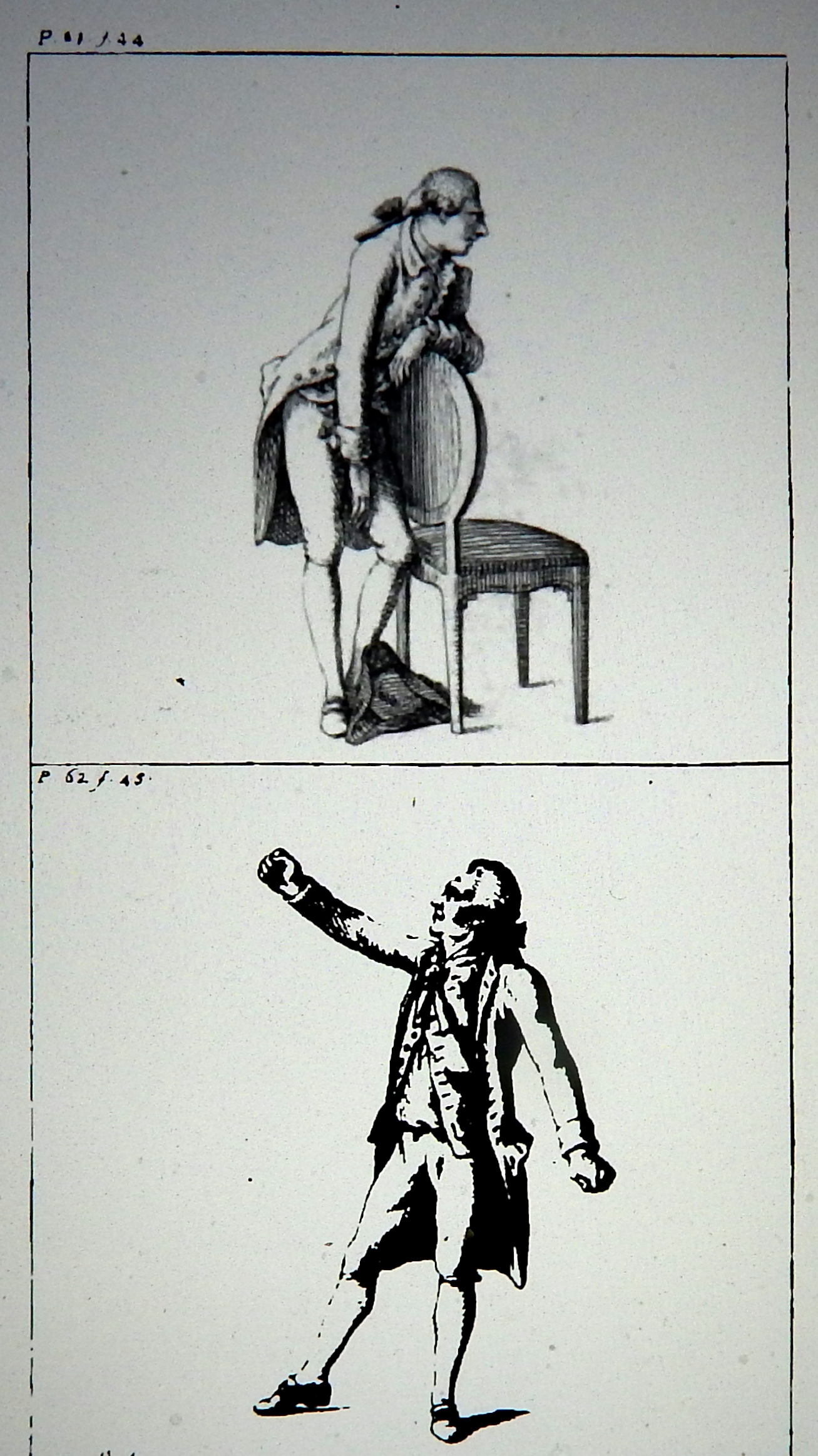
Figure 89: Illustrations from Johann Jakob Engel’s Ideen zu einer Mimik, Erster Theil (1785), showing gestures that provoke emotional responses without signifying anything in particular. 

Meanwhile, in Paris, as the Revolution began to unfold, Francois de l’Aulnaye (1739-1830) completed the first dissertation related to the ancient Roman pantomime, De la Saltation théatrale, ou, Recherches sur l’origine, les progrès, & les effets de lapantomime chez les anciens (1790). Much of the work consisted of an annotated compilation of ancient references to dance, pantomime, details of theater history related to Roman pantomime, and brief synopses of each emperor’s attitude toward pantomime, followed by almost a hundred pages of notes and original Latin texts. The obscure origins of pantomime in Greece or in a very remote primeval time preoccupied Aulnaye. It feels as if he was disappointed that pantomime did not have much of a life or history before the advent of the Roman Empire and he needed, perhaps in a time of intense anti-monarchial sentiment, to associate the art with a more distinguished, mysterious heritage than that of the warlike and imperial Romans, who nevertheless brought the art to a “perfection” previously inconceivable (Aulnaye 1790: 2). Aulnaye included nine watercolor plates of ancient artworks, but these depicted mimes or non-pantomimic dancers, except for one plate showing pantomime masks and another of engravings purporting to show a sculpted pantomime’s head and a sculpted pantomime scene, copied from “the cabinet of the Duc d’Orleans” [Figure 90]. 

Figure 90: Illustrations (Plate II, 1 and 2) purporting to show ancient tragic pantomime based on artifacts, from Francois de l’Aulnaye’s 1790 dissertation on ancient pantomime. 

But the strength of the dissertation is in its situating of pantomime within a broad, cross cultural, interdisciplinary historical context. Pantomime moved across manifold temporal, cultural, disciplinary, linguistic, economic, and political boundaries. More than any other society, the Roman Empire cultivated to “perfection” this power of pantomime. In perhaps the most interesting section of the dissertation, Aulnaye explains how all the arts intersect through pantomime. He compiles short paragraphs that connect pantomime to dance, music, acting, masking, fashion, sculpture, painting, rhetorical gesture, and even architecture (Aulnaye 1790: 11-17; 78). He never claims that pantomime “translates” words into gestures or has any codified correlate with language or literature. Rather, “the art of gesture is an ocular music.” Pantomime is similar to language insofar as it is a kind of bodily or gestural “poetry” (poésie); “it is an art of dreaming, which, by a magical power, transports us into the milieu it describes.” He then attempts to explain why language is inadequate to the goal of pantomime to create a poésie of sensations that “excite the soul”: “we have introduced rhyme into our verse, and this Gothic invention, without any compensation, gives us hard shackles, attests always, in spite of our vain rationalizations, how little our language is suited to Poesie” (Aulnaye 1790: 16-17). Otherwise, except for a reference to Noverre, Aulnaye made no connection of pantomime to his own pantomime-saturated time. Yet this was the one text of the century that presented pantomime as an art unregulated by music, dance, language, or any other art while being an appropriation of all the arts. 
Previous Section

Next Section

References

Table of Contents

The Shift from Oblivion to Paris: Vienna and Semiramis: Pantomime Turns Serious

Pantomime: The History and Metamorphosis of a Theatrical Ideology: Table of Contents

PDF version of the entire book.

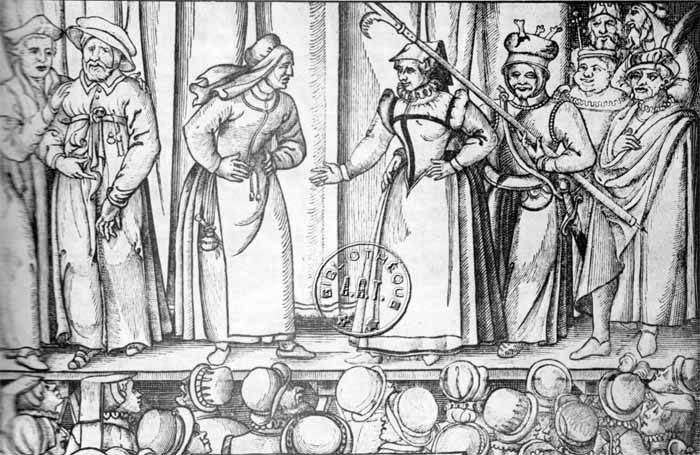
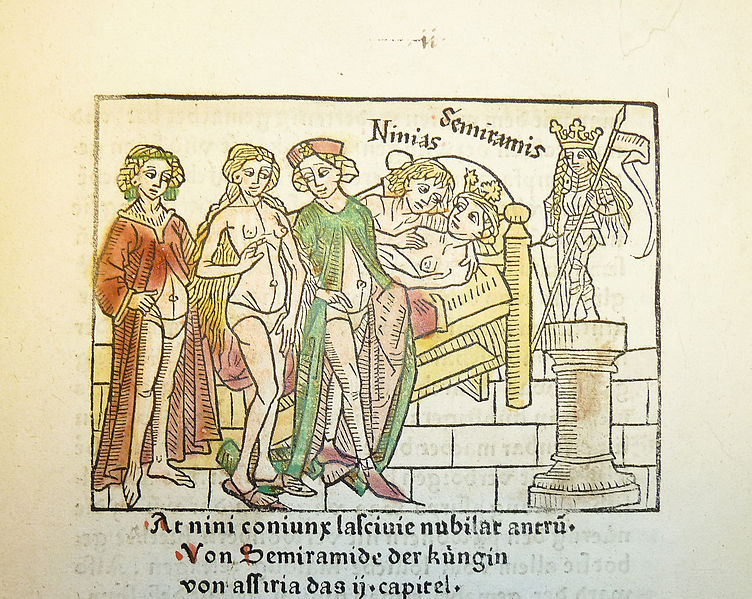
Figure 87: A fifteenth century German woodcut depicting Babylonian Queen Semiramis and her son Ninias. Photo: Forum Opera.
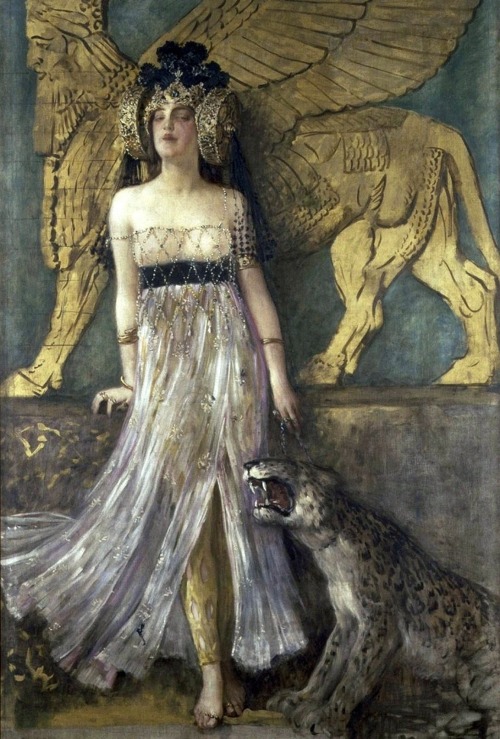
Figure 88: Queen Semiramis (1905), painting by Italian artist Cesare Saccaggi (1868-1934). Photo: Public Domain.

Vienna and Semiramis: Pantomime Turns Serious

When Hilverding accepted an invitation to direct ballet activities in St. Petersburg, his assistant, Gasparo Angiolini (1731-1803) succeeded him as ballet director in Vienna. Angiolini pursued an ambitious vision for ballet pantomime. In 1761, he collaborated with the librettist Ranieri de’Calzabigi (1714-1795) and the composer Christoph Willibad Gluck (1714-1787) on the ballet pantomime Don Juan for the Kärntnertortheater. This production, adapted from Moliere’s 1665 play, although it had a few comic moments, attempted a much more “serious” mood than Les Fêtes chinoises or The Loves of Mars and Venus, with the final scene set in a cemetery and Don Juan entering hell accompanied by churning strings and ominous, intoning trombones. Initially about twenty minutes in length and then expanded to about thirty-five minutes, the piece attracted much attention for its seriousness and its innovative determination to subordinate dancing to the demands of dramatic intensity. Angiolini claimed that tragic ballets had preceded him, in Stuttgart, but Don Juan was significant insofar as the piece was clearly built around the characters of the story rather than around the dancers in the imperial company (Angiolini 2015: 34). It also followed Hilverding’s model of taking a speech/voice oriented text and proving that the same story could be told more economically with only instrumental music and “gestures.” Angiolini, Calzabigi, and Gluck “reformed” the ballet by eliminating irrelevant divertissements, reducing the kinetic “embellishment,” and concentrating pantomimic gestures within dance positions or movements, so that the arms and hands communicated ideas or sentiments instead of fluttering, undulating or rising decorously. The trio of collaborators followed up this triumph with the even more successful opera Orfeo e Euridice (1762), which includes the famous “Dance of the Blessed Spirits,” wherein dancing advanced the narrative rather than functioned as a divertissement. Angiolini, Calzabigi, and Gluck became involved in other projects that did not bring them together, but in 1765, they collaborated again on what was their most “serious” production of a ballet pantomime: Semiramis, adapted from the 1748 tragedy of Voltaire, although Gluck had already written an opera about Semiramis, also in 1748, with a libretto by Metastasio. The ballet pantomime could not be more serious: the Babylonian queen Semiramis, having murdered her husband, plots to marry her own son and establish an empire with a new sexual and moral framework, although neither she nor her son are aware that their passion for each other is incestuous; the revelation of incestuous desire motivates the son to kill his mother. The piece was only about a half hour long and Gluck’s music was intensely austere, almost entirely in a minor key, with very short, darkly colored scenes (Gluck 1993: CD 2); such music was “what can only be called the beginnings of a new aesthetic, in which ordinary musical beauty becomes subordinate to a greater purpose: dramatic passion” (Heartz 1995: 215). Angiolini’s pantomimic choreography emphasized the beautiful performance of “simple” physical actions with tragic import rather than the execution of steps or synchronized movements. His approach becomes clearer when looking at the language of his scenario for Semiramis. For example, these words describing a section of the second act when the Queen must declare a new husband: 

Ninias [the son] enters, followed by soldiers. He carries to the feet of Semiramis the trophies of victory and the spoils of his defeated enemies. One sees that the Queen focuses on him. She would even declare him at that instant her inclination; but remorse is felt in her soul. But Semiramis finally chooses him; he bows down to her; she points out, and addresses the high priest and orders him to perform the ceremony. Oroés refuses because he does not believe that this marriage may be acceptable to the gods: after repeated refusals, the Queen issues a sign of contempt that makes heard what will be obeyed by Others. She leads Ninias to the altar; but suddenly the sky darkens, thunder rumbles, the simulacrum of Belus, and the Altar are struck by lightning; terror seizes all minds, and the temple remains empty in a moment (Angiolini 2015: 55).

All of these actions occur within a few minutes; no action motivates the performance of a dance, yet all physical action works on driving the narrative forward, one “simple” action spurs another, with a tremendous compression of emotions into “actions” or “gestures,” as Angiolini describes them; an emotion here does not cause a character to dance, rather, an emotion causes a physical action in one body that causes a responding emotion and physical action in another body, so that actions or gestures by different bodies are in a kind of dialogue with each other or linked to each other, without, however, requiring any embellishment of movement to signify that the narrative exists above all to display such embellishment, to show steps and positions, a dance. 

Semiramis was probably the closest thing to ancient Roman pantomime that the eighteenth century produced. It had a tragic theme; scenes were brief, and all performance elements built to an intense dramatic climax. Gluck wrote only enough music to “cover” the execution of the actions; he did not write music that allowed performers to fill time executing steps and movements that did not cause other performers to respond. Physical signification relied heavily on the hands, facial expressions (“mask”), and the upper body. Angiolini treated the corps de ballet like a Greek chorus, divided between the female entourage of the Queen, the soldiers of Ninius, and the priests. Angiolini even used something like supertitles to reinforce or clarify the emotional atmosphere at three moments, for example: “a hand traces before her on the wall of the cabinet this verse: ‘My son, avenge me: tremble, perfidious wife” (Angiolini 2015: 54). This effect was similar to the use of the interpellator in the ancient pantomime. Angiolini was quite familiar with Lucian and other writers on the ancient pantomime and drama, and he explicitly acknowledged his desire to recover the ancient approach to pantomime. He even went so far as to assert that “the dance of our day has degenerated to the point of no longer seeming more than the art of making capers and antics, jumping or running in step, or at most of comporting the body or walking with grace without losing balance, displaying soft arms and quaint, elegant attitudes. Our schools do not teach us anything; and this follows us in what we produce in the theaters, where one shows the vigor of a jiggle for a few minutes with strength, and lightness. These are our Columns of Hercules […] this miserable meandering [baladinage]” (Angiolini 2015: 39-40). Furthermore, Angiolini and his collaborators had demonstrated that pantomime was capable of achieving a somber, monumental grandeur unique to their own time. Semiramis greatly expanded the range and complexity of pantomime to represent emotions and provoke them in the spectator. It depicted lust, violent ambition, remorse, vengeance, and contradictory expressions of love while provoking “horror, pity, terror” in the spectator, while depicting such disturbing “passions” with elegance, majesty, grace, and delicacy (Angiolini 2015: 67-68). As Fabbricatore observes, with Semiramis, Angiolini had moved the ballet pantomime far beyond the balletic inclination to provoke astonishment and admiration for physical virtuosity. In doing so, he also moved the aesthetic appreciation of human movement away from compliance with “universal,” idealizing laws of beauty linked to the regulation of the body through balletic steps and positions and toward a much more subjective and even “revolutionary” idea of kinetic beauty as an “emancipation” of feeling, a “poesie,” that amplifies individual differences and thus undermines the illusion of social unity (Fabbricatore 2012: 13). In this respect, too, Semiramis was close to the ancient Roman pantomime, which so often excited audiences because it exposed “factions” within them. 

However, Semiramis has the reputation of having been a failure (Homans 2010: 88-89; Heartz 1995: 211-213). The piece was supposed to celebrate the wedding of Josef II, Archduke of Austria (1741-1790), to Princess Maria Josepha of Bavaria (1739-1767), toward whom the Archduke felt no affection. The Archduke and his entourage walked out on the performance, and the audience responded with stunned silence. It is difficult to understand how Angiolini, Calzabigi, and Gluck could believe that their piece was an appropriate way to celebrate a wedding. But it is possible that for the three of them the desire and power to experiment was greater than the pleasure of accommodating any social or aesthetic protocol. The trio did not foresee especially bad consequences for their experimental impulse, and none resulted. Angiolini was proud of Semiramis and regarded it as one of his finest productions. To accompany the 1765 performance, he published his Dissertation sur les Ballets Pantomimes des Anciens, pour servir de programme au Ballet Pantomime Tragique de Sémiramis, in which he explained his approach to a new kind of ballet pantomime inspired by the ancient Roman pantomime. The pamphlet probably exerted greater influence over the theater world than the subdued audience response to the performance. In 1773, Angiolini staged another production of Semiramis in Venice. The shadowy adventurer Ange Goudar (1708-1791) wrote about this production in considerable detail as part of his propaganda campaign against the ballet pantomime, which he had launched in 1759, with his Observations Sur Les Trois Derniers Ballets Pantomimes Qui Ont Paru Aux Italiens Aux Francois. He remarked that in Semiramis “the feet do not speak at all,” and then he touched upon the argument he introduced in the Observations, where he claimed that, “it is a malady of our ballet masters that they want to make the legs speak, if one may express it thus, and to articulate attitudes: dance is so little equipt to render ideas methodically, that any progress that one gains in this art will always be very imperfect [ . . . ]” (Goudar 1759: 10). His main complaint was that the pantomimic gestures, though well-performed by Monsieur and Madame Campioni, do not achieve their intended signification if the spectator does not read the program (the Dissertation) that accompanies the performance. Pantomimic gesture in itself does not explain that Semiramis and Ninius do not know that they are mother and son. Angiolini’s occasional use of supertitles, Goudar implies, merely reinforces the point that gesture is helpless at conveying what a handful of words makes clear. To amplify this point, Goudar focuses on the final scene in which the Shadow of Ninus rises from the tomb and leads Semiramis into the earth. He presents a spoken dialogue between the Shadow and Semiramis, which is an adaptation of Voltaire’s original language. In the speech exchanged between Semiramis and her dead husband are manifold thoughts and feelings that pantomimic gesture presumes to represent but cannot or winds up representing something other than intended, with “ridiculous” consequences (Goudar 1777: 88-98). Goudar’s critique represents the conservative ballet perspective: dance is a great art because it has no need to represent anything other than itself, other than an idealized humanity achieved by the geometric regulation of the body through “universal,” idealizing steps and positions, supplemented by glamorous costumes and scenography. Of course, this perspective is blind to the point of pantomime, which is that gesture is indeed enigmatic and even arbitrary; it is relative to the body that performs it, it is relative to the emotion that motivates it, to the scene, to the person who sees it, to the music, to the possibilities of “metamorphosis” within the performer. The use of supertitles or an accompanying program or “interpellation” simply reinforces this point without, however, diminishing Angiolini’s contention that gesture could “say” things that language could not (Angiolini 2015: 49-50). But for many in the ballet culture, this pantomimic way of thinking “seriously” about human movement was now no longer a “low,” marginal aesthetic surfacing from the crude aspirations of the foire theaters and the acrobatic frivolities of the grotteschi—it constituted a major threat to ballet (cf., Fabbricatore 2011).

Semiramis inaugurated a European vogue for “serious” pantomime or pantomime héroïque. The trio of collaborators went on to enjoy bountiful careers. Gluck and Angiolini collaborated on a couple of other tragic ballet pantomimes, Ifigenia in Aulide (1765) and Alessandro (1766), about which virtually nothing is known. When Hilverding became embroiled in a scandal in St. Petersburg, Angiolini replaced him, and Hilverding returned to Vienna. Until 1773, Angiolini was busy in St. Petersburg and Moscow staging both tragic and pastoral ballet pantomimes. Then he worked in Venice and Milan before returning to Vienna (1774) to collaborate with Gluck again on the tragic ballet Orphelin de la Chine, another adaptation of Voltaire and another work about which nothing is known. He was in St. Petersburg again from 1776-1778 producing tragic ballet pantomimes, then in Venice, Turin, and Verona, before settling for a while at La Scala in Milan, where he produced yet more tragic and heroic pantomimes, including, among many others, La morte di Cleopatra (1780), Attila (1781), Alzira, ossia gli americani (1782), and Teseo in Creta (1782), about which one must locate extremely rare sources that Stefania Onesti has been able to identify but unable to consult on behalf of her monumental dissertation on Italian ballet pantomime (Onesti 2014 II: 764-765). From 1783-1786, he was again in St. Petersburg, where he mostly taught. By 1789, he was back at La Scala to revive some of his older works and introduce new ballets and ballet pantomimes: Fedra (1789), Sargine (1790), and Amore e Psiche (1789), which was an adaption of the pantomime scene in Apuleius (Tozzi 1972: 158-167). The career of Angiolini thus indicates an expanding international audience for “serious” ballet pantomime, although he was not at all averse to devising comic ballet pantomimes. 

While working at the Regio Ducal Theater in Milan in 1773, Angiolini shared choreographic duties with Noverre, whose approach to ballet pantomime struck him as damaging to the genre. He therefore published his Lettere di Gasparo Angiolini a Monsieur Noverre sopra Ballo Pantomimi (1773), in which he asserted that Noverre had initiated a conflict in ballet pantomime between French and Italian factions, so to speak. He accused Noverre of arrogance in devaluing the pioneering contributions to the ballet pantomime by Hilverding and the Viennese court culture, which had saved pantomime from the “barbarism and indecency” of the commedia aesthetic, and in underestimating the power of Italians to create greatness in the arts (Angiolini 1773: 10-40; 110-111). Angiolini argued that the ballet pantomime is a form of poetry rather than drama, and Noverre failed to grasp this distinction by constructing excessively convoluted, protracted narratives that failed to achieve the elegant “simplicity” of movement necessary to produce seriousness in pantomime. Curiously, echoing Goudar, he complained that Noverre relied too much on accompanying programs to bestow coherence on his pantomime ballets, although Angiolini himself continuously relied on programs (Angiolini 1773: 25-39; Tozzi 1972: 166-168). He contended that Noverre lacked sufficient musical skill to construct ballet pantomimes, for the choreographer should also be a composer, as was Angiolini himself (Angiolini 1773: 47-51; 91-93). Even though Angiolini’s fame derived from his development of the serious ballet pantomime, he complained that Noverre treated the genre as superior to all other forms of ballet, whereas both choreographers and dancers should move with equal ease and mastery from one genre to another (Angiolini 1773: 101-102). Noverre responded by publishing his own pamphlet in which he described Angiolini as a resentful, malignant figure, whose critique was worthy only of a condescending sneer, although he did insist that the movement “language” of pantomime could not expand or grow more complex without written progams accompanying the performance. In any case, he appealed to audiences to decide whose approach to ballet pantomime was best (Noverre 1774: 11-13, 18-19). A pamphlet war between Noverre and Angiolini supporters then ensued, and Kathleen Hansell has given an excellent account of it (Hansell 2002: 229-235; cf. Carones 1987: 42-54). She suggests that ultimately Noverre lost the contest, because he, unlike Angiolini, was unable to integrate dance (steps), ballet (geometric configuration), and pantomime (gesture). He became deeply disillusioned by pantomime, because he assumed that “pantomime unaided is so obscure, it needs something akin to [a presumed] declamatory text of ancient Roman spectacles: the explicative scenario [ . . . ] Noverre and his followers had not recognized the creative prospects of Italian mime in dance” (Hansell 2002: 240). But the pamphlet war also revealed that the struggle for control over the identity and aesthetics of the serious ballet pantomime had become a basis for intensifying cultural differences over the expressive power of the body. 

Noverre, however, remains a cherished figure in ballet histories. Even if his ballet pantomimes were tediously long, incoherent, and ruinously expensive, they eventually succeeded in detaching the Paris Opera ballet company from the Opera and establishing the autonomy of ballet through the ballet d’action. Moreover, Noverre repudiated his enthusiasm for pantomime and ended up embracing the enduring conservative philosophy that ballet was above all about the beauty of the steps and positions. Angiolini, on the other hand, never advocated for ballet companies to operate independently of operas. He cultivated an interdisciplinary aesthetic. He wanted the ballet pantomime to achieve its own intense, compressed moment of seriousness in relation to other theatrical experiences brought together on the same program, and in this respect, too, his thinking was similar to the ancient Roman pantomimes. Angiolini’s influence in his own time was greater than might be supposed from the ballet and theater histories of the last century. Part of the problem is that, aside from Don Juan and Semiramis, documentation relating to his many other ballet pantomime productions is lacking. But, as Hansell has observed, another part of the problem is that for many of his productions Angiolini himself composed the music, and his music, relentlessly mechanical and uninspired in itself, was far more conservative than his choreographic imagination: his “rudimentary musical language […] consigned the majority of his works to oblivion” (2002: 231). Music in pantomime accompanies the gesture, like soundtrack music; it does not motivate movement or provide a reason for gesture or dance, as in ballet. Pantomime music should be aligned with a particular emotion rather than with the movement, even if the movement signifies a different emotion. But Angiolini was not able to convey nearly as strong an emotional response to life through music as he was able to do through movement. An implication of this situation, then, is that ballet pantomime thrives in a vibrant atmosphere of collaboration between highly talented artists rather than in relation to a single, unifying artistic intelligence like a choreographer, director, composer, or librettist. Gluck’s dark music for Don Juan and Semiramis bestowed a unique beauty on Angiolini’s pantomimic organization of movement that allowed those pieces to resonate powerfully across Europe. But Calzabigi’s taut, tense scenarios also inspired dramatic clarity of gesture, as he himself implied when he complained that Gluck should not get all the credit for the success of his reformist operas (Prod’homme 1917: 265-266). Yet each member in the trio of collaborators was individually so successful that he was able to pursue numerous opportunities that did not include both of the others. While Angiolini went to St. Petersburg, Gluck went to Paris, where he triumphed, especially with libretti by Calzabigi, who was prodigiously busy in Italy and Vienna in addition to his projects with Gluck. In Paris, Gluck’s efforts to integrate ballets into his operas met with resistance from the Opera ballet corps, and he sometimes had to add dance scenes to accommodate the dancers and their claques, who certainly caused problems for Noverre as well. The ballet pantomime achieved power and appeal as a sign of “reform,” innovation; the genre seemed important insofar as it created an aura of instability in the theater culture, as opposed to ballet, which treasured the absolute stability of its aristocratically conceived “universal” rules of movement. The message of reform and innovation never seemed stronger than when the trio of collaborators produced Semiramis for a completely inappropriate occasion—they made the point that together they could do whatever they wanted, and they wanted to “reform” the conditions under which their artistic talents could operate at their most serious level. The collaborations of this trio of artists made the ballet pantomime seem an opportunity for daring aesthetic adventure, and this nimbus of daring sustained hope and enthusiasm for the genre long after the trio had run out of occasions to collaborate. 

Angiolini’s ballet pantomimes showed at least that some large audiences wanted something more or other than ballet to reveal the “serious” or “heroic” expressive power of human movement. Yet ballet companies were expected to accommodate this emerging audience appetite, and it was as if ballet pantomime was unable to establish its own institutional identity without ballet having a controlling partnership in it. Ballet needed the ballet pantomime to develop the ballet d’action and emancipation from opera. Ballet pantomime needed the ballet to pursue the experiment in large-scale pantomimic action, which was necessary in expanding the appreciation and transformation of social identities. But as long as ballet companies were responsible for producing ballet pantomimes, they were inclined to make the genre conform to ballet’s aesthetic system. Performances of ballet pantomimes lack good documentation, particularly in relation to movement. However, August Ferrere, a choreographer who apparently never worked as such in Paris, compiled in Valenciennes a workbook of four short ballet pantomimes he produced probably for a company touring in northeastern France and Belgium. He dated the manuscript 1782, so presumably the pieces were contemporary with that time. These are “light-hearted” pieces that depict village scenes, except for Le Peintre amoureux de son modèle, which has a vaguely urban setting and is a very loose, very abreviated adaption of a 1757 comic opera of the same name by Egidio Duni. Ferrere inscribed many details for each of the ballet pantomimes: musical notations, tempi, keys, instrumentation, and durations; number of performers; and descriptions of actions to be performed within each section of the piece. For the movements of the performers, Ferrere provided Feuillet notations of dance steps, floor patterns for group movements, and sometimes little sketches of figures and their gestures. The manuscript is the most detailed description of any dance or pantomimic works in the eighteenth century. Carol G. Marsh and Rebecca Harris-Warrick have published a lengthy analysis of the manuscript. They point out that the pantomimic sections of the pieces are not consistently distinct from the dance sections. Sometimes pantomime occurs within a dance or while dancing, sometimes a performer pantomimes while another dances, and sometimes a section of a scene contains only pantomime, creating a “fluidity of movements,” although the manuscript refers generally to pantomimic action without describing gestures (Marsh 2005: 263). A video reconstruction by the Divertimenty Company of scenes from Le Peintre amoureux de son modèle demonstrates the effectiveness of the manuscript in prescribing this oscillation between pantomimic and dance movement (Divertimenty 2014). While the manuscript gives a vivid idea of how these small, cheerful ballet pantomimes worked in performance, the extent to which Ferrere’s approach to the genre was typical or conventional remains unclear without corroborating evidence. Even so, the manuscript indicates that Ferrere displayed a fairly conventional choreographic imagination. Marsh and Harris-Warrick fixate on identifying all the steps for the dances, they identify the types of dances, and they describe the relation of the dances to the action of the scenario. They also analyze the geometric floor plans for the group dances and the relation of the music to the movement (2005: 243-275; cf., Jablonka 2012). Indeed, the obsession with dance steps and configurations makes it difficult to grasp the narrative action, let alone the “meaning” of it all. But that is perhaps the point. What the analysis of the manuscript makes clear is that Ferrere tries to turn as much of the action into dance as possible. He resolves all conflicts with dance; he ends all scenes with dance; if he begins a scene with a pantomime, he soon begins a dance; otherwise, he begins his scenes with dances; every scene contains more than one dance, and occasionally dances seem irrelevant to the ostensible narrative. The music (by an unknown and unremarkable composer, possibly Ferrere himself) structures all the action in the pieces, and Ferrere even describes the relations between steps and notes. One gains a strong impression of dance and music circumscribing pantomimic action, as if pantomime interrupts an insistently “harmonizing” desire or perhaps imperative to dance. The manuscript creates an aesthetic framework in which it is very difficult for the expressive power of pantomime to expand. From a ballet perspective, it is no doubt not surprising that a ballet company would construct this relation between dance and pantomimic action. What is peculiar is the motive within European culture to encourage a “serious” appreciation of pantomimic art and at the same time to situate pantomime within an institutional apparatus that does not allow pantomime to increase its power to control perception or understanding of the body’s expressivity, in spite of the era’s obvious preoccupation with how the body “says” things that cut through or across the different languages which breed conflict within the culture and define the “foreignness” of it.

Previous Section

Next Section

References

Table of Contents

The Shift from Oblivion to Paris: Pantomime against Ballet

Pantomime: The History and Metamorphosis of a Theatrical Ideology: Table of Contents

PDF version of the entire book.

Pantomime against Ballet

The philosophical discourses on ballet, pantomime, and music in the theater introduced by Diderot, Rousseau, and Noverre amplified uncertainty about the relation between ballet and pantomime and about the nature of the thing called “ballet pantomime.” Ballet historians tend to treat the ballet pantomime as a transitional genre that led to the creation of the ballet d’action and the establishment of ballet as an autonomous art, independent of opera and pantomime. However, the ballet pantomime continued long after the ballet d’action had become the defining feature of autonomous ballet. The ballet d’action was the genre by which ballet claimed authority to tell its own stories or construct narratives that were unique to the aesthetic principles that defined ballet as an art. That is, a ballet d’action told some kind of story using the movement vocabulary, the “positions” and steps, that belonged only to ballet. The choreographer, using the movement vocabulary, determined the movements of all bodies in the ballet; whereas in pantomime, movement ostensibly came from the “heart” of the performer, who used a highly personal, distinctive gestural vocabulary that was nevertheless transparent enough to communicate ideas and sentiments to audiences who “read” physical significations in an equally intuitive manner, if not necessarily in the way the performer intended. From the perspective of conventional ballet history, the ballet d’action emerged as a strategy for controlling the term “ballet.” The foire theaters, like Hollywood much later, tended to apply the term “ballet” rather promiscuously, to refer, at first, to parodies of state theater ballets, and then to refer to performances, even “serious” ones, that featured dancing, like the ballet pantomime. The real purpose behind the struggle to establish ballet as an autonomous art was to demonstrate the authority of state institutions (theaters and schools) to regulate and standardize bodily movement in relation to an idealized image of the body that could only be achieved or performed through an elaborate, rigorous education involving a complex infrastructure of personnel, resources, social networks, curricula, and bureaucratic oversight. This goal entailed the use of narratives that supported the system for regulating bodily movement; more precisely, ballet was above all about the beauty of steps and positions, which meant that the narrative served the dance rather than dance served the narrative. As interludes or intermezzi within opera productions throughout Europe, ballets rarely had any connection with the opera narrative (Hansell 2005: 18-19). This situation encouraged the whole ballet mentality to believe that the approved steps and positions, combined with lavish costumes, were interesting in themselves and did not achieve any greater meaning by representing distinctive characters, particular emotions, or anything outside of the stage itself. 

Pantomime and ballet pantomime implied a nebulous resistance to the institutionalized regulation and idealization of bodily movement promoted by ballet culture, with its emphasis on the exclusivity of the academic education needed to succeed in the art or even to appreciate it. Ballet pantomime was appealing precisely because the definition of it was unclear. When in Paris Noverre began in the 1760s to introduce “heroic ballets” that incorporated pantomime as a way to invest movement with emotion, he apparently alternated moments of dancing with moments of pantomimic movement, in which performers walked rather than danced. According to Friedrich Melchior Grimm (1723-1807), a prodigious commentator on theatrical affairs in Paris, “one walks in [Noverre’s ballets] more than one dances. One sees in them much less of steps and symmetrical dances than of gestures and groups. [ . . . ] In the ballets of Noverre dance and measured walking are very distinct; one dances only in the great movements of passion, in decisive moments [ . . . ]. This transition from measured walking to dance and from dance to measured walking is as necessary in this spectacle as the transition from recitative to aria and from aria to recitative is in opera, but dancing for the sake of dancing cannot occur except when the danced drama is over” (Hansell 2005: 27; Grimm 1829 VI: 300). But Grimm was generally sympathetic to Noverre’s efforts to produce “serious” ballet pantomimes, although in discussing a 1779 revival of Noverre’s Médée (1763) he observed that the pantomime scenes unfolded so rapidly that it was sometimes difficult to appreciate their significance without consulting the program. That was “the extreme difficulty and the most beautiful triumph” of pantomime: to compress physical actions into “a grand and magnificent tableau” that nevertheless occurred so quickly. By contrast, dance sections presumably allowed for easier attention to spectacle because of the repetition of steps and movements (Grimm 1880 XII: 368). In pantomime, movement was continuously changing from one idea to the next, one sentiment to the next, and the performer preferred to change a movement or gesture to make a point rather than to repeat it. However, Noverre’s approach to ballet pantomime did not inspire as much enthusiasm in Paris as the Opera expected, and he soon focused, with no greater success, on ideas of heroic ballet that remained within the conventional ballet movement vocabulary, preferring even to forget what was perhaps his most distinctive achievement as a choreographer, Les Fêtes chinoises.

Meanwhile, much of the innovative thinking about ballet pantomime took place outside of France, chiefly through the Italian concept of ballo pantomimo, the term the Italians gave to the thing that Weaver and Riccoboni had introduced (Fabbricatore 2014: 24-25). In Italy, opera houses resembled the English scene in adopting a commercial dimension, with aristocratic sponsors or investors and sideline enterprises, such as gambling, so that an opera house was also sometimes a casino or social club, a phenomenon which probably contributed to some of the French hostility toward Italian opera. As in French opera, Italian opera included ballets that hardly ever had any connection with the opera narrative, but the ballets were often as long as the opera itself (Hansell 2005: 24). French ballet, however, tended to keep dancers’ feet close to the surface of the stage to create a smooth, gliding, often undulant movement, while the Italian ballet favored leaping, sprinting movements (“caprioles”) that produced an “aerial” effect and made much wider use of hands and arms to signify emotions or motivations. The Italians, unlike Noverre, integrated pantomimic movement with dance, especially in the genre known as grotteschi, which by the middle of the eighteenth century was more of a fantastical than comical dance supplemented by spectacular scenic transformations inspired by ancient mythic themes (Hansell 2005: 20-21). Ballet throughout Europe generally adopted the same system of steps and positions, and the Italians used the French terms to identify the different positions, even if they used the system for different choreographic goals (Hammond 2005: 111, 149). But in Italy, as in France, controversy reigned over the use of pantomimic movement to construct “serious” theatrical works. The most famous grotteschi performer and choreographer and the author of an influential 1779 treatise on ballet technique, Genarro Magri (ca. 1735-1785), continually quarreled with ballet practioners and theorists, including Noverre, over how to represent “passions,” identities, and ideas through movement. Magri advocated for versatility of performance skills in dancers and diversification of themes and “passions” that movement could represent; he therefore saw the ballet pantomime as an opportunity to achieve these objectives, and in Vienna, Naples, and elsewhere in Italy, his approach to performer education, which stressed a “violent” tension between “extensions” and “containments” of the body, shaped not only the grotteschi aesthetic but the ballo pantomimo, which offered opportunities for grotteschi dancers that conventional ballet was unwilling to provide (cf. Magri 1779 I: 93; Tomko 2005: 159-160). While Magri favored the development of larger and more complex dance productions, he always saw ballet companies as components of opera houses, even if the ballets had nothing to do with the operas. Economic practicalities probably motivated this viewpoint, but he also saw the “Pantomimo ballato” as having descended from the ancient Roman pantomime, which accompanied action with singing (Magri 1779: 9).

By 1760, it was clear that the future of the ballet pantomime was in the hands of ballet companies attached to opera houses rather than with the foire theater companies that had invented the genre. It was also clear that Italianate sensibilities were guiding the development of the ballet pantomime. The ballet companies warmed to the ballet pantomime possibly because ballet audiences were impatient with the populist conservatism of the foire productions, with their interminable devotion to the commedia format. But ballet audiences were probably also impatient with ballet productions that merely glorified the elegant, acrobatic display of steps and positions. For ballet to achieve higher (autonomous) status as an art, it had to develop a seductive and long form capacity to represent “passions” and “serious” themes, a variety of emotional relations between bodies, and the movement vocabulary of steps and positions had very limited power to do that. Indeed, the books on ballet technique, such as Magri’s, that proliferated in the latter half of the eighteenth century tended to focus obsessively on identifying the correct execution of steps and positions without explaining how to combine movements to construct characters or to represent anything or even how to move in relation to other bodies. Pantomime provided a way to expand the narrative-emotional charm of ballet, at least until ballet was able to build its movement vocabulary to make every representational movement “pure dance.” But ballet companies could not embrace pantomime without transforming it. This meant releasing pantomime from the commedia format, so that audiences could see pantomime as something other and greater than what the foire theaters had made of it. The Italianate perspective, which nevertheless had many partisans in Paris, entailed considerable skepticism toward the French inclination for strict classifications, clear distinctions between pantomime and dance, which were fundamental in preserving the concept of “pure dance” or dance as an end in itself, with no need to represent anything other than the geometrical grandeur of bodies in movement. As Philippe Gumpenhuber (ca. 1706-1770) observed in relation to a performance at the Vienna Kärntnertortheater in 1759, the scene, choreographed by Vincenzo Turchi, presented “pantomimes, which are done while dancing,” as opposed to Noverre’s alternation of pantomime and ballet sequences (Gumpenhuber 2005: 312). The ballet pantomime amplified the scale of pantomimic action. Ballet companies in Italy and at the Kärntnertortheater usually consisted of twelve to fourteen persons, whereas commedia-oriented pantomimes in the foire theaters rarely involved more than three or four persons on stage at the same time and mostly involved only one or two figures at once. The ballet companies had to make use of many more performers to justify their existence and to support a larger field of action than commedia ensembles found profitable. In 1758, Franz Hilverding (1710-1768), a choreographer at the imperial Kärntnertortheater in Vienna, staged the ballet pantomime Le Turc Généreux, which updated a section of Rameau’s ballet héroïque, Les Indus galantes (1735), apparently without any of the singing. The artist Bernardo Belloto (1721-1780) produced a beautiful, widely circulated engraving of a scene from this ballet pantomime [Figure 86]. 

Figure 86: Painting by Bernardo Belloto (Canaletto) of a scene from the ballet pantomime Le Turc Généreux (1758), directed by Franz Hilverding in Vienna. Photo: British Museum. 

The picture shows sixteen performers on the stage, at least twenty-three musicians in the orchestra pit, and a scenic environment of great opulence. The engraving, which is the most detailed evidence available for this production, may be questionable in its accuracy, but it is nevertheless clear that ballet pantomime had become a large-scale venture and that the artist chose to represent pantomimic rather than balletic movements. Each of the sixteen figures on the stage adopts an individual gesture, including the five European women on the left, the seven Turkish men on the right, and the four figures, two men and two women in the center of the stage, which includes the Turk raising his dagger, a woman trying to restrain him, another woman on her knees imploring him and at the same time extending a protective arm to the man on his knees to her right, who is the target of the Turk’s dagger. It is a delightfully complex scene, because it presents a divided community on stage, yet all the members of the community individuate themselves through their gestures and movements. Pantomime could show a group or social world as a convergence of teeming, vibrant individuals, whereas ballet consistently saw group identity, whether energetic or subdued, as best represented through uniformity of movement, all members in step and synchronous with musical cues. The ballet director does not choreograph pantomimic movement like this but elicits it through various verbal and visual appeals to the performers’ sense of what gestures are appropriate responses to a particular dramatic moment. The performers are expected to find their own unique emotional connection to the moment and thus their own unique gestures. But a skillful, exciting group pantomime is probably more difficult to achieve than getting a group of performers to follow the same steps and move in synchrony to musical cues. 

Gumpenhuber’s synopses of brief but sometimes spectacular ballet pantomimes produced by Italian choreographers in the Vienna Kärntnertortheater in 1759 suggest that much of the pantomiming involved groups enacting scenes of village or country life, such as a wigmaking workshop, a fish market, a fruit harvest, a fair, a harbor promenade, or a cabaret. A couple of ballet pantomimes depict exotic scenes involving pirates or Turks. These are cheerful or “jolly” pieces, as Gumpenhuber calls them, but it is clear that the “pantomimes, which are done while dancing,” function to provide opportunities for dances, including solos, pas de deux, and the group dances that invariably begin and conclude the pieces (Gumpenhuber 2005: 312-319). Pantomime here created an atmosphere of diffuse communal energy that dance then harnessed into a unified, disciplined sentiment. Such grotteschi demonstrated that pantomimic dancing could provide “jolly,” convivial entertainments that referred to the actual world outside the theater and had no need to rely on the buffoonish, self-contained antics of the commedia format. But Le Turc Généreux attempted a much more “serious” or complex use of pantomime to construct group actions and to narrate relations between figures on the stage. Hilverding revealed the potential of the ballet pantomime to operate on an even more “serious” level than what Weaver, Riccoboni, or Noverre had achieved insofar as he worked with a large staff of Italians who showed enthusiasm for the genre. 

Previous Section

Next Section

References

Table of Contents

The Shift from Oblivion to Paris: Diderot and Rousseau: How Pantomime Embodies Ideology

Pantomime: The History and Metamorphosis of a Theatrical Ideology: Table of Contents

PDF version of the entire book.

Jean-Jacques Rousseau, portrait by Maurice Quentin de La Tour (1704-1788). Photo: Public Domain
Denis Diderot, portrait by Louis-Michel van Loo (1707-1771). Photo: Public Domain.

Diderot and Rousseau: How Pantomime Embodies Ideology

However, from another, emerging perspective in Paris, the chief source of conflict within society was not the body but language. Noverre believed that the ballet had become sterile, excessively grandiose and oppressively rigid, and utterly dependent upon the opera and texts to justify its existence. In 1751, however, the philosopher Denis Diderot (1713-1784) had already published his essay Lettre sur les sourds et muets, in which he examined the authority of language to define consciousness, reveal emotion, or allow for accurate perception of the body. He contended that pantomime was an attempt to translate language into gesture, but because “it is impossible to translate a poet into another language,” pantomimic action was inauthentic or at any rate artificial compared with the authentic gestural semiotics of deaf mutes (Diderot 1916: 164, 216). Perhaps the fascination with pantomime in Paris inspired him. In Rameau’s Nephew (1761), which remained unpublished until long after his death, Diderot used the term “pantomime” to describe actions that construct social identity as a theatrical phenomenon and therefore establish a fundamental distinction between what might be called the “natural” self and a social self, which embeds the need to be someone else within the awareness that one “needs someone else.” These actions are “the different pantomimes of the human species.” The dialogue clarifies the idea of human social life as a pantomime through the concept of “positions […] derived from others”: 

HIM: I move around from one piece of earth to another. I look around me, and I take up my positions, or I amuse myself with positions which I have derived from others. I’m an excellent mimic, as you’re going to see. 

Then he begins to smile, to imitate a man admiring, begging, obliging. He sets his right foot forward, his left behind, with his back bent over, his head raised, with his gaze looking directly into another person’s eyes, his mouth half open, his arms stretched out towards some object. He waits for his orders. He receives them. He dashes off, comes back. He’s done the job and is giving an account of it. He attends to everything. He picks up what falls down. He puts a pillow or a footstool under someone’s feet. He holds a saucer. He goes up to a chair. He opens a door. He closes a window. He pulls the curtains. He observes the master and mistress. He is immobile, his arms hanging down, his legs lined up straight. He listens. He seeks to read what’s on their faces. And he continues, “That’s my pantomime, almost the same as what flatterers, prostitutes, valets, and beggars do.” 

The antics of this man, the stories of Abbe Galiani, and the extravagances of Rabelais sometimes force me to profound reflections. There are three stores where I have acquired some ridiculous masks which I put over the faces of most people. I see Pantalon in prelate, a satyr in a judge, a pig or an ostrich in a minister, and a goose in his first deputy. Myself serious in a monk. 

ME: But by your count there are lots of beggars in this world, and I don’t know anyone who doesn’t do some steps in that dance of yours. 

HIM: You’re right. In the entire kingdom, there’s only one man who walks. That’s the king. All the rest take up positions. 

ME: The king? Isn’t there more to it than that? Don’t you think that, from time to time, he finds beside him a little foot, a little curl, a little nose which makes him go through a small pantomime? Whoever needs someone else is a beggar and takes up a position. The king takes up a position before his mistress and before God. He goes through the paces of his pantomime. The minister goes through the paces of prostitute, flatterer, valet, or beggar in front of his king. The crowds of ambitious people dance your positions in hundreds of ways, each more vile than the others, in front of the minister. The noble abbe in his bands of office and his long cloak goes at least once a week in front of the agent in charge of the list of benefices. My goodness, what you call the pantomime of beggars is what makes the earth go round. Everyone has his little Hus and his Bertin. 

HIM: That’s a great consolation. 

But while I was speaking, he was imitating in a killingly funny way the positions of the persons I was naming. For example, for the little abbe, he held his hat under his arm and his breviary in his left hand; in his right hand he lifted up the train of his cloak. He came forward, with his head a little inclined towards his shoulders, his eyes lowered, imitating the hypocrite so perfectly that I believed I was looking at the author of the Refutations appearing before the Bishop of Orleans. For the flatterers and for the ambitious he crawled along on his belly–just like Bouret at the Ministry of Finance. (Diderot 2002: 60-61).

After complimenting Rameau’s nephew on his pantomime, Diderot nevertheless remarks: “But there’s one creature who can do without pantomime. That’s the philosopher who has nothing and who demands nothing.” The dialogue indicates a major shift in thinking about pantomime. Diderot uses the term pantomime to refer to more than a mysterious entertainment that reveals the expressive power of the body; pantomime is a system for defining a body’s relation to a vortex of power—in this case, the King. For Diderot, pantomime is not a metaphor for a society’s control over social identity; it is the way in which a person physically encodes his or her identity within a social order or hierarchy. This physical coding is pantomime because it “derives from others,” it is a theatrical performance, it masks the “natural” identity of the performer. Rameau’s nephew is merely self-conscious of his pantomimic supplements to the dialogues with his friend; it is an aspect of his self-acknowledged “mediocrity.” But Diderot presents himself as a philosopher who lives outside of the pantomimic system controlling social identity and disguising “mediocrity” within his society. By the time he wrote Rameau’s Nephew, pantomime could no longer claim to be a marginalized popular art that assumed its “silent” form because an elite, royalist ruling class had deprived the common people of a “voice” in their own public theaters, although Madame de Pompadour’s role in effecting this change should not be underestimated. Pantomime had become so skillfully integrated into the French entertainment culture, especially through the commedia archetypes, that it no longer constituted a “threat” to the state theaters and perhaps was no longer even capable of signifying popular resentment against aristocratic privilege. The expanding pantomime culture functioned as a sign of social stability in much the same way as television sitcoms in the United States today are understood as “mainstream” entertainment. Diderot felt himself in conflict with a society that articulated its “mediocrity,” its complacency, its excessive stability through pantomime. Indeed, he had already been imprisoned in 1749 for his critical views of the government, and subsequently sectors within the government and the clergy worked to undermine and then suppress (1759) his work on the monumental Encyclopédie (1751-1772). And yet it was a French ballet pantomime that provoked considerable civil disorder in London at the Drury Lane Theater in 1754, although the riot of course did not reach the scale of violence that in their day the Roman factions on occasion had perpetrated. While imperial Roman society was perhaps no more tolerant of civil disorder than eighteenth century English or French society, it was certainly more tolerant of internal instability, a situation encouraged by the ideology of “metamorphosis.” It may be, then, that Diderot underestimated the capacity of pantomime to “agitate” audiences desirous of changing their “positions” within society, especially if he saw pantomime in the foire theaters dominated by the oppressively “eternal” qualities of commedia characters. The Encyclopédie article on pantomime, written by Louis de Jaucourt (1704-1779) and published in 1765, made scant reference to pantomime of its own time: “This art would probably have much greater difficulty succeeding among the northern nations of Europe than the Romans, whose vivacity is so rich in gestures, which mean almost as much as full sentences. […] However, we have seen in England, and on the scene of the comic opera in Paris, some of these actors play dumb scenes that everyone could understand. I know that Roger and his brethren must not be compared with pantomimes of Rome; but does the London theater not now own a pantomime that could oppose Pylades and Bathyllus? The famous Garrick is an especially wonderful actor, who performs all kinds of tragic and comic subjects.” The article overwhelmingly cited ancient Roman commentaries on pantomime, but Jaucourt nevertheless inserted a moral tone that aligned well with Diderot’s contention that pantomime had an enervating effect on culture: “Rome was too rich, too powerful and too immersed in softness, to become virtuous; the art of pantomime, which was introduced so brilliantly under Augustus, and was one of the causes of the corruption of morals, ends only with the destruction of the empire” (Jaucourt 2017: 11: 829). In his 1773 dialogue essay, Paradoxe sur le comédien, Diderot never mentioned pantomime. Yet he applied to the art of acting the same argument about pantomime that he introduced in Rameau’s Nephew: the actor performs best when he does not feel the emotions he either feels or represents but derives the representation of feeling by carefully observing it in others. The “paradox” of the great actor (such as Garrick) is that in performance he is completely estranged from what he “naturally” feels at the moment and is at the same time completely estranged from the emotions he must represent. This idea of “self-control,” as Diderot calls it, when applied to pantomime, means that movement does not arise spontaneously in performance; movement derives from the “system” of physical signification imposed on the body by the social order. Diderot, however, believed that the “system” was incapable of transforming itself because the collective members of a corrupt society, who unconsciously produced the system in relation to the vortex of power and from whom pantomimes “derived” their physical signification, were too estranged from their “natural” selves and therefore could not envision a more “natural” or greater social order. He did not believe that pantomimes could see outside of the system to produce a physical signification that created a more powerful, more liberated image of the body and the emotions within it. But the ballet pantomime, insofar as it operated outside of the commedia format and followed a “serious” direction, at least offered an opportunity to question the idea of a system controlling social identity, physical signification, and the representation of sentiment. The very ambiguity of the term “ballet pantomime” opened up great uncertainty about what “system” was in control of the body or perhaps whether a new system was necessary for a new audience. Despite his prodigious learning, Diderot was nevertheless too dogmatic, too deeply attached to language, to see physical signification as something more than a system “derived from others,” as something felt or constructed internally rather than observed. 

In his Discours sur la poesie dramatique (1758), Diderot proposed that a higher form of theater would emerge through the unity of music, pantomime (gesture), and scenic design (tableau) (Diderot 1771 I: 183). As the dialogue-essay develops, he explains that for this unity to occur, performance spaces must be much larger and scenic décor must become more richly detailed, more naturalistic. His fictional dialogue partner, “Dorval,” having observed that “we speak too much in our dramas,” argues that silent, pantomimic scenes should alternate with speaking scenes, so that “gesture responds to discourse” (163), and Diderot and Dorval discuss examples of how pantomime might alternate with speech in the bourgeois domestic dramas they feel the stage needs (182-185). Diderot scarcely mentioned the relation of music to pantomime, but he had an acute sense of how silence works to dramatic effect in conjunction with particular bodily movements that unfold as a living “tableau.” Indeed, he supposed that when “silence reigns” over the tableau, the spectator is more likely to perceive how society imposes movement or pantomime on the body, because the whole process of “interpreting” the movement, like the movement itself, “derives from others” (272-273). Yet as an element of a new kind of theater, he favored pantomime over ballet and dance in general, which he described as “measured pantomime.” Dance, however, “awaits a genius” who understands this, can lift the art out of its awful artificiality, and reveal the natural movement of the body, for “dance is to pantomime as poetry is to prose, or rather as natural declamation is to song” (251; cf. Rebjekow 1991: 65-67). But to develop this theme would require a deeper understanding of the relation between music and movement than he provided. His friend Jean-Jacques Rousseau (1712-1778) expanded the philosophical discourse on pantomime by focusing on the unity of music and movement. In 1752, Rousseau achieved considerable success with his one-act opera Le Devin du village, about lovers who distrust each other and seek advice from the village soothsayer. The work, given at the Opera, contained a lengthy pantomime scene, although the libretto does not indicate the actions performed: Rousseau thus signified that pantomime required or inspired a different sort of music than ballet or opera. The following year (1753), he participated in the so-called “Querelle des Bouffons” by publishing his Lettre sur la musique française, in which he argued that Italian opera was superior to French opera because the Italian language was more melodic than the French language. Melody for Rousseau was central to connecting musical sound to the voice, to the body (Rousseau 1753: 34-40). As the representative of French opera, Rameau created music according to abstract principles of rhythmic and harmonic structure at the expense of melody. These principles conformed to “universal” laws of physics or “language” that operated outside of the body, outside of the “heart” and independently of what was inside of the body. Melody was the natural expression of feeling, of emotional movement within the body. Rhythmic and harmonic structures regulated the movement of the body; particular time signatures, tempi, chords, and instrumental effects were necessary to synchronize the body with “universal” pressures external to it, as exemplified by the “coldness” of ballet. But melody released feeling from within the body, and it is feeling that moves the body “naturally” rather than in relation to an external pulse or harmonic configuration (Rousseau 1753: 64-78). This point is significant for pantomime in that melody inspires the movement of the body but the bodily movement does not become synchronized with the melody. The melody articulates a feeling, and the feeling awakens a movement that is unique to the moment rather than prescribed by a score or text or rule. It’s not clear if Rousseau actually implemented this way of thinking in Le Devin du village, although the music is quite tuneful while the harmony and instrumentation are rather clumsy. But perhaps the implication of Rousseau’s thinking is clearer if we consider an action performed in pantomime: Pierrot approaches Columbine, who sits under a tree reading a letter and does not notice him. A melody, played on any instrument or sung, can apply to both characters. But each character may feel a different emotion. For example: Columbine responds with voluptuous pleasure to the letter from one of her admirers, while Pierrot approaches her with great apprehension, fear of being rejected by her. The actions may be performed differently by different performers or even differently by the same performers on different occasions. Columbine may depict her pleasure with a great exhalation or an intense shiver of delight. Pierrot may move toward her in a surreptious manner, almost on tip toes or he may swagger toward her and then abruptly stop and walk backward in a hunched, diminished manner. The performers do not move their bodies in synchrony with the notes of the melody or even with the rhythm of the melody. They move according to how the melody stirs the character’s feeling within them. The performers therefore determine the movement, not a choreographer or a score or any kind of acoustic-geometrical relation between music and physical signification. Music for pantomime, as Rousseau understood it, is therefore intensely melodic or rather, it requires powerful melodies that stand alone, so to speak, when detached from complex harmonic edifices and elaborate sonic structures that conceal a fundamental emptiness of feeling. Rousseau’s thinking about music may seem closer to the ancient Roman pantomime than the French obsession with ballet and heavily regulated movement allowed. However, the Romans tended to think of music as a counterpoint to the movement of the pantomime: music, usually sung, followed the movement rather than motivated it; melodies were much more elaborate and mellismatic, functioning as commentaries or responses to the actions of the pantomime. But Rousseau’s ambition was not to recover ancient Roman pantomime. His main objective was to show how the unity of melody and gesture was the path to revealing a more “natural” representation of feeling. As a result, he made music much more integral to pantomime performance. But both he and Diderot were actually at odds with the ancient Roman idea of pantomime, because, in their focus on revealing a repressed, “natural” expression of human identity, they remained completely oblivious to the Roman concept of metamorphosis–the idea that human identity is unstable and assumes multiple manifestations. Indeed, Rousseau developed a hostile attitude toward theater, which, like all the arts, was the product of a civilization that transformed natural beings into artificial identities, who inevitably become fixated on representations rather than on reality, which for him means living in a more equitable society or community. Or rather, as Tracy Strong (1997) contends: “Rousseau does not so much want to keep theater out of life, but to experience life as theater.” That is, the relation between melody, feeling, and movement does not remain confined to the stage or to the enactment of scenes and characters; it is a central element in the performance of everyone’s daily life in a more just or natural formation of society.

Previous Section

Next Section

References

Table of Contents

The Shift from Oblivion to Paris: French Pantomime Adapts to State Power

Pantomime: The History and Metamorphosis of a Theatrical Ideology: Table of Contents

PDF version of the entire book.

Figure 83: La foire Saint-Germaine around 1670. Photo courtesy of Association de la Régie Théâtrale.
Figure 84: Foire performance in the sixteenth century of a “foreign farce,” engraving by Jean de Gourmont (1483-1551). Photo courtesy of Association de la Régie Théâtrale.

French Pantomime Adapts to State Power

In France, meanwhile, pantomime evolved, as usual, in relation to the politics of monarchial absolutism. In the waning days of Louis XIV’s reign, the foire theaters began to organize an effort to institutionalize their productions, so that they could operate throughout the year instead of only for brief periods in the fall or spring and thus achieve greater protection from their marginalization by the state-run theaters. This collaboration began at the end of 1714 and resulted in the formation of the Opera-Comique, which probably occurred in large part because the Opera was willing to accommodate some of the foire requests in exchange for the alleviation of large debts it had incurred. The King granted the foire group a “monopoly” on certain theatrical entertainments that was somewhat similar to the “patent” or licence sanctioned theaters received from the king in England, which is to say that the foire companies received the “privilege” of performing in a conventional theater without receiving any subsidy. But the establishment of the Opera-Comique, initially in the Hotel de Bourgogne, did not go smoothly for a variety of reasons, only some of which were financial, and years passed before there was any clarity about what role this theater should play in French cultural life, for the foire theaters did not disappear with the creation of the Opera-Comique. In 1719, the King issued a decree that forbade all performances in the foire districts, except for marionette shows and rope dancing. The decree supposedly prevented the foire theaters from competing with the Opera-Comique as well as with the Opera and the Comédie-Française. But enforcement of the law was apparently erratic, because, by 1721, the foire theaters had resumed staging productions in their traditional districts (St. Germain and St Laurent), although foire companies, including the Hotel de Bourgogne, tended to schedule their performances throughout the year so that they did not compete against each other on the same days, a feat requiring an extraordinarily sophisticated level of collaboration (Cesar.org.uk 2016). This situation was opposite to that which prevailed in ancient Rome or in eighteenth century England, where the public encouraged head-to-head competition between pantomimes. 

            The French pantomime operated within this highly controlled yet imprecisely defined zone of theater culture lacking any official status. As mentioned earlier, pantomime in France emerged and evolved in response to the French government’s determination to control, through its own state theaters, the transmission of the “official” French language, speech, and voice, so that a function of the state theater was to establish how French should be spoken, sung, and even written. The idea of a “standard” or idealized form of speaking French was central to the government’s vision of a unified French identity. The foire theaters trafficked in dialects and “foreign” modes of speaking, and, moreover, as a demotic form of entertainment, they attracted audiences in large part because of their ability to appeal to audience resentments toward official pronouncements and to audience pleasure in the lampooning of “pretentious” figures and aspects of state institutions. From the royal and state perspective, language achieved its most “serious” or idealized voicing through tragedy, which, during the first half of the eighteenth century, almost invariably dealt with figures of state and themes of struggles for power. But to prevent comic language in the theater from undermining or degrading the “serious” language of tragedy, the state reserved comic dialogue exclusively for its own theaters, the Comédie-Française and the Opera, and thus, through the decree of 1697, forbade the foire theaters from using in performance anything but fragments or scraps of spoken or sung language. The lack of access to “serious” language meant that foire performances appeared almost entirely in a comic mode. But the foire theater companies overwhelmingly understood comic performance in relation to the commedia archetypes imported from Italy. It is difficult to grasp why the foire artists throughout the century relied so relentlessly on Arlequin, Colombine, Pierrot, and other buffoons from the commedia roster to set up almost every comic situation. To say that audiences “liked” the characters simply displaces the question: why was the foire public incapable of appreciating comic performance outside of the commedia framework? The answer is probably somewhat similar to why the English became devoted to pantomimic commedia archetypes. Unlike the English, the French believed that movements of the body could communicate “serious” sentiments and ideas without speech or voice to frame them, but only through ballet, a rigid, prescribed regulation of bodily movement. Otherwise, wordless actions resulted in an amusingly absurd “scene.” But the enduring insistence on commedia archetypes to inhabit this scene suggests that the goal of wordless actions was to preserve stability of identity. Despite the persistently fantastic absurdity of the scenes they inhabited, Arlequin, Colombine, Pierrot, and their fellow archetypes thrived—they never changed, they never became other than the grotesque specimens of humanity that are the inevitable result of “unregulated,” wordless movements. The commedia framework was effective not just in Paris, but in Brussels, Milan, London, Hamburg, or wherever the foire companies traveled. Actors often became identified with a particular character, such as Arlequin, for much of their careers, reinforcing the idea in public consciousness that the characters are “eternal” emblems, not of humanity, but of the stability of a social order that functions to preserve unity of identity. No matter how chaotic or arbitrary their environment, the commedia characters remained resilient, unperturbed, fixed, their stupidity incapable of destroying them. Such a benign world-view, so heavily infused with the Christian theme of “authenticity” of identity, could hardly cause alarm for the chief guardian of the social order, the government itself. But it was an ideological framework for pantomimic performance that was opposite the imperial aesthetic of the Roman pantomime, which emphasized the “metamorphosis” or instability of human identity and allowed for a far more volatile relation between pantomimic performance and social order. 

            French pantomime became trapped within the commedia format, just as ballet became trapped within the Opera hierarchy. Indeed, pantomime evolved as a kind of counter-ballet, if not exactly an anti-ballet. By the early 1720s, many foire shows consisted of parodies of operas, ballets, and tragedies performed in the state theaters (Dictionnaire des theaters de Paris II 1756: 662), and it was through these parodies that pantomime was somewhat able to break out of the commedia framework. The dramatist Alain-René Lesage (1668-1747) was significant in developing the pantomime culture of the foires. His comic play Turcaret (1708), which satirized the corruption of moneylenders and borrowers, was a great success at the Comédie-Française in 1709, but lobbyists for the banking industry persuaded the theater (or its actors) to withdraw the work after seven performances (Lesage 1905: viii). Disgusted, Lesage thereafter wrote for the foire theater companies. For several years, he wrote short comic plays, such as Le Monde rendverse (1718), which, despite their heavy dependence on dialogue, somehow evaded the ban on dialogue in foire performances; this probably caused them to be published in Amsterdam rather than in Paris (Lesage 1731 IV; 1733 II). Lesage worked within the commedia framework insofar as Pierrot, Columbine, Scaramouche, and especially Arlequin are recurrent characters and at least one or the other always seems to find a place in any of the author’s pieces. But he greatly widened the range of comic characters in his pieces, so that usually no more than two commedia types appeared within a cast of uniquely individuated comic characters. But the ban nevertheless shaped most of his pieces. In 1713, the foire in St. Germain produced his  Arlequin, Roi de Serendib, a three-act vaudevillian “piece” that interspersed pantomimic scenes with scraps of songs (“airs”) without actually using any dialogue. The pantomimic scenes only describe broad actions, without reference to gestural inflection or performance instructions, as for example this from the end of Act One, Scene One:

The thieves take the barrel, smashing Arlequin into it, and go after recovering the funds. Arlequin, seeing no hope of salvation, cries, shouts, rolling in the barrel. There comes a hungry Wolf, who seeks the pasture. He will smell the barrel; and when there senses the flesh inside. He makes every effort to break the lid. While this goes on, Arlequin passes his hand through the hole in the plug, and catches the tail of the Wolf, who, before seeing the hand, is afraid and wants to abscond; but pulls the barrel, his tail remaining in the hands of Arlequin, so that for a moment the barrel is divided into two. The Wolf flees to one side, Arlequin to the other.

Theater changes scene, and shows the capital of the island.

The Mezzetin appears, dressed as a high priestess, the idol worshipped there. Pierrot comes as confidente and makes reflections on customs of the island, and the state of their business. “Airs” by the Mezzetin and Pierrot follow. (Lesage 1810: 8-9)

It may seem that writing such a scene is fairly simple, but a somewhat coherent, visual structuring of wordless, physical actions over three acts, or even one act, is actually quite difficult, easier to “see,” perhaps, as a comic strip than as a text. Yet pantomime performers could make quite a bit out of this collection of words, they could find manifold ways of performing each action humorously. The text awakens opportunities for physical movements without prescribing them, nor does it build actions around an assumed vocabulary for performing them, as in a ballet scenario. Lesage showed that pantomime could attract major literary talent, even though, aside from the bland lyrics to the brief airs, pantomime concealed rather than revealed literary talent. It took a literary mind to produce skillfully constructed pantomime narratives—thinking in terms of actions, rather than gestures or movements, requires a kind of syntactic visual imagination that performers seldom possess, and even many literary talents, including dramatists, lack it, although pantomime never seems to become ambitious without the infusion of an external literary intelligence that is self-consciously aware of actions that do not need speech to connect them to each other, one thing after another.

            Even so, Lesage and his fellow scenarists for the foires,“protected by persons of distinction,” continued to insert dialogue passages in their “pieces,” which in turn continued to irritate the state theaters and even the shadowy organizers of the Opera-Comique (Chauveron 1906: 74). He even satirized the effort to “silence” the foire shows in his allegorical one act “piece,” Les funérailles de la foire (1718), in which the Opera, the Comédie-Française, the Italian Comedy, and the Opera-Comique preside over the death and burial of “the Foire,” an “extravagance” which excited Paris too much when in reality “it is beautiful to die of the boredom” provided by the “good” theaters (Lesage 1733: 177). The 1719 law, which forbade all shows in the foires except marionette “pieces” and rope dancing, apparently benefited the Opera-Comique more than the state theaters. Some foire companies wanted to produce shows that featured grander elements of spectacle than were possible in the open-air performance spaces of the foire districts: they needed a proscenium theater (Hotel de Bourgogne) that could handle complex scene changing machinery. Like the English, the French increased their focus on pantomime as they became more involved with spectacle. But as the Opera-Comique developed, and the foire aesthetic along with it, a kind of music theater emerged that accommodated an elaborate nomenclature of forms which had no place in the state theaters: spectacle-pantomime, parodie-pantomime, divertissement-pantomime, pantomime-pastorale, tragédie-burlesque, tragi-comédie, pantomime italienne, and other hybrid names for music hall entertainments that combined singing, pantomime, and scenic spectacle, as listed in the volumes of the Dictionnaire des théâtres de Paris. Out of this messy profusion of “unofficial” theatrical forms came the thing called “ballet pantomime,” which perhaps had a larger impact or wider currency as a term than the other genres invented by the foire producers in the 1720s. 

            The first use of the term was apparently in August 1729 to describe a short piece, Noce Angloise, which followed a one act by Lesage and a Spectacles malades at the Opera-Comique (Dictionnaire des Théâtres1756 II: 200). The composer Michel Corrette (1707-1795) used the term to describe a small work, L’Ages, for which he wrote the music and which the Opera-Comique performed in 1733. Subsequently the Opera-Comique produced the ballet pantomimes Pygmalion (1734), L’Estaminette Flamande (1735), L’Ecole de Mars et le Triomphe de Venus (1736), and L’Art et la Nature (1737), so that the term seems originally to have designated a peculiar kind of “serious” performance produced at the Opera-Comique. Ballet pantomimes were an occasional rather than regular feature of foire programs, and many of them, featuring one or more commedia characters, were brief parodies of Opera ballet interludes, so that for several years “ballet pantomime” seemed to signify a parody of something danced at the Opera, although not all pantomime parodies took this name. In 1738, however, the Comediens Italiens presented in the Hotel de Bourgogne Les Filets de Vulcain, by the Italian actor and theorist of acting Antonio (Antoine) Riccoboni (1707-1772), with music by Adolfe Blaise (1712-1772). Riccoboni had in 1734 produced Pygmalion, a kind of “afterpiece” ballet pantomime, with the Comediens Italiens (Dictionnaire des Théâtres 1756 IV: 307). The scenario for Les Filets de Vulcain derives from the same mythic material as Weaver’s “serious” pantomime of The Loves of Mars and Venus presented in London twenty years before. But Riccoboni’s production created a more erotic atmosphere, with more actions describing the mutual affection between Mars and Venus, and more elaborate spectacle: “Then one sees Olympus, the gods and goddesses on clouds, each with their attributes. All the divinities descend to earth. [ . . .] the goddesses regard Venus with indignation; the gods in contrast take care for her” (Dictionnaire des Théâtres 1756 II: 577). Riccoboni included more characters in his piece than Weaver in his, and most importantly, he, like Weaver, included no commedia archetypes, although unlike Weaver, Riccoboni avoided actions or “bits” designed for comic effect. Riccoboni’s pantomime was a suave erotic drama, in which the adulterous love between Mars and Venus can only be resolved through the direct intervention of divine powers. Riccoboni, who “understands perfectly the art of the pantomimes,” himself performed the part of Vulcan, and although the reviewer for the Mercure de France shows some uncertainty about calling the performers dancers, he does refer to the piece as a ballet (Dictionnaire des Théâtres 1756 II: 575-578). 

In 1750, Riccoboni published a book on “the art of the theater,” in which he explained his attitude toward movement on the stage. He placed great emphasis on the weight and speed of a gesture rather than on the geometric relation of a movement to the body. But his most important point was that movements should occur “naturally,” rather than as components of a beautiful image, which meant that one could not improve one’s performance by studying it in a mirror. One must link movements to the expression of emotions, and these movements come from the performer’s unique relation to particular emotions rather than to an image of himself or to an institutionalized code of performance or even to the emotions defining a character. He divides all emotions into two general categories: tender and forceful. Within these two categories, the physical signification of emotion evolves out of a fundamental struggle for dominance between the weight and speed of gestures. He believed that movements on stage could be simpler, stronger, more elegant, and more natural than “customarily” performed. But he also grasped that relations between movements are relations between emotions; one emotion develops out of another, just as all emotions develop out of the two basic categories of emotion—no emotion is discrete or autonomous. As he remarks mysteriously: “[T]enderness is almost never in the theater a single movement, and it is ordinarily accompanied by some other gesture that characterizes the situation and serves to guide the actor in the manner by which he is moved” (Riccoboni 1750: 48). The book makes frequent reference to the performance of tragic material—unusual, indeed, for an author who spent most of career with the Italian Comedy Company—but it is also clear that the whole point of the book is to move “the art of theater,” both tragic and comic, away from “customary” modes of performance and toward a more emotionally powerful kind of representation that arises out of movements which find no place in either the ballet or the conventional pantomime. 

            Les Filets de Vulcain probably had greater impact on theater outside of the foire culture than in it. In late 1738, Riccoboni produced a second ballet pantomime at the Opera-Comique, Orphee, which was even more “serious” and perhaps more spectacular than Les Filets de Vulcain, featuring a larger ensemble and a wider range of emotions (Dictionnaire des Théâtres IV 1756: 44-47). In 1739, the Opera-Comique stage Boizard de Pontau’s Diane et Endymion, another ballet pantomime based on a mythic theme devoid of any commediacharacters (Dictionnaire des Théâtres 1756 II: 305). Then in 1740, Riccoboni produced another large ballet pantomime, Les Nocturnes Rendezvous, this time for the Theater Italien, which had become an adjunct of the Opera-Comique (Dictionnaire des Théâtres IV 1756: 425-426). Despite the apparent enthusiasm for these “serious” manifestations of ballet pantomime, the Opera-Comique faced difficulties in developing any more “serious,” non-commedia constructions of ballet pantomime. Part of the problem was that such productions required a larger orchestra, and the Opera-Comique had to lure musicians away from the Opera, further exacerbating tensions between the two institutions. Audiences for ballet pantomimes seemed to associate the term with spectacular scenic effects and large ensembles, which entailed financing schemes that may have caused resentment among foire troupes with less ambitious agendas, for the producers of “serious” ballet pantomimes sought to attract new audiences rather than to please traditional foire audiences. But the biggest obstacle to the Opera-Comique’s ballet pantomime project was the Opera. The administrators of the Opera saw the “serious” ballet pantomime as a major threat: the Opera-Comique was trying to invade the domain of “seriousness” by attaching ballet to pantomime and thereby avoiding the rules governing seriousness (that is, a higher quality of aesthetic experience) in the state theaters. In 1742, the Opera succeeded in shutting down the Opera-Comique altogether for a decade. During this period, the foire theater culture suffered a “complete eclipse,” producing trash “unworthy of the name artwork” (Soubies 1887: 17-20). The Opera apparently considered the ballet pantomime as kind of corruption or appropriation of the ballet héroïque, a genre the Opera launched with Colin de Blamont’s Les Fêtes grecques et romaines (1723). The ballet héroïque was actually a large-scale operatic work of a “serious,” allegorical nature. It usually featured, in addition to a prologue, three or four acts related to each other by a theme rather than by characters or a single plot. Les Indes galantes (1735), for example, presented in each act a different exotic setting, different characters, and a different expression of sexual love in a remote, despotic land: Turkey, Inca Peru, Persia, and an unidentified land of “savages.” Dances functioned as interludes within and between the acts, but most of the ballet héroïque was sung. The Opera enlisted the composer Jean-Philippe Rameau (1683-1764) to create ballets héroïques beginning with Les Indes galantes and following with Les fêtes d’Hébé, ou Les talens lyriques (1739), La Temple de la Gloire (1745), Les fêtes de l’Hymen et de l’Amour, ou Les dieux d’Egypte (1747), and Les surprises de l’Amour (1748). The ballet interludes in these pieces displayed a grandeur the foire companies could never emulate, only parody, but they were largely devoid of pantomimic movement. By 1740, however, the ballet pantomime did more than offer a movement aesthetic that operated outside of the rule-based, step-focused movement aesthetic of ballet. Ballet pantomime demonstrated a capacity to develop “serious” themes entirely through movement, and this capacity amplified awareness of the incapacity of the Opera ballet to produce “serious” dances independently of opera. In a sense, pantomimic movement—especially the ballet pantomime—exerted a strain on the political-administrative structure of the Opera, a pressure to allow ballet to become an autonomous art with its own agenda. The government found it more expedient to suppress the Opera-Comique than to deal with the political-economic complexities of establishing a separate ballet institution. 

But the ballet pantomime did not disappear. Following the suppression of the Opera-Comique, the Foire St. Laurent produced the ballet pantomime Les Quatre coins (1746), and then in 1747, the Foire St. Germain produced Les Fêtes du Bois de Boulogne, with a libretto by Valois d’Orville (1713-1780), who was notable at the time for his parodies of ballets in operas by Rameau, with whom he nevertheless collaborated on the opera Platée (1745). These, of course, were not “serious” productions. Meanwhile, however, the Franco-Dutch choreographer Jean-Baptiste-Francois Dehesse (1705-1779) had entered the circle surrounding Madame de Pompadour (1721-1764), who had installed a little theater at Versailles, Les Petites Appartements, where she was herself an occasional performer. Dehesse staged there several ballet pantomimes: Les Chasseurs et les petits vendangeurs (1746), Bûcherons ou le Médecin de village (1748), L’Operateur chinois (1748), Le Pedant (1748), and Les Savoyards ou les Marmottes (1749) (Jullien 1874: 24, 46, 53, 74). Although these pieces, which soon migrated to public theaters under the auspices of the Comédie-Italienne, probably do not qualify as “serious” manifestations of the genre; nevertheless, with the exception of Le Pedant, which features Pierrot, they did not rely on commedia archetypes and briefly presented amusing scenes involving workers or peasants in pastoral settings (Histoire anecdotique V 1769: 482-490). In 1753, however, Dehesse staged at the Italian Theater the ballet Acis et Galatée, and it was not a parody of Lully’s 1686 opera of the same name, which the Opera had revived shortly before; it was, according to the Parfaict brothers, “a Tragedie Pantomime” that “could not fail to make a fortune” (Dictionnaire des Théâtres VII 1756: 343). Dehesse used Lully’s music without any of the singing, thereby demonstrating that pantomime could tell the same “serious” story without relying on language or the voice to bestow seriousness on the subject matter. By this time, the King had rescinded the ban on the Opera-Comique, which then continued to operate in partnership with the Comédie-Italienne, the major purveyor of ballet pantomimes; Madame de Pompadour was no doubt influential in achieving this situation. But Dehesse shifted his attention to the production of pastoral ballets for the Italian company and did not pursue the idea of “tragic pantomime” that he introduced with Acis et Galatée—he was more comfortable with pastoral than with tragic modes of performance, although the commedia format was not especially attractive to him. 

By the middle of the century, pantomime mania, emanating from Paris, pervaded much of Europe, probably because audiences ubiquitously perceived pantomime as a comic mode of performance. How could they not? Pantomime was everywhere the work of people who saw wordless movement as the product of commedia archetypes. Yet the pantomime culture continued to attract artists who sought to bring “seriousness” to the genre. These were, of course, people who were familiar with the history of ancient Roman pantomime rather than people who saw their careers on the foire stage determined by royal decrees and the goals of the state theaters. In 1754, Noverre presented his ballet pantomime Les Fêtes chinoises at the Opera-Comique, although he probably had developed a version of the piece as early as 1751 in Marseilles or Lyon (Dictionnaire des Théâtres VII, 1 1756: 434-435; Kirstein 1970: 111).The show purported to depict scenes of a Chinese festival in spectacular if not altogether accurate detail. There was no story; instead, according to a witness, Boulmieres, the spectator saw a sequence of scenes showing the movements of large ensembles of mandarins and slaves, including “eight rows of dancers who, rising and dipping in succession, imitate fairly well the billows of a stormy sea. All the Chinese, having descended, begin a character march. There are a mandarin, borne in a rich palanquin by six white slaves, whilst two negros draw a chariot on which a young Chinese woman is seated. They are preceded and followed by a host of Chinese playing various musical instruments” (Kirstein 1970: 111; Monnet 1900: 175-176). The idea, apparently, was to pantomime the movements of an entire society. The costumes and scenery were extravagantly luxurious. But the scale of the ballet pantomime was unprecedented: another witness claimed that as many as ninety persons formed the complete ensemble, and that no one had ever seen so many performers on a Parisian stage. The spectacle made the unprecedented point that pantomimic movement could achieve monumental dimensions and did not depend on conditions of “intimacy,” characterization, or familiar cultural milieux to excite audiences or evoke “seriousness.” Upon the recommendation of Jean Monnet (1703-1785), the general manager of the Opera-Comique, David Garrick brought Noverre to London to stage Les Fêtes chinoises at Drury Lane in 1755; Louis-René Boquet (1717-1814) designed the expensive and opulent costumes and scenery. The show was a disaster. Large, proletarian sectors of the audience, supposedly inflamed with anti-French sentiment, rioted, attacked the scenery, attacked the theater, and attacked the performers as well as upper class spectators who supported the show and sponsored the vogue for chinoiserie that was just as strong in London as in Paris. Garrick had to summon the militia to protect him from rioters who besieged his house. These disorders probably arose more in relation to class tensions within the audience than in relation to unified audience hostility toward France, for many in the audience were enthusiastic about the show. The violence recalls the fights between the theater claques of the Roman Empire: rival theaters and newspapers may have sponsored the proletarian agitators in an effort to undermine the authority of the Drury Lane Theater and its aristocratic patrons to control London theater culture (Ou 2008: 34-40). Noverre nevertheless remained in London until 1757 as Garrick’s guest, despite the onset of the Seven Years War (1755-1763) between England and France. There, making use of Garrick’s large library, he began work on his book, Lettres sur la danse (1760), in which he proposed that ballet could achieve greater emotional expression and autonomous power to tell stories by adopting the freer movement of the body found in pantomime (Dahms 2010: 38). From the ballet perspective, or rather, from the official state theater perspective, the riot simply confirmed the suspicion that the wordless, unregulated movement in pantomime agitated audiences, awakened underlying resentments or discontents within a society, and thus contributed to the instability of that society. 

Previous Section

Next Section

References

Table of Contents

The Shift from Oblivion to Paris: Pantomime in the Shadow of Ballet

Pantomime: The History and Metamorphosis of a Theatrical Ideology: Table of Contents

PDF version of the entire book.

Figure 81: Diagram from Feuillet’s Choreographie ou l’art de’crire la dance (1701) showing the steps and movements of a sarabande for female dancer in relation to specific musical notation. Fueillet (1701). 

Pantomime in the Shadow of Ballet

In Italy (Venice), ballet evolved in relation to opera, which began to include choreographed dances as interludes in the early seventeenth century and then by 1644 as a device for advancing the operatic plot itself, derived from ancient mythological themes (Hall 2008: 365-366). The Italians tended to see ballet as something to be integrated into a larger narrative framework dominated by singing, whereas the ancient pantomime subordinated the singing voice to the movement of the dancer. It’s not clear if they adopted this approach because they were unaware of the ancient pantomime aesthetic or because they believed their own time required a different relation between dance and voice than the Roman model offered. In France, under Louis XIV (reigned 1643-1715), ballet became an autonomous art that could tell a fairly elaborate story entirely in movement. French ballet showed a great fondness for themes taken from ancient mythology and history. But the French insisted that all movement conform to a system of positions, gestures, and kinetic tropes that was always larger or more powerful than any dancer or choreographer’s imagination in the sense that one could not make a ballet without using only the elements defining the system [Figure 81]. Ancient Roman pantomime never followed any unified or standardized system of movement other than the pyrrhic step. The French architects of ballet in the seventeenth century do not indicate any awareness of ancient pantomime. Ballet evolved in France, and then elsewhere in Europe, independently of the Roman model of narrative dancing and has made no attempt ever to become anything like it. This is not to say that ballet did not develop pantomimic movements, only that in ballet movements were “pantomimic” insofar as they conformed to an authorized, balletic definition of pantomime that had nothing to do with pantomime in the original meaning of the word. 

Yet it was the French who brought the term “pantomime” from the shadows of history and oblivion. In 1682, Claude-Francois Menestrier (1631-1705), a scholar with a prodigious range of interests, published Des Ballets anciens et modernes selon les règles du theater, which includes numerous references to ancient pantomime as a danced performance of “fables” dealing with the theme of “metamorphosis” (Menestrier 1682: 42). While he cited ancient texts, including Lucian, and inscriptions to explain Roman pantomime, he saw pantomime in the image of the ballet of his time: “The ancients gave the name of pantomimes to dancers of ballets,” and their name—as imitator of all–comes from their ability to imitate more than human actions (136). Menestrier did not discuss the pantomime movement aesthetic, other than to quote Lucian about pantomimes “expressing passions through the movement of the arms,” nor did he examine the performance contexts for pantomime, although he did claim that the Greeks invented ballet as an accompaniment to the singing of Homeric epics (172, 296-297). He avoided any reference to the manifold moral ambiguities associated with ancient pantomime, because for him ballet always “conforms to good morals” and presents “nothing indecent” (146). Instead, he identified the themes or “passions” danced by pantomimes, for the important thing was that pantomimes depicted through movement passions, multiple identities, and conditions of metamorphosis. Without signifying anything other than itself, dance lost all moral power, for dances that “express beauty without representing anything” are “disgusting” (301). It is evident that Menestrier regarded ballet as any kind of dance sponsored by a state or royal government, and such governments sponsor dances that reveal “the mysteries hidden within Nature”—or the order or “harmony” of things that is otherwise invisible to the spectator (41). In his mind, the invisible order of things achieved optimum representation through geometric organizations of movement, and his book, curiously, includes several pages of schematic diagrams of geometric relations between dancers for a 1667 court dance celebrating a marriage in Parma to show how ballet “in our time” differs from that of the ancients (178-187). Menestrier conflated pantomime, ancient Greek dancing, and ballet, because his purpose was to bestow the authority of ancient knowledge and practice upon French efforts to establish ballet as a cultural priority and a powerful emblem of national seriousness in the arts. In pursuing this goal, he wound up, perhaps inadvertently, redefining pantomime much more broadly than the Romans did: it means telling a story through movement alone. Since Menestrier, this is the definition that most people have applied when using the word, for most people use the word without any awareness of the original Roman meaning. 

The formation of French ballet was responsible for the redefinition of pantomime, but the managers of French ballet culture were not eager to embrace pantomime, at least as defined in this new, broad manner. French ballet masters and their sponsors felt a distinction between ballet and pantomime was necessary to establish the authority of ballet. It was not that ballet did not include pantomime scenes, but rather that ballet used pantomime within its own movement language. Pantomime in a ballet conformed to the gestural signs designated for it by the general system of movement defining ballet, and ballet defined itself as a kind of language-calculus that followed specific rules for moving the body and for bodies to move in relation to each other. Ballet achieved authority, “legitimacy,” and royal status to the extent that it was a language that could be standardized, regulated, assigned corporeal-spatial classifications, and therefore recombined systematically. If ballet was a language, then it could be “inscribed”—that is, notated or schematized. Menestrier in 1682 had described ballet as a kind of geometrical organization of movement. In 1700, Raoul-Auger Feuillet (1653-1709) published Choréographie, ou l’art de d’écrire la danse, which notated, with both words and diagrams, hundreds of positions, steps, thrusts, turns, “demonstrative signs,” and their “mutations” used in ballets performed at the Paris Opera and approved by Louis XIV himself [Figure 81]. The book, which had numerous editions, showed how “characters” in a ballet were the product of particular combinations of signs and their mutations, and its clarity and scope of presentation allowed it to dominate thinking about choreographed balletic movement throughout the eighteenth century. The Opera subsequently issued an annual edition of notations that expanded the vocabulary of movements acceptable in ballet. “The publication of these dances was intimately associated with the status and popularity of dancing at the court of Louis XIV” (Goff 1995: 206). But publication of the dances was also fundamental in transforming ballet from a court into a public entertainment, which meant that the Opera, as a “legitimate” theater, was (since 1689) now a major institution worthy of subsidies paid for by all citizens of the kingdom. The notation and publication of French opera ballets greatly strengthened the authority of ballet to define the optimum representation of characters and subject matter in dance and establish a unified movement aesthetic by which choreographers and audiences could measure the skills of dancers and the value of individual ballets. Feuillet’s book did not contain a single use of the word pantomime, and indeed the myriad diagrams in the book convey the impression that the beautiful movement of bodies depends on principles which are highly abstract, geometric, and mathematical—quite technical but learnable through repetition. Eventually, in 1760, the ballet master Jean-Georges Noverre (1727-1810) published his also hugely popular Lettres sur la danse, in which he complained that opera ballets were cold and remote from the “passions” that animated the body, and he repeatedly referred to pantomime as “warmer, truer, and more intelligible” than the official ballets, even though “the art of pantomime in our day is probably more limited than it was in the reign of Augustus”; ballet, he asserted, “must become Pantomime in all gestures and speak to the soul through the eyes” (Noverre 1760: 18, 20, 31). He did not include a single diagram or image in the entire book.

But Noverre’s enthusiasm for pantomime was possible because of the peculiar circumstances under which pantomime operated in tension with the “legitimate” theaters of Paris. In 1697, Louis XIV expelled the Comedie Italienne from Paris, after the company had enjoyed royal support since at least middle of the seventeenth century. An ostensible reason for the expulsion was that the troupe had prepared a show that made fun of the king’s wife, Madame de Maintenon (1635-1719). The company, housed in the Hôtel de Bourgogne, had specialized in commedia dell’ arte improvisations in Italian, but to maintain its competitiveness in relation to the newly established (1680) Comédie-Française and the open-air unregulated popular entertainments that took place in what the French called the Théâtre de la Foire, the company had formed partnerships with French dramatists to produce French language plays that featured the perennial characters of these entertainments, including Pierrot, who seems to have made his first appearance by that name in 1673 (Duchartre 1929: 102, 261). 

Figure 82: Painting of the foire St. Laurent, Paris (1767) by an unidentified artist. Photo: Public domain. 

However, the motive for expelling the Italian company was more complex than the issue of Madame de Maintenon’s reputation. The Comédie-Française, founded in 1680 as the state theater of France, feared competition from the Italians would destroy it if the Italians succeeded in their efforts to perform their repertoire in French. But the theater also feared competition from theatrical groups that performed plays in foreign languages. Louis XIV therefore issued a law, also in 1697, that forbade any kind of dialogue in performances produced in the Théâtre de la Foire or the production there of any written text for the theater (Campardon I 1877, xviii-xix). Up until this time and long afterward, the Théâtre de la Foire in Paris consisted of theatrical productions appearing irregularly at primarily two sites in Paris: Saint Germain and Saint-Laurent [Figure 82]. Shows took place outdoors or under canopies or on makeshift stages and attracted bystanders visiting the “fairs” or marketplaces set up at these sites. These theatrical companies had no official status, no subsidies, and for the most part no corporate benefactors or investors; they survived off the generosity of bystanders. Different wandering companies performed at different times of the year, and sometimes they competed directly with each other in the same open public space. In addition to commedia dell’arte entertainments, these fair sites might feature marionette shows, tightrope walking, juggling, acrobats, or any productions of plays in a foreign language or by a foreign company. The foire theater companies responded to the royal ban on dialogue in clever ways, such as characters speaking or singing to the audience instead of each other or speaking only monologues or, as in Roman pantomime, having a narrator speak “for” the characters on stage. But a major consequence was the development of pantomimic action to tell stories, although most of the stories derived from the old commedia scenarios and their characters. The pantomime Alard (or Allard) had performed in things called pantomimes at the St. Germain foire at least since 1697, when he performed as Arlequin in a version of Scaramouche (Memoires I 1743: 4). His troupe also performed in London around 1700. In his book, The History of the Mimes and Pantomimes (1728), the English ballet master John Weaver remarked that in Alard’s London performances, the vestiges of Roman pantomime had “sunk and degenerated into Pleasantry and ludicrous Representations of Harlequin, Scaramouch, Columbine, Pierot, etc” (Weaver 1728: 3). By 1707, however, an erudite German theorist of dance, Johann Pasch (1661-1709), in an enormous mess of a book intended, evidently, for both dance teachers and skeptical Protestants, had reached the conclusion that pantomime, as the French practiced it through the character of Harlequin, was entering ballet as a comic dimension, which, although quite remote from the tragic or “serious” idea of pantomime favored in ancient times, was nevertheless capable of provoking complicated (“bizarr”) dramatic emotions (Pasch 1707: 61; Winter 1974: 46). The scenario, of unknown authorship, for a 1710 pantomime, Arlequin et Scaramouche, performed at the foire St. Laurent, gives some idea of how pantomime operated in this environment that restricted the characters from speaking, except through song. The following passage (Act I, Scenes iii and iv) from the three-act scenario gives an indication how language functions in relation to foire pantomimic action.

SCENE III

Colombine appears at the window & goes to retrieve the dog from his hut. Arlequin salutes his mistress, & seeing the Doctor leave the house: he starts to dance with Scaramouche; this is followed by a lazzi of giving a letter to Colombine.

SCENE IV.

A troupe of male and female grape pickers comes and offers some [grapes] to the Doctor. Arlequin & Scaramouche engorge themselves. The Doctor opens a large purse and distributes money to the grape-pickers. Arlequin & Scaramouche intervene, so that they receive all the shares of their comrades and then they leave. (Arlequin 1711: 9)

As written, the pantomimic action appears incoherent, confusing, and perhaps even unintelligible, although the scenario consistently maintains this vein of absurdity. Some scenes include brief songs, almost ditties, performed by different characters, but a performance of the entire scenario probably lasted at best about a half-hour. There is no plot as such, but rather a series of scenes featuring different characters in the ensemble who perform different kinds of amusing physical actions in different settings and even different disguises: no matter how absurd the situation or the action, the characters remain implacably fixed in their identities, with Arlequin always in love with Colombine, the wife of the foolish Doctor. The language describing the actions is vague, “unregulated,” in the Roman sense of pantomime, even though French pantomime utterly lacked the montage principle of “metamorphosis” to establish the relation between one scene and the next. The actions in the two little scenes are “unregulated” because they can be interpreted in manifold ways of moving the body, and for this reason they cannot be dance or at any rate ballet. Within the hierarchy of French cultural milieux, dominated by royal institutions, including the ballet, the term “pantomime,” though accepted as a Roman invention, nevertheless meant above all unregulated movement of the body to tell a story, and unregulated movement was by implication comic—it told stories that were incoherent, not “logical,” ludicrously absurd. But while French pantomime did not regulate the movements of the performers, as ballet did with the kind of notational precision described by Feuillet, these unregulated movements seemed confined to a narrow set of archetypal, ridiculous characters who remained eternally incapable of any action that could bring them to a “higher” level of being or at least lift them out of an otherwise permanent state of absurdity, stupidity, or grotesquerie. 

            However, even this narrow, deformed idea of pantomime constituted a threat to the state theater institutions, which complained to the king for years that the law of 1697 did not go far enough to limit competition from the foire theaters. In 1719, the Comédie-Française, along with the Opera, finally succeeded in getting a law issued that forbade all performances in the foires, with the exception of marionette troupes and tightrope walkers (Campardon I 1877: xxi). This law significantly reduced the glut of crude or debased theater performances that the Comédie-Française believed diminished public enthusiasm for theater in general. Some companies that were actually French had registered as foreign to avoid aspects of the 1697 law. But the 1719 law had the effect of elevating the foire entertainments as they shifted to the newly established Opera-Comique, because the public itself was apparently sympathetic to the law and felt the foires had become oversaturated with mediocre and careless theatrical entertainments, which often included nasty parodies of Opera ballet intermezzi. In the 1720s, French pantomime therefore became more sophisticated, developing a thing called the “ballet pantomime” or what the Italians soon perfected under the term “ballo pantomimo.”

              But if the French were critical of foreign troupes for degrading the foire theater culture, foreigners were critical of the French for exporting their own degradations of foire theatrical entertainment. In England, the dance scholar and ballet master, John Weaver (1673-1760) thought that French pantomime as he had seen it in London failed to be anything more than buffoonish skits, although he was deeply appreciative of French ballet, having translated, among other French dance works, Feuillet’s dance notation treatise as Orchesography (1706) (Goff 1995: 209). In his mind, French pantomime, as performed in the foires, had betrayed the imperial aesthetic of ancient pantomime because it lacked seriousness of purpose. Pantomime and ballet, he reasoned, could benefit from a closer association with each other, which meant that pantomime had to move away from comic themes and ballet had to move away from a subordinate relation to opera. Ballet in Paris was an adjunct to the Opera, and the political-administrative structure of the Opera imposed on ballet an incidental relation to the larger operatic narrative, so that ballets functioned only as entr’actes, interludes, intermezzi, or divertissements. The French had not developed ballet as an autonomous art form, despite the efforts of Menestrier and Feuillet to move ballet in that direction. Under its first artistic director, the composer and choreographer Jean-Baptist Lully (1632-1687), the Opera, from 1673-1683, demonstrated seriousness of purpose through the genre known as tragédie lyrique, which followed many rules that he prescribed. The ballet interludes for these lyric tragedies were “serious” insofar as they contributed a ceremonial gravity and splendor to the operatic enterprise. The dancers often wore masks and extravagant costumes, and many of their movements derived from the court ballets involving aristocratic guests that Lully had choreographed (frequently with Moliere) for Louis XIV before the establishment of the Opera (Cowart 2008: 18-33; Buford 2001: 71-74). Under the monopoly over state musical entertainments granted him by the King in 1672, Lully exerted almost total, absolute control over the Académie Royale de Musique, but this power was possible only if he subordinated ballet to opera. With the court ballets, such as Ballet Royal de la Nuit (1653), Lully created long, spectacular, allegorical dances that presented different, picturesque scenes, moods, and ensembles without telling any story; these, however, were occasional affairs, connected to a calendar of court social events. If, with the establishment of the Académie Royale de Musique, ballet became independent of opera, then ballet would require its own considerable resources, its own theater, and its own season, which would compete for the time of audiences and the energies of Lully, who was expected to compose operas every year as well as stage them. This situation would entail the appointment of a separate artistic director and staff, who would then compete with the opera for resources, setting up a perpetual power struggle within the Académie. Lully made many enemies, partly because of his ruthlessness in dealing with rivals, partly because of his role in getting the Comedienne Italienne expelled, and partly because of his flamboyant homosexuality, which offended the pious Madame de Maintenon and her austere cabal within the royal circle, who had their own protégés within the Opera. Under pressure from her, the King reluctantly fired him in 1687. And yet for decades afterward, because of the political complexity of the Académie administration, ballet in Paris remained subordinate to the opera in the intermezzi format established by Lully. 

In England, Weaver had to work within a different socio-political environment. The state did not subsidize theatrical entertainments; instead, the king issued “patents” or licences to commercial theaters, and these theaters competed with each other for public audiences. Unlicenced or “unregulated” theaters simply did not exist, except as private entertainments in the homes of wealthy persons. Because the English theater operated outside of the state opera politics that prevailed in France and Italy, Weaver supposed that England was in a better position to resurrect the ancient art of pantomime by experimenting with “representations of entire stories, carried on by various motions, action, and dumb show” (Weaver 1728: 4). He had in mind a kind of ballet that emphasized acting over virtuoso movement technique: “But should we form our Notions of these [ancient] pantomimes from the Dancing we have among us, we should imagine an Actor rather described here than a Dancer. And indeed the whole Course of the Praise is given them for the Excellence of their Imitation of Manners and Passions, and not from their Agility, their fine Steps, and their Risings” (1728: 27). He also felt that neither ballet nor pantomime benefited from the use of commedia characters, although he himself occasionally produced and performed in “grotesque” or “burlesque” entertainments that featured these characters. In 1717, Weaver produced for the Drury Lane theater The Loves of Mars and Venus, A Dramatick Entertainment of Dancing Attempted in Imitation of the Pantomimes of the Ancient Greeks and Romans, generally acknowledged as the first ballet to tell “an entire story.” However, the ballet, if indeed it was one, was on the same program as a performance of Beaumont and Fletcher’s five-act play The Maid’s Tragedy (1611), so Weaver did not create anything resembling a monumental dance work. It was, nevertheless, a “serious” work, with music specially composed for it by Henry Symonds (Weaver 1728: 55-56). Following the overture, Mars and his entourage of warriors entered performing a pyrrhic dance. Venus then appeared in her dressing room, accompanied by a “symphony of flutes.” The third scene featured Vulcan, performed by Weaver himself, forging a metal net with which the Cyclops and his slaves will ensnare Mars and Venus. After “feverish activity,” Mars and Venus engaged in a dance dialogue, “strength against softness.” Suddenly, the Cyclops and the slaves enveloped Mars and Venus in the net and entangled them. “There was only a single set of variations for the finale.” The piece included a dance in which Venus attempted to repulse Vulcan, which Weaver claimed was “altogether of the Pantomimic kind,” with Venus using fourteen separate gestures to signify her repulsion. He explained how certain “passions” or emotions involved particular gestures. To signify anger, for example, the left hand should be “struck suddenly by the right and sometimes against the Breast.” Admiration (of Vulcan for Venus): signified “by the raising up of the right Hand, the Palm turn’d upwards, the Fingers clos’d; and in one Motion the Wrist turn’d round and Fingers spread; the Body reclining, and Eyes fix’d on the Object.” Contempt (of Venus for Vulcan): signified by “scornful Smiles; forbidding Looks; tossing of the Head, filliping of the Fingers; and avoiding the Object” (Weaver 1717: 23). The piece was not a ballet insofar as Weaver devised movements for the actors that did not follow the geometrical positions and kinetic tropes prescribed by the French. But he tried to “regulate” the pantomimic action by imposing his own semiotic gestural system, so that he produced an idiosyncratic sort of ballet pantomime. 

The Loves of Mars and Venus provoked considerable excitement in London, but its impact was ambiguous. John Rich (1692-1761), the director of the rival Lincoln’s Inn Fields Theater, staged a parody of Weaver’s show, Mars and Venus; Or, The Mouse Trap. In 1718, Weaver produced at Drury Lane a second “Dramatick Entertainment in Dancing, after the manner of the ancient Pantomimes,” Orpheus and Euridice, which was longer and perhaps even more serious than his previous effort. But audiences were not large enough to sustain his seriousness of purpose. He attempted to elevate pantomime by developing a gestural language that encompassed a larger range of emotional signification than could be found in either ballet or the commedia derived pantomime (Weaver 1721: 144). But he lived in an era that was deeply ambivalent about the communicative value of bodies independent of language and speech. The French assumed that a “higher” level of purely bodily signification entailed elaborate “regulation” of movement. While the English found such regulation stifling or pretentious, they nevertheless tended to believe that bodily significations unframed by speech invariably produced a comic effect. Rich, who was barely literate, was a formidable competitor for the Drury Lane Theater because he exploited this prejudice by presenting pantomimes that abandoned any gestural code that was not buffoonish in the extreme. These shows, always featuring the stock commedia types, specialized in physical gags, pratfalls, and clownish stunts, with he himself, under the name Lun, playing Harlequin numerous times. A 1717 show at Lincoln’s Inn Fields featured for the first time the term “harlequinade,” which subsequently became an English synonymn for pantomime. Rich’s pantomimes attracted large audiences, and also much criticism in the press for their shameless depiction of a ludicrously debased humanity that supposedly crippled the ability of London theater to stage works of more ambitious dramatic imagination. He himself realized that his limited, acrobatic approach to pantomime was not sufficient to sustain the interest of large audiences. But he also grasped that a more elevated gestural language, as Weaver proposed, was possible only by abandoning the commedia archetypes, which entailed taking huge commercial risks that neither Lincoln’s Inn Fields or Drury Lane could afford. Moreover, the harlequinades in both theaters functioned as preludes or “after-pieces” to written comedies and dramas, in which the display of verbal skills was the chief attraction. These after-pieces, which lasted only about twenty minutes, sometimes contained two parts, a “serious” first half and then a comic parody of the serious part. It is, however, difficult to ascertain what was serious about the first part; it was probably just a set up for comic bits in the second part. But Rich’s pantomime aesthetic depended above all on visual and scenic effects, sight gags, “tricks,” elaborate stage machinery, and outlandish costumes: he developed the distinct Harlequin image of a tight body suit checkered with the colors yellow (fire/jealousy), blue (truth/air), black (invisibility/ water) and red (love/earth), “and it was a convention that Harlequin, in striking his attitudes, should always point to one or other of these colors” (Wilson 1935: 58-59). Rich’s Harlequin always carried a kind of bat or paddle that enabled him to perform magical transformations of objects or people, such as leaping over houses or converting humans into animals. Pantomime scenes would include dragons, serpents, and other mechanical monsters, as well as more mundane tricks, such as a table rising and forming a canopy. In The Necromancer and Dr. Faustus (1723), “Rich’s idea was primarily to amalgate the scenic splendors and mythological tone of the masque (which still lingered on the boards) with the schoolboy antics of the Harlequinade” (Wilson 1935: 59; Lawrence 1886: 545). Until the middle of the century, the two theaters were in almost savage competition with each other, and competition escalated primarily through the the deployment of increasingly spectacular pantomimes, even though these remained “after-pieces.” Neither theater could maintain its patent by producing only pantomimes, but neither theater could stay in business by producing only regular plays. In his delightful autobiography (1740), Colly Cibber (1671-1757), the actor-manager of the Drury Lane Theater, explained how “childish Pantomimes first came to take so gross a Possession of the Stage”:

I have upon several occasions already observ’d, that when one Company is too hard for another, the lower in Reputation has always been forced to exhibit some new-fangled Foppery to draw the Multitude after them: Of these Expedients, Singing and Dancing had formerly been the most effectual; but, at the Time I am speaking of, our English Musick had been so discountenanced since the Taste of Italian Operas prevail’d, that it was to no purpose to pretend to it. Dancing therefore was now the only Weight in the opposite Scale, and as the New Theater sometimes found their Account in it, it could not be safe for us wholly to neglect it. To give even Dancing therefore some Improvement, and to make it something more than Motion without Meaning, the Fable of Mars and Venus was form’d into a connected Presentation of Dances in Character, wherein the Passions were so happily expressed, and the whole Story so intelligibly told by a mute Narration of Gesture only, that even thinking Spectators allow’d it both a pleasing and a rational Entertainment; though, at the same time, from our Distrust of its Reception, we durst not venture to decorate it with any extraordinary Expence of Scenes or Habits; but upon the Success of this Attempt it was rightly concluded, that if a visible Expence in both were added to something of the same Nature, it could not fail of drawing the Town proportionably after it. From this original Hint then (but every way unequal to it) sprung forth that Succession of monstrous Medlies that have so long infested the Stage, and which arose upon one another alternately, at both Houses outvying in Expence, like contending Bribes on both sides at an Election, to secure a Majority of the Multitude. But so it is, Truth may complain and Merit murmur with what Justice it may, the Few will never be a Match for the Many, unless Authority should think fit to interpose and put down these Poetical Drams, these Gin-shops of the Stage, that intoxicate its Auditors and dishonour their Understanding with a Levity for which I want a Name (Cibber II 1756: 50-51).

Pantomimes made Rich wealthy, and in 1733, he built a new theater, Covent Garden, where his productions were somewhat more refined, though no less spectacular. Drury Lane tried to brand itself as providing a higher level of entertainment (Shakespeare), but both theaters struggled to control the spiraling costs of their competing pantomimes and the resentment of actors in the regular plays. In 1747, the actor David Garrick (1717-1779) became manager of the Drury Lane Theater and remained so until 1776. Despite his disdain for pantomime, he recognized that success in the genre was an economic necessity, although competing against Rich proved a monumental, long-term task. At first, he tried to control public appetite for pantomime by launching new pantomimes around Christmas in the hope that audiences would prefer pantomimes as “special,” seasonal entertainments rather than as a constant feature of every theatrical performance. Then, on December 26, 1750, he presented Queen Mab, Harlequin, by the comic actor Henry Woodward (1714-1777), with music by Charles Burney (1726-1814), a work so spectacular and enthusiastically received that Rich momentarily perceived a major threat to Covent Garden’s competitveness. At last, in 1759, Garrick wrote his own, very successful Christmas pantomime, Harlequin’s Invasion, except that it mostly wasn’t: it was a comic play featuring numerous whimsical, cartoonish characters who banter with each other while foiling Monsieur Harlequin’s ludicrous effort to invade England with “fairies, hags, genii, and hobgoblins.” This was apparently the first time that Harlequin spoke, and while he didn’t speak nearly as much as other characters, neither did he or any of the other characters engage in any pantomime. Indeed, the only vaguely pantomimic action in this three-act cartoon show consisted of a dance performed by “children in Pantomime characters” in the first act, and then at the end, when “Shakespear Rises: Harlequin Sinks”–various Shakespearean characters danced with the Three Graces and “several Fairies and Genii” (Garrick 1759). John O’Brien  (2004: 228) suggests that Harlequin’s Invasion was actually an “anti-pantomime” insofar as it was a propagandistic effort to destroy pantomime with the spoken word and enfold its comic function within the patriotic language of Shakespeare, although Pedicord and Bergman observe that Garrick simply didn’t have much, if any, pantomimic talent in his company (Garrick I 1980: 405). Garrick wanted to make the display of verbal skill the dominant motive for theatrical entertainment, and pantomime, as perfected by the patent theaters, undermined the authority of the voice to attract spectators. As an actor, Garrick had achieved unprecedented fame through the use of his voice and through his passionate devotion to Shakespeare, which by 1760 had contributed heavily to the establishment of Shakespeare as the paragon of the English language and even the soul of England itself. Garrick revolutionized acting by developing a naturalistic style of performance. In both serious and comic roles, he relied on subtleties of inflection, rhythm, and dynamics of his voice to construct a vast range of characters on the stage who seemed “alive” to a uniquely intimate degree. His physical gestures were similarly restrained yet perceptive, so that it seemed as if the words and movements issued “naturally” from the characters rather than inflated them. Before Garrick, a declamatory style of acting prevailed, in which actors tended to impress audiences with a sonorous, oratorical projection of words, with a virtuosity of elocution, verbal adroitness, and brilliance of “wit” or “temperament” supposedly defining the character. Performers often spoke from or in poses. The declamatory style emerged as a way to impose respectability on the theater in response to heavy condemnation of it by middle class moralists, most notably Jeremy Collier (1650-1726), whose famous “jeremiad” in 1698 against the immorality of the theater had compelled the culture surrounding the stage to move in a new direction more sensitive to middle class than aristocratic taste. But while the imbecilities and crude physicality of pantomimes for decades provoked pervasive contempt from the London press and literary worlds, it is understandable why audiences may not have found drama on the stage as compelling as pantomime. Grandeur of speech becomes oppressive when it inhibits freedom of movement and action, which is invariably the case when embellished and ornate pronunciation becomes the central value in the display of verbal skill. In his 1728 guide to the “reigning diversions” of London, The Touch-Stone, James Ralph (1705-1762) facetiously proposed that writers of “wit” could benefit from the study of pantomime, with its “silent Rhetorick,” as a way to achieve greater and more poetic economy of mimesis instead of the “tedious” fetishization of words that had overtaken the stage and literature (Ralph 1973: 104-108; Domingo 2009: 52-57). But the spectacular conflict in the English theater between linguistic and pantomimic performance was the consequence of a larger situation. After many centuries of Christian obsession with the authority of the Word to define the world, the eighteenth century opened up the possibility that the body might be as powerful a sign of human identity as language, that the body’s movement could communicate many things for which language was inadequate. The French explored this possibility through ballet and through the foire pantomimes. But they also grasped that when bodies perform with a measure of artistry that does not depend on speech or even a text, such performances can create a mistrust of language, a sense that people use words to conceal, constrain, or deceive identities, to set up a veil or barrier between motive and action, or at any rate to transmit significations that separated identity from body. The French state therefore sanctioned ballet as a national project and then defined it as a severe regulation of the body according to abstract geometrical principles of “harmony” and carefully inscribed rules, while allowing pantomime, as an unregulated movement of the body without words, to thrive only in a comic mode, as an extravagantly absurd anarchy. The English, however, were deeply suspicious of ballet and the French preoccupation with “rules,” and indeed, they continued to regard ballet as a “foreign” art until well into the twentieth century. But they embraced the pantomime as the French had fashioned it in response to the 1697 royal decree, and then, led by Rich, proceeded to Anglicize it as the “harlequinade,” which linked wordless movement not only to the anarchistic imbecility of its narratives, but to “magical” transformations provided by elaborate scenic technology, and to a cartoonish vision of the “legitimacy” bestowed upon the theater by the royal patents. The English had long forgotten the obscure and tragic “dumb show” idea that Shakespeare had included in Hamlet and The Tempest, preceded by the dumb show experiments in Gorboduc and Locrine. But authors embedded these fascinating, tragic dumb show scenes within a vast mass of speech almost as a way to amplify the authority of the voice to represent more accurately what the scenes depicted perhaps too ambiguously. These haunting dumb show scenes remained obscure curiosities, and never became (anymore than Weaver) a point of departure for a more serious approach to pantomime than the later awareness of the ancient pantomime actually produced. The English were too invested in the belief that language is the dominant source of identity to allow pantomime to signify anything other than the fantastically absurd chaos that ensues when words and voice disappear from human actions. 

Previous Section

Next Section

References

Table of Contents

The Return of Pantomime: The Shift from Oblivion to Paris: The English Experiment with Dumb Shows

Pantomime: The History and Metamorphosis of a Theatrical Ideology: Table of Contents

PDF version of the entire book.

The Return of Pantomime

Figure 80: The dumb show scene from Laurence Olivier’s 1948 film production of Shakespeare’s Hamlet.

The Shift from Oblivion to Paris

The English Experiment with Dumb Shows

Christian-medieval beliefs regarding relations between voice, body, and narrative in performance assured that knowledge of the pantomime aesthetic remained in deep obscurity for many centuries. The Renaissance and the invention of the printing press expanded ideas about the body in performance inspired by ancient texts and art, but knowledge of pantomime played a negligible role in the restoration of proscenium theater culture. Even Lucian’s On Dancing was scarcely known in theater circles until the late seventeenth century (Hall 2008: 365-366). When ballet began in the late fifteenth and early sixteenth centuries, in Italy, princes and choreographers built elaborate court dances on ancient mythological themes from the framework of medieval patterns of aristocratic social dance and ceremonial movements with music (Strong 1973: 23-25). In the latter half of the sixteenth century, Catherine de Medici (1519-1589), in Paris, fostered the development of the ballet de cour as a way to enhance the prestige of the Valois dynasty, but from its beginning, with Balthasar de Beaujoyeulx’s Ballet de Polonais, in 1573, ballet derived from a specific movement vocabulary (“positions”) under the command of a choreographer, whose task was to show how the harmonious movement of bodies resulted from following a rational system of action sanctioned by royal authority. 

In the early seventeenth century, in England, the royal court, especially during the reigns of James I (1566-1625) and Charles I (1600-1649), sponsored elaborately choreographed masques, spectacular political allegories, several supervised by the architect Inigo Jones (1573-1652), which sometimes integrated aristocratic spectators with performers hired by the king (Orgel 1975: 60-83; Strong 1973: 213-243). These, however, were not ballets, because the British court was never able to establish a unified way of moving for the many performers in this type of political entertainment. Shakespeare’s The Tempest (1611), staged for James I, contains a brief pantomime performed by “several strange Shapes, bringing in a banquet; they dance about it with gentle actions of salutation; and, inviting the King, & c. to eat, they depart” (III, iii). Hamlet (1599-1602) contains an even more complex pantomime (“dumb-show”) in which five performers wordlessly enact the murder of a king by a poisoner and the “wooing of the Queen with gifts” (III, ii; 1982: 296):

Enter a King and a Queen; the Queen embracing him, and he her. She kneels, and makes show of protestation unto him. He takes her up, and declines his head upon her neck: lays him down upon a bank of flowers: she, seeing him asleep, leaves him. Anon comes in a fellow, takes off his crown, kisses it, and pours poison in the King’s ears, and exit. The Queen returns; finds the King dead, and makes passionate action. The Poisoner, with some two or three Mutes, comes in again, seeming to lament with her. The dead body is carried away. The Poisoner wooes the Queen with gifts: she seems loath and unwilling awhile, but in the end accepts his love.

In discussing this scene, Harold Jenkins observes that dumb shows in Shakespeare’s time were “common enough” and that it is “easy […] enough to exaggerate the singularity” of such scenes, but he focuses on describing the manifold scholarly controversies surrounding Shakespeare’s puzzling motive for inserting the dumb show. He concludes that evidence of the text allows for no greater motive than to allow the actor playing King Claudius to appear “inscrutable” in response to the pantomime depicting the King’s murder of Hamlet’s father (Shakespeare 1982: 501-505). But to say that dumb shows were “common enough” implies a theatrical convention or tradition more familiar to Shakespeare than to anyone studying dramatic texts from his time, for dumb shows are rare indeed in the plays of Shakespeare’s contemporaries. Forty years before Shakespeare wrote Hamlet, mysterious dumb show scenes preceded each act of the very dark five-act tragedy Gorboduc (1561), by Thomas Norton (1532-1584) and Thomas Sackville (1536-1608), with each dumb show enacting in pantomime the actions occurring in the ensuing act burdened, to say the least, with huge speeches. Consider, for example, the pantomime beginning Act II:

First, the Musicke of Cornettes began to playe, during which came in upon the stage a King accompanied with a nombre of his nobilitie and gentlemen. And after he had placed him self in a chaire of estate prepared for him, there came and kneled before him a grave and aged gentelman and offred up a cuppe unto him of wyne in a glasse, which the King refused. After him commes a brave and lustie yong gentleman and presents the King with a cup of gold filled with poyson, which the King accepted, and drinking the same, immediately fell downe dead upon the stage, and so was carried thence away by his Lordes and gentelmen, and then the Musicke ceases. Hereby was signified that as glasse by nature holdeth no poyson, but is clere and may easely be seen through, ne boweth by any arte: so a faithful counsellour holdeth no treason, but is plain and open, ne yeldeth to any undiscrete affection, but giveth wholesome counsell, which the yll advised Prince refuseth. The delightful gold filled with poison betokeneth flattery, which under fair seeming of pleasant words beareth deadly poyson, which destroyed the Prince that receyveth it. As befell in the two brethren Ferrex and Porrex, who, refusing the holsome advise of grave court counsellours, credited these yong Paracites, and brought to them selves death and destruction therby (Norton 1883: 29-30). 

In his monograph on Gorboduc, Homer Watt discussed in some detail the dumb show scenes, which “are the most striking native element in the tragedy.” Like other commentators on the play, Watt contends that the verbose tragedies of Seneca were the model for Norton and Sackville’s play, which “is so Senecan as to be absolutely without action,” “interesting only to a learned and courtly audience.” The dumb shows exist to satisfy an “English” craving for “some action on the stage” and to highlight the “moral lesson” of the play, although if anything it is actually the other way around: the dumb shows present enigmatic, “inscrutable” actions that require an entire act of tedious, moralizing speeches to explain. Watt rejects the idea that the dumb shows derive from Italian intermedii pantomimes that supposedly took place during the performance of commedia dell’arte comedies in Italian court theaters. These intermedii are perhaps similar to the French divertissements—small dance pantomimes separating acts in a play or opera and, unlike in Gorboduc, mostly irrelevant to the play or opera. According to Watt, Norton and Sackville, who never visited Italy, were innovative in linking pantomimic scenes to tragedy, and he accepts that Norton and Sackville invented the dumb show for English tragic drama. But he also asserts that the authors adapted a tradition of allegorical pantomimes that appeared in court masques or civic pageants, although the only evidence he presents of such pantomimes comes from descriptions of Queen Elizabeth’s coronation procession. He implies the existence of an undocumented tradition of allegorical pantomime that may have descended from medieval times (Watt 1910: 78-82). Dumb show scenes also appear in another English drama, the revenge tragedy Locrine, written between 1585 and 1591 and published anonymously in 1595, though once ascribed to Shakespeare. Here an allegorical pantomime featuring mythological or animal characters precedes each act, for example, preceding the second act: 

Enter Ate as before. After a little lightning and thundering, let there come forth this show:–Perseus and Andromeda, hand in hand, and Cepheus also, with swords and targets. Then let there come out of an other door, Phineus, all black in armour, with Aethiopians after him, driving in Perseus, and having taken away Andromeda, let them depart, Ate remaining (II, I; Locrine 1734: 14). 

Ate, “a goddess of revenge,” then gives a little speech explaining the significance of the pantomimed actions, as she does after every dumb show, although she does not play a role in the drama itself, which concerns Trojans and Scythians in Britain. Act III: “Enter Ate as before. The dumb show. A Crocodile sitting on a river’s rank, and a little Snake stinging it. Then let both of them fall into the water” (Locrine 1734: 27). The final, fifth act dumb show is just as peculiar as the rest: “Enter Ate as before. Jason, leading Creon’s daughter. Medea, following, hath a garland in her hand, and putting it on Creon’s daughter’s head, setteth it on fire, and then, killing Jason and her, departeth” (47). The pantomimes function as capsuled allegorical analogies of the ensuing, speech-driven dramatic action, unlike in Gorboduc or Hamlet, where the dumb shows function as premonitions or enigmatic intimations of actions in the play otherwise “explained” by speech. In the notes to their own 1778 edition of Locrine, Samuel Johnson (1709-1784) and George Steevens (1736-1800) quote Bishop Thomas Percy’s (1729-1811) remark about the play: “This tragedy is in the old turgid pedantick style of the academick pieces of that time, which were composed by the students to be acted in their colleges, on solemn occasions. It has not the most remote resemblance to Shakespeare’s manner” (Johnson 1780: 728). From this perspective, the “tradition” of dumb shows refers to a practice of schools inserting pantomimes into tragic dramas to achieve pedagogical goals in relation to the schoolboys who performed the plays. Even so, how this practice emerged remains quite obscure, as does further evidence of dumb shows in tragic dramas. Regardless of their mystifying origin, the dumb show scenes in GorboducLocrine, and Hamlet disclose a vivid pantomimic imagination in relation to tragic themes that had almost no knowledge of Roman pantomime. Elizabethan dramatists apparently did not grasp the Roman concept of pantomime even from ancient sources that were available to them (cf., Mehl 2011). In The Roman Actor (1626), a dark play based on Suetonius’s gossip about an affair between Paris and Domitia, the wife of the Emperor Domitian, Philip Massinger (1583-1640) believed that Paris was an actor of tragic plays rather than a pantomime; nevertheless, the play, which assumes an audience quite learned in Roman history and culture, does capture well a turbulent imperial environment in which tempestuous theatrical personalities intersected erotic and political sentiments, with violent consequences. Paris explains why the greatness of the Roman Empire depends more on theater than on philosophers:

if, to inflame

The noble youth with an ambitious heat

T’ endure the frosts of danger, nay, of death,

To be thought worthy the triumphal wreath

By glorious undertakings, may deserve

Reward, or favour, from the commonwealth;

Actors may put in for as large a share

As all the sects of the philosophers:

They with cold precepts (perhaps seldom read)

Deliver, what an honourable thing

The active virtue is: but does that fire

The blood, or swell the veins with emulation,

To be both good and great, equal to that

Which is presented in our theaters? (I, iii; Massinger 1813: 345-346)

But the English dramatists loved too much the sound and power of their language to invest further in their obvious talent for constructing speechless actions in a tragic mood, and it would be a long while after The Tempest before they returned to a “serious” idea of pantomime. 

Previous Section

Next Section

References

Table of Contents

The Disappearance of Pantomime in the West: The Ideological Shift from Performer-Driven to Text-Driven Performance

Pantomime: The History and Metamorphosis of a Theatrical Ideology: Table of Contents

PDF version of the entire book.

Figure 79: Illustration for Hrosvitha’s play “Dulcitius” (ca. 990) published in Nuremberg in 1501. Photo: Literatura Europea.

The Ideological Shift from Performer-Driven to Text-Driven Performance

The fall of the Goths and the Vandals in the west and Justinian and Theodora’s consolidation of virtually absolute power in the east brought an end to the pantomime culture by 534. The Church–Arian, Catholic, and Orthodox–played at best only an incidental or subsidiary role in the extinction of the pantomime, even though it was the most hostile force in relation to the art. Pantomime was enormously popular without being a popular art, for its aesthetic, under the Romans, embodied an imperial-aristocratic understanding of relations between human identity and action—the imperial ideology of metamorphosis. That is to say, pantomime depended for its existence upon the will of emperors and aristocrats to appreciate its significance in achieving a larger political goal of structuring the distribution of power, “gifts,” identities, and opportunities (“movement”) within imperial society. Pantomime did not arise “organically” from a sector of the society as a ritual or cathartic activity in which people believed that watching or performing pantomimes produced some magical beneficial effect or provided, as mime did, an amusing, distorted image of human absurdity. The mimes were a popular art, even if their performances were never really popular in the sense of gathering large audiences; they depended on the occasional and often meager generosity of street spectators, who regarded them as humble representatives of what was most “common” about human beings. The appeal of mime lay in its “organic” relation to a “common” set of enduring comic archetypes, the performance of which could always make spectators feel superior to much more imperfect incarnations of human identity. Mime depended on the market for such archetypes, even though the market was not large or prestigious or capable of asserting any serious “influence” over its audience. This independence of mime from an ideological rationale allowed it to survive, often in a rudimentary or even impoverished form, through many centuries and in different cultural contexts, so that remnants of its identity could reappear, for example, as commedia dell’arte or the Turkish karagöz puppet theater or the comedies of Goldoni (Reich I 1903: 648-680). The pantomime, however, depended for its existence upon a world-view that was unique to an aristocracy or imperial ruling class. The appeal of pantomime lay in its power to evoke a superior, higher, or at least “uncommon” view of human identity that only a ruling class could provide. Christianity may have played a greater role in dissolving the world view supporting pantomime than in vanquishing pantomime itself, but most likely the ruling class adopted another world view that was more useful to itself in an era of expanding Christianity. Christian theology stresses the idea of authenticity of being, the idea that a human being has a “true” self that is the work of God. The spiritual transfiguration of a human identity and body, which unites a person with God and “eternal life,” entails the “revelation” of this authentic or true self. This theology, which, under imperial management, became an ideology, eclipsed the ideology of metamorphosis embodied by pantomime culture, but not because the pantomime failed to adapt to the new ideology, but because emperors, beginning with Justinian, decided that they achieved greater or more “authentic” power if they involved audiences in elaborate court ceremonies rather than seduced them with pantomime performances. 

The pantomime aesthetic presents human identity as a transparently theatrical phenomenon. It openly dramatizes the idea that the human body contains within it multiple identities, and some of these identities are even “divine” when pantomimes enact the actions of gods. The performance of these identities requires a sequencing or narrative organization of action that emphasizes the metamorphosis of the performing body from one figure to another, so that all the “characters” are subordinate to a larger, montage image of human transformation. The pantomime is the “story” of a body’s movement across several identities until it reaches a final pose of mythic glorification of the performer’s capacity for theatrical transformation. The pantomime aesthetic is performer-driven rather than text-driven, because it assumes that voice and indeed language obfuscate perception of the body as the foundation for the theatricality of human identity. Masks are fundamental in establishing metamorphosis as a theatrical phenomenon. What the audience wants to see is, not the “story” of a character, but the theatrical signs attached to a motive for action, how a desire to do something entails the wearing of a mask, a shift in identity. This mode of performance is highly effective at comparing one identity with another and at comparing one performer with another, which then fosters an intensely competitive attitude toward performance on the part of performers, spectators, and sponsors. Claques and factions are a product of this competitiveness, but so, too, is innovation in performance. The dramatization of competitiveness as a process of metamorphosis functions as an analogy or symbolic representation of the society’s understanding of the struggle for power and the construction of empire as theatrical phenomena, as a matter of skillful deployment of masks, the performance of glamourous movements and poses, freedom from textual constraints, and the success of individual bodies (rather than “characters” or imaginary identities) in attracting sponsors, wealth, constituencies, even violent forces. But this mode of performance, this symbolization of how imperial power works, has credibility, authority, and immense appeal only when it comes, as a “gift,” from those who have power, from a ruling class. It may be that by the beginning of the sixth century the ruling class believed that this theatrical model of understanding imperial power could not sustain the Empire, but it is also the case that when the pantomimes disappeared, the Empire got smaller and smaller. 

The barbarian kingdoms that formed in the collapsing Empire followed a different understanding of how performing bodies articulate a ruling class ideology of what gives identities power. This was the proto-skaldic tradition. The barbarian elites believed that their distinctive languages had given them power to defeat their enemies and establish kingdoms. They believed that words, voices, song possessed magical powers to infuse audiences with the strength to dominate others. The proto-skaldic performer voiced the names of ancestors, recounted the deeds of warriors, and recited the struggles for power that had shaped the “fate” of the tribe. The narrative assumed a genealogical linearity and unity of kinship identity. The body of the proto-skaldic performer might contain multiple voices, but the performer always remained only himself or “true” to himself, the descendent archivist of the tribe, who “remembered” others rather than embodied them. The proto-skald performed without a mask, and his voice immobilized his body in an effort to focus attention on the referents of words, thus affirming the pantomime presumption that speech and voice veil or obscure the reality of the body. The warrior ethos of the barbarians limited their understanding of power as something measured in relation to the strength of individual bodies. In the battlefield, however, the strength of an individual body is so often insufficient to overcome the arbitrary or unanticipated conditions that bring injury or death. Perhaps this is why the barbarians distrusted the body as a sign of power in performance and placed so much weight on words, on referents, on imaginary identities or “spirits” who were not really “present.” Nevertheless, the barbarian distrust of bodily theatricality was congruent with the Christian belief that the body is a thing to transcend, that attachment to the body is a sign of weakness or sinfulness. 

Pantomime fell into oblivion because the historical record of its achievement vanished, was inaccessible to peoples who did not know Latin or Greek, or was largely controlled by a clergy with no incentive to remember this “Satanic” art. The Church made a strenuous effort to get Christians to forget theater of any sort, although dance, even of a religious nature and in spite of numerous Church proscriptions against it, assumed many new and often bizarre forms that may have assumed a vaguely pantomimic manifestation, such as the Dance of Death processions (see Backman 1952, especially 154-161). Ancient Greek drama disappeared from consciousness for centuries, and during this long slumber all but a tiny portion of it was lost. But the forgetfulness of societies is due more to political than religious reasons. The Romans, and even the Greeks themselves, had forgotten Greek drama as a thing for the stage long before the beginning of the Empire, and it’s more than probable that no one who lived at any time during the Empire ever saw a performance of any Greek play that has survived to this day. Roman drama for the stage during the imperial era has completely and irrevocably disappeared, but actually it scarcely even existed, because although the Romans nurtured a deep fascination with theater and invested enormous resources in providing theatrical entertainments, they simply did not believe that the writing of plays produced satisfying theatrical performances. Even after the fall of the Empire, it took several centuries for the concept of drama to achieve credibility as a basis for theatrical performance. Since the Renaissance, however, and the rediscovery of ancient drama, Western civilization has believed that carefully constructed texts provide the strongest justification for watching theatrical performances and even performances in other media, such as dance, television, radio, film, and video games, for which directors and choreographers are often considered the “authors.” In performance, texts tend to subordinate actors to “characters” imagined by the author, so that the spectator, theoretically, “sees” the character rather than the actor. But for the spectator to see the character, the character needs to be situated within a unified narrative context in which the spectator will not confuse the actor with other characters in the narrative or suppose that the performance is about the relation or difference between the actor and the character or suppose that the narrative is about the difference between one performance and another. The text regulates the power of the actor, so that, theoretically, neither the character nor the narrative are dependent on the actor to establish their value, which should always be greater than that of the performance or “spectacle,” as asserted by Aristotle, in The Poetics, even though when he wrote this treatise (ca. 335 BCE), text-driven theater as he prescribed it was already in serious decline. 

In his hierarchy of values in dramatic art, Aristotle subordinated character to narrative or “plot,” because actions beyond the control of any character determine the identity or outcome of the character. A character does not change so much, if at all, so much as the situation in which the character finds himself or herself. The situation, given by the plot, by the actions of others beyond the control of a character, changes the condition of the character but not the character himself. Sophocles’s Oedipus (429 BCE) exemplifies the Aristotelian theory in a tragic vein: without knowing it, a good and great man has done the wrong thing for a good reason, and so have other characters in the drama, but all of these “good” actions have led to an unfortunate outcome for Oedipus and the city for which he was once king. Oedipus was king, and then, because he discovered that he had killed his father and married his mother, he blinded himself and went into a lonely, wandering exile. The character’s situation changes drastically, but he himself does not. 

In the realm of ancient tragedy, the “learning,” upon which a “change” of character usually depends, always comes too late to avert an unfortunate outcome or “fall.” Pantomime, however, aligned itself with an altogether different concept of “tragic” action. What the Romans apparently expected in the way of tragic action from pantomime was something “serious” (not funny), an emotionally intense scene, with a mythological origin. The pantomime performed different characters, and these characters changed from pose to movement to pose, and from, say, ebullience to rage, without changing in relation to any larger, external action other than the pantomime’s decision to embody them. If the pantomime performed Oedipus, he would only perform a moment out of many possible ones in the whole, epic story of Oedipus—say the moment at which Oedipus appears after having blinded himself. The point of the scene, then, or the performance as a whole, was not to show why Oedipus blinded himself or what he may have “learned” that motivated his unfortunate condition; the pantomime showed how a blind man moves, using the pyrrhic step, and still appears as a king, even if he has lost his throne. The character has not changed, but in this context, the character only exists to reveal the power of a particular kind of action, a physical movement, that is larger or “greater” than any character or body that performs it. The pantomime could add or omit, reconfigure or revise the different characters in his or her repertoire, so that the narrative organization of the characters, the “plot” of the performance, was dynamic, adaptable to different performance environments. The pantomime detached a character from one narrative context, the mythic story, and placed it in another narrative context, the story of the pantomime’s metamorphosis, how different characters live within a single body, and thus how even a humble body may move like a king. But this was possible only to the extent that the spectator was as aware of the actor as of the character and saw both almost simultaneously. The pantomime aesthetic appealed to people across different classes and eras because it transparently connected the concept of metamorphosis, as a theatrical phenomenon, to a power or freedom to release identities from the contexts that created them rather than (as with Aristotle) to the power of contexts or stable, carefully constructed “plots” to determine identities. In this respect, the pantomimes linked identities to actions in a very physical sense rather than to the referents of actions that occur in a time and place that is not actually present, which inevitably happens when the performer uses speech to tell a story. The “tragic” dimension to the pantomime aesthetic and indeed to the imperial ideology of metamorphosis ultimately lay in the inescapable comparison of one identity to another through performance, which engaged or “agitated” audiences to the extent that it inspired and escalated competition between identities, actions, performances, so that the outcome of performance, the outcome of metamorphosis was victory or defeat, a winner and a loser—something quite “serious” was at stake. And in the absence of any clear or even feasible standard for evaluating this mode of performance, the seriousness of the pantomime aesthetic and the whole ideology of metamorphosis entailed the formation of claques and factions, power struggles, which in turn harbored a greater capacity for social disruption than perhaps any other theatrical aesthetic has been able to achieve. A kind of violence and even a provocation to violence seems inherent to this aesthetic, which presents human identity as divided within itself, in conflict with itself: human identity is itself in a state of schism. 

Western civilization has subsequently, overwhelmingly favored performance narrative strategies that unify actor and character by submerging the actor within the character, so that the performance focuses entirely on the character imagined by an author, and not on the construction of the character, this “other identity” within the actor, by the actor. Christianity has perhaps exerted a significant influence on performance narrative through the idea that a character may change in a major way or initiate actions that produce an outcome in alignment with the character’s desires. This was not an idea that either Aristotle or the ancient dramatists took seriously, at least in relation to tragedy. But the concept of conversion was central to Christian theology of personal transformation and redemption. It breeds the notion of characters as moral emblems: a good character becomes bad or a bad character becomes good, which is not a classically tragic mode, because in a tragedy, actions beyond the control of a character change the situation of a character but not the character herself. The seven plays of Hrosvitha (ca. 935-1002) provide a good example of the Christianization of characters in a performance text. The plays of Terence (185-159 BCE) inspired her to write in dramatic form, although it is not clear why she chose this form to tell her stories when she also wrote similar stories in verse and when it seems that absolutely no one else had even written a play since Seneca nearly a thousand years earlier. In her short plays, probably written around 975-980, characters convert to Christianity after leading sinful or errant lives (Gallicanus, Callimachus) or they repent their sinful lives to embrace holiness (Abraham, Paphnutius) or they remain utterly steadfast in their Christian faith in spite of great pressures to abandon it, including prison, horrible tortures, and the death of loved ones, so that the Christian authority of a character proves stronger than any situation the character faces (DulcitiusSapientia) (Forse 2002: 62-65). The compactness of the dialogue, the zippy pace of the action, and the variety of scenic contexts suggest that Hrosvitha was aware of the practicalities of theatrical performance and of dramatic structure that engage audiences rather than readers. Even scenes such as Sapienta’s discourse on numbers when asked the age of her daughters and the discussion of music in Paphnutius, which veer toward Platonic dialogue, can achieve a comic effect when performed in a theatrical manner. Forse (2002: 65-66) proposes that Hrosvitha wrote the plays as a contribution to the ecclesiastical reform movement of the late tenth century. Hrosvitha, he says, intended the texts to be read aloud by students learning Latin as well as “elements of decorum and civility within ecclesiastical, royal, and aristocratic circles.” The plays, however, possess an aesthetic complexity that implies a larger sense of purpose than classroom exercises or pedagogic goals. Hrosvitha probably knew very little about the ancient pantomime culture, if she knew anything at all, but with her aristocratic heritage and close connection to the court of Otto II (955-983), she was familiar with the skaldic aesthetic that dominated the Teutonic taste for performance. Skaldic entertainments were probably what Bishops Luitprand of Cremona and Ratherius of Verona had in mind when they condemned clergy for enjoying “profane games and performances” (Reid 1991: 161; Butler 1960: 4). That Hrosvitha set all of her plays in the heyday of the Roman Empire may well have some connection to Otto’s attempts to invade Italy and to restore the Roman Empire under a German dynasty: she wanted to model relations between emperors and women in a supportive way that would allow strong, Christian, female voices to be heard and appreciated as influential in the fate of empire. That is why she chose to write in a dramatic-theatrical form as opposed to the skaldic form, where the male warrior voice controlled all the characters in the narrative. The audience for the plays, then, was something other and larger than students in a classroom. Hrosvitha may have written the plays as a series of entertainments for the edification of aristocratic patrons of the abbey at Gandersheim, where she lived. It is even possible that she staged the plays in different rooms of the abbey or a similar large building. The scenic variety of the plays suggests that scenes moved to different rooms and audiences moved accordingly. Dulcitius, for example, contains a scene in which three women, imprisoned for their Christianity by Diocletian’s governor Dulcitius, watch from their cell as Dulcitius, possessed by Satan and thinking he is making love to the women, kisses pots and pans in a kitchen (Roswitha 1923: 38-39). This scene gives the impression that the author had a specific performance site in mind when she wrote it, such as a pantry attached to a kitchen in the abbey. The performers would have been nuns or young women studying at the abbey, which means that women would have played male roles. In her prefaces to the plays, Hrosvitha makes no mention of their performance, but by writing prefaces, she obviously anticipated an audience, of “learned and virtuous men,” that was somehow already aware of her dramatic work, because, “impelled by your kindly interest,” she agreed to submit her work to them, albeit full of doubt and humility about its quality (Roswitha 1923: xxviii, xxx). With their almost complete reliance on voice and dialogue to construct action, the plays would seem not to offer much in the way of opportunities for physical movement in performance. Each play contains numerous, often quite brief, scenes in different settings, but each scene projects a tableau-like quality, a sense of characters speaking from poses assumed in unique performance spaces, although occasionally characters do refer to the performance of physical actions, such as in Abraham, where Abraham says, “Come nearer, Mary, and give me a kiss,” to which Mary responds, “I will take your head in my arms and stroke your neck”; later, the characters say things like, “Sit down and I will take off your shoes” and “Oh, Mary, why do you turn your face away and stare at the ground?” and “You go first, dearest father, like the good shepherd leading the lost lamb that has been found. The lamb will follow in your steps” (Roswitha 1923: 83, 85, 88). The author retains much of the Gothic belief that when bodies move much during performance it is because demonic spirits have possessed them, like Callimachus in the kitchen, although in her last play, Sapientia, Hrosvitha does introduce actions that would be quite bold in performance: “Then fling this rebellious girl into the boiling liquid.” […] “I will leap into it joyfully of my own accord […] I am swimming merrily in the boiling pitch” (Roswitha 1923: 146). Other fantastic speech-actions ensue. The plays of Hrosvitha reveal an enigmatic transitional phase in the evolution of theatrical consciousness in Western civilization. She wanted the voices of strong, chaste women to be heard in a way that they could not if she relied on the otherwise highly constricting predominate modes of narrative performance in her time: the skaldic entertainment, the tiny, emergent liturgical drama of the Quem quaeritis, or the elaborate imperial ceremonials modeled by the Byzantines. In her mind, a Christian mode of theatrical performance emphasized voice and word at the expense of “demonic” bodily expression. Yet in Sapientia, it is evident that she struggled against the temptation to make her chaste characters move with a power that diminished or even subverted the authority of (at least male) voice and word and perhaps even the narrative itself, which of course was a major reason the Church had condemned the Roman pantomime. But Hrosvitha’s Christian plays inaugurate a long, unfinished era in which it is incredibly difficult for people to construct theatrical actions without speech or dancing.

Previous Section

Next Section

References

Table of Contents

The Disappearance of Pantomime in the West

Pantomime: The History and Metamorphosis of a Theatrical Ideology: Table of Contents

PDF version of the entire book.

Figure 77: Section of a sixth century ivory consular diptych depicting Amalasuntha, Queen of the Ostrogoths, who paid for pantomime performances in Italy after the art had disappeared in the Eastern Empire. Photo from Anna Maria Elizabeth Cust, “The Ivory Workers of the Middle Ages,” London: Bell, 1906, 30.

The Disappearance of Pantomime in the West

The end of the pantomimes was almost congruent with the end of theater altogether in the Byzantine Empire. Mimes continued to linger for a few decades, at least in some remote regions of the Empire, according to a few Oxyrhyncus papyri. But theater was probably extinct well before the end of the sixth century, or at best we have no evidence for its existence in the Empire until the appearance of a few forlorn and hardly exciting examples of Christian drama in the tenth century, with even the anonymous though ambitious eleventh century Christos Paschon apparently composed only out of an entirely literary impulse, with no life in the theater (White 2010: 385; Puchner 2002: 314-317). In what had once been the Western Empire, the fate of pantomime culture is less clear. There, too, pantomime seems to have disappeared by the middle of the sixth century insofar as no evidence for it exists after that point. When the Byzantines reclaimed Italy from the Goths in 535-537, the imperial ban of pantomimes prevailed at least in those regions of the country, like Ravenna, firmly under Byzantine control. But elsewhere in the west, pantomime most likely disappeared because no imperial power existed to support it and because either the Goths lacked appreciation of the art to invest in it or communities and aristocratic families lacked resources to sustain it. Yet unlike in the east, in the west the political and religious conditions did not entirely preclude the survival of the art. Catholicism was dominant in Italy and throughout the west, but Arianism remained strong there, especially among the Goths, whose introduction to Christianity had mostly come through the teachings of the Arian, Gothic-Greek Bishop Ulfilas (311-383). Catholics favored a policy of co-existence with Arianism in the belief that Arians would inevitably convert to Catholicism the more they were exposed to the doctrines and lithurgical practices of Catholicism (Amory 1997: 256-263). But while the Catholics adopted a less dogmatic approach to the Arian heresy than the Orthodox Church, they apparently did not believe that pantomime was helpful in undermining the appeal of heretical doctrines or in attracting new converts. Sixth and seventh century texts from the Catholic realm make no reference to pantomime or theater, not even to denounce it. 

The Goths, however, had their own performance tradition, although it is unclear if their predilection for Arianism sustained it or if their immersion in Roman culture undermined the functions it served in the forests of the north. Around 100 CE, Tacitus described “German” tribes who performed “ancient hymns—the only style of record or history which they possess”—that celebrated “a god Tuisto, a scion of the soil, and his son Mannus as the beginning and the founders of their race.” The Germans sang to awaken courage for battle within themselves, and one of their hymns invoked “Hercules, the first of brave men” (1914: 266-267). “Their shows are all of one kind,” he writes, regardless apparently of whatever differences pertained otherwise to the multitude of Germanic tribes inhabiting Germania, “naked youths, for whom this is a form of professional acting, jump and bound between swords and upturned spears” (1914: 296-297). Tacitus also mentions an eastern German tribe, the Nahanarvali, who performed some sort of “prehistoric ritual” in a grove presided over by a “priest in female dress” (1914: 324-325). The extent to which any of these practices remained within the performance aesthetic of “barbarian” cultures in the sixth century is unknown and probably quite remote. In his sixth century history of the Goths, Jordanes, himself descended from Goths, chronicles two thousand years of purported Gothic history without reference to a single instance or aspect of a performance culture among the tribe, for Jordanes contains nothing of the anthropological focus in Tacitus. Nevertheless, though Jordanes’s history derives from a much larger, lost history of the Goths by Cassiodorus, virtually the entire history of the Goths up to the fourth century, much of which is mythic or simply fictional, resided in the memory of Gothic societies over the centuries as conveyed through the voices of the tribal archivists, skaldic figures, for the Goths had no written language until Ulfilas translated the Bible into Gothic around 360 (Heather 1991: 61-67). As the term is used conventionally, skaldic poetry refers to a literary art, the earliest evidence for which comes from the ninth century. But in pre-literate Teutonic societies, someone like a skald must have functioned to tell the stories that skalds later sang from texts they composed in Old Norse—this person perhaps mostly recited genealogies of kings and the battles they fought, with the idea that these “histories” inspired in their listeners the courage to engage in battle, for “the barbarians lived the pathos of heroism to the fullest” (Wolfram 1988: 7). Runic inscriptions from Germany and Scandinavia, the earliest of which date from around 160 CE in Denmark, link to a skaldic or archival performance function insofar as they relate to heroic commemoration or magical invocation, although the Goths apparently had only a faint connection to runic culture (Looijenga 1997: 24). According to Bertha Phillpotts, “Runic verse is closely akin to skaldic verse” (1920: 29). But the key point here is that the runic culture developed as a result of Germanic tribes interacting with Romans to produce what the barbarians regarded as their own “secret” writing, “something hidden from outsiders” (Looijenga 1997: 17-18, 61). The great majority of runic artefacts date from the sixth and seventh centuries, although numerous artefacts from earlier times have been discovered over a vast area from Scandinavia to Germany and Eastern Europe (Looijenga 1997: 10). In the barbarian cultures, the oral, archival performance of tribal history evolved in relation to this idea of a secret, exclusive, aristocratic, warrior ethos. It is possible that the preponderance of runic artefacts from the sixth and seventh centuries is the result of the intensification and expansion of runic inscription within barbarian culture and an intimation of the rise of Teutonic cultures across Europe in later centuries. But if so, the Goths were only indirectly responsible, insofar as by the fifth century their connection to runic culture was nil, for they had their own written language, used exclusively by themselves, and a proliferation of runic culture in Germania at that time and into the seventh century was probably due in no small measure to an awareness among Teutonic peoples of the rise and fall of the Goths in Italy and Western Europe, an awareness or gathering self-consciousness that resonated for centuries through the oral performance aesthetic. The longest rune yet discovered, the Rök stone in south central Sweden, carved around 800, makes exalted reference to Theodoric in its commemoration of a dead son. But this runic inscription seems merely to foretell an impending tide of Germanic literary activity, derived from oral models of storytelling, that first, in the ninth and tenth centuries, simply invoked the misty but glorious memory of Theodoric, such as in the Deor, Waldere, and Widsith poems, and then, in the eleventh century, culminated in the various epic refashionings of Theodoric’s spectacular life as the mythical Dietrich of Bern (Verona), most memorably, perhaps, in the monumental Nibelunglied (ca. 1200).   

 The question therefore arises: did the proto-skaldic performance aesthetic of the Goths, however it may have been perpetuated through the Gothic language, inhibit or encourage the Roman pantomime culture? While no documentation on pantomime in the Western Empire exists after the death of Theodoric in 526, neither does any documentation on the proto-skaldic performance aesthetic of either the Ostrogoths or the Visigoths. The philosophy of co-existence between Goths and Romans that prevailed in Italy and the west was not especially congenial to the preservation of pantomime culture, but neither was it a major barrier, for the Goths showed a willingness and sometimes a great eagerness to adopt some Roman customs, especially in the realms of law, commerce, and governance (Wolfram 1988: 194-197, 288-290). But Goths and Romans tended to live separately from each other, with only the upper levels of Gothic and Roman societies developing any inclination toward an idea of “integrating” the two cultures. The Gothic rulers in Italy and the western regions often granted a considerable measure of autonomy to local communities, which precipitated an intensification of regional affiliations. After the death of Theodoric and even well before then in Gaul and Hispania, this autonomy became increasingly aligned with declining investment in urban society, as territorial governance shifted toward kings, whose chief priority was to “settle” their peoples on country estates and allotments, which often entailed exempting Gothic settlers from taxation or reducing taxes to Roman estate holders whose lands had generated allotments (Innes 2006: 56-60). Some Roman aristocrats owned vast estates in Gaul and Hispania, but it was no longer to their advantage to sponsor urban entertainments or to procure advancement within the Empire or even to preserve the Empire in the west. Indeed, many wealthy Romans saw a more powerful life for themselves by ascending the hierarchy of the Catholic Church than by serving any secular bureaucracy. This attitude is already evident in the letters of the Gallo-Roman aristocrat, Ruricius, Bishop of Limoge (485-510), who wrote to his aristocratic friends, mostly other Church officials, in a highly refined, even flamboyantly suave, style in which the continual references to, discourses on, and expressions of kindness, generosity, humility, affection, grace, and exaggerated self-deprecation function as a coded rhetoric for the signification and exchange of wealth and power, especially since Ruricius and his friends always seem to write from some mighty country estate where they are able to write elegantly, using metaphors and examples derived almost entirely from the beauties of nature around them and free of any need to refer to anything in any city or even to any community outside of themselves, let alone to any of the violence caused by the invading Franks (Ruricious 1999: esp. 105-106). In this villa-oriented centering of civic and religious power, one could hardly expect the Catholic leadership to show an abiding concern for the decline in urban investment if the strengthening of cities entailed the sponsoring of entertainments, like pantomime, that glorified the body and provided opportunities for factionalism, schism, and an expansive assertion of secular authority. It was therefore up to the Gothic rulers to decide the fate of pantomime in the west. Their Arianism was not a problem for pantomime and might even have been helpful in sustaining the art. The Arian creed was always subordinate to the tribal king, and it had no hierarchical structure within itself to precipitate the kind of ferocious power struggles that plagued the Catholic and Orthodox Churches. 

But outside of Theodoric, no Gothic kings anywhere in the west seem to have betrayed the slightest appreciation of pantomime, and even Theodoric presented games and pantomime entertainments as gifts to his Roman rather than Gothic subjects, not as an art that could achieve integration with a Gothic proto-skaldic performance aesthetic. The Goths believed that they were separate from the Romans, and that this separateness gave them the power to rule. They grasped that their own culture was replacing the Roman culture, but they did not really see each culture transforming the other to produce a new kind of imperial world. In a letter to his brother-in-law, the poet-bishop Sidonius Apollonaris (430-489) described his encounter, around 454, with Theodoric II, King of the Visigoths from 453 to 466. The King, he writes, is robust, good-natured, lacking in pretention, disciplined, diligent and sensible rather than zealous about performing his duties. He gives a banquet for his guests that is remarkable for its lack of ostentation, formality, or trivial talk. “At the supper sometimes, though rarely, comic actors are introduced who utter their satiric pleasantries: in such fashion, however, that none of the guests shall be wounded by their biting tongues. At these repasts no hydraulic organs blow, no band of vocalists under the guidance of a singing-master intone together their premeditated harmony. No harpist, no flute-player, no choir-master, no female player on the tambourine or the cithara, makes melody. The king is charmed only by those instruments under whose influence virtue soothes the soul as much as sweet sounds soothe the ear” (Sidonius Apollonaris, Letters, 1.2; Sidonius Apollonaris 1892: 358). After Theodoric II, it is very hard to locate any evidence for a greater or even equivalent interest in any performing art on the part of Gothic kings. Nevertheless, the Goths must have maintained some kind of performance aesthetic in relation to their proto-skaldic culture, although they might not have relied on the Gothic language to construct it. Wherever they ruled in the former Empire, it is remarkable how the Gothic language failed to take hold. Indeed, the languages that became French, Spanish, and Italian, even in their most archaic forms, contained almost no words borrowed from the Gothic language, and thus it seems that the Goths in the west adopted Latin as their primary medium of communication, even in relation to their own cultural history. As the Gothic foederati became increasingly autonomous, Latin metamorphosed into regional dialects that eventually became separate languages without becoming at all “Gothicized” by the original language spoken by the ruling culture. The performance aesthetic may even have moved away from the proto-skaldic tradition to a hybrid format that incorporated Roman elements derived from the pantomime. 

Around 950, Emperor Constantine VII (905-959) compiled De ceremoniis aulae Byzantinae, which describes the various ceremonies performed by the imperial court in Constantinople. Some of the ceremonies date back to the sixth century, but it is not clear if the descriptions of these older ceremonies means that such ceremonies continued to be performed at the time of the compilation or if Constantine included them for a historical purpose, as a kind of repository of imperial performance strategies. One section of the book (I: 83; Reiske 1829: 381-386) describes a dance performed on the ninth day of Christmas by members of two Gothic “factions.” The performance takes place in one of the dining halls of the palace, where the Goths have nineteen seats at the entrance and eat with the imperial retinue. Each faction of Goths has a “master” or “commander” (drungarius): Greens, on the right, and on the left, “Venetians.” The Goths of both factions wear leather cloaks, “shaggy” hair, and “different kinds of masks.” The Officer of Theatrical Scenes and Games summons the factions, and the factions approach the Emperor’s table bearing shields, which they strike with swords or “rods,” making a “great noise,” while one of them cries out “Tul, Tul.” When they reach the Emperor’s table, the factions encircle it, with one faction inside the circle of the other faction, and with one faction apparently moving clockwise and the other counter clockwise. They do this three times. Then they are “quiet,” with the Venetians on the left of the table while the Greens are on the right. Representatives from each of the factions sing to the “masters” a “so-called Gothic chant” or hymn built around “the number of the letter of the Greek alphabet.” The song praises God for those “crowned with victory.”  Following this is a recitation of poems consisting of “edicts against the enemy” and praise of the Romans and the Emperor, to which the master of the Goths cries “Ampaato,” “giving at the same time a sign of the favor with a high hand.” The Goths then beat their shields and cry, “Tul, Tul.” The singers continue, completing four quatrains of verse based on the obscure alphabetical principle, which conclude with a blessing: “may the powers of your mind be as the sun. Christ is present to each of you, healing and nourishing each of your minds. Accept, O Lord, will of dominion over me and the judges of the ends of the empire.” The Goths cry out: “Tul, Tul,” and then run out as they ran in, beating their shields, Venetians on the left and Greens on the right (Reiske 1829: 381-384).     

The Gothic performance has provoked much scholarly confusion. It is not clear if the performance is something that happened long before the compilation and was a unique event worth remembering or if the performance occurred with some regularity at Christmas time and appeared in the book as a piece within a vast repertoire of imperial ceremonies for different occasions, although Goths are not mentioned anywhere else in the book. The “so-called Gothic chant” is quite difficult to decipher in relation to some sort of numerical-alphabetical principle based upon the Greek or Latin rather than Gothic language, so perhaps the Goths sang the chants translated from the Gothic (Kraus 1895: 254). But the few words that are in Gothic–“Tul,” “Ampaato,” and “Iber,”–have a meaning that no one can identify. Weiner (1921: 329-330) proposed that “the language used by [the Goths] is that of the Spanish Mozarabs, that is, Catalan, with an admixture of Arabic words,” for he assumed “the Goths who were present at the Byzantine court in the tenth century can have been only Spanish Goths,” even though by that time the Visigoths had virtually disappeared from Spain. Moreover, the text itself says the Goths belong to two factions, the Greens, presumably attached to the imperial court apparatus in Constantinople, and the “Venetians,” perhaps Ostrogoths settled in the Veneto region of Italy. A later entry in The Book of Ceremonies (II, 35) mentions five dances performed for a birthday celebration by the Venetian and Green factions, but makes no reference to Goths (Reiske 1829: 633). Because of this anomaly, both entries suggest that these performances occurred before the time of the book’s compilation and that they were not a regular feature of the imperial ceremonial calendar. Westbrook (2013: 14) suggests that the Gothic dance dates from “the late fourth century” and somehow “survived into the tenth century,” which seems highly unlikely because, again, of the lack of reference to Goths anywhere else in the book and because of details in the description of the performance, such as the obscure or mangled account of the Gothic chant. Philpotts (1920: 186) considers it possible that the Goths might be Varangians or “members of an East Germanic tribe” without explaining why the text refers to a faction from Venice, which she calls “the Blues,” even though elsewhere the book (I: 69) makes specific mention of a “Green Russian faction” (Prasini russae factionis) involved in the performance of an acclamatory hymn (Reiske 1829: 311). Kraus contends that the dance dates from a time “in which the Goths were still providing imperial military service, which from Justinian onward was not the case,” although he acknowledges that even in medieval times, Germans sometimes dressed in animal costumes and wildly brandished weapons during the twelve days of Christmas (1895: 231). However, the dances described in both I: 83 and II: 35 project a disciplined, military precision rather than folkloric exuberance. Westbrook (2013: 252) says that iron masks excavated in the 1930s from the ruins of the palace in Constantinople were “probably used for the Gothic dances,” although these have been dated from the end of the twelfth century (Bolognesi Recchi-Franceschini 1995: 132). Finally, Cottas (1931: 6) explicitly links the Gothic shield dance to the pyrrhic movement associated with pantomime. She then links the Gothic dance to a pyrrhic dance, L’Arnaoute, performed in the eighteenth century in the hippodrome of Constantinople by Macedonian butchers in which two teams of fifteen dancers encircle each other “in a sort of agitation” to reenact Alexander’s battles against Darius in front of their commanding general—one group armed with knives and the other with spears. The detailed description of this performance appears in Madame Chenier’s Lettres grecque, evidently written before she moved from Constantinople to Paris in 1762 (1879: 132-134, 143-147). But Chenier herself (1729-1808) made no connection between l’Arnaoute and the Gothic dance; for her, l’Arnaoute is the vestige of an archaic, classically Greek dance tradition, including the Pyrrhic step, dating back to the time of Athenian tragedy (the beginning of the Choro) and preserved over the centuries through Greek communities (“villages Grecs”) in Dacia, Bulgaria, and Wallachia, where Chenier’s family had business connections with governing lords (“hospodars”) (Chenier 1879: 149-152; Faguet 1902: 6). It’s possible, though, that descendants of Goths, settled in these communities, perpetuated a kind of military dance that combined elements of the Gothic dance described in The Book of Ceremonies with some “archival” remnant of the Teutonic sword dance described by Tacitus. But the main point is that the Byzantine Gothic dance indicates how feeble was the capacity of the Goths to provide any kind of alternative to pantomime performance in fulfilling their role as providers of acclamatory entertainment for the Emperor. 

As previously implied, however, the limitations of the Goths in absorbing the pantomime aesthetic were due to pressures internal to Gothic culture rather than to constraints imposed by Byzantine culture. These pressures were perhaps most evident in the circumstances that determined the tragic fate of Amalasuntha, Queen of the Ostrogoths (495-535; reigned 526-535), briefly discussed already. She was the daughter of Theodoric the Great and the widow of a man, Eutharic, descended from the highest level of Gothic nobility. When her father died in 526, her son, Athalaric (516-534), became king and she became the queen regent. Her ambition was to align the Gothic culture more closely with Roman culture and thus to build a more integrated society within Italy. She sought to achieve this goal by educating her son in the refined values of the Roman aristocracy. But Athalaric experienced intense pressure from the Gothic nobility to resist this education. Gothic nobles approached the Queen and urged her to release her son from the book learning he received from three Gothic elders, “For letters, they said, are far removed from manliness, and the teaching of old men results for the most part in a cowardly and submissive spirit.” Fearing that the nobles were plotting against her, Amalasuntha relented, but under the tutelage of the nobles, Athalaric fell in with some licentious boys, who, “by enticing him to drunkenness and to intercourse with women, made him an exceptionally depraved youth.” He died suddenly, and Amalasuntha found herself running a kingdom in which a sector of the Gothic nobility, unwilling to accept orders from a woman, conspired against her. She cultivated a close relation with Justinian and Constantinople, hoping either for resources to develop her vision of a new, integrated Italian society or for an escape to Constantinople. She arranged for the assassination of three Gothic nobles and their relatives who were plotting against her, and she unwisely entered into a pact with the learned but unscrupulous Gothic prince Theodahad (480-536), whom she had prosecuted for his fraudulent seizure of Tuscan lands. She believed she could placate the Gothic nobility by creating the illusion that she governed the Gothic kingdom in partnership with Theodahad, a nephew of Theodoric the Great. The illusion, however, was hers. Theodahad’s treachery was spectacular. Unforgiving of Amalasuntha’s punishment of his real estate frauds, he conspired with the relatives of the nobles Amalasuntha had executed, arrested the Queen, and attempted to deceive Justinian about the arrest. He imprisoned Amalasuntha in a villa on Lake Bolseno, then, fearing the wrath of relatives linked to the assassinated nobles, he ordered the murder of the Queen in her bath (Procopius 1919: 15-39). This murder enraged Justinian and precipitated the long imperial war that devastated the Gothic kingdom and which by 552 put an end to Gothic rule in Italy and indeed even to any idea of Gothic “influence” upon Roman culture. The husband of Amalasuntha’s daughter, Matasuntha, Vittigis, quickly succeeded Theodahad as King of the Goths, when Theodahad, who was apparently incapable of acting without treachery, even toward his own people, failed to protect the Goths in Naples against the invasion by Belisarius’s army. Vittigis arranged for the assassination of Theodahad, but it was too late for him to turn the tide against the Goths. When Totila succeeded him, the Goths thought they had a savior. He showed considerable skill in adopting Roman techniques for gathering supporters, even among the Romans, and for waging war against the imperial forces. But he lacked the vision of a new, integrated, imperial civilization that motivated Amalasuntha, and eventually a huge imperial army led by Narses destroyed him, his army, and most of what remained of Gothic Italy. By this time, the integration of Gothic and Roman culture was irrelevant to the imperial government—without victorious warriors, “Gothic culture,” as such, ceased to exist. 

Amalasuntha believed that the warrior ethos of the Goths would keep the Goths separate from the Romans and eventually destroy the Gothic kingdom. An implication of this belief is perhaps evident in a letter that Cassiodorus, her secretary and an erudite scholar of Greek and Roman literature, wrote on behalf of Athalaric to a Governor Severus conveying the Queen Regent’s desire (order, actually) that nobles should spend more time in cities, for while the countryside offers many pleasures, “’Why should so many men refined by literature skulk in obscurity?” “Let the cities then return to their old splendour; let none prefer the charms of the country to the walls reared by the men of old. Why should not everyone be attracted by the concourse of noble persons, by the pleasures of converse with his equals? To stroll through the Forum, to look in at some skilful craftsman at his work, to push one’s own cause through the law courts, then between whiles to play with the counters of Palamedes (draughts), to go to the baths with one’s acquaintances, to indulge in the friendly emulation of the banquet—these are the proper employments of a Roman noble; yet not one of them is tasted by the man who chooses to live always in the country with his farm-servants” (Cassiodorus Variae 7.31; 1886: 561-566). With Amalasuntha as their sovereign, the Gothic nobility saw the difference between Gothic and Roman culture as a matter of conflict between “masculine” and “feminine” constructions of cultural identity, with the refinements of urban life, including the enjoyment of “spectacles,” implicated in the insidious “feminization” of Gothic manliness. But by the time Amalasuntha came to power, pantomime had virtually disappeared from Roman culture in the east and was now something Theodoric had supported as a gift to the Romans in the Gothic kingdom. The problem for the Gothic nobility was that his daughter seemed to regard Roman cultural productions, like pantomime, as gifts to the Gothic people. Pantomime projected an ambivalent or enigmatic cultural identity insofar as it was no longer officially Roman, not sufficiently Christian in its semiotics, and by no means inclined to abandon its body-centric aesthetic for the voice-oriented, magic-word addicted proto-skaldic culture of the Goths. Yet within this ambiguity lay the power of pantomime as an artistic medium. It was this ambiguity that allowed the Goths in Constantinople to “borrow” the martial, pyrrhic movement and masking from pantomime to construct their own Christmas dance for the Emperor without being identified as “feminized” Romans or anyone but Goths.

In the Vandal kingdom in North Africa, governed entirely by men, pantomime could prosper in an environment whose citizens, Roman, Punic, and barbarian, largely believed the Vandals had freed them from onerous imperial taxes, oppressive landowners, Orthodox strictures, and corrupt imperial officials. North Africa was a stronghold of Arianism to the point of making life quite difficult for Catholics. But the Vandals could not build their economy without resorting to piracy, raiding, and plunder, which meant that they relied on the sea rather than on the land to secure their future, unlike the Goths, who were never confident of their ability to achieve power through the sea. In their mode of governing, the Vandals were flexible, opportunistic, and even improvisatory. However, they underestimated the magnitude of land-based resources they needed to sustain a fleet capable of dominating the Mediterranean, and they underestimated the role of seemingly remote geopolitical conditions in determining their success at raiding without assuming the need for reliable allies, even among the Goths, with whom they were in almost constant conflict. As long as the Byzantines were preoccupied with huge European threats to the Empire, North Africa remained a peripheral concern, for the Vandals, having grown accustomed to the pleasant life afforded them by their possession of North Africa, Sicily, Sardinia, Corsica, and the Balearic Islands, showed no enthusiasm for large, imperial ambitions that would require their rather small but affluent population to become much more disciplined and much less “separate” from the different peoples they ruled. In 534, Belisarius invaded the kingdom with a rather small fleet and army, and restored the lands to the Empire, although Justinian’s motive in sending Belisarius may have been primarily to end piracy. In any case, the Vandal kingdom came to an abrupt end before the death of Amalsuntha, before Justinian and Belisarius embarked on the invasion of the Gothic kingdom in Italy. The imperial government completely dispersed the Vandal population into different sections of the Empire, so that it virtually disappeared as a distinct ethnic identity. 

Nevertheless, for about a hundred years, the Vandals operated a kingdom in which a substantial portion of the population enjoyed a leisurely existence. The poems of the North African Luxorius suggest that he lived in an indulgent society, even though he wrote at the very end of the Vandal kingdom. His fleeting verses evoke an atmosphere of refined aestheticism, utterly devoid of Christian sentiment. He marvels, for example, at pleasure gardens, an exotic fountain, mysterious statues, the beauty of allegorical paintings, the beauty of a black Egyptian animal fighter, a pornographic sarcophagus, the gentle qualities of otherwise wild animals, and a blind man who by touch can discern the whiteness of a woman’s skin. He makes fun of the sexual peculiarties of both men and women, he makes fun of homosexuals, dwarves, hunchbacks, a hermaphrodite, and the vanities and delusions of various egocentric persons he knows, such as (No. 24) the female pantomime, Macedonia, a dwarf, who performs the roles of great women like Andromache and Helen to make herself grow taller (Rosenbaum 1961: 150-151). In a couple of poems (75 and 76), Luxorius writes scornfully of a cymbal dancer, Gattula, whose ugliness completely undermines her skill in dancing with cymbals; she furthermore degrades herself by squandering her bonuses on gifts for men in the vain hope of awakening their affection (Rosenbaum 1961: 156-157). Several poems deal with charioteers and the delights of the hippodrome. But in the context of all these poems, the reader gets the impression that pantomime in Arian North Africa remained insulated from the Christianization of it in the east, still devoted to themes from pagan mythology, still immersed in hyper-voluptuousness, if given also to freakish sensations and pleasures. When Belisarius reclaimed the Vandal territories for the Empire, Arianism vanished, and with it the pantomime, for one reason that Justinian launched the war against the Vandals, which was not altogether popular in the east, particularly with the clergy and the land owning class, was to rid the world of the Arian heresy, which was fundamental in maintaining the “separation” between Goths and Romans. It is evident that the Vandals tolerated pantomime and probably even created conditions under which the art thrived. Pantomime might have continued to thrive, if the Vandal elite had been wise enough to build alliances with either Justinian or, even better, with Amalasuntha, who sought to strengthen her precarious position in Ravenna by cultivating a partnership with the Vandals. But under King Hilderic, the Vandals in 526 had murdered Amalfrida, Theodoric’s sister, the mother of Theodahad, and widow of the Vandal King Thrasamund, ostensibly because of her conspiracy in 523 to overthrow Hilderic after he recalled from exile Catholic and Orthodox bishops in an effort to improve his relations with the Byzantines (Cassiodorus Variae 9.1; 1886: 574). The point, however, of killing Amalfrida when both Amalasuntha and Justinian had ascended to their respective thrones was to signfy that the Vandals were separate from both the Gothic Kingdom and the Empire and that any idea of alliance between the Goths and the Vandals was doomed. This decision eventually proved as fatal to the Vandal Kingdom as to the Gothic Kingdom, for it showed Justinian that the Vandals were unprepared and unwilling to wage war, incapable of rising above piracy, and that Amalasuntha, if not the Goths, would find her greatest ally in Constantinople. To a large degree, then, the end of pantomime was a collateral result of the disparate political ambitions of two women, Amalasuntha and Theodora. 

Previous Section

Next Section

References

Table of Contents

Roman Politics and Pantomime Evolution: Summary of Pantomime’s Evolution in the Roman Empire

Pantomime: The History and Metamorphosis of a Theatrical Ideology: Table of Contents

PDF version of the entire book.

Figure 77: Reconstruction of “luxurious ambience” in the First Century CE at the Villa San Marco in Stablae, an ambience most congenial to the performance of pantomime in the Roman Empire. Photo: Rudolf Asskamp, Marijke Bouwer, Jörn Christiansen, Herwig Kenzler and Ludwig Wamser, “Luxus und Dekadenz. Römisches Leben am Golf von Neapel,” Mainz: Zabern, 2007, page 2.

Summary of Pantomime’s Evolution in the Roman Empire

An emperor facilitated the introduction of pantomime into the Roman Empire and an emperor ended pantomime in the Empire. Pantomime was an art that prospered in an imperial world. It was a dynamic art that evolved primarily in relation to competitive pressures exerted by pantomimes themselves. In Alexandria and in the Hellenistic period, before pantomime came to Rome, the pantomime performer probably sang and danced the mythic roles. In Rome, however, this unity of voice and movement appeared constraining and limited both the expressive power of song and the signifying power of the body. Bathyllus and Pylades built their unique and popular performance personas around the concept of the voice coming from other bodies than the pantomime’s. With them, pantomime was an exclusively solo performance. When these two achieved fame, pantomime was the work of professionals who established their credentials to perform by graduating from schools and affiliating with a network or guild of appropriately educated performers, mentors, and teachers. These professionals performed for money and developed their repertoires in relation to an academic curriculum that presumed to define the scope and limits of the art. The rivalry between Bathyllus and Pylades further consolidated pantomime as an intensely competitive cultural activity, in which audiences constantly compared one pantomime with another in relation to the same set of mythic themes or scenes. The narrative organization of pantomime performance arose out of a comparative appreciation of the pantomime’s performance of different “characters” inhabiting his body, so that the performance narrative was not about the mythic figures but about the performer’s “metamorphosis” from one identity to another. However, neither the emperor nor the public ever showed any inclination to endorse a “standard” for evaluating pantomime performance as fostered by the curricula of performing arts academies. The hierarchy of value in pantomime performance thus developed through the auras of star pantomimes, whose seductive performative qualities extended well beyond performance spaces and were uniquely capable of captivating aristocrats. Pantomimes became useful in advancing the political ambitions of aristocrats, who strengthened the star status of pantomimes by sponsoring claques attached to the stars, so that competition between pantomimes entailed competition between claques and their aristocratic sponsors. But the public disturbances resulting from conflicts between claques over pantomime fees in 15 CE led to a profound change in pantomime culture. The legislation of 15 CE, led by Tiberius, basically put an end to a professionalized class of pantomime performers. Pantomime became the work of slaves and freedmen whose education in the art was more informal and idiosyncratic than was the case with pantomimes trained in the Alexandrian academic tradition. Pantomimes became part of ensembles owned or contracted by aristocratic families. Most performances took place in villas, with occasional performances in theaters presented by aristocratic sponsors as “gifts” to potential constituencies. The fortunes of pantomime in Rome depended on the favor of the emperor, but the art spread rapidly throughout the Empire, as aristocratic families nurtured an entertainment that provided a powerful erotic ambiance, emphasized the theatricality of the body over the obfuscating sonorities of speech, and competed strongly and economically with other entertainments like gladiatorial combats, venationes, and chariot races. The spread of pantomime entailed a proliferation of pantomimes and an intensification of competitive drive for unique star qualities or performance styles. Innovations were inevitable. By the middle of the second century CE, pantomime was no longer always or only a solo performance, the range of mythic themes expanded almost extravagantly, and performances involved the introduction of novel scenic devices, acrobatic stunts, and glamorous costume accessories, as indicated especially by the pantomime scene described in The Golden Ass. Female pantomimes apparently made their earliest appearances sometime in the latter half of the second century. The Crisis of the Third Century precipitated further changes. The sponsorship of public entertainments throughout the Empire became increasingly centralized and under imperial control, as aristocratic families and municipal councils lacked the resources to provide “spectacles” on the scale expected by the public. As the imperial government consolidated its control over the entertainment industry, the “center” of pantomime culture shifted from Rome to the east and to Greek leadership in the art. In the fourth century, the consolidation involved the integration of pantomimes into the hippodrome culture and the merging of theatrical and hippodrome factions. Pantomime culture remained impervious to condemnation of it by Christian patriarchs, but by the 380s, in accordance with imperial imperatives, pantomimes had themselves become Christians and developed a “non-pagan” approach to the dominant performance theme of “metamorphoses” that nevertheless stressed voluptuous eroticism. Within the hippodrome culture, pantomimes received imperial appointment to represent chariot-racing factions and to supervise interlude entertainments and ceremonial performances. Beyond the hippodrome, pantomimes signified a sexual ambiguity or libidinousness that the factions, especially the Blues and Greens, found very helpful in recruiting members and partners in their shadowy and even underworld business enterprises. The conflict within Christianity between Orthodoxy and Arianism, which inspired so much public disorder throughout the Empire in the fourth and fifth centuries, did little, if any, damage to pantomime culture, as long as the pantomimes and factions received protection and privileges from the emperor. In the late fifth and early sixth centuries, however, the factions (Blues and Greens) instigated a series of riots in response to efforts of emperors to curtail their privileges and compel them to conform more severely to the increasingly elaborate imperial ceremonial protocol, which by then entailed the complete unity of the imperial government with Orthodoxy. Because of his passion for the former pantomime Theodora, Justinian’s ability to secure and sustain imperial power depended in no small part on his determination to inaugurate a new era of sexual morality. His marriage to Theodora occurred, it would seem, at the expense of pantomime culture. The pantomimes were banished throughout the Empire about the same time. In an Empire dominated by Orthodoxy and guided by a man whose love for Theodora might well represent the ultimate triumph of seductive theatricality over sacred authenticity, there was suddenly no longer any tolerance for the notion that sexuality and “metamorphosis” were fundamentally theatrical phenomena. As long as pantomime culture thrived, it carried within it remnants of Arianism, a potential for sparking schism, violent division within Christianity and within the Empire.  

Previous Section

Next Section

References

Table of Contents