Figure 113: Students performing the “Spring Pantomime” in Greco-Roman costumes in 1915 at the Fairmont State Normal School, Fairmont, West Virginia, USA. Photo: Frances Benjamin Johnston (1864-1952). Photo source: West Virginia and Regional History Center.
American Women Exert Influence on Pantomime
An approach to pantomimic art outside of the French-dominated fixation on Pierrot and the commedia tradition did not begin to reassert itself until the twentieth century. Part of this reassertion was due to women developing a path to body consciousness that was independent of the male-dominated literary and theatrical institutions pervasively invested in upholding a male perspective on female performance. Much of the development of this modern female body consciousness occurred outside of France. But in relation to pantomime, an important figure in the development was the French pedagogue Francois Delsarte (1811-1871), whose ideas gained an especially receptive female audience in the United States. Disenchanted with the highly codified aesthetics of acting he learned as a music student at the Paris Conservatoire, Delsarte devised his own “system” for acting that bestowed emotional values on gestures and mystically linked movements, gestures, and facial expressions to spiritual moods. As a musician, however, he placed great emphasis on vocal training, the “harmonic” coordination of physical gesture with vocal dynamics and inflections that revealed the moral, mental, and physical well-being or credibility of the performer; in effect, his system prepared students more for oratory or “eloquence” than for acting. He never published his theories, and it was his students who compiled somewhat misty reminiscences of his lectures (cf. Delsarte 1893). One of his students in Paris was the prodigious American theater visionary Steele MacKaye (1842-1894), who, compelled by the Franco-Prussian War to return to America, promoted Delsarte’s ideas in New York City through a school he established in the 1870s (Ruyter 1979: 18-21). He himself never published any work about Delsarte’s “system,” although he was a successful author of plays and proposals for new theater technologies. His pedagogic style appealed mainly to teachers of oratory and eloquence, not to actors. These teachers attracted many female students, who believed that the study of “correct” vocal delivery, poise, posture, and expressive gesture would improve their social mobility and make them more attractive to a higher social class. Some teachers published idiosyncratic manuals on Delsarte’s theories of oratory and bodily communication, and while these books hardly provided a unified understanding of his “system,” they nevertheless accommodated an expanding vogue for self-improvement linked to a class-conscious self-awareness of the body as a signifier. Such books tended to be at once more rigorous and more philosophical than, for example, Mary Tucker Magill’s little book Pantomimes (1882), in which the author regards pantomime as a branch of “elocution,” a way of showing the body stirred to a distinct, believable movement by the emotions inscribed in a poem, recited by the performer, and apparently accompanied by music. Much of the book consists of illustrations depicting a solitary woman assuming the poses ascribed to particular conditions or emotions: Expectation, The Vow, Affection, Anger, Sorrow, Joy, or Fear [Figure 114]. Magill clearly has in mind an idea of poetic performance in which the performer does not assume a “character,” but brings to physical expression an emotion within her that unites her body to the words of a poem. In a sense, the body illustrates a poem the way the pictures in the book illustrate emotions. While the book is much too simple to be credible, it does reveal a fundamental weakness in Delsartean thinking: the failure to connect movements, gestures, and emotions to each other to produce narratives. Teachers like breaking down large structures into discrete, teachable units, but they tend to lack the capacity to theorize how discrete units may be combined to produce large structures.
Figure 114: Illustrations from Mary Magill’s “Pantomimes” (1882) showing gestures for signifying Fear, Sorrow, and the Vow.
One of the most popular Delsarte manuals was Delsarte System of Expression (1887) by Genevieve Stebbins (1857-1934), a student of MacKaye and a lecturer on the Delsarte system at Boston University. The book largely consists of translations of classroom lectures, demonstrations, and exercises given by Delsarte or recollected by his students. Delsarte advises the student to perform the exercises before a mirror so that she will see how others see her perform the movement (Stebbins 1887: 25). Even though the book captures Delsarte’s distinctive voice in the classroom, Stebbins devoted only perfunctory attention to the vocal delivery aspect of Delsarte’s system and concentrated on the theme of “aesthetic gymnastics,” the training of the body to make “fitful” significations or, more abstractly, “the aesthetic within the semeiotic” (57-58). She inventoried a multitude of exercises covering almost every part of the body that could carry expressive value, and the student could perform every exercise alone, before a mirror and without the need for any theatrical devices, such as makeup or fashion accessories. Indeed, a feature of Delsarte’s system is that it does not require the student to study any performance other than her own; he makes no reference to any actual performances by any actors, orators, or dancers, and he never encourages students to study the performances of others, theatrical or otherwise, even though actors invariably learn more by studying other actors than by doing exercises. But the point of the system was to strengthen the confidence of the student to present her “correct” self to an audience, rather than to present her self as a manifestation of multiple or “other” identities. As a compilation of exercises for regulating bodily movement, the system as Stebbins described it encouraged dancelike rather than histrionic impulses. She did, however, include a special section on the “Grammar of Pantomime,” in which she discussed, quite abstractly, the “nine laws that govern the significance of motion in the human body.” She explained each law in aphoristic terms, so that, for example, within “The Law of Motion,” “Excitement or passion tends to expand gesture; Thought or reflection tends to contract gesture; Love or affection tends to moderate gesture.” As for “The Law of Direction,” “Lengths are passional; Heights and depths are intellectual; Breadths are volitional” (167-174). Stebbins then shows the application of the laws by imagining a scene in which the student greets a person she loves only to discover that the person does not love her, thus causing her to use her body to signify a wide range of emotions (177-184). The performance of this scene is technically complicated, requiring much exercise to perform “correctly,” even though the reader perceives the scene as a situation that she may expect to encounter in “real life.” In this context, then, pantomime is about the performance of the body in daily life; it is the “correct” bodily manifestation of a morally and intellectually “fitful” personality or “soul.” But Stebbins developed her own concept of “harmonic gymnastics,” in which she stressed the relation between “dynamic breathing” and the performance of gestures and movements; this relation, though it involved numerous exercises, brought the student into contact with the spiritual or religious dimension of her self, and the exercises bore some similarities to yoga. The exercises called for movements that were beautiful in themselves and had no “semeiotic” significance beyond indicating the performer’s healthful pleasure in performing them (Stebbins 1892: 13-25). Stebbins and her school in New York City, which formed the so-called “New York School of Expression,” exerted considerable influence over prominent leaders in medicine, public education, music, Ivy League universities, and high society (the Vanderbilts, J. P. Morgan), and hundreds of her students spread her teachings throughout America (The Successful American 1902 V: 105-107). Around 1893, she and her students began wearing chitons or tunics in class to allow freer movement of their bodies and to emulate the “Grecian” beauty of classical statuary, which was the inspiration for various poses. Stebbins and her students produced recitals to demonstrate their skills, and these included solo pantomimes, along with solo poetry recitations, dramatic monologues, solo songs, and statue poses (Werner’s Magazine January 1901 XXVI: 456). The nature of the solo pantomimes (e.g., “Amazon Drill,” “The Nymph”) remains unclear. In 1903, she published a small book that included, along with the music score, nine photos of one of her students, Marie MacDonald, performing, “in illustrative poses,” a “pantomime,” “The Rubaiyat by Omar Khayyam,” with MacDonald wearing what was presumably a Persian costume. The book suggests that Stebbins saw solo pantomime as a movement between one pose and the next, and in this respect her pantomime aesthetic resembled that of the ancient Romans. Yet although she began her career as an actress under MacKaye, she herself seems to have lacked the confidence to make pantomime a central goal of her teachings and aesthetic, perhaps because of the failure of Delsartean pedagogy to address relations between movement tropes or gestural “laws” and their combination into narratives that in some measure must take the performer “outside” of herself.
One of Stebbins’ most influential students was Bess Mensendieck (1864-1957), a physician, who around 1896 migrated to Vienna, where she established a physical education school for women. The curriculum integrated the Delsarte/Stebbins pedagogy within a larger field of references to medical science, art history, and German philosophy. Mensendieck departed from Stebbins by moving away from the idea that bodily education was about giving the student confidence to appear alone before audiences. Rather, she saw bodily movement as a kind of pantomime of common or daily actions that one must perform regardless of whether anyone was watching these actions. The focus was on the “correct” performance of simple actions that the student (always female) would perform repeatedly throughout life: bending, sitting, lifting, reaching, walking, stretching, kneeling, squatting, balancing, pivoting, standing up, sitting down, folding, wiping, sweeping, chopping, lying down, rising up, climbing, tossing, or kicking. Over time, the incorrect performance of these actions would cause unnecessary organ stress, spinal and orthopedic injuries, and sometimes nervous disorders. In her book Körperkultur des Weibes (1906), she described numerous exercises, based on the simple actions, that strengthened muscles, prevented stress on organs, kept joints flexible, improved blood circulation, preserved the firmness of the spine, and amplified mental-emotional well being. She further explained how the correct, healthy way of performing the simple actions was also the most beautiful way of performing them and the way that the body carried within it access to a deeper awareness of the metaphysical realm explored by German philosophy. The book was enormously successful, enjoying many editions (under the title Körperkultur der Frau) until 1923, and enabling its author and some of her students to establish a vast network of “Mensendieck schools” in Germany, The Netherlands, Czechoslovakia, Denmark, Sweden, and Norway, where health institutions still operate using Mensendieck’s methods (cf. Halvorsen 2009; Haldorsen 2006). An innovative feature of the book was that it used photography to demonstrate the exercises and the “correct” and “incorrect” performance of selected simple actions. Even more remarkable was the use of a completely nude female model (apparently Mensendieck herself) to perform the actions for the camera. Mensendieck went beyond Delsarte’s insistence that the student practice actions before a mirror. She believed that a woman could not improve her body without seeing it, and a woman could not see her body without gazing at her nakedness. The controlling idea is that you cannot really know yourself without seeing yourself naked. But seeing one’s body in the mirror is not the same as seeing it in a photograph, for the camera and the photographer see more of the body than the subject allows herself to see. Photography was therefore a part of the exercise regime, and students were expected to photograph as well as be photographed, to see as well as be seen, to see their own bodies by seeing other bodies. Mensendieck’s ideas exerted immense influence over thousands of women in the early years of the twentieth century because her work implied that a modern body signified an elevated condition of freedom: the modern body emerged out of a disciplined, self-determined, conjunctive relation of the body to health, science, art, daily life, morality, seeing and being seen, and bold, naked revelation. Her intention was fundamentally hygienic, with no ambition to prepare students for careers as professional performers. Yet a major consequence of her pedagogy was to inspire many women to pursue careers as solo dancers and to become members of a large female audience that wanted to see women moving alone, on their own, in a new way.
The Delsarte-Stebbins-Mensendieck pedagogy created the educational context that allowed for the formation of modern dance in the early twentieth century. Early modern dance was almost entirely the work of women. The early modern dances were predominantly solo performances, partly because the Delsartean pedagogy focused almost entirely on the development of the individual body, and partly because the “pioneers” of modern dance felt that the desire to perform should not be inhibited by the lack of resources to create on a larger scale. Some famous and certainly inspiring early modern dancers had no connection with the Delsarte-Stebbins-Mensendieck pedagogy: Loie Fuller, Isadora Duncan, Maud Allan, Mata Hari, all of whom received their professional education in the theater or some branch of show business. But the audience for modern female bodily performance was much greater and more diverse than the theater culture or these stars could accommodate. The Delsartean educational lineage was not encumbered with any need to preserve cherished theatrical conventions, and it was free of any desire to uphold the constraining rules and “false” ideals of ballet, which of course considered pantomime a debased or crippling image of itself. Stebbins and Mensendieck introduced larger, more philosophical concepts of pantomime than prevailed in the theater, and these concepts allowed their students to apply, build, or combine movements narratively, into dances that were “modern” because they were “free” (Freietanz) of obedience to nineteenth century assumptions about what movements could be considered dance. In effect, this female-oriented pedagogy led to a freer relation between music and speechless movement. The uncertainty about how to construct movement narratives out of the classroom exercises and “simple actions” of daily life led to narratives—dance concerts—that resembled those of the ancient Roman pantomime, even if most dancers had no knowledge of the Roman pantomime.
The epoch of the solo modern dance was the period 1902-1924. Originally solo dancers performed one or two dances within a vaudeville or variety show. For example, the American Loie Fuller (1862-1928), at the Folies Bergère in Paris (1892-1896), enshrouded herself in a swirling, voluptuous flower-colored, undulating fabrics, and this dance she updated and supplemented with inventive lighting, scenographic, and mirror effects until 1902 (Brandstetter 1989: 17-33; cf. Lista 1994). By contrast, in 1905, the Dutch dancer Mata Hari (1876-1917) created a sensation in Paris with her exotic “Indonesian” dances, in which she wore almost nothing but jewels and a diaphanous skirt; in some salon performances, she wore even less (Waagenaar 1976: 44-47). Exotic dances by white women purporting to embody the luxuriant sensuality of colonized lands appealed to European and American audiences, but Mata Hari brought a somber, erotically charged intensity to her desire to disclose an “other” or “foreign” identity within her solitary self. In partnership with Fuller, Isadora Duncan (1877-1927) in 1902 launched a tour of German cities, where, dressed in a “Grecian” costume, she improvised a series of dances inspired by the music as she heard it. None of these dancers had any connection with pantomime; indeed, Duncan detested pantomime, although Fuller developed an interest in it after starting her Paris school in 1901. But they dramatized the point that to have an audience a solo dancer needed to display a way of moving that was unique to herself and not defined by any standard technical competence. But to do that, the dancer needed to have the whole concert program to herself rather than slots within it. In 1903, the Canadian-American dancer Maud Allan (1873-1956) presented her debut concert in Vienna, a two-hour program of the “orchestric expression in dance of pieces by Bach, Beethoven, Schubert and Schumann, to the accompaniment partly of orchestra and partly of grand piano” (Allan 1908: 80). In each of the dances, she told a little story, requiring her to change costumes and assume a different “character”: “Spring Song,” “Marche Funebre,” and scenes inspired by ancient Greek or Renaissance art. Allan was aware of ancient Roman pantomime, “which at the dawn of the Augustan age had become the mania, the rage of the Roman populace,” although she preferred to regard it, ambivalently, as both a refined Greek art and a corrupting influence on dance (16, 19). Nevertheless, she incorporated into her own dances the ancient pantomimic idea of movement between “statuesque poses.” In Berlin, where she had studied music under Busoni, she made the acquaintance of the Belgian composer Marcel Remy (?-1907), who had been in Paris a member of the circle around Stéphane Mallarmé. Remy “guided” her in the study of ancient art and “orchestric subjects,” and it “was not a case of rapid achievement,” for “nothing was more difficult than to weave harmonious, musical connection between the different poses so that there should be no break, so that there should be nothing to mar the rhythmic sense of continuous harmonious expression” (76). In 1905, she began work on her most famous piece, “The Vision of Salome,” which had its premiere in Vienna in early 1906. Allan claimed that the Bible story of Salome inspired her, not the 1891 play by Oscar Wilde or the 1904 opera adaptation of the play by Richard Strauss, both of which provoked considerable controversy and public discussion. It was, however, difficult for audiences of the time not to see more than a coincidence in her choice of material, if for no other reason than that Allan applied a consummately theatrical approach to the subject and did not simply construct another “exotic dance” derived from an ancient source. She did not use Strauss’s famous “Dance of the Seven Veils” from the opera as her accompaniment, but instead commissioned Remy to compose music especially for her. Indeed, in Allan’s scenario for the piece, the dance is fairly brief; most of the piece consists of pantomimic actions that occur after the dance takes place. The actions externalize a psychic condition in which Salome experiences turbulent, contradictory emotions and perceptions, as when, for example, she beholds the head of John the Baptist on a platter:
There is a sudden crash. She is horror-stricken! Suddenly a wild desire takes possession of her. Why, ah! why, should her mother have longed for this man’s end ? Salome feels a strange longing, compelling her once more to hold in her hands this awful reward of her obedience, and slowly, very slowly, and with ecstasy mingled with dread, she seems to grasp the vision of her prize and lay it on the floor before her. Every fibre of her youthful body is quivering; a sensation hitherto utterly unknown to her is awakened, and her soul longs for comfort (126).
Salome dances a little bit around the head. But then returns to a pantomimic mode:
Now, instead of wanting to conquer, she wants to be conquered, craving the spiritual guidance of the man whose wraith is before her; but it remains silent! No word of comfort, not even a sign! Crazed by the rigid stillness. Salome, seeking an understanding, and knowing not how to obtain it, presses her warm, vibrating lips to the cold lifeless ones of the Baptist! […] The Revelation of Something far greater still breaks upon her, and stretching out her trembling arms turns her soul rejoicing towards Salvation. It is gone! Where, oh, where! A sudden wild grief overmasters her, and the fair young Princess, bereft of all her pride, her childish gaiety, and her womanly desire, falls, her hands grasping high above her for her lost redemption, a quivering huddled mass. It is the atonement of her mother’s awful sin! (127).
Salome does not die, as in Wilde and Strauss, and her motive in requesting from Herod the head of John the Baptist has more to do with avenging the forced marriage of Herodias, her mother, to Herod, than with a frustrated erotic attachment to the Baptist, although the scenario makes clear her sexual excitement in perpetrating violence against both her stepfather and the religious fanatic. This complicated psychological drama Allan performed in an ornamental “oriental” costume that was only slightly less scanty than the skimpy, jeweled bikinis worn by Mata Hari. Audiences found this intersection of Judeo-Christian conflict, psychological turmoil, brazen eroticism, and complicated pantomimic action fascinating (cf. Malnig 2012: 132-134). With “The Vision of Salome” as the climax of her dance program, Allan toured throughout Germany, Budapest, and Paris with much success. In 1908, she performed the piece in a London music hall to avoid the censorship of plays on Biblical themes. There the piece attracted enormous audiences, and Allan earned a fortune. Even though most of her Salome piece was a pantomime, with her triumph in London Allan established the image of the “foreign,” Biblical dancer Salome as the catalyst for the female solo modern dance concert.
However, the problem with Salome as an “other” identity within the performer was that she completely eclipsed all other identities the performer sought to reveal in the program. Allan herself recognized this problem and tried to correct it in her autobiography by contrasting three photo images of her Salome with nine of her in other scenes and settings, yet she was never able to produce another dance-pantomime or program with nearly as much power as her Salome solo. Earlier, in 1905, the mysterious and remarkably innovative dancer Adorée Villany had experimented with a Salome performance in which she combined speech from Wilde’s play with dance, nudity, and pantomimic movement. But by 1908, she had abandoned Salome and constructed dance programs in Germany and occasionally elsewhere in Europe that featured her solo nudity in the performance of dances from different cultures and historical eras: The Assyrian Dance, The Dance of Esther, Dance of the Roman Woman, The Old Egyptian Dance, The Old Hebrew Dance, The Old Persian Dance, The Dance of Phryne, The Babylonian Dance, The Pre-Raphaelite Woman,and Death and the Maiden. Because of the nudity, she performed her programs only for private audiences, which did not prevent her from running into legal difficulties in Munich and Paris. She was imaginative about using photography to document her performances, which, along with extensive commentary, she compiled into a huge, opulent, and immensely enjoyable book in 1912. The photography suggests that, despite her claim of being a dancer, her performances were more pantomime than dance and included much posing by which she could display her nudity. She continually revised her programs, so that she replaced or supplemented the mythical-historical scenes with dances of a more abstract character (Dance of Anger, Dance of the Blind, The Seduction) or inspired by contemporary paintings by Stuck or Böcklin [Figure 115]. Yet in spite of her dynamic thinking about solo performance, her influence was limited, largely because her performances were private, for elite, invited audiences: she consistently and ambitiously used her nudity to evaluate her relation to historical, mythical, and abstract forms of “otherness” within her body, which meant that public awareness of her achievements remained confined largely to press reports of her entertaining performances in the courtrooms prosecuting her for doing nude dance programs even “secretly.” The image of Salome/Oriental femme fatale therefore continued to dominate the concept of solo female dance/pantomime. In November 1907, about six months after Allan’s Paris performance of “The Vision of Salome,” Loie Fuller staged in Paris, at the Théâtre des Arts, La Tragédie de Salomé a one-act “mimodrame,” with a libretto by Robert d’Humières(1868-1915) and music by Florent Schmitt (1870-1958).
Figure 115: Adorée Villany, ca. 1910, “Dance of the Bees,” from Villany (1912).
This was a grandiose production entailing opulent stage décor, manifold spectacular lighting effects, and a sumptuous orchestral score. Although d’Humières’ scenario unfolded as a sequence of distinct dances–the dance of pearls, the dance of the peacock, the dance of serpents, the dance of steel, the dance of silver, and the dance of fear—Fuller was the only body in movement; Herod, Herodias, and the Baptist were simply bystanders of the Princess’ performance. Supposedly the show dramatized the huge upheaval of nature caused by Salome’s dancing: the act begins with a lurid, “russet-hued” sunset on the terrace of Herod’s palace and concludes with a violent, orgiastic, apocalyptic storm, with the sea turning blood-red; then tempestuous, “sulphurous” clouds poison the sky, lightning shatters the stone pillars, with Salome “swept about by an infernal frenzy” (Hale 1913: 8-10). The production, however, was a fiasco. Fuller, who was forty-five at the time, apparently used the same sort of voluptuous, swirling movements with which she had created the voluptuous, swirling undulations of fabric in her abstract “flower” dances of the 1890s. “Salome was an overly voluptuous temptress who entwined herself in strings of pearls, performed a writhing dance with a six-foot-long artificial snake covered in glittering green scales, and even allowed a brief glimpse of herself naked silhouetted behind a screen.” Much of the audience regarded the production as kitsch, and as a result, “it was the last time [Fuller] allowed her body to appear onstage” (Garelick 2007: 93). The character of Salome (and Schmitt’s monumental music) completely overwhelmed her. Though she advised Allan on preparing for the London performance of “The Vision of Salome,” Fuller failed to understand what Allan already grasped: Salome was more than a dancer; she was in the grip of powerful psycho-emotional states that achieved far more effective physicality through pantomimic rather than danced movement. The mistake was in assuming that Salome was Dance, and that dance defined her, when actually Salome saw dance as subordinate or even incidental to her larger erotic, political, and religious assertions of power.
Figure 109: Image of BEWTH performance at Pieterskerk, Leiden (1976), from Schade (2005: 89)
The Technologization of Pantomime
Champsaur and Richepin
Wague was not the only man in the Parisian fin de siècle pantomime culture who believed that the modernization of pantomime depended on a larger and more innovative attitude toward the representation of women, although it is doubtful that any other man at the time had quite as much impact as he did in this aspect of the culture. Perhaps membership in the Cercle Funambulesque was not helpful in developing this dimension of pantomimic modernism; as long as Cercle members saw pantomime as an opportunity to equate a “crisis” of confidence in language with a crisis in the representation of modern male identity, they were unable to see pantomime outside of Pierrot. But pantomime, even in its “decadent” phase, was still larger than the Cercle. In 1888, the novelist and journalist Félicien Champsaur (1858-1934) published two one-act pantomime scenarios, Les Éreintés de la vieand Lulu. In the same year, Champsaur arranged for private performances of these pieces at the Cirque Molier; in 1892, Lulu received a public performance at the Nouveau Cirque, also operated by the wealthy horseman and animal trainer Ernest Molier (1844-1933), who wanted to see pantomimes featuring pretty women, and there Lulu was successful enough to receive regular performances until 1894. The “clownesse” Lulu made her first appearance in Les Éreintés de la vie, an extravagant satire of capitalism completely outside the commedia format and featuring, as Molier requested, a parade of many pretty women, in bizarre costumes and sometimes nude, including a fairy, a doctor (Madame Beauty), her female valet, Fortune, and numerous dancers. Lulu appears briefly as a crippled clown seeking the plain water brought by the fairy and sold, by a group of financiers, as an elixir of health and beauty endorsed by Madame Beauty. The piece requires a large cast and many expensive props, including a procession with the Golden Calf at the end, perhaps because Champsaur wrote the work first as a kind of multimedia production in which the text physically interacts with plentiful drawings supplied by Henry Gerbault (1863-1930), who had a long career as an illustrator of humorously erotic women. The pictures function like a pantomimic-cinematic performance of the text, for they interact with the typography rather than, as in a comic strip, contain it, and all of the many characters are introduced on the page with individual illustrations before the reader reaches the text proper. It was a technique that Champsaur had employed in several earlier books. But for the 1888 performance, Champsaur recruited talent from major theaters, including the Opera and the Palais-Royal, with a young theater student, Mademoiselle Menty, playing Lulu. He had previously written ballet scenarios, but he turned to pantomime because he felt it was a more modern art (Champsaur 1892: 402). But modernity, for him, meant a kind of intensely eroticized (feminized) narrative intermediality and self-consciously disconcerting physical movement that was simply unimaginable in the commedia format or in ballet. Indeed, the illustrations show a vibrant style of movement that one would never see in a ballet or in the commedia format because it is so individualized and built around peculiarities of character, status, and costume. For example, a group of ballet dancers, in tutus and seeking the health elixir, enter on crutches.
With Lulu, the scale of production was much smaller, involving only three characters: Lulu, Arlequin, and the philosopher Schopenhauer. The plot is very simple. The philosopher Schopenhauer, reading a book while walking down the sidewalk, stumbles across a strange object, which he determines is a human heart, even though it is made of stone. Lulu enters, looking for her heart, pondering how she may have lost it. She finally sees that Schopenhauer has it and is studying it somberly, for “he wants to know what a woman’s heart contains.” Lulu requests the return of her heart, but he ignores her, even when she implores him; then she becomes enraged, and then horrified as the philosopher begins, with “tools,” an autopsy on the heart. She tries to seduce him with kisses and caresses, but he remains disinterested until “curiosity prevails over prudence”, and he hands the heart to Lulu, who puts it in her pocket. Arlequin, desolate and bearing a candle, appears, seeking Lulu’s heart. As she dashes away, Lulu sees Arlequin and becomes excited. She gives her heart to him, and he places the candle in the hands of the “clown philosopher.” Lulu and Arlequin scamper off exchanging kisses, while Schopenhauer is left alone, “having understood nothing of anything in the heart of Lulu.” The candle flickers in the moonlight. Like Les Éreintés de la vie, the published version of Lulu makes strong use of illustrations to visualize the performance of the actions, but the images here do not interact so boldly with the text, even though three artists contributed to the book: Jules Chéret, Henry Gerbault, and Louis Morin, who already by this time enjoyed an esteemed reputation, at least within Molier’s circle, for sophisticated pornographic drawings. The three artists depicted Lulu differently. Chéret couldn’t make up his mind if Lulu was a red head who wore only a diaphanous yellow slip that did not cover up her naked lower half or if she was a dark figure who wore a yellow tutu that nevertheless left her lower half naked. Morin showed her as a blonde wearing a diaphanous negligee with large, ruffled collar and a little conical hat. But Gerbault produced the image of Lulu that resonated the most strongly: she wears a bluish tutu, black socks, and ballet slippers, although she looks more like an athlete than a dancer; her blonde hair is sculpted in the form of a Phrygian cap.
Figure 110: Lulu as depicted by Henri Gerbault and Louis Morin for the published text of Félicien Champsaur’s pantomime Lulu (1888).
Despite her bizarre costume, Gerbault has represented her in a much less caricatured way than any other artist or any other character. He did, however, one drawing of her in which she wears a peculiar dark hat from which dangle a pair of small orbs or bells, but otherwise she kneels completely nude on the pavement, while gazing at her heart in her hand, out of which sprouts a question mark. The idea of having three artists depict Lulu, whom Champsaur describes only through the basic actions she performs (“Then, with a finger on her lips, a hand on the empty square of her heart, with a pleased and coquettish air, she throws back her fine head, helmet of blond, to see what frightens her”), serves to reinforce for the reader the sense that even such a vague female figure like Lulu creates substantial instability of perception in men [Figure 111]. The venerable historian of French theater, Arsène Houssaye (1815-1896), contributed a brief preface full of aphorisms—“to understand a woman, it is best to love her.” His remarks bestowed a useful prestige on the publication, so that when the scenario achieved its public performance in 1892, it attracted much attention—and apparently displeasure within the Cercle Funambulesque. Paul Huguonet invited Champsaur to promote (or more likely defend) Lulu in La Plume, which regularly devoted space to the Cercle. Champsaur responded by citing several newspapers that had reviewed the production enthusiastically, and then concluded that, “there is no formula for the new pantomime,” for “it is not prohibited by any law to carry into the pantomime the slinky ones, the beautiful girls, bankers, clownesses, dancers and pigs. Pantomime can express everything” (Champsaur 1892: 402, 405). Rather veiled within Champsaur’s article was the implication that he had to “explain” why he had completely abandoned Pierrot in his pantomimes, had introduced characters from outside of the commedia repertory, and had made eccentric female characters drive the action. But the reader senses in Champsaur an impatience to say more than that his pantomimes have inspired enthusiastic responses and that if anything new is to happen in pantomime it cannot be because one is forbidden to do some things in it—perhaps a coded reference to the origin of French pantomime in the royal proscription of the foire theaters against speech, which led to the assumption within the popular pantomime culture that pantomime achieved some kind of “purity” or power of performance to the extent that it forbade anything outside a basic set of elements (the commedia format). The impact of Champsaur’s pantomimes is somewhat muddled. He described pantomimic actions in a concise but vivid manner, avoiding altogether the interior dialogue that Margueritte developed to make the pantomimic action a translation of the character’s thoughts.
Schopenhauer, annoyed, leaves and sits away from her. Lulu follows him. Prayers, anger at not being able to reason with the obstinate scholar, makes her even more troubled. She surrounds him with seductions, dances, bewitching graces, precursory gestures; she whispers in his ear extreme delights, if he will return her heart, her fantasy, her feeling without which she cannot live or love in her reality. By losing her heart, she has lost her kiss (1888: n.p.).
Whereas Margueritte saw actions coming out of ideas (thoughts), Champsaur saw ideas coming out of actions: the characters search for something outside of themselves, like a heart (love) or an easy healthful tonic, an elixir, whereas Pierrot always remains imprisoned within himself. Champsaur’s approach allows him to build a narrative logic around relations between ideas rather than between a familiar set of characters. Nevertheless, Champsaur did not abandon Pierrot. In 1896, he produced another of his illustrated novels, Pierrot et sa Conscience, with drawings by August Gorguet (1862-1927), in which Pierrot, awakening from his sleep in a Montmartre cemetery, reflects on the different women he has loved or encounters on his wandering around Paris, reaching conclusions conventionally ascribed to him: “Joy is indeed lugubrious. We do not find the woman who fulfills the dream, and, like any ideal, we cannot embrace her” (1896: 136).
But Champsaur expanded the imaginative scope of pantomime considerably, especially in Les Éreintés de la vie, where it seems as if an entire society moves perversely in relation to a dominating idea, the illusion of an elixir that brings health and beauty to those who otherwise do not receive enough love. Yet perhaps the biggest impact of the Champsaur pantomime aesthetic was the character of Lulu. In 1892, the German dramatist Frank Wedekind (1864-1918) saw Lulu in Paris, and the character inspired him to create his own turbulent, amoral, and almost demonic Lulu in the “monster tragedies” Erdgeist (1895) and Die Büchse der Pandora (1904), which then became the basis for G.W. Pabst’s famous silent film Die Büchse der Pandora (1929) and Alban Berg’s unfinished expressionistic opera Lulu (1935), as well as for the very successful, sensationalistic Broadway play Lulu Belle (1926), by Charles MacArthur (1895-1956) and Edward Sheldon (1886-1946), which situated a black Lulu in the African American neighborhoods of Harlem, New York. In 1969, Wedekind’s wife, Tilly Wedekind (1886-1970), who had played Lulu on stage, published her memoirs, Lulu: Die Rolle meines Lebens, in which she described how, in her conjugal life, she inescapably continued to play the role of Lulu, because Frank Wedekind pathologically saw his wife through the character he created in Lulu (Wilson 2010: 79-110; T. Wedekind 1969: 48-52). Through Wedekind (and Lulu), Champsaur may have exerted more influence on pantomime in Germany than in France, for Wedekind, whose influence on expressionism was large, himself experimented early (1894-1897) with pantomime when, in the early twentieth century, the Germans showed a sudden capacity to imagine pantomime without Pierrot (cf., Hilton’s introduction to Wedekind 1982: 233).
But in spite of the public enthusiasm heaped on the text and performance of Lulu in Paris in 1892, Champsaur wrote no further pantomime scenarios. Perhaps he felt that any evolution or expansion of pantomime as he envisaged it entailed too much self-destructive conflict with an immensely privileged elite (the Cercle) and conventional theater institutions that seemed deeply frightened by a pantomime without Pierrot or a pantomime in which a bewitching Lulu had replaced Pierrot. Instead, Champsaur published his fascinating multimedia novel Lulu, roman clownesque (1900), in which he purported to describe the “the kindness, the cruelty, the caprices, the joys, the sadness, the humiliation and the revolt before the Force of the money, the transformations of mind and heart, of sense and of body” that Lulu’s career as a performer provokes (423). The book contains 200 illustrations by 31 artists (330 sleek art deco illustrations by Lucien Jaquelux in the 1929 edition) and an appendix with the author’s commentary on his text [Figure 112]. Most of the text consists of descriptions or scenarios of Lulu’s performances as a pantomime, dancer, acrobat, rope dancer, trapeze artist, and singer. It is not clear why Champsaur calls her a clown, because her performances are not so much humorous as extravagantly voluptuous stunts, such as a striptease on a trapeze or a pantomime with an enormous pig, Rambo, who brings her various gifts, in spite of her haughty disdain for him, for “the infinite prettiness of woman was exalted in contrast with the brute. Lulu had proved herself an ironic and great philosopher, contemptuous of the love of the male. […] Between them, they translated the whole hideousness and all the beauty of love” (70). Lulu encounters real historic personages (Baron Rothschild, Edgar Degas) as well as characters from other Champsaur novels; one chapter reprints the entire Lulu pantomime scenario, and another scene consists of the gargoyles on the Notre Dame cathedral having a conversation about Lulu’s debut in Paris. The book contains the lyrics of songs that Lulu sings or that are sung during her pantomime performances.
Figure 112: Lulu as imagined by different artists in Félicien Champsaur’s Lulu, roman clownesque (1900).
The illustrations show her in her many costumes, but in some of the pictures she is nude, and specific chapters deal, in a semi-scholarly fashion, with her image in posters and photographs, which make her the “apotheosis of modernity” (235). Champsaur gives Lulu a personal history: she was born in Rennes to bourgeois parents who paid little attention to her; she was “perverse,” she was “strong” and “healthy,” she was very athletic, she preferred to live in “solitude,” without friends or attachments to anyone, and she decided to become a clown after reading Maurice Sand’s Masques et bouffons (1860-1862), an enormous treatise on the Italian commedia tradition (10-14). But for the great majority of the book Champsaur treats Lulu as a kind of allegorical figure who embodies a male fantasy of a “modern” woman. What makes her modern is her “solitude”: she seems much more excited by her own body and how it performs than she is in other bodies, which is why she has “no heart,” although that does not prevent her from exciting audiences throughout Europe. She is modern because she is “perverse,” driven by a form of masturbatory self-exuberance that leaves her indifferent even to her own desirability, so that the pleasure of watching her perform is the pleasure of watching a woman enjoy herself and no one else, which, however, produces a somewhat misanthropic view of society. She is not the courtesan in Decadent literature nor even the amoral destroyer of men and women in Wedekind’s dramas. She embodies a mythical image of modernity as a solitary self-metamorphosis through pantomimic performances of “clownish” pleasure in the power of her body to excite herself and voyeuristic audiences. In this respect, Champsaur sees her in a way that resembles the Roman imperial view of pantomime as a solo performance demonstrating the power of mythic identities to manifest themselves in the body of the performer and thus establish the “metamorphosis” of the performer as the revelation of a fundamental condition of freedom. The Roman perspective was, of course, “tragic,” while Champsaur’s modernist perspective is “clownish”—that is to say, sardonic, jaded, deeply ambivalent, if not really comic (cf. Oberhuber 2015; Bazile 2007).
In Lulu, roman clownesque, Champsaur envisioned pantomimic modernity as something much more ambitious and complex than the theater world could accommodate. His vision required a novel rather than a scenario not only because he saw “woman” as central to the construction of modernity. A modern perception of “woman” precipitated complicated new relations between bodily performance and images, space, and time that could not be concentrated within a conventional theatrical space (Lulu, like a Roman pantomime, constantly brings her performances to new or unusual spaces). Another prominent writer of the time, Jean Richepin (1849-1926), also turned to the novel to imagine pantomime as no one saw it on the Parisian stage. He was a co-founder of the Cercle Funambulesque, and, as already mentioned, he had collaborated with Sarah Bernhardt, his lover at the time, on the 1883 production of Pierrot assassin. In his novel Braves gens (1886), he tells the story of the relationship between an inhibited, unconfident composer, Kergouët, and an idealistic, “gullible” actor, Tombre, who seeks to produce a new, “modernist” form of pantomime that will achieve a higher level of artistic power than commercial pressures allow or the compromises that are necessary to build a successful career in the mainstream theater. But the modernist pantomime simply means a “new Pierrot,” a “Shadow Pierrot” (Pierrot-Ombre), a “sinister, spectral” Pierrot, a Pierrot “in black,” but also a Pierrot “without a line in his face and hands all white, but not a cheerful white, no! Pale white. An alcoholic American white, a lugubrious white. Finally, a ghost, but a real ghost […] a Pierrot who makes one shudder, and think” (Richepin 1886: 60-61). In the “revolutionary” pantomime Tombre has written, L’Ame de Pierrot, Colombine, “beautiful and gracious,” functions as Pierrot’s “soul,” which he seeks to recover, although she “ended up as a sort of personification of Death itself, of that Death that he desired so much, and which was the supreme object of all his love. Not hideous Death; on the contrary, a suave, ideal, winged dancing apparition” (178). As Claude Jamain remarks, for Tombre, pantomime is not about the recovery or triumph of love, but the revelation of “the necessity of death” (2014: paragraph 42). But the actress Tombre selects to play Colombine refuses to play Death. He succeeds instead in facilitating the romance between the shy Kergouët and the student he loves, Madeline. Kergouët and Madeline retreat into obscurity as village musicians, while Tombre joins an “American” (actually French) circus (“The Happy Zig Zags”), where, as a kind of macabre clown-acrobat, he becomes completely unrecognizable as he was in Paris and basically anonymous to the world, even though his performances possess a severe realism, infused as they are with real tears and intense alcoholic suffering. His colleagues die off. He returns as a wreck to Paris, where he dies. But he manages to see Kergouët again and, in a hallucinatory, alcoholic haze, discloses to him his transfiguring faith in his “zig zag” pantomimic aesthetic, in which he embodies “all modern humanity, nervous, martyred, diabolized, paradisal, by that spirit which is God” (477). The “zig zag” aesthetic involves convulsive, contradictory movements, gestures, and glances that arise directly from the body, the “soul,” the emotional life of the actor rather than the Pierrot he assumes, so that pantomime becomes an intense autobiographical revelation, even though the actor is unrecognizable or hidden behind various aliases (cf. Forrest 2013). This autobiographical anonymity of pantomime performance is the basis for a redemptive “modernism” in theater, although Kergouët decides that he “must say farewell to the vices of youth” and accept that he is unable or unwilling to surmount the obscurity in which he has buried his talent.
But for Richepin, the “soul of Pierrot” and the “zig zag” aesthetic remained theoretical constructs, figments of a novelistic imagination. Despite his involvement with the Cercle Funambulesque, he contributed no pantomime scenarios to the society and wrote no scenarios after Pierrot assassin, which he never published, although he remained busy writing comedies, dramas, and opera libretti. Writing Braves gens apparently convinced him that pantomime, ruled by Pierrot, was an aesthetic or embrace of Death. Pantomime was a dead art, even if Pierrot kept coming back to life or escaping execution, as he does in Tombre’s L’Ame de Pierrot. It was a dead art precisely because it depended for its survival on the resurrection, reincarnation, or endlessly deferred extinction of a single figure, Pierrot, who superficially represented, his devotees might foolishly claim, an irrepressible “life force.” But as Richepin implies in Braves gens, Pierrot worship remains embedded within self-destructive addictions, a deluded attachment to something that suppresses or denies the power of the body to move outside of the eternal, “lunar” image of Pierrot. Perhaps for this reason, Richepin conjured up ancient Roman pantomime in his novel Contes de la décadence romaine (1898), in which, through a first person voice, he assumed the persona of an aristocratic aesthete in the late Roman Empire, who describes how the public has turned away from the cultivation of beautiful experiences and nourished instead an insatiable taste for the deformed, the monstrous, and the ugly. In the end, “tired of a life where it is no longer possible to satisfy my love for the beautiful,” he decides to die Stoically, slitting his wrists in a luxurious bathtub while nude dancers scatter flowers on the mosaic floor. In one chapter, “Le Chrétien,” the narrator, who regards Christianity as a foolish preoccupation of the lower classes, recounts a pantomime performance sponsored by his friend, the freedman Phryllas, in the notorious Subure district of Rome. Through the favor of the Emperor, Phryllas had become rich collecting rents from the debauched citizens in his district. But he had an enemy: a Christian who preached against the lupanars and vice dens of Subure. With the Emperor’s assistance, Phryllas arranged to have the Christian “play the part of Orpheus in a pantomime representing the death of the Thraceian singer torn apart by the Bacchantes, while the roles of the Bacchantes would go to prostitutes of Subure, those who were the most furious against the Christian ruin of their trade” (Richepin 1898: 200). The performance took place in a private amphitheater with 77 spectators, including the Emperor. The narrator notes that the décor was admirable because there was no décor, for “everything was real, the rocks, the trees, the cliffs, the torrents,” “a minutely reconstructed little Thrace.” However, his “enthusiasm chilled” in regard to the performance by the Christian, for the “Christian did not in the least evoke the world of Orpheus and resembled more the beasts tamed by the lyre.” This Orpheus was small, dirty, ugly, with black skin: “He looked like a cynocephalus from Egypt, like the grimacing monkeys that priests of Isis drag along after them down the street,” quite in contrast to “the radiant nakedness of many admirable Orpheus statues to which we have become accustomed.” Because he had refused to play the role, the Christian was compelled to wear a laurel crown that drooped down his face and the lyre was chained to his wrists, “like an instrument of execution.” But the Bacchantes were “excellent,” full of “mad joy,” their fury was “sincere,” and they were beautiful, nude, “disheveled, screaming, waving gold-tipped thyrses […] gleaming, scarlet torches.” “A good master of pantomime” would have trained the Christian to flee the Bacchantes and then charm them with his lyre. The whole effect was comic, “like a display of marionettes.” The Christian made a “ridiculous speech absolutely devoid of meaning […] mingling Syriac words with Greek and abominable Latin barbarisms.” “Fortunately, the baseness of this show was somewhat redeemed by the horrible beauty of the denouement,” when the Bacchants threw themselves upon the Christian and tore him apart, “snatching scraps of flesh from his body,” and dismembering his body in a manner that inspired “many of us” to compliment Phryllas for the “pleasure he had given us.” Yet the narrator insists that the pantomime would have been much more grandiose and artistic if a real and “beautiful” pantomime had played Orpheus (202-205). Nevertheless, Richepin’s representation of ancient Roman pantomime is not much different from his representation of “modern” pantomime in Braves gens: the hunger for beauty brings one to Death. Pantomime is most beautiful when it is perfectly “real,” a revelation of autobiographical anonymity, when the performer has completely eclipsed the character as the figure one sees in movement but reveals nothing more than his embodiment of Death. The Christian/Orpheus is not much different from Tombre/Pierrot in manifesting the idea that the creation of redemptive art or beauty entails a degradation of the body, the “shadow” of Death. This affinity between the Christian and Tombre implies that the notion of pantomime as an aesthetic of Death long precedes Pierrot and that Pierrot cannot be blamed for what is inherent to pantomime itself. But of course that implication comes from the mind of a French decadent who was incapable of escaping the Shadow of Pierrot—at least as a scenarist of pantomimes. In 1901, Richepin collaborated with the composer Paul Vidal on the ballet scenario L’Imperatrice, which premiered at the Théâtre Olympia. Set in Byzantium, the ballet tells the story of a pair of pantomimes, Psellius and Myrrha, who obtain a magic wand from a sorceress. With the wand, the three plan to obtain the treasure the Empress (performed by Caroline Otero) offers to anyone who can cure her of boredom. The wand enables Psellius and Myrrha to appear before the Byzantine court in luxurious finery and bring with them a kind of perfumed grass, which, when inhaled, awakens an exhilarating pleasure in life, causing the chief eunuch to become enamored of one of the court ladies. Psellius and Myrrha stage for the Empress a pantomime about “the death and resurrection of Adonis.” Intoxicated by the perfumed grass, the Empress falls in love with Psellius and tries to replace Myrrha in performing the part of Kypris. Myrrha stabs the Empress, who nevertheless forgives her, “as the dawn rises in gold and purple splendor.” Howard Sutton regards the scenario as “characteristic of the author’s experiments with fantasy,” but, because of “the welter of violence” in the final tableau, “there can be no doubt that it was an artistic error” (1961: 199-200). The scenario continues Richepin’s theme of pantomime possessing a unique, deathly power to dissolve distinctions between life and art to create a greater, redemptive beauty. But the piece also stirs up uncertainty about the distinction between ballet and pantomime, especially since he designated L’Imperatrice as a ballet rather than as ballet pantomime or at least some kind of innovative intermedial project. It is as if, like an eighteenth century ballet master, he needed the regulated movements of ballet to “contain” the pantomime and prevent pantomimic movement from becoming too lifelike—and thus too contaminated with intimations of the body’s mortality. But this was a view of pantomime shaped by the seemingly interminable struggle of the nineteenth century French male literary imagination to “explain” the power of a bizarre male body (Pierrot) to live so long and so carelessly “in silence,” without words, without an effective “language” to regulate his motives and actions. In the twentieth century, the silent cinema would develop a pantomimic aesthetic that could tell the story of L’Imperatrice without considering at all the need for any balletic movement.
Figure 108: Group of Aborigines, some bearing weapons, near gold mines in Victoria, Australia, 1857. Photo by AntoineFauchery (1823-1861), in the collection of the State Library of Victoria, Melbourne, Australia.
Gilburnia (1856)
Even stranger was the pantomime scenario Gilburnia, “completed among the flying fish of the Gulf of Bengal” in 1856 by an Italian, Raffaello Carboni (1817-1875), but not published in Rome until 1872. An Australian-Italian scholar, Tony Pagliaro, discovered the text in Rome and published (1993) a facsimile of it as well as a translation and detailed annotation of it. Born into modest circumstances in Urbino, Carboni studied philosophy at Urbino University without graduating. In the 1840s, he became embroiled in legal difficulties resulting from his involvement in a conspiracy against the papal government of Urbino and from a charge of sexual harrassment. He fled to London, where he worked as an interpreter for Italian exiles. News of gold discoveries in Australia motivated him to travel there in 1852 and seek his fortune as a gold prospector. Gold mining proved to be a hugely unhappy experience. He became involved in the 1854 Eureka Rebellion, in which miners revolted against the colonial government’s corrupt attempt to require miners to purchase licenses before they could prospect. After government troops massacred miners at the Eureka Stockade in Ballarat, Victoria, Carboni was among those arrested and put on trial. The jury acquitted him and all other “conspirators,” which led to numerous political reforms in Australia. In 1855, Carboni published in English in Ballarat his book The Eureka Stockade, which is the only eyewitness account of the rebellion and the work for which Carboni is best remembered. But Carboni decided a literary career suited him better than gold prospecting, and he returned to Italy, composing Gilburnia while making the long journey home. Unlike other miners, Carboni was curious about the Aborigines and evidently spent time interacting with them, possibly even living with them (Carboni [Pagliaro] 1993: vii, xviii-xxi).
In eight scenes, Gilburnia depicts conflict between an indigenous tribe, the Tarrang, and white miners. The action takes place in Tarrangower, a mining site about a hundred miles north of Melbourne. The opening scene presents the idyllic life of the Tarrang in a documentary manner and introduces Gilburnia, daughter of the tribal elder, a “distinguished creature in gleaming skin, without blouse, dress or sandals” (8). Members of the tribe hunt down a kangaroo with a pack of dogs. Gilburnia “trembles with joy as she waits” for the hunters to return with the kill that honors her. The hunter she loves, Rang, drops the kangaroo before her, but a rival, Boom, contests the assertion that Rang killed the animal. According to tribal convention, Rang and Boom must fight with boomerangs to determine who killed the kangaroo and who will marry Gilburnia. However, when Boom defeats Rang, Gilburnia spurns him and “already despises the law of the tribe.” Boom seizes Gilburnia and attempts to “tame” her by tying her to a gum tree. Led by Gruno, a gang of white gold miners bearing guns approaches. Their drunken gunfire scatters the Tarrang. Gruno seizes Gilburnia and takes her to his camp. There another miner contests Gruno’s claim to Gilburnia, which leads to a violent fight, which Gruno wins. He washes himself in preparation for raping Gilburnia. The scene changes to the Tarrang, who plot to attack the miners and free Gilburnia. Fleeing the miners, Boom disappears into the forest, but loses his footing on a cliff and falls to his death; the tribe performs a perfunctory funeral ceremony, then marches off to attack the miners, leaving the elder behind. Gilburnia appears and explains how she slipped away from Gruno’s tent during the fight. “Where is Rang?” she wonders, but her father warns that her lover has gone to fight the miners. The Tarrang burn down the miners’ camp at night and set the forest on fire. The warriors decide to rest in the moonlight beside a pool. But the enraged miners attack them and scatter them. Gruno discovers the elder and demands that he reveal where Gilburnia is hiding. When the elder refuses, Gruno prepares to lynch him. Rang appears and kills Gruno with his club, which, a flashback reveals, Gilburnia had put into his hand. A miner shoots Rang in the arm; troopers arrive and arrest him and all the other Tarrang fighters. The scene shifts to a courthouse in the morning, where the Protector of Natives presides over a tribunal of the accused Tarrang. The miners tell lies about Gruno “saving” the “black girl” from ritual sacrifice; the Tarrang had kidnapped her. The Tarrang want her to testify, but the miners claim she died in the forest. But she appears and testifies. The Protector, however, “only finds the fetters, not the victim.
Gilburnia, leaving him with the chains, transferred the scene to the bush. Permitting the tribe to kiss her breasts in homage she then intones the Moon goddess’s May song. She then sought out the sarsaparilla violets and bound with sage the garland her father placed upon her again. He proclaimed her queen of Tarrango. She took her seat beside the lagoon and clearly Rang is her destined bridegroom. […] He has no other wish if she is beside him… And… therefore the pantomime finishes (32).
Except it doesn’t. The author remarks that it is his “duty to explain” how the Tarrang escaped the whites. In the court, the Protector ignores Gilburnia’s testimony, the all-white male jury unanimously votes guilty, and the Protector sentences all the Tarrang fighters to death. A “violent hurricane explodes” and “destroys the court.” “Everything disappears!” The scenario concludes with an Old Testament quotation: “So the evil will fly and be scattered, like leaves in thrall to the autumn wind” (Carboni 1993: 1-33).
As a pantomime, Gilburnia is remarkable for more than its unusual subject matter. For one thing, Carboni wrote the scenario in rhymed verse, to create the effect (for the reader at least) of an epic poetic tale. He also included an “Antarctic vocabulary” of terms used in the text that are unique to the Australian milieu. Carboni wanted pantomime to create a sort of anthropological documentary on the environment and culture of the Tarrang that was far more innovative than earlier docu-pantomimes like Arnould’s Captain Cook project or Cuvelier’s Le mort de Kleber. In the opening scene, the stage must evoke through scenic effects the dynamics and challenges of the landscape: “On the plain there are no navigable rivers, but dry creek beds most the year. [ . . . ] Oh, God, what a hardship! Are the gates of heaven broken then, if the current is so terrible in the channel that devours it? [ . . . ] The ants are furious when touched and the tongue of the horse fly burns. [ . . . ] Since the forest is the realm of parrots of every language, colour, form and beak, May is a ceaseless Babel. […] The pasture is empty, immense, idle. It has no fruit, vegetable or single plant to satisfy the wanderer’s hunger” (6-7). The pantomime must show general cultural attributes of the Tarrang across different times of the year: “When the full moon in the month has come, the savages from all about gather near the pool for their festivities. […] The entire tribe will pay homage to the goddess, singing and dancing their May song together. [ . . . ] In the dog days of February, absorbed in sweet idleness, the black remains in his shelter under trees. [ . . . ] Setting out for the mountain the savage already is scaling the bark of the gum trees and strangling the possum in its lair” (7-8). The ethnographic montage of scenes from the life of the tribe as a whole concludes with the igniting of a fire behind which stands Gilburnia: “In the light she re-adorns herself. A sarsaparilla necklace of double bells meets with her approval.” But Carboni also includes an ethno-montage of the miner culture: “He who does not gaze into the depths of dark eyes oppressed by gold fever can have no idea of how it intoxicates. [ . . . ] One man sweating pours water on the earth that he has dug out and carried to the waterhole to wash. Elsewhere ‘another’ squanders his gold. [ . . . ] A fourth coughs up blood in his attempts. He’s out of luck, just like Aesop’s dog. Trying to cross the river with meat in his mouth. The bread he has eaten has cost its weight in gold. [ . . . ] In the springtime of his fortune, a fifth, working on the vein of gold, considers himself a king as he thinks of the journey back to his homeland. Suddenly the shaft collapses with a roar! Alive at two hundred feet or so, he remains in the depths, his greed at an end. The hut of a sixth has caught fire. He was asleep from exhaustion and perhaps in his drunkenness didn’t notice what had happened. Oh, addiction to liquor! The plague of the gold-fields” (15-17). Carboni envisioned a pantomime capable of cinematic displacements of time and space, including flashbacks, as well as a newsreel type documentation of remote, contesting cultures. But while he introduced audacious, challenging effects, nothing in his scenario was beyond the capacity of imaginative directors, designers, or actors to perform. Pagliaro contends that the pantomime narrative restores the Tarrang characters to the idyllic status quo that began the piece; the violent storm is the “divine justice” that supersedes the corrupt justice of the white miners (xvi). But the bizarre ending in a flashback suggests that the harmonious return to nature and marriage did not really satisfy Carboni, and he wanted to leave his reader or spectator with a violent image of destruction. Gilburnia finds the laws of her own people as oppressive as those of the whites. Men within each culture fight each other for control over a woman, and then the cultures fight each other for control over her. Her desire is not for the man who wins the fight. But her desire does not bring justice; an annihilating hurricane must intervene. Both cultures must “disappear” if her desire is to prevail.
Carboni’s motive in writing the pantomime is obscure. Although he published (1859, 1872) a couple of ballet scenarios for insertion into dramatic works, he never wrote another pantomime, and he did not publish Gilburnia until seventeen years after he wrote it. Yet in the published texts for his “grand opera ballet” La Campana della Gancia (1861) and for his “Roman drama” La Santola (1861), the publishers list the “latest version” (1859) of Gilburnia as “available.” He published several dramas in different genres throughout the 1860s and compiled them into a two-volume anthology (1872-1873) (71). Gilburnia has never received a performance, but neither have any of his other dramatic works. The literary and theatrical success he longed for eluded him, despite his friendships with prominent authors, politicians, and aristocrats. He traveled restlessly around Italy and participated in Garibaldi’s Risorgimento movement, but his friends seemed not to take him seriously (xxiii; cf. Lorch 1969). His health deteriorated, and he died in Rome in a charity hospital. Pagliaro claims that Carboni’s literary influences were once popular but now forgotten writers and journalists, and he speculates that Carboni’s interest in pantomime derived from experience of the ballo pantomimo. But Carboni concludes several scenes with explicit reference to pantomime: “The BEAUTY of the pantomime commences”; “Now comes the GOOD of the pantomime”: “And the BEST of the pantomime follows,” and so forth (15, 20, 24). The scenario makes no reference to music or dance, except for the early ethnographic scene of the tribe dancing to the accompaniment of tapping sticks, “just like violinists,” “the forte and the piano, beating the singer’s tune, until he’s out of breath and accompaniment is vain” (7). But the 1861 publication announcements list Gilburnia as a “pantomime for ballet dancers with a symphony.” Still, it is indeed difficult to see how a choreographer could treat the scenario as either a ballet or a ballet pantomime, simply because Carboni sees the action unfolding without any reference to correlate musical effects but includes various sound effects, such as parrots squawking in the forest. Carboni chose pantomime as the medium for Gilburnia because he wanted to tell a story of sexual conflict, female desire, and male authority that only the speechless actions of “foreign” bodies could perform. The achievement of justice depended on seeing bodies without prejudice, without staking a “claim” to them, and without speaking of them. But to achieve this goal, he had to invent an utterly new kind of pantomime, one that no one had seen nor would. He exhibited a strange, endearing faith in his project, for it is impossible to imagine any theater or any actors of the time willing to represent the Tarrang or even the miners. It is difficult to imagine it even for our own time.
Figure 105: “Pierrot” (1913) by German artist August Macke (1887-1914). Photo: from Ernst-Gerhard Güse (ed.), “August Macke. Gemälde, Aquarelle, Zeichnungen,” Munich: Bruckmann, 1986, page 256.
Pantomime Noire: The Cercle Funambulesque
Although L’Enfant prodigue had a transformative effect upon him, Séverin was skeptical of the efforts to modernize pantomime by the Cercle Funambulesque. For example, he disliked that Carré had given Pierrot a mother and father, even though the story very much depends on Pierrot, as the prodigal son, having parents. Pierrot, he believed, should be utterly alone in the world, without family or friends (Séverin 1929: 169). His own idea of modernization moved in a different direction: he introduced recurrent characters outside of the commedia format, such as the dancer and eventual film star Musidora (1889-1957); he perfected a gestural economy built around an elegant vocabulary of hand movements—a feature of the Mediterranean style of pantomime, which was “warm” because of its restrained realism; and he favored realism in his scenarios, such as Conscience, in which Pierrot grapples with a profound moral crisis and avoids engaging in extravagantly absurd stunts. He was imaginative at expanding the expressive power of the face, especially the eyes. Catulle Mendes shared Séverin’s reluctance to embrace the Cercle Funambulesque, whose productions, outside of L’Enfant prodigue, suffered, they believed, from amateurism, a lack of sufficient training in pantomimic art, and an excessive emphasis on literary attitudes toward pantomime. But Mendes and Séverin had less interest in reviving some “traditional,” romantic-era idea of Pierrot than their adaptation of ‘Chand d’habits might suggest. Rather, they wanted to free Pierrot from the supposedly Symbolist affectations they believed the Cercle Funambulesque had imposed upon him; they wanted to develop a Pierrot who thrived in the materialistic and often socially conscious aesthetic of realism. Séverin’s approach to Pierrot gained popularity at about the same time that the Cercle Funambulesque was reaching its end. But the Cercle was significant in raising expectations of pantomime at a time when the conventional theater culture showed little inclination even to produce pantomime. The Cercle “officially” operated from 1888 to 1898, and the membership included many prominent writers and artists in Paris, including among others: Champfleury, Joris-Karl Huysmans, Jules Lemaitre, Jules Massenet, Leon Hennique, Jean Richepin, Eugene Larcher, Felix Galipaux, Jules Chéret, and Paul Huguonet. However, the ideas that formed and animated the society had received their impetus in the early 1880s from a co-founder of the society, the writer Paul Margueritte (1860-1918). Ostensibly, both Margueritte and the Cercle aimed to achieve contradictory goals: to create a modern pantomime aesthetic and to restore pantomime to what it was in the eighteenth century and the time of the foires (Huguonet 1889: 238). In reality, a muddled idea of modernity triumphed inadvertently over a languid idea of traditional pantomime. A peculiar achievement of Margueritte’s program was that it treated Pierrot as a role among many that an actor could play rather than as an identity that supersedes all others assumed by the actor.
In 1883, Alexandre Guyon and Jean Richepin produced, as part of a program that included other scenes, recitations, and musical interludes, Richepin’s scenario Pierrot assassin at the large Trocadero Theater with an orchestra of thirty musicians, which played, among other pieces, the march from Wagner’s Tannhäuser (1845). In Richepin’s three-scene scenario, never published, Colombine persuades Pierrot to murder the widow of Cassandre to obtain her bag of money; he kills the widow and Colombine tries to pin the crime on the widow’s bodyguard Flamberge. At Colombine’s house, the ghost of the widow appears as the couple eats dinner; Colombine and Pierrot try to escape, but Flamberge and the police arrive to arrest them. In the final scene, a doctor declares that Pierrot is insane. He tries again to escape, but the gendarmes capture him. He is furious with Colombine, and succumbs to the “final crisis of despair: he at last knows what his love for a woman is worth. He is cured” (Huguonet 1889: 149-152). The scenario exemplifies the trend in the 1880s onward toward depicting the dark, criminal Pierrot, the so-called “pantomime noir.” But the production was also innovative in that Guyon and Richepin persuaded the famous actresses Sarah Bernhardt (1844-1923) and Gabrielle Réjane (1856-1920) to play Pierrot and Colombine. For Bernhardt, playing Pierrot was merely a kind of experiment, an opportunity to demonstrate another facet of her acting skill; she apparently worked with Legrand and Guyon in developing her pantomimic skill, although Ariane Martinez (2008: 118; Martinez 2020) doubts the audience believed Bernhardt, known for her “golden voice,” took the part seriously, and she contends the production was a “fiasco,” partly because the Trocadero was much too big for pantomimic performance. The show therefore did not continue there or anywhere else, never enjoyed a revival, and Richepin never published his scenario, although it must be said that the performance was a benefit for an institute for the blind. But Nadar made photographs of Bernhardt and Réjane in their costumes, and these, with their bizarre erotic quality, kept the memory of the innovative event alive, for here the actresses are clearly performing something poetic for the camera that was perhaps not visible in the theater. The crossdressing element also included Alexandre Guyon (1830-1905), who played the role of Cassandre’s widow. Guyon had himself on occasion played Pierrot, but more often performed as Arlequin, and for much of his career he wrote pantomime scenarios for the Funambules and other theaters. Since 1880, he had been working with the Trocadero, the Funambules having disappeared altogether in 1862 to accommodate Baron Hausmann’s expansion of the Parisian boulevards. He, like Richepin, Bernhardt, and Réjane, regarded the commedia style pantomime as a kind of playful laboratory in which to explore strange aspects of acting rather than as a submission to a revered tradition. This attitude, which pervaded the Cercle, probably contributed to the perception that the efforts to modernize Pierrot arose from impulses that were dilettantish, amateurish, or decadent.
Whatever its defects, the Bernhardt-Richepin production at the Trocadero succeeded in stimulating efforts to imagine Pierrot as an emblem of modernity. Most of these efforts came from people who were outside of the pantomime culture and, in many cases, had only an occasional involvement with theater: literary men who also wrote novels, journalism, historical works, poetry. A few were major artists, like Adolphe Willette (1857-1926) and Jules Chéret (1836-1932), whose many posters and illustrations in journals did much to promote a modern image of Pierrot. These images depicted Pierrot as an energetic, pleasure-loving Parisian, not as an idle, carefree village buffoon; Willette sometimes even showed Pierrot wearing a black rather than white costume. Pierrot’s image promoted manifold non-theatrical events and products, and in 1888, Willette launched an illustrated magazine called Le Pierrot, although Pierrot’s image appeared only intermittently. Poets wrote macabre, melancholy, and even morbid poems about Pierrot: Paul Verlaine, “Pierrot” (1869), “Pantomime” (1882) and “Pierrot gamin” (1886); Achille Melandri, Les Pierrots (1885), with illustrations by Willette; Jules Laforgue, Les Complaintes (1885)—“Complainte de Lord Pierrot”—and L’Imitation de Notre-Dame la Lune (1885); Albert Giraud, Pierrot lunaire (1884), which, in German translation (1892) became the basis for Arnold Schoenberg’s famous, expressionistic song cycle of 1912, as well as several other song cycles by German and Austrian composers in the early years of the twentieth century. The silent, speechless figure of Pierrot awakened in these poets a dark, pessimistic, desolate voice, as if modernity entailed a confrontation with the failure of love to overcome a fundamental estrangement from the world. In 1881, Leon Hennique (1850-1935) and Joris-Karl Huysmans (1848-1907) published the pantomime scenario Pierrot sceptique, which included illustrations by Chéret, who depicted Pierrot wearing a black costume. The pantomime has never been performed, although the actions in it do not seem any more “unperformable” than those in scenarios for the Funambules. Perhaps the most remarkable thing about the scenario is its violence. Pierrot’s wife has died, which is the reason he wears black, and most of the action consists of his efforts to avoid paying those who provide funeral services, such as a tailor, a hairdresser, an undertaker, and a marble headstone carver, while he becomes involved with a female mannequin-like character, La Sidonie, who comes to life in the hairdresser’s shop and with whom he has a grotesque dinner scene. He doesn’t mind trying to kill everyone he meets, and the piece ends with all the stores and his apartment going up in flames as he escapes with La Sidonie. But for Hennique and Huysmans, the deluxe publication of the text was the performance, the interplay of typography, illustration, page space, and paper texture. The book was about the “impossibility” of performing a modern Pierrot outside of a suave, aesthetically designed text. Hennique pursued this idea of an anti-theatrical, Book Pierrot in “pantomimes” that were not published until 1903, La Redemption de Pierrot, with illustrations by Louis Morin, and La Songe d’une nuit d’hiver, with illustrations by Chéret. These seem like decorative short stories, packaged as exquisite little books, most of which are told through spoken dialogue, not physical actions, including Pierrot himself. In La Redemption, Pierrot abandons his evil habits and becomes a kind of holy figure as a result of his erotic desire for a statue of the Virgin Mary, with whom he engages in spoken dialogue about his sinfulness in attempting to rob the church where the statue resides. Such was the decadent mind: demonstrating a love or fascination for a theatrical character meant putting him in a precious little book rather than on stage; it meant imagining a Pierrot for readers intoxicated by exotic libraries rather than for spectators agitated by raucous theaters. But the desire to “give voice” to Pierrot or to describe him through the voice, through poetry, song, opera, or purely instrumental musical pieces, spread beyond France, especially in the early twentieth century, as a result of the decadent fetishizing of Pierrot, even if many of these works could claim no affinity with the decadents. Brinkmann (1997: 163-166) identifies at least fifty “musical Pierrots” composed in Europe and the United States between 1873 and 1926, the great majority of these appearing between 1899 and 1915. A 1917 anthology, Mon ami Pierrot, contains seventy-five poems about Pierrot, most of which were the work of American authors. One of the more peculiar of works of the decadent eighties was the ballet pantomime Pierrot macabre (1886) authored by the Belgian poet Theodore Hannon (1851-1916) and the Belgian-Italian composer Pietro Lanciani (1857-1912). The piece was performed in Brussels at La Monnaie with a fairly large orchestra; Paul Legrand was supposed to play Pierrot, but had other commitments, so Joseph Hansen (1842-1907), formerly ballet master at La Monnaie, played Pierrot and did the choreography, for which he received praise from the La Guide Musical (23, 12, 25 March 1886: 92). While mourning the sudden death of Colombine, Pierrot encounters a seductive fairy, Laetitia, who distracts him from his sorrow. After an almost expressionistically “somnolent” funeral cortege, Pierrot dances with spiders and spectres before finding himself in Laetitia’s voluptuous garden. But then Colombine comes to life after experiencing what was a profound “lethargy” only to discover that Pierrot’s focus is now Laetitia. She therefore takes up with a pair of “Polchinelles,” which drives Pierrot to despair and then to his death. But a kiss from Colombine, recommended by Laetitia, revives him, and he falls into Colombine’s arms. Pierrot macabre contains numerous striking images, perhaps because the entire scenario is written in rhymed verse and in different rhyme schemes, none of which can be experienced through the performance of the piece, but which nevertheless produce in the reader a memorable and genuinely macabre sense of movement among the many characters and perhaps in any performance of the piece as well (cf. Mayeur 2009).
Paul Margueritte developed another innovative way of defining the relation between scenario language and bodily movement in actual pantomimic performance. The son of a distinguished general and a nephew of the poet Stéphane Mallarmé, Margueritte was able to indulge a youthful enthusiasm for amateur theatricals in a precocious manner. For a couple of summers in the 1870s, he operated a theater in Valvins, a suburb of Paris, where he put on Pierrot pantomimes and serious plays with his friends and citizens of the town. Romantic authors inspired him: Gautier, Banville, Poe, Hoffmann, and these decided his conception of an “ultra-romantic” and “very modern Pierrot,” “a refined Pierrot, neurotic, cruel and ingenuous, combining all contrasts, a veritable psychic Proteus, a little sadistic, willingly drunk, and perfectly wicked” (Margueritte 1910: 11-13, 15). This modern Pierrot appeared in the scenario Pierrot assassin de sa femme, written in 1881. The first performance took place either in Valvins in the early eighties or at a soirée given by Alphonse Daudet in 1886, with Margueritte playing Pierrot, and then subsequent performances took place “here and there,” including André Antoine’s Théâtre Libre in 1888, when, Margueritte says, Antoine played the undertaker, although this role scarcely exists in the text (Margueritte 1910: 17; Margueritte 1925: 22-26). The piece is really a silent monologue of physical gesture. In a barren room, Pierrot contemplates the corpse of his wife, Colombine, whose body lies on a bed. He drinks cognac and gazes at a portrait of Colombine. He reflects on the process of committing the crime. He killed her because she stole from him, drank his best wine, beat him, and cheated on him. But he wasn’t sure how to kill her—most methods seemed too violent and messy. While massaging his foot, he decided to tickle her to death. The murder scene then occurs as kind of flashback. Colombine, whom Pierrot has bound and gagged, awakens from her sleep and cries out almost orgasmically (“twists in a frightful gaiety”), and then suddenly she dies from the excitement. The flashback over, Pierrot resumes drinking and studying the smiling portrait of Colombine, but the alcohol only agitates him, and he becomes filled with fear and desire for the woman in the picture. “The music wanders.” He becomes drowsy and decides to go to bed. The room becomes dark, so that “nothing can be distinguished but a white and vague Pierrot” holding a candle. But the bed bearing the corpse starts to glow red, “like a huge lantern,” and then the portrait exudes a strange light: “first the frame glows, phosphorescent [ . . . ] and then Colombine [in the portrait] lights up: her laugh bursts red and white.” Pierrot responds indignantly, tries to be brave in facing the luminous phantom. But the sound of Colombine’s laughter as she was being tickled to death intensifies, causing Pierrot to twist into convulsions. He falls dead before the portrait (Margueritte 1882; 1910: 99-105). The piece is remarkable for its representation of Pierrot’s psychic-emotional turbulence, a state of trauma. But what is even more remarkable is that Margueritte shifts into first person voice to describe actions meant to be performed silently, for, as he reminds the reader, “Pierrot is mute.” He describes Pierrot’s “thoughts” as if the character is talking to himself, and these thoughts appear in a larger font than the actions that only describe scenic and physical actions. For example:
Colombine, my charming wife, the Colombine in the portrait, was sleeping. She slept there in the big bed: I killed her. Why ? … Ah, there you go! She stole my gold; drank my best wine; beat me, and harshly; as for my brow, she furrowed it.
Cuckold, yes, she did that to me, and to the point, but what does that matter? I killed her; because I liked it, what is there to say? To kill her, Yes … it smiles at me. But how did I do it?
The author describes the state of the murderer’s mind through the voice of the murderer, which the spectator never hears; instead, the pantomimist must choose gestures and movements that “translate” the monologic voice into its physical equivalent. Margueritte undoubtedly developed his own set of gestures for performing the “voice,” but the point of the voice is to indicate that the performer must come up with his own gestural “translation” of it, that different bodies “understand” the voice in ways that cannot be inscribed or imposed upon the body through a transcending choreography that is supposedly understandable across variable physiognomies. But he also insisted that selecting the appropriate accompanying music was “indispensable” to completing the pantomimic action and was perhaps even more important than the scenario language in constructing the physical gesture, which, in the case of Pierrot assassin de sa femme, was the work of Paul Vidal (1863-1931), a figure well-connected to almost all the composers of the Paris musical world during the Symbolist era: “The music is in pantomime a sticky garment and fluid, which is reflected even in the décor and reaches, by invisible extensions, the most tenuous states of mind in the spectator-listener” (Margueritte 1925: 158-159). Yet discussion of the text as a literary object has overwhelmed discussion of Margueritte’s innovative approach to pantomime performance. The Symbolist poet Stéphane Mallarmé (1842-1898), a friend of Margueritte, wrote a cryptic mini-essay, “Mimique,” about the piece, in which he deliberately made unclear whether he was responding to the performance or to the text, although he does conclude the little prose poem by remarking that “between the sheets [pages of text] and the gaze reigns a still silence, the condition and delight of reading,” which apparently is different from the “silence within an afternoon of music” that is the performance. But he also mentions “the unpublished reappearance of Pierrot or the poignant and elegant mime Paul Margueritte. [ . . . ] the face and gestures of the white phantom [are] like a page not yet written [ . . . ] The scene [i.e., ‘the artifice of a notation of feelings’] illustrates only the idea, not an actual action, in a hymen (from which the Dream proceeds), vicious but sacred, between desire and accomplishment, perpetration and remembrance: here ahead, remembering, the future, the past, under a false appearance of the present. Thus operates the Mime […]” (Mallarmé 1897: 187). Mallarmé’s text may seem almost fantastically obscure in explicating anything about pantomime, but Margueritte found the poet’s response very helpful in advancing his own ambition to create a modern pantomimic aesthetic, for the poet’s enigmatic language conferred an intense aura of mystery on the phenomenon of pantomime that strengthened the “seriousness” with which Margueritte’s elite cultural network applied to the art (Margueritte 1925: 28). In 1969, the Parisian literary journal Tel Quel sponsored a “Double Session” (“Double séance”) featuring two presentations on literary ontology by the philosopher Jacques Derrida (1930-2004), which the journal published across two issues in 1970 (Hill 2007: 33-34). In the First Session, Derrida provided an enormous analysis of Mallarmé’s tiny text in relation to Margueritte’s scenario, in which he claimed that it was “irrelevant” whether “Mimique” was a response to a performance or to the scenario, for the performance could not exist without the scenario, and in any case, “we,” like Mallarmé, can “see” the text whereas “we” cannot see the performance. Derrida’s point is that what literature “is,” what establishes literature as a “presence,” is the interplay of signifiers constituting the text rather than anything performed on a stage that the text compels the reader to “see” or what Mallarmé calls “the false appearance of a present.” But this assertion allows Derrida (and Mallarmé) to suppose that “it is prescribed [ . . . ] to the Mime that he not let anything be prescribed to him but his own writing, that he not reproduce by imitation any action or any speech. [ . . . ] The Mime ought only to write himself on the white page he is; he must himself inscribe himself through gestures and plays of facial expression” (Derrida 1981: 148). Pantomimic action is therefore a “hieroglyphic inscription” that lies outside the power of language to “translate,” “for the Mime is not subject to the authority of any book” (144-145). While construing the “white phantom” of Pierrot as “the white page” on which the performer inscribes a “hieroglyphic” message is, for Mallarmé and Derrida, a useful metaphor to define literary “presence,” the metaphor assumes that the whole of pantomime is synonymous with the “whiteness” of Pierrot, which makes pantomimic action a separate kind of “writing” that cannot be deciphered linguistically, an argument Marmontel made back in the eighteenth century. Recall, however, that the argument against Marmontel was not that pantomimic action was indecipherable or untranslatable, but that it amplified the subjectivity of the spectator, who, without access to any sort of understandable language of gesture, assigned a meaning to the “hieroglyph” that was more likely unique than shared. But by consolidating all of pantomime within the figure of Pierrot (even in 1969!), the French had found a way to reduce or confine pantomimic action within a realm of bodily “inscription” that served to eliminate differences between spectators in reading the gestures. In this sense, Pierrot was and remains a national cultural project to preserve the authority of language—and specifically writing—to restrain subjectivity and unify the Subject, as the deconstructionists call the “presence” of the reader, with some kind of ideological structure operating to make the body understandable rather than a divisive source of misunderstanding. It is difficult otherwise to explain why French civilization has invested so much energy in cultivating Pierrot (cf., Jamain 2001).
But the French cultural investment in Pierrot becomes inescapably entangled in a pervasive mood of “decadence” that preceded rather than resulted from the disastrous Franco-Prussian War of 1870-1871 and the vacant years of pantomime in the 1870s. By the time of Pierrot, assassin de sa femme, pantomime was no longer in any sense a popular art; it was a “taste,” a refined pleasure, cultivated by connoissseurs who were members of a cultural elite dominated by literary ambitions, as Margueritte acknowledged when he recalled his nostalgic meeting with the withered Paul Legrand (Margueritte 1925: 34-35). From a literary perspective, however, pantomime could be taken “seriously,” as a manifestation of modernity, only if Pierrot became a dark figure, immersed in crime, and driven by perverse impulses more aligned with psychiatric disorders than with anarchic nonsense. But making Pierrot dark meant giving him a troubled erotic life with Colombine that the Pierrot of bygone days would gladly have sacrificed in favor of yet another fine meal. The sexual intimacy ascribed to Pierrot motivated encounters with death: he became a murderer, he tried to kill himself, he died anyway and repeatedly, which, because formerly he was so “innocent” in his bizarre whiteness, made pantomime “decadent” at the same time the Parnassians revived it as a cult art. Pantomime (Pierrot) within the Parnassian-Symbolist milieu became a kind of luxurious, but peripheral, research project within a larger aesthetic program, a thing that was useful in showing what else one did as an artist. The pantomime performances of the Cercle Funambulesque occurred only occasionally, mostly in salons and sometimes in a small theater, where the atmosphere was as much social as it was artistic. Margueritte wrote many novels, verse plays, memoirs and historical works, but he wrote (with the writer of song lyrics Fernand Bessier [1858-1936]) only one further pantomime of any significance, Colombine pardonnée (1888), in which, again, he played Pierrot and his friend Paul Vidal composed the music, although the person who played Colombine remains unidentified (possibly Félicia Mallet). Again he used the device of spoken dialogue to describe the thoughts of the characters that the actors translated into entirely pantomimic action. But this time, Colombine is very much alive and has her own thoughts in dialogue with Pierrot’s. This piece is startling for its almost pornographic depiction of the sadomasochistic relationship between Pierrot and Colombine. Pierrot throws Colombine out of his house because of her infidelity, but he still kisses objects of hers that she has left behind, although the cuckoo clock reminds him that he is a cuckold. While he sleeps, Colombine returns, covered with snow, but when she removes her coat, she appears in a diaphanous tunic under which she is nude. She starts drinking and eating. Pierrot wakes, and they begin their sadomasochistic interplay. She begs forgiveness, dances lasciviously for him, urges him to kiss her and recognize that he has already forgiven her. Pierrot attacks her, attempts to rape her, and she cries out. She demands that he ask forgiveness on his knees, and when he does prostrate himself, she puts her foot on his neck. When the cuckoo clock strikes again, he seizes her as if to strangle her. But she is haughty and unafraid; she dismisses him with a smile and goes to bed behind the curtain. Alone, Pierrot sees the knife stuck in the bread and then his own image in the mirror, which causes him to laugh. “The knife attracts him! Without turning, with his arm stretched back, he seizes it and brandishes it, shining, sharp, terrible.” When Pierrot disappears behind the curtain, the spectator hears “a cry to make the hair stand up” and then “an eternity of silence” before Pierrot opens the curtain to reveal Colombine dead, with the knife plunged into her heart. Then he closes the curtain, “with his finger lifted to his mouth,” as if to tell the spectator to keep what was seen a secret (Margueritte 1910: 115-122). In his rather lengthy review of the performance at the Théâtre Libre for the Journal des débats, the prominent literary critic Jules Lemaitre (1853-1914), a member of the Cercle, praised Margueritte’s innovative spirit, his creation of a “tragic and neuropathic” Pierrot. He considered the piece as the equal of contemporary literary works by Alphonse Daudet, Paul Bourget, and Edmond de Goncourt that dealt with morbid psychology; indeed, the piece “contained the entire substance of all these works [and] thirty centuries of literature and human experience,” because “it is nonetheless true that the more serious disadvantages of written or spoken theater disappear in pantomime. […] The psychology of a pantomime always seems credible, because it is ourselves who create it in proportion, for pantomime is of all dramatic genres that to which the spectator collaborates most” (Lemaitre 1889: 347-350). But in spite of such an encouraging response, Margueritte never followed up with another pantomime scenario of similar innovation or intensity.
The Cercle was not unified in its approach to the modernization of pantomime. On the same program as Colombine pardonnée was the one-act pantomime L’Amour de l’Art, by Raoul de Najac (1856-1915), who played Arlequin. In this piece, Pierrot displays his love of stealing by swindling Arlequin in a dice game and then stealing objects from various people he encounters, including the police who come to arrest him for theft. For Pierrot, stealing is an “art” that he “loves” for its own sake as a proof of his superior intelligence. Pierrot here is much closer to the Pierrot of Deburau’s time, and Lemaitre acknowledged that he “enjoyed it less laboriously than the tragic fantasy of Paul Margueritte. At least the characters were old acquaintances; and there was, in the pleasure they gave me, more security: I confess the timidity of my mind” (Lemaitre 1889: 355). Najac was nostalgic for the “old pantomime” of earlier decades, and he was at odds with the crypto-Wagnerians who dominated the Cercle and sought to modernize pantomime by making Pierrot tragic. In 1888, he published Les exploits d’une Arlequin, a transcription of his conversations with François Fredon, a pantomime who had operated his own ensemble in the 1850s and presented commedia pantomimes in provinicial towns throughout France but never in Paris. Fredon described the many pleasures and adventures of playing Arlequin with a group of performers who enjoyed the itinerant, often improvised fairground life. Najac saw in Fredon’s life a healthy integration of pantomime and communal culture, whereas in Paris Pierrot had become a morbid creature, contaminated by a sinister, Teutonic pessimism. His idea for modernizing pantomime was to shift focus from Pierrot to Arlequin, Polchinelle, and other members of the commedia ensemble; in his Petit traité de pantomime (1887), however, he doubted that elevating Colombine or introducing any new female characters to the commedia format would create a more vibrant pantomime culture (Najac 1887: 24). He favored making Arlequin the dominant figure of pantomime, which certainly does not happen in L’Amour de l’Art or in Barbe-Bluette (1890), in which Arlequin dies in the middle, killed by Colombine. In Le Retour de Arlequin (1887), he composed a completely solo performance for Arlequin, but he mostly succeeded in imposing on Arlequin qualities associated with Pierrot’s melancholy affection for Colombine (Najac 1887: 36-48). But the Parisian cultural press, which to a large extent was under the control of Cercle members, responded enthusiastically to Najac’s pantomime productions (cf. La Revue d’art dramatique XIII 1889: 240-241; La Plume 15 September 1892: 404-407); the Cercle even produced a three-scene Arlequin pantomime with no Pierrot, Lysic (1890), by Eugène Larcher, one of the founding members of the Cercle. After Deburau, though, Arlequin ceased to interest Parisians as much as Pierrot, and Najac simply lacked the imagination to renovate Arlequin beyond what Fredon had managed to do with the character in the 1850s in provincial France: Arlequin was just too rustic to carry any weight as a figure of modernity. The Cercle focused instead on exploring what was modern (or perverse) in the sexual dimension to Pierrot’s character, which entailed making Colombine more complex as a sexual being and central to Pierrot’s motives for action, for the idea of a male homosexual Pierrot was obviously unimaginable within the cultural milieu, even if the all-male members of the club did encourage sexual ambiguity. Richepin and Bernhardt had shown that a stronger female presence was necessary to modernize the pantomime. Félicia Mallet (1863–1928) played Pierrot in L’Enfant prodigue, the Cercle’s most successful production, which established her as a major talent in the Paris theater world; the artist Édouard Vuillard (1868-1940) did several sketches of her in her black Pierrot costume, which emphasized an androgynous look that other artists also wished to capture (Cogeval 2003: 107-109; “Performance, not results” 2014) [Figure 106].
Figure 106: Left: Zinc silhouette of Colombine by Fernand Fau for a marionette pantomime produced at the cabaret Chat noir (1887). Photo: Musées de Châtellerault. Right: Félicia Mallet as Pierrot, a photographer, a photograph taken by Arthur da Cunha, published in the Bulletin de Photo-Club de Paris, March 1896.
Another Parisian actress, Jane May, closely emulated Mallet’s performance when, in 1891, she brought her own production of L’Enfant prodigue to London, at the Prince of Wales Theater; the show, “a little tragedy of a family of fools,” greatly impressed reviewers for The Spectator and The Author, although the reviewer for The Author felt that, in spite of May’s excellence as a performer, “it is utterly impossible for a woman’s figure in man’s clothes to look otherwise than anomalous. […] Pierrot is not a ‘jolie jeune garcon,’ but a ‘gamin maladie,’” a view, however, not shared by the reviewer for The Spectator (The Author I, 12, 15 April 1891: 323-324; The Spectator 4 April 1891: 15). In 1896, May took the production to New York, where she worked with the dancer Isadora Duncan (1878-1927), who played Colombine. In her autobiography (1927), Duncan, who disliked pantomime, described how rehearsals with May were a “martyrdom”: “Jane May acted the part of Pierrot, and there was a scene where I was to make love to Pierrot. To three different bars of music I must approach and kiss Pierrot three times on the cheek. At dress rehearsal I did this with such energy that I left my red lips on Pierrot’s white cheek. At which Pierrot turned into Jane May, perfectly furious, and boxed my ears” (Duncan 2013: 24-25). But this level of crossdressing and subtle allusion to lesbianism was perhaps the limit of what the Pierrot paradigm could allow in the way of an enhanced female presence in pantomime or of some idea of innovative sexual relations. After her performance as Colombine in Barbe-Bluette, Mallet abandoned the Cercle to pursue opportunities as a cabaret singer, dancer, and pantomime outside of the commedia format. Indeed, it seems almost incredible that the Cercle was incapable of imagining pantomime without the commedia format or even without Pierrot, even though the members were well aware of ancient Roman pantomime if reluctant to acknowledge any idea of pantomime outside of the commedia format after the seventeenth century (Huguonet 1889: 11-38).
In the cabaret world, Mallet found a protégé, Georges Wague (1874-1965), whom she educated in pantomimic art and introduced to organizers of cabaret performance. His career began when he collaborated with the songwriter Xavier Privas (1863-1927) to produce “cantomimes” at the soirées sponsored by the arts maganzine La Plume at the famous Café Procope. Cantomimes were pantomimes of songs sung off stage, so that pantomimic performance entailed moving from one song to the next, one mood to the next; in this respect the cantomime was somewhat similar to ancient Roman pantomimes. Wague often performed the cantomimes in the conventional white Pierrot costume, and in 1896, he played the father of Pierrot in a production of L’Enfant prodigue, a role he reprised in the 1907 film version, the first feature length European film, as well as in a 1916 remake. By the middle of the 1890s, however, Wague had determined that pantomime could not develop in a modern direction as long as it remained fixated on Pierrot. Pantomime, he believed, had to incorporate elements from the other arts. He himself performed in plays, ballets, operas, and eventually in numerous silent films; in 1929, he performed in the first French talking film, Les Trois Masques. From Mallet, he learned how to connect movement to emotion, and he rejected Séverin’s philosophy of developing a kind of gestural vocabulary or sign language that supposedly translated words or sentences into movements. Pantomime was not the “translation” of emotion into movement; rather, emotions released or propelled movements in different ways depending on the character or situation, so that the pantomime showed emotion in an innovative, unique, and insightful way—“a maximum of feeling with a minimum of gesture” (Wague [1923] in Martinez 2008: 155). Anger, for example, should not always be translated as clenched fists or clenched teeth. Wague stressed facial expression at the expense of broad movements of the hands and arms and “reliance on slow and exaggerated gestures” (Williams 2012: 116; cf. Martinez 2008: 146-155). In 1910, he openly published his thoughts on “La pantomime modern” in the Paris Journal (November 19, n.p.), in which he repudiated altogether the Deburau/Pierrot paradigm and asserted that pantomime could only become modern and “human” when it expanded the range and complexity of emotions the body was capable of signifying. From Wague’s perspective, breaking away from the commedia format and deepening the emotional power of pantomime meant strengthening the presence of women within it. In 1899, he formed a company with his wife, the actress Christiane Mandelys (1873-1957), with whom he performed in numerous cantomimes, pantomimes, and silent films. He worked with numerous female partners in producing small pantomimes with potent emotional, often erotic, intensity: Christine Kerf (1875-1963), Marietta Ricotti, Caroline Otero (1868-1965), Angèle Héraud, Stasia Napierkowska (1891-1945), Ida Rubinstein (1883-1960), and the Danish actress Charlotte Wiehé (1865-1947), who developed her own unique style for combining song and pantomime and who contended that “gestures should be avoided as much as possible. The expression of the face, the general movement of the body must be enough to express all the ideas. It should not be believed, in fact, that the art of pantomime consists of a sort of deaf-mute language, a whole long line that a good mime expresses in a striking manner with a single movement.” However, she acknowledged that, “certain things are impossible to render” in pantomime, “for example, ‘I have a brother.’” Furthermore, “An essential condition for a pantomime to be attractive is absolute, intimate harmony with music. It is essential that the gestures fall with mathematical precision on the note that is needed” (Martinez 2020). The most famous of Wague’s partners was Colette (1873-1954), but apparently he also worked briefly with the early film director Germaine Dulac (1882-1942) on developing a cinematic style of acting that would come close to “life itself” and possess its own “visual rhythm” (Williams 2012: 108-109). But more importantly than his conflict with Séverin over the nature of pantomimic movement, Wague understood that freeing pantomime from the suffocating grip of the commedia format and Pierrot meant finding female partners who could expand the emotional power of movement and provide a wider array of tensions between male and female bodies. In the twentieth century, pantomime moved in a “modern” direction in large part because of female performers who were not imprisoned within the Pierrot fantasy that for so long had dominated the French male romantic imagination.
French pantomimes of the Symbolist era that avoided the image of Pierrot have certainly not received much attention. Thanks to the publicity generated by the Cercle, other theaters occasionally experimented with pantomime in the late 1880s and 1890s, including the famous bohemian left bank cabaret Le Chat Noir, which operated from 1881 to 1898 and attracted as customers numerous prominent literary and artistic figures. The cabaret produced only a few small pantomimes over several years: L’Épopée, pantomime à grand spectacle en 20 tableaux (1887), by the cartoonist and wordless comic strip artist Caran d’Ache (1858-1909), Cruelle énigme, pantomime burlesque (1891), by the satirical artist Fernand Fau (1858-1919), Pierrot pornographe, pantomime en 6 tableaux (1894), by the illustrator Louis Morin (1855-1938), and Le roi débarque, pantomime en 4 tableaux (1895), also by Morin. These pieces appeared on programs with other experimental performance pieces that combined acting, music, and the display or shadow projection of illustrations by the artists (Maindron 1900: 343-348). Scenarios are difficult to locate. According to Jules Lemaitre’s review in Les Annales politiques et littéraire, Cruelle énigme showed the private lives of people living on four floors of a mansion. On the ground floor, the caretaker caresses his cat and two friends play billiards. On the second floor, a young woman searches for fleas, while a neighbor spies her through a keyhole. On the third floor, a bourgeois family reads a newspaper. Suddenly four clowns descend from the fourth floor and crash through the windows of the other floors. The décor transforms into the roof of the house, where a squadron of police officers pursue the clowns around the chimneys. But the clowns raise a ladder to the moon “and take refuge in this star dear to poets, lovers and people who are a bit crazy” (Lemaitre 1891a: 40). Cruelle énigme was a shadow play in which Fau used silhouette cut outs to represent the characters. Lemaitre appreciated the imagery but complained that the simultaneous actions occurring in three or four floors made it difficult for the viewer to achieve any “unity of impression,” creating a pantomime that lacks “precision, variety, flexibility, and speed of movement.” Figurines cut out of zinc were “capable of only a small number of gestures and subject to the unavoidable sluggishness of pulling strings.” “The Chinese shadow is doomed, either to immobility of the limbs, or to the gesticulation of very simple attitudes and attitudes” (40). But Le Chat Noir continued to produce zinc silhouette pantomimes. Pierre pornographe was also a zinc silhouette pantomime, with music by Charles Sivry (1848-1900), who composed numerous songs for the cabaret. In this piece, Morin pokes fun at his reputation as an illustrator of erotic and pornographic scenes. A lecherous judge lusts after Colombine, who is in love with Pierrot, a painter, for whom she models in his studio. Pierrot visits the Jewish ghetto to sell paintings to the dealer Isaac Laquedam (a vein of anti-semitic satire sometimes appeared in the cartoons of Chat Noir artists). With his riches, Pierrot visits a grocer for fancy foods. Isaac displays in the window of his shop Pierrot’s painting of Colombine nude. The judge, accompanied by a pair of prudish priests, recognizes Colombine in the painting, and the three of them express alarm at the moral degeneracy of the era. The judge summons the police to seize the painting and arrest Pierrot. Colombine sobs in Pierrot’s studio. One of the priests offers her diamonds, but she pushes them away. The judge offers to free Pierrot if she accommodates his sexual desires, but she refuses. “Funereal images” of prosecuted artists and writers appear. Pierre goes on trial, with “prosecution and argument in music,” and then “condemnation in music.” “Pierrot is doomed! But the great Christ of the background lights up and these words appear: Loi Berenger,” which refers to laws passed in 1885 and 1891 sponsored by senator René Bérenger (1830-1915) that emphasized the rehabilitation and integration of persons convicted of crimes rather than their punishment and encouraged leniency toward convicts who demonstrated sufficient capacity to “correct” themselves. In the final scene, Pierrot and Colombine embrace in his studio, which glows with pink light. The stage displays the reformed Pierrot’s future, non-pornographic paintings: a wedding, a family walk, and palms of academic glory (Morin 2009) [Figure 74]. But with the death in 1897 of the inventive “charlatan” Rodolphe Salis (1851-1897), the owner of Le Chat Noir, the cabaret could not survive, and even pantomimes as peculiar though slight as Cruelle énigme and Pierre pornographe simply disappeared, despite the appearance of new cabarets.
A far more ambitious pantomime, utterly remote from the commedia format, was Néron, presented at the Hippodrome in February 1891 and recalling the equestrian pantomimes of the Cirque Olympique during the Napoleonic era. The scenario was the work of Paul Milliet (1848-1924), the librettist for famous operas by Massenet, Mascagni, and Cilea, among others. Édouard Lalo (1823-1892) wrote the music for the huge spectacle in three tableaux. Lalo never published the orchestral score, which has been lost, but some parts of it included music he composed for his opera Fiesque (1867), based on a play by Schiller (Hale 1918: 1056). The piece depicted three grandiose scenes from the life of the Roman emperor Nero. In the Golden Palace,
Agrippina is pursued by the vision of Britannicus wrestling the crown the imperial crown from the brow of the usurper, Nero, her son; Britannicus must die, and she will poison him; the poison is prepared and tried on a slave, who falls dead. Britannicus and Junie arrive, accompanied by their friends; Britannicus is invited to drink; he does so without fear, and dies poisoned. Junie takes refuge with the vestals, to escape from Nero, and is protected by them and by the Christians. Furious, Nero condemns the Christians to be devoured by wild beasts, but before delivering the Christians Nero organizes a fete in his own palace and we see the gladiatorial combats in all their exactitude. The combats finished, the conquerors receive golden palms, the dead are carried away and the Christians make their entrance. Immediately an iron cage, large as the arena, springs up from the earth, the [lion] tamer makes his appearance, goes to the lions’ den, sees that the Christians are thrown into this den, from which jump six [actually twelve]enormous lions. The tamer then amuses himself with his lions, chasing them about the cage in the wildest manner. This is the first time that Parisians have seen lions liberated in so large a space as the arena of the Hippodrome. After [the lion tamer] drives the lions back into their den the cage descends to give place for the tableau, the burning of Rome [ . . . ] (Salvador 1891: 13).
The final tableau showed the burning of Rome and the violent death of Nero, followed by the entry of legions supporting the new emperor, Galba. Néron inspired an exceptionally long “review” by Jules Lemaitre in Les Annales politiques et littéraire, but he preferred to meditate on the character of the emperor and avoided discussing the production, although he claimed it was a “brilliant pantomime” (Lemaitre 1891b: 281-282). However, the science and technology journal La Nature discussed in some detail the innovative mechanics involved in the staging of the second tableau. The Hippodrome engineer Ernest Berthier was responsible for the design of the machines, which included a conveyor belt on which gladiators engaged in combat against a metallic backdrop on which were painted scenes amplifying the sense of being in a Roman amphitheater. At the conclusion of the gladiatorial combat, the painted backdrop ascended upwards and in its place an enormous iron grill rose from the floor and created a huge cage in less than a minute. Trap doors opened and a dozen lions, perched on elevator platforms, leapt onto the stage and attacked effigies of Christians strapped to pillars in the arena. These machines employed a hydraulic piston system linked to an electric engine and levers that allowed a single technician to command all the scenic changes (Mareschal 1891: 411-414). The Hippodrome invested heavily in Roman costumes for over a hundred performers, a chorus, a full-scale orchestra, and extravagant props like a horse-drawn chariot, and during rehearsals, the lions mauled the then-famous German lion-tamer Julius Seeth, who survived the attack and performed his scene (Salvador 1891: 13) [Figure 107]. Néron attracted huge audiences and international attention, but the Hippodrome produced no more pantomimes of anywhere near this scale. The cost of producing the show was perhaps too great for whatever profits it yielded. Lemaitre’s motive for discussing Nero at length rather than Néron probably arose from his ambivalence toward both. The show obviously stirred him, but he disliked the “fashion” of “young writers,” who for the past decade had cultivated a more favorable attitude toward Nero than ancient authorities like Tacitus and Suetonius and regarded the Emperor as an aesthete, a dilettante, an intelligent poet, rather than a cruel despot. Perhaps the critic believed that the “voluptuous” spectacular effects of the production diminished too easily the cruelty the scenario ascribed to the Emperor, and he had to remind his readers of a dangerous, corrupting enjoyment in the show. It is more likely, though, that Néron succeeded quite well in dramatizing the alignment of voluptuous aestheticism with monstrous cruelty, and this alignment was far more disturbing than whatever absurd, imbecilic cruelties perpetually befell Pierrot or that he inflicted, for with the Cercle, cruelty was an inescapable feature of his “poetic” personality.
Figure 107: Scenes from the pantomime Néron (1891), staged at the Hippodrome, Paris. Top: Photo by Albert Londe of Nero on his throne. Photo: Musée d’Orsay. Below: Scene with lions and mechanical apparatus for bringing the lions on to the arena stage. Photo: Mareschal (1891: 412-413).
The French Pierrot fixation and the Cercle Funambulesque have attracted impressive scholarship since Adele Levillain’s 1943 dissertation, The Evolution of Pantomime in France, which provides excellent summaries of pantomime scenarios not covered here. She regarded the Cercle as significant for moving pantomime toward realism: “The naive buffoonery and fantasy of the earlier classic pantomime of Deburau’s day gave way to mimodramas and comedies of manners, the greater number of which reflected the modern realism, the decadence, pessimism, scepticism and disillusionment of the epoch” (419). Levillain tended to see Pierrot pretty much according to the intentions of his many creators, which led to an absence of insight into the larger cultural pressures that confined pantomime to the figure of Pierrot. Tristan Remy’s biographies of Deburau (1954) and Wague (1964) have been valuable for subsequent Pierrot scholars, including Jean Starobinski’s Portrait de l’artiste en saltimbanque (1970), which treats Pierrot within the concept of “mythological archeology.” Starobinski regards Pierrot as an enigmatic icon, so his work is especially valuable for linking Pierrot to the visual arts of modernism. Robert Storey published two books (1978, 1985) on Pierrot. Although he provided many important details related to the performance of Pierrot on Parisian stages, Storey mainly focused on how Pierrot captivated the modernist literary imagination, often through poetic works that have no connection to the stage. He saw pantomime entirely through the figure of Pierrot, which, after all, was his central subject, but this approach did limit his ability to see the history of Pierrot in relation to the larger history of pantomime. Recently Gilles Bonnet concentrates on the literary texts intended for performance in La pantomime noire 1836-1896 (2014), although the focus is mostly on texts from the period 1880 to 1896. It is largely an exploration of literary rather than pantomimic invention. For the French literary imagination that became preoccupied with pantomime in the 1880s, pantomime was a “spectral” form of performance because it was wordless. As such, “pantomime noire objectifies for the public a distinctive enunciation that is, properly, funereal” (195). Moreover, “pantomime noire brings multiple levels of representation” (142), because it is always about the “repression” of Pierrot and his struggle to reconcile psychic, material, and interpersonal realities beyond the power of language to reconcile. “The art of pantomime noire is profoundly an art of disequilibrium,” and is for that reason an anti-rational art that “forces opponents and otherwise antonyms into dialogue, at least to confront each other, with violence and each time from different angles. From the tragic and the comic, these zigzags of dark grotesquerie are born, or each leaves an imprint in the other, while absenting itself at the sharpest moment of the encounter” (328). Bonnet relies heavily on this sort of highly abstract, philosophical language to explain the significance of pantomime noire, but he does make a convincing case for asserting that Pierrot was a convenient focal point for articulating a “disequilibrium” in French literary imagination, for revealing a crisis of confidence in literary or poetic language rather than a crisis in pantomime and bodily communication.
Arnaud Rykner has edited two valuable scholarly anthologies that consider the international and interdisciplinary dimensions of French pantomime. Pantomime et théâtre du corps. Le jeu du hors-texte (2009) gathers together essays on various manifestations or influences of fin de siècleFrench pantomime in countries outside of France (Austria, Spain), in film (Marcel Carné’s Drôle de drame[1937]), and in contemporary theater (Jean Genet, Samuel Beckett), among other themes. Especially informative are Ingrid Mayeur’s essay on Hannon’s Pierrot macabre and Rykner’s piece on “Le ‘corps imprononcable’ de la pantomime fin de siècle: de la defection du verbe à l’absolu de l’image,” in which Rykner claims that pantomime confronts the spectator with a body that is “primordial” because it is “unpronounceable” (80). Pantomime, at least as formulated within the Cercle Funambulesque, produces the spectacle of an “illogical” body vulnerable to “epilepsy, ecstasy, and hysteria”—a kind of “dream” body that leads to an “insurrection of representation” and an “impossible theater.” Pantomime is thus like a freak show. “Pantomime is monstrous because it shows itself, and nothing more, and that showing itself shows this limit of the logos that constitutes the body, our body” (91). Subsequently, Rykner compiled an anthology of essays written entirely by himself, Corps obscènes: pantomime, tableau vivant et autres images pas sages (2014), in which he speculates on relations between pantomime and photography, cinema, tableau vivant, and the use of “silent” or still bodies in literary works by Zola and Maeterlinck, although he does not really make clear how anything in the pantomime he discusses creates “obscene bodies.” Meanwhile, Ariane Martinez (2008) provides an excellent account of the continuity of French pantomime (Pierrot) within French modernist performance in theater and film through the first half of the twentieth century, connecting the Pierrot of the “decadent” 1880s to such diverse diverse figures as Jean Cocteau, the futurist Enrico Pampolini, Antonin Artaud, and the actor Jean-Louis Barrault, although she remains focused almost entirely on pantomime in France. A German scholar, Jörg von Brincken (2006), argues that what makes the pantomime scenarios of the Cercle Funambulesque modern is their relation to abstract concepts like the grotesque, the ugly, the uncanny, the horrifying, and the nihilistic, which work to produce a “radical” art that compels the reader/spectator to see comedy as more a “painful” but transforming phenomenon than “normal” constructions of it allow. Brincken’s approach is highly theoretical, although he is reluctant to discuss in any theoretical way the relation between language and movement and reluctant even to mention Pierrot, preferring instead to refer to theoretical figures like “the Clown Monster” (271). His approach creates the effect of seeing the pantomime scenarios detached from a performance context and detached from a clearly delineated historical context, so that they seem like specimens demonstrating a general “pathology of the modern” (244). But while Pierrot is obviously an important cultural icon, the modern scholarly concentration on Pierrot to the exclusion of any other kind of pantomime suggests that even since World War II, intellectual discourse on pantomime remains locked into a late nineteenth century French assumption that pantomime is no bigger than Pierrot.
Perhaps the most interesting essay in Rykner’s Corps obscènes deals with Le Mort by the Belgian writer Camille Lemonnier (1844-1913), “the Belgian Zola” (2014: 55-67). This was first an 1882 novel set in rural Belgium about a pair of brothers who murder a colleague to gain the lottery money he won. The brothers bury the body, but the body nevertheless keeps revealing itself, both physically and in a spectral way, causing violent, tragic conflict between the brothers, Balt and Bast, which leads them both to Death. In 1891, Lemonnier (with the American mime Paul Martinetti [?-1924]) adapted the novel as a three-act pantomime and then as a three-act “mimodrame,” with music by Léon Du Bois (1859-1935), and then, in 1892, as a five-act tragedy, which, in 1903, he revised as a three-act tragedy. The pantomime, a “farce tragique,” received its premiere at the Alcazar Theater in Brussels in 1894, while the five-act tragic drama, under the title Les Mains, premiered at the Nouveau Théâtre, Brussels, in 1899; the three-act tragedy, under the title Le Mort, apparently had its first performance, in Brussels, in 1903 (56). Though Lemonnier regarded the pantomime as a parody of his novel, it is a quite somber affair, in which the author occasionally employs the interior dialogue pioneered by Margueritte to describe pantomimic actions that depict the brothers descending into a hellish psychic realm in which the image of Death grows overpowering: “Balt and Bast look at each other. Balt thinks: ‘This money will go to me. An old peasant like me does not marry a beautiful girl without grabbing something.’” (Lemonnier 1894b: 4). But the extent to which the mimodrame is really a pantomime is not clear, because the scenario includes so much speech in quotation marks to describe emotions that the author should inscribe as physical actions. The piece is unusual for being a serious pantomime that has no connection with Pierrot or the commedia format, and it was also unusual for the Martinettis (four family members appeared in the production), who were well known in the United States and England for their clown-stunt form of pantomime (Leavitt 1912: 111). But the most striking thing about the piece is its naturalism and the effort to make pantomime achieve documentary accuracy in representing scenic effects: “The storm subsides. The dawn gradually clears the sky. One hears the angelic tolling of the village bells,” while nevertheless introducing numerous Symbolist effects that intensify the seriousness of the piece—“Thus is the simple tale distorted into the supernatural perspective indigenous to Flemish poets” (Grossvogel 1961: 211): “Balt observes the pit. His hands move as they did after the crime, for murder has remained in them and will not leave them”; “Terrified, the two brothers recognize Death. A terrible jostling ensues. Slinking from behind the tapestry, Balt pursues the specter. The tapestry falls onto the notary. Bast, meanwhile, trying to avoid the fall of the tapestry, makes the old man fall. General panic. Suddenly the two brothers realize that Death has disappeared and that in his stead in the pit is the clerk of the notary. This new turn of Death disturbs them; they find themselves face to face with the Irremediable. Meanwhile, the miller boy runs towards Karina. She throws herself in his arms. He persuades her to follow him.” (Lemonnier 1894b: 5, 11). With Le Mort, Lemonnier struggled to find the proper literary form to articulate his story. He moved to a pantomime version, perhaps because he wanted to make the “simple tale” more mysterious by letting the music “speak” instead of words, as if, in performance, the spectator were watching the novel unfold instead of reading it “in silence.” In the mimodrame version, every line in the scenario corresponds to a musical cue and bar in Du Bois’ score (1894a). But Lemmonier did not believe in his own capacity to describe physical action or in Du Bois’ musical intuition to connect motivating emotion to physical action, so he twice more revised the story as a tragic drama. He never attempted another pantomime, although in 1922, a Paris edition of the pantomime scenario appeared with expressionist woodcuts by Paul Baudier (1881-1964), transforming pantomime into a “dark,” visual reading experience, the “hieroglyphic” book that was such a motivating goal of Symbolist involvement with pantomime.
After Lemonnier, however, pantomime in Belgium seems to have had no theatrical life until Marcel Hoste (1912-1977) established in 1952 his Sabbatini Pantomime Theater in Ghent, inspired by the French mime Marcel Marceau, whom Hoste met in Paris. Hoste’s father was a theater photographer, and previous to his engagement with pantomime, Hoste had devoted his energies to painting, drawing, and the production of marionette and hand puppet plays. In 1959, he established a Mime Academy, while the Sabbatini Pantomime Theater became involved in productions that combined mime with puppetry. In 1964, he staged Höre Israel in Paderborn, Germany, and later the same year, with Maria Van Heirbeeck, he staged for the Flanders Festival in Ghent Patent 2003, a love story that used an electronic music accompaniment supervised by Louis De Meester (1904-1987) (Vyazemskaya 2017; Lanckrock 1971). The Pierrot archetype fashioned by Marceau moved Hoste into pantomime, and he never entirely escaped the archetype, but with Höre Israel and Patent 2003, he, like Lemonnier, realized, toward the end of his performance career, that a distinctly “Flemish” pantomime did not include Pierrot. But perhaps for many decades after the 1890s, Néron had shown how costly it was to imagine pantomime without Pierrot. In a sense, then, resistance to Pierrot within a culture was an absence of pantomime.
In any event, between 1820 and 1890, pantomime was altogether absent from many continental theaters outside of France, if it did not persist in the lingering remants of the decaying ballo pantomimo in Italy and in Denmark, where the choreographer August Bournonville (1805-1879) maintained a suave, charming, imperturbably ebullient style of ballet pantomime into the 1860s. The pantomime situation in German-speaking lands was peculiar. In 1749, a young schoolteacher, Johann Christian Strodtmann (1717-1756), published Abhandlung von den Pantomimen, a quite erudite essay on the ancient Roman pantomime that skillfully compiled all the literary sources on the subject and critiqued them. Engel published his widely read Ideen zu einer Mimik in 1785. Yet when Henriette Hendel-Schütz performed her somber pantomimes in Berlin in 1811, commentators regarded them as utterly strange, innovative phenomena without precedent in Germany and indeed without descendents. Then in 1838, the Brockhaus Encyclopedia published two very long entries on “pantomimic art,” suggesting the importance with which the Brockhaus editors (and the educated elite) regarded the subject. The first, by the philologist and historian Carl Grysar (1801-1856), covered in considerable detail the ancient Roman pantomime, including many references to presumed performance techniques, impersonated characters, performers, and commentators. The entry was a revised, much more refined, and less arcane treatment of the theme than a long article on Roman pantomime that Grysar had published in 1834. He then returned to the arcane, scholarly format in 1854 with an even longer essay: the most comprehensive treatise in German on “Der römische Mimus” until Hermann Reich published Der Mimus in 1903; Reich rightly criticized him for confusing mimes with pantomimes, which Grysar did not do in his encyclopedia entry. The second encyclopedia entry covered “new pantomimic art” and was the work of the theologian-composer and music theorist Gottfried Wilhelm Fink (1783-1846). But Fink’s prolix entry was entirely theoretical. Probably he had never seen a pantomime performance when he wrote the entry. Except for one reference to Henriette Hendel-Schütz, he did not mention any pantomime performance, performer, or creator of pantomimes for the whole period following the Roman Empire. He did not mention Pierrot or Harlequin or any other pantomime character, except for the title role in Auber’s opera La muette de Portici (1828). Despite his expertise in music, Fink’s discussion of the relation between music and pantomime was perfunctory and nebulous: “The interpenetraion of music and pantomime is necessary for completing the enchantment” (498). He ignores altogether any exploration of the relation between pantomimic action and scenic elements, narrative structures, or entrepreneurial initatives. Instead, he writes at length about pantomime from a murky philosophical perspective, as if pantomime were a hypothetical construct, something the mind had to build according to a logic or an argument that existed outside of any empirical evidence, for his main thesis was that the pantomimic movement of the body must reveal the “soul” within the body:
The livelier the soul itself is in the matter [of pantomime], the more loyally and truly it shapes [the action], carries it into itself, the more forcefully the expressions and gestures will bring the action to life [ . . . ]. Therefore the less the soul is absent, the fuller it is in the action, and the more vivacious and profound it grips [the matter, the action] and penetrates it, the more powerful, the more accurate and the more definite, the more true and beautiful [the soul] emerges through looks and expressions without art [ . . . ] as the spiritual victory of the inner life in truth and appropriate beauty. [ . . . ] The chief laws thus remain here, as in all life, a pair of simple commandments: Make the Spirit faithful and true as much as possible in the noble, manifold pursuit of perfection, with an inclination for good. Be always with all the power of your being in the thing to which you have surrendered, and fill youself with [the soul] as if it can only exist in the moment of action. [ . . . ] To be sure, the whole body is the organ of the soul [ . . . ] (496).
This foggy, convoluted language provides an intimation of the expressionist subjectivity that Germans brought to pantomime in the next century. More importantly, though, Fink’s entry is a laborious effort to explain how something that is absent from his culture, pantomime, should exist within the culture: it is a potential art. His purpose is to identify good reasons why the culture can benefit from pantomime, and these reasons exist beyond the splendid precedent set by the Romans and beyond any empirical evidence of pantomime as any other culture practices it. The reasons are moral, arising from the Christian concept of the soul. In effect, the “new pantomimic art” did not exist, because no one in Germany had adequately theorized it, no one there grasped its virtue, no one understood how pantomimic action distinctly revealed a profound “inner” being, the soul, a thing otherwise invisible and unspeakable.
Figure 99: August Bouquet’s portrait of Jean-Gaspard Deburau (1830), the defining, archetypal image of Pierrot. Photo: Gallica, Bibliotheque nationale de France (public domain).
Pantomime in the Romantic Era
As a vestige of a neoclassical aesthetic sensibility, pantomime struggled to find a place in the Romantic era. After 1820, with the Cirque Olympique moving more forthrightly and exclusively into the circus business, pantomime in Paris largely confined itself to the Théâtre des Funambules. Since 1816, this theater specialized in programs that included, besides pantomimes, acrobats, clowns, trained animals (dogs in costumes), and rope dancers, including the famous Madame Saqui (1786-1866), a tightrope dancer, who performed, wearing an elaborate costume, on a rope that held her on a steep incline, which she “descended […] in a veritable delirium of improvisations” (Ginisty 1907: 80). The pantomimes were almost entirely in the commedia format and remained devoted to comic conventions that were already ancient. The audience at the Funambules, which seated 776, was apparently largely proletarian, accustomed to eating and drinking while watching the show, and eager to relax within a “mephitic atmosphere” (Baugé 1995: 9; Janin 1881: 15; cf., Nye 2016). The theater possessed excellent machinery for scene changes, but it did not enjoy any prestige and its entertainments never displayed the seriousness, scale, or opulence of the spectacles produced at the Cirque Olympique. Nevertheless, the famous boulevard actor Frederick Lemaitre (1800-1876) began his career there in 1818. But perhaps the biggest star associated with the Funambules was the pantomime Jean-Gaspard Deburau (1796-1846), although the resentful Madame Saqui was not altogether helpful in making room for his stardom. His ascent to stardom was, however, quite peculiar, for while he was indeed very popular with his audience at the Funambules, his stardom owed as much if not more to another audience than those who were regular patrons of the Funambules. He was born in Bohemia to a French soldier and a servant woman. His father turned the family into an itinerant troupe of acrobats that wandered around Europe until they eventually reached Paris in 1816. The Funambules engaged the family as acrobats, but Deburau did not make his debut as a performer before 1819 and possibly much later, for he “alone in this glorious family, without a first name, without even a name, was always the most obscure, the least appreciated, and the most unfortunate artist of the French Empire” (Janin 1881: 41). He performed at first a highly acrobatic pantomime in which comic gags resulted from extravagant leaps, combats, and stunts with props. It seems that from the beginning of his performance career he played Pierrot and no other role, while other actors in this theater did not have such a fixed relation to the characters they played (cf. Pericaud 1897: 498ff.). Unlike Cuvelier, Deburau did not publish scenarios of his pantomimes, presumably because either his performance depended heavily upon improvisation or it changed from one performance to the next. Yet he did work from scenarios. Isabelle Baugé has published the oldest scenario in which Deburau performed Pierrot, Le Bœuf enragé (1827), composed by Charles Nodier, who wrote under the name of Laurent and never wished to be identified as the author of any pantomime scenarios (Baugé 1995: 95-100). The scenario adopts the narrative chaos typical of the commedia format, with twelve scenes and each scene lasting about a minute. It is ostensibly about a proposed marriage contract between Boissec and Cassandre’s daughter Colombine, of whom Arlequin, Cassandre’s gardener, is enamored. Arlequin and Colombine run off together, accompanied by Pierrot, Cassandre’s valet. Each scene consists of an excuse for Pierrot or Arlequin to engage in clownish antics. In scene 8, for example, Pierrot and Arlequin, thirsty after fleeing their enemies, stop at a wine shop, which transforms into a pharmacy: the pair consume drugs instead of wine and become delirious. An explosion ensues, followed by the procession to slaughter of an ox, who, “visibly hostile to the idea of becoming a pot of stew,” crashes through Cassandre’s porcelain boutique, thereby incarnating the bœuf enragé. The piece ends with the allegorical figure of Love and the three witches who accompany him compelling Cassandre to allow the marriage of Arlequin and Colombine; Pierrot leads the couple to the “temple de l’hyménée” (Baugé 1995: 99-100; Pericaud 1897: 69-73). Pierrot, Arlequin, Cassandre, and Colombine appear over and over again in the Funambules pantomimes, like a group of old friends whose company the audience may enjoy on any performance evening, although occasionally the characters appear under different names: Colombine as Isabelle, Pierrot as Jacquot or Bazile, Cassandre as Pandolph (Pericaud 1897: 119). In the scenario manuscripts examined by Pericaud, Pierrot never appears alone and is largely a secondary character, a sidekick. He has no romantic attachments, except perhaps for the one-scene La Baleine (1833), in which Pierrot, despondent because Colombine has no interest in him, allows himself to be swallowed up by a whale and spends the entire scene amusing himself with the debris of a shipwreck in the belly of the monster (Pericaud 1897: 135). In nearly all the available pieces, Pierrot and his pal Arlequin stumble into various absurd miscommunications with characters, animals, and objects. Deburau constructed Pierrot as an adroit clown whose friendship with Arlequin or other male characters creates anarchy wherever they go. His Pierrot demonstrated how a character lacking talent, skill, education, intelligence, wealth, status, power, ambition, good taste, and moral sense could nevertheless bumble rather thoughtlessly through the absurdity of life and still end up happy. Audiences at the Funambules probably found this message consoling, perhaps even encouraging, even if it is contrary to what anyone then or now would regard as “respectable.” Yet in 1832, when Jules Janin (1804-1874), the ambitious drama critic for the Journal des Debats, published his biography of Deburau, he described the actor, as Pierrot, in a lavishly romantic manner:
This is a man of much thought, much study, many hopes, much suffering; this is the actor of the people, the friend of the people, gossip, gourmand, flâneur, fop impassive, revolutionary, as is the people. When Deburau found his cool and silent sarcasm, that established his superiority, his inexhaustible sarcasm, of which he is so prodigious! Deburau found everything at once a comedy. […] Gilles [Pierrot] is the people, Gilles, by turns joyful, sad, sick, healthy, beating, beaten, musician, poet, silly, always poor, like the people. It is the people that Deburau represents in all his dramas; he knows the sentiments of the people: he knows what makes them laugh, what they enjoy, what gets him angry; he knows what the people admire, what they love; that which he is. Hey, people, beat your wife, drink up, caress your child, make debts, pay debts, marry your girl, make fun of your doctor, your confessor, respect your police commissioner; cry when you want, and cry well; then, make yourself pleasant, gracious, the smooth talker; the pretty boy, the man of good fortune […] (Janin 1881: 69, 75)
Hardly anything Janin ascribes to Deburau’s Pierrot appears in the available scenarios or in any accounts of the Funambules. But Janin avoids discussing scenarios in relation to Deburau’s performance, although he devotes several pages to listing all the props in the Funambules. He prints one scenario, Ma Mere l’Oye, ou Arlequin et le Oeuf d’Or (1829), in which Pierrot and Arlequin, sometimes using disguises, engage in chaotic interactions with various people in the countryside, in a village, in a hotel, in a store, and finally in a forest, where they encounter Mother Goose (Janin 1881: 131-153). When Pierrot dances or plays music, he creates “confusion” or a “mêlée.” Janin, however, does not use anything from this scenario to explain Deburau’s performance nor, indeed, does he describe Deburau’s performance technique, stylistic variations, or contrast to other pantomimes. He presents Deburau/Pierrot as a figure entirely detached from the narratives and ensembles in which he appears. Even as a biography of the actor, the book lacks attention to details and peculiarities of the actor’s personality, habits of working, and relations to others, and the text reads more like a publicity dossier. What interests Janin is the image of Pierrot that he, Janin, a prolific writer of fiction, has conjured up for an audience that was most likely never in attendance at the Théâtre des Funambules. That was perhaps the point of printing the scenario: to contrast the Pierrot on stage with the Pierrot that Janin had made out of the low comedy character. But even the image of Pierrot that Janin builds with words is rather vague and mostly rhetorical: “[…] these gilded lounges, these maids in silk aprons, these great ladies in carriages, our pretty little world, at war, political, sentimental, graceful above all, ah, yes, have no fear! Deburau has never seen a salon; he argues that the maids do not exist, the comic types are effaced, the financier, politician, warrior, poet, all look alike, they all have the same figure and the same costume; from which he concludes that comedy of the past is no longer possible in this leveled society, and asks permission to do as he pleases” (Janin 1881: 74). But the 1832 edition of Janin’s biography contained an engraving of the famous 1830 portrait of Deburau by the artist Auguste Bouquet (1810-1846) [Figure 99]. This is a highly romantic image, showing the unique Deburau/Pierrot as a kind of alien figure, with his eerie white face, wide white sleeves, wide white pantaloons, and black skullcap. The pose does not reveal the huge white buttons that were also a distinctive feature of the costume. Janin’s rhetoric should be read with this image in mind to grasp its full impact, although Deburau’s costume was actually a variation on the “white Pierrot” costume that had been traditional within the commedia format since before the time Jean-Antoine Watteau (1684-1721) had painted his own famous “Gilles” around 1719 [Figure 100]. But unlike Watteau’s painting, Bouquet’s image depicted a mysteriously transformed human being, and Janin’s text seeks to construct Deburau/Pierrot as a transformative figure in Parisian culture, even if this image of Pierrot was not really the Pierrot that audiences saw in the Funambules.
Figure 100: Antoine Watteau’s 1719 portrait of Gilles (Pierrot) in the Louvre, Paris. Photo: Public domain.
The point was that he was an emblem of human transformation, and Janin transformed him into something other than what even Deburau had made him, so much so that Deburau complained to George Sand that Janin’s portrait of him “was not the art, not the idea that I have; it is not serious, and the Deburau of M. Janin is not me” (Sand 1893: 104). But the transformative effect of the Bouquet portrait perhaps achieves its clearest dramatization in another image by Bouquet, his engraving “Self-Portait as Transvestite” (1831), deposited in the Fine Arts Museums of San Francisco [Figure 101]. The young artist appears in a dark dress, with a thick belt tightly squeezing his waist and a dark scarf tightly wound around his neck. He holds his palette while gazing at the viewer; behind him, resting on the easel, is the portrait of Deburau/Pierrot, suggesting that the Pierrot image has transformed the sexual identity of the artist.
Figure 70: August Bouquet’s “Self-Portrait as Transvestite” (1831) with his famous Pierrot image behind him, deposited in the San Francisco Museum of Fine Arts.
But what was Janin’s motive in making Deburau/Pierrot something other than what he was in reality? Robert Storey has written extensively on the mythologizing of Pierrot by literary figures of the time: Janin, Gautier, Banville, Sand, Baudelaire, Champfleury. He argues, using a psychoanalytical framework, that pantomime is a “regressive” art. “The pantomime, the melodrama, the circus entrée were all spectacles expressive of fantasy and wish, of a most potently infantile kind” (Storey 1985: xiv). He builds upon an assertion put forth by Jean Starobinski in his 1970 book Portrait de l’artiste en saltimbanque: “for the modern artist[s],” pantomime “will appear like the reflections of a lost world; they will live in a space of recollection; they will bear the mark of a passion for a return. These will be creatures of regressive desire […]” (Storey 1985: xiv; Starobinski 1970: 25). Storey then produces abundant evidence to show that the pantomime in the Funambules was quite different from the way literary figures have portrayed it, that pantomime assumed different forms, that Deburau played different characters besides Pierrot, that Deburau’s Pierrot varied in relation to different types of pantomime, and that other scholars are wrong in claiming that pantomime scenarios in the commedia format were monotonously similar. Yet despite all of this variety, differentiation, and complexity within the genre and within the Funambules, the literary enthusiasts of pantomime focused their energies on conjuring up a Pierrot that represented their “regressive desire” more accurately than the reality of the stage. For Storey, this determination to allow imagination to triumph over the inadequacy of reality is the essence of literary Romanticism, which, he contends, eventually destroyed pantomime, even if it created the enduringly romantic image of Pierrot (Storey 1985: 6-20; Storey 1978: 94-110).
In Storey’s estimation, the “regressive desire” guiding the mythmaking minds of the literary figures arises from a profound disillusionment with the cultural institutions of their time. He quotes Janin, who claims that “there is no longer any Theater-Francais; there is only the Funambules”; and because comedy is “in its Decadence,” it is necessary to write a History of Art that is “squalid, filthy, beggarly, drunken, exciting, a squalid, filthy, beggarly, and drunken Pit; since Deburau has become the King of this world, let us celebrate Deburau the King of this world” (Storey 1985: 5; Janin 1881: 5-7). Janin even compares himself and his era to Gibbon and the “effeminate decadence” of the late Roman Empire (Janin 1881: 207-210). But Storey also quotes from the biography of Deburau by Tristan Rémy, who observed that much of the Pierrot mythmaking occurred at the end of the nineteenth century by writers who accepted Janin’s assertion of a “Boulevard that had lost all of its romantic turbulence at the time of Deburau’s emergence from obscurity”: “The legend of the perpetual fair that reign[ed] on the Boulevard du Temple, with its shouts of joy, its careless ambiance, the blissful crowd before the acrobats’ carpet, the merrymaking of festivals and carnival-time, the masterfully painted descriptions, the brilliantly colored frescoes—all of this exist[ed] only in the imagination of historians at the end of the nineteenth century who talk[ed] about the beginning of that century as today one recalls 1900 and la Belle Epoque” (Storey 1985: 6; Rémy1954: 68); Edward Nye (2015) also stresses the distance between the romantic image ascribed to Deburau/Pierrot by literary figures and the realities of the commercial theater that sustained Deburau as a star performer. Perhaps by 1830, French culture appeared “moribund” (Janin’s word) to some French romantics when compared with the grand adventures of the Revolution and the Empire. But Janin does not present any evidence that the Comédie-Française, the Opera, the ballet, or any other Parisian cultural institution had somehow declined, nor does Storey. Neither author refers to the pantomimes of Cuvelier or to any pantomimic art other than that belonging to the commedia format—for Storey, these are “outside my ken” (1985: xv), even though the ballet pantomime remained immensely popular, with the Aumer/Scribe/Halevy Manon Lescaut enjoying great success in 1830. Marian Smith (2000) has described in considerable lively detail the richness and inventiveness of Parisian opera and ballet in the 1830s. Stirring events also befell the Parisian mainstream theater of 1830, with the flamboyant historical-romantic dramas of Eugene Scribe, Alexander Dumas, and Victor Hugo. One might also mention that the music of Berlioz and the art of Daumier, Corot, and Delacroix were major features of Parisian culture in 1830, the year that brought the July Revolution and a humiliating defeat for the reactionary ultra-royalists, who, under Charles X, had sought to restore archaic aristocratic privileges at the expense of middle-class entitlements. Thus, Janin’s claim that the “there is only the Funambules” and only “squalid” art in his time is absurd and not altogether compatible with the concept of a “regressive desire” for a less “effeminate” community or culture.
Janin was twenty-eight years old when he published his biography of Deburau. His position as the drama critic for the Journal des Debats was already a remarkable achievement. He was born into a poor family in Saint-Étienne, but the generosity of his great aunt enabled him to receive a good university education. He was ambitious without having a clear idea of how to fulfill it other than that he had to go to Paris to discover his path. He never had any vocational affinity for journalism, and he obtained his position on the Journal des Debats in an almost comically incidental manner. But he grasped that the media built audiences by creating news as much as they reported it: newspapers had to foster controvery, introduce provocations, and initiate trends. For Janin, the distinction between being a drama critic and a publicist or promoter was irrelevant. Saint-Beuve accused him of overpraising those who curried his favor, and actors and dramatists invariably cultivated his friendship and even paid for it, so that he was able to live much more luxuriously than his drama critic’s salary or his many novels allowed (“The History of a Critic” 1876: 831). He wrote a prodigious number of prefaces to works of other authors, and apparently he “never forgot or forgave a wound inflicted upon his vanity” (825). He understood how to capture the attention of readers by sharing his seemingly bold discovery of pleasures that had been ignored, discarded, marginalized, or underestimated. Deburau was a useful example of a pleasure many of his readers would never have discovered on their own or through other media, precisely because the Funambules never pretended to be anything other than entertainment for people who lived in deep obscurity. In his position as drama critic, Janin saw that he could wield the power to create careers and define reputations: transforming the obscure clown Deburau into a star was proof of this power. In this sense, the Deburau biography was as much an act of romantic imagination as Victor Hugo’s Hernani (1830). By 1833, the biography was in its third edition. As a result of its publication, Deburau received an invitation in October of 1832 to perform at the prestigious Palais Royal, where the audience consisted primarily of persons from the upper levels of society. The reception, however, “was polite but cold,” and Deburau never again performed anywhere else but the Funambules (Huguonet 1889: 93). Deburau nevertheless became a star, although his stardom always remained bound up with the Pierrot character. While Storey argues that Deburau experimented with different Pierrots, the actor did not alter the image of the character and the “quiet” or “still” approach to the character’s movement that Janin praised (Storey 1985: 14). When the Funambules began performing pantomimes with dialogues, Deburau kept Pierrot completely silent. Indeed, Deburau may have deeply regretted having allowed his identity to become inseparable from that of Pierrot. On April 18, 1836, Deburau went walking with his new wife. A seventeen-year old apprentice, Florent Vielin, a passionate fan of Pierrot, recognized the actor and began to taunt him, as if Pierrot instead of Deburau was on the street: he called Pierrot a “dummy” and his wife “Pierrot’s whore.” Deburau ignored him, but eventually his rage overwhelmed him, and he turned on the boy, using his cane to strike him on the head. The boy died the next day. Deburau was arrested for murder, but the court was sympathetic and acquitted him, although Deburau himself appears to have experienced profound remorse (Holmes 2000: 84-86). On stage and in the scenarios, Pierrot often engaged in cruel, violent behavior, with an oblivious aplomb that amplified the comic effect—he was an “expert in humiliations, in bizarre mutilations, in acts of castrating terror” (Storey 1985: 29). But the murder of Vielin showed that the image of Pierrot was much bigger than any theater that presented him. The murder showed the power of the image to consume both the performer and the spectator and reveal a destructive, malevolent dimension in both and in the romantic literary imagination that mythlogized the alien, poetic Pierrot, “the friend of the people.”
The image of Pierrot constructed by Deburau, Janin, and the French romantic literary imagination lived a different life than the one created for him in the Funambules scenarios. Neither Deburau nor Nodier cared to publish the scenarios, for in the scenarios, Pierrot inhabited an incoherent, absurd, and stupid world, not a poetic one. More precisely, the poetry on stage was largely the result of startling scenographic effects. For example, in Scene 3 of Ma Mère l’Oie, Pierrot, in the countryside, knocks on the door of a house to inquire the whereabouts of Arlequin and Colombine. As soon as he knocks, the house grows huge, the door opens, and an enormous woman appears. Pierrot asks if she has seen Arlequin and Colombine; she says, No, and tells him to go home. The house then shrinks to normal size, and the surprised Pierrot decides to knock again. This time the house becomes very small, and a tiny woman answers the door. She invites him in; he inserts his hand into the house, pulls out a flute and sheet music, and “plays a comic air with the orchestra.” Suddenly the flute transforms into a grill and the sheet music into a lamb chop, as the house resumes its normal size (Pericaud 1897: 138-139). The scenario strings together a series of “magical,” comic scenic effects that depend much more on stage machinery than on peculiar qualities of the characters or even on unique qualities of the performer. The scenarios remind one of the fantasy short films made by Georges Méliès between 1896 and 1906 in which comic effects result from optical “tricks” that produce fantastic transformations of objects and people: one remembers the tricks rather than the characters or the actors. It was to his advantage as an actor for Deburau to detach Pierrot from the scenarios and create for him a poetic aura built around his “white” appearance and quiet, calm manner of movement. This Pierrot lived in the imagination of viewers rather than on the stage or in the scenarios; he did not depend on elaborate machinery to enchant his audience. Deburau assumed that Pierrot belonged to him, not to the Funambules theater or to any authors. He could assume that because by 1827 no other Pierrots appeared in Parisian theaters, no other actor played him. Janin, however, claimed that Pierrot belonged to “the people”; Deburau was simply the surviving embodiment of a poetic image formed long ago by the French national psyche. But the Pierrot that Janin invoked was not really the Pierrot of the old foires (that Pierrot still lived in Nodier’s scenarios). Rather, the Pierrot he conjured up was like a resource: an image available to manifold narratives, performers, artists, authors, and viewers. But the act of transforming Pierrot from a stage clown into a poetic image resource was the work of an author, not an actor—it was the work of words consumed by numerous readers who could “see” Pierrot without ever attending the Funambules. Or: readers would go to the Funambules expecting to see the Pierrot that Janin invoked. This Pierrot belonged to the romantic literary imagination and affirmed the authority of the romantic sensibility to imagine the world rather than to see it. Deburau grasped this, from his perspective, regrettable implication of Janin’s biography when he discovered that audiences did not see Pierrot as a character he played but as a persona that consumed his identity and perhaps could invade any identity almost like a disease. Deburau’s relation to Pierrot contrasts well with Frederick Lemaitre’s relation to Robert Macaire, a character introduced in the melodrama l’Auberge des Adrets (1823) by Benjamin Antier, Jean-Armand Lacoste, and Alexandre Chaponnier. In the play, Macaire, along with his partner Bertrand, is a fugitive convict who mascarades as a respectable bourgeois visitor of an inn and gains the trust of a family by solving a domestic problem while plotting crimes against them. Lemaitre transformed this rather shadowy, subsidiary character into a charming rogue, a genial swindler, a grandiose and egotistical imposter, whose efforts to help people always hide a sinister motive. Lemaitre made the character immensely popular without making the play popular, much to Chaponnier’s distaste. The character assumed a life outside of the theater, as an emblematic “benefactor of humanity” in numerous guises—lawyer, physician, journalist, philanthropist, and so forth—who secretly plotted embezzlements, robberies, and corrupt financial schemes. Robert Macaire became a “type without author,” a “transmedial” and “transgeneric” figure, who into the twentieth century appeared in several plays, novels, and films; Daumier produced in 1836-1838 a famous series of illustrations showing Macaire promoting himself in various Parisian settings (Therenty 2010: 29-30; cf., Carrique 2012) [Figure 102]. Other actors than Lemaitre played Macaire in the theater—Le fille de Robert Macaire (1835), Robert Macaire en Belgique (1837)—and Daumier made Macaire a popular cartoon figure in the press, although other artists also depicted him. In 1834, Lemaitre rewrote the 1823 play, greatly enlarging the part of Macaire and allowing him and Bertrand to escape with his criminal treasure rather than dying repentantly, which compelled the government to ban the play the following year. This action against an immensely popular production only succeeded in making Lemaitre and Macaire even more popular. In Gautier’s estimation, “Robert Macaire was the great triumph of revolutionary art which followed the July Revolution” because of the “sharp, desperate attack it makes on the order of society,” although he probably meant the character that Lemaitre performed rather than the play itself (Sennet 1977: 204). For James Rousseau, Macaire was simply the “child of the century; he is the incarnation of our positive epoch, egotisical, avaricious, a liar, a braggart, and, as we say, he is perfectly in place—essentially a joker” (Rousseau 1842: 5). But no matter how widely Robert Macaire became dispersed in various media, he always remained the invention of Frederick Lemaitre rather than of any author or artist; he shaped the representation of the character in other media, with his signature sardonic laugh, his loquacious rumbling voice, his myriad improvised inflections, and his relaxed, pontificating, controlling gestures. Macaire belonged to Lemaitre in a way that Pierrot did not belong to Deburau, perhaps because Lemaitre was as much in revolt against the literary imagination as Macaire symbolized the subversion of institutionalized controls over frauds such as himself. He was against the inscription of identity, against the inscriptions imposed on identity by institutions—theater, banks, the government, the law. Deburau created an image of Pierrot that others could appropriate to a degree that was far removed from what he was on stage. That’s because Deburau/Pierrot was not in revolt against language or inscription; he was merely bereft of words and assumed it was to his benefit to allow others to inscribe him. The refusal to publish the scenarios covered up this lack.
Figure 102: Engraving of Robert Macaire (left) in a restaurant by Honoré Daumier, published as No. 19 in 1836 in the series Caricaturana. Photo: Fine Arts Museums of San Francisco.
But Deburau lived in a time in which the romantic literary imagination showed little interest in the details, the processes, the execution, and the realities of performance. The romantics focused on the impact of performance, the feelings it evoked, the images it inspired, and the significance or emblematic status that could be attached to it. The romantic discourse on pantomime followed a different path than the pantomime discourse of the eighteenth century philosophes, with their obsessive attention to the moral, ethical, aesthetic, and existential issues arising from bodily communication without words and without a “system” for regulating the movement of the body. But when Deburau was famous, pantomime had become a “minor” art and scarcely the cultural mania it was in the previous century. Pantomime had become a minor art because Pierrot had become the main thing that was left of it. As a minor or marginalized art, pantomime was vulnerable to efforts to ascribe an exaggerated splendor to it. But exaggeration is necessary to establish the authority of imagination in relation to realities that can otherwise suffocate enthusiasm for the material world. So the next step in the romanticization of Pierrot was to invent a Pierrot that neither Deburau nor any other actor actually embodied. This ThéophileGautier (1811-1872) did in an extraordinary essay published in the September 1842 issue of Revue de Paris, “Shakspeare [sic] aux Funambules.” Here he proposed that the spirit of Shakespeare survived in the Théâtre des Funambules. He recalled the “beautiful time, the time of Le Bœuf enragè […] and Ma Mère l’Oie,” although his reminiscence focused, not on the performers or performances, but on the audience of the Funambules, for “here is a public, and not all those bored gloves, more or less yellow, all worn feuilletonistes, outraged, bored, these canopies of Helder street occupied only with their cosmetics and their bouquets; – A public in jackets, blouses, shirts, shirtless often, with bare arms, the cap on the ear, but naive like a child to whom the tale of Bluebeard gives way simply to the poet’s fiction (yes, the poet), accepting any condition to be amused; a true public comprehending the fantasy with a wonderful facility” (Gautier 1842: 60). He worries that the renovation of the Funambules has destroyed the golden aura of the theater. But then the smell of the varnish provokes his fantasy of a fantasy audience and inspires him to inscribe his own Pierrot fantasy, a scenario that no has ever seen on the stage.
The scene is a street “absolutely like in a piece by Molière.” Down this street walks a despondent Pierrot—“he is sad, a melancholy secret devours his soul.” He has no money; his master Cassandre pays him with kicks instead of wages. He is, moreover, enamored of a duchess, who descends from a carriage to enter a church, the Opera, “we know not where.” He “fears that his charming physique has deteriorated, and “bitter thoughts” plague him as he ponders how he can appear with the duchess when he has no clothes to match the “mysterious Eden” in which the duchess lives. A clothes merchant then appears transporting “more or less wrinkled duds.” He carries a cast off National Guard sword under his arm. Pierrot pulls the sword out without the merchant noticing. But instead of returning the sword into its sheath, he plunges it into the merchant, killing him. Pierrot selects the finest clothes the merchant possessed and pushes the body down a cellar. However, the shadow of the clothes merchant rises out of the cellar and calls in a cavernous voice: “Seller of clothes! [Marrrchand d’habits!]” Pierrot battles the shadow with a log; finally he strikes it and knocks it back into the cellar. He mocks the shadow by speaking the phrase “Seller of clothes!” Pierrot at home puts on his new costume: Cossak pants, an apple-green coat, and, “to hide his criminal pallor,” he dons black whiskers and rouge cheeks to look “most charming and triumphant.” When Pierrot appears in the milieu of the duchess, he struts about as a lion of the boulevards, “full of composure, dignity, and propriety.” As he lounges in an armchair, burning with love for the duchess, he hears the “dying whisper of the sacramental phrase: ‘Seller of clothes!’” The ghost of the merchant rises up, but Pierrot cannot suppress it. He tries to escape the shadow by dancing wildly, but then he becomes overheated and wants some ice cream. He struggles between “gluttony and cowardice,” but gluttony triumphs. He eats the ice cream, which turns into fireworks in his mouth, and he swallows the spoon. Nevertheless, Pierrot manages to gain the affections of the duchess, and, “to the shame of morality and human nature,” he is a happy person. “But, alas, nothing collapses as quickly as prosperity,” for “his love for the duchess does not prevent him from maintaining some dancers of the Opera.” He has to sell the clothes he stole. In a new scene, Pierrot encounters the spectre of the clothes merchant on the street, who calls out in his macabre voice: “Seller of clothes!” Pierrot approaches him and offers to sell the clothes. The merchant replies that the clothes are very worn and offers only thirty sols. Pierrot calls the merchant a thief, but soon agrees to the sale. But the merchant refuses to pay, saying that the clothes are his anyway. Furious, Pierrot attacks the merchant, pulls the sword from his chest, strikes the phantom repeatedly, and maintains possession of the clothes. Still lacking money, Pierrot approaches Cassandre with a tale of woe: he presents himself as a victim of Barbary pirates, who have cut out his tongue, blinded him, and cut off his arms, so that he walks around like a penguin. The incredibly stupid Cassandre gives him money for each ailment. Pierrot, however, wants all of Cassandre’s money and inserts his hidden arm into Cassandre’s pocket. Cassandre accuses Pierrot of stealing arms and threatens to bring him to the police. But Pierrot has the money and apparently runs off, for suddenly Pierrot leads the procession to celebrate his marriage to the duchess. The shadow of the clothes merchant rises up from the prompter’s box on the stage and calls out: “Seller of clothes!” Pierrot tries to suppress the phantom by sitting on the prompter’s box. Astonished by this action, the bride comes to take him by the hand, for the phantom is visible only to Pierrot. The spectre rises up again and embraces Pierrot and the two engage in an “infernal waltz,” whereby the sword planted into the clothes merchant penetrates the chest of Pierrot, so that both “victim and murderer are skewered by the same iron, like two beetles pierced by the same needle.” The pair dances wildly as a fire engulfs them. The bride vanishes, the entourage gasps in pain as the curtain falls (Gautier 1842: 61-65).
Gautier’s Pierrot fantasy depicts a humanity totally defined by fantastic stupidity and avarice; it seems much closer to the commedia pantomimes of Lesage’s time than to anything one would see in the Funambules. Pierrot is violent, vicious, devoid of moral sense, and without any unique talent or ability. But no one else in the story is anything but profoundly stupid. Gautier absurdly claims that his fantasy Pierrot is comparable to the dumb-show characters in Shakespeare’s Hamlet merely because Banquo’s ghost inspired the shadow of the merchant. Indeed, Gautier’s own commentary on his scenario seems like a fantasy insofar as he ascribes meanings to it that the scenes he imagines do not support: “Does not Pierrot walking down the street in his white shirt, his white pants, and his white flour face flush with vague desires symbolize the human soul, still innocent and white, tormented with infinite aspirations toward higher regions?” (Gautier 1842: 65). From the very beginning, Pierrot’s “whiteness” symbolizes, if anything, the obvious mask by which humanity conceals its immeasurable stupidity and corruption. Pierrot’s love for the cretinous duchess—the “higher regions”—never achieves any focus and is merely incidental to his far more protracted encounters with characters for whom he feels at best no affection at all. But Gautier’s essay resonated more strongly with his audience than anything Deburau/Pierrot did on stage. The Funambules realized this and in October of 1842 commissioned a scenario entitled Marrrchand d’habits!, the authorship of which remains unknown, although Storey contends that it is the work of a Funambules administrator, Antoine-Emmanuel Cot d’Ordan (Baugé 1995: 18-19; Storey 1985; 117-118). This scenario, consisting of five very brief tableaux, is only about two pages long, and reads like a highly truncated outline of Gautier’s comparatively lengthy text: the author retains only a few of Gautier’s comic gags, eliminates Gautier’s comments on Pierrot’s criminal state of mind, and, in the first scene, introduces the duchess as an acquaintance of Cassandre. The text reduces Pierrot to a homicidal clown, without even Gautier’s sense of a demonic struggle to defeat conscience: the ghost merely seems like an annoying pop-up or fly that causes Pierrot to act clumsily. But there is no evidence that Deburau or anyone else actually performed this scenario. The realization of the text on stage, however, was irrelevant in relation to Gautier’s essay, for the main impact of the essay was to transform Pierrot from a theatrical to a literary figure. A literary Pierrot was “serious” insofar as his audience wanted something more of him than did the audience at the Funambules—they wanted a more complex Pierrot, the so-called “tragic” Pierrot, a figure of Shakespearean resonance. But this tragic Pierrot lived more on the page than on the stage, not because Deburau or his successors were incapable of developing a tragic pantomimic style, but because the theater audience for pantomime, confined now entirely to the Funambules, saw pantomime as an antidote to seriousness and tragic feeling. The slowly decaying ballet pantomime, though far more luxurious and “disciplined,” appealed to an audience that was no less parochial in its idea of speechless entertainment than the audience for the Funambules. In this cultural milieu, pantomime on a grand scale was completely unthinkable and not even remembered. Gautier’s Pierrot made pantomime synonymous with a Pierrot who lived outside of the commedia format, who lived outside of the theater, who lived independently of Cassandre and Colombine. He was a “melancholy” or “tragic” figure because, in his bizarre “whiteness,” he was solitary, alone, and without voice. But in his aloneness, he differed significantly from the solo pantomimes of ancient Rome in that his identity completely consumed the pantomime performer and did not permit any other identities to inhabit the body of the performer. Pierrot represented the antithesis of the metamorphosis of identity that the Roman pantomimes embodied. For the literary romantics, Pierrot signified the silent, solitary, melancholy body possessed of a single, unchanging identity—the “invincible Pierrot,” as Banville described him in Odes funambulesques (1857) (Banville 1873: 106). But this image of the silent, solitary, melancholy Pierrot soon came to define pantomime itself, at least in continental Europe, insofar as it eclipsed any other idea of pantomime. A similar phenomenon had already taken place in England, where, since the 1760s, pantomime had become largely, perhaps even exclusively, incorporated into a Christmas vaudeville spectacle designed primarily for children. But there, the figure of Harlequin, not Pierrot, succeeded in completely defining the performance of pantomime. To understand how figures descended from mime came to dominate perception of pantomime entails the construction of a complex historical-theoretical framework that involves exploring what might be called ideological relations between words and bodily performance.
Gautier’s essay inspired literary authors to write their own pantomime scenarios of a more “serious” nature than those inscribed by the anonymous scenarists of the Funambules. The most significant of these literary authors as far as scenarios that were actually performed was the art critic Jules Champfleury (1821-1889), who, in addition to his prolific commentaries on art, wrote numerous novels and studies on a variety of subjects, including porcelain, cats, caricature, Balzac, and Richard Wagner. But Champfleury never wanted his authorship of pantomimes disclosed, even though it was no secret that he wrote them. Explicitly inspired by Gautier’s essay, he wrote his first pantomime scenario for the Funambules in 1846, soon after the death of Deburau in June of that year and four years after Gautier published his essay, and wrote five more between then and 1849 (Champfleury 1859: 9). After Janin published his biography of Deburau, the actor had no interest in collaborating with anyone who did not have a long and close association with the Funambules. The Pierrot that Champfleury created lived on the Funambules stage through Deburau’s protégé Paul Legrand. The death of Deburau occasioned in Paris an outburst of pompous mourning, which Champfleury himself described with grandiose words of hommage (Pericaud 1897: 287-288). For the ambitious, young, romantic literary authors in Paris, Deburau’s death conveniently signified the end of an epoch or perhaps more precisely indicated a grand opportunity, for Deburau’s death supposedly also implied the death of Pierrot, and the death of Pierrot entailed the death of pantomime itself, for, as Pericaud, remarked, “Pierrot alone had made pantomime live” (Pericaud 1897: 291). Gerard de Nerval wondered, “Is the pantomime itself dead after [Deburau], like tragedy after Talma?” (298). Well, not really. The Funambules continued almost immediately to produce pantomimes among other light entertainments, and in these pantomimes, Pierrot remained the dominant character, played by Charles Deburau or Paul Legrand. But as Pericaud noted with the production of Champfleury’s Pierrot, valet de la mort, in September 1846, “We have arrived at an epoch of positive transition in the pantomime” (297). Yet Champfleury’s relation to the Funambules was not altogether positive, for, in addition to disputes over compensation for his work and quarrels over the performance of his scenarios, “this author, so impulsive, so visionary, was not loved by the mimes precisely because of his originality” (336).
The Funambules presented Pierrot, valet de la mort in September 1846, although Champfleury had originally written his scenario to feature Arlequin. But the mystical writings of Swedenborg had urged him to pursue a more “spiritual” path through Pierrot. A spiritual dimension, though, is hard to discern, for much of the piece consists of “cascades,” which occur when two or more characters strike each other in different buffoonish ways or with different objects without resolution until the scene changes. In a village, Pierrot, Arlequin, and Polchinelle each seek to marry Colombine, the daughter of Cassandre, who proposes that his daughter marry the best swimmer among the three. But they all wind up in a cascade, “effroi général.” In a room, Pierrot pines for Colombine on a bed. She shows up to comfort him, but Arlequin and Polchinelle soon follow, and Colombine decides to run away with Arlequin. A doctor arrives to treat the “abysmal” Pierrot, who swallows medicines, including leeches, but has no money to pay the doctor. Pierrot therefore falls dead on his bed. Death then appears and, in a fairly lengthy speech, tells Pierrot that he can come back to life if he becomes Death’s valet; in this position, Pierrot can dispose of his rivals and marry Colombine. Skeletons bring in drinks; Pierrot takes up his violin and the skeletons dance. In a forest, Colombine and Pierrot dance. A fairy appears and speaks to them, saying that she loves youth, beauty, and love, which means that she favors Pierrot over Arlequin. But she can save the couple only after they are married. Cassandre enters to separate the couple and count his money. He believes that Pierrot is dead and does not want his daughter to marry a “skeleton.” Arlequin and Polchinelle show up to enjoy the picnic Pierrot and Colombine have arranged. Another cascade ensues involving “combats” between all four men, and Arlequin abducts Colombine. Arlequin takes Colombine to a mill that also contains a bakery. Pierrot appears and asks for a cake, which Colombine brings to him. When he starts to caress her, Arlequin intervenes. Cassandre, and Polchinelle also enter, and yet another cascade ensues, as a windmill blade hoists Polichinelle, and Arlequin and Colombine escape again. The fairy reappears and leads everyone to a palace, where girls dance around Pierrot, Cassandre, and Polchinelle. Pierrot turns his attention to these girls. But suddenly a tree splits open and releases the dark voice of Death, who reminds Pierrot that to win Colombine, he was supposed to deliver Arlequin and Polchinelle. Now Death must take Pierrot. A “grand combat” or cascade ensues, as Pierrot attacks Arlequin, who clobbers Pierrot. Cassandre and Polchinelle attempt to help Pierrot, and Arlequin finds himself battling the three, until the Voice of Death announces: “Pierrot, you fight for a bad cause.” The characters cease fighting, the dancing girls return, and Polchinelle dances. But Death comes back to retrieve the scythe he has left beside the tree. Polchinelle grabs it and strikes Death, who falls dead. Everbody’s happy: Colombine and Arlequin are together, Cassandre has what he wants for his daughter, Polchinelle dances around the corpse of Death, and Pierrot plays the violin (Baugé 1995: 31-38).
Even with a large imagination for performance possibilities, it is hard to see how this scenario offers a deeper understanding of Pierrot, pantomime, “poetic” atmosphere, or the world than was already present in the history of commedia format pantomime. Pierrot is no more important than Arlequin, Polchinelle, or Cassandre, and, as usual, he shows greater interest in eating than in Colombine. The scenes function to provide scenographic stunts. Champfleury presents Death as a voice rather than as something embodied and given pantomimic form. Perhaps his idea is that voice or language carry with them the aura or intimation of death; pantomime makes transparent the struggle of the body to defeat the voice, death, identity without a body. But one could just as easily say that the commedia format pantomime was always about the immortality of the characters: their spectacular stupidity, their unflattering depiction of humanity just never dies, survives the decay of epochs and eras, because their imbecilic obliviousness results from the lack of any consciousness created through language. But the most remarkable thing is that after the death of Deburau, which supposedly was synonymous with the death of Pierrot, neither Champfleury nor the Funambules could imagine any pantomime without the commedia format, without Pierrot. Even so, Pierrot, valet de la mort was “only a small success” (Pericaud 1897: 300). Though he was generally enthusiastic about the piece, Nerval felt that Pierrot’s relation to Death required better management, for Pierrot’s “return to virtue is too abrupt and lacking in motivation”; in the theater, the danse macabre of the third scene did not match “the thought of the poet.” The most striking thing from Nerval’s perspective was the idea of Pierrot defeating Death by playing his violin, although the scenario does not at all contain this idea (Pericaud 1897: 298-299).
Two weeks after the debut of Pierrot, valet de la mort, Champfleury submitted a new scenario, Pierrot pendu, which was much more successful. From then on, he wrote one new scenario every year until 1849. His scenarios were innovative, he claimed, because they introduced the idea of a “bourgeois pantomime” (Champfleury 1859: 91, 116, 207, 210). Pantomime was bourgeois insofar as it no longer parodied the tastes of the aristocracy or made fun of “higher aspirations”; rather, bourgeois pantomime made fun of bourgeois aspirations to a “good marriage,” financial security, fine eating, and propriety. As an art critic, Champfleury became famous for championing the realism of Courbet and Manet, which might lead one to suppose that his bourgeois pantomimes invested Pierrot with a realism that was previously absent. Yet in remaining committed to the commedia format, bourgeois pantomime became more realistic only because the narrative, the sequence of actions, became more logical. In Pierrot pendu (12 scenes), Pierrot sneakily steals various items from Arlequin, Cassandre, Polchinelle, a captain, a notary, and a merchant. Cascades ensue as a result of various deceptions perpetrated by Pierrot. A voice announces after each theft: Pierrot, tu sera pendu! (“Pierrot, you will be hanged!”), which is how the characters know that Pierrot is the thief. Arrested and put on trial, he denies all accusations, even when the police reveal that he has all the stolen items. The judge sentences Pierrot to be hanged, but allows him to enjoy a last meal. He then ascends the gallows, accompanied by demonic phantoms, who remind him of his crimes; he trembles in terror. But a fairy appears to tell him that all was a dream, a warning against criminal behavior: Arlequin’s marriage to Colombine may proceed (Baugé 1995: 39-52). Gautier wrote a lengthy review of Champfleury’s “magnificent pantomime.” But much of the review consisted of his poetic-philosophical ruminations on the archetypal significance of Pierrot, “pale, haunted, clothed in pallid clothes, always hungry and always beaten, the ancient slave, the modern proletarian, the pariah, the passive and disinherited being who assists, sullen and sly, in the orgies and follies of his masters” (Gautier 1859: 24). When he describes what he actually saw in the theater, he sees much that is not in the scenario. Pierrot’s thefts are efforts to prevent Polchinelle from marrying the ugly Polchinelle; Colombine’s attic is an “asylum of innocence and happiness,” and it is as if Gautier is rewriting Champfleury’s scenario with more poetic language. Where Champfleury simply writes: “Pierrot trembles in the midst of the flames,” Gautier writes: “Everything is over – for the body at least; – as for the soul, it is something else! A genie appears and carries away the trembling psyche of the deceased Pierrot into the depths of a semi-Christian hell, half pagan, all red with flame and all black with smoke. There, the tribulations of the unfortunate one begin again: claws grab him; the wings of demons clutch his face, and he is plagued by a variety of torments that would weary Dante” (Gautier 1859: 33). While the performance no doubt contained details and qualities not found in the scenario, it is evident that Gautier prefers to see Pierrot as more of a poetic, metaphoric figure of tarnished human innocence than as a hapless, failed exemplar of bourgeois morality. But in Pierrot marquis (1847), which eliminates Arlequin altogether, Champfleury’s idea of a bourgeois pantomime appears even more transparent. Here, among other antics, Pierrot attempts to swindle Polchinelle out of his inheritance by lethally changing the therapies ordered by the doctor for the ailing Polchinelle Sr., such as exchanging a small syringe for a huge one, and changing the old man’s will. Believing himself wealthy, Pierrot “dresses magnificently” and in a “rich salon” encounters a Professor in black, who claims that Pierrot can heal his boredom by playing tragic roles. Pierrot responds with comic gestures to the Professor’s spoken references to French tragic drama. At the end, of course, Pierrot ends up poor and “sad” in the mill with which the piece begins. However, a fairy appears and tells him to be happy, for “fortune does not make happiness.” “You are of the people, Pierrot, and remain with them. The people are poor but content with their humble fate” (Baugé 1995: 53-65). But the piece produced a less enthusiastic response from Gautier, who acknowledged that Champfleury was “reforming” pantomime and making it more “Protestant” by constructing the action more logically (Pierrot, for example, is white because of all the flour in the mill). “Authority and tradition no longer exist […] Farewell naive formulas, Byzantine barbarities, impossible hues […] Here Pierrot reaches fortune in an entirely civilized way, by an assumption of will accompanied by fraud, substitution of persons, and other aggravating circumstances. Perfectly within the jurisdiction of the courts: the inheritance thus does not consist of fantastic wealth: tanks filled with pieces of gold, heaps of carbuncles, cassettes of diamonds, but of good big bags of coins, authentic bank notes, as is appropriate in this prosaic period ours” (Gautier 1859: 151). Champfleury takes away from Pierrot a “solemn and mysterious physiognomy” that in the old, “Catholic” pantomime formed the basis of a “profound and inexplicable attraction” in the spectator, although, again, it is difficult to escape the sense that Gautier has ascribed a far more mysterious Pierrot to the past than he or anyone else ever actually saw in the theater (Gautier 1859: 150-151).
But Champfleury’s desire to “reform” pantomime with logical actions did not preclude his enthusiasm for the fantastic and absurd in a way that anticipates surrealism: the logic of the unconscious and the dream. In La reine des carrots (1848), a “pantomime fantastique en 12 tableaux,” he created perhaps his most ambitious scenario, even though, again, he dispensed altogether with the character of Arlequin. In this piece, Pierrot works as a gardener for Cassandre, battling insects and snails while trying to harvest vegetables for daily meals. Exhausted by his labors, he takes a nap and dreams that the Queen of Carrots appears to him. She accuses him of making “martyrs” of her subjects and incites the carrots to revolt against him. Colombine and Cassandre also appear and complain that lunch is not ready because Pierrot sleeps. Pierrot is divided between serving Cassandre and accommodating the Queen and her “weeping” carrots. Polchinelle complicates matters when he strikes an alliance with the Queen and begins wearing carrots as ornaments as part of a strategy to obstruct Pierrot’s desire to marry Colombine. Combats ensue, with Pierrot saving Colombine from Polchinelle by killing a magistrate, who had intervened to suppress the revolt of the carrots. Other vegetables become involved in the turmoil, and the Queen enters into an alliance with the Royalty of Fruits, within which a sorceress has transported Colombine. The Queen is jealous of Pierrot’s affection for Colombine. He enters the Queen’s boudoir, but when he displays for her Colombine’s bridal hair, she admits defeat and throws her crown into the cooking pot. Pierrot and Colombine marry and bring the fantastic dream to an end (Baugé 1995: 67-80). La reine des carrots was quite successful, but Champfleury, who had been unable to attend rehearsals, was furious about the production, because “nothing was left of his own idea in the piece” (Champfleury 1859: 194; Levillain 1943: 207). The old-fashioned thinking of his collaborators so exasperated him that he vowed not to write anything for the Funambules again. The theater nevertheless persuaded him to write another scenario, Les trois filles a Cassandre (1849), in which Pierrot struggles to escape from his marriage to a shrew. As usual, though, the actors and the director undermined him and discarded many of his inventive comic effects (Levillain 1943: 210-211). He then gave up writing any more scenarios until 1865, when he wrote Le pantomime de l’advocat for the Théâtre des Fantaisies parisiennes, the Funambules having closed in 1862.
Champfleury deserves attention, because he was alone among all the literary romantics in attempting to bring a romantic idea of pantomime to the stage before the 1880s. His scenarios were much more ambitious, inventive, and “modern” than those devised by the often anonymous house writers for the Funambules. But it is doubtful that his efforts brought a greater degree of “seriousness” to pantomime, especially when directors and performers deliberately sabotaged so much of what might be regarded in the scenarios as serious at least in the way of innovation. Along with the other romantic writers, he remained utterly trapped within the idea that pantomime was Pierrot and did not exist outside of the commedia format. He could not escape this idea, because the Funambules, as the only theater providing pantomime entertainment, remained even more deeply entrenched within the idea, which seemed to have achieved such perfection through Deburau, the mythic “man of the people” glorified by the romantics themselves. But to say that the Funambules could not escape the Pierrot/commedia paradigm is to say that it remained the prisoner of its audience, an oppressed proletarian crowd, who commanded the respect of higher classes only when it tenaciously claimed ownership of cultural forms that those higher classes did not regard as serious. George Sand described this audience as “an intelligent, active, mocking race of individuals, their faces prematurely bereft of the freshness of youth as a result of overwork or enforced idleness, equally devastating evils for the young. Physically frail, too pale or too feverish, they reflected the effects of unhealthful climate, mephitic living conditions, privations and hardships. They were at the same time weakly and strong, frivolous and serious,” but possessed of “a feverish energy, a habit of enduring suffering, a mocking insouciance” (Levillain 1943: 148). It was, however, an audience that achieved its greatest sense of power through its capacity to mock the world and its pretensions to seriousness. This pleasure in mockery meant that no matter how deeply the audience appreciated the art of Deburau, it could never allow pantomime to become anything other than a clown show, for Deburau/Pierrot himself was the perfect incarnation of an identity defined by a “silent,” imperturbable, inescapable, and unkillable mockery of the world. Champfleury’s scenarios seem like tiny, incidental contributions to pantomime culture when compared with the great mass of scenarios produced for the Funambules by Charles Charton, Cot d’Ordan, Eugène Grangé, Alexandre Guyon, Charles Bridault, Deburau himself, and numerous anonymous house authors; nearly all of these works disappeared with the dissolution of the Funambules in 1862. Pericaud and Levillain (1943: 93-117) have discussed the few scenarios that have survived. These show the vast gulf between the “bourgeois logic” of Champfleury’s scenarios and the anti-logic of the many Funambules scenarios that Champfleury felt stifled the potential of pantomimic art. Typical of these works is Arcadius, ou Pierrot chez les indiennes (1852), a pantomime in eleven scenes, by Charles Charton (1806-1867), who spent nearly fifty years of his life in the Funambules, for which he wrote and directed at least 150 pantomimes. He detested Champfleury’s scenarios and built his own scenarios around the presumption that Pierrot could exist only by denying any reality outside of the Funambules. Adèle Levillain regards Arcadius as Charton’s “masterpiece” (1943: 96). But it is a masterpiece of childish fantasy set in “America at the time of Christopher Columbus.” Here Indians live in a huge, golden German Gothic palace and go by names such as Rolao, Zauqui and Zaoqua, while some of the Indians, including Congo, are evidently “Negros.” The Indians also maintain an “Asian garden” with a statue of the god Atlas; one scene takes place at an “African site,” and another takes place on a mountain overlooking the Caspian Sea. Arcadius, leader of the Indians, desires Cora, daughter of the Indian chief Rolao, but her affections lie with Fernando, the captain of a Spanish expedition. Fernando is enthusiastic about union with Cora, but Arcadius imprisons Fernando and Rolau in another vast Gothic palace, where “ferocious savages” prepare to eat them. The prisoners escape, but Aracadius abducts Cora, depositing her in a “lugubrious cavern.” The Spaniards attack, an “abominable mêlée” ensues. As Fernando’s valet, Pierrot does not have a prominent part in the piece, but he does get chased by a bear and he does free Cora and pushes the black servants of Aracadius into the Caspian Sea, “where they drown.” When the dying Arcadius attempts a final stab at Fernando, “the spiritual Pierrot” intervenes and snatches the weapon. Cora and Fernando stand united (Charton 1852: 1-8). Geographical, historical, and cultural absurdities abound here as they do in all of Charton’s extant pieces. But pantomime, he claimed, followed it own logic of possibility, for “In pantomime everything must be silent. The audience has only eyes and no ears” (Pericaud 1897: 364; Levillain 1943: 96). But even this statement is absurd, because Arcadius contains large amounts of dialogue, as, indeed, did nearly all the pantomimes presented at the Funambules, although Pierrot is among several characters who never says a word. Champfleury was unique in striving to expand the “silence” of pantomime beyond the exclusively silent Pierrot that Deburau had created. But as Champfleury discovered, the more “silent” (speechless) pantomime became, the more difficult it was to produce, for without any dialogue at all, pantomime required a much larger directorial imagination and a lot more rehearsal time than was available at a shabby theater like the Funambules performing at least two shows a day.
Given the realities of production and audience at the Funambules and the deep bias there favoring the mocking of “higher aspirations,” it is understandable that the literary romantics would prefer an imaginary Pierrot created out of their own words to the Pierrot they saw on the stage. But the romantics had credibility within their own class, if not necessarily within the proletariat, insofar as they constructed the impression that their “poetic” image of Pierrot emerged organically from what they referred to ostensibly as “the people,” from the very audience that resisted the transformation of Pierrot into a figure who could also belong to a “higher” class. The romantics achieved power to the extent that their writings created or became national monuments; making Pierrot another symbol of the nation was a strategy that gave greater fluidity to the concept of “the people” than the audience inhabiting the Funambules and thus “redeemed” that audience and its devotion to inanity. Pierrot and pantomime could survive the intensifying decadence of the Funambules in the 1840s only by capturing the imagination of a different audience, an audience of readers. But the death of Deburau galvanized the romantic rehabilitation of Pierrot in bizarre ways. For example, upon the death of Deburau, the song writer Eugène Grangé (1810-1886), the author of numerous scenarios for the Funambules as well as a prodigious number of plays for other theaters, composed a memorial song, “Deburau and Talma, a dialogue of death about the living,” in which Deburau updates Talma on the current state of France, to which Talma replies: “So I was in profound error /When I dreamed of former glories/ […] it crumbles this old world” (Pericaud 1897: 300-301). The owner of the Funambules, Billion, forbade the singing of the song in the theater, for he did not see how glorifying the dead actor would motivate people to see living ones. Commemorating Deburau through voice rather than through pantomime was an obvious irony. But Grangé was unwilling to claim authorship for any of the scenarios he wrote for the Funambules because, as he said when he became a member of the Legion of Honor, “If I had signed my Funambules pieces I should have had to wait ten years longer to obtain this [this red ribbon]” (Levillain 1943: 91).
With the Odes funambulesques (1854), by Théodore de Banville(1823-1891), Pierrot had become an archetype of bourgeois poetic consciousness. Banville describes Pierrot as “my friend,” and he includes a kind of scenario that opens with the death of “a bourgeois.” The dead bourgeois discovers that he is in a theater that “is not the Théâtre-Français.” Pierrot appears, and the bourgeois, greatly delighted, remarks that the pantomime looks “quite beautiful for an antique overwhelmed with obsolescence.” In response to the bourgeois’ questions, Pierrot makes only movements. The muse of the Funambules is “Madness”; the theater is more marvelous than anything built by Louis XIV; much as he respects great literature, he does not perform tragedy or drama. Instead, he parodies actors of these genres. When the bourgeois takes out his snuffbox, Pierrot parodies that as well. The bourgeois concludes that, “No one has ever understood you as well as I do, due to the style of your pantomime, sublime and touching at once.” Nevertheless, the bourgeois wants to meet someone with whom he can speak “in simple prose […] simple poesie.” So Pierrot introduces him to a young and pretty elf or fairy. From then on, the piece unfolds in rhymed verse as the bourgeois encounters other archetypes of the Funambules, including a clown, who, in verse, evokes Arlequin, Colombine, Polchinelle, Cassandre, and Pierrot, “the greatest of all, calm as a Roman,/The most spiritual, the most truly human,/Formidable, and always greater than his fortune,/My dear friend Pierrot, the cousin of the moon!” (Banville 1854: 113-129). The point of the piece is that Pierrot and pantomime have become enshrined in bourgeois consciousness because they embody a harmless image of happiness achieved through a simple, undemanding “poesie.” But they are also dead, emblems of a benign Death conjured up by a complacent bourgeois consciousness.
A far less benign image of the bourgeois conflation of Pierrot with Death appears in Le Spleen de Paris (1869) by Charles Baudelaire (1821-1867), who wrote the small prose poems that make up the book in the 1850s. In “Le vieux saltambique,” the author describes his visit to a fairground, where he witnesses a great “plebian jubilee,” a huge crowd excited by astonishing feats of physical prowess. Utterly ignored by the crowd is a decrepit, solitary, forgotten acrobat, “mute and motionless,” a figure of “absolute wretchedness.” The “unforgettable look he cast over the crowd and the lights” causes the author, suddenly filled with sorrow, to see himself in the place of the acrobat, “the old writer,” who has been forgotten by his readers, debased in the end by “the public’s ingratitude” (Baudelaire 1997: 27-30; Baudelaire 1919: 66-68; Baudelaire 1917: 37-41). With “Une mort héroïque” the identification of pantomime with Death is even stronger, partly because Baudelaire prefers to imagine his deathly Pierrot rather than report what he has actually seen. This prose poem reads like a fable. In a small German principality, the pantomime Fancioulle, seeking a “serious” purpose for his life, participates in a conspiracy against the despotic Prince who rules the country, even though the buffoon is the favorite actor of the Prince and “almost like one of the Prince’s friends.” The conspiracy fails; Fancioulle and the conspirators face death. However, the Prince, a demonic aesthete and an “altogether insatiable voluptuary,” circulates the rumor that he will pardon the conspirators if Fancioulle performs one of his famous pantomimes for the court and the conspirators. The performance reaches the summit of pantomimic art, an amazing “intoxication of Art,” which creates “a paradise that shuts out all thought of death and destruction.” The Prince is also spellbound, yet intensely jealous of the pantomime’s emotional grip on the audience. He sends a child to deliver a mysterious message to Fancioulle, but the pantomime, “awakened from his dream,” releases a great hiss and falls dead on the stage. The conspirators are executed that night. Subsequent court mimes never achieved the “miraculous talent of Fancioulle” or such high “favor” (Baudelaire 1970: 54-57; Baudelaire 1917: 87-94). The fable suggests, somewhat allegorically, that the idea of Art as an “intoxication” to “veil the terrors of the abyss,” Death, is an illusion, for Art in reality is the most beautiful or “intoxicating” intimation of Death. Pantomime at the highest level of performance provides the most transparent revelation of Death mascarading as Art. But this was a more “serious” idea of pantomime than anyone performing it could imagine.
No romantic author was more “serious” about pantomime than Baudelaire, even if he had no interest in writing pantomime scenarios or seeing pantomimes performed. He did not think highly of French pantomime or of the Pierrot that “the late-lamented Deburau had accustomed us—that figure pale as the moon, mysterious as silence, supple and mute as the serpent, long and straight as a gibbet.” He preferred instead “the English Pierrot” he had seen in Paris in his youth, because this Pierrot was darker, more violent, and more destructive in his buffoonery, far more grotesque. In his essay on “the essence of laughter” (1855) Baudelaire claimed that laughter is the release of a “satanic” pressure within the body. Laughter is always a response to grotesque phenomena, which is “the absolute comic,” such as when, after being guillotined, the decapitated body of Pierrot rises up and displays his own head, as if his body could admire it, before stuffing it in his pocket. The grotesque is the degradation of an ideal: laughter therefore signifies a pleasure in degradation and asserts the superiority of the laugher over the grotesque thing that provokes laughter, for “the comic can only be absolute in relation to fallen humanity.” “Pantomime is the refinement, the quintessence of comedy; it is the pure comic element purged and concentrated” (Baudelaire 1972: 153-154). But Baudelaire’s theory applies effectively in relation to “the English Pierrot” and the imaginary Fancioulle, not in relation to pantomime in the Funambules in the 1850s, which, from Baudelaire’s perspective, had long ceased to contain any “serious” dimension. French pantomime had declined, he implied, because it had filtered out the “degradation” that gave it any seriousness (or cause for laughter) and become the bland, “poetic” image of “my friend Pierrot” or “the invincible Pierrot,” as Banville called him, a figure of charming, benign deathliness, free of degradation.
The cohort of romantic authors and artists that dominated Parisian cultural life in the 1850s included the innovative photographer Gaspard-Félix Tournachon, known as Nadar (1820-1910), who was also a journalist, novelist, caricaturist, and aerialist. Nadar took vivid portraits of the romantic authors and artists in the cohort: Gautier, Nerval, Banville, Baudelaire, Champfleury, Courbet, Sand, Berlioz, Delacroix, Manet, and Daumier, among many others. These portraits were significant in connecting romanticism to the new technology, to a “modern” mode of image making. He photographed his subjects without the artifice and formal complexity of conventional portraiture, yet the images often project a stirring poetic vibrancy. Nadar interacted with his subjects to get them to reveal some alluring quality that draws the viewer into the image, thus bestowing on it the subjectivity that the romantics valued so highly. In 1854, Nadar photographed the son of Baptiste Deburau, Charles Deburau, who had assumed the role of Pierrot at the Funambules. For these portraits, Deburau wore his Pierrot costume: the long, white, collarless tunic with huge buttons, the billowy white pants, and the black skullcap, as well as the white face. In all of the dozen portraits, he stood before a dark screen and assumed rather quiet poses embodying qualities associated with Pierrot: “Pierrot Laughing,” “Pierrot Listening,” “Pierrot with Medicine,” “Pierrot with Fruit,” and so forth. One photograph shows Pierrot standing next to a camera on a tripod with his hand resting on plate frame while his eyes gaze downward at something other than what the camera would see, as if to suggest that the archaic Pierrot is as comfortable with photo technology as he is with a basket of fruit (Hambourg 1995: 224-227) [Figure 72].
Figure 103: “Pierrot photographe” (1854), photo by Nadar of Charles Deburau. From Hambourg (1995).
Figure 104: “Pierrot laughing” (1855) photo portrait of Paul Legrand by Nadar. Photo: Public Domain.
Hamon (1999: 37-40) ascribes multiple ambiguities to this photograph, not least of which was the misleading involvement of Nadar’s brother, Adrien, in the making of the series, but the main peculiarity is that the viewer sees Pierrot taking the photograph, not Deburau. In 1855, Nadar took a few portraits of Paul Legrand, who at that time was Charles Deburau’s chief rival in the role of Pierrot. In these images, Legrand wears essentially the same costume as Deburau, and, as in the Deburau/Pierrot photographs, he stands before a dark screen, although Nadar did shoot one image of Pierrot sitting in a kind of studio garden terrace having a picnic meal. Legrand’s Pierrot seems somewhat gentler, older, and sweeter than Deburau’s, and less mysterious [Figure 104]. But again, these are portraits of Pierrot, not of Legrand. The Nadar Pierrot portraits effectively demonstrate that in the nineteenth century the figure of Pierrot overwhelmed the identity of anyone who incarnated him. Whoever played Pierrot with any success never played anyone else and could not play Pierrot without suppressing any identity outside of the character. It is as if Pierrot has no charm or even credibility as a character if he is merely one role among many that an actor performs. Pierrot takes over the actor, dominates him, and leaves no hunger within the actor to reveal any other identity, even his own. By the middle of the nineteenth century, pantomime in France had become entirely identified with the image of Pierrot. That is to say, pantomime was about movements of the body that were beautiful and enchanting because they created only one strange, inescapable identity for the body: Pierrot, a figure presumed to be “ironic, mocking, detached […] an enigmatic, marginal man whose vitality and autonomy prove his superior sensibility” (Hambourg 1995: 224). This mid-century Pierrot completely eclipsed the Roman idea of pantomime as the embodiment of an ideology of metamorphosis and the belief that the body contains many identities (cf., Knowles 2015).
While the image of Pierrot expanded in popularity for the rest of the nineteenth century, the performance of pantomime in the theater continued its long, inexorable decline, becoming an increasingly marginal art perfected by and dominated by a handful of men attached to small theaters that found their niche in preserving the belief that Pierrot was a national treasure. To say, though, that pantomime survived as long as it did because of the Pierrot image promoted by the romantics is feasible only by acknowledging that the nineteenth century was completely oblivious to any idea of pantomime outside of Pierrot. Even within the commedia format into which nineteenth century culture had imprisoned pantomime, it was inconceivable that any other commedia figure could rival Pierrot as a pantomimic image of “invincible humanity.” No Colombine, no Polchinelle, no Arlequin could emerge to challenge the supremacy of Pierrot as a symbol of pantomime, for the “silence” of Pierrot was the invention of Deburau and it retained its beauty or credibility only if it belonged to Pierrot and no one else. Those who played the other commedia figures submitted to this silence with the deepest obscurity; most of these actors had other roles to play. Within the culture, the purpose of pantomime was to affirm and reinforce the authority of an implied archaic archetype of the “silence” of the body, of the limits of the body to signify anything without words, without careful regulation through an elaborate system of signification, as in ballet, which by 1860 was itself in serious decline, awaiting, from Russia, in the 1870s, a far less complacent attitude toward ballet to restore romantic energy to an art too easily captivated by formal rigidity. Those seeking careers in bodily performance found larger opportunities at the various circuses that blossomed in Paris in the 1840s in the wake of the Cirque Olympique’s abandonment of pantomime in the 1820s. But the circus only reinforced the assumption that it was not a site for the production of narratives that bestowed “seriousness” or some high aesthetic value on bodily performance; it was merely a site for the display of bodily virtuosity, spectacles of technical proficiency.
Throughout the second half of the nineteenth century, all the memorable stage Pierrots descended from Deburau’s Pierrot, beginning with Deburau’s son, Charles, as if these Pierrots exemplified a kind of royal pedigree, although such a pedigree did not prevent either pantomime or Pierrot from drifting into deeper decadence and frailty. Deburau planned for his son to have a life outside of the theater, because he believed that a life in the theater was unhealthy. But Charles Deburau (1829-1873) became intensely enamored of his father’s artistry, which he studied with fanatical zeal; upon his father’s premature death, Charles felt dynastically destined to perpetuate the Pierrot mystique. He was only nineteen when he played Pierrot in La reine des carrots (1848). He brought an elegant, supple, “physiognomic finesse” to the role (Huguonet 1889: 102). But he remained attached to his father’s conception of Pierrot as a carefree, irresponsible, anarchic spirit whose greatest pleasure was eating and drinking. His movements and “silence” were his father’s made youthfully fresh. However, the audience, while respectful of Charles’ “Catholic tradition” of pantomime, as Gautier called it, was also open to a new idea of Pierrot. The owner of the Funambules since 1843, Charles-Louis Billion, saw a grand commercial opportunity in setting up a rivalry between Charles and the ambitious Paul Legrand (1816-1898), who had studied the elder Deburau’s Pierrot for six years at the theater and had assumed the role immediately following Deburau’s death. Billion was masterful in extracting profit from the theater without increasing much, if at all, investment in higher production values to attract audiences. A rivalry between Deburau and Legrand would, he surmised, attract spectators more effectively and more cheaply than paying a single star a higher salary or spending more to achieve higher quality spectacle. But for the rivalry to work, Legrand had to come up with a different kind of Pierrot. He was not as handsome or suave as Charles Deburau; he had a short stature, a “soft” physiognomy, and a homely face, and he avoided performing the acrobatic stunts at which the Deburaus excelled. His fame therefore rested upon his construction of an “emotional” Pierrot, the sad, melancholy, poignant Pierrot perpetually thwarted in his efforts to love a woman. He wrote numerous scenarios to consolidate his conception of the character—“[Pierrot] leaves the stage the prey of a violent despair”—and he made astute choices of music to support the emotional scope of the movement (Larcher 1887: xxi, 41). Legrand’s emotionalism, his willingness to show Pierrot weeping or in scenes of solitude, intimated, especially for the literary-minded after 1880, the idea of a Pierrot capable of “tragic” pathos or at least the dark moods (“pantomime noir”) that literary audiences associated with a worthwhile degree of “seriousness,” which in the 1880s implied an alignment with the Symbolist attraction to “decadence.” But unlike the rivalry between Bathyllus and Pylades in the early Roman Empire, the rivalry between Deburau and Legrand did not lead to a glamorous era for pantomime. Legrand felt compromised by Deburau’s influence at the Funambules, while Deburau grew disenchanted with Billion’s reluctance to invest in the scenic upgrades necessary to sustain audience interest in the elaborate féerie pantomimes that best displayed his Pierrot. The Parisian audience for pantomime was not large enough to sustain even one Pierrot, let alone two. In 1853, Legrand moved to the nearby and opulently renovated Folies-Nouvelles, which sought to attract a more upscale audience than the Funambules. But at the Folies-Nouvelles, Legrand had to share much of the year with the many light operas and “spectacle concerts” produced at the theater. Even with Legrand gone from the Funambules, Charles Deburau found that his audience was not large enough to keep him in Paris, despite a series of unfortunate efforts to establish himself independently of the Funambules. Unlike his father, who never left Paris once he settled there, Charles toured France extensively beginning in 1857; for ten months he was in Egypt (1860-1861). In 1865, he attempted a triumphal return to Paris with the help of Champfleury’s scenario Le pantomime de l’avocat. By this time, Champfleury had become a director of the Fantaisies-Parisiennes theater, but neither Champfleury’s scenario nor Deburau’s artistry was enough to keep Pierrot on the stage: pantomime disappeared altogether from that theater, and Deburau was soon touring again all over France, even though the provincial theaters lacked the scenographic technology for the “tricks” that made his performances in Paris so distinctive. Marseille and Bordeaux proved especially appreciative of his “traditional” Pierrot. Nevertheless, as with his father, his health was never robust, and the stress of touring, of infusing new life into Pierrot, brought him to an early death in Bordeaux in 1873 (Huguonet 1889: 108-120). Legrand, meanwhile, lingered in Paris until the end of the 1850s, when the new owner decided that pantomime failed to attract audiences large enough to be profitable. He, too, began touring: Rio de Janeiro (1861-1863), Cairo (1870, 1871), and some reliable years in Bordeaux (1864-1870). By the time of his departure from Paris, his Pierrot seemed “old,” a kind of relic from a faded era, when people associated romanticism with youthful directions in culture, although part of the appeal of Legrand’s Pierrot was that he captured a sense of the character being “too old” for his feelings toward women and for the absurdity of his existence. He tried to turn Pierrot into the “good, devout, honest servant” of Cassandre, an “amiable” rather than demonic Pierrot, but when he returned to Paris for the final two decades of his career (1871-1888), he found his audience consisted for awhile of patrons of a café-cabaret and then ended his career performing for children at the Théâtre-Vivienne (Huguonet 1889: 134-137).
Legrand’s Pierrot resonated more strongly than Deburau’s in the arts media of Paris, but his Pierrot had no descendants on the stage, perhaps because Legrand did not see the Pierrot of the future as providing anyone with a career in the theater. Deburau, however, found a disciple in Louis Rouffe (1849-1885), a native of Marseille who studied under Deburau in Bordeaux. Rouffe’s career unfolded almost entirely in Marseille; he never performed in Paris, and hardly any evidence of his approach to Pierrot remains, although Huguonet (1889: 172) contends that he sought to apply innovative ideas that Champfleury had struggled to introduce decades earlier and grew closer to Legrand than Deburau would have approved. He apparently allowed Pierrot to discard his white costume on occasion and assume costumes particular to the situation in which he found himself. But Rouffe was not strong enough to create a new Pierrot, and he died even more prematurely than Deburau. His most important achievement was probably his student, the Corsican Séverin Cafferra, known as Séverin (1863-1930), who claimed that he applied a “gestural language” that Rouffe had devised; each word supposedly had its own gesture, and from these gestures one created “pantomimic phrases” (Séverin 1929: 38-44). “Under his shaved, flour face, all white, [Séverin] expresses, in turn, the different types which are agitated, palpitated, and stirring in the present society. He is the dandy, the snob in Pierrot Don Juan; Pescarp, the rogue, the apache in Conscience, the gallant and heroic soldier in Pousse caillou; the poet, the dreamer in Chand’ d’habits; the hallucinating madman in Pierrot, assassin de sa femme” (Claris 1903: 327). In 1890, Séverin went to Paris to see L’Enfant prodigue, a three-act pantomime by Michel Carré (1865-1945) and André Wormser (1851-1926), which had, unexpectedly, inspired considerable enthusiasm in the city under the auspices of the recently formed Cercle Funambulesques, a society dedicated to “modernizing” pantomime. The performance deeply impressed Séverin, who saw in it the necessity of creating a modern idea of Pierrot, and he resolved the following year to transfer his career to Paris. He collaborated with the El Dorado Theater to produce a short ensemble pantomime, which was successful enough to remain on the program for three months. His mother’s illness, however, compelled him to return to Marseille and the Alcazar Theater. It was not until 1896 that he returned to Paris to perform at private salons arranged by the Provençal critic Paul Arène (1843-1896), who had written a favorable review of Séverin’s performances in Marseille. He met the novelist Emile Zola, then he met Legrand, who observed that Séverin represented a “warm,” Mediterranean approach to pantomime and Pierrot. But the person he most impressed at the salons was the Parnassian poet and novelist Catulle Mendes (1841-1909), who decided to write a pantomime especially for Séverin, ‘Chand d’habits, an adaptation of the Gautier/d’Otan Marchand d’habits. The piece was a hit; after two weeks at the Théâtre-Salon, it transferred to the Folies Bergère, where it ran for 150 performances (Levillain 1943: 395). Even a foreign reviewer could write: “And Severin himself is never prolix. His gestures are definite, simple, and free from the mere suspicion of restlessness. Though he can dance with the maddest of them, though he can make love with an ardour which is childlike and pathetic, he never over steps the bounds of reticence, and there is an ingenuous dignity even in his discomfiture. His face, moreover, is the true Pierrot’s face; and his features are as expressive as possible on this side of distortion. To see him is to realise the ancient charm of pantomime, and to marvel once more at the decay of a beautiful art” (“Pantomime in Paris” 1897: 386). From this point on, Séverin remained in Paris, where the consensus soon emerged that he was “the last of the great Pierrots.” He extended his career deep into the 1920s, but the peak of his fame was in the years 1896-1912. In 1908, through an adaptation of his scenario Conscience, he introduced his Pierrot to international silent film audiences. In New York, distributors regarded it as a “powerful” “art” film (under the title Incriminating Evidence), because of its “gruesome” story of a man falsely accused of murder and only his friend, Pierrot, can save him, once he stops blackmailing the murderer and yields to his conscience (Film Index 4/6 1909: 8). “The marvelous ability of Severin is given a prominent position and to witness his power in gesture and still more able facial expression is a revelation” (Film Index 4/5 1909: 4). At the time of the film’s New York release in February 1909, Séverin had been and continued performing the stage version in several cities of the United States to considerable acclaim: “There is no actor but could profit by witnessing the play. It would be interesting to see what an American company would be able to do with it. It is to be feared that the net result would be amateurish, to say the least” (Variety, January 1909: 17; Los Angeles Herald, 36/136, 14 February 1909: 54).
Outside of imperial France, a peculiar type of pantomime, designated at the time as “attitudes,” deserves attention for bringing “seriousness” to a small-scale mode of pantomimic performance that was entirely the creation of female performers. Kirsten Gram Holmström has written extensively about the “attitudes” phenomenon in her 1967 book Monodrama, Attitudes, Tableaux Vivants. Here the intent is to situate the performance of attitudes within the larger context of pantomime history. The inventor of the attitude was an English woman, Emma Hamilton (1765-1815). Born into very humble circumstances, she adopted different names and “roles” as a way to advance up the English social hierarchy. By the time she was a teenager, she was a popular entertainer at stag parties given by aristocratic men. Through her connections with these men, she became, around 1783, a model for the artist George Romney (1734-1802), who painted numerous famous portraits of her posing as mythic figures. Romney’s portraits enabled her to gain admission into the upper levels of London society. She became the mistress and eventually the wife of Sir William Hamilton (1730-1803), the British ambassador to Naples. At his sumptuous Neapolitan villa, Emma and William hosted lavish diplomatic parties. In 1787, Emma Hamilton began performing attitudes. These were always salon entertainments, never for public audiences and never with any commercial motive. Originally, the attitudes or “mimoplastic art” consisted of twelve poses of mythic figures inspired by paintings or statues. Hamilton then introduced dancelike movements as transitions from one pose to the next, although it is not clear to what extent, if any, music accompanied her performances. Within the salon environment, “Lady Hamilton appeared as if in an arena, in the ordinary lighting of the room, with the spectators gathered around her. […] Her only properties consisted of two or three cashmere shawls and occasionally she held some object such as an urn, a lyre or a tambourine” (Holmström 1967: 114-115). According to William Hamilton, an attitude was the image of an emotion, and Emma’s purpose was to introduce “a new genre on the borderline between pictorial art and theater […] an attempt to widen the boundaries of pictorial art” (140). But she was close to the Roman pantomime aesthetic in the idea of performance as movement from one pose to the next, one emotion to the next, and one character to the next. Her performances attracted the enthusiastic attention of prominent literary and fine arts personalities, such as Goethe, in Naples (1787) and the painter Élisabeth Vigée Le Brun (1755-1842) for whom Hamilton modeled in 1790. In 1791, a German artist, Friedrich Rehberg (1758-1835),did a series of twelve engravings depicting the attitudes Hamilton performed; an Italian artist Tommaso [Thomas] Piroli (1754-1824) copied them, and the Piroli engravings provide perhaps the best view of how the performance worked as a sequence, even though they “do not succeed in conveying the special artistic atmosphere of the attitudes, which arose from an intensive instant of immobility carrying with it the seed of a lightning-swift movement” (120) [Figure 65]. The Rehberg-Piroli drawings depict twelve character poses: Sibylle, Maria Magdalena, Lonely Dreamer in Love, Sophinisbe, Amyone, the Muse of Dance Art (Terpsichore), Hygiene, Nymph, Priestess, Cleopatra, Holy Rosa, Niobe; but apparently her most remarkable character was Medea, not depicted by Rehberg-Piroli. Hamilton performed the attitudes in London (1791), again in Naples (1792), and as late as 1800 in Dresden. Hamilton moved from sitting to standing to sitting again to standing to reclining to dancing to kneeling, and so forth, and she performed a different emotion with each pose, so that, for example, each of her three sitting poses conveyed a different idea of the relation between sitting and feeling (brooding, wistful, forlorn). Hamilton was a serious performer, but she had “no direct successors” (140). Rather, the appeal of her performance lay in its social exclusivity: she embodied the aristocratic fantasy of bringing to life idealized neoclassical images of mythic women, of dissolving the distinction between model and subject, between life and and art.
Figure 96: Drawings of “attitudes” performed by Emma Hamilton by Tommaso Piroli, based on the original drawings by Friedrich Rehberg (1794). Top: Niobe. Bottom: Cleopatra. Photos: Royal Museum Greenwich.
A different approach to mimoplastic performance came from Ida Brun (1792-1857). She was born into one of the wealthiest families in Denmark. Her mother, Frederike (1765-1835), an ambitious poet and author of books describing her travels in Europe, befriended many of the major Danish and German literary figures. As a small child, Ida displayed a precocious artistic talent that Frederike encouraged obsessively within the highly cultivated milieu to which she provided access through her influential salon. In 1824, she published a memoir, addressed directly to Ida, though dedicated to her friend Madame de Staël (1766-1817),that described her daughter’s “aesthetic education” in an effort to discredit the belief within her milieu that she, Frederike, had damaged her daughter by using her performances to advance her own ambitions as a cultural broker, for “throughout her life, [Ida] remained childish and immature,” despite being so often in the presence of some of the greatest minds in Europe (Holmström 1967: 162). Frederike explained how Ida, at the age of five, revealed her gift for pantomime when, during a soirée in Copenhagen, the composer “Weise […] improvised wonderfully on our piano; then you broke out for the first time into pantomime, extemporizing beautiful and noble positions appropriate to the extemporized music, in which at the same time there also appeared pictures from the antique that had impressed themselves on the young soul” (Brun 1824: 75). Early on, Frederike kept Ida from attending theater performances, because she was afraid that Ida would become “perverted into a dancer” (Brun 1824: 74). At the age of nine, however, Ida had begun pantomiming scenes from Sophocles’s Electra for her mother’s salon audiences, and she consistently showed a “preference for the highly tragic, in pantomime as well as in song” (Brun 1824: 88). Ida’s knowledge of tragic characters came from salon readings of the classic texts and from images seen in books and museums. Frederike seems to have drawn inspiration from Hamilton’s performance of attitudes, but she apparently never actually saw Hamilton perform. Ida combined pantomime with singing (such as Gluck and Cimarosa arias) in a manner that remains obscure, for Frederike claims that Ida’s performances were largely improvised, though she wore costumes and used props specifically designed for her characters. In 1802, she performed at the Roman home of the artist Angelica Kauffmann, whose rapturous response indicated to Frederike that it was time to organize her life around the scheduling of Ida’s salon performances. Ida performed before numerous major cultural figures in Europe, including Madame de Staël, Goethe, Canova, the Humboldts, and Adam Oehlenschläger, among many others. She posed for the great Danish neoclassical sculptor Bertil Thorvaldsen in 1809, and then, in 1811, for the great Danish neoclassical painter Johan Ludvig Lund. Yet a clear picture of her performances remains elusive. Between 1805 and 1810, Christian Heinrich Kniep (1755-1825) did a series of fine drawings of her performing, although it is difficult to see how the images relate to each other as a performance [Figure 97]. But the narrative organization of her pantomimes receives muddled treatment from those who wrote about her, including her mother.
Figure 97: Drawing of Ida Brun by Christian Heinrich Kniep (1805-1810). Photo: Bakkehusmuseet, Copenhagen.
In De’l’Allemagne (1813), Madame de Staël wrote lushly but cryptically about Ida’s performances:
Her dancing is just a succession of ephemeral masterpieces, which one longs to fix for ever; and Ida’s mother has conceived in her thoughts everything which her child expresses by her movements. Madame Brun’s poems reveal a thousand beauties in art and nature which our careless glances have not discovered. I have seen Ida, while still a child, represent Althaea about to burn the torch on which the life of her son Meleager depends; she expressed, without a word, the grief, the mental strife, the terrible resolution of a mother. No doubt her animated looks served to make us understand what was passing in her heart, but the art of varying her gestures, and draping herself artistically in the purple mantle which she wore, produced at least as much effect as her countenance. She frequently remained a long time in the same attitude, and each time no painter could have invented anything better than the picture which she improvised (Plon 1874: 39; De Staël 1852: 377-378).
Frederike describes one of Ida’s performances, from 1804, somewhat more mysteriously:
I had read to you the whole of the Psyche of Apuleius out of Lucian; from old pictorial representations you had called these into the life of marble; and on a beautiful afternoon in September, at the moment when Weise was there, the darkened room in which I lay was opened; the sofa was brought before the door leading into the salon, which was fantastically and mysteriously decorated with shrubbery; a lawn altar and other necessary properties—and you appeared on the altar costumed as Venus, before you a group of maidens sacrificing incense (from the other small room opposite were heard Weise’s accompanying chords), and there you alone carried through the entire cycle of the legend in light joy, deep sorrow and frightful truth—while your expressive gesture made the absent seem present, and the beloved god or frightful goddess seemed in your poses, expressions and looks, as fleeting but longed for or as fear-awakening (Brun 1824: 84).
In 1805, Ida performed for Madame de Staël in Geneva a scene called Canephores (The Choephori), with a “dark bedroom, onto which my salon opened, as background: You, veiled, on the pedestal, the light falling on you sideways from above; soft, animating music, and after the animation, the Canephores distributing gifts.” And then Ida was Althea, the mother of Meleager: “The dark room in the background opened with a feeble illumination, and the slain brothers appeared on the right side on a large couch; while I had intended something different, Madame de Staël had reserved for herself the preparation of the torch with which Althea touches off the fire that is supposed to burn the fateful funeral pyre and, in it, the life of the son” (Brun 1824: 86). The idea of a twelve-year old girl performing Venus, a grieving mother, or Electra is a bit strange, but perhaps the impact of her performances was not entirely as Karen Klitgaard Povlsen has described it when she writes: “Ida was the nineteenth-century ideal of woman par excellence: white marble, graceful, and silent; the muse, ready to receive masculinity’s fantasies about the feminine” (Povlsen 2011: Paragraph 20). As Frederike observes, the improvisatory nature of the performance allowed Madame de Staël to intervene in the Althea performance and shape it, which precipitated some tension between the two women. Madame de Staël blurred the distinction between mothering and directing. For Frederike, the tragic pantomimes were a way of making an art out of mothering, of making a daughter into a work of art, of making motherhood and daughterhood a revelation of superior “aesthetic development.” Holmström (1967: 240) refers to “a divine endowment within a sectarian project,” by which she means that Frederike saw Ida’s “genius” as something God had provided as the basis for releasing her own maternal genius. But others seem to recognize this “genius.” In 1806, the literary theorist and historian August Schlegel (1767-1845) dedicated a poem to Ida Brun. In a short preface to the poem, he asserted:
This designation “of ideal Dance” is, however, not a completely accurate term of her talent, because in our best performing dances there is still too much empty meaning that merely demonstrates physical dexterity. Mlle. Brun does not limit herself merely to plastic mimicry or to the art of and beautifully painterly positions, for which some women for several years have acquired universal admiration. She puts dramatic coherence into her representations, and enfolds within each different degrees of feeling and passion, their shifts and transitions. But it is not at the same time mere pantomime, instead all her movements find the music, that is, they relate to merely natural gestures as the soaring of the voice in song to common speech (Schlegel 1846: 254).
In the poem itself, he gives some idea of the sequence of figures Ida performed:
Take the bow and the arrow,
And, as Diana, lose
Proud courage in the grove.
You will be scared of Aegis,
With the helmet covering your forehead,
You will be Jove’s daughter.
Scattering roses, you are Aurore;
Bearing the basket, Kanephore,
In the splendor of the festival procession.
You pour from the sacrificial bowl;
Now veil yourself, Vestal,
Guarding the eternal hearth.
Let your hair fly, Bacchante;
Gird yourself, and as Atalante
Are victorious in your lilting race.
Soon, only a chorus of Muses
Swells the virginal bosom,
An abundance of enchantment.
You, Althaea, I saw with a shudder,
After a long struggle and resistance
The mysterious fire
Fanning into the glow of death
And despairing then bleeding,
Turn the dagger on yourself. (Schlegel 1846: 256)
Schlegel’s poem indicates altogether ten different mythic figures in Ida’s pantomime repertoire, which “she dresses with the highest grace, and which she never abandons, even when expressing tragic passions with the most shocking boldness and depth” (Schlegel 1846: 254). Ida performed other characters that Schlegel does not mention: Andromache, Athena, Venus. But he does convey the sense that the pantomimes were as much a poetic as a pictorial phenomenon, a kind of beautiful action that no image could capture. It was also a fragile phenomenon. Ida’s health was not robust, and as she approached the end of her adolescence, she became moody, ambivalent about performing, and it was as if the poetic allure of her pantomimes depended on her ability to incarnate a mysterious convergence of great, tragic womanhood within a childish or immature girl’s body. She stopped performing in 1810 or 1811. Frederike insinuated that Ida’s pantomimes came to an end because of the stir created by the solo pantomimes of Henriette Hendel-Schütz, who performed in public: “In the late autumn of 1812, Henriette Händel Schütz fell down upon us like a meteor, unexpected, unforeseen”; moreover, it was Madame de Staël, writing from Finland, who proclaimed Hendel-Schütz as a “very remarkable picturesque and dramatic talent” (Brun 1824: 95-96). By performing solo pantomimes in public for money, Hendel-Schütz attracted the scrutiny of critics and commentators in the press. Frederike probably felt that such scrutiny could only jeopardize the mother-daughter aesthetic project she had guided within the refined, insulated, aristocratic salon culture over which she presided.
Henriette Hendel-Schütz (1772-1849) pursued yet another approach to solo tragic pantomime outside of France during the Napoleonic era. She was born in Saxony into a theatrical family and made her first appearance on the stage at the age of two. From an early age, she studied, in Gotha, Breslau, and Berlin, acting, ballet, Italian pantomime, painting, sculpture, and music under highly respected teachers, including Johann Engel, Georg Benda, Johan Georg Pforr, Wilhelm Iffland, Johann Gottfried Schadow, and August Schlegel. Even as a teenager, she had a busy career in the theater playing secondary roles in operas and plays at provincial theaters until 1796, when she began a ten-year career at the Berlin National Theater directed by Wilhelm Iffland. She married a tenor when she was sixteen, but the couple divorced in 1797, when she married again. But the second marriage, to a physician, ended in 1805, when she married another physician, named Hendel, who died a few weeks later while treating typhus patients at a military hospital. Her efforts to lead a quiet bourgeois domestic life with two children suddenly seemed unrealizable and she returned to the theater. While studying painting under Johann Georg Pforr in Frankfurt around 1795, she became aware of the Rehberg-Piroli drawings of Lady Hamilton’s attitudes performances, which impressed her so much that “it was pantomime and the plastic body pose that, for an entire decade, she tried, in silence, in her innermost being to fathom with the utmost diligence” (Erinnerungen 1870: 7-8). In Halle, she made the acquaintance of the philosophy professor Karl Julius Schütz (1779-1844), who introduced her to the Dresden archeologist Karl Böttiger (1760-1835), a figure of considerable influence with many influential friends in the cultural sphere. Böttiger was at the time perhaps the preeminent German scholar of ancient theater, having published treatises on ancient tragic masks in 1799 and 1801. He was also a controversial theater critic, who, in 1795, had published in the Journal des Luxus und die Mode a long critique of the Rehberg drawings of Lady Hamilton; in 1796, he published a book describing the evolution of actor-manager Wilhelm Iffland’s acting style, including occasional pantomimic gestures (bodily movements). Then in 1802, he published an essay describing how the myth of Ariadne and Bacchus might be performed as a pantomime “according to Xenophon,” with some reference to Lucian (Böttiger 1802: 9-20). With the assistance of Schütz and Böttiger, Henriette immersed herself in the imagery and aesthetics of ancient tragic performance and thus “discovered her genius” (Zernin 1870: 10). She married Schütz, who became her partner in the performance of solo tragic pantomimes that came even closer to the Roman model than either Hamilton or Brun. Hendel-Schütz gave her first pantomime performance in Frankfurt in 1808, and she continued her solo performances until 1817, appearing in various German cities and then in Finland, Copenhagen, Stockholm, Amsterdam, St. Petersburg, and Paris, although French audiences in 1813 were much less enthusiastic about her “representations” than her German, Dutch, and Scandinavian audiences. The anonymously edited Erinnerungen (1870: 38) contended that her performances “combined ancient and modern plasticity.” Her movements “were not copies of real statues or paintings but self-invented situations” that often had as much a literary as a pictorial inspiration. Moreover, she developed different historical styles of movement; Ziernen edition identifies an ancient (which sometimes included Egyptian motifs), an Italian (Renaissance), and an “old German” style of performance, which together form a “poetic-dramatic mime.” In the ancient style, she presented, around 1809, Isis, Carayatid, Ariadne, Cassandra, and Odalisque. The Italian style consisted entirely of scenes from the Bible, depicting the Madonna in relation to several events from Christ’s life and crucifixion. The old German style presented scenes of “Mary,” rather than of the Madonna, in what was presumably a Protestant enactment of the Annunciation and the Transfiguration of Christ’s mother. Hendel-Schütz used musical accompaniment, and some of her movements were dancelike, but the nature of the music remains unclear. The Zernin edition explains that the Dresden composer Friedrich Kaufmann (1785-1866) devised an “acoustical cabinet” to accompany the pantomimes, and the “harmonichords” produced by this cabinet induced a reverent mood in the spectator. Apparently the harmonichords were similar to the four-voice male acapella cathedral choirs in Berlin and Düsseldorf (Erinnerungen1870: 50-51), but these “sweet-melting sounds” came from a machine that produced trumpet tones and melodies automatically, although Kaufmann did not introduce the acoustical cabinet until 1810 at the earliest (Wolf 2011: 29-66). For some scenes, the accompaniment also included literary passages spoken by Professor Schütz, who resigned his position at Halle University to tour with his wife. Another thing that was unique to Hendel-Schütz’s performance aesthetic was the lack of poses: she was never a statue or “frozen” into an image, as was the case with the Romans and with Hamilton and Brun. Even when she was still or in a state of repose, what struck the viewer was sense of her being continuously “alive” and never “framed” or “frozen” into a picture, although commentators tended to compare what they saw in performance to famous artworks by such artists as Raphael, Corregio, Canova, or Dürer. Indeed, when Joseph Nicholas Perroux (1771-1849) published in 1809 his 26 “pantomimic positions” of Hendel-Schütz, he depicted her in stilted poses rather than in pantomimic action, as if pantomimic action could not be represented as anything other than a finality of action, a “position” by which a gesture immobilized the body of the performer and turned her into a figure in a frieze, an effect somewhat contradicted by the two-line poetic captions [Figure 67]. However, commentators of her performances suggest that she evoked paintings rather than imitated them (Erinnerungen 1870: 50). She performed on a stage rather than in a salon, but she didn’t rely much on scenery to create a pictorial context for the action. According to the memoirs,
She gave [a performance] on a small stage, with a performance space enclosed by walls on three sides covered with black or gray cloth and the required painting wavering in background. Out of disdain for all ordinary surprise effects she never used a curtain, before which indeed the clumsiest person could easily adopt a tolerable attitude, but she went constantly close to the eyes of the audience, without strange props or a mirror being necessary, from one representation to the other. In these transitions she revealed most notably her peculiar talent in the quickest play of gestures and drapery and her extraordinary ease, agility and assurance in the assembly of both the main figures and the surrounding groups. At the same time, she developed the resolution of an attitude and the formation of another attitude again into most diverse positions, which, although quite unintentional, for many connoisseurs were almost as picturesque and ideal as the attitudes themselves (52).
It is not clear from this passage what the difference is between a position, which seems to refer to the character, and an attitude, which seems to refer to the emotion signified, but the emphasis is on “the play of gestures” and the rapid metamorphosis of the performer from one figure to the next, without many theatrical effects—she makes imaginative use of garments and shawls and keeps close to the audience, as if to separate herself from a theatrical frame.
Figure 98: Drawings by Joseph Nicholas Perroux depicting “pantomimic positions” performed by Henriette Hendel-Schütz (1809). Photo: from Perroux (1809: Plates VII, XII, XVIII).
She also refused to use light from above that would put her in a circle of illumination into which she had to remain during the performance. Instead, she used an Argand lamp set at the side of the stage that allowed her to move about freely while casting strong, dramatic shadows, a “beautifully painterly” chiaroscuro effect that is completely absent from Perroux’s drawings (53). A Dresden artist claimed that she could perform eighteen positions within six minutes, and each position could produce an “irreproachable painting” (51). The stage performances were undoubtedly much longer, but this comment indicates Hendel-Schütz’s considerable skill in contracting, expanding or reconfiguring the narrative organization of the “positions” through her movements rather than through an external structure of scenic panels into which she placed herself, even if her commentators continually refer to her “painterly” effects or “living pictures.” What they stress is the visual dimension to performance, which becomes diminished or veiled with the use speech, music, or even dance when it conceals the body within its own “positions” and steps. Hendel-Schütz added characters to her repertoire, but apparently at the expense of the religious figures that were part of her original set of solo pantomimes, for the newer figures came largely from classical mythology: Psyche, Galathea, Niobe, Agrippina, Medea, and a “Sphinx position,” “which has already caused so much scandal [ . . . ]for here she succeeds in symbolizing the transition from animal symbolism to the new anthropomorphism” (46). But perhaps one of her most difficult characters was the Penthesilea she introduced in Berlin 1811. This “position” was actually Scene 23 from the vast tragic drama Penthesilea (1808) by Heinrich von Kleist (1777-1811). The blank verse play depicts the entirely female Amazon society ruled by Queen Penthesilea, who leads an attack on the Greeks and captures Achilles, with whom she falls in love against the Amazonian law forbidding affection between males and females or the presence of males within Amazonian society; when Achilles seems not to grasp the seriousness of Penthesilea’s love for him, she becomes insane with rage and kills him savagely. In Scene 23, she realizes that the monstrous violence of her emotions was not a terrible dream but an inescapable reality: she dies, unable either to fulfill her love or to uphold the Amazonian law. Kleist never found a theater to produce his great play, which had its first performance only in 1876, but the published text created excitement within intellectual circles and some controversy because of its violence and strange sexuality (Sembdner 1969: 205-213). Hendel-Schütz’s pantomimic performance of Scene 23 ran into difficulties. Professor Schütz prefaced the pantomime with a brief discussion of the play, and then he read the scene while his wife pantomimed it, but commentators found Schütz’s efforts “boring” and “unsatisfying”: “That the Amazon Queen has committed murder, has been afflicted with the curse from the priestesses, and then has purified herself; that she sees the corpse of the murdered man before her and beside him, soulless and lifeless, sinks down, one saw afterwards better than one had previously heard it” (Vossische Zeitung, 25. 4. 1811, Nr. 50). A reviewer for the Berlinische Nachtrichten also complained that “such a long continuous pantomime like this always remains somewhat unclear, because of the many conditions that it requires; and the presentation was as little satisfactory as that of Blandine, it goes too far into the Dramatic.” This reviewer felt that other scenes in the well-attended performance, particularly the religious ones (Hagar, Ishmael, Magdalena), were far superior because they had a pictorial rather than literary inspiration: “The Egyptian figures appeared now in a yellow veil, and then Isis arose slowly from her seat, which was yet a kind of transition from the Sphinx. […] The groups from today’s Niobe were especially beautiful; impressive were the positions of the mother, because her long veil, spread over her beloved children, was tense in its progressive movement and raised the tenderest of children up to the implacable gods; this physical strength revealed what a powerful nature lives in this woman” (Spenersche Zeitung, 25. 4. 1811, Nr. 50). Nevertheless, the Penthesilea scene further indicates the exceptional scope of Hendel-Schütz’s willingness to innovate in pantomimic performance and to intensify the degree of “seriousness” applied to the art. She was thirty-five years old when she embarked on the pantomimic project and thus demonstrated that beauty and inventiveness in solo tragic pantomime did not depend entirely on a girlish or a youthful body. In 1815, Professor Schütz published Blumenlese aus dem Stammbuch der deutschen mimischen Künstlerin Frau Henriette Hendel-Schütz, which consisted of tributes to her acting and pantomime skills from numerous, major German intellectuals, artists, and theater personalities. But her devotion to pantomime was soon to end. In 1812, her stepdaughter Thekla, and her own two children, Axel and Sappho, had accompanied her on the European tour and performed in some scenes. Thekla was apparently a prodigy, who displayed a great gift for pantomime as well as other arts, and her mother saw her as one who could succeed and surpass her in the art. But when the family reached Cologne in 1813, Thekla died of scarlet fever (Erinnerungen 1870: 14-15). By 1815, Hendel-Schütz had become a widely admired and even beloved figure of German culture, but she was not able to inspire anyone to become her successor in the art of solo tragic pantomime. As she entered her mid-forties, she decided she needed to lead a quieter life. Much of the tragic feeling in her performances probably stemmed from her inability to achieve the healthy domestic life she craved: through four marriages, she became the mother of sixteen children, but only three of her children outlived her. Her marriage suffered much strain because of her husband’s gambling addiction, and eventually they separated in 1824. In 1818, she returned to Halle, where her husband received a new appointment at the university and where she maintained a close relationship with her father-in-law from her previous marriage; he provided her with a home after the split from Professor Schütz. For a couple of years, she acted in plays at the Halle Theater, and then she retired completely from the theater. When she stopped performing the solo tragic pantomimes, the genre disappeared, supplanted by altogether less serious ideas about pantomime.
The lack of successors to the solo female tragic pantomime pioneered by Hamilton, Brun, and Hendel-Schütz remains puzzling. Holmström claims that the genre was “entirely dependent on [an] intellectual coterie,” and, in the case of Hamilton and Brun, “practiced above all by amateurs as an amusing ingredient of social life.” She further remarks: “It is striking that it was only in Germany that the genres were taken seriously. This is probably due to the fact that the professional theater was not yet so firmly established there as it was in France and England,” where performers were “not aristocratic amateurs but practicing scholars and artists” (1967: 239). But this assertion is not entirely accurate. German professional theater during the Napoleonic era was actually fairly extensive, with an abundance of court theaters. The “Sturm und Drang” period (ca. 1770-1785), led largely by dramatists, did much to reveal the potential of theater to become a significant cultural, economic, and political institution within German culture. Neither France nor England produced a dramatist as powerful or imaginative in the medium as Friedrich Schiller (1759-1805). Even in the realm of popular theater, the popularity throughout Europe of the melodramatist August von Kotzebue (1761-1819) perhaps exceeded even that of Pixerecourt. In the realm of theatrical performance, such figures as the actor-manager Wilhelm Iffland (1759-1814), the architect Karl Friedrich Schinkel (1781-1841), and, of course, Goethe bestowed considerable prestige on the professionalization of theater culture. The solo tragic pantomimes possibly appealed to the German intellectual “coterie” because they were a non-French form of neo-classicism. It was a form of pantomime that did not originate from Paris or possess the attributes of the grandiose French pantomime perfected by Cuvelier. It was a serious form of pantomime that did not rely on the overly familiar figures of the commedia style of pantomime that infested provincial German theaters with its childishness. With the end of the Napoleonic era, perhaps neoclassical iconography ceased to inspire women (or men) to bring it to life through pantomimic performance. The solo tragic pantomime presented too lonely an image of humanity for a new era increasingly stirred by the ambitions of Romanticism, with its glorification of “unrepressed” voices and exhilarating poetic language. Whatever the reason, the solo tragic pantomime, as an alternative to the grandiose ensemble pantomimes in Paris and Milan, was not able to last even as long as them, and they were largely gone by 1820.
Figure 95: Baptismal scene from “Le renégat ou La belle géorgienne” (1812), pantomime de Cuvelier; costume de Marie Franconi (Aldina) et de Laurent Franconi (Saint-Amand) / dessinés par Joly. Photo: Bibliothèque nationale de France.
Pantomimic Melodrama
Meanwhile, in France, the Revolution, constantly afflicted with monumental internal conflicts and a formidable array of hostile foreign powers, required vast, unprecedented experiments in governance to prevent the project from collapsing altogether, and these unfolded under the complicated political system called the Directory (1796-1799), whose very complexity of organization created instabilities that no single political faction could manage successfully yet which nevertheless assured that the concentration of political power favored those who created instability rather than resisted it. The spectacular confusions, corruptions, and conspiracies spawned by the Directory provided a huge stimulus for making melodrama the dominant form of theatrical entertainment in Paris and then elsewhere for decades to come. Melodrama transformed Parisian theater into a major industrial engine of the economy. Charles Nodier (1780-1844) astutely claimed that melodrama, with its inclination toward absolute moral clarity in the construction of dramatic action, functioned like a religious experience “in the absence of a truly moral religion,” like Christianity, which the Revolution had completely undermined, “for Christianity no longer existed, if it had ever existed” (Pixerécourt 1841: viii). Melodrama achieved such a potent hold over enormous and diverse audiences that other forms of theater, even comedy, seemed like incidental, perhaps even anomalous, features of theater culture. The genre and its most successful author, Guilbert Pixerecourt (1773-1844), have therefore long attracted intense scholarly attention, most notably from Ginisty (1910), Mason (1912), Hartog (1913), Lacey (1928), Rahill (1967), Heilman (1968), Brooks (1976), and Waeber (2005). However, with melodrama absorbing so much theatrical energy and imagination and appropriating so many other genres, including pantomimic effects, it is not altogether self-evident how pantomime not only survived but even prospered under the Empire, although on a much smaller scale than the melodrama. Indeed, without Cuvelier and his close association with theThéâtre de la Cité-Variétés and the Théâtre de la Gaîté, pantomime might have disappeared completely, except, perhaps, for whatever remnants of the commedia format that managed to persist, however shabbily, long enough to enable the famous Duburau to construct the iconic, “poetic” Pierrot figure in the 1820s. In his introduction to an anthology of Pixerecourt’s melodramas, Nodier offered some insight into why audiences might prefer pantomime over melodrama as he explained why the language of melodrama was so popular and yet so corrupt:
The education of the people coming out of the revolution was like no other human education. It was made in sections, in the clubs, in the galleries of the Convention, where the French language had undergone an ordeal that threatened to be fatal. Speech had been in peril along with the whole society. They spoke falsely; it was the distinctive character of the epoch. Expressions of that time were matched to the empty and disjointed exaggeration of ideas. Logical orders of thought had given way to a hollow phraselogy, mere sonority, whose impact had become a habit and a need for the public ear. There was a universal mold, useful as a platform, in the bureaucracy, the Cabinet, the press, where the oratorical period infallibly took its form; it was a banal kind of language which was sentenced to receive an imprint [value] before entering circulation, and then fall as a currency in the popular trade. Good writers were not allowed to be surprised by the invasion of this artificial verbiage, whose duration could only be ephemeral, but good writers compose for posterity, and only concern themselves with that (Nodier 1841: x-xi).
Nodier contended that this corruption or hyper-inflation of language under the Revolution and the Directory opened up an opportunity, which Pixerecourt exploited, to produce voices that spoke within a kind of linguistic domain bearing the deflated signs of what one might call a popular (Nodier calls it “epochal”) codification of “sincerity” or “authenticity.” But Nodier also observed that melodrama produced its own kind of “hyperbolic” language to signify the release of the voice from the tyranny or “falseness” imposed on speech outside the theater (1841: xiii). Pantomime appealed to audiences that were distrustful, not only of the extravagant philosophical and political language of the “epoch,” but of the pretensions within melodrama to a mode of speaking that was somehow more sincere or innocent than the society allowed in real life. While the plots of pantomimes often resembled those of melodramas, the point of pantomime was to show the extent to which the moral clarity of narrative and dramatic action was an entirely visual phenomenon, as if speech itself was inescapably the sign of “falseness” imposed upon the body and its movements. Pantomime purported to show how the body alone could articulate moral values through a gestural performance that was closer to nature or some deeper condition of moral truth than was possible as soon as the body, through the voice, entered into an alliance with society or “the epoch” by becoming infiltrated with language. It may seem, then, that pantomime under the Empire had moved, theoretically, far away from the “old” perspectives of Marmontel, Diderot, Cochin, Gretry, Aulnaye, and even Angiolini and Arnould, who understood that human movement lacked any inherent moral value without a spoken or inscribed attachment to language. But Empire pantomime did not actually repudiate the eighteenth century philosophies of the art; rather, it existed to support the perception that language was not necessary, perhaps even irrelevant, to the embodiment or performance of moral qualities.
Jean-Guillaume-Antoine Cuvelier (1766-1824) was the dominant author of pantomimes during the Directory, the Empire, and the early years of Bourbon Restoration, but he did not confine himself to this genre. He wrote numerous melodramas, comedies, and musicals for the Théâtre de la Cité-Variétés, the Théâtre de là Gaité, the Théâtre de l’Ambigu-Comique and the Cirque Olympique, all of which shared a consortium of investors, including the Franconi circus family. These theaters did not produce only pantomimes, and actors in pantomimes also performed in melodramas, comedies, and light operas. Cuvelier sometimes collaborated with Jean-Baptiste-Augustin Hapdé (1777-1839) on the authorship of pantomimes, although Hapdé composed several on his own, as did Henri Franconi (1779-1849), who specialized in pieces involving animals. Several of the pieces called pantomimes produced by these authors nevertheless contain speeches or spoken dialogues, but none of them contain nearly as much verbosity, tedious expository talk, voicing of sentiments, or speechifying of motives, moral views, or personal history as one inevitably encounters in melodrama. These authors produced slightly more pantomimes than they published, and sometimes publication of the scenarios appeared a few years after the original performance. The point of publication is somewhat obscure, because none of the published scenarios appears to have been performed anywhere but in the Parisian theaters that originally produced them, and even these theaters seldom revived them. The scenarios document the theatrical imagination of their authors; they demonstrate how the authors exploited dramatic and theatrical effects to attract diverse audiences and sustain the sponsoring theaters as powerful commercial enterprises. They are not interesting because of the stories they tell, but because of their skillful compilation of “show business” tropes for which the narratives provide a logic for their display, although the stories are by no means irrelevant in relation to their coding of moral and political values.
Pantomimes under the Empire and Restoration contained three acts, and almost all of them were “serious” in tone. Yet none ever approached the ambitions and level of artistry achieved by Viganò. Historical themes in exotic settings were standard and provided excellent opportunities for unusual costumes and spectacular scenery; a pantomime with even a scene set in contemporary Paris was perhaps unthinkable. For example: Cuvelier’s Saint-Hubert, ou le cerf miraculeux (1814), takes place in 688 CE, in the Ardennes forest; his Les Hommes de la nature et les homes policés (1801) is set in the New World among Native Americans (“savauges”); La femme magnanime (1812) recounts historical events in Rochelle in 1628; L’Enfant du Malheur, ou les amans muets (1817) takes place in Persia “in the time of Caliph Harooun al Raschild”; Les Tentations, ou tout les diables(1800) is set “in Hell, in the deserts of the Thébaïde, and in a temple of Nature” in an ancient time “before the reign of emperors of the Orient”; Le Mort de Kleber (1819) unfolds in Egypt following Napoleon’s invasion in 1799; for La fille Hussard (1798), “the scene is Germany, near Belgrade”; Le renégat, ou la belle georgienne (1817), set in Palestine in 1191, features Ethiopians, eunuchs, and various Arabic figures in addition to a heroine from Georgia and Crusaders; Le Main de fer, ou l’épouse criminelle (1810) occurs in fifteenth century Dalmatia. Production values were grand: each act entailed a scene change, and often scenes changed within acts. Many scenes take place in the gardens or apartments of palaces, in rural landscapes, forests, deserts, mountains, arbors, or groves. Prison scenes, when called for, apparently belong only in the second act, although scenes of bondage may occur in the third act. But Cuvelier does not describe settings in much detail. For example, for the first act of La fille hussard (1798), set in Germany, “the theater represents a forest; to the left, one sees a little house” (Cuvelier La fille 1798: 3). The scene for the second act exemplifies one of his longer instructions for the scenographer: “The theater represents the park of the chateau of Baron Traumandorf, in which the count and his daughter were received. The back of the theater allows one to see the inside of the fortifications surmounted by an old tower; a guard paces on a platform” (Cuvelier La fille 1798: 9). Scenes often nevertheless required compex lighting effects to represent dawn, twilight, or subterranean grottos: “the twilight of the evening begins to obscure the countryside” (Cuvelier Saint-Hubert 1814: 8). Equestrian and military pantomimes included not only the performance of horses, but also of elephants, as in La Lanterne de Diogene (1808), of a wolf, as in Saint-Hubert, of deer, as also in Saint-Hubertand in Franconi’s Genevieve (1812). Le Mort de Kleber opens with two Arabs “arriving on a camel drawn by a slave” (Cuvelier La Mort 1820: 5). The Cirque Olympique was usually responsible for performing the pieces involving animals, because it had a large stage attached to its arena (McCormick 1993: 29). But this theater also produced works that involved no animals, such as Le coffre de fer (1818), apparently in violation of the theater’s licence, which forbade the production of any dramatic works, including pantomimes or performances involving acting instead of acrobatics. But under the Empire and Restoration, the Cirque Olympique produced shows of such patriotic grandiosity that the government probably found greater benefit to itself by ignoring the law rather than enforcing it. The great majority of pantomimes contained a large number of characters, sometimes as many as twenty-three, requiring separate, named actors, supplemented by plentiful supernumeraries representing crowds, armies, entourages, and such things as “peasants” or “jugglers” or “troupes of Croations” or “ladies of the court.” Occasionally a piece included a small child as a character; Saint-Hubert requires two, Lilirose, age three or four, and Theobert, age five or six, this role performed by a Monsieur Blin, who the following year, 1815, played a three year old in Genevieve, although he had played a similarly aged child in the 1812 production of La Femme magnanime. While the actors remained attached to theaters rather than to authors, Cuvelier, Hapdé, and Franconi clearly wrote parts for specific actors, even if their styles of narrative construction remained consistent across theaters. A variety of composers created or arranged music for the pantomimes, including Othon Vanderbroeck (1758-1832), Alexandre Piccini (1779-1850), and Charles Foignet (1750-1823), among others. Scenarios named scene designers (Isidore, Justin Leys, Moenck) only occasionally and identified those responsible for the mise-en-scène even more rarely, mostly when the author himself was the director, but the Belgian choreographer known as Eugène Hus (1758-1823) received credit as early as 1805 for directing Le Gnome, a “pantomime-magico-buffounne” composed by Cuvelier’s wife, Flore. These persons may seem deeply obscure, but Cuvelier and the other scenarists probably had them more in mind when writing the scenarios than the characters the scenarios propose to be performed. This way of thinking about the “inspiration” for the scenarios was probably fundamental in constructing a pantomimic performance aesthetic that was consistently alluring and powerful insofar as it created an image of humanity that was phantasmal rather than vivid.
While the pantomimes constantly take place in a historical milieu, the characters themselves have virtually no past: their qualities or personalities are never more than what they display when they first appear and are seldom subject to modification or evolution as a result of interactions within the environment. Ostensibly this lack of a past that formed the character results from the absence of language, which is so helpful in referring to events off stage or previous to the action on stage that explain the character’s qualities or motives. However, pantomime could create “backgrounds” for characters through a different approach to the organization of narrative action on stage. The French preferred to observe as closely as possible the classical unities of time, place, and action, with the optimum time span for the action on stage occurring within twenty-four hours, which generally requires speech for characters to explain motives for action that were formed well before the time in which the story begins: If a character seeks vengeance for a cruelty inflicted on him as a child, then someone on stage must use speech to explain the influence of the past upon the present motives of the character, because gestural signification alone is too imprecise to create a clear distinction between present and past tense, between what happens now on stage and what happened before anything that appears on stage. But when pantomime moves away from the unities and represents larger expanses of time, it could encompass a more complex conception of character, so that a brief pantomimic scene showing, for example, a rich boy’s tormenting of a poor boy for his failure to impress a girl could lead to further brief scenes showing how, over time, an early cruelty has defined the character of a man determined to seek vengeance against an entire social class. Such a pantomime does not need to be any longer than the three-act, forty-minute shows devised by Cuvelier. Indeed, Cuvelier even experimented with this sort of montage encompassing of large stretches of time in La Lantern de Diogene (1807), which depicts Diogenes, carrying his lamp in search of an “honest man,” encountering Alexander the Great, the Emperor Augustus, and the Emperor Charlemagne, before casting his light upon the greatest of all honest men: Napoleon Bonaparte. But this sort of narrative structure was entirely unique within the pantomime culture of the time. French pantomime scenarists remained devoted to the idea that character and motive arise out of a situation that requires no history to explain them. The obsession with compressing the unity of time, place, and action carried with it a conservative attitude toward human identity: situations change rapidly, but characters scarcely change, if at all. In this respect, despite unprecedented resources at its disposal and despite the unprecedented social fluidity of its time, French pantomime remained remote from the imperial Roman idea of metamorphosis and the fundamental instability of human identity.
To use the 1895 terminology of Georges Polti, the most common “dramatic situation” in French pantomimes of this era is a conflict of sexual passions, in which character A loves character B, who loves character C, who also loves character B; character A therefore resorts to the abduction of character B, which leads to the rescue of character B by character C and the restoration of the loving relation between B and C that prevailed at the beginning of the piece. This dramatic situation was of course a convention of “serious” pantomime well before Cuvelier exploited it, but he and other scenarists developed interesting variations on it. In La Main de fer (1810), for example, one of the longest of all pantomimes, the Dalmatian Duchess of Spalatro has conspired with her palace security officer, Vardowiki, to murder her husband, “the man with the iron hand” (which was the result of a war wound), because she loves his nephew, Stephanos, who, however, loves Angolina, the daughter of the Duke’s closest associate, Bonelli, and his wife, Alexa, a promiment member of the Duchess’s court. The Duchess attempts to imprison both Stephanos and Angolina when they resist her demands, and she devises a scene in which she orders Bonelli, disguised as one of her conspirators, to insert a burning iron rod into the eyes of his own daughter, but father and daughter manage to deceive their enemies into thinking this torture has actually taken place. Disguises are a useful trope for Cuvelier in extricating good people from bad situations. He suavely constructs a scene in which Alexa assists the Duchess in her treachery to protect her daughter Angolina. In the ruins of an ancient mansion, the Duchess, “the ferocious Regilde,” becomes engulfed by the flames of a fire she has set to trap her enemies, and in the fire she sees approaching her a warrior. She draws her sword against him, but the figure transforms into “the horrible skeleton” of the Man with the Iron Hand. This figure, bearing the name of the pantomime, has appeared only once previously, in the second act, when the Duchess has a dream in which she sees her dead husband, as a shadow, accompanied by demons, “monsters with human faces,” who warn, through an intertitle, that before the day is over she will die. Cuvelier acknowledged that he borrowed ideas from Shakespeare’s Macbeth (Cuvelier La Main de fer1810: 30). Saint-Hubert opens with an audacious scene: Hubert, the Merovingian Duke of Acquitaine, in the presence of his wife, Fleuribane and their two small children, expresses his “violent love” for Hildefrede, Countess of Louvain. While initially skeptical, Hildefrede finds herself attracted to Hubert and then possessive of him, demanding of him that he make sacrifices as proof of his love. These include his initiation into a wild Druid ceremony, in which, under the spell of an enchantress, he renounces Fleuribane. Hildefrede arranges to have Fleuribane framed for the murder of her own father, Dagobert, whom she, Hildefrede, has engineered through poisoning. In the third act, Hubert and Hildefrede go hunting on horseback, with Hildefrede accompanied by her entourage of “Amazons,” also on horses. Suddenly a violent storm fills the landscape. A “monstrous wolf” enters the scene, causing great “disorder,” as it chases Fleuribane, now a starving fugitive in the forest with her children, and various village women before scattering the hunters. Hildefrede falls from her horse and manages to recover when the wolf returns and chases her until they both fall into a pit to catch wild animals. The shadow of Dagobert appears before Hubert and vocally proclaims Fleuribane’s innocence. Then a deer, “a miraculous animal,” appears, “advancing on a group of clouds,” with “the sign of a new law, brilliant and luminous.” The deer reveals a Christian altar, from which emerges a swan with a gold key tied around its neck by a fire-red ribbon. A “mysterious voice” instructs Hubert to take the key to save his wife and receive the blessing of God. Hubert is deeply repentant, and Fleuribane forgives him, so that the piece concludes with the reunited family on their knees, along with the rest of the huge cast, arms raised toward God, “celestial signs in the clouds.” With this image, “the bloody cult of the Druids is abolished in the Ardennes and France is no longer idolatrous.” The complexity of physical action in this act, with so much going on almost at the same time, suggests how the Cirque Olympique could connect action on its rather large stage to action in the arena, and then create an image at the end whereby, one assumes, the entire cast, on its knees in the arena, extends its arms toward the sign of God in the clouds projected from the stage. Les hommes de la nature et les hommes polices (1801), set on an island in the New World, begins with different Native Americans, “savages,” offering the Indian maiden Hea various gifts, such as crocodile and tiger skins, to win her hand, with Ohi her choice, when a storm arises, causing a ship on the horizon to sink. The Indians save one survivor, the aptly named Badman, the Governor. Hea seems momentarily attracted to Badman, who is aware of her attraction and nourishes it. Cannon fire announces the approach of another English ship coming to the aid of Badman. The captain of the ship arrives and also shows an interest in Hea, but defers to the Governor, which provokes the jealousy of Ohi and precipitates a conflict between the Native Americans and the English marines. Badman abducts Hea and imprisons her on the ship. In his palace, the Governor lives a luxurious, “perfumed” life with the atmosphere of a seraglio. But as an experiment, he allows Hea to wander about alone in a glamorous room, which allows a peculiar scene to develop: Hea discovers her image in a large mirror for the first time and begins to smile at herself. She also uncovers jewels and Western garments and admires herself wearing them. Women from the seraglio, bayadères, enter and instruct her on how to dress in the Western style. Seeing her dressed as a European, Ohi, captured trying to rescue Hea, is amazed and angered, but Badman invites him to adopt a European military uniform and instruction in military arts, which he accepts. Ohi, however, soon realizes that Hea dislikes Badman, even if she is fond of European fashion. Badman does not trust Ohi and has him imprisoned in a dungeon, but Hea develops a plan, involving the jewels for bribery, to free him, which leads to a battle between the Indians and the English, with the Governor triumphant. He orders the execution of Hea and Ohi, but the storm is not over. Lightning strikes Badman and kills him, scattering the English forces. “A luminous cloud develops and brings the two spirits to earth. Ohi and Hea sink to their knees.” In this pantomime, the central characters perhaps experience a greater measure of change than one usually finds in these works insofar as Hea and Ohi apparently remain clothed in European garments at the end, and, by sinking to their knees before the “luminous cloud,” they assume a vaguely Christian pose, although reference to Christian symbols is elsewhere absent.
These are only three variations of the triangular dramatic situation based on sexual conflicts between characters A, B and C. The dramatic situation seems capable of yielding evernew possibilities for narrative invention. But while this dramatic situation functioned as the foundation for manifold narratives that motivated the performance of the picturesque and often astonishing physical actions that attracted audiences, one cannot overlook the impact of this convenient ordering of dramatic imagination in compromising the power of pantomimic performance, let alone insight into sexual identity or sexual relations. Pantomime narratives serve to uphold utterly conventional ideas of sexuality. Characters never change sexual partners happily. A true and good love is always reciprocated, always given at the beginning of the piece, and, if threatened, restored by the end of the piece. A character whose attraction to another character is unreciprocated is invariably evil and doomed. Powerful, ambitious female characters are demonic, cruel, and insatiably demanding, while “good” female characters, though capable of heroic sacrifices, clever ruses, and amplified signs of resistance, demonstrate their innocence by being in some way imprisoned and the object of unwanted desires. Good male characters, while sometimes deceived or misguided, invariably display martial qualities through combat, although they are not always victorious. L’héroïne suisse, ou Amour et courage (1798), however, deviates somewhat from this template: Esther, the daughter of a former French officer living in Switzerland, is the object of the Swiss governor’s unwanted desire. Frustrated by her disdain for him, the Governor imprisons her, her father, Franker, and her lover, Armand. But she devises an escape, and then returns, in the third act, dressed as a Swiss soldier, to protect her father and boyfriend, bringing with her an insurgent army of peasants. She kills the Governor; Armand and Franker are throughout powerless and function like the innocent, unjustly imprisoned women of later pantomimes. On the level of narrative, it does seem that pantomime became less interesting the further it operated after the Revolution. But Cuvelier did not always stick to the triangular dramatic situation of sexual conflict. In Le Mort de Kleber(1808), a young French officer, Jules, saves his mother, Georgette, from abuse by three Arabs, but Jules himself is attracted to an Arab girl, Samea, who reciprocates his desire, although Georgette tells him that Samea is “not for him.” Samea lives with Kadilla, her grandmother, and Ziska, an Ethiopian slave girl, all of whom are enthusiastic about the leadership of Jean-Baptiste Kleber (1753-1800), the commander of the French army in Egypt following Napoleon’s departure for France in 1799. These three women believe that Kleber will make Egypt a colony of France and as a result Egypt will “enjoy the benefits of civilization and the arts,” a new era of freedom that will bring an end to “wicked harems and dismal prisons.”[1]Yet Kadilla becomes unwittingly the instrument of Kleber’s murder. Much of the pantomime consists of scenes depicting Kleber’s humanitarian qualities, his generosity toward the poor, his concern for the wounded, his tolerant attitude toward the Arabs and even his Mameluke adversaries. He is, moreover, a brilliant general, a skillful negotiater, and a wise administrator. The scenes with Kleber contrast with the scenes of a group of Muslim fanatics, who believe that Kleber’s liberalism will undermine “true faith” in God. These men recruit a young religious student, Soleyman, to precipitate their plan to overthrow the French. The imam, Seid, and Soleyman approach Kadilla and ask her if Soleyman, who claims to be traveling on personal business related to his father, can spend the night in her Cairo home because French troops now occupy the nearby mosque. Kadilla respectfully agrees to accommodate the imam. When night falls, Seid informs Soleyman of Kleber’s presence on a terrace at a table with other officers. As Kleber walks along the terrace, Solyeman stabs him and the engineer who accompanies him. The death-cry of the general ignites pandemonium, cannon fire, fusillades, as the Janissaries commence their insurrection. The French, however, prevail and “massacre” all the insurgents. Jules, having discovered Soleyman hiding in a cistern, battles Seid and then arrests Soleyman. The pantomime ends with the gruesome executions of Seid and Soleyman, who has his right arm burned off before the both of them die slowly as the curtain falls. Cuvelier included a note, one of several bestowing academic dignity on the text, describing how calmly Soleyman accepted his death, crying out when burned that this punishment was not part of the sentence. Le Mort de Kleber is perhaps closer to tragedy than any other scenario Cuvelier composed. In some scenes, he relied heavily on dialogue to reveal the political sentiments of the Arab women, the humanitarian qualities of Kleber, and the conspiratorial framework of the Muslim insurgents. As Cuvelier notes, some of Kleber’s lines were actually quotations ascribed to the general (“Treason needs the shadows of night; true courage reveals itself in broad daylight”), and to some extent Le Mort de Kleber revived the idea of the documentary pantomime introduced by Le Mort de Capitaine Cook. The pantomime was also unusual in combining so much dialogue of a political, philosophical, and diplomatic nature with scenes of men, French and Arab, on horseback and even one scene with Seid and Soleyman on a camel. It is doubtful, though, that Cuvelier used as much dialogue as he did because he did not trust pantomime to signify the ideas constructed with the words. Rather, the effect is of words being powerless to overcome the profound cultural conflict they articulate. Only force, superiority of physical action, resolves this conflict, because force itself presumably carries within it a moral dimension that language may make transparent but not victorious.
In 1812, Cuvelier returned to the theme of conflict between Muslims and Christians with Le renégat, ou La belle géorgienne, which he revised for its revival in 1817, when he published the scenario (Spieth 2007: 118, 143). It’s not clear what changes Cuvelier made in the piece after five years; most likely the changes accommodated performance possibilities offered by the newly constructed Cirque Olympique. The story divides focus between two characters. Aldina is a Georgian woman sold into slavery and has become a member of Saladin’s harem in Palestine in the year 1191. As a “Circassian beauty,” she represents for Saladin the apex of womanly beauty. But she also awakens the desires of Saint-Amand, a French Templar Crusader and Humfrey, a former Crusader who has become an associate of Saladin in his fight against the Christians, who plan to attack the seraglio and free the women in the harem. Saladin appears as a humane figure, who releases Aldina and allows her to return to Georgia after she intercedes on behalf of Saint-Amand, who has most reluctantly killed Saladin’s brother after the young man willfully failed to acknowledge the Frenchman’s superior combat skills. Saint-Amand, however, remains imprisoned, and Aldina, in collaboration with a eunuch, develops a scheme to free the Templar, whom she loves. Saladin leaves for Egypt and appoints Humfrey the Emir of Palestine. Humfrey discovers the escape attempt and imprisons Aldina and Saint-Amand. The last half of the third act takes place in an ancient Roman “amphitheater-circus,” where Humfrey, perched on his Emir throne above the arena, plans to have wild beasts devour Aldina and Saint-Amand. But Conrad, King of Jerusalem, appears with a great army, launching a huge battle between the Christians and the Saracens, which culminates with the burning of the seraglio palace and the release of the wild animals, who end up devouring Humfrey instead of Aldina and Saint-Amand. The piece is more emphatic than the Le Mort de Kleber in making female identity and freedom the basis for conflict between Islam and Christianity. Picturesque details abound: the sumptuous seraglio, odalisques, a suggestion of lesbianism among the odalisques, “black” eunuchs, “white” eunuchs, “mute” eunuchs, Ethiopians, Arabs and “Saracens,” a harem ballet, Aldina’s Georgian costume, a view of Jerusalem, veiled women, “European ladies” accompanying Conrad’s army of resplendent Crusaders, as well as scenes of Arabs and Crusaders on horseback (the scenario is not clear if any “European ladies” also appear on horseback). Yet this pantomime is less interesting aesthetically than Le Mort de Kleber. Cuvelier incorporates much more dialogue, perhaps because he did not see how physical action alone could make transparent Humfrey’s treachery or Saladin’s humanness. He also included some songs sung by the “old Ethiopian women.” But when Cuvelier writes dialogue or any kind of speech, he becomes verbose and crude, as is more than evident in his melodramas. The piece makes no serious reference to religious or ideological differences between Islam and Christianity: the Crusade seems entirely a project to abolish harems and to affirm European men as more desireable to women than Muslim men. The spectacle contains plenty of combat in all three acts, but this violence lacks the imperial sense of purpose and anti-imperialist insurrectional ambition that brings Le Mort de Kleber to such a dark, bloody conclusion. Le renégat suggests that by 1817 the “serious,” Empire-style pantomime had itself become imprisoned within an exhausted narrative structure built around the show business dramatic situation of “saving” innocent women from corrupt male or female aristocrats. This mode of pantomime could not advance without coming up with better reasons for telling stories that engaged audiences with coherent opportunities for extravagant “action” and spectacle. If it could not advance, then, as will become evident, this mode would disappear.
Cuvelier himself seems to have recognized that the genre needed to move to a new level of seriousness and artistic ambition, which may account for why he turned his attention to pantomimic adaptations of Shakespearean plays, first with Macbethou Les sorcières de la forêt (1817) and then with Le more de Venise: ou Othello (1818), both produced at the Cirque Olympique. Macbeth unfolds in four acts instead of three. The storm-laden first act consists largely of dialogue, most of it spoken by the three witches, while the last three acts are almost entirely without speech. In a lengthy footnote, Cuvelier explains that he has eliminated the figure of Lady Macbeth because he finds it implausible that Macbeth would commit his crimes to satisfy the ambitions of his wife: it must be his own ambition that is responsible for killing Duncan; moreover, he observes, only one historical source available to Shakespeare makes reference to the “complicity” of Lady Macbeth. Cuvelier’s witch dialogue is not a translation or even a paraphrase of Shakespeare’s, but it is much more economical and mysterious than dialogue that appears elsewhere in his work. Too rational to believe in supernatural beings, he treats the witches as allegorical figures, agents of prophecy, who articulate Macbeth’s insatiable ambition (“Ambition devours his soul”), while Macbeth remains completely silent as they address him with their portents. The figure of Destiny appears, bearing a large book in which is inscribed Macbeth’s future, although only two of the three witches ever speak. In the second act, Cuvelier introduces Idamia, daughter of Duncan, to whom Macbeth proposes marriage in an elaborate dumb-show celebrating Macbeth’s victory over the Norwegians and his appointment as Thane of Cawdor, a scene that is amazing in the amount of political, ceremonial, sexual, and personal information that the performers must convey entirely through pantomimic action. Idamia remains ambivalent toward Macbeth. In this vast scene, Cuvelier includes another female character, Comalla, a gardener in Duncan’s castle, who develops a mutual affection for Hietar, son of Duncan’s steward, but although these two characters assist in Macbeth’s downfall, Cuvelier does not make much of their romance. Instead of Lady Macbeth, Cuvelier constructs Seyton (Satan), his deputy and partner in crime. The drugging of the guards and the murder of Duncan unfold in pantomime, as does the discovery of the murder by Malcolm, Banquo, and Idamia, Macbeth’s feigned shock, and the suspicion directed toward him by Malcolm, Rosse, Banquo, Macduffe, Menteth, Lenox, and Idamia. In the third act, Seyton and his troops pursue Banquo, Malcolm, Rosse, and Lennox on the heath before Macbeth’s castle, where Seyton kills Banquo and captures Malcolm, but the others escape. The scene changes to a garden before a “huge Gothic gallery with a stairway”; statues of Ossian and Fingal adorn the garden. Comalla tries to comfort the sorrowing Idamia, when an “old bard” appears and requests of Comalla that a troupe of bards, led by Hietar, be allowed to pay homage to the statue of Ossian. The old bard plays the harp while Princess Idamia watches “with the aspect of a prophetess.” The old man approaches Idamia, opens his robe, and reveals the senior of the three witches. This witch conducts Idamia to the statue of Fingal, on the pedestal of which are engraved in fire the words: “Macbeth is the assassin.” Macbeth then appears to pursue his idea of a union with Idamia, but Idamia shows him the inscription, which provokes his ire and feigned bafflement. The witch shows Macbeth the murder dagger, then flies off mounted on a dragon. Unperturbed, as if what had transpired was merely a hallucination, Macbeth proceeds with the ceremony of having himself crowned as king, but Idamia and Comalla leave “coldly.” The coronation banquet unfolds in the garden, with the bards singing for a large crowd of soldiers and servants, followed by a ballet. Seyton invites Macbeth’s officers to a “richly serviced table,” and Macbeth descends from his throne to join them. But thunder and lightning explode, and the shadow of Duncan arises, terrifying Macbeth. With the fourth act, Cuvelier returns to more familiar territory with a prison scene in which Hietar, his father, Palm, and Comalla, collaborate with Idamia to free Malcolm from his tower cell by disguising Idamia and arranging for Idamia to take Malcolm’s place in the cell. Macbeth appears, becomes, of course, furious at Malcolm’s escape, and orders the arrest of the collaborators. In the forest, Macbeth and Seyton, with their guards, capture Malcolm, but then flames burst from a rock, revealing the three witches. They release a serpent that attaches to Macbeth’s chest—he screams, and he and his men scatter into the forest while Malcolm sinks in gratitude before the witches, who present him with a horn by which he may call his supporters. Inside a huge military tent, Macbeth suffers intensifying anxiety, a sense of “falling into an abyss.” The three witches visit him and taunt him by conjuring up, through a dark cloud, the phantasmal image of Duncan; they then disappear, and Macbeth “searches to divine whether what he has seen is a dream or reality.” But Seyton and Angus arrive with war banners, ready to attack Malcolm’s army. The final scene is the battle, with Birnam Wood, aflame, advancing toward Macbeth’s forces and led on horseback by Malcolm, Lennox, Rosse, and Macduffe. The three witches appear on an “elevation” overlooking the scene, and the senior witch announces that “the reign of crime is over.” A great battle ensues with Macbeth’s castle becoming engulfed in flames. Malcolm delivers a blow that causes Macbeth to fall from his horse to his death. Macduffe battles Seyton and strikes a mortal blow. Macbeth’s forces surrender. Idamia, all officers, and “the people” gather around Malcolm on his horse, a white steed given to him by the witches, and salute him as the “legitimate sovereign.”
The piece is exceptionally demanding and even astounding as a pantomimic performance, especially in the monumental second act. But it is doubtful that Cuvelier brought a higher level of seriousness to pantomime by replacing Lady Macbeth with Idamia. His obsession with dramatizing the innocence of women was probably central to Empire-style pantomime’s failure to escape its narrative prison. He was afraid of a morally ambiguous female character, because he apparently assumed that such a character would upset the moral clarity of the performance as a whole. Lady Macbeth is a demonic figure, but she also has a conscience that ultimately destroys her. The witches in Shakespeare’s Macbeth are sinister, amoral creatures, who prophesize but do not assist the “good” characters or the bad. For Shakespeare, ambition, the achievement of power, entails a great struggle with conscience, even if a position of power is a destiny, ordained by mysterious forces beyond human understanding. The lack of moral clarity in the signs of destiny or prophecy allowed Shakespeare to create a far more violent drama of ambition than Cuvelier dared to imagine with basically the same set of signs. Shakespeare has the “innocent” woman in his play, Macduff’s wife, killed off by Macbeth’s hit men; Cuvelier doesn’t even provide Macduffe with a wife, for Idamia, Comalla, and the witches already suffuse the pantomime with the female innocence that brings moral clarity to the world. He contrasts the wifeless Macbeth with all the other wifeless male characters, suggesting that Macbeth’s “illegitimate” quest for power somehow arises out of his partnership with Seyton, although Cuvelier doesn’t really develop this idea with sufficient seriousness, perhaps because he did not understand how to do it. In 1813, Cuvelier’s sometime professional partner, Hapdé, had produced, at the Théâtre de la Porte-Saint-Martin, a version of Macbeth, Les visions de Macbeth, ou, les sorcières d’Écosse: mélodrame en trois actes, a grand spectacle, as “Tableaux in the genre of Servandoni,” which the police shut down, even though the police had approved production in 1812. Later in 1813, Hapdé submitted the piece as a melodrama for production at the Théâtre de la Gaîte, but the committee there refused to approve its production, because it was too expensive to stage a play with such a “somber” mood (Hapdé 1817: vi). In 1816, Hapdé again submitted to the police the same manuscript approved in 1812, but again was unsuccessful in obtaining approval for performance. Cuvelier’s pantomime Macbeth enjoyed much success at the Cirque Olympique in 1812 and obviously did not suffer suppression when the theater revived the piece in 1817. In a lengthy introduction to his melodrama, Hapdé explains why the work has not been performed. He acknowledges Cuvelier’s Macbeth, “disquised as a pantomime,” but contends that he informed the Cirque Olympique of his own project, which would not cause the Cirque any anxiety. Much of Hapdé’s introduction focuses on the politics and administrative problems of Parisian commercial theater, which is so obsessed with containing costs that it is difficult to produce anything that succeeds. What “ruins” theaters, or theater administrations, is a lack of seriousness and ambition. Macbeth is about an ambitious man. But Hapdé’s Macbeth is “a victim of destiny,” controlled by supernatural powers, like Oedipus (Hapdé 1817: vi-vii). Macbeth is therefore a drama of how great ambition becomes engulfed by great “remorse.” But it is not difficult to see why Cuvelier’s Macbeth achieved success and Hapdé’s did not. Hapdé’s version contains plenty of expensively spectacular scenes, but it also contains a great deal of speech, in prose, as if the theme of remorse requires extensive explanation, an abundant amount of voicing, because pantomimic action is incapable of signifying the deepest measure of guilt, conscience being a voice, not a body, although Hapdé nevertheless includes a pantomimic scene (Act II, Scene vii) in which the labeled, allegorical figure of Remorse, “a species of infernal spirit with long claws,” rises from the floor in Duncan’s room to grab Macbeth, as “the shadow of Duncan escapes the room and places Macbeth between shadow and Remorse.” This Macbeth not only has a wife, Fredegonde, but a small son, Edward, though Fredegonde is more of a supportive than an ambitious wife: she seeks above all to protect her husband from his enemies and regards the prophecy of his kingship as a divine command rather than a motive for action. The witches, however, inform Fredegonde that she can protect her husband from Malcolm’s forces only by sacrificing Edward, and they will not accept the sacrifice of her own life instead. The melodrama ends as Fredegonde, after placing her child in the arms of a witch, sinks with Macbeth into an abyss of fire, while the Spirit of Scotland, Malcolm, the Bards, and the shadow of Duncan appear in an “amphitheater of clouds,” before which soldiers and citizens prostrate themselves. With this scenario, in which his dialogue is on a much higher level than any dialogue Cuvelier wrote, Hapdé tried to move to a more serious level of boulevard performance that did not depend on telling a story of imperiled female innocence. But he discovered that telling a story involving a deeply “remorseful” woman required a lot of talk and a lot of spectacular scenic effects, which, nevertheless, the Théâtre de la Gaîte considered too expensive in relation to such a “somber” representation of marital devotion. Hapdé’s difficulties in getting his Macbeth produced perhaps indicate why Cuvelier decided not to give Macbeth or any other character a wife and to fall back on the popular trope of the innocent female (Idamia) threatened by the desires of a dangerously powerful man. It wasn’t that Cuvelier lacked imagination or courage to move pantomime to a higher level of artistry, which Viganò was achieving at the same time; it was that his society remained too hungry for narratives of endangered female innocence to accommodate other narrative frameworks or female characters who embodied the moral ambiguities embedded in struggles for power and elevated status.
It is therefore not altogether surprising that Cuvelier’s next Shakespearean pantomime was an adaptation of Othello, the tragic story of a husband’s failure to believe in his wife’s innocence. The three-act scenario, however, is quite difficult to obtain. Michelle Cheyne has read the scenario because she believes that seeing the Cirque Olympique production of it in 1818 in part inspired Balzac to write his own, unsuccessful melodramatic version of the story, Le Nègre (1822).Using passages of dialogue and pantomimic dream sequences, Cuvelier was able “to expand rather than simplify the intrigue to normalize the interracial couple” by “developing backstories” for Othello, Desdemona, and other characters (Cheyne 2013: 87). Desdemona, for example, became attracted to the Moor, “the wild African,” because of his “perilous voyages to Africa” and particularly because he rescued her from a fire while she witnessed a ceremony in the Doge’s palace: “a heroic rescue is the true source of this white woman’s love for a man of a different race” (Cheyne 2013: 87-88). Cuvelier deviates from Shakespeare by introducing the figure of Aviano, Desdemona’s brother, with whom she is close, although Othello is unaware of him. Iago exploits this relationship when he “intercepts a message from Aviano criticizing his sister for her marriage and for her liberty while he is prisoner and unable to wed the mother of his child.” Iago obtains the handkerchief that Desdemona uses to staunch the blood from a wound inflicted on Aviano; the handkerchief was a gift to Desdemona from Othello, but Iago presents it to Othello as if Aviano had received it as a gift from Desdemona (Cheyne 2013: 93-94). These seem like major deviations from Shakespeare’s original telling. But in 1819, an anonymous reader of the London Theatrical Inquistor reported to the editor on the Cirque Olympique production: “This Pantomime has completely succeeded […] If Mr. Cuvelier had made his hero speak, I do not think he would have followed the plan of the English tragedy so closely as he has done. Numerous and striking situations, terrible and extraordinary incidents rapidly succeeding each other, have ensured to this production a brilliant success, amongst a people who are not eminent for reflexion.” The writer goes on to say that pantomime is preferable to melodrama, because “it addresses itself only to the eye, and, at least offers no violence to the understanding” (Theatrical Inquistor March 1819: 192). It would seem that of course pantomime, French or otherwise, would regard Shakespeare’s narrative frameworks as more valuable than his language, which obviously is the basis for his greatness. But in making pantomimes of tales told by Shakespeare, Cuvelier attempted to show how pantomimic action, gestural performance, could achieve a semantic, poetic, and intellectual power that approached the level of seriousness and distinction that Shakespeare achieved through voiced language. For Cuvelier, moving pantomime to a “higher level” meant finding more “serious” narrative frameworks in which to reveal—and contain—the pantomimic virtuosity of his performers. But this strategy made him less bold, less ambitious, and less of an artist than Viganò, who saw that pantomime was at its most “serious” when it developed a new movement aesthetic that overwhelmed the power of established narrative structures to contain it and compelled the creation of new modes of narration unique unto itself.
Perhaps, however, the most successful of the pantomimic adaptations of Shakespeare was the three-act Hamlet devised by the French dancer and choreographer Louis Henry (1784-1836) for the Théâtre de la Porte-Saint-Martin in 1816. The great French actor François Joseph Talma (1763-1826) had produced a French language version of Shakespeare’s text a few months earlier (October 1815) at the Académie Royale de Musique, a “profound” performance, “among the most beautiful in a long time” (Journal de Paris 20 Octobre 1815: 3-4). Henry’s piece was also successful—in Paris and beyond. He toured with his Hamlet, in which he performed the role of Hamlet; a German translation of the scenario appeared in 1817 after Henry led a performance of it at the Kärnthnerthortheater in Vienna, although the German translation describes the piece as a “five-act ballet,” not a three-act pantomime, and contains five scene changes, not three. Yet the translation is quite close to the original and the music, by Count Robert de Gallenberg (1783-1839), was the same, even if the actors, except for Henry, were different. In Paris, Henry used actors from the Théâtre de la Porte-Saint-Martin, including, in the role of Gertrude, Marie Quériau, who, “as a mime,” enjoyed a “European reputation” (d’Argé 1823: 502), but also a large corps of dancers. In Vienna, Henry employed Austrian and Neapolitan dancers, including his own wife, who performed the role of Gertrude, but apparently not as large a ballet corps as in Paris. Some ballet historians refer to the work as a ballet, although the term “ballet” at the Théâtre de la Porte-Saint-Martin and in German-speaking lands did not mean quite the same thing as it did in the “official” ballet culture of the Paris Opera. Yet in neither Paris nor Vienna did anyone consider calling the work a ballet pantomime, still a popular genre throughout Europe. Henry produced dances for the Théâtre de la Porte-Saint-Martin and choreographed a prodigious number of ballets in Naples at the Teatro San Carlos, but because he clearly identified his works as pantomimes, ballets, or ballet pantomimes, the distinction between his Hamlet as a “pantomime tragique” in Paris and as a ballet in Vienna is puzzling, and may have more to do with audience expectations than with performance aesthetics, so that in Vienna “ballet” competed more effectively with official Parisian authority over the term (see also Sheidley 1993: 56-60). In both the French and German versions of the scenario, the action unfolds pantomimically. One action follows another in rapid succession, with each action adding to the construction of the narrative and introducing complexities of emotion, motive, and relations, sometimes deceptive, between characters. Act III, Scene 2 even contains dialogue between Hamlet and Gertrude when Hamlet accuses his mother and Claudius of his father’s murder. But the pantomimic action from scene to scene is remarkably vivid, concise, and intense. Here, for example, is Act I, Scene 4:
Ophelia, daughter of the latter [Claudius], appears. Hamlet, in his approach, reveals a feeling so violent that Gertrude perceives that he is madly in love.
Considering his desire, she asks if the princess has captured his heart. Hamlet avows the passion he has conceived for Ophelia, who, despite the blush that covers her face, suggests that she returns the feelings of her lover. Gertrude, stirred by his wishes, proposes to Claudius to unite them. The latter, concealing his rage, pretends to consent (Henry 1816: 7).
To convey these actions swiftly yet convincingly, without clumsy exaggeration or danced repetitiveness, requires considerable performative and directorial sophistication. Much of the piece is a chamber drama involving only four characters (Hamlet, Claudius, Gertrude, and Ophelia), with Norceste (Laertes) appearing occasionally to receive and execute Hamlet’s “secret orders.” The large ballet corps performs in the two fêtes that celebrate the coronations of Claudius (Act I, Scene 6) and then Hamlet (Act II, Scene 9). The conclusion of the piece is significantly different from Shakespeare’s original telling. In a subterranean tribunal, Hamlet appears before the Senate, accused by Claudius of conspiracy against the state. To save her son, Gertrude confesses to the crimes committed by herself and Claudius, but Claudius persuades the Senate that she is merely acting out of motherly protectiveness. The Senate condemns Hamlet to death. Ophelia then appears to affirm Hamlet’s innocence. But when the Senate appears unmoved, she draws a dagger from her breast and stabs Claudius to death. A blast of lightning strikes the scene and the subterranean chamber becomes engulfed by a darkness out of which arises the apparition of Hamlet’s father, who signifies the real assassins and Hamlet’s innocence. Gertrude falls dead, as the apparition raises the crown to Hamlet. While few would propose that this ending offers the depth of tragedy with which Shakespeare concluded his Hamlet, Henry’s version does possess a weight or gravity of feeling, a gripping austerity or solemnity of mood, that Cuvelier, with his heavy reliance on grandiose spectacle, never achieves. The piece evokes as no other pantomime of the time the old, ominous dumb shows that Shakespeare himself knew and used in Hamlet.
The Shakespearean pantomimes may have brought the genre to a new level of seriousness, but this new level of seriousness did not secure a sturdy future for the large-scale dramatic pantomime that had evolved over the seventy years since Angiolini and Audinot had introduced it. By 1821, Viganò was dead, Cuvelier focused on melodrama until his death in 1824, and Henry had decided that his future lay in ballet, chiefly in Naples. Continually frustrated in his dealings wth the boulevard theaters, Hapdé had by then largely retreated from moving to a “higher level” of production or from producing any new theater works, his last resonant writing being a moving account of the military hospitals he supervised under Napoleon, Les Sépulcres de la Grande Armée (1814). Perhaps his most interesting pantomime was the four-act L’Enlèvement d’Hélène et le fameux cheval de Troyes (1811), an almost unimaginably vast spectacle requiring a gigantic cast–Helen, Paris Menelaus, Ulysses, Philoctetes, Pyrrhus, Achilles, Agamemnon, Laokoon, Priam, Hector, Penthesilea, Andromaque, many gods, Amazons, Trojans, Greeks, to mention but a few—and one monumental scene after the next to support the story of a woman rescued from her “abduction” at an enormous cost. In 1814, Hapdé published a pamphlet, De l’Anarchie théâtrale, in which he argued that Parisian theater culture had sunk into a self-destructive chaos because theatrical genres had become so confused and disordered, with theaters producing too many shows that included too many incongruous performance elements in a doomed effort to be serious and excessively indulgent toward audiences at the same time. To curtail this aesthetic and economic “anarchy,” Hapdé proposed that the government set up a system or an administrative unit that defined all theatrical genres, established rules for their production, and advanced laws regulating theaters according to the genres assigned to them. A sympathetic reviewer for the Journal de Paris blamed the anarchy on the melodrama, a creation of the Revolution, which destroyed all genres by absorbing them. But he recommended an “active surveillance” of the theaters, because the melodrama was more the creation of its audience than of persons possessing any refinement of taste. Hapdé’s proposal was actually too tame, but the reviewer’s was sarcastic: a count or baron should be present in each theater, accompanied by soldiers with bayonets. At gunpoint, audiences would receive orders to whistle at protected, powerful men and untalented actresses, “as was done before” [the Revolution]. “And it would also be nice to restore those wise provisions” in which a young girl, seduced by gold or the “vilest ministers of pleasure” was “exempt from the holiest authority” as soon as the pensionaires of the Académie Royale de Musique were enrolled (Journal de Paris 30 September 1815: 3-4). But this convoluted jesting nevertheless constructs a useful insight: the reviewer implies that theater audiences had become deeply, rigidly, perhaps even inescapably fixated on the melodramatic narrative in which an heroic figure (usually male) rescues an innocent victim (usually female) from a predatory but (usually) not alluring character. Only by force, “at gunpoint,” would audiences endure any modification or abandonment of this narrative structure. This assertion may seem exaggerated, but consider variations of the “dramatic situation” that seriously alter the emotional texture of the narrative structure: a heroic figure fails to save an innocent person from a predatory character (the classic tragic structure). Or: a heroic figure saves a person who is really not innocent or changes from innocent to evil (predatory). Or: the person who saves an innocent character is not innocent or not consistently heroic. Or: a predatory figure becomes more alluring to the innocent person than the heroic figure and perhaps only God can “save” the innocent person, as in the late medieval Dutch miracle play Marike van Nijmegen (ca. 1499) (Coigneau 2002: 148-149). Or: the heroic figure must save a predatory figure from an innocent person who has become predatory. Or: as the reviewer for the Journal of Paris suggested, the narrative contains no innocent person; a young girl has to overcome repressive moral scruples and “good” people to save herself from a dismal existence. These alternative narrative structures were not more difficult to construct than the dominant model of the heroic rescue of innocence. Rather, they were more difficult to imagine, because any alternative to the dominant model would bring about the collapse or at least a deep uncertainty of the morality projected through the model. Indeed, the dominant or default narrative model of the heroic rescue of innocence was so powerful that it functioned almost like a religion engulfing theater audiences, who by no means consisted merely of dull, pious illiterates.
The reasons for the rather abrupt end of the Empire style pantomime in the early 1820s are peculiar because they arose out of a peculiar set of conditions. The spectacle pantomimes did not disappear because audiences had grown tired of them or because audiences sought a “higher level” of pantomime than producers supplied or because other entertainments had somehow rendered pantomime obsolete or uncompetitive. On the contrary: well before 1820, the Cirque Olympique was the only venue in Paris supplying spectacle pantomimes, though not only these, and this huge theater, operating between April and October, continuously attracted larger audiences per performance than probably any other theater in the city. Pantomime did not benefit greatly from attentive theater criticism, although the heavy censorship of the era severely limited the capacity of the press to introduce moral, aesthetic, or political ideas that did not receive approval from the government. A royalist and then a Bonapartist, Jean Louis Geoffroy (1743-1814), was a pioneer of the feuilleton for the Journal des débats and a kind of public spokesman for imperial France (Bara 2008: 166-167). He was a conservative who believed that the greatness of French theater manifested itself through the use of the French language, especially as Racine and Corneille had revealed its expressive power. He nevertheless acknowledged that pantomime is “often more eloquent than speech,” even if “we are not really as passionate about pantomime as it had once become for the Greeks and Romans” (Geoffroy, Cours V 1820: 127). He wrote long, enthusiastic reviews of the ballet pantomimes produced by Gardel, for the Opera ballet company, and by Gardel’s chief rival, Jean-Louis Aumer (1774-1833) for the Théâtre de la Porte Saint-Martin, especially the latter’s hugely ambitious and luxurious Cléopâtre, reine d’Égypte (1808), whose impressive and tragic third act, “it is best to remember is not a ballet but a pantomime; for the ancient Romans, far from forbidding the tragic in pantomime, made all the Greek tragedies into pantomimes” (Geoffroy, Cours V 1820: 139). Geoffroy, like Marmontel, was always doubtful that ballet or pantomime could represent ideas or philosophical perspectives. Yet in his long review of Cléopâtre, his own description of what he saw shows that the piece was quite effective in representing through physical action a fairly complex relationship between political and sexual power even as he claims that pantomime is incapable of doing it:
The world divided between two masters, one a bad warrior, but a good politician; another a good captain, but a slave to his passions; fortune and victory siding with reason and caution, leaving valor lost to debauchery, the complete toy of a coquette: these are objects that pantomime cannot attain; but as the artifices of a new Armide seduce a warrior, the whole arsenal of the coquetry becomes more attractive, the loves, the games, the smiles, the zephyrs, the nymphs, the orgies of Bacchus, the intoxication joy, love and wine, none of this gets better in the character of an opera (Geoffroy, Cours V 1820: 135).
Aumer even complicated the narrative by introducing the character of Octavia, the sister of Octavian and the wife of Anthony, to put Anthony not only between Cleopatra and Octavian, but between Cleopatra and Octavia, while putting Octavia between Anthony and Octavian, as well as between Anthony and Cleopatra. Anthony “turns to his wife with tender looks; but his eye is inflamed at the sight of his mistress: pity pleads for Octavia, love decides for Cleopatra” (Geoffroy, Cours V 1820: 136). Geoffroy displayed, however, an even more ambivalent attitude toward pure pantomime, although most of what he reviewed as “pantomime” were ballet pantomimes produced at Théâtre de la Porte Saint-Martin. He was generous in his praise of the astonishing skill of pantomime performers at incarnating complex characters entirely through movement, especially female actors, such as Madame Quériâu, a “vulgar” dancer, but a brilliant actress, who (in 1806), while “very distinguished in comic pantomime,” had (in Jenny, ou le marriage secret) “come to surpass herself in tragic pantomime: it is difficult to carry theatrical expression any further or to paint with greater energy the passions of the soul through the movements of the body and the face” (425). He saw pantomime as an art of performers and even gave advice on pantomime performance: “if [a pantomime] would be truly moving, he will be sober in his performance; he will not fatigue so much with convulsive movements. Nothing announces a cold actor better than the exaggeration of play [jeu]” (428). But Geoffroy was never insightful about the narratives he described in detail, nor did he have much at all to say about the significance of pantomime for his time other than occasionally to contrast it with the Romans. His reviews of shows at the Cirque Olympique were much shorter than his reviews of the ballet pantomimes of Gardel and Aumer; these focused on the use of picturesque effects and trained wild animals, although he surmised that the Romans probably surpassed contemporary Paris in the production of such entertainments. Still, “the elephant at the Cirque is remarkable for his docility; at least he is a curiosity of nature, brought in to attract the attention of reasonable people as much as any curiosity of art” (439). Even so, Geoffroy was almost the only critic writing about this rich period of pantomime history, in great contrast to all the pre-Revolutionary philosophical discourse on pantomime. When he died in 1814, press commentary on pantomime became very scarce, at best not much more than occasional announcements of pantomime performances. While the absence of an external published discourse on pantomime did not seem to harm attendance at pantomime performances, it failed to exert any pressure on pantomime culture to move beyond the borders of audience expectations. Such pressure had to issue from within pantomime culture. But unlike in the Roman pantomime culture, this pressure within the Parisian pantomime culture was not the result of competition between pantomimes or pantomime companies, for the political environment under Bonaparte and then under the Bourbons was hostile to competition as a strategy for revising and raising audience expectations. The distinction between pantomime and ballet pantomime, though at times muddled in practice, served, like the scheduling of performances, to inhibit competition between companies for audiences of the same category of entertainment.
The Empire style spectacle pantomime came to an abrupt end because those who created it no longer had anything to offer in the genre. Despite Geoffroy’s focus on pantomime performers, the spectacle pantomime was the medium of scenarists and directors, not performers. The huge casts for spectacle pantomimes show that many actors possessed skill in pantomimic performance. Except for Henri Franconi, however, none of this prodigious pantomimic talent manifested any ability to construct pantomimic narratives. Only a few persons could actually think out pantomimic action as a “serious” narrative that could attract audiences. Of these few, Cuvelier dominated so powerfully that the others found it extremely difficult to imagine narratives outside of the narrative paradigm or model that he established. To imagine three serious, coherent acts of pantomimic action involving numerous characters and seductive scenic effects is a very rare talent, even if it never achieves the visionary artistic grandeur of Viganò. It was so much easier to tell a melodramatic story with dialogue and monologues. It was also less costly: large-scale pantomimic action required much more preparation and rehearsal time. Melodramas may not have attracted larger audiences than pantomimes, but they probably produced greater profits. To justify the costs, creative as well as financial, of producing spectacle pantomimes, scenarists had to move the “serious” pantomime to a “higher level.” But it was clear that a higher level did not require an enhancement of pantomimic performance skill or of scenic splendor. From the perspective of Cuvelier, who was the controlling spirit of the spectacle pantomime, a higher level meant innovation in the narrative organization of pantomimic action. The turn to Shakespeare was an effort to invest the spectacle pantomime with a deeper level of seriousness, but Cuvelier’s unwillingness to abandon the heroic rescue of innocence model of narrative structure showed that he had reached the limit of his imagination in constructing a narrative that he believed would attract audiences large enough to pay for its performance. To work on a smaller scale, as Henry had with his Hamlet, was apparently not a sustainable option. Though Henry’s production for the Théâtre de la Porte Saint-Martin appears to have enjoyed considerable success even outside of Paris, he seems to have decided that he could achieve just as much success with less creative toil by producing ballets and ballet pantomimes. In any case, at the Cirque Olympique, which by 1820 was the sole producer of spectacle pantomimes, the huge performance space was not conducive to small-scale productions; without grandeur and grandiosity of production, the theater had no audience. In the 1820s, the Franconis realized that audiences no longer required melodramatic stories and morality to justify their pleasure in spectacle. A new narrative model was more profitable: a program of circus acts that built tension and excitement through the astute juxtaposition of discrete acrobatic and scenic stunts rather than through a unified narrative that had to accommodate the constraints imposed upon “stories” by the tediously narrow morality of the era. But viewed from the twenty-first century, the Empire style pantomime appears as an incredible accomplishment, unimaginable in our own time, not because our own time lacks the resources but because our own time lacks confidence in unregulated bodily signification to sustain audience attention on such a large narrative scale. Cuvelier’s era could not move pantomime beyond the narrative paradigm he perfected, but our own era suffers great difficulty even in building large narratives entirely out of bodily movements that are not dances, not a bunch of steps, positions, and movement tropes imposed upon the body to prevent narrative from urging the body to override systems designed to regulate it and keep it from attempting stories that are “too difficult” to tell.
[1]Cuvelier was a founder of the Sophisian order in Paris, a branch of the Freemasons that performed in secret supposedly ancient Egyptian rituals retrieved from oblivion by Napoleon’s archeological projects in Egypt. Cuvelier recruited numerous theater people to the order (Spieth 2007: 118, 143).
Figure 93: Monumental scenic designs by Alessandro Sanquirico for Salvatore Viganò’s production of Psammi (1817). Photos: New York Public Library, Victoria and Albert Museum.
Salvatore Viganò
Outside of France, the Revolution had a different impact on the relation between ballet and pantomime in the form of the coreodramma developed by the Italian choreographer Salvatore Viganò (1769-1821), although the term itself was the invention of his adoring biographer, Carlo Ritorni (1786-1860). A very cultured and wealthy man, Viganò, a nephew of the composer Luigi Boccherini and a brilliant student of Dauberval, achieved stardom as a dancer in Venice and Vienna before becoming the ballet director at La Scala in Milan in 1811. Viganò felt that French ballet, under the heavy influence of Gardel and Revolutionary politics, had become too purified and emotionally stunted as a result of curtailing the pantomimic elements. However, the alternative to French ballet that Viganò proposed, the coreodramma, was slow to develop after he made his first attempt at it in Vienna with Die Geschöpfe des Prometheus (1801), for which Beethoven composed the music (Thayer I 1967: 271-272). The coreodramma created a monumental, tragic grandeur that was unprecedented in ballet or pantomime. In 1804, Viganò produced in Milan Coriolano, his first translation of Shakespeare into the new synthesis of ballet and pantomime, but this work and his subsequent four coreodrammi, produced, over a period of a dozen years, responses for which documentation beyond plot synopses is lacking but which nevertheless allowed Viganò to keep experimenting with the new technique (See Ritorni 1838: 81-127; Prunières 1921: 74-80). Then, in 1817, he produced Mirra, an adaptation of Vittorio Alfieri’s 1789 tragedy about father-daughter incest. He followed this success with further triumphs: Psammi (1817), Otello (1818), La Vestale (1818), I Titani (1819), La Spada di Kenneth (1819), among others. In these works, Viganò perfected the blending of balletic and pantomimic movement by linking all movements to rhythmic structures in the accompanying music. At the same time, he greatly expanded the movement vocabulary of ballet by introducing many “expressive gestures” that derived from the study of artworks and the iconography of emotions. Audiences could follow the action of rather complicated tragic narratives without the need of programs or intertitles: “every moment of the action ought to be performed on stage, in order to avoid complex references to facts and events that happened somewhere else; even the relationships between various characters and their psychological nuances were rendered by mime movements” (Poesio 1998: 5). Viganò’s choreodramatic approach created a highly economical movement style that allowed him to compress many narrative details into precise gestural tropes. His performers dance-mimed intense narratives, yet only in a few instances did they actually perform dances, and often these were adaptations of folk dances, like the furlana. Commentators marveled that his Otello was more powerful than Rossini’s opera and even stage versions of Shakespeare’s play. He made Desdemona the focus of action and amplified the role of Iago’s girlfriend, Emilia, which somehow made the piece even darker and more mysterious than audiences apparently expected of the original text while at the same time being a much shorter theatrical experience: the published scenario for this great tragic performance was only seven pages long (Viganò 1818: 5-12; Potter 2002: 63-64). He devised choreodramatic “monologues” and “duologues” that replaced the traditional ballet solos and pas de deux, and these operated in counterpoint with huge choral ensembles that did not move in unison; rather, each member of the chorus had her own, unique set of rhythmically patterned gestures, so that the chorus moved as if it were a great, panoramic spume or gathering hurricane of individuated bodies, “the ever changing configurations of the corps de ballet” (Hansell 2002: 270). As the poet Percy Bysshe Shelley explained in a letter to a friend, Viganò’s productions “are wholly unlike anything represented on our stage, being a combination of a great number of figures grouped with the most picturesque and even poetical effect, and perpetually changing with motions the most harmoniously interwoven and contrasted with great effect” (Dowden II 1886: 201). Coreodramma entailed sumptuous production values at La Scala exceeding those of any other theater in Europe at the time. Working with the great architect Alessandro Sanquirico (1777-1849), Viganò set the action in scenery filled with spectacular architectural details and the powerful application of new lighting technologies (Hansell 2002: 269-270) [Figures 93-94].
Figure 94: Monumental scenic designs by Alessandro Sanquirico for Salvatore Viganò’s production of La Vestale (1818). Photo: Gallica (Bibliotheque nationale de France).
The grandeur of production arose from the layering and interweaving of manifold gestural, musical, and visual details requiring considerable preparation and rehearsal time. No one was more “serious” about pantomimic movement than Viganò. His themes were epic. Psammi, set in Pharoanic Egypt, deals with a conspiracy against a king, with scenes set in a vast palace and within a pyramid and huge choral movement scenes (particularly the “funeral march of Egyptian character” opening the fourth act) that, as in other Viganò productions, captivated the spectator as much as any of the major characters of the story (Ritorni 1838: 151-154). La Vestale opens, Ritorni reports, as “a scene of astonishing breadth suddenly appears, of all new construction, of marvelous richness due to the many objects that fill it. It is divided in two parts. Behind and outside of the common scene […] and on the lower-level you notice the Roman circus of oval shape, […] full of obelisks and statues, that forced the running chariots to turn around the periphery. The bleachers and the galleries are full of consuls, senators, of all the Roman dignitaries, and general spectators of the struggle already begun between the athletes, during which the trumpets announce that the chariot race must follow” (Ritorni 1838: 199-200; Ertz 2010: 353-364). The Irish novelist Lady Morgan (1781-1859) rapturously describes the scene in the fifth act when Julia, the Vestal, is about to be buried alive and wherein subtle details of physical expression harmonize with memorable visual and musical details:
She stands at the altar in the midst of a vast and gloomy edifice, whose ponderous columns appear to be of granite and porphyry. The lateral ailes and pillared vistas of the mysterious fabric are seen stretching into the depth and obscurity of a distant perspective. The pale light of the altar-fire gleams upon the face of the Vestal, as she watches it; she stands deeply absorbed in thought, and in her countenance the most passionate abstraction is perfectly expressed; while the music which symphonizes to her reverie, seems a part of her own sensations. Suddenly bursting into the conviction of her fatal secret, she exhibits all the struggles between nature and grace, passion and reason […] (Morgan 1821 I: 170).
With a libretto only five pages long but containing five acts, La Spada di Kenneth, a more melodramatic work set in archaic Scotland, featured a Druid playing a harp to invoke “invisible” Spirits conjured up by an off stage chorus as the heroine, Elizabeth, bearing a torch, follows her across a fog-shrouded cliff and down into a grotto, a feat requiring extraordinary coordination of pantomimic movement, music, and theatrical machinery (Viganò, La Spada 1819: 11). A vast, Gothic gloom engulfs the action, as in the grotto scene opening the third act:
Meanwhile, the Druids show themselves preoccupied in their mysterious studies; one of them comes over with the news of public consternation at the duel of Bruzio and Baliolo. Their surprise is augmented with the arrival of Elizabeth heself, who is brought by the servant descending from the cliffs into the cave, and manifests to the Druids her resolution to conquer the sword of Kenneth guarded by them. Useless to distract her are all their grievances, useless the terrible ones, and gloomy voices, rising from the grave to frighten her. The Druids therefore give her the key to the iron door of the sepulcher, and while Elisabeth is about to open it, with all her strength, part of the walls themselves collapse, and reveal the receptacle, where the bust of theburied ancestor Kenneth is distinguished in the midst of the flames with the fatal, contested sword (Viganò La Spada 1819: 11).
In I Titani, Viganò attempted to show, allegorically, how love arises within a prehistoric, primordial world suffused with terrifying myths and chaotic aberrations of nature and is the basis for a humane society, the foundation of civilization. Aside from the human characters, the piece featured numerous allegorical characters: Calamity, the Fates, Sleep, Death, Nemesis, Fraud, Discord, Lasciviousness, and Old Age, in addition to “four huge Giants, with many Titani higher and lower, with the Cyclops, and all the Children of the Night.” The pantomime of the enormous Giants was the achievement of elaborate theatrical machinery (Ritorni 1838: 249-251). The five-act scenario, to the extent that one can derive a coherent understanding of it from the fifteen-page libretto, which Ritorno largely copies into his book, depicts the vast chaos and psychological darkness created by the quarreling of the allegorical figures and the efforts of the primeval human family to bring zones of peace and light to the violent cosmos. The theme of human identity transformed from primitive to civilized had appeared already in Die Geschöpfe des Prometheus, but in 1813, Viganò returned to the Prometheus myth with greater resources and a more powerful organization of the material. Mary Ann Smart provides an excellent description of the “re-imagining” which took up six acts in six different settings “without concern for the unities”:
He represents the chaos of the pre-rational human world much more vividly, embodying it in not just the two humans that Prometheus created out of clay (as in 1801) but in a frightening mass of savage, ungovernable humanity. The language used to characterize the primitive humans is also much more raw – the children in 1813 are described successively as “savages,” as “automata,” and as inferior even to animals. Both ballets are structured as a series of oppositions between chaos and reason (or attempts to instill reason); but the Milanese version proliferates these alternations, depicting the civilizing of the humans in a series of small increments, each interspersed with alarming (and theatrically compelling) outbursts of savagery[…] the later ballet grants greater autonomy to Prometheus and the creatures themselves in reaching maturity. The power of music is also a central theme in the Milanese ballet; but here the primitive humans are able to respond to music only after they have received the initial civilizing impulse from their exposure to fire. And while the 1801 ballet concludes with a celebration of the completed education of the human children by the Muses, the 1813 spectacle places the wedding of the now-civilized children of Prometheus earlier and devotes its final act to the torture of Prometheus on Mount Caucasus, his rescue by Hercules, and his pardon by Jupiter. (Smart 2013: 212).
In the 1813 version, Viganò used only some of Beethoven’s original music, which he supplemented with music by the Austrian Joseph Weigl (1766-1846). In subsequent productions, Viganò compiled music from different sources; La Vestale involved works from seven different composers, including Viganò himself. Matilda Ertz describes in considerable detail Viganò’s selection of musical pieces, structures, and harmonies in La Vestale to produce strong emotional contrasts from one scene to the next (2010: 365-409). Viganò greatly expanded the ballet orchestra to take advantage of emotional effects achieved through instrumentation. Smart explains how Viganò’s arrangements of Beethoven’s music in conjunction with that of other composers (Haydn, Weigl) in Prometeo provoked stormy emotional controversy over an Italian appropriation of “Northern” music to construct “an arcane language that encoded secrets of universal history” (2013: 226-230). She quotes the response of an Italian who wrote an enthusiastic little book about the Prometeo production:
Today’s generation want greater things. They want to be violently moved, ravished – . . . I cried tears of consolation as I watched, and the day seemed long as I awaited the evening, which would allow me to look again upon this spectacle. Imagine all possible beauties gathered in a single tableau, or, better put, a continuous series of marvels (Smart 2013: 227; Ferrario 1813: 10)
But the important point is that Viganò subordinated music to a unique, grandiose vision of movement on the stage in stark contrast to the French inclination to use music to standardize movement and build self-contained dances at the expense of narrative and emotional power. Viganò explored a Wagnerian concept of “music drama” without the voice instead of without dance. The great French author Stendhal (1783-1842), in his Life of Rossini (1824), referred repeatedly to Viganò’s “genius” and “masterpieces,” which created “the Golden Age of Milan” that ended when the powerful choreographer died. Anna Brownell Jameson (1794-1860) wrote rapturously of her encounter with Viganò’s Didone (1821):
I thought the Didone Abbandonata left us nothing to regret. The immense size of the stage, the splendid scenery, the classical propriety and magnificence of the dresses, the fine music, and the exquisite acting (for there is very little dancing), all conspired to render it enchanting. The celebrated cavern scene in the fourth book of Virgil, is rather too closely copied in a most inimitable pas de deux; so closely, indeed, that I was considerably alarmed pour les bienséances; but little Ascanius, who is asleep in a corner (Heaven knows how he came there), wakes at the critical moment, and the impending catastrophe is averted. Such a scene, however beautiful, would not, I think, be endured on the English stage. I observed that when it began, the curtains in front of the boxes were withdrawn, the whole audience, who seemed to be expecting it, was hushed; the deepest silence, the most delighted attention prevailed during its performance […] All [Viganò’s] ballets are celebrated for their classical beauty and interest. This man, though but a dancing-master, must have had the soul of a painter, a musician, and a poet in one. He must have been a perfect master of design, grouping, contrast, picturesque, and scenic effect. He must have had the most exquisite feeling for musical expression, to adapt it so admirably to his purposes; and those gestures and movements with which he has so gracefully combined it, and which address themselves but too powerfully to the senses and the imagination—what are they, but the very “poetry of motion,” la poésie mise en action, rendering words a superfluous and feeble medium in comparison? (Jameson 1826: 51-52)
Another visitor to Milan, the Swiss James Galiffe (1776-1853), also remarked with fervor: “The ballet was the most magnificent, and the most truly classical that I ever saw; not even the theater of Paris could exhibit any thing comparable to Viganò’s ‘Psammi, King of Egypt;’ and the London newspapers, accustomed to blazon forth the eclat of the indifferent performances at their opera in the Hay-market, would have been puzzled to find terms for the expression of the enthusiasm excited by this pantomime. […] Every scene presented such admirable groups, in the ancient Egyptian style, with such wonderful correctness and precision in the details, as to evince a no less profound study of costume, than elegance of taste in the choice of the subject” (Gallife II 1820: 445). Jacqueline Mulhallen gives a wonderfully detailed explanation of how the intensely stirring performances of Otello and La Spada di Kenneth, seen two and three times each, in Florence and Venice as well as in Milan in 1819 deepened Shelley’s ambitions as a dramatist (2014: 508-513; 2010: 153-159). La Spada di Kenneth, Shelley wrote, is “the most splendid spectacle I ever saw [ . . . ] The manner in which language is translated into gesture [ . . . ] the unaffected self possession of each of the actors, even to the children, made this choral drama more impressive than I should have conceived possible” (Mulhallen 2010: 153); and, as Mulhallen observes, Shelley’s spectacular dramatic poem “Prometheus Unbound [1820] can be seen as a response to the visual and aural stimuli of the scenes in La Spada combined with a reading of Aeschylus’s play and the experience of reports and prints of Viganò’s Prometeo,” which Shelley could not have seen in performance (2010: 159). At any rate, Viganò’s choreodramatic aesthetic made a powerful impact on spectators from different national and cultural backgrounds because it seemed like a revelation, a new and exciting path in theatrical production. He had his detractors, including Rossini, whose music Viganò used for effects the composer had never imagined, and they complained that his work was not even dance, although Viganò labeled all of his works “ballets” (See Petracchi 1818: no page numbers). Much of the criticism directed against Viganò assumed a political character. His ballets were a self-conscious challenge to French definition of the art and to French influence over European culture in the aftermath of the Revolution and the Empire, and for that reason provoked highly partisan responses. But the political dimension to his art has resonated well beyond his own time. He envisioned a new way of doing ballet freed from the “tyranny” of the French ballet’s obsession with dances built out of steps and positions. His works appealed to audiences that did not live entirely in the closed, exclusive world of ballet. Writing from a ballet perspective deeply attached to the French system, Jennifer Homans (2010: 650) makes the misleading statement that Viganò’s ballets were “lacking what audiences elsewhere most appreciated: divertissements. Viganó’s choreodrama was thus a local taste—Milanese rather than Italian.” The coreodramma did not disappear because it lacked audiences either within or without Milan. Viganò’s productions required vast resources, financed in large part, according to Stendhal, by the profits from the gambling casino operated by La Scala; when the Austrians reclaimed Milan in 1815 they forbade gambling (Stendhal 1957: 435). Moreover, the productions required great amounts of rehearsal time, because all of the movements within each of these grandiose dramas were not only unique to each character, each person, in the always large cast but unique to the narrative. He also had a brilliant ballerina, Antonia Pallerini (1790-1870), the dominant female figure in nearly all of his Milanese productions, who was exceptionally open to an entirely different approach to ballet stardom and perhaps for that reason enjoyed an unusually long career on stage. The stress of working on such an ambitious scale probably precipitated Viganò’s sudden, premature death from cardiac arrest. Viganò did not establish a school that would standardize his technique into system—pantomime, after all, is unregulated movement. And he never theorized or published his thinking about coreodramma, and so most of the power of his art emanated from the shadowy depths of his singular charismatic artistic personality. Viganò represented a moment when ballet and pantomime, with the other arts, could move in a new and profoundly stirring direction. He was a great artist. He was big enough and mysterious enough for all that his own time offered, but too big, too “excessive” for all the time that has come after him. For over a century after his death, the memory of his spectacular productions completely smothered any alternative idea of pantomime in Italy, which clung to the ballo pantomimo controlled by opera houses. Even the commedia companies remained devoted to voice-driven performance. Viganò brought an unprecedented level of tragic grandeur to pantomime and an equally unprecedented complexity of corporeal movement that was unimaginable in ballet. No one since the Renaissance was more consistently and prodigiously “serious” about pantomime than Viganò, and no one awakened such powerful emotional responses to pantomime as him. He made pantomime a revelation, a transformational experience. He enlarged Hilverding’s idea that pantomime could best represent the kinetic dynamics of groups, crowds, or social sectors, within diverse historical periods, without creating unison, monolithic blocks of humanity: each member of the huge ensemble, every supernumerary, had to develop a distinctive identity within the signifying practice defining the group to which the performer was assigned (cf., Poesio 1998: 5). His narratives focused on mythic themes (Prometeo, I Titani) or remote historical subjects (Coriolano, Psammi, Mirra, Kenneth di Spada, Giovanna d’Arco), yet the physicality of the action gave the narratives a vivid immediacy, especially because Viganò linked the performance of an action to the signification and provocation of a contrasting or complicating emotion. His five-act libretti moved swiftly in performance and consumed much less time than conventional full-length ballets or operas, because he conceived of narratives as compilations of actions rather than compilations of performer skills. In Giovanna d’Arco (1821, performed 1826, in Naples), Joan of Arc continually shifts from moods of valiant elation to depression and abject unhappiness, as all around her misunderstand her heroic actions in defense of France, while the other characters, including her English adversaries, similarly shift their emotions in response to her indifference toward their largely pragmatic motives. He convoluted his narratives with mysterious, quasi-supernatural effects, but these remained subordinate to a spectacular vision of a tarnished, vulnerable humanity guided by dark “spirits” or allegorized powers that assume human forms and issue from human bodies, perhaps most extravagantly in I Titani (Act III):
It is Bread that is guided by Love, followed by Fauni and Sileni descending from the alpine hills to release mortals from killing, bringing with them rustic waves [of wheat] to teach the yielding of the land that can only yield more through art and labor. While Bread teaches Hyperion and his children agriculture, Love now encourages one and now others to patiently undergo the inconveniences of this new state of nature. Bread after having accomplished this charitable act towards the miserable mortals, returns in the woods accompanied by them with infinite expressions of gratitude. […] Hyperion remains alone, thoughtful and sorrowful about the present calamity; but turning a look of horror on the infernal gifts of the traitors and barbarian brothers, flinches and trembles to see that from the fatally overturned copper vase a sanguine mood overflows, predicting new and more serious misfortunes (Viganò I Titani: 16).
For Viganò, pantomime offered a completely unique, powerful, and hauntingly grandiose kinetic fresco of humanity metamorphing, changing in response to “fate,” self-consciously creating history. The startling emotional intensity of his productions made it seem possible that pantomime could displace ballet and opera as the “grandest” manifestation of European theatrical culture. He brought pantomime to a point where it could change the course of European theater. He died, however, before he could document his methods and productions sufficiently for others to follow the path he envisioned. As Fabrizio Frasnedi has remarked, “Ballet for Viganò did not have a history, not as ballet d’action, not as a tradition of tragic pantomimic gesture, nor as a strategy of ensemble [montaggio]. Action and passion are, for [his ballo], almost indistinguishable terms. There is no action if it does not give rise to passion […] (Frasnedi 1984: 323). That is, Viganò linked action (rather than movement) to a uniquely motivating emotion, so that action and passion abandoned any regulating, institutionalized system of signification designed to define them and imposed upon bodies. But of course, ballet and opera companies had little incentive to appropriate his vision, regardless of how fascinated audiences were with his productions. As institutions, the ballet and opera companies functioned to protect mediocre imaginations and talents by subscribing to standards, rules, conventions, traditions, and academic systems designed to assure “quality” or “artistry” in performance from one season to the next: they sought a stability of operation that did not depend on the arbitrary distribution of powerful artistic genius. Ritorno called Viganò’s productions “coreodrammas,” because they unfolded outside of the conventional ballet system of rules, positions, steps, and corporeal idealizations, although Viganò always called his pieces ballets, for he saw himself as redefining ballet. Occasionally Ritorno refers to a small section of a Viganò piece as a “danza,” but most of the action he describes as “pantomimo.” But to achieve pantomime as Viganò envisioned it required an extraordinary directorial and managerial imagination, a mind of tremendous intellect and a personality of immense charisma. Viganò developed pantomimic action in relation to a monumental organization of performance variables: scenic architecture, lighting, music, props, costumes, and grandiose theatrical effects, such as a woman pushing open a huge iron gate surrounded by turbulent women holding torches. Pantomime synthesized all these production elements into an enormous emotional storm, a somber, tragic Gesamtkunstwerk. But coreodramma requires access to production resources that ballet and opera companies could not expect their government providers to accommodate, unless, like La Scala, they operated their own casinos, which, even if governments had approved them, would have required managerial talents as rare as Viganò’s. For these reasons, ballet and theater histories have underestimated Viganò’s importance, the power of his theatrical imagination to undermine a complacent belief in an assumed inherent value for ballet and perhaps even opera as opera houses defined them through their elaborate systems for regulating bodily action. In 1984, Viganò was finally the subject of an academic conference in the Reggio Emilia that resulted in the publication of a hefty book of essays on him (Raimondi 1984). But, as Poesi (1998: 4) has observed, the conference and the book were the work of literature and music historians, not dance or theater historians, and he accurately complained that these scholars did not say much more about Viganò than Ritorno had already said. In 2014, José Sasportes and Patrizia Veroli organized in Venice a conference on Viganò dominated by dance historians, who did indeed look beyond Ritorno for evidence of Viganò’s significance as a choreographer. Another large book emerged (Sasportes 2017). But while these scholars provide interesting details about Viganò’s life and method of production, they also reveal an inclination to place him “in context,” to see him as a figure evolving out of various unique historical circumstances that are obviously not irrelevant. The probem with Viganò, however, is that he actively challenged whatever “context” in which others wished to place him. That is what it means to create art that is genuinely “revolutionary.” Viganò’s productions were far more revolutionary in their approach to theater than anything staged in Paris during the Revolution or the Empire or during the many ensuing decades of talk-infested theater, romantic ballet, operatic inflation, and Pierrot.
Figure 92: Scene from “Psyche” (1790), ballet pantomime by Pierre Gardel. Photo: New York Public Library.
Pantomime and the French Revolution
On January 13, 1791, the National Assembly of France abolished the “privileges” assigned to state theaters and ended state censorship of the theater. According to the law, “Any citizen may construct a public theater and produce any kind of genre, making prior to the establishment of the theater a declaration of intent to the municipal authorities.” Theatrical “entrepreneurs” must allow municipal authorities to inspect theaters, but municipal authorities could not stop or defend the production of any piece (Tissier 1992: 25; Beaucé 2011: 79). The effect of this law was an enormous expansion of theater culture in Paris. The number of theaters in the city rose from 14, in 1789, to 35, in 1793. By 1796, Paris had at least 50 theaters (Kennedy 1996: 3). Lagrave (1972: 195) estimated that in 1750, about 12.6% of the Paris population attended the theater at least occasionally or about 63,000 persons out of a city population of about 500,000. When the Revolution erupted, the population of the city remained the same. It is difficult, however, to believe that the same percentage of the population could sustain 35 theaters, especially when all theaters now operated commercially. To attract audiences and compete with each other, theaters had to maintain large support staffs and casts to provide the production values (scenery, music, advertising, overhead) that would sell enough seats to cover costs. Emmet Kennedy tabulated 90,000 performances during the Revolutionary period: “No entertainment of this magnitude exists for any previous period in French history” (1996: 3). Such a prodigious increase in theatrical production could not have happened without a substantial increase over the pre-Revolutionary period in the percentage of Parisians who attended the theater at least occasionally. But the degree of increase remains unclear, in part because it is not possible at the moment to calculate the distribution of audiences across theaters, genres, performances, or productions. Presumably most spectators attended different kinds of performances, depending on mood or occasion. Theaters therefore tended to produce a variety of shows, although some theaters did specialize—the Académiede Musique produced operas and ballets, the Theater de Republique focused heavily on new plays, for example. Melodrama arose as a way to combine genres—pathos, comic moments, music, spectacle, even occasionally dance—and thus attract audiences across “mood,” class, and rule-bound categories of aesthetic experience; melodrama followed formulas built around conventional devices or tropes rather than rules that preserved distinctions between one genre and another. The idea that the commercialization of the theater resulted in audiences that were largely illiterate or uneducated or unruly denizens of a “boulevard du crime” requires evidence that no one has yet presented with sufficient credibility. After the law of 1791, theater in Paris became like television in our own time: a commonplace or “popular” media activity enjoyed by increasing numbers of people from different sectors of life. What is particularly surprising is that the law eliminating the conditions that created pantomime did not put an end to pantomime. Although the new theaters became filled with the sound of voices and no one in Paris even considered excess speech an affliction of the stage, pantomime continued to attract audiences and, compared with the pre-1791 period, when pantomime, particularly in the commedia format, was ubiquitous in the foire domain, may even have drawn larger audiences or at least a niche audience that was sturdy enough to sustain the genre. Different theaters in Paris produced pantomimes, but no theater seemed to specialize in it until the Franconi brothers opened the Cirque Olympique in 1807, followed by the Théâtre des Funambules in 1816, although a theatrical entrepreneuer named Saint-Edme in 1798 had corresponded with a state minister about “nationalizing the pantomime” and establishing a theater devoted exclusively to “republican works” of pantomime (Welschinger 1880: 33-36; 84). Even so, after 1791, pantomime became a marginal or occasional entertainment, never a central feature of Parisian theater culture. The Revolution brought an end to the century of pantomime, the most abundant era of pantomime history since the Roman Empire, perhaps because the Revolution scarcely produced a revolutionary change in pantomime aesthetics.
Adele de Sacy, a three-act pantomime by Charles Gaullard-Desaudray (1740-1832) from 1793, performed by students at the Théâtre du Lycée des Arts in the Palais Royal, resembles Dorothée in subject matter and structure. Set in the Middle Ages, the narrative focuses on Adele and her daughter Caroline, who hide in a cave in a mountain near Montcenis. They have fled there after the murder of Adele’s troubadour parents by Armand, who has seized the family chateau. Armand desires to possess Adele, who awaits the return of her husband Godefroi and her brother Sacy from Palestine, where they have been fighting in a Crusade. Othello, the nephew of Godefroi, brings her a letter from her husband that announces his imminent arrival. Caroline reveals her attraction to Othello. But when Godefroi and Sacy arrive, a hungry lion appears; Godefroi attempts to pursue it, but Caroline becomes lost in the mountain. The lion comes back to menace a village festival, but Godefroi and his troops arrive to kill the beast. Then Othello appears and announces that Armand and his army approach. Storm. Armand’s army swarms down from the mountain and abducts Adele and Caroline. The last act takes place in the chateau, where Adele resists the attentions of Armand, but then agrees to his terms to protect her daughter. Godefroi and his troops attack the chateau and force Armand to accept peace terms. But he can’t be trusted; his troops reverse the situation. Then the army of Othello and Sacy attacks; they hurl firebombs and a huge fire consumes the chateau and the village. Othello saves Godefroi from Armand’s sword, while Sacy releases Adele and Caroline. “Godefroi is reunited with his dear Adele,” and Caroline pairs with Othello: Celebration within the village, triumphal march (Gaullard-Desaudray 1793).
The appearance of a lion, however enacted, and the use of firebombs to create a burning chateau presented a spectacle never previously seen in pantomime. Just as interesting is the character of Othello. In Dorothée, the Page was a minor character; in Adele, the Page (Othello) moves from the periphery of the narrative to the chief heroic figure, displacing the husband as the savior and creating in the spectator greater uncertainty about which male figure to trust in defeating an evil competitor. L’Esprit des journaux françois et étrangere published a lengthy and enthusiastic review of Adele. The unidentified author observed that ancient Roman pantomime relied entirely on gestures, delivered with a “high degree of perfection,” to produce “extraordinary sensations and effects.” The “modern” pantomime, he contended, seeks to “surpass” the Romans or at least equal them by connecting human movement to painting, architecture, scenic technology (“méchanique”) and “above all music” to discover a mode of representation “not found among the ancients.” “Our pantomimes are therefore galleries of tableaux that present to the eyes, by the disposition of the personages and with the aid of gestures, the principal points of a noble or voluptuous action, a terrible or touching action, an action that perhaps looks different under a different face.” “A pantomime is therefore like a painting or drawing”; it presents “nuances of feeling” that are underneath or outside “the language the characters might say in the situation” in which they find themselves. Adele de Sacy is “a large drawing” with strong characters and “manifold interesting situations” performed effectively in a space as unfavorable as a theater school. The reviewer, however, found unbelievable the notion of a lion inhabiting the environs of Montcenis. Then, in the second act, Adele appears in a very brilliant costume, even though a lion may have devoured her still missing daughter. With Armand pursuing her, when has she had time to consider her toilette? The need for “verisimilitude” requires the sacrifice of the second costume; the first costume is more interesting because it keeps the viewer focused, “without cessation,” on the character’s misfortunes. Finally, the battle scene might be more effective if the troops guarding the castle hurled down heavy stones and tar on the assailants, as was done in medieval times. In short, the whole pantomime would be stronger with greater historical, biological, and psychological accuracy (“Théâtre du Lycée des Arts”1793: 347-354).
Criticism of Adele de Sacy of a different sort came from “sans culottes” carrying out the “surveillance” of public institutions promoted by the Committee on Public Safety. These revolutionaries denounced the pantomime because in it the viewer could see a close parallel to Marie Antoinette and her son, who were under arrest and very soon to die, and the pantomime might awaken divisive sympathy for them. The administrators of the Lycée des Arts appeared before a tribunal to defend the “public utility” of their theater and school. The administrators invited the tribunal to a special closed performance of Adele and, in the interest of “public tranquility,” suspended all public performances pending a decision by the police and the court. The school won its case in court (Estree 1913: 90-91). But the motives for denouncing the pantomime may have arisen from more than a suspicion of royalist sentiment embedded in the characters. The author of Adele, Gaullard-Desaudray, a metals engineer, founded the Lycée, in 1792, because he “felt that scientists and craftsmen should be in closer contact than they were before the Revolution.” He had submitted proposals to the National Assembly and Convention to form a national organization of scientists and craftsmen to register inventions and issue grants to inventors. But these proposals failed to gain support. He then became a member of a Bureau set up to support inventors, and when this agency was unable to accomplish what he envisioned, he established the school, which would integrate the arts and sciences on behalf of practical applications (Smeaton 1955: 309-310). It may be, then, that the lion, the brilliant dress, and the firebombs in Adele functioned as opportunities for the students to solve particular technological problems. The pantomime embodied a seductive educational philosophy that operated independently of the state educational program. Gaullard-Desaudray, who brought knowledge of the Birmingham steelmaking process to France, had received, in 1790, a “bonus” of 15,000 livres from the Revolutionary government, which annulled the pension he had already received under the monarchy for this contribution (Proces-Verbal 1792: 57). In his efforts to establish a national organization of scientists and bureau of inventions, Gaullard-Desaudray faced a formidable opponent in the Baron Claude-Urbain Servières (1755-1804), who was head of the Société des inventions et découvertes and, in 1792, accused Gaullard-Desaudry, head of the competing Société du Point central, of “immorality,” envy, and jealousy in his efforts to discredit him, Servières, the aristocrat who “democratized” his name as “Reth,” with accusations of dissembling and prevarication (Demeulenaere-Douyère 2008: 70-71). Gaullard-Desaudry prevailed in the conflict, so it may also be that a resentful faction of scientists or politicians affiliated with Servières organized the denunciation of Adele to undermine Gaullard-Desaudry’s growing influence within the Revolutionary government. Thus, as in ancient Rome, the political ramifications of pantomime during the Revolution reverberated well beyond the narrative content of pantomime performance.
But Adele de Sacy was a peculiar, exceptional, even bizarre example of pantomime performance during the Revolution, although a revival of it took place in Bordeaux in 1798 (Tourneux III 1900: 865). For several years (1791-1796), pantomime performances occurred rarely, according to program listings for all the new theaters that emerged after the law of 1791. Supporters of the Revolution appear not to have regarded pantomime in itself as a threat to the Revolution or as an emblem of aristocratic privilege; the various citizens’ committees charged with managing the Revolution never developed a coherent program or policy in regard to the organization of theater culture as a whole. Moreover, the public seemed preoccupied with hearing a multitude of voices in the new theaters: dramatists and theatrical entrepreneurs devoted their energies to speechifying the stage. Confusion and uncertainty about what a theater of the Revolution should embody in the way of aesthetics, institutions, and politics gave space for a good deal of improvisation in the sphere of pantomime as well as other theatrical genres. But audience tastes were hardly as radical as their politics. Pantomime performances almost disappeared completely between 1792 and 1796, even though most of what appeared in the theaters was work from the pre-Revolutionary period or work that emulated pre-Revolutionary aesthetics. The idea of using pantomime as propaganda for the Revolution never progressed beyond a couple of attempts by civic groups to celebrate the victory of French forces against the Austrians at Lille, in 1792: Le Siége de Lille performed in Lyon a couple of months after the battle and then again in Toulouse (1793), and Le bombardement de Lille, performed in Paris, outdoors, in the Champ de la Réunion, 1793; the Lille battle was also the theme of several stage plays (Gonon 1844: 202; Lefebvre 1890: 40). In 1794, the Gaité theater in Paris produced a program of pieces that included a one-act pantomime, Le tombeau de Nostradamus, a revival of a scenario that premiered, before a royal audience, in 1787 and was a “silent” adaptation of a 1714 one-act comic opera by Lesage and featured Arlequin interacting with “machines” (Aulard 1898: 103). More ambitious perhaps was a three-act pantomime, L’Enlèvement ou la Caverne dans les Pyrénées, “by a citizen” (apparently Cuvelier), which appeared in 1792 at the Théâtre des Variétés in the Palais Royal, where Adele was performed, and then enjoyed forty-five more performances up to 1798. Relentlessly action-packed, this show depicted the struggle between two men, Don Carlo and Don Pedro, to win the affections of an orphan girl, Rosina, who loves only Don Carlo. When brigands (“Miquelets”), led by Barbamo, kidnap Don Carlo and Rosina, the action shifts to a cave in the Pyrenees, where Barbamo has imprisoned the pair, while plotting to gain treasure deposited in Rosina’s chateau. Much of the second and third acts consist of combats between Barbamo and Don Carlo, Barbamo and Don Pedro, and Don Carlo and Don Pedro, although, after various reverses in Barbamo’s favor, Don Carlo saves Don Pedro, and then Don Pedro and his troops save Don Carlo and Rosina. “Rosina falls to her knees before her guardian [Don Pedro]; he raises her and unites her with the one she loves and who saved her life [Don Carlo]” (L’Enlèvement1792: 21).So ends the pantomime. The action featured the use of pistols and carbines as well as swords, but, aside from the startling reversals of fortune experienced by the characters, what is interesting about the scenario is the conflict between two good men, although the sinister Barbamo is probably the most engrossing character. The idea of conflicting forms of goodness or, as with the character of Don Pedro, of goodness that appears only after being seen as not so good or even evil somewhat resembles the Roman preoccupation with metamorphosis. But strong characterization is less important in pantomime than fluidity of identity—indeed, the problem with the commedia format was that the characterizations were so strong (fixed) that the characters kept performing the same actions, the same stories over and over again. As the anonymous reviewer of Adele pointed out, spectators of “modern” pantomime do not so much as identify with characters as they identify with a scene, with a “painting,” with what may be called a cinematic image: one sees oneself within a situation, within an image of action, just as, in Roman imperial times, the spectator did not identify with Clytemnestra or Ajax but with the phenomenon of metamorphosis as embodied by the performer, with the concept of “another” identity within oneself.
Despite the paucity of attention to pantomime during the Revolution, entrepreneurial associates of Jean-Guillaume-Antoine Cuvelier (1766-1824), the presumed author of L’Enlèvement, embarked in 1794 on a scheme to establish in Paris a “théâtre de la pantomime nationale” on the Ile de la Cité. However, producing other kinds of theater instead, they soon changed the name of the place to Le Théâtre de la Cité-Variétés. Then, on September 10, 1794, the theater produced Cuvelier’s three-act “military pantomime” Les Royalistes de la Vendée. Cuvelier had served as an adjutant-major in the campaign to suppress the Vendée insurrection, although he himself had worried for a while that his own aristocratic heritage would bring him under the scrutiny of the Committee on Public Safety. The scenario for Les Royalistes de la Vendée was a variation on that for L’Enlèvement, with Royalist forces functioning like the brigands in the latter piece. At a village in the Vendée, Royalist marauders disrupt the festivities celebrating the betrothal of the Republican hero Leon and Rose. Led by “the Capucin,” the Royalist gang abducts Leon and Rose after murdering her father and then chaining the lovers in a dungeon. The Royalist general Rudemont attempts in vain to convert them to the Royalist cause; the Capucin offers her lover’s freedom if Rose submits to his sexual advances, but she refuses. She manages to escape with the help of a disguised Republican, Romain. In the countryside, she runs into Romain, and they hide while the Royalists prepare to burn Leon in a great bonfire. The Republican forces appear, and Rose leaps over the bonfire to save Leon. When Rudemont attacks her, she draws her pistol and compels him to surrender. But the Capucin grabs her; Leon seizes him as Romain kills Rudemont. The Capucin escapes as the Republicans celebrate their victory, but he falls from a tree into a river (see L’Esprit des journaux françois et étrangere, September 1794, 266-268; Foster 1998: 180-182). In this piece, Cuvelier introduces a more aggressive female central character than in previous heroic pantomimes: Rose physically battles the Capucin, uses a pistol smuggled to her by Romain to make her escape from prison, kills a Royalist soldier, saves her lover Leon from burning, and captures Rudemont. She is willing to sacrifice her lover to defend the Republic, and, at the end, it is not altogether clear if she is closer to Leon than Romain. As Susan Leigh Foster remarks: “As a woman fighting side by side with all other republicans, Rose signaled the preeminence of citizenship over gender […] and marked the realization, however brief, of utopian conceptions of gender equality” (1998: 182). In addition to the cannon shots, numerous combats, fire effects, and reversals, Les Royalists contained, in the second act, a powerful pantomimic scene in which Rose and Leon, chained to the walls of the dungeon, struggle to touch each other, but can’t quite manage it, a startlingly graphic image of sexual frustration. The pantomime achieved 25 performances, not especially impressive compared with 75 for Dorothée (since 1782), the 59 for Le Mort du Capetain Cook (since 1788), or the 311 for Arnould’s hugely successful pantomime, La Forêt-Noire (1791) but sufficient for the management of Le Théâtre de la Cité-Variétés to produce another three-act Cuvelier pantomime, La Damoisel et la Bergerette, ou la Femme vindicative (1795) (Kennedy 1996: 96-97, 132). In this work, Cuvelier amplified the theme of female aggressiveness by building the action around the conflict between two women. Ravenstein loves Caroline, with whom he has a son, Love. The Princess of Witermgk loves Ravenstein, who is indifferent to her. Enraged by her failure to inspire his affection, the Princess indicates to her brother, the Elector of Witermgk, that, “a simple shepherdess may not have a son and that she [Caroline] has become mad.” Such is the excuse for the obligatory abduction scene. The Elector orders the arrest of Caroline. Cuvelier’s fascination with prison scenes continues, in the second act, with Caroline incarcerated in a madhouse run by an abbess. The scene requires the pantomiming of different inmates suffering from various delusions: a Roman emperor, Don Quixote, village fiddlers imagining themselves as Orpheus, an Asian princess—they perform their ballet, “for it is dances, minuets, that nourish their passion” (Cuvelier 1795: 8). Ravenstein enters the madhouse dressed as a woman, whom the abbess takes for a “pretty girl” and kisses his forehead, as do all the other nuns. The disguise enables Caroline to escape, not without difficulties, as the Princess appears unexpectedly and again threatens Caroline’s son, Love. Transvestism recurs in the third act, when Caroline appears disguised as a man. The piece is apparently set in the past a couple of centuries ago, for the final act involves a scene shift from a tavern to a “carousel” for a jousting tournament that involved the use of actual horses requiring “skilled riders.” Apparently the carousel functioned like a revolving platform that enabled the horses to encounter each other while remaining in place, similar to a treadmill. Hidden by his visor-helmet, Ravenstein faces the Elector and defeats him. He then raises the visor and denounces—spoken words–the Elector’s cruelty and perfidy. The furious Elector responds—spoken words–by threatening Love with death. They fight; Ravenstein again disarms the Elector, motivating the Princess to attack Ravenstein with her sword. But Caroline intervenes and fights with the Princess, while a battle ensues between Ravenstein’s forces and the Elector’s. Caroline kills the Princess, Ravenstein kills the Elector, and the village celebrates the defeat of the aristocratic tyrants, with the horses executing “cadences.” Despite all of these remarkable narrative and pantomimic innovations on behalf of the Revolutionary spirit, a reviewer for the Journal des spectacles remained unimpressed: “The problem with pantomimes, in general, is that they lack development and resemble each other: they nearly always take place in prisons, towers, chateaux, with attacks and combats. It is difficult to imagine anything new, and that is the reproach that one may make against this new production by Cuvelier […]. [Le Damoisel] offers interest, without doubt, but one finds here nothing very new” (L’Esprit des journaux 1795: 291). But Cuvelier’s greatest work in pantomime was yet to come, under the Empire, when pantomime achieved a much grander imaginative scope than during the Revolution. And yet the Revolution did open up possibilities for pantomimic action that were previously unimaginable.
Pantomime may not have benefited much from the Revolution to the extent that revolutionaries considered pantomime as a “popular” art associated with the foires or with the “reform” of a state institution, the Opera. The ballet pantomime, however, prospered during the Revolution, probably at the expense of the ballet itself, which had largely depended on the support of aristocratic claques. In the 1789-1790 season for the Paris Opera, 14% of the works performed were ballet pantomimes, as opposed to 9% for ballet, 3% for ballet héroïque, and 74% for various genres of sung music theater. For the 1790-1791 season ballet pantomime defined 17% of works performed, while ballet declined to 2% and ballet héroïque rose to 6%. The following year, 1791-1792, the Opera moved toward simplifying the range of genres it accommodated: “lyric tragedies” defined 43% of the works performed, but 31% of works were ballet pantomimes, while ballet and ballet héroïque lingered at 4% and 3% respectively. For the 1792-1793 season, ballet pantomime claimed 24% of works performed and ballet héroïque 4%, while ballet completely disappeared, as the Opera began experimenting with new genres like the “Scene patriotique.” More new genres appeared the following year, 1793-1794, such as “Tableau historique” (7%), “Fait historique” (1%), and “Ballet anacreontique” (1%), but ballet pantomime retained a 19% share and ballet héroïque a 6% share. However, in the period April to August 1794, the Opera plunged into a maelstrom of genre redefinition and invention, as ballet and ballet pantomime disappeared completely, ballet héroïque claimed a 7% share, opera an 11% share, and lyric tragedy a 12% share, while the new revolutionary genres consumed almost 70% of works performed, with something called the “Sans-culottide dramatique” achieving a 26% share (Darlow 2012: 209-211). While these Opera statistics are not especially helpful in explaining the impact of the Revolution on pantomime in general, they do suggest that the Revolution discovered innovative uses for ballet pantomime, if sometimes under new names, such as “Tableau historique” and “Fait historique.”
By the time of the Revolution, the ballet pantomime was almost entirely the work of ballet companies attached to opera houses, following the model of the Opera in Paris, for the foire theaters, which had invented the genre, and the new commercial theaters no longer saw any potential in it, although they occasionally they did produce works, like Le Damoisel, that contained little “ballets” of a crude, popular character, as if reversing the fate of pantomime within the ballet companies that wished to “contain” the unruly but appealing genre. The success of the ballet pantomime during the Revolution and its persistence well after it was due to Pierre-Gabriel Gardel (1758-1840), the ballet master and chief choreographer for the Paris Opera ballet, who had assumed this position in 1787 and maintained it until 1827. His brother, Maximilien (1741-1787) was the previous ballet master at the Opera; his father, Claude (?-1774) had been ballet master in Württemberg, Mannheim, and Nancy; his sister, Agathe, was a dancer at the Opera and so was his wife, Marie Boubert (1770-1833). Because of the tightly knit conditions that made his career possible, Gardel saw ballet as a closed world, populated by people who lived almost completely within their own self-regulated environment. He was, however, politically astute. Even before the Revolution, he advocated for the ballet d’action that would detach the ballet from the opera. When the Revolution erupted, he succeeded admirably in protecting the ballet from accusations of being an aristocratic extravagance. He openly embraced Republican political ideals, even though, as an administrator, he systematically worked to make the ballet company an utterly sequestered domain impervious to external influences, and, indeed, during the Revolution, the Paris Opera ballet became a separate administrative unit. He choreographed mass spectacles (Fêtes) celebrating Revolutionary achievements and occasions. His ballet pantomimes, always “serious” in mood, focused on the neo-classical themes and tropes favored by leaders of the Revolution, whereas the pantomime tended to focus on contemporary, medieval, or “Gothic” themes and tropes. Along with Noverre, he realized that ballet would become an autonomous art only if it produced evening length pieces, managed large-scale narratives. Ballet historians often credit Gardel with instituting the idea that the chief theme of ballet is dance itself: narrative provided opportunities for dances, was subordinate to dance, rather than the other way around. More precisely, narrative provided opportunites to glorify dancers’ bodies and their virtuosity of movement, whereas pantomimes never thought of narratives as opportunities to display their virtuosity of gesture, for in pantomime, economy of movement always carries higher value than the embellishment of it. In ballet, virtuoso dancing in a sense “redeems” narrative, bestows a glamor on an “obligation” to tell something, whereas pantomime integrates narrative into the body—it “embodies” narrative, it embeds movement and telling within each other, even if it doesn’t “explain” anything the way words are meant to do. Gardel found it very difficult to construct large-scale ballets without pantomime. But he sought to regulate and even limit pantomime within the ballet by codifying the movement of different pantomimic scenes, so that dancers could perform them systematically, according to techniques taught in the ballet studio. He was not an especially imaginative choreographer, and within the closed world over which he presided, innovation was mostly an inconvenient reminder of a world outside of the glamorous sanctuary. He built ballets around dancers rather than characters, and he built dances out of the virtuoso turns, leaps, swivels, flutterings, and fancy footwork that his dancers perfected. Ballet could thus make stars out of dancers and perhaps could not survive at all without stars, whereas pantomime produced stars, if at all, only incidentally or in any case, only when, well into the nineteenth century, the stage fetishized the lonely, melancholy figure of Pierrot and the performer played no one but Pierrot. Pantomime producers attracted audiences, not with stars, but with innovative spectacle and emotional stories. Gardel was a suave administrator. With the Revolution, he saw that the ballet attracted audiences because of its grand spectacle of female beauty rather than because of its aristocratic luxuriousness. He filled the stage with female bodies while reducing, even to zero, the presence of male bodies, and all the stars were women. He accommodated the “fashion for antiquity and simple costumes, which allowed him to undress his nymphs without seeming to compromise their modesty” (Homans 2010: 251) By the early nineteenth century, ballet had become an intensely “feminine” art managed by male choreographers, male sponsors of ballerinas, and male journalists. Men had little incentive to enter the profession, and indeed, “by the 1830s male dancers were being reviled as disgraceful and effeminate creatures” (Homans 2010: 294). Pantomime, however, gave opportunities for the display of male bodily movement without the stigma of “effeminacy.” As a result of Gardel’s long control of the Opera ballet, pantomime within the ballet pantomime became completely separate from pantomime presented as such, became, increasingly, a distracting decorative effect, so that by the middle of the nineteenth century, lovers of ballet could rejoice that the art could dispense altogether with the need for any pantomime at all.
Throughout his career, Gardel remained devoted to neoclassical themes and iconography. His style and approach to his mythic material scarcely evolved from Psyche (1790) and Le Jugement de Paris (1793) to Achille a Scyros (1812) and perhaps his last major work of choreography, Proserpine (1818). Nearly all of his works take place in a charming, idyllic, idealized, mythic world, in which ethereal human figures float and glide through glamorous glades, salons, and palaces far removed from the prisons, “combats,” pyres, passionate embraces, maternal anxieties, violent crowds, props (letters, sewing!), money transactions, storms, pistols and swords bestowed upon pantomime characters. Nymphs and goddesses inhabited this enchanting world, not women; male figures appear as exotic, utterly unique visions, allegorical emblems of masculinity, not men. In the published scenarios for his ballet pantomimes, it is difficult to distinguish the pantomime scenes from the dance scenes, which raises the question: What is the difference between the language of balletic imagination and pantomimic action? Here, for example, is Act III, Scene 8, from Le Jugement de Paris, typical of any passage from any scenario by Gardel, wherein it is not clear if the language describes pantomime or dance:
It is Pallas who approaches the timid shepherd [Paris] with a proud air; seeing his anxiety, she reassures him and offers him strength and courage; she paints his glory in all its beauty; and to raise his spirit, she makes warriors appear [apparently performed by female dancers], who dispute by force of arms, over the olive branch, the flattering prize assigned to him and his valor. Paris seems not very sensible to the charms of glory, and his air is that of indifference; the goddess appears furious; she wants to paint her wrath, when sweet and voluptuous sounds announce the impatience of Venus: Pallas moves away promising to avenge well this insult (Gardel 1793: 15).
Here is a passage, of similar size, from the second act, set in the madhouse, from Cuvelier’s Le Damoisel; unlike Arnould, Cuvelier does not break his acts into separate scenes:
The lovers are dismayed. Ravenstein wants to release his beloved [from the cage]. He files away at a bar. He shakes with multiple tremors: Caroline helps as much as her strength may permit. Suddenly a sharp noise resounds: the angelus of the morning bells. Le Damoisel [Ravenstein] stops, petrified with fear. Caroline collapses in a faint. Already he perceives a light: it is the lantern of the abbess, who, accompanied by a tower guard and two jailers, makes her rounds. Ravenstein looks at the moment to be surprised, but he knows how to evade them and moves to the opposite side [of the jailroom]. The abbess approaches the cage, sees Caroline overwhelmed on her stool, reaches the cell bars, and sees nothing [to disturb her]. She leaves (Cuvelier 1799: 10-11).
From a linguistic or literary perspective, it may seem as if the same person wrote both passages and that each author’s use of words is the same to describe the actions the characters perform. The passages do not seem different in relation to narrative construction, the sequencing of physical actions, although, in performance, Gardel’s piece probably runs twice as long as Cuvelier’s, because the “actions,” as dance, involve the protraction and repetition of movements. Perhaps a theory of verb use or of the relation between verbs and nouns could clarify the difference in attitude toward language between balletic and pantomimic scenarists in the two passages. But such a theory, requiring evidence from a much larger database than these passages to be credible, does not yet exist, and I lack the qualifications to construct one. Otherwise, it is only the referents of the signs (words) that create the differences between the two scenes, not the signifying practices of the writers. Both authors omit altogether from their scenarios the language they use to describe how the dancers or actors should perform the inscribed actions. For Gardel, such language describes the steps, positions, and patterns the dancers should assume to perform each action constructing the narrative, with an emphasis on highlighting movements that are worth seeing regardless of their value in communicating more narrative information (thus, the repetitions and protractions of movements). For Cuvelier, such language describes the emotions that the pantomimists translate into movements, describes the emotional relation of bodies to spaces, objects, and to each other. But this language emerges only after the scenarios have been imagined; it is not the language that constructs the narratives. Theoretically, then, actors and dancers should be able to to perform either scene according to their distinct modes of movement, because fundamental differences in attitude toward language are not what separate pantomime from dance, and in any case are not what lead to differences in the imagining of wordless bodily performance. In reality, however, it is easy to imagine pantomimes performing both scenes and very difficult to imagine dancers performing Cuvelier’s scene. It is not that dancers are somehow incapable of performing within the set of referents inscribed by Cuvelier—it is that they never imagine themselves within such a set. Ballet dancers do not imagine themselves in prison, carrying lanterns, filing cell bars, or writhing in chains, because in their minds dance in itself is a condition of freedom that doesn’t exist if the body must represent a state of bondage or an older woman must carry a lantern or a person must file the bars of a cell, even though it is quite possible to represent these actions through choreographed rather than pantomimed movement and even though ballet entails the severe regulation of bodily movement. In the minds of dancers, dance ceases to exist when it represents something other than itself, with all of the repetitions, protractions, and extensions of limbs defining the “system” defining dance. In the minds of pantomimes, however, the condition of freedom has nothing to do with any particular mode of movement or with the age of the performer or with the extent to which the body is attached to any objects. Freedom for the pantomime lies in the ability of movement to represent something other than itself or the body that performs it. A state of bondage is simply another opportunity to show how movement achieves aesthetic value. In the ballet, dance continually sought to “emancipate” itself—from the opera, from pantomime, from representation itself and thus increasingly closed itself off from that which did not accommodate the concept of freedom nourished by its system of movement; whereas pantomime “emancipated” itself to the extent that it expanded its domain of representation and claimed more of what words, music, and the visual arts claimed for themselves. It was therefore not differing attitudes toward words, narration, or even the body that separated pantomime from the ballet pantomime so intensely and irrevocably at the time of the Revolution; it was opposed attitudes toward representation and perhaps even toward the Christian belief in the “authenticity” of signs.
Figure 91: Portrait of “Mr. Fisher as Tereeboo, King of O Why hee [Hawaii],” in a performance of “The Death of Captain Cook,” in London, 1818. Photo: National Library of Australia.
Pantomime Outside of the Commedia Model
Throughout the 1780s, pantomime had begun to resist its “containment” within the ballet pantomime and within the commedia format of the foires, which in the early 1770s faced renewed circumscriptions and suppressions from the government at the behest of the Opera and the Comédie-Française. With the growth of the “serious” ballet pantomime after Don Juan and Semiramis, the commedia pantomime gradually shifted focus away from Arlequin to the somewhat more melancholy, pathetic Pierrot figure. Neverthess, even before the Revolution, significant innovations in both the scale and content of pantomime performance came from people seeking to build large audiences through stirring, rapidly moving spectacles that connected spectators to grand historical events and the movements of society as a whole. Nicolas-Médard Audinot (1732-1801), a founder of the 1250-seat Théâtre de l’Ambigu-Comique in 1769, was a pioneer in the early 1780s in the development of the pantomime héroïque and the pantomime Romanesque—three act pantomimes on historical or fantastical themes, with orchestral accompaniment, performed by actors, including children, rather than dancers. Audinot started his career in theater working with marionettes, which perhaps encouraged him to assume the function of a director at a time when the concept of the stage director scarcely existed (Faul 2013: 65-75; Mason 1912: 4-11). Until well into the nineteenth century, the production of stage plays generally unfolded around the ambitions and priorities of leading actors or, as at the Comédie-Française, of doyens and their hierarchical committee decisionmaking. Plays rigidly followed “rules” of composition that seldom allowed more than three persons on stage at the same time and consisted almost entirely of dialogue or monologues that severely restrained the movement of actors and compelled them to conform to the gestural codes or tropes aligned with the rules governing a particular type of scene. Choreographers handled the wordless movement of dancers in ballets, but they tended to focus almost entirely on the assignment of steps, positions, and geometric patterns; they didn’t really direct action in the sense of bringing some emotional quality out of the actors that was not prescribed, encoded, prescribed or regulated by a text or movement “system.” In collaboration with Jean Mussot, known otherwise as Arnould (1734-1795), Audinot expanded the pantomime beyond the small scale, commedia productions of the foires. The three-act pantomime required not only a more complex visual-kinetic imagination, but a grander subject matter to sustain the attention of audiences. Dorothée (1782) is a good example of this new kind of pantomime. In a Milanese “salon,” Dorothée and a couple of women work at embroidering scarves while a governess instructs her son. An army courier arrives bringing a beautiful portrait of “his master,” which “she receives with transport.” The mayor arrives and tries to seduce Dorothée, who repulses his advances. He then orders her arrest for subversive activities. Act two shows Dorothée brought to prison and chained to a stone bench; her jailer displays signs of affection for her. But the mayor appears with Dorothée’s son and offers her and her son a happy life if she accedes to his desires. When she refuses, he condemns her to death. In the final act, set in a “public place,” preparations are underway to burn Dorothée at the stake. General Dunois and his troops arrive, and he shows indignation at the savage behavior of the guards. Violence flares between the troops and the guards, and the troops kill the chief of the guards. Trémóuille, the husband of Dorothée, arrives and snatches her from the stake. The mayor appears and, enraged, draws his sword against Trémóuille. But Trémóuille and his entourage hurl the mayor into the flames. “Dorothée recovers from her fainting and opens her eyes to contemplate a husband she adores.” Fête générale. Fin de la pantomime.
Much of his audience was supposedly illiterate, but Audinot nevertheless found it helpful to insert placards or supertitles (as at the beginning of the third act of Dorothée) to explain actions that had occurred off stage or “during the interval.” Though he himself felt little inclination to publish his pantomime scenarios, the scenario for Dorothée remained the basic model for published pantomime scenarios for many decades. Indifferent to literary merit, it only described one action after another, so that an entire story taking place in different locales could be understood without a single word spoken, without any spoken or written explanation of who the characters are, without any confusion about which characters are good and which bad, without any reference to a didactic or elevating purpose, and without any suggestion of comic moments. It is like reading a play consisting entirely of stage directions, with everything usually revealed through dialogue or monologues compressed into physical actions that need no explanation. For example, this paragraph that concludes the first act:
Archers appear; they have their warrants for Dorothée, who, with almost no strength to the look, expresses her despair by sighs, moans and sobs, to which they respond with hard and menacing gestures. Dorothée stands protectively before her women, adjusts herself, and demands to see and embrace her child, which the barbarians mercilessly refuse. Finally, they lead her off more dead than alive (Audinot 1782: 15).
But Arnould and Audinot had bigger ambitions for pantomime than the crude melodrama of Dorothée. In 1786, Arnould produced L’Héroïne américaine, a three-act pantomime based on the then well-known story of Inkle and Jarika, which was already the subject of a popular play, La Jeune Indienne, by Chamfort first produced in 1764, although Arnould claimed that he had been inspired by an account of the story in Raynals’s Histoire des deux Indes (1770). On a forested Caribbean island, the English officer Inkle leads toward the sea a squad of soldiers who guard several chained Native American women. A group of Indians (“savages”) attack them. The Indian maiden Jarika helps Inkle to escape. She hides him in a grotto, where they grow romantically attached to each other. Eventually she guides Inkle to an English captain whose ship has dropped anchor in the distance. The captain becomes enamored of Jarika, and he offers to buy her from Inkle. At first, Inkle “hesitates,” but then agrees to the captain’s offer when he doubles the price. (This part of the plot is closer to the original Inkle and Yarico story recounted in Richard Ligon’s A True and Exact History of the Island of Barbadoes (1657) than to the sentimental version Chamfort developed in which the English officer and the Indian girl end up married.) The captain has Jarika shackled and orders an attack on the Indians. The Indians, however, strike back and drive the captain back to his ship after capturing Inkle. The Indians are ready to burn Inkle at the stake, but their Chief does not wish to engage in atrocities. Jarika discovers that her heart is with the Chief. Inkle pleads for her forgiveness, but “she vows an eternal hatred toward him and his nation.” The Chief banishes Inkle from the island, and the tribe celebrates the union of Jarika and the Chief.
The scenario contains many more actions and scenic effects than this elementary synopsis indicates, including more battles between the Indians and the English, cannon shots fired from the anchored ship, and Jarika deceiving her own people to protect Inkle. Here Arnould does not introduce any supertitles. The performer playing Jarika must signify entirely through movement an array of intense emotions: sexual desire, tenderness, eagerness, shock, despair, fury, hatred, and yet desire again and joy. Arnould organizes the scenarios into brief, fast-paced paragraphs, so that reading it is like watching a silent film without intertitles. With L’Héroïne américaine, Arnould got pantomime to embody overt political perspectives: the emphasis on Jarika’s point of view urged the spectator to adopt an anti-slavery, anti-British attitude and to see female sexual desire in relation to a conflict between a colonial, “civilizing” force and a native, “savage” primitivity. Indeed, the political aspect of the scenario puts it in sharp contrast to the popular 1787 opera, Inkle and Yarico, produced in London by George Colman (1762-1836), which concluded with the Englishman marrying the Indian girl, presented no scenes of violence between Indians and English colonialists, and included only one other Indian character, the comic female Wowski. In 1792, the French theatrical entrepreneur Alexandre Placide (1750-1812), formerly “the first rope dancer to the King of France,” brought his company to New York City, where they performed Arnould’s pantomime under the title The Indian Heroine, “which was frequently repeated all over the United States, sometimes under the title of The American Heroine, during the next quarter of a century” (Moore 1961: 7, 13). Colman’s opera also enjoyed some success in several cities of the new United States between 1794 and 1797, but it’s not clear if Placide or audiences saw any competitive opportunity in the contradictory constructions of the tale (Seilhamer 1891: 410-411). A March 1792 performance of Arnould’s pantomime in London, prior to a July revival of Colman’s opera, was, however, “very ill-received” (Oulton II 1796: 102; Hogan 1968: 1465). In addition to numerous commedia pantomimes and tightrope acts, Placide, in 1792, introduced American audiences to Dorothée and another Arnould pantomime, Le Maréchal des Logis (1783) (Moore 1961: 11-12). Vanessa Boulaire (2013: 227) observes that L’Héroïne américaine was one of the first theatrical works to represent a sexually attractive “woman of her nationality” as the focus of dramatic interest.
Anould, meanwhile, embarked on an even bigger project, the four-act pantomime La Mort du Capitaine Cook (1788). With this production, Arnould introduced the concept of the documentary, historical-ethnographic pantomime, although he was not the first to use Captain Cook’s adventures as a subject for pantomime. In 1785, the Irish dramatist John O’Keefe (1747-1833) collaborated with the scenic artist Philip de Loutherbourg (1740-1812) on Omai, or, A Trip round the World, a Christmas pantomime presented at the Covent Garden Theater in London. This show did not include Cook as a character; instead, the story developed mostly around the character of Omai, a Polynesian, who came to London with Cook in 1773 and returned to Huahine with Cook in 1777. Omai purported to present spectacular scenes of Polynesian tribal ceremony and the exotic landscape of Kamchatka, but anthropological accuracy was hardly a priority, for, as usual with the Christmas pantomime in London, O’Keefe fashioned a kind of vaudeville pageant with numerous songs, choruses, and recitatives, as well as a constant stream of comic “bits”; Harlequin and Colombine appear as servants and consume more stage time than Omai or anyone else (See Carr 2014: 39-42). Arnould composed a genuinely tragic pantomime that attempted to depict life on Hawaii (“O-Why-e”) as reported in Cook’s journals. He broadened the range of pantomimic expression. The whole first act sets up a conflict between two Hawaiian chiefs, Oki and Etoé for the affections of the King’s daughter, Emaï, who loves Oki. The tribe prepares for the wedding of Oki and Emaï with the gathering of flowers and ritual performances by the “savages,” who, “half-nude,” wear plumes and beads and other accessories identified as “Hawaiian” (Arnould 1788: 9). The music, by Jean Baptiste Rochefort (1746-1819), used some music ascribed to “primitive” people (Carr 2014: 43). However, Etoé does not relinquish his desire to possess Emaï, and during the ceremony he attacks Oki, who overpowers Etoé just as Cook’s ship begins to fire its cannons. In the second act, in which Cook and the English first appear, Cook trades with the Islanders, exchanging Western utensils for Island foods, including a mirror that Emaï receives. Island women pair up with English sailors and marines. But Etoé attempts to rape Emaï while she gazes in the mirror. Cook arrives and assures Emaï and Oki that he will protect them. Etoé gathers his followers and launches an attack on the King’s troop; Cook’s marines attack Etoé’s forces—Arnould likes battle scenes in which one side drives the other into retreat, and then the other side counter-attacks to reclaim the scene and then loses it again only to reclaim it, so that it is not immediately clear which side is stronger or will prevail. When Cook’s men finally triumph, he urges mercy for Etoé, but Etoé is incapable of overcoming his “savage” inpulses: he grabs a knife and stabs Cook in the back, then the marines kill him. Most of the fourth act consists of a monumental funeral procession involving the English and Islanders toward a huge volcanic mountain; the mourners carry various gifts to the mountains, including fruits, large sculptures of heads, and roasted pigs. The drumming of the marines gives way to the drumming of the Islanders. The Island priest taps the earth with his staff and inaugurates a solemn dance of the Islanders, which concludes with a final salut from the cannons of the English ship.
With Le Mort du Capitaine Cook, Arnould greatly expanded the scope and scale of pantomime. He saw the future of pantomime as dependent on an international approach. Successful pantomimes did not need to have a French subject or even French characters to please a French audience. “Serious” pantomime could take on historical subjects and incorporate ethnographic details and did not need to introduce comic effects, and in this respect, pantomime was capable of handling themes conventionally associated with neoclassical tragedy, without depending on ballet performers or choreographers to organize the action. In effect, he showed that pantomime would develop to a “higher level” through actors rather than dancers. His scenarios required actors to display much greater complexity in the physical signification of a wider range of emotions than was expected of dancers, singers, or actors of stage plays. Yet his cinematic style of rapid succession of actions and scenes assured that the emotional impact of the performance derived from the skillful structuring of visual elements rather than from characterization or from the showcasing of acting virtuosity. Pantomime could greatly compress otherwise elaborate narratives into fairly brief periods of time; the four-act Le Mort du Capitaine Cook probably took about forty minutes to perform. This efficiency allowed a foire theater like the Ambigu-Comique to produce more shows of greater variety than text-oriented works that invariably required more rehearsal time, especially to remember lines and find the proper “voice” for the characters. To compete with the official literary theaters, the foire theaters had to produce new shows more rapidly and present programs that packed more variety. It was not necessary for the foires to rely on the pantomime dialoguée (scroll texts, supertitles, airs) to “explain” the action to the audience. Arnould also perfected the “soundtrack” approach to musical accompaniment and even sound effects, like cannon shots and thunder, which meant deciding the action then finding music that supported the mood of the action rather then dictated it. With these advantages, pantomime could cross national, linguistic, class, and cultural boundaries more easily than literary theater, opera, and even ballet, for Arnould’s Cook pantomime achieved huge success in London, Dublin, Canada, and the United States (Worrall 2007: 140-146). Mason (1912: 16) contended that, “Arnould prepared the way for the greatest of the melodramatists, Pixerecourt […] He was the first author on the Boulevard to discover what were the requirements of a popular drama.” Pantomime may well have opened up possibilities for melodrama after the Revolution, but melodramatists, including Pixerecourt, never really grasped the implications or possibilities of pantomime as Arnould envisioned it. They seemed to assume that pantomime would be even better or more emotional with the addition of spoken words, voices that would strengthen the appeal of characters. But Arnould saw that pantomime’s emotional power did not depend on strong characterizations but on vivid, stirring, kinetic images of bodies moved to action by fundamental moral, sexual, or political motives. He envisioned a completely visual-sonic theater in which the performance of bodies “explains” everything and creates a different kind of narrative than opera, vaudeville, ballet, or conventional theater. In this respect, he was probably more modern than his successors and anticipated many modernists who perceived that language, speech, constrain perception of the body and inhibit understanding of identity as an image rather than as a referent of language. He anticipated the image-saturated cinematic consciousness of twentieth and twenty-first century modes of representation. Arnould saw pantomime as an art evolving independently of the repressive laws in France that created it, which made him close to the Roman pantomime mentality but also capable of moving pantomime in a direction that neither the Romans nor his own time nor even perhaps our own time ever imagined. Through his innovations, pantomime embodied the spirit of the Revolution that, however, in the end, spawned the rather reactionary melodrama.
Pantomime scenarios allowed for variations, improvisations, elaborations, or revisions of the gestural vocabulary in performance, so that the narrative either brought a measure of instability to the performance or the performance brought a measure of instability to the narrative. For example, in 1788, the choreographer Jean Dauberval (1742-1806), a student of Noverre, staged Audinot’s Dorothée in Bordeaux, with a soundtrack compiled from the music of various composers, preceded by a “pantomime prologue,” D’Orleans sauvé, set in the time of Joan of Arc and an updating of Audinot’s pantomime Des preux chevaliers (1782). For both pantomimes Dauberval added characters and manifold supernumeraries, including, in D’Orleans sauvé, Joan of Arc, who does not appear in Audinot’s Des preux chevaliers, although the narratives remained basically the same. Each pantomime involved a different cast, so the program was a huge production requiring the participation of well over a hundred performers, most of whom were probably amateurs, although not all, for Dauberval’s wife played Dorothée, and in Bordeaux the following year (1789) played the lead role in Dauberval’s most famous ballet, La Fille mal gardée. Dauberval explicitly invited audiences to compare his work with Audinot’s: “I desire that the audience, in comparing my tableaux with those of Mr. Audinot, approves the augmentations that I thought my duty to make, these being changes which seemed to me essential” (Dauberval 1788: 4). Without changing the stories at all, Dauberval, in every paragraph corresponding to Audinot, introduced “augmentations” in the performance of the stories that revealed the distinctive imprint of a directorial rather than literary sensibility. Compare Audinot with Dauberval in the scene (paragraph) from Dorothée in which the Page visits Dorothée to deliver the portrait of her husband.
Audinot Version (1782: 14)
A Page comes from the army, brings to Dorothée a letter that he has difficulty retrieving. Finally, he gives it to Dorothée who opens it with excitement on the bed with an action that designates what it contains. The Page then gives her a case that contains the portrait of his Master. She receives it with transport, kisses and shows it to the other women who admire the resemblance.
Dauberval Version (1788: 20-21)
One hears a knocking at the door; Dorothée hides her son: one ignores in Milan that she has the happiness to be a mother; one ignores that Trimouille is her husband. The noise increases, Dorothée fears that it is her uncle, the Viceroy [the Mayor in Audinot], who bothers her with his affections. Armante [the male tutor, unnamed and female in Audinot] opens the door. This is the page of Trimouille. Dorothée advances eagerly toward him: her women surround her, he seeks the letter, which he retrieves with difficulty; finally he gives it. Dorothée opens it with excitement and reads it with emotion, indicates the declarations of love that it contains. While Dorothée is so deliciously occupied, the women refresh themselves with the Page. Benjamin [the child] reappears, he already wants to play with him; but the Page is too distracted to notice, and Benjamin maliciously goes on tiptoes to read the letter his mother holds. The end of this letter announces a box that contains the portrait of her belovedTrimouille. She requests it of the Page. The wretched Page isn’t sure where it is. Painful impatience of Dorothée, reproachful stares of Armante and the women…. Finally the Page feels the box in his belt and gives it to Dorothée. She seizes it transported with sweet emotion, almost as if the original were before her, seized all of her senses; she opens the box, covers the portrait with kisses, shows it to the women, who admire the resemblance. Watching, Benjamin deftly slips between the arms of Dorothée and kisses the portrait of the author of his days, and leans his pretty head to receive his mother.
Whether all these details added by Dauberval were really “essential” to the performance is perhaps less important than the idea that such details were the essence of performance. Audinot’s scenario provided opportunities for various performative and visual “bits” that came from the director of the scene, and Dauberval wanted his readers to “see” what his unique vision of the story brought to the performance. On the eve of the Revolution, pantomime had evolved to a level of performance complexity that compelled the viewer to evaluate the experience according to theatrical rather than narrative or even acting values. Pantomimic action was now effective insofar as the director coordinated it with distinctive use of costume, music, scenography, and props, such as books, letters, boxes, portraits, scarf embroidery, swords, mirrors, plates of food, money, keys, torches, or flags. The dance world has always showed a deep aversion to the use of props, which seem to hinder the virtuoso glorification of the dancer’s body and movement, a bias that constrained the development of the ballet pantomime. But for pantomimes and their directors, props opened up possibilities for inventive movement. However, the comparison of the scenario passages obviously indicates that including the details of the performance means adding more words to the description of it, even though no one in the scene ever says anything. These are the words spoken “behind the scenes,” in the director’s mind, in preparing the scene for performance. In this respect, then, pantomime was no more free of language than the enthusiastic Angiolini or the skeptical Marmontel assumed. Yet as a reading experience and as an approximation of the swift, “cinematic” style of performance that Audinot and Arnould developed, Audinot’s spare scenario seems more satisfying, because of the focus on the actions motivating performance rather than on the performance of the actions.
As serious pantomime expanded its scale and subject matter, it became a favored form of theatrical entertainment in France, because of its innovative spirit, because of the controversy it provoked, and because of the growing uncertainty of its political and class affiliations. The state ban on dialogue in non-state theaters had created an appetite for a mode of performance that by 1789 seemed to regard speech, singing, and even dancing as obstacles to theatrical pleasure. But with escalating innovation came increasing instability of the genre. Through the ballet pantomime, the government attempted to “contain” pantomime within the ballet companies and subordinate it to ballet. The foire theaters, however, understanding the need to move beyond the commedia format and guided by the ambitions of Audinot and Arnould, saw the future of pantomime in relation to actors rather than dancers; from the 1780s onward, then, pantomime and ballet pantomime diverged to the point of belonging to almost entirely separate artistic worlds, even if some figures, like Dauberval, occasionally inhabited both worlds, and even if pantomimes still occasionally included dances, songs (“airs”), and projected texts. As pantomime became more “serious,” it attracted more diverse theatrical talents and more theatrical innovation, which created a broader, more diverse audience for it. This diversity deepened uncertainty about how to define or “regulate” the genre, which then precipitated further uncertainty about how to define the political or class affiliations of the genre. In June 1778, the King watched at Marly Programe de la Pucelle d’Orléans, a “grand spectacle” and pantomime héroïque, which celebrated the victory by Joan of Arc’s army over the English at Orléans. The published scenario does not identify an author for it, yet considerable organizational skill was nevertheless necessary to produce this huge piece, which involved large battle scenes, the appearance of various historical figures and their minions, as well as spectacular scenes of civic agitation. The singing of a great many brief airs interrupts the flow of pantomimic action and produces the curious perception of a turbulent historical event, of the seething movement of bodies, simultaneously provoked and restrained by lyrical voices. The Programe was probably a government project designed to awaken patriotic feeling and to connect the King and his government to a great historical moment that involved the participation of citizens, male and female, across different sectors of society. A second performance of the piece took place on January 2, 1786, at the theater in Rouen, perhaps to prepare the public there for the visit of the King a few months later. Of course, since the days of Madame de Pompadour, the royal court had shown greater enthusiasm for pantomime than the state theaters. But with the Programe, the government made innovative use of pantomime for grandiose propaganda.
A different approach to propaganda pantomime was Julia, ou la Vestale, the performance of which took place at the newly established Théâtre des Variétés in the Palais Royal on June 16, 1786, perhaps in conjunction with the King’s visit to Rouen. Again, the published version of the scenario does not indicate an author nor even a list of the cast members, although a note at the end of the text assures the reader that two different officials had approved the publication and performance of the three-act pantomime in January 1786. Lecomte (1908: 136) simply notes: “Succes de mise en scène.” The story is set in ancient Rome, before the imperial era, when the Romans are at war with the Gauls. Rome has selected Julia to take vows to become a Vestal Virgin, even though she loves Camille, an officer involved in the campaign against the Gauls. After she takes the vows, however, she and Camille have a secret rendezvous. But the priests learn of the love affair and condemn Julia to death for violating the sacred vows that protect Rome. Camille manages to gain access to the vault in which the priests have imprisoned Julia, but Julia does not want to flee with him if it means that he must abandon his duties as an officer, especially at the moment when the Gauls have launched an invasion of Rome. But she persuades him to go fight and leave her to “rest alone.” Most of the third act consists of a spectacular battle between the Romans and the Gauls, including fighting before a gate, on walls, and across a bridge. Finally the Romans prevail; the priests, priestesses, and Vestals appear and greet Camille as their savior. The only reward he will accept is the release of Julia, conveyed through one of four scroll texts in the performance: “Revoke her arrest; the gods will be saved” (Julia 1786: 29). The citizens realize that Julia is as much the savior of Rome as Camille, and so she and Camille receive laurel wreaths. The piece concludes with a triumphal march. It is an interesting piece for several reasons, not least of which is the idea of patriotic feeling awakened by the spectacle of the Gauls suffering defeat. Julia appears to have been a government project, but the political goal of the performance remains obscure: along with the Joan of Arc pantomime, Julia may have been designed to show how women can protect the state in unexpected but powerful ways. But unlike the Programe, Julia contains no songs and moves with the cinematic rapidity of an Arnould production, although in the first act a group of children perform a “little ballet” (Julia 1786: 5). The dramatic structure is peculiar. The first act is monumental: Julia takes the vows before the sacred flame while surrounded by priests, priestesses, and Vestals, with such impressive moments as when the Great Priestess takes Julia’s hand and leads her to the statue of the “goddess” before which they kneel as the flame grows. The third act is even more grandiose, with the great battle and masses of Roman citizens. Yet the entire second act is quite intimate, featuring only Julia and then Camille in the vault. Even more peculiar is the inscription of meditative feelings that the actress must signify through pantomimic movement. For example, Julia, alone in the vault:
The image of her lover mixed with dark ideas agitates her. What is Camille doing? Where may he be? Ah! Why could she not perceive his eyes in the crowd of spectators of her execution; they would penetrate the walls of the tomb. But he will not survive Julia. But until his last breath, he blames her for the terrible fate that his love was preparing him (Julia 1786: 17).
That an actress could convey these and various other “thoughts” in Julia’s mind without relying on supertitles or songs suggests that by the mid-1780s, pantomime performance could achieve a level of sophistication that would be extraordinary in any era.


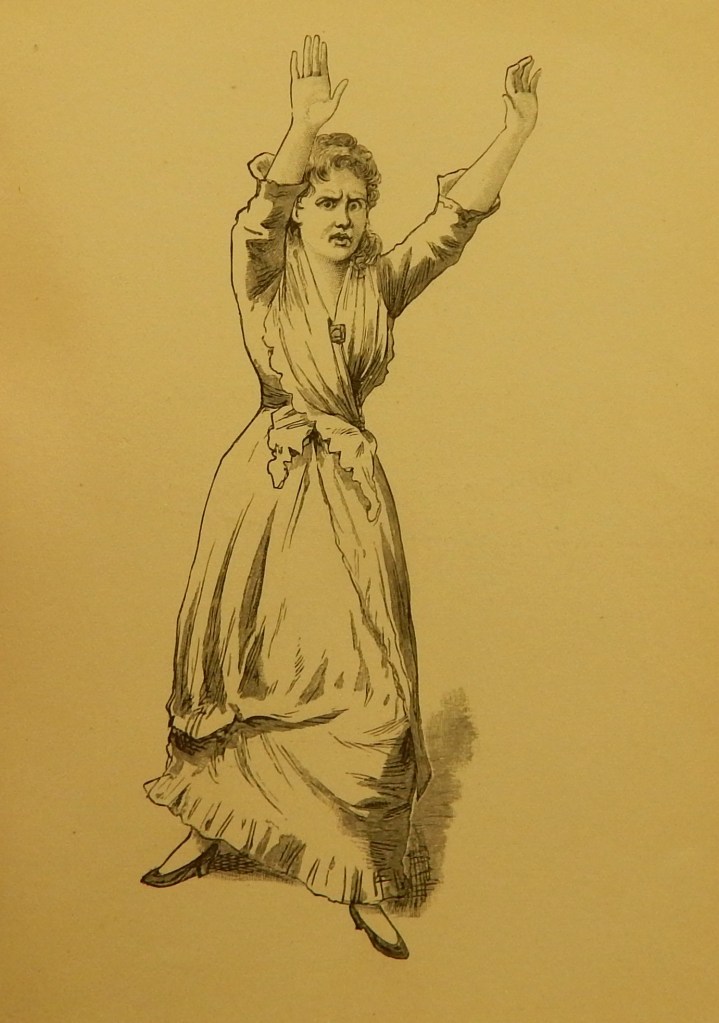


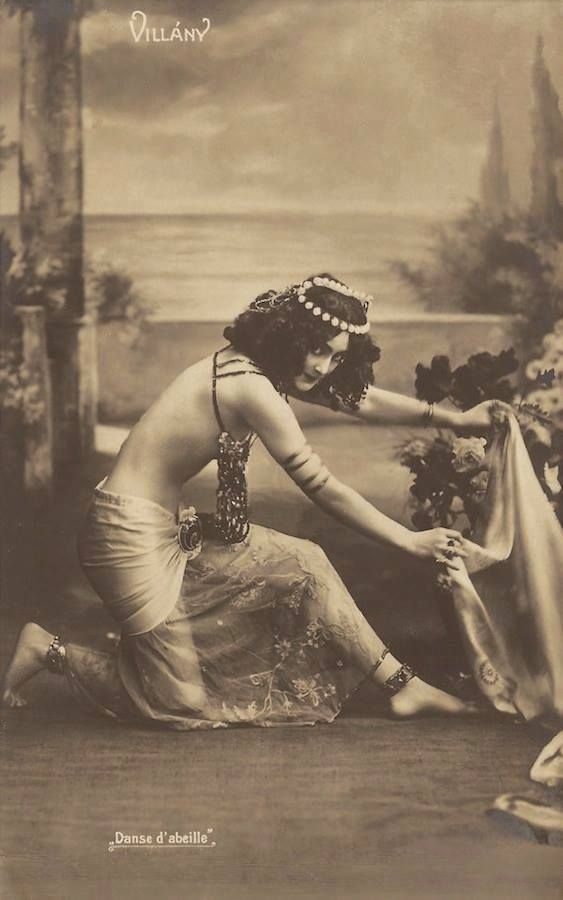
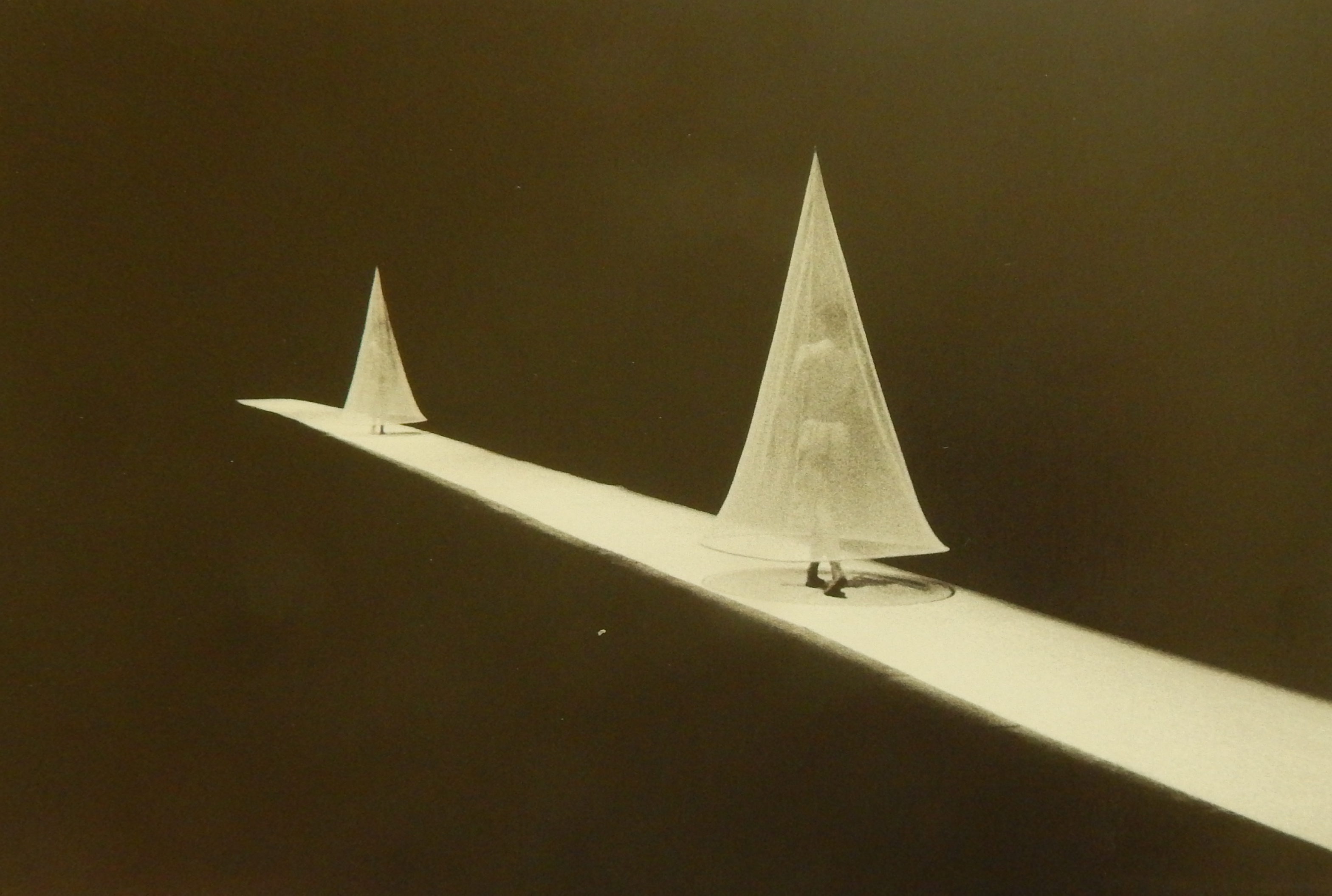


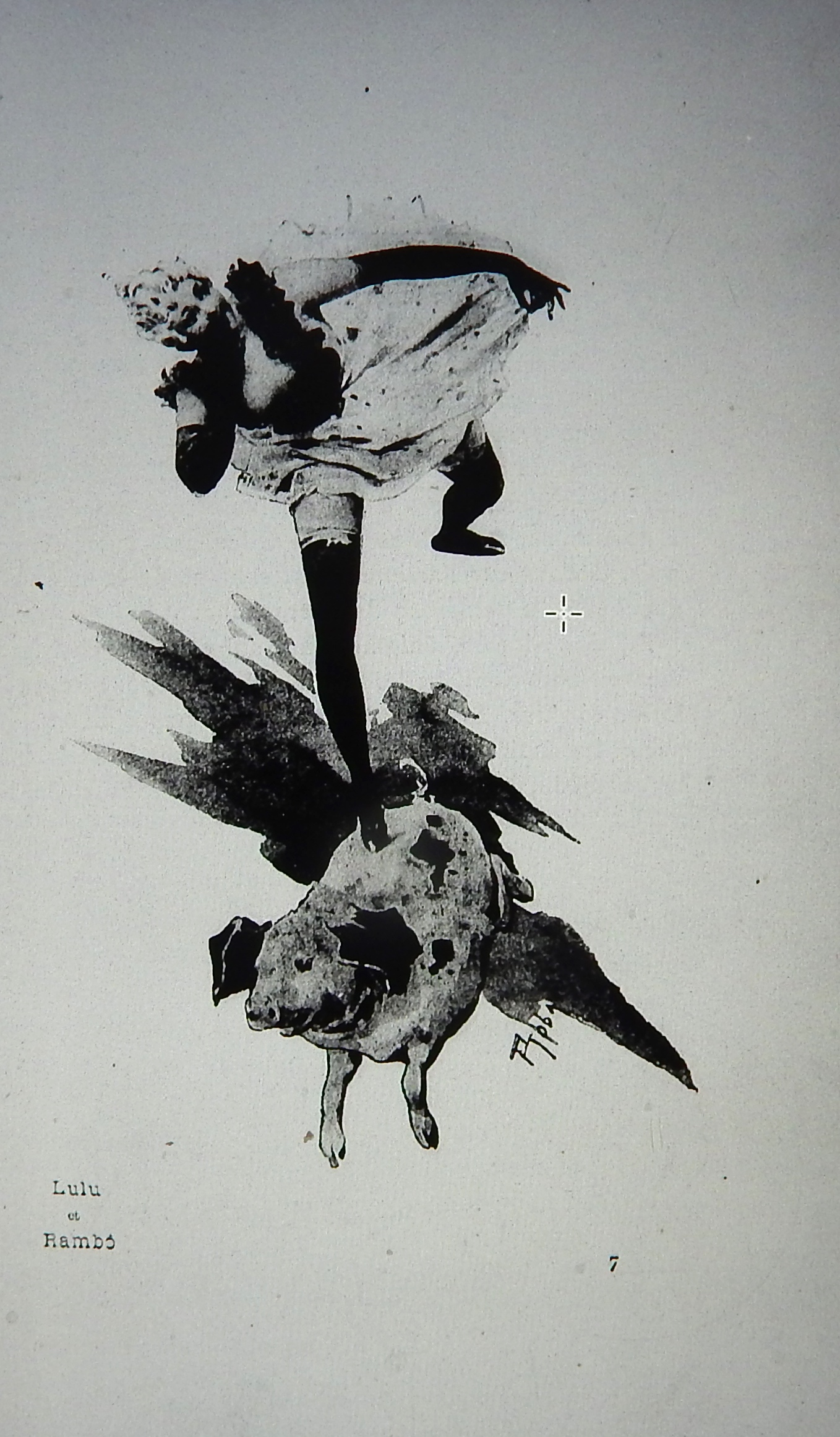

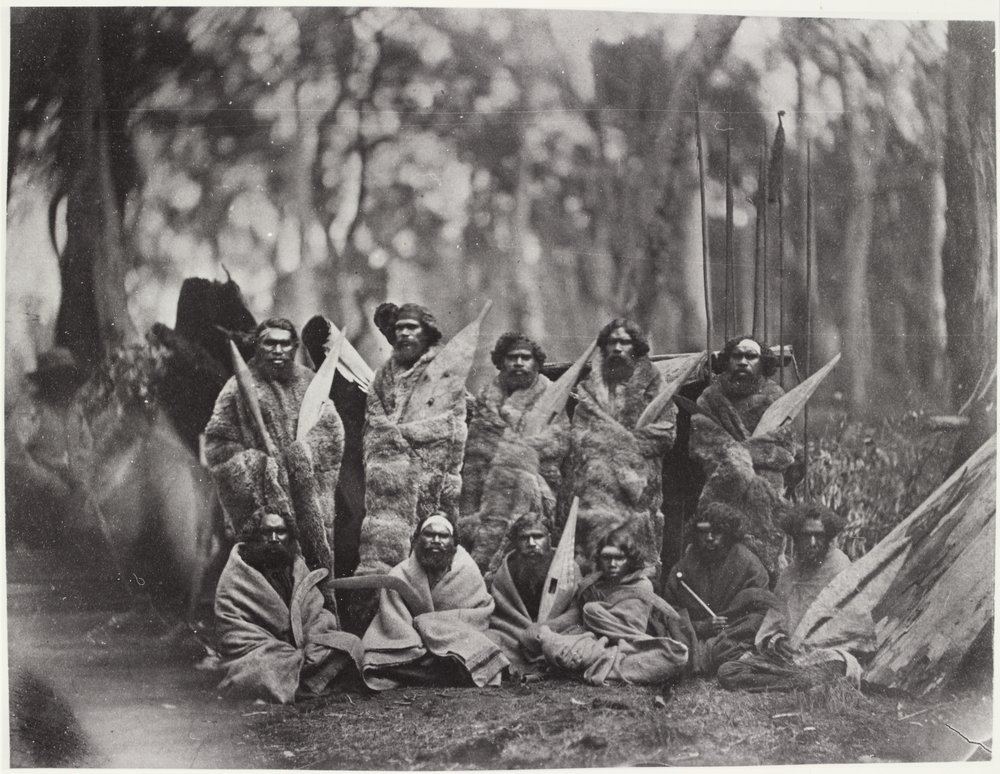

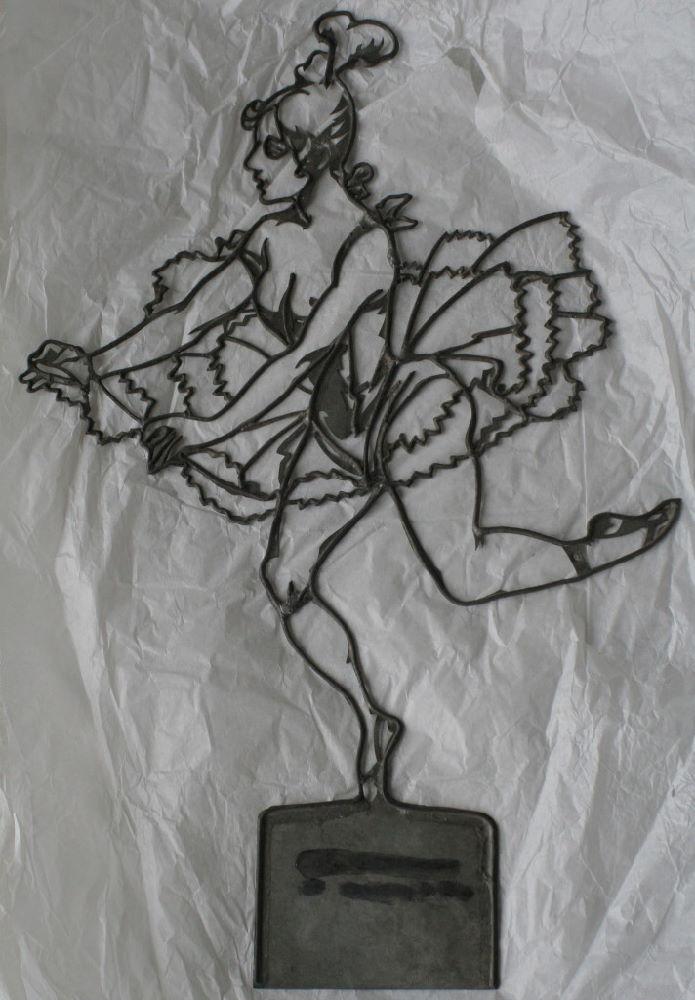
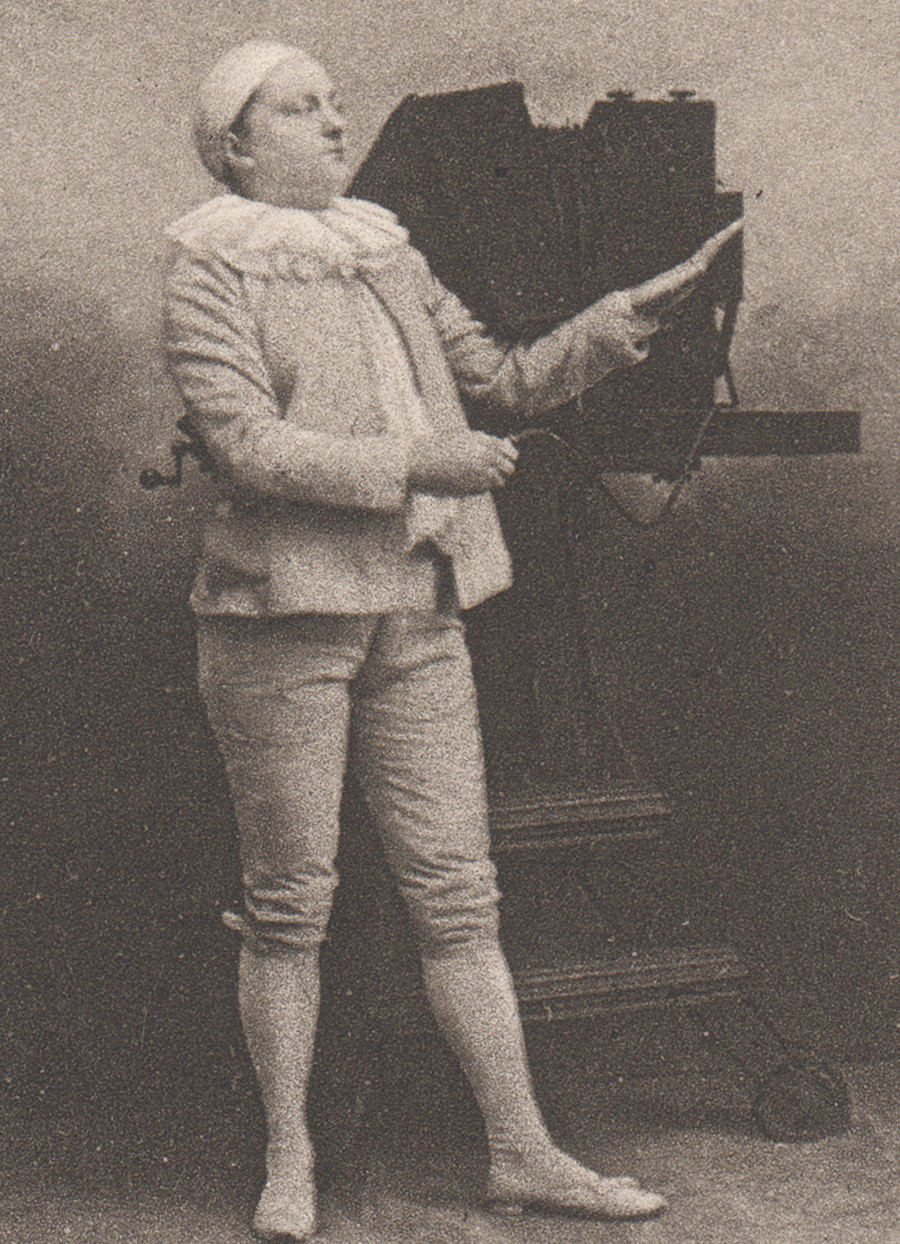
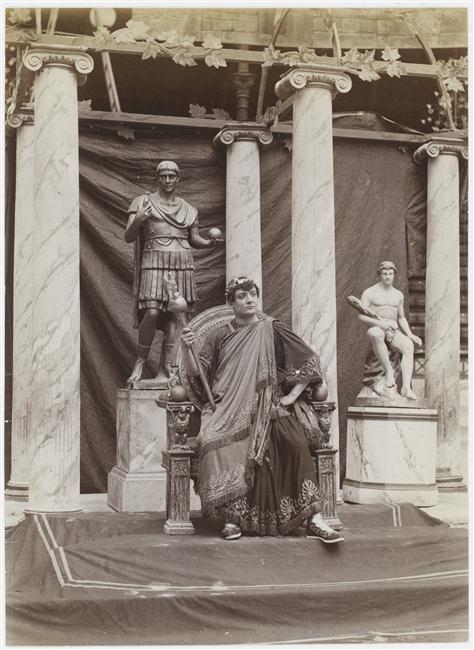

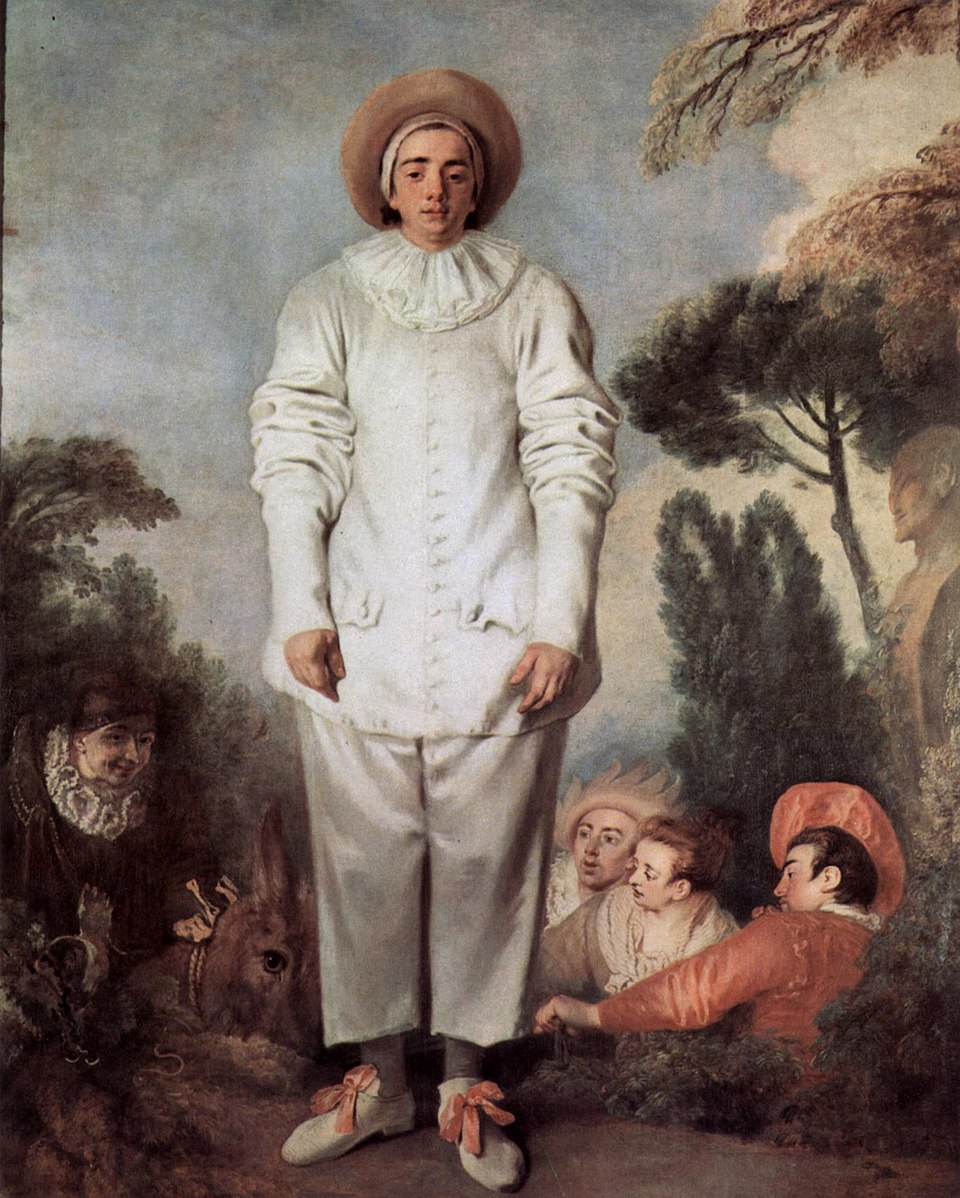


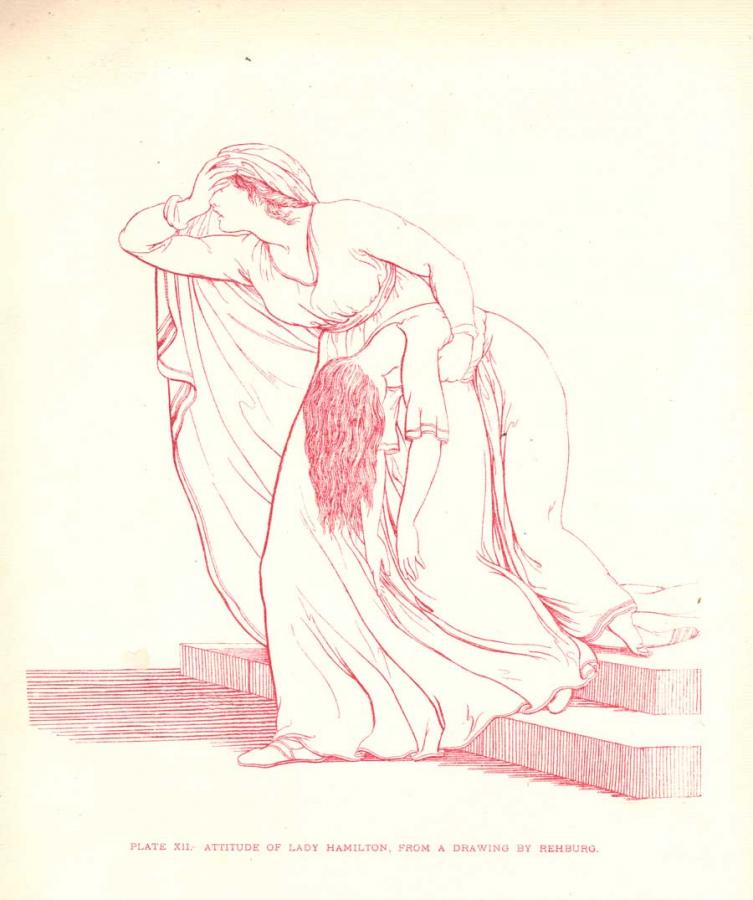


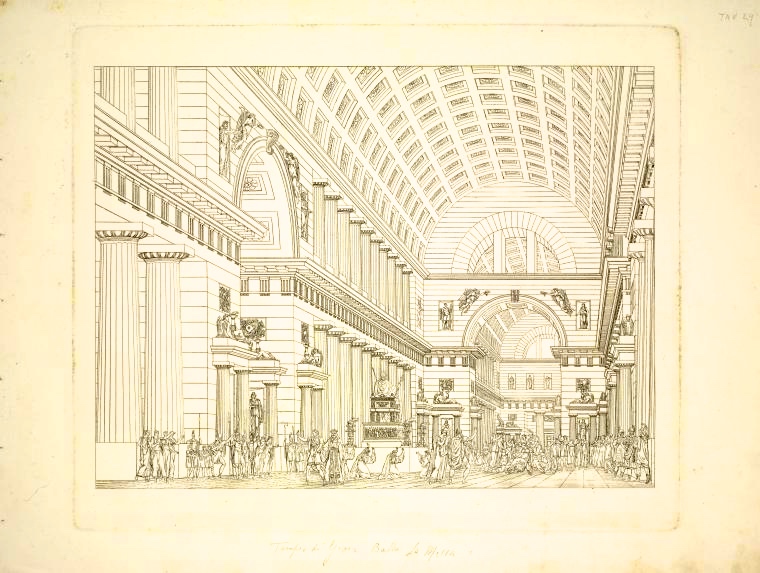
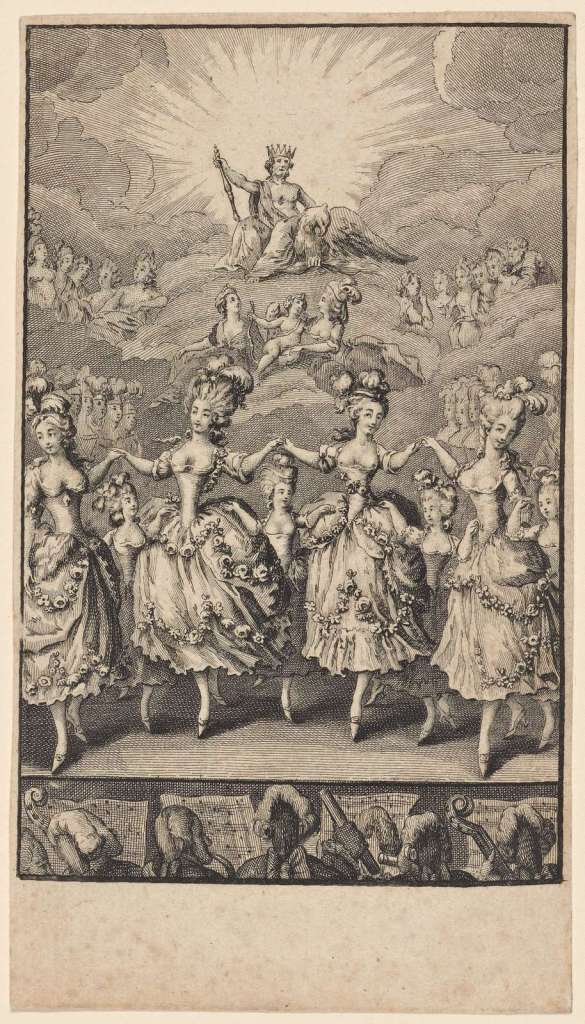
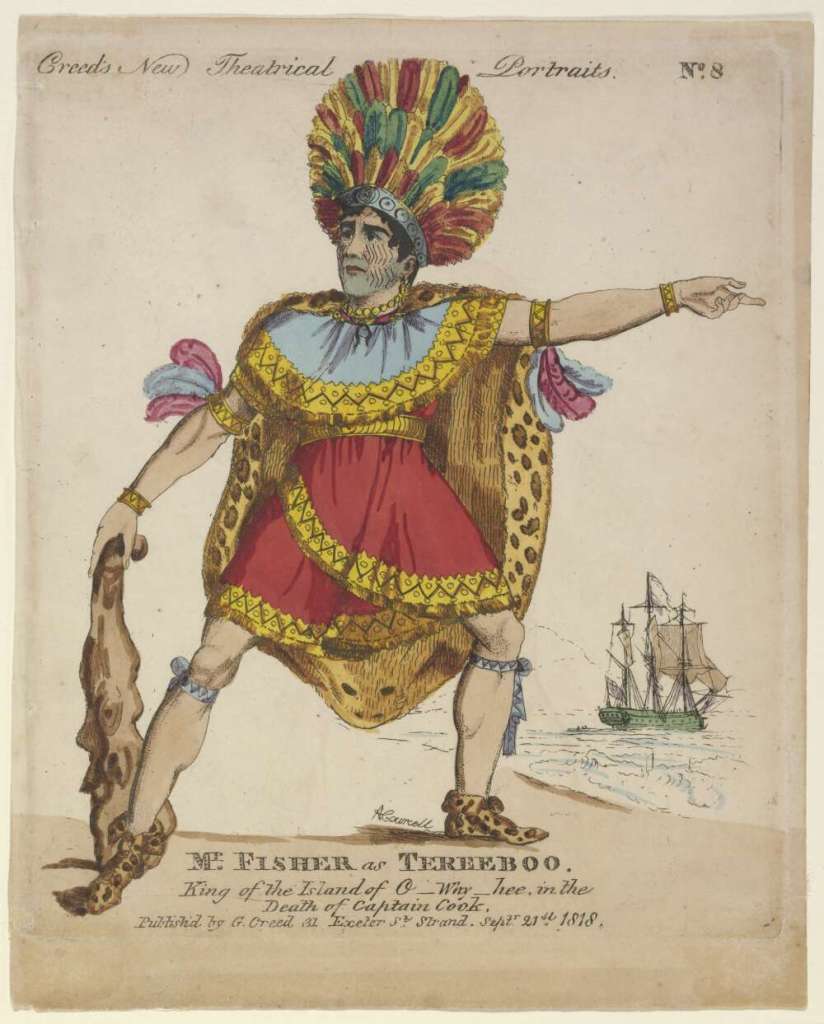
 Karl Toepfer