Roman Pantomime Aesthetics: Instrumental Accompaniment

Pantomime: The History and Metamorphosis of a Theatrical Ideology: Table of Contents

PDF version of the entire book.

Instrumental Accompaniment

The music that accompanied the pantomime scenes was largely instrumental. But the scale of instrumental ensembles remains obscure. Visual and literary representations of musical accompaniments rarely indicate more than three instruments, even though the Romans were capable of assembling huge orchestras, often consisting of only a few different types of instruments, for grandiose state ceremonies, such as triumphs, funeral processions, and arena spectacles. According to the Historia Augusta (Vopiscus Carinus 19.2), the Emperor Carinus (ca. 250-285 AD) sponsored a gigantic orchestra consisting of 100 trumpets, 100 horns, 100 flutes, and 100 tibia players accompanying 1000 pantomimes and gymnasts. The Romans enjoyed the music of a fairly wide range of instruments, but the pantomime culture was quite selective in its use of them. It is therefore useful to summarize the qualities and functions of the instrument repertoire.

The tibia (or aulos) was the most commonly used instrument for accompanying theatrical performances of all kinds, including the pantomime. This instrument was a woodwind, double-piped and double-reeded, made from a specific Mediterranean reed, arundo donax (Landels 1999: 28), although Theophrastus (371-287 BCE), in his history of plants, observed that tibias could also be made of tree wood, bone, or ivory. Each pipe, divided into three sections, contained holes for six notes. Although it often mistranslated as a “flute,” the tibia actually sounded more like an oboe, giving off an intense, piercing, and wailing tone. The instrument appears to have entered Greek culture from Asia at a quite ancient time, for evidence (from Crete) of similar instruments dates as early as 2300 BCE (Aign 1963: 122). Depictions of male and female tibia players in tomb paintings and mirror engravings indicate the Etruscan fondness for the instrument. Some representations of tibia players show the performer using a mouthpiece, called a phorbeia, strapped around the neck and over the head, to hold the instrument steady [Figures 3, 5]. The tibia became so strongly identified with a distinctive Roman musical tradition that in 115 BCE conservatives succeeded in enacting legislation that forbade any kind of performance except the music of Latin tibia players, singers, and clothed dancers, although this decree apparently had no effect in diminishing the expanding popularity of stringed instruments (Wille 1967: 219). 

The Greeks developed five types of tibia roughly equivalent to soprano (parthenikos), alto (paidikos), tenor (kitharisterios), baritone (teleios), and bass levels (hyperteleios), with the kitharisteriosso named because it was played with the cithara. But the Romans appear to have modified the instrument by introducing pipes of unequal length at least as early as the second century BCE. The reason for the unequal lengths is obscure, but the longer, right reed undoubtedly produced a deeper tone. A contrapuntal relation between left and right reeds was, however, unlikely; left and right played in unison or, perhaps, the right reed produced a drone tone under the melody played on the left reed. Production notes attached to the manuscripts of Terence’s six plays (ca. 160 BCE) indicate the use of a different tibia to accompany each play (Landels 1999: 188; Wille 1967: 169-170). The combining of tibia types most probably did not occur. A few artworks depict a tibia player performing with a lyre player or, even more rarely, with a syrinx (pan-pipes). Otherwise the overwhelming majority of images representing tibia players shows this instrument as the sole source of musical accompaniment for a scene, and only occasionally does a figure clashing cymbals or tapping the tympanum supplement this solitary accompaniment. The Romans lacked the polyphonic or contrapuntal consciousness to build orchestral compositions that combined the different types of tibia, and indeed, in the theater, they do not seem to have imagined compositions containing more than two parts, except for percussion punctuation. Orchestras containing many instruments, such as the huge ensembles assembled by Carinus, functioned almost entirely to amply a single melodic line; the multiplication of instruments simply increased the volume of a unison sound and thrilled audiences by the sheer magnitude of sonic power. A large mosaic in Zliten, near Tripoli, probably dated somewhere in the second century CE, twice represents two horns, one trumpeter, and an organist accompanying the contests of five pairs of gladiatorial combatants; the same instruments, but clearly not the same musicians, accompany gladiatorial performances on two different days (Ville 1965: 147-154) [Figure 27]. It’s possible that this combination of instruments could introduce interesting polyphonic effects, but most likely the horns and perhaps even the organ simply sustained a drone or pedal point under the melody or fanfare of a single instrument. In any case, none of these instruments accompanied a theatrical performance. 

Figure 27: Part of the late first century Zliten mosaic, from a villa near Tripoli, showing musicians integrated with gladiatorial spectacle. Photo: Public domain.

The Romans associated musical instruments with specific occasions and did not permit any instrument to be used for any occasions other than those prescribed for it. The tibia served a wider set of occasions than any other instrument, including theatrical performances, sacral-cult performances, and private concerts. Because of its reedy sound, the tibia was the most appropriate instrument for evoking energies or spirits identified with the earth, especially the divine powers celebrated by the Dionysian and Cybelian cults. Roman artists delighted in depicting both outdoor and interior occasions for tibia playing, and theater audiences regarded the tibia player as a visible and engaging element of the performance, for the player could move with choreographic calculation to reinforce the emotional ambience of a scene. The player could point the reeds upward, horizontally, or downward; the player could sit or stand while playing; and he or she could sway with the melody or even dance. On the basis of a passage in Cicero (Lucullus 2.7.20), Wille (1967:169) contends that, “Roman theater performances began with a musical overture from the tibia player, which preceded the prologue.” But the evidence is not sufficient to make this claim more than plausible. It is clear, however, that the tibia, more than any other instrument, stimulated (or at least announced) an atmosphere of emotional-psychic release, a mood of relaxation from constraints on the expression of desire, an amplified sense of freedom, and thus, an appeal for movement. 

In images of them, tibia players never appear alone; they always accompany an action or interact with another instrument. It seems unlikely, then, that in the pantomime program, a tibia player would perform a solo piece without collaborating with a dancer, a singer, or another instrumentalist. Harpists are another matter. Roman art contains numerous images of solitary lyre players, both male and female, and quite possibly the appeal of the instrument lay in its capacity to detach the performer from the rest of humanity and amplify the uniqueness and even loneliness of his or her individuality. The lyre was of ancient origin; the Egyptians appear to have developed an elaborate harp culture as early as 3000 BCE, but lyres probably entered the Greek cultural domain from the Middle East with the legacy of the Babylonian civilization. Greek rhapsodes favored the lyre for the singing of epic poetry, hymns, and paeans. The poets accompanied their own singing. As the rhapsode tradition decayed, the lyre ceased to become the exclusive property of poets, and audiences valued the instrument for qualities that were independent of the language the poets had expected it to “support.” The Greeks devised chamber orchestras of lyres and introduced interactions between the lyre and other instruments, such as the aulos, the cithara, and the syrinx. The Egyptians, however, remained the culture most preoccupied with the possibilities of harp music, although the instrument probably had its origin in Mesopatamia before 3000 BCE. Harp technology in Egypt was so sophisticated, even before the Minoan civilization, that the lyre was perhaps an adjunct to larger and more complex harps containing 21 to 29 strings. The Greeks in the fifth century began to show some fascination with the large, sometimes giant, “arced” and “angular” harps used by the Egyptians, but these instruments do not seem to have gained a secure place, other than as beautiful objects for display, in the Greco-Roman civilizations and certainly not in the theater culture of either civilization. It is not clear why the large harps did not acquire a strong presence in the Mediterranean world. Most likely, both the Greeks and especially the Romans believed that large harps inhibited the mobility of the performer and undermined the expectation that music should stimulate movement in the performer or expand the power of music to migrate to new and different performance sites. Large harps, as represented in Egyptian art, connoted an excessively stable performance environment in which music remained “entombed,” sealed off from other sectors of a rigid social hierarchy.

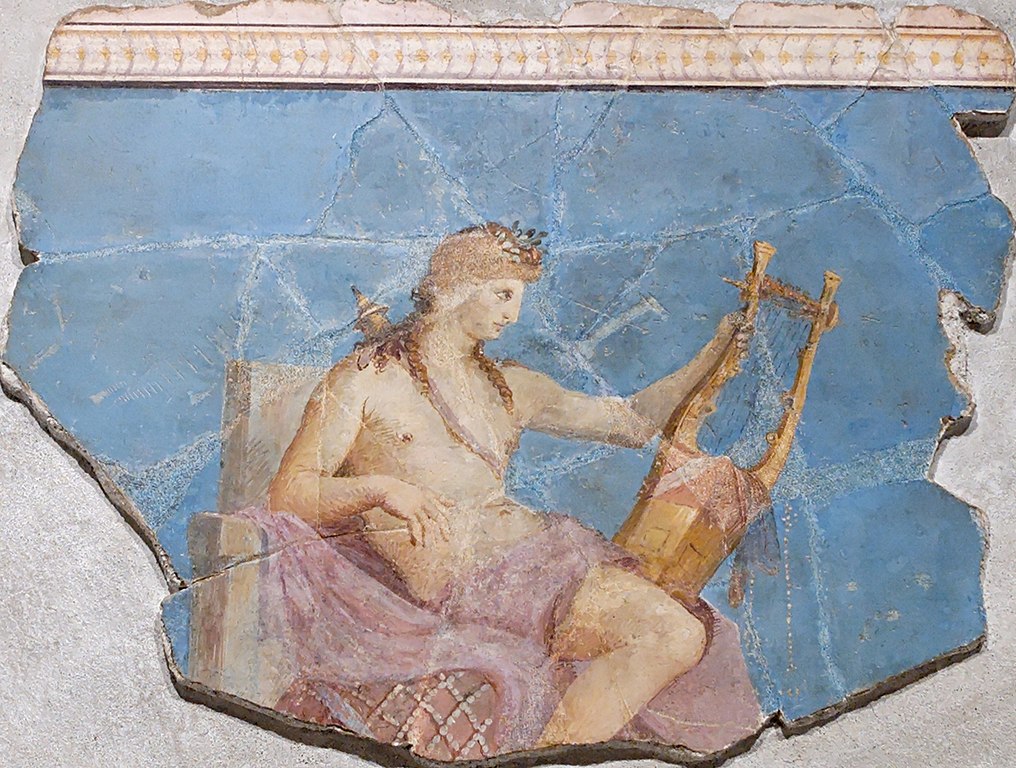
As perfected by the Greeks and adopted by the Romans, the lyre was a small harp that the performer cradled in the left arm and plucked with the right hand. Some performers used a plectrum to pluck the strings. Lyres came in slightly different shapes and sizes, made of wood formed into a U with a small resonating box. The conventional lyre contained seven or eight strings of equal length, with each string tuned to a different note according to the “mode” of a piece. The lyre could encompass an octave and, by dividing the strings with one hand while plucking with the other, move upward or downward another octave. The sound was bright, sparkling, shimmering. The Greeks devised a kind of large lyre, the cithara, from the Greek kithara (string player) and Assyrian chetarah; the word guitar derives from this earlier nomenclature. This instrument contained a larger resonating box and thicker strings than the lyre to produce heavier and deeper plucking tones [Figure 29]. Lucian (De saltatione 26, 68) uses the word kithara(rather than lyra) to describe musical accompaniment of pantomimes, so perhaps he makes no distinction between lyres and citharas, as his translator, A.M. Harmon, apparently assumes, or we can assume that a cithara was as likely as a lyre to accompany the pantomimes (Lucian 1936: 238-239; 270-271). The lyre player could sit or stand while playing the instrument and could accompany himself or herself while singing. The player could walk while strumming and even participate in certain stunts, such as playing while standing on the shoulders of another performer. In Homer’s time, the lyre was associated with mythic storytelling in an aristocratic warrior milieu, the Orpheus myth being the most obvious example of the instrument’s power to release the male hero from chthonic darkness and return him to Apollonian radiance. But by the fifth century BCE, it had become the favored instrument of Greek heterae. Privileged Roman women studied the lyre and produced concerts within a salon milieu, and by the third century CE, Athenaeus could observe that the lyre was a “feminine instrument.” The pantomimes could thus select the lyre as an appropriate accompaniment because the implied “feminization” of the music served to sustain the association of the pantomime with the evocation of an aristocratic aesthetic. The Romans designed exquisitely ornate and gorgeous lyres that could glitter with jewels and golden details, and as such, these glamorous instruments could function as captivating elements of a theatrical spectacle. 

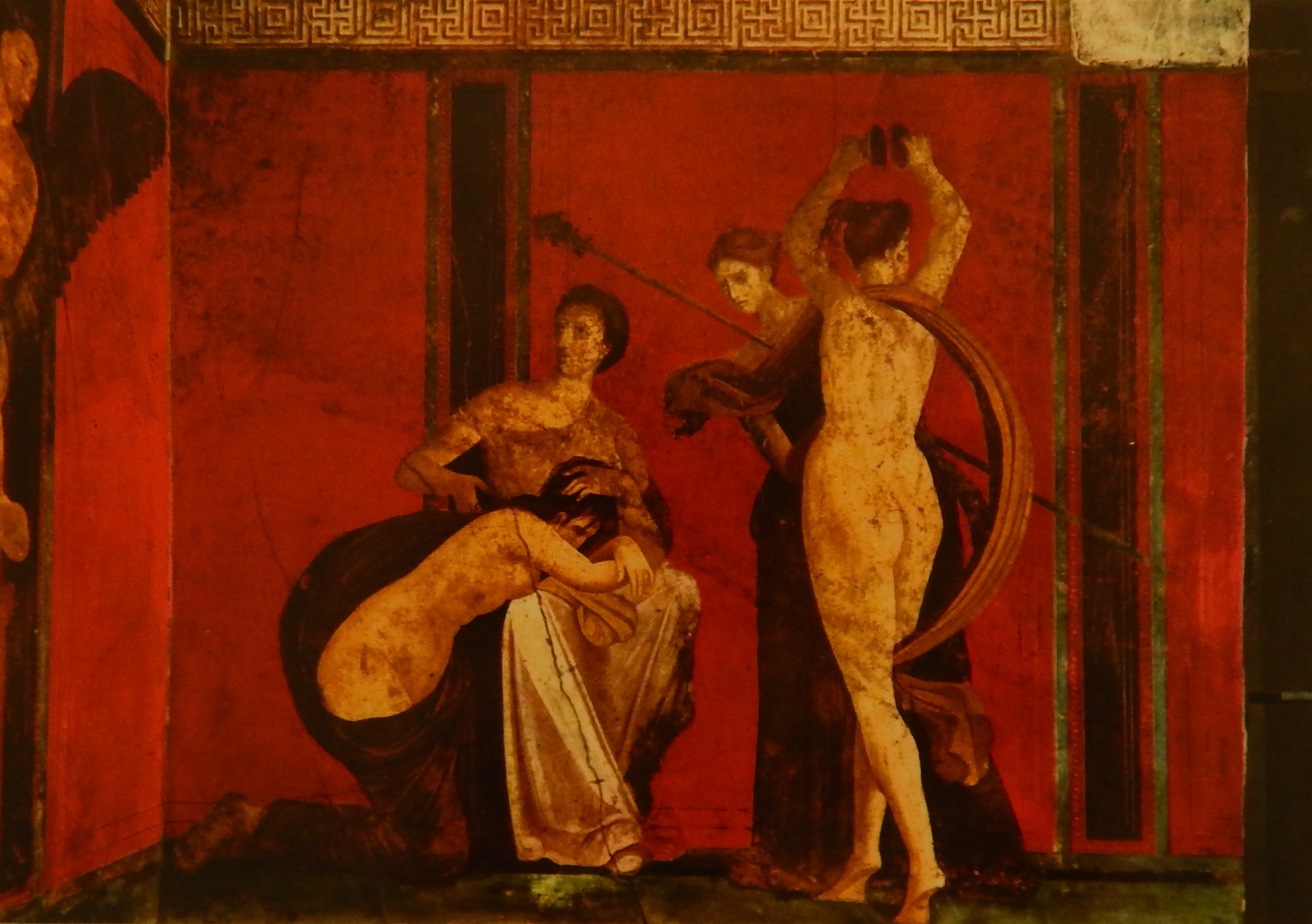
Although the lyre was the most satisfying instrument for solo performance, it collaborated well with other instruments, including other lyres, the syrinx, the tibia, the tympanum, and cymbals, but not horns or trumpets, for these never appear with lyres in either literary or visual descriptions of musical performances. Athenaeus (Deipnosophistae XIV, 618) quotes Ephippus as asserting that “the music of the flutes [auloi] and the lyre is a joint partner in our stage plays; for when one adapts his mood skillfully to that of his associates, then, and only then, do we get the greatest delight” (Athenaeus 1937: 329). A painting of an outdoor Bacchic rite from Herculaneum in Monaco shows a female tibia player and a female lyre player accompanied by three other women playing, respectively, cymbals, tympanum, and crotali, with the crotali player also using her foot to work the scabellum (Guidobaldi 1992: 62) [Figure 28]. Otherwise Roman era descriptions of lyre performance do not mention a combination of more than three instruments, with a conventional limit of “orchestra” size consisting of one lyre, one tibia (or syrinx), one cymbal player, and one tympanum. Of course, some pieces on the pantomime program could well involve musical accompaniments requiring smaller combinations of these instruments. One of the panels of the first century CE ritual wall paintings at the Villa of Mysteries in Pompeii depicts a nearly nude older man playing the lyre while a boy plays the syrinx; on a panel opposite these musicians appears the nearly nude figure of a female dancer performing the pyrrhic step while clashing cymbals over her head [Figure 9]. The meaning of this vast and fascinating depiction of a mysterious cultic rite is the subject of endless, tortured debate, so it is by no means clear how the viewer was expected to read the represented temporal relation between the numerous figures in the entire painting (cf., Sauron 1998; Grieco 1978; Kirk 2000). But even if the solo cymbal player represents a later (or earlier) moment in the narrative logic of the painting, the spatial design of the painting produces in the viewer the effect of being surrounded by numerous figures performing actions simultaneously, as if to suggest that actions in different times and spaces are related to each other without actually causing each other according to a strictly linear narrative logic. This mode of abstraction strengthens the idea that music and movement in one place and time are part of the music and movement of another place and time. 

From this way of thinking arises an antiphonal aesthetic of sound diffusion. Enthusiasm for antiphonal effects raises the question of the physical relation of the musicians to each other. As mentioned earlier, visual artists seemed to treat the musicians as part of the “scene,” placing them close to the actor, to other musicians, and sometimes to the spectators. But the extent to which this closeness to other figures was a convention of performance or a convention of visual representation remains obscure. In the Zliten gladiatorial mosaic, the musicians seem to share the same space as the combatants, which is probably a misleading representation of the actual conditions of performance [Figure 27]. Another mosaic, now in the Vatican Museum, depicts a bizarre scene of two male tibia players accompanying two female dancers. One tibia player assists a male crotali player, and the other tibia player apparently assists two other crotali players. Each tibia player also taps the beat with a scabellum attached to his foot, which makes clear that each player is performing different music. Some sort of arch apparently separates the two dance performances, and a male dwarf stands under the arch next to a table with crooked legs [Figure 28].

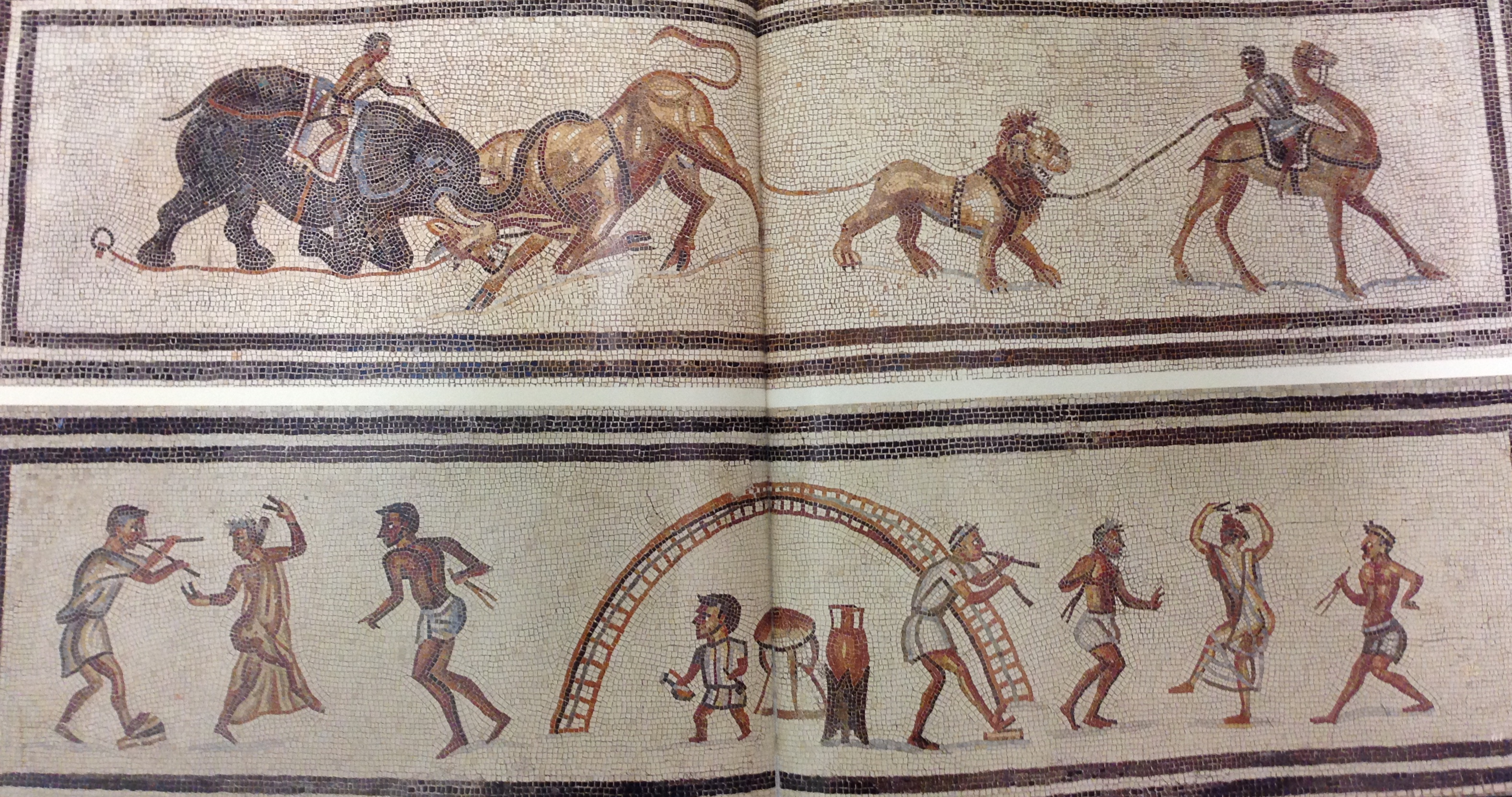
Figure 28: Top: Template of a painting from Herculaneum in Monaco depicting an orchestra. Photo: from Guidobaldi (1992: 62). Bottom: Vatican mosaic depicts dancers and musicians beneath a wild beast competition. Photo: from Buranelli (2002).

Perhaps the artist wished to depict a kind of improvised dance contest or celebration, so that what the viewer sees is two dance performances occurring at the same time in different places or in the same place at different times. The picture invites the viewer to compare two slightly different performances that in reality could not have been seen simultaneously. Yet this visual distortion of space-time relations has its correlate in performance, not only through the synoptic organization of the pantomime program, but in the spatial relations between the musicians and the dancers. In imagery of cultic ritual processions, artists tend to expand the space between musicians to intensify a sense of freedom and movement. Cymbal players, perhaps invariably female, always seem to dance. 

Figure 29: Second century CE statue of Apollo carrying a cithara, Berlin Pergamon Museum. Photo: Public domain.

The Romans encouraged mobility in their musicians because they associated music with the movement of powers or energies across temporal and spatial boundaries. The broad, even vast stages of Roman theaters, up to 200 feet wide, accommodated a processional, frieze-like organization of action, but the action never included more than several bodies. The purpose of these monumental stages was not to fill them with awe-inspiring masses of bodies, but to dramatize the space between bodies, to reveal the possibilities of movement. The tibia player may be “close” to the dancer, in the sense that the spectator keeps both in the same field of vision. But the reason for keeping the musician close to the actor is to signify that persons who may seem “remote” from an action are nevertheless a part of it, just as the actor himself is “close” to the “remote” mythic figure he impersonates. If the musician is “close” to the dancer, she does not necessarily stay in a designated spot on the stage; she follows the dancer. Quite likely, if both tibia and lyre accompanied the dancer, the dancer would perform between the two musicians, allowing for them to produce a sort of stereophonic effect. If cymbal players always danced, they certainly had plenty of space to dart in and dart out for dramatic clashes. When present, the chorus, which, at full strength, probably consisted of no more than six or seven members, was always “there,” watching, when individuals within it were not performing some small part, but never so “present” that it undermined focus on the pantomime’s virtuosity. At least in relation to theatrical performances, Roman audiences showed little interest in seeing large masses of bodies in movement; their taste in this direction found fulfillment in “reality,” in the huge scale of triumphs, grandiose funeral, wedding, or cult processions, military parades, and spectacular games. The pantomime culture never glorified group unity or the power of crowds. It focused relentlessly on the beauty of unique soloists, and a group, always small, was attractive only insofar as it was possible for a few talented soloists to work together. 

The pantomime aesthetic also admitted the syrinxor pan-pipes, but the function of this instrument in the theater is quite uncertain. The instrument is of very ancient and unknown origin. It produced a flute-like sound by blowing directly into the bores of dried reed stems. The Greeks tended to make the stems of equal length bound together by twine or beeswax. Different tones resulted from using beeswax to seal off a portion of the bottom of the pipe to raise its pitch. A typical Greek syrinx contained five to seven reeds, capable of quite limited tonal range and dynamic contrast. Evidence of female players of the syrinx is scanty, but this is no doubt due to the loss of the archeological legacy (Behn 1954: fig. 145). In his second century CE novel Daphnis and Chloe, Longus (1916: 160-161) observed that Echo “was educated by the Nymphs, and taught by the Muses to play on the hautboy [tibia] and the pipe, to strike the lyre, to touch the lute, and in sum, all music” (Longus 1916: 160-161) The Greeks associated the haunting sound of the instrument with the gamboling or playfulness allowed in a rural setting, with evocations of Pan, but not necessarily with agricultural activities. Because it conjured up a mood of primitive simplicity, the Greeks do not seem to have ascribed a high status to the syrinx (Landels 1999: 69-71). The Roman world, however, saw greater possibilities for the instrument. Roman syrinxes, following models established by the Etruscans and Italians, contained as many as twelve reeds, and they were cut to different lengths to produce different tones. Syrinx makers produced beautiful instruments made of wood or bronze and embellished with elegant decorations. Moreover, the music of the syrinx no longer evoked an exclusively pastoral mood. Roman musicians brought the instrument indoors and allowed it to participate in a refined, closed off environment—or rather, they allowed the spirit of Pan to inhabit elegant villa interiors. Nevertheless, in the theater, the syrinx remained a subsidiary instrument, incapable of transcending its ancient association with a primeval stirring of nature. It was therefore not the appropriate accompaniment for the great majority of tragic mythic scenes performed by the pantomime. A syrinx accompaniment to the Atreus scene described above was probably unimaginable in the Roman world, even as a travesty of tragic pretensions in the comic domain of the mimes. The visual evidence indicates that a more appropriate use of the syrinx was in the articulation of romantic themes involving the adventures of Hercules, the intrigues of Venus, the pastoral fantasies containing Dafnis and Chloe, Pan and Echo, the sylvan dreaminess that Claude Debussy evoked so exquisitely in The Afternoon of the Faun (1892). 

Roman spectators enjoyed the sound of powerful, metallic horns that were of Etruscan origin. The Greeks devised a kind of trumpet, the salpinx, containing a long thin tube with a cupped bell that they used almost exclusively in relation to military maneuvers and ceremonies. But this instrument seems to have disappeared with the ascent of Roman civilization, which adopted horns favored by the Etruscans. “Horns and trumpets are an invention of the Etruscans,” Athenaeus declares (Deipnosophistae IV. 183; II 1928: 311). The Etruscans cultivated two types of horns appropriated by the Romans: the tuba and the bucina (cornu). The Etruscan trumpet, the lituus, had a long, widening bore with a curved bell. The Roman trumpet, the tuba, perfected by the first century BCE, had a narrower bore and a flared bell. It made a loud, intense, searing sound that reverberated across great distances. Ennius described the sound as “terrifying.” Some visual artists depict players in procession raising the instrument high, as if launching the sound into the sky and filling the air with an enormous announcement. The instrument functioned almost entirely in a military atmosphere. It was used to signal attack, retreat, and formation and to add solemnity to military ceremonies, triumphs, and grandiose funeral processions of military leaders. The players were always male. The Etruscan bucina was a large curved horn, but the Romans made it an even larger instrument with a wider bore that coiled around the body of the performer and a much wider bell so that it became what nowadays people would consider a sousaphone. It made a deep, droning sound that underpinned a melody played on another instrument. Like the tuba, the bucina was primarily an instrument for martial occasions, in which groups of tubas and bucinas in procession collaborated to amplify the mood of solemn spectacle. Neither the tuba nor the bucina had keys, so it is not clear how the instruments could produce variations in tones. Perhaps in groups different instruments had different pitches that permitted the production of chords or overlapping tones. Although Virgil, in the Aeneid (VII.511-515) describes Allecto, a female fury, blowing a “long, hellish note” on the bucina to rally the Latins to war against Aeneas, women in Roman civilization did not play this instrument.

Neither the tuba nor the bucina had any “place” in theatrical productions or performances involving imaginary persons or dances. However, both instruments contributed to the excitement of arena spectacles. The Zliten mosaic in Tripoli shows pairs of bucina players and single trumpet players, along with single organ players performing accompaniment to gladiatorial combats [Figure 27] (Ville 1965: figs. 15 and 16). Dated around 230-240 CE, another monumental mosaic, covering the floor of an opulent villa in Nennig near Trier, contains an image of a bucina player and an organ player; this image is part of a complex design that also includes images of gladiatorial combats (Parlasca 1959: 35-36, plates 36-37). The idea of musicians accompanying human combats, although explored by the Greeks, was a passion with the Etruscans (Thuillier 1985: 232-233). The Etruscans used either tubas or tibias to announce the start and the end of contests and to celebrate the victor of a contest. But the tibia was the favored instrument for accompanying the contests themselves, with the tuba replacing the tibia when a city lacked tibia players capable of assuming the musical aspects of the contests: a “character more provincial, more barbaric” was the result of allowing the trumpet to “replace” the tibia in “not only giving the signal for combat but also in accompanying the entire action” (Thuillier 1985: 239-241).  However, it is not clear how the tuba could replace the tibia in connection with musical accompaniment when the tuba was simply incapable of the tonal variety provided by the tibia. The Romans, on the basis of the mosaic evidence, developed musical accompaniments to gladiatorial combats by replacing (probably around the end of the first century BCE) the tibia with the water organ and adding tubas and bucinas to create small (but loud) ensembles, although Thuillier himself points to two Etruscan funeral steles, dated, respectively, 450-420 BCE and 390-360 BCE, that depict two and three tuba players accompanying boxing matches (1985: 144-145; 223-224). If the tibia was the favored instrument for accompanying the combats, why would a funeral memorial insist on tubas to evoke the memory or afterlife of the dead chief? It would seem, then, that aesthetic rather than logistic values defined the nature of musical accompaniments to gladiatorial combats. Did this aesthetic impulse provide the tuba and the bucina with a place in the hippodrome, where the pantomimes became attached to the different chariot racing factions? Did the pantomime ensembles employ trumpets and horns to accompany the processions glorifying the chariot claques and teams? 

But these questions do not provoke confident answers. Jean-Paul Thuillier (1985: 81-109) does not discuss any musical effects in relation to Etruscan horse or chariot races, for he has no information to support such a discussion. Despite widespread representation and commentary on the chariot races in the literary and artistic record of the Roman world, scarcely any reference to musicians has emerged. A single tuba player appears in only two images depicting events in the hippodrome. One of the mosaics in the huge complex at Piazza Armerina (ca. 315-350 AD) shows a tuba player standing beside an official (editor) preparing to bestow the victory palm on a charioteer (Humphrey 1986: 226-233) [Figure 30]. A complicated terracotta mould, probably from Rome in the late fourth century CE but now missing from the British Museum, shows three charioteers bearing victory palms with the central figure standing between the other two victors; next to him (on his right) stands a tuba player and on his left stands a woman holding the reins of horses while a child poses before her. And behind all these figures and horses rises the hippodrome obelisk, two pillars topped with statues and a two-storey “pavilion” (Humphrey 1987: 250-251). But the absence of musicians from the extant visual record of the hippodrome races probably doesn’t signify much anyway about the relation of music to the spectacle, because neither the pantomimes nor the claques appear at all in the record. What is clear, however, is that the artists in both cases associate the tuba player with an official task, the bestowing of the victory palm. Most likely, occasions for tuba playing were the responsibility of the hippodrome administration and not the chariot teams and factions or the aristocratic families that sponsored them. These occasions would include fanfares for ceremonies and processions celebrating the races as a whole (not individual teams) and fanfares signaling the start of the race, the end of the race, the bestowing of the victory palm, and perhaps the sinking of the dolphin effigies that indicated which lap had begun. Whatever music accompanied the processions of individual teams and pantomime entourages for the claques was “private” insofar as it symbolized an aristocratic rather public sponsorship. Like the arena spectacles, the hippodrome contests were the responsibility of public authorities. These authorities, representing the army, the imperial cult, or provincial or municipal governments, preserved the symbolic signification of music. Tubas and bucinas belonged to the realm of “public” music; they were the “sound” of the state, the army, the public. Control over musical sound was a measure of state authority. Governments sometimes allowed aristocrats to own gladiatorial units and produce venationes (wild beast shows) in the arena (Wiedemann 1995: 41-43). But it was necessary for the music that accompanied the gladiatorial contests to project an “official” status that did not give one team or combatant an advantage over another. The circus (hippodrome) was a similar performance environment, in which the administration of the contest could not appear to favor one team over another, including music choices that could stir crowds and disturb the contest. Music did not accompany the races (as it did the gladiatorial contests), so the main use of music in relation to the pantomimes was in the processions promoting the individual teams and factions to which the pantomimes were attached. The appropriation of the trumpets and horns by the state, the army, and the emperor detached the pantomime from the military culture that originally gave rise to the pyrrhic movement. The pantomimes and the aristocratic patrons who sponsored them had no claim to a “sound” and a power owned by the state and by the military that assured the “reality” of the state. This sound designated a limit to the power of the aristocracy in its control over public spaces and pleasures. Thus, the exclusion of tubas and bucinas from the pantomime musical repertoire resulted from political, not aesthetic or logistic motives.

Figure 30: Fourth century CE mosaic from Piazza Armerina in Sicily showing tuba player beside official bestowing a victory palm on a chariot racer. Photo: Public domain.

Another wind instrument with an uncertain relation to the pantomime was the water organ. In his Pneumatika, Hero of Alexandria (ca. 62 AD) described the complex construction of this instrument along with many other mechanical devices and automata (Hero of Alexandria 1851: section 76). But the Greek engineer Ctesibios (ca. 270 BCE) probably devised the instrument described in Hero’s treatise. The organ used water pressure to control the flow of air pumped (using foot bellows) into a set of eight to ten pipes rising from a “small altar of bronze” holding the water. The performer pressed “keys” that allowed air to flow into the pipes, but it is not clear how many keys were available. A second performer was necessary to tread on the bellows. The mechanics of the instrument were intricate, and Landels (1999: 267-270) has attempted to explain them in even greater detail than Hero. The organ made a very loud, reedy sound, as if created by an extremely powerful and complicated tibia. This sound, along with tubas and bucinas, was an appropriate accompaniment to the gladiatorial games; a section of the Zliten mosaic shows a female organ player. One might therefore suppose that, like the trumpets and horns, the sound was arena-oriented and “public” and belonged to the state. However, the large and beautiful mosaic from Mariamin, in Syria, dating from the late fourth century CE, depicts an orchestra of six female musicians preparing to perform a concert on an indoor stage [Figure 31]. One of the women stands behind a large organ while two little boys tread the bellows. The instrument is ornately decorated and contains many more pipes than organs represented elsewhere, perhaps twenty-four or twenty-six altogether. The refinement of the garments, along with the blatant frontal posing of the women, indicates that the performers were aristocrats. The mosaic “came from an apsidal room, evidently a dining room; the diners would recline in the apse, while the entertainers performed in the rectangle space in front” (Dunbabin 1999: 171). It would appear, then, that at least in the eastern sector of the late empire, the organ was compatible with indoor entertainments and could accompany pantomime performances or participate in program interludes. The organ, along with an expansion of the orchestra, would constitute an innovation in the pantomime aesthetic. The mosaic depicts an unusually large orchestra that includes, beside the organ, a tibia player, a cithara player, and three percussionists. Whether such a large orchestra actually supported pantomime shows cannot be confirmed or denied. But the extraordinary refinement of the image, along with the monumental effort to memorialize the performance, does indicate that aristocratic entertainments in the late empire had evolved toward an expanded repertoire of sounds, sensations, and precision effects, to accommodate the expectations of an audience for rarified, exquisite pleasures. The pantomimes depended on aristocratic patrons, not audiences in the public theaters, for their livelihood. So it is not unreasonable to suppose that the pantomimes enjoyed access to musical resources of the scale and variety shown in the mosaic. What is peculiar about this orchestra is that it does not achieve its size through multiplication of instruments; the orchestra has expanded by including different individual instruments. State-sponsored orchestras tend to favor a doubling or multiplication of favored instruments, like tubas, bucinas, and tibias, to produce powerful sounds that reverberate across vast spaces and above the rumble of crowds, with Carinus’s extravaganza of 284 CE attempting to set some sort of precedent in this regard. By contrast, the aristocratic aesthetic glorified in the mosaic emphasizes the ensemble as an interplay of highly distinct, individual sounds, and indeed, by placing the tibia player next to the organ, the picture further implies that the sound of the tibia differed from the sound of the organ, which here may have resembled tones similar to those ranging from a bassoon to an alto flute. If pantomimes could acquire an orchestra of this size and diversity, they could rely on a large number of subtle sonic effects to embellish, amplify, or color their movements. Such sounds, which in the pantomime aesthetic always followed the movement rather than anticipated it, would encourage the performer to complicate the choreography, so that particular physical gestures—the turn of the head, the sweep of the left arm, the thrust of the right arm, the teetering of the whole body—would, in a particular scene, prompt an associated sound from a particular instrument, perhaps in a manner somewhat similar to the relation between actor and orchestra in a traditional Chinese opera theater. If its function as accompaniment to gladiatorial shows and venationesis any guide, the water organ would have supported the pantomimes only in those mythic scenes that depicted heroic combats. However, the Mariamin mosaic presents the organ within a highly feminized performance space, far removed from the martial masculinity of the gladiatorial arena, although, as the woman organist in the Zliten mosaic implies, some Roman audiences did not find a woman out of place contributing, on this instrument, to a blaring, exhorting sound that perhaps also served to stir the crowd yet resounded above its roar. 
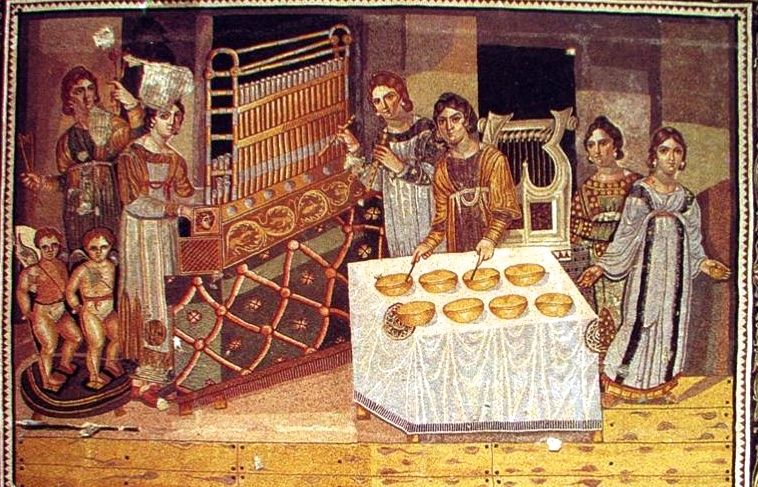
Figure 31: Late fourth century or early fifth century mosaic of female musicians from a villa in Mariamin, Syria. Photo: Public domain.

Pantomime musical accompaniments also sometimes included a variety of percussion instruments. But enthusiasm for these instruments served to satisfy a delight in the peculiar sounds they made rather than to explore or strengthen the rhythmic structure of a composition. Except for the tympanum, Greek and Roman music made no use of drums, although the Assyrians had already developed a type of kettledrum and deployed sets of them in large-scale processions. To the extent that they were aware of them, the Romans disclosed no interest at all in complicated African drumming techniques, but probably not because they regarded drumming as a manifestation of an inferior culture. The barbarian tribes from Germany also displayed a complete lack of interest in drumming. The Greeks and Romans were obviously uncomfortable with music that established the primacy of rhythm over tonality or indeed allowed music to function as a power controlling the movement of the body, which is the case when the “beat” is strong enough to “drive” the body to synchronize its movement with a rhythmic configuration. Music signified freedom insofar as the movement of the body inspired it rather than the other way around. Thus in the pantomime, the music followed the dancer. The pantomime located the source of dance-like movements within the body rather than in sensations or pulses external to it. In a sense, the dancer was “free” of musical rhythm or even tonality, which act as coloring devices to establish the mood of a scene rather than as the “drive” determining the movement of the body. The external sound world became synchronized with the movement of the dancer, which meant that musicians had to watch the dancer, the body in motion, to guide the performance of the music. It further meant that that a powerful, predictable beat could not enslave the body to synchronized movement patterns that would suggest that the dancer has surrendered to the music or “obeys” its “natural” impact on the nervous system. 

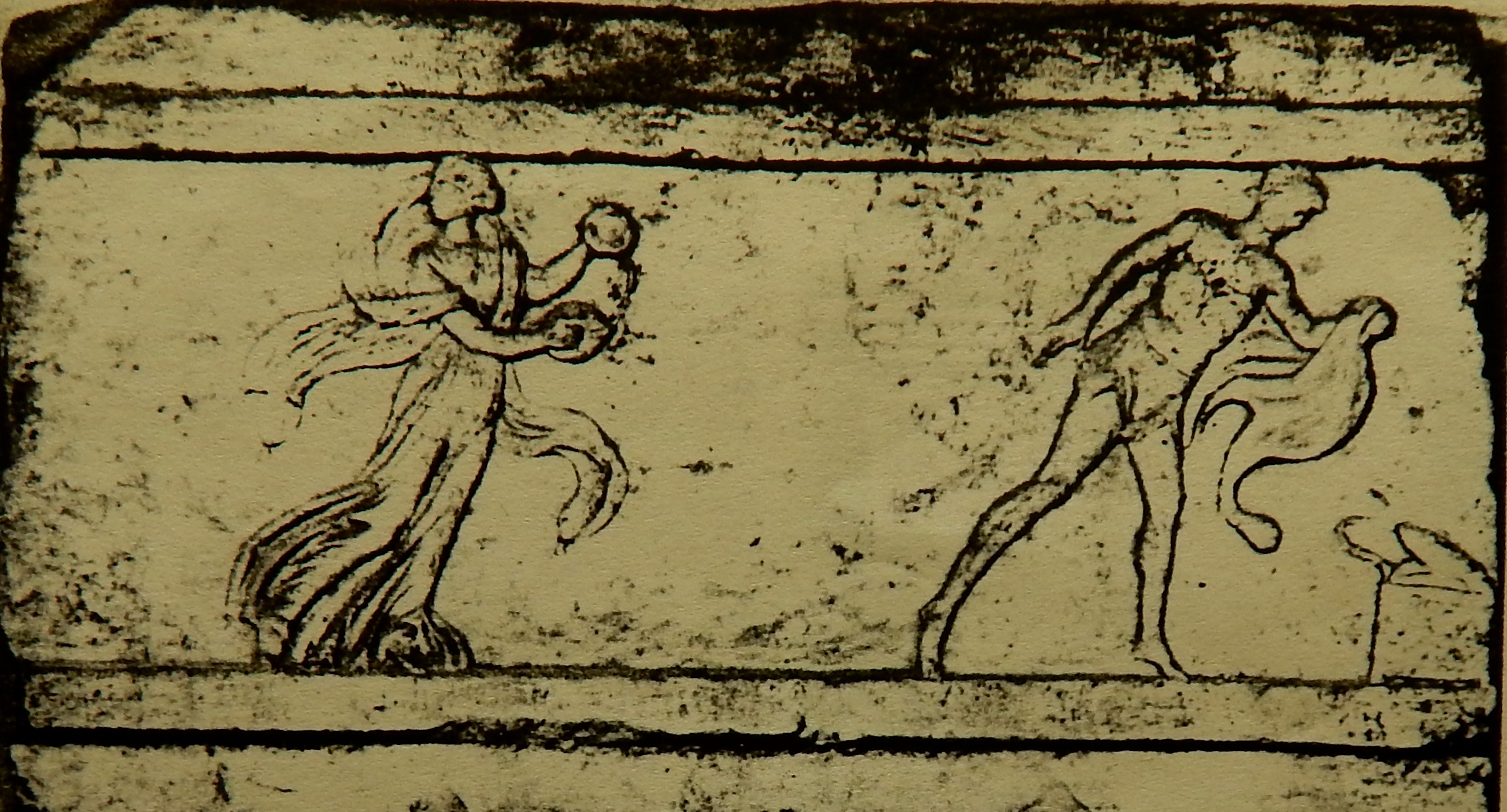
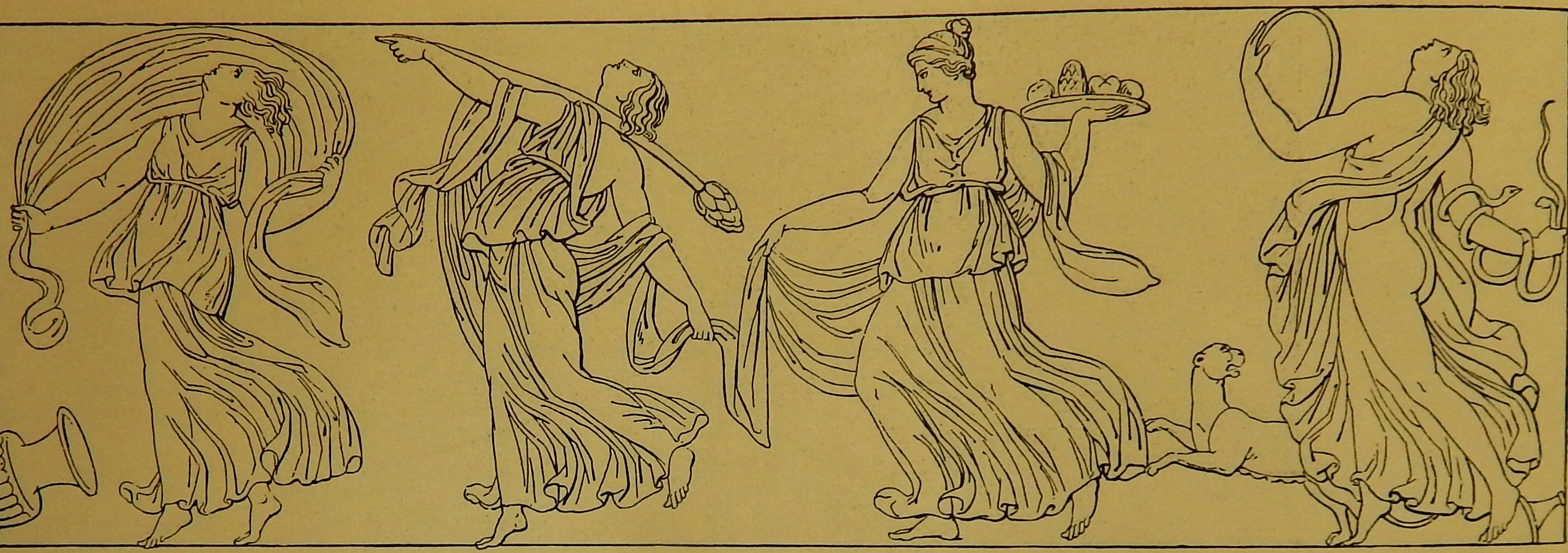
One drum was ubiquitous in the ancient world: the tympanum. The Roman cultural domain never employed any other drum. The tympanum resembled a tambourine, except that it had no bells or jingles. It was a wooden ring covered by an animal hide on only one side of the ring. The performer held the ring with one hand and tapped the hide with the fingers of the other hand. Performers never struck the hide with both hands, nor did they use any beaters, which means they never tapped out any sort of complex rhythmic pattern. They purpose of the drum was not to provide a “pulse” for the music or to sustain an ostinato motif. From a musical perspective, the tympanum provided a dramatic tone that resounded either regularly or at special moments that coincided with unique gestures or harmonic climaxes. Visual evidence of tympanum players across centuries indicates that performers used drums of different sizes to produce higher or deeper tones. But Roman paintings, mosaics, and reliefs never show more than one tympanum player in a scene; while tympanum players in the pantomime ensembles may have used different drums for different scenes, it is quite unlikely that more than one drummer ever performed in relation to any scene. Probably the most famous image of a tympanum player is the first century mosaic of street musicians from Pompeii attributed to Dioscurides of Samos, which shows a masked male tapping the inner surface of the hide as he holds the instrument level with the floor [Figure 32]. Lansdel (1999: 81) speculates that this curious performance technique might have produced a unique “low, muffled sound,” but it is not clear how such a sound was useful. It may be that tapping the drum on the inside did not produce a sound any different from tapping the outside surface of the hide, in which case, the choice to hold the instrument level with the floor was the result of seeking a special visual effect. At any rate, this image is by no means representative of tympanum performance in the visual record. Nearly all images of tympanum players show female performers (always only one), maenads, participating in a Dionysian procession or bacchanale. The female performer always holds the instrument high, with the hide facing the spectator, and she dances and tilts her head back or upward to signify an ecstatic mood, quite the opposite of the almost grotesque delicacy and intimacy Dioscurides depicted in his image of the street musicians. Artists associated the instrument with an atmosphere of intoxication or revelry. It therefore is quite probable that in the context of pantomime performance the instrument appeared only in those program pieces and mythic themes related to exultant celebration or euphoric abandon. The drum never appears in other, non-Dionysian processions, nor in relation to any other rituals. The performer contributed an exciting image to the pantomime performance, striking the drum while swirling or spinning and always to punctuate a dramatic gesture or twist of the body; the drum itself often contained beautiful decorations and tassels on the ring. But these effects would occur only intermittently in any pantomime program. The primary purpose of the tympanum was not, as Landels (1999: 81) suggests, to “emphasize the rhythm that was already inherent in the melody.” It was to show the “wildness” and “striking” power of female excitement, perhaps further strengthened by the stark juxtaposition of the animal percussive tone and the shrieking cry of ecstasy.
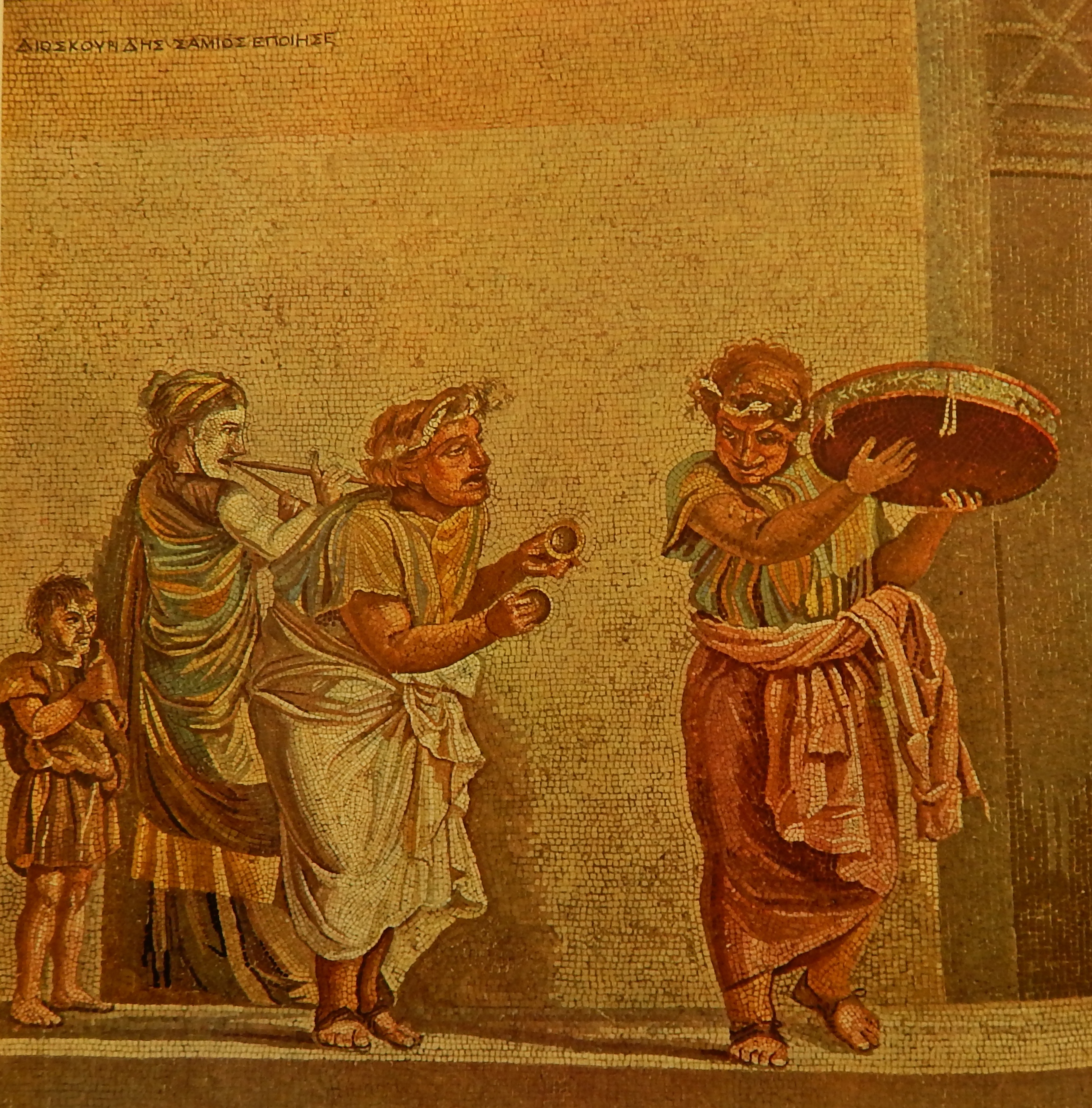
Figure 32: First century mosaic of street musicians from the villa of Cicero, Pompeii, in the Museo Nazionale, Naples, showing the large tambourine, accompanied by cymbals and tibia, a combination unlikely to create complex rhythmic patterns, even if the rhythms themselves were complex and unstable. 

To “emphasize the rhythm,” musicians sometimes employed the scabellum. This was a clapper attached to the foot of the musician, who tapped out a simple rhythm while playing another instrument. The purpose of the scabellum was to produce a kind of ticking sound that imposed, simultaneously, a sense of urgency and steadiness on the music. It was physically impossible for the performer to produce a rhythmic configuration anymore complex than a simple metronomic beat, and musicians never seemed to have used more than one clapper at any one time. Moreover, the scabellum appears only occasionally in images of musicians, nothing approaching the ubiquity of cymbals and tympani. As the Vatican mosaic suggests [Figure 28], the clapper was useful for infusing a measure of “liveliness” into a dance number that had no specific mythic content and was simply a display of physical agility. Indeed, the mosaic contrasts this device for amplifying “liveliness” with the use of wooden hand clappers or crotali to inject “liveliness” into the performance of the competing dancer. The use of crotali was much more common in the ancient world than the use of the scabellum, and representations of crotali players appear across many centuries, from at least the eight century BCE to the fourth century CE Mariamin mosaic (Aign 1963: 106). The performer could dance while playing crotali and create many striking visual-sonic effects by swinging body and arms while piercing the air with clusters of clicking or snapping sounds. Clappers were usually attached to both hands and could produce much more complicated rhythmic configurations than the scabellum, which is probably why they did not function primarily to “emphasize the rhythm” of the music. Rather, the crotaliprovided a peculiar sound that was appealing to audiences in relation to particular kinds of music and dance. In the visual evidence, crotali players are largely female and represented as solo dancers whose use of the instrument enhanced the visual interest of the performance, but no evidence has emerged to indicate that pantomimes themselves handled crotalito support their movements. The clicking sound would occur only occasionally, to introduce a uniquely mysterious mood that was memorable because of the surprising rather than expected effect of the sound. 

Cymbals, on the other hand, apparently enchanted audiences so much that they resounded frequently. Indeed, cymbal performance was so interesting that spectators delighted in the spectacle or the image of solo cymbal players. But ancient cymbals, made of bronze, produced a different sound from the cymbals of today. They were smaller and transmitted a high-pitched, bell-like tone when struck together as a pair of metal plates each containing a hollowed out cup within a bronze disk. Cymbals came in different sizes: some were very small and produced a delicate tinkling sound, while others reached the size of a salad plate and shattered the air with explosive crashing sounds. These instruments were ancient well before the Romans started using them. The Old Testament includes several references to the use of cymbals in religious processions and rituals (Psalm 150: 5; Ezra 3: 10; 1 Chronicles 25: 12 Chronicles 5: 12; 2 Samuel 6: 5). The Egyptians only began using cymbals around 800 BCE, so it is likely that the origin of the instrument was the near east. But only in the Roman world did cymbal playing become a sign of refined voluptuousness. As with tympanum players, cymbal players in paintings and reliefs were everywhere female, maenads performing ecstatic dances; artists showed them nearly nude and often with the cymbals clashing above their heads and their heads turned or tilted upward, while their bodies, poised on tip-toes, assumed elongated or “aroused” poses. Images, of course, never show more than one cymbal player in the scene, for the audience accepted that an instrument individualized a player rather than subordinated her to the instrument’s power to duplicate or multiply its sound. But cymbal playing had less to do with perfecting a musical effect than with enhancing the image of the power of a hard, hammering, metallic tone to animate the female body toward ecstasy, to signify its “wildness.” Thus, the technique of cymbal playing entailed the display of a choreographic technique, which may well have included the performer’s skill in making the polished plates flash and gleam or in devising unusual ways to strike the plates. Performers struck the plates over the heads or spun around while striking them or fluttered their arms between crashes. A fascinating second century CE mosaic from Madaba, Jordan depicts a female dancer with cymbals attached to her wrists and ankles; her pose indicates that she drops her hand and raises her foot to allow the wrist cymbals to strike the ankle cymbals [Figure 33]. 

Figure 33: A second century CE mosaic of a woman dancing with cymbals attached to her ankles along with a nude male or hermaphrodite dancer, from a villa in Madaba, Jordan. Photo: Madaba Museum.

Here cymbal playing has become an acrobatic art, and as the mosaic artist assumed in choosing his subject, it was an art capable of solo performance. It’s true that the Dioscurides mosaic of the street musicians in Pompeii shows a masked male cymbal player delicately clinking a pair of small cymbals [Figure 32]. But, as with the depiction of the tympanum player, this mosaic is hardly typical in its representation of cymbal performance in the pantomime, even if the scene renders fairly realistically a typical street concert. While pantomime cymbal players might play as delicately as the street musician, the class distinctions between mime and pantomime or between popular and aristocratic entertainment make the mosaic unhelpful in giving an accurate image of cymbal performance in the pantomime. The pantomime, with its emphasis on competitive star personalities, required that even the most incidental performers infuse theatrical performance with mythic glamour, which is to say with an aura of voluptuousness that emerges above all when the performance space’s abiding function is to signify magnitudes or capacities for luxuriousness. 

Small bronze bells were perhaps another percussion instrument whose sound delighted audiences for the pantomime. Archeological excavations have retrieved these bells from numerous locations; I have not found any reference to them in the visual and literary sources. Graves from the Villanova period (1100 BCE-700 BCE) in Northern Italy contained flat, iron or bronze plates in the shape of bells that were incised with intricate geometric decorations. Little beaters were found with these bells, but these instruments assumed a largely symbolic rather than practical function in protecting the dead, for in some cases they make no sound at all when struck (Beck 1954: 128, fig. 166). Etruscan grave sites also contained bronze bells, often fairly large and of exquisite design. The Etruscans were unique among the societies of antiquity in ascribing a special power to bells. Beck (1954: 135) suggests that bells were widespread in the Etruscan culture. They hung from a metal cord, chain, or string at the entrances to dwellings and sounded when stirred by the wind. Because of their mysterious power to ward off malevolent, invisible spirits in the air or earth, bells may have cast an appealing aura in processional or theatrical performances when women walked or danced while striking them, although it is difficult to find visual or literary evidence to support this function for the excavated artifacts. The reason I feel somewhat comfortable in supposing such a function is the Mariamin mosaic (ca. 350 CE) found in an aristocratic house from the Syrian town of that name [Figure 31]. In this enchanting image, a woman with two beaters strikes eight bronze or brass bowls set in two rows on a table. The bowls thus should produce an entire octave of bell tones. Dunbabin (1999: 171) says this mosaic, now in the Hama Museum, belonged to a room that contained a stage, and the mosaic itself places the female musicians on a stage. The mosaic implies considerable sophistication in the use of bell sounds in concert performance. By using two beaters, the performer is capable of producing chords as well as complex melodies and a carillion effect. True, the bowls on the table immobilize the performer to a greater extent than bells carried in the performer’s hands, just as the organ stabilizes the performer. Nevertheless, the mosaic suggests the richness of “color” or chromaticism that audiences in the Late Empire could expect of bell sounds in a theatrical milieu. The archeological evidence of an enthusiasm for bells, combined with the lack of any evidence to indicate a prohibition or convention against the use of bells in theatrical performances, inclines me toward the probability that pantomimes felt free to exploit these delicate sounds in performance. 

Previous Section

Next Section

References

Table of Contents

Roman Pantomime Aesthetics: Sung Accompaniment

Pantomime: The History and Metamorphosis of a Theatrical Ideology: Table of Contents

PDF version of the entire book.

Figure 26: “Bacchanale” (1871), by Sir Lawrence Alma-Tadema (1836-1912), projects a Victorian perception of music-making in Imperial Rome.

Sung Accompaniment

The musicians who accompanied the pantomimes were obviously an important aspect of the represented action. But the size, composition, and performance contribution of the musicians remains obscure. Visual evidence indicates that Roman spectators liked seeing the musicians in the same frame as the dancer, unlike in conventional Western theater, ballet, opera, movies, and dance, in which the musicians perform out of sight, in a pit or off stage, or on a recording [Figure 3]. Audiences apparently saw music making as a dramatic action that contributed to the spectacle value of the performance. Different instruments and voices created different dramatic auras, but it is by no means clear what the “standard” musical ensemble for pantomime was, and most likely, for separate pieces within the pantomime program, different instrumentalists and singers combined to provide a variety of musical interludes. 
A chorus was apparently a feature of many pantomime companies, and probably most choruses were entirely female. The sex of the chorus is significant. The chorus of ancient Greek drama was entirely male, because women were forbidden to perform in the theater. Perhaps the idea of female choirs emerged in the Hellenistic theater out of the hetaere culture of Greek brothels and entertainment salons. But it’s also possible that the Romans, who did not forbid women from performing in the theater, encouraged the introduction of female choirs and felt far less inhibition than the Greeks about displaying their desire to hear female voices sing. However, the historian Titus Livius (59 BCE-17 CE), in his History of Rome (7.2), composed 27-9 BCE, asserted that when in 364 BCE the Romans invited the Etruscans to perform a play as a way to urge the gods to alleviate a terrible pestilence, the actors only danced to the music of a flute “in the Tuscan fashion,” and did not speak or sing. It was only afterwards that young Roman men “began to imitate them, exercising their wit on each other in burlesque verses, and suiting their action to their words. This became an established diversion, and was kept up by frequent practice.” Livy pointed out that these young men “chanted satyrical verses quite metrically arranged and adapted to the notes of the flute, and these they accompanied with appropriate movements.” And he explained that it was the actor Livius Andronicus (285-204 BCE) who, at least a hundred years later, “for the first time abandoned the loose satyrical verses and ventured to compose a play with a coherent plot. Like all his contemporaries, he acted in his own plays, and it is said that when he had worn out his voice by repeated recalls he begged leave to place a second player in front of the flutist to sing the monologue while he did the acting, with all the more energy because his voice no longer embarrassed him. Then the practice commenced of the chanter following the movements of the actors, the dialogue alone being left to their voices” (Livius 1912: online). But it is clear from Livius’s account that one should not confuse “the chanter” with a chorus. Hieronymus (St. Jerome), writing in the late fourth century CE, remarked that Pylades in Rome introduced the chorus to pantomime productions in 22 BCE, although it cannot then be supposed that the chorus replaced the solo singer (Hieronymus, Chronicles of Eusebius, 189.3). Wille (1967: 167-168), in examining the fragments of Republican tragic drama, detected traces of choral text in imitation of Greek models, but was unable to determine if they were spoken or sung. In any case, the singing of “virtuoso solo arias” quickly superceded whatever attempts the tragedians made to produce choral songs. From the beginning, the Roman dramatists appear to have assigned the chorus a marginal role, and they amplified the marginality by thinking of singing as above all a solo activity. But the concept of the chorus probably changed with the professionalization of the theater. Even for the Republican dramatists, the chorus never fulfilled the role that Horace, in the Ars poetica, ascribed to it, as the “well-meaning advisor, the passionless mediator, the reliable observer, the friend of justice and peace” (Wille 1967: 168). Livy (7.2) implied that the chorus represented a dubious or stigmatized sector of society when he remarked that, as a result of Livius Andronicus’s innovations, “the young people left the regular acting to the professional players and began to improvise comic verses. These were subsequently known as exodia (after-pieces), and were mostly worked up into the ‘Atellane Plays.’ These farces were of Oscan origin, and were kept by the young men in their own hands; they would not allow them to be polluted by the regular actors. Hence it is a standing rule that those who take part in the Atellanae are not deprived of their civic standing, and serve in the army as being in no way connected with the regular acting” (Livy 1912: online). Unlike Athenian audiences, Roman audiences did not perceive a “communal voice” as rational or reliable. But that does not mean they took no pleasure in choral performance. Rather, the pantomime cultivated a different function for the chorus as a multipurpose ensemble whose identity was mutable and unstable. In his description of the pantomime in Corinth, Apuleius details the actions of a very large ensemble; those who appeared in the pyrrhic procession re-entered as “extras” in the extravagant retinues of Juno, Minerva, and Venus. The pantomime chorus, composed mostly if not entirely of slaves, functioned to perform multiple tasks in relation to the pantomime production as a whole. Before the star pantomime appeared, the chorus might sing a song, then some members might perform a dance, while another member might afterward perform acrobatic stunts. Yet other members might assist in the preparation of theatrical effects. A distinction in status between the musical and choral ensembles is probably irrelevant. Procopius’s account of the Empress Theodora’s days as a member of a pantomime chorus stresses that choral performers assumed duties as prostitutes.  
Choral songs, when they appeared, were popular tunes, hymns, or paeans. The choral interludes that appear in the tragedies (60-65 CE) of Seneca (4 BCE-65 CE) or in the Octavia (70 CE) bear almost no resemblance to the use of the chorus in pantomime productions, even though, with their eight or nine foot meters, they convey a strong enough lyrical impulse that Seneca may have considered them songs (“Canite, o pubes inclita, Phoebum!” — Agamemnon, l. 310). Seneca’s choruses are simply too dense with arcane erudition, extravagant descriptions, grandiose philosophizing, and ornamental vocabulary to submit to musical elevation. These monumental overflows of language lack the refrains, the repetitions, and the simple, single-minded emotional focus of a song meant for performance in a theater. Nevertheless, the very complexity of his choruses indicates that Seneca viewed the group or “communal” identity signified by the chorus in a manner that resembled the pantomime perception of the chorus: communal identity was too complex, too mutable, and too saturated with linguistic pyrotechnics to “represent” some larger category of shared social identity or even the community designated by the text. The reason the Romans showed little interest in cultivating the choral tradition of Greek drama is that they saw any category of group identity as too dynamic or unstable to achieve credible representation through a unified, unison voice. A song with an autonomous theme might justify the unison voice, but not some moral crisis capable of reinforcing the uplifting architecture of dramatic narrative. Pantomime choral songs probably functioned to stimulate a mood of bacchanalian revelry, a loosening of inhibition in the audience. Seneca’s choruses, with their interminable Stoic moralizing and panoramic erudition, have the exact opposite effect, but in their exhausting extravagance, they do share with the bacchanalian spirit an affinity for a “community” defined through its excesses.

In his essay on the dance, Lucian (De saltatio23) remarked that “singing combined with dancing does in truth stir the heart-strings, and it is the choicest gift of the gods” (Lucian 1936: 237). This assertion, combined with Titus Livius’s explanation in his history of Rome (7.2) of how Livius Andronicus turned over the speaking of monologues to a singer, suggests that at least sometimes solo songs accompanied the movement of the pantomimes, although further evidence to support this supposition is quite difficult to excavate. Visual evidence of performance includes instrumentalists but not singers, even if one speculates that a lyre player was also a singer. Apuleius does not mention singing in connection with the “Judgment of Paris” pantomime in Corinth. Presumably a song that accompanied a mythic scene contained lyrics explicitly related to the character or action impersonated. But the process of composing a song that is specific to a scene is much more complicated than composing or selecting purely instrumental music to accompany the scene. The composer and pantomime must work closely together to coordinate movement and lyrics, and the pantomime must give up some measure of freedom to determine the movement for the scene. Purely instrumental music allows for greater flexibility than songs to build the star pantomime’s repertoire. The same instrumental piece can be used for different scenes or the same the scene can work with different music. When music follows movement, choreographic improvisation and experimentation is easier. But when the music is sung, spectator perception becomes more strenuously divided between aural and visual tracks, and thus weakens focus on the pantomime’s virtuosity. Moreover, songs more than instrumental compositions depend on their performers to establish their expressive power, and it would not be to the pantomime’s advantage to depend much on a singer’s health to sustain his own appeal. An interpellator rather than a singer was therefore the favored device for injecting language into the scene. 

Nevertheless, both choral and solo singing was apparently a feature of pantomime programs. Hendrik Wagenvoort (1920: 102) cited a Diomedes’ quotation of a fragment of Suetonius that originally “pantomimes and flutists and choruses sang in comedy” and that as a result of competition between them, they separated into different art forms, although it is not clear how competition in comedy urged the performers to drift into tragic modes of performance. Gaston Boissier (1861: 13) interpreted this passage to mean that the actors, who had previously danced during songs, while speaking dialogue without music, confined themselves to excelling at purely pantomimic impersonations, becoming saltare tragoediam; the singers became cantare tragediam, and the flutists became concert artists. Otto Ribbeck (1875: 633-637) somewhat later proposed that Republican tragedy was a combination of song, aria, monologue, and dialogue. He was determined to reconcile the existence of ancient Latin drama fragments, which are all vocal parts, some containing what he regarded as purely sung meters, with Livy’s statement that Livius Andronicus had established a convention of detaching the “singer” from the actor, which, in effect, eliminated the need for drama itself or literary control over theatrical action. If anything, though, his uncertainty about what was sung and who was singing simply indicated that Roman dramatic performance during the Republic underwent a confusing evolution and that the Romans themselves were uncertain, even doubtful, of the power of language or words or voice to reveal the significance of the mythic scene. But Wagenvoort was skeptical of earlier explanations. He proposed instead the appearance of an “intermediate form” of performance, the cantica tragica, which became extinct before the end of the Republic and perhaps functioned to transform tragic drama into a sort of opera. When Nero, however, attempted to revive tragic singing, “the new songs were no longer formed by their connection to the surrounding dialogue […] they not only had the same origin as pantomime, but they also betrayed the same ambition to dissolve the boring tragic action into the most sensational episodes” (1920: 111). But embedded in these speculations is the belief that Roman culture sought some technique to infuse tragic theatrical performance with language or at least voice. Without the word or the voice, some special power was presumed absent from a tragic mode of performance, and language itself seemed to achieve vitality in the theater only in the debased domain of comedy inhabited by the mimes. However, even if one accepts Wagenvoort’s idea of an “intermediate form,” the cantica tragica, this form clearly failed to establish the “special power” of language to generate tragic drama beyond the end of the Republic. Nor was the cantica tragica effective in preventing the dominance of pantomime in the tragic domain at the beginning of the Empire (22 BCE). Nero’s “new songs” for his tragic performances were probably variations on the format for pantomime programs; he was innovative insofar as he sought to display his virtuosity in all the roles offered by an entire program, not just the mythic scenes of the star pantomime. With singing, he could demonstrate his artistry as a musician and poet, as well as an actor. A more plausible explanation is that Roman culture disclosed a deep skepticism toward the power of language to “represent” reality accurately from the beginning of the theater culture in 364 BCE, when the Etruscan dancers somehow persuaded the gods to lift the plague where linguistic appeals had failed. An enduring preoccupation with the body as the truest manifestation of reality motivated and sustained a fascination with pantomimic action that undermined or inhibited faith in language and speech to create “new” or “other” identities within the self. 

Yet singing was a feature of pantomime programs, for the Romans appreciated songs as autonomous, self-contained aesthetic experiences. Wille (1967: 218-220) reviews the evidence of Roman song-art before the time of Catullus (87-54 BCE), whose poems achieved enough popularity as songs that Horace (Satires 1.10.18) condemned the singer Tigellius and the composer Demetrius for the protracted droning they inserted into their adaptations of lyrics by Catullus and Calvos (Wille 1967: 220). In general, musicians in Roman civilization had low social standing, and singers perhaps assumed an even lower position than instrumentalists in the status hierarchy of music culture. The epigraphic evidence for singers consists entirely of persons, 25 altogether, who were either slaves or freed slaves. Of these, ten were women, all of whom were slaves (Wille 1967: 318-319). The epigraphic inventory for instrumentalists is much larger. Instrumentalists were sometimes freeborn, but the vast majority were slaves or freed slaves. Musical virtuosity no doubt helped slaves achieve their freedom, but perhaps it was more difficult to demonstrate virtuosity as a singer than as an instrumentalist. It may be that some singers, chiefly women, accompanied themselves on the lyre, as a way of amplifying their virtuosity, but most likely they did not do so in relation to the star pantomime’s performance. When manumission was a central objective of virtuosity, it was not likely that the pantomimes would encourage a situation in which the virtuosity of the musician might undermine perception of the dancer’s virtuosity. Moreover, a further complication for song was the mysterious attitude toward portamento, which occurs when the musician slides from one tone to another, producing a glissandosound. Before the Hellenistic era, the Greeks expected singers to move from one tone to the next, including microtones, with perfect intonation, without sliding into them. Portamentowas forbidden, for, as Ptolemy tersely remarked: “Sliding tones are the enemy of melody” (Sachs 1943: 207). But in the Hellenistic era, when the preoccupation with microtones faded, portamentoeffects proliferated, coupled with an enthusiasm for mellisma, in which a syllable could slide across several notes, and a singer could disclose considerable uncertainty about the “true” tone of a syllable or word. This sliding effect makes the voice, perhaps more than an instrument, more sensuous or voluptuous, more fluid and unstable, than when producing clearly differentiated shifts in tone. But whereas on the lyre, the musician could mathematically calculate the difference between tones by dividing the string into exact sectors, a singer did not enjoy such a reliable method of hitting the correct note. The possibility of committing a distracting intonation error was therefore greater for singers than for instrumentalists and a further motive on the part of pantomimes to avoid sung accompaniments. Most solo singers probably came from the chorus, and the pantomime ensemble encouraged their talent to the extent that it benefited the pantomime program as a whole. Solo singers thus best demonstrated their virtuosity through the singing of songs that preceded the appearance of the star pantomime and contributed to the unique “aura” cultivated by the pantomime ensemble. These songs intensified the “Dionysian” mood associated with pantomime as an art form and provided spectators with supplementary evidence of the ensemble’s unique ability to evoke an atmosphere of voluptuous luxuriousness. The repertoire of songs would range from hymns and paeans to gods or even to the star pantomime or to patrons to melodies celebrating or lamenting erotic romance, carnal pleasures, or the qualities of the seasons to bawdy if not obscene tunes not much different from what might be sung in a brothel. 

Previous Section

Next Section

References

Table of Contents

Roman Pantomime Aesthetics: A Hypothetical Scene

Pantomime: The History and Metamorphosis of a Theatrical Ideology: Table of Contents

PDF version of the entire book.

Figure 25: Václav Jindřich Nosecký and Michael Václav Halbax, Feast of Thyestés and Átreus (ca. 1700), Zákupy Castle, Czech Republic. Photo: Public Domain.

A Hypothetical Scene

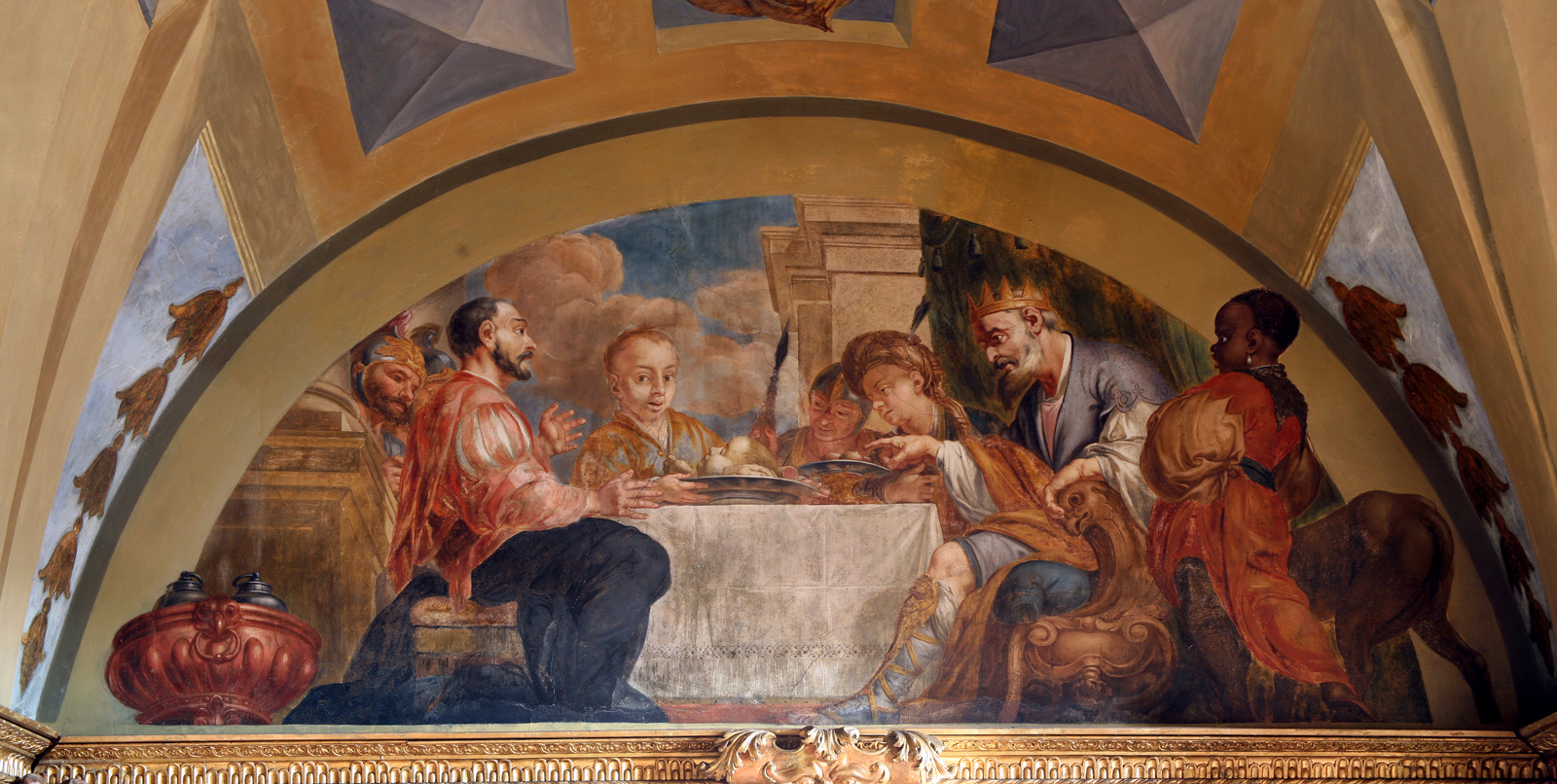
Consider, for example, a situation in which the performer enacts the scene from the House of Atreus myth in which Atreus welcomes his brother Thyestes to his home for the purpose of reconciling the brothers after Thyestes had seduced Atreus’s wife and become her husband. But the reconciliation banquet is only a ruse: the dinner consists of Thyestes’ sons, but he does not know that until Atreus informs him, completing one of the most sensational scenes in the mythic repertoire and providing an excellent opportunity for memorable theatrical sorcery. What might be the relation between music and movement in this scene? Assume an orchestra of three female musicians playing an aulos, a tympanum, and cymbals. The scene begins with the pantomime assuming the pose that completed his previous scene, and the music is that which concludes the previous scene. The pantomime’s assistant comes forth from the chorus to remove the dancer’s mantel while the dancer removes his mask and displays it, assuming briefly a new pose. The aulos player recapitulates the theme that pervaded the previous scene. The musicians would then vamp while the assistant attaches a new mantel to the pantomime, who places the mask in the mask rack and reaches for the mask of Atreus, displays it next to his face, and then covers his face with it, as the assistant fastens it from behind. At the moment the mask covers his face, the musicians begin a new composition, let us say in a brisk 6/8 time and in a shiny Dorian mode. The pantomime strikes the “Atreus pose” as the assistant retreats to the chorus. The aulos plays the “inviting” melody, supported by a rhythmic accentuation in which the cymbals clash on the second beat and the drum taps on the fifth beat. The pantomime then initiates the “welcoming” section of the scene with movements appropriate to the deception Atreus executes, such as: imploring a god to bless the reconciliation of the brothers, presenting an attitude of graceful humility, urging his guest to receive gifts, encouraging the perception that he is harmless or weak or regretful or preoccupied by a noble wish or perhaps all of these things. And if the audience requires orientation to the mythic context, the interpellator, standing slightly apart from the musicians, can speak a helpful caption: “Atreus, poisoned with desire for revenge, welcomes his adulterous brother Thyestes to his palace.” Such a caption is sufficient to establish Brilliant’s “synoptic” function for the scene. The pantomime could conclude the welcoming section by balancing with upraised arm a sumptuous platter piled with cooked meats and, after turning or gliding acrobatically, setting the platter on a tripod. At this point, the pantomime might assume another pose, which displays Atreus in a mood of profound anticipation, a frozen struggle to constrain an intensity of excitement at the bestowal of a “gift.” The music shifts into a darker, Lydian mode, chromatic harmony in a slow tempo of 4/2. The aulos blows a somber melody in a lower register, while the drum strikes on the first and third beats. The pantomime then moves into the “revelation” section. Again, the cymbals clash on the second beat, but they also clash whenever the pantomime turns his head or moves his left hand in a sweeping, lifting, or thrusting gesture. The aulos player distorts the melody through rubatoexaggerations whenever the dancer moves forward or raises both arms above his waist. In the revelation section, Atreus projects an aura of triumphant fulfillment. He encircles the platter, as if in a trance; he extends his right arm and receives from the assistant an opulent goblet, from which he takes a sip and vibrates with exhilaration. With his left hand, he draws a dagger from his belt and spins around and around, brandishing the weapon and the goblet, while the cymbals clash with each revolution. Then abruptly he approaches the platter, flipping the dagger and sipping. He pokes the meat with the point of the blade, as if offering it to his imaginary guest. He sways, as if performing some mysterious culinary rite, until suddenly, from underneath the meat, is revealed a small pair of masks, signifying the faces of Thyestes’ sons. With the dagger, Atreus plucks the masks from the platter and lifts them high. He advances toward the audience, displaying his gruesome trophies and performing a giddy, self-enthralled dance. He delicately sets the masks in the great goblet and strikes the final pose of the scene, in which he gazes at the ghastly goblet in his uplifted hand as if admiring a marvelous piece of art. The pantomime is now ready to initiate the next scene, which might even be the same story fragment seen from Thyestes’ point of view. 

I do not propose that this speculation constitutes a “reconstruction” of how pantomime actually took place, although I have imagined a performance according to the knowledge of pantomime production available from the historical record. Indeed, a problem with such a speculation is that it is perhaps too generic, in the sense that it does not account for the historical periodization of the pantomime: the speculation could apply equally to a pantomime in the first century BCE and to a pantomime in the fourth century CE. How performances of the Atreus scene differed across different times in terms of theatrical and musical tastes or styles remains obscure in such a speculation. Nevertheless, it is clear from the speculation that in a performance involving these generic features, the theatrical elements considerably complicate the relation between music and movement. This complexity only increases if other possible musical and theatrical effects enter the performance, such as a song sung by a lone voice, a choral song, a larger orchestra, a more elaborate costume and mask, more props, a more active participation of the interpellator, a more acrobatic mode of movement, or the addition of another performer impersonating Thyestes. Historical periodization of pantomime performance styles probably entails identifying the extent to which such complexities “color” or modify the generic model imagined here. But further complexity would distort the model if it were possible to identify movement styles unique to a performer or performance group or to performance locale: even if the same performance concept were followed, the Atreus scene might well appear differently if it were performed for an audience in Alexandria or Gaul rather than in Rome. Yet it is precisely the intricate embroidering of such sensuous, material details in the telling of myth that so annoyed the ancient theorists of music across several centuries, from Plato to Aristoxenos to the Pseudo-Plutarch to Ptolemy to Aristides, and urged them to complain that music had sunk into a decadent phase, having become the servant, so to speak, of unwholesome fantasies that prevented people from a deeper, supposedly “universal” intimation of the “incorporeal beginning of the soul.” However, the complexities introduced by the model enactment of the mythic scene indicate that the “synoptic” approach to the use of mythic material did not entail a simplification or reductivism to satisfy less demanding or less sophisticated audiences than supported the epic poets or idealized festivals of Greek drama in times long past. On the contrary, the pantomime represented for its audiences a more “advanced” form of mythic narrative than the poetry and drama of earlier and more “primitive” eras, in somewhat the way that the imperial idea of governance in the Mediterranean world superseded the tribal and city-state political structures that preceded the Hellenistic period. The pantomime did not function to prepare audiences to assume civic responsibilities nor to connect civic communities to destinies and moral crises embedded in myths; it functioned to estrange audiences from myth and to treat myth as a manifestation of a collective imaginary shaped, modified, intruded upon, transformed, or metamorphosed by “reality,” all those sensuous, material details and stylistic idiosyncracies imposed upon myth by performance. As will become evident, the audience that cultivated the pantomime was aristocratic, in the sense that pantomimes molded their aesthetic to accommodate the tastes of a ruling class and expected audiences from other classes to emulate those tastes. The taste of the ruling class was for experiences that demonstrated the aesthetic authority of “reality,” not the moral authority of myths or ideals associated with a mysterious cosmic order. The Atreus scene is not “about” how powerful passions destroy family ties, nor is it an “explanation” of how the passions defining the “fate” of an individual contribute to the fate of an entire society. The scene is “about” how a person may employ beautifully executed gestures to conceal violent, depraved motives. It is “about” the disturbing mutability of human identity, the inability or refusal of humans to see corruption beneath beautifully contrived gestures, movements, and details. Myth is not the raw material for understanding the logic or “story” of a fate bestowed upon a society; it is the raw material for understanding the process of metamorphosis. The central problem for the culture is not how to move humanity toward the ideal, toward a more just or unified society; but how to recognize “reality,” how to perfect perception, how to trust one’s senses and thus respect the limitations of one’s trust in others, no matter how intimately others are known.  

Previous Section

Next Section

References

Table of Contents

Roman Pantomime Aesthetics: Rhythmic Features of the Accompaniment

Pantomime: The History and Metamorphosis of a Theatrical Ideology: Table of Contents

PDF version of the entire book.

Figure 24: Relief with Five Dancers before a Portico (The Borghese Dancers), 2nd century CE, Marble, Musée du Louvre, Paris, France. Photo: Ilya Shurygin.

Rhythmic Features of the Accompaniment

The synchronization of music and movement usually depends on rhythmic, rather than harmonic, organizations of sound. It is apparent, however, that the Greeks subordinated rhythm to harmony, in the sense that the “pulse” of music did not determine its mode of “mood.” How the Greeks even signified rhythmic values remains quite obscure. Most scholarly commentary on Greek rhythmic practice arises out of protracted discussion of the metric system governing the composition of poetry, with probably the most monumental contribution in this direction coming from the writings of Rudolf Westphal (1826-1892), especially in his immense commentary on Aristoxenos, completed between 1883 and 1893. An assumption governing discourse on Greek rhythmic practice is that music emerges from literary language by functioning as a system for controlling the meaning and emotional resonance of words through patterns of syllabic accent and tonality. Because much of Aristoxenos’s writing on rhythm was not preserved, Westphal relied on references to Aristoxenos’s thinking in the writings of other ancients, primarily Aristides Quintilian, who wrote, according to his editor, Thomas Mathieson, “sometime in the late third or early fourth century A.D.,” although other scholars claim he wrote in the early third century (Aristides Quintilian 1983: 14). Aristides’ thinking is at points so densely technical that it requires more than a little patience to read him. Consider this paragraph on rhythm:

There are also other mixed rhythms, six in number: cretic, which is composed of two trochee thesis [downbeat] and a trochee arsis [upbeat]; iambic dactyl, which is composed of a iamb thesis and a iamb arsis; trochaic bacchic dactyl, which consists of a trochee thesis and a iamb arsis; iambic bacchic dactyl, which is configured contrariwise to the aforesaid rhythm; iambic chroeic dactyl (it accepts one of the dactyls in the thesis and one in the arsis); and trochoid choreic dactyl, compounded analogously with the aforesaid rhythm. “Cretic” derived its name from that people; the rest have their names from the aforesaid feet (Aristides 1983: 100). 

His discussion of music is intensely abstract and only rarely does he make even the slightest reference to actual performance and none to any actual composition. It is very doubtful that musicians in the Roman Empire paid much attention to the theoretical principles he described, and this indifference was a motive for writing the treatise. In his only reference to the pantomime, he criticizes Cicero for condemning music as immoral while praising “the dancer” Roscius, “who at that time displayed himself with rhythms alone and these ignoble and inferior” (124). Nevertheless, Aristides perceived rhythm as the movement of music and the body (orchestra), and his remarks on the subject provide some insight into how the pantomime deployed music.

            Rhythm, according to Aristides, refers to the interval of time between tones; melody is a calculated organization of these intervals that “moves the heart” (94). The smallest unit of time is called the “protos,” which may also be called the point or pose. The point, so to speak, generates energy that “moves” in mathematical proportions or ratios of tones. Arsisis an upward movement of the body and thesis is a downward movement. A rhythm establishes a repetitive relation between upbeats and downbeats. Specific temporal values or durations ascribed to upbeats and downbeats result from dividing a tone into “feet” “considered to have two (equal or unequal) phases each—not time units—and classified in four groups according to whether the ratio of length of the two phases was 1:1, 2:1, 3:2, or 4:3” (Sachs 1943: 260). These ratios are “related to intervallic sound by nature” (Aristides 1983: 95). The system for dividing tones into upbeats and downbeats derives from the metric patterning of accents imposed upon the speaking of poetic language. Music (as song) is assumed to have emerged from the exaggeration or intensification of tonal and rhythmic properties embedded in consonants, syllables, words, and sentences, although, as Landels (1999: 111-112) observes, in poetry, the Greeks imposed a metric pattern on the words rather than selected words that “naturally” accommodated the pattern. The metric system of upbeats and downbeats merges into the ratio system of phases (feet), to allow for numerous combinations of feet. Even if one includes pitch values in them, metric patterns do not produce melodies unless they are unstable, combined with other patterns that preclude the idea of “translating” upbeats and downbeats into notes. Nineteenth century commentators on Greek music, like Westphal, attempted such translations to show how the civilized orderliness of modern Western music has its origin or foundation in ancient musical practice. But the Greeks, subordinating rhythm to melody, treated rhythm as a mathematical combination of temporal intervals rather than as the controlling “pulse” of a musical composition. This means that Greek music and literature were not as closely aligned as some commentators have asserted. It also means that Greek rhythms were more unstable or richer than the study of prosody would indicate. Even if one assumes the dubious task of translating the downbeat as equivalent to a quarter note and the upbeat as equivalent to half a downbeat or an eighth note, as so many commentators do to “simplify” the relation between metric pattern and rhythm, the rhythms that emerge from poetic language are quite diverse and often unusual in Western music: 9/8 or 12/8 or 5/8 or even 11/8 (tetrapodie) rhythms were not as strange to the Greeks as they are to Western ears. But John Landels insists that it is necessary “to abandon the concept of lines of verse. The more elaborate structures of Greek song consisted not of regular repeated lines, but of metrical units of varying length, grouped together to form stanzas” (1999: 123). In other words, rhythmic structure shifted to accommodate melodic invention motivated by texts whose metric patterns were also unstable. Moreover, the translation of metric patterns into musical notation does not take into account other important aspects of rhythm, such as rests, triplets, pedal points, or tempos, although Aristides alluded to them without explaining their significance (1983: 101-102). He declared that rhythmic “modulations arise in twelve ways,” but he named only eight and did not discuss any of them, even in some vague relation to his contention that “the best rhythmic composition is that productive of virtue; the worst, that of evil” (1983: 102). But his reluctance to explore rhythmic modulation suggests that the music of his time pursued rhythmic practices that were too complex to function as manifestations of a divine, geometrically-ordered cosmology in which movement contains two “species”: straight line or orbit (1983: 176). 

            The diversity of rhythmic meters hardly means that the ancients were enthusiastic producers of “danceable” music. On the contrary, complexity of “rhythmic modulation” favors “singability” over “danceability.” The pantomime culture most likely encouraged the production of tunes audiences could hum and associate with the emotional ambience of a particular star or company. Music composed to synchronize the dancer’s body with an external “pulse” was probably not a priority, insofar as pantomimic virtuosity was not synonymous with the display of superior skill at synchronization. Music accompanied the dance in the way that it accompanied singing, which could even mean that the rhythm of the accompanying music was different from the rhythm of the singer or dancer or that, in any case, the dancer could still feel comfortable moving to a melody in such “awkward” meters as 7/4 or 9/8. For dramatic effect, the pantomime could move slowly while the music moved quickly, and vice versa. If synchronization occurred, most likely it was because the musicians followed the dancer, the star, producing particular tones to coincide with movements when the dancer decided to make them. As a result, the rhythmic structure of the music could become even more complex than an “awkward” meter. In any case, how would synchronization work? In conventional dance practice, upbeats lift the body and downbeats bring the foot to the ground. But if the dancer is narrating, not one but several mythic scenes in succession, conventional synchronization of the body with upbeats and downbeats, no matter what the rhythmic meter, merely diminishes dramatic power and at best confines the performance to a predictable, if not mechanical, display of acrobatic agility. The combination of acting with dancing requires a more complex relation to music.

Previous Section

Next Section

References

Table of Contents

Roman Pantomime Aesthetics: Pantomime Musical Accompaniment

Pantomime: The History and Metamorphosis of a Theatrical Ideology: Table of Contents

PDF version of the entire book.

Figure 23: Apollo with kithara, painting on plaster from the Scalae Caci on the Palatine Hill, First Century CE. Photo: Marie-Lan Nguyen, public domain.

Pantomime Musical Accompaniment

The pantomime not only detached the voice of the narrative from the dancer but subordinated the voice to the movement. The interpellator took his cues from the movement, and thus conveyed the impression that language was a response to action rather than a cause of it. The relation of music to the performance reinforced this subordination of aural components to visual. Lucian makes almost no reference to music in his comments on the dance. In the Roman world, musicians do not appear to have achieved the star status of pantomimes. The Romans absorbed the musical theories and practices of the Greeks, but unlike the Greeks, they did not ascribe a cosmic significance to music or treat the mathematical basis of Greek music theory as the mystical manifestation of a divine power. As Behn (1954: 126) observed: Roman music “found its fulfillment as the servant of an unconcealed materialism, through sensuous carousals,” and through practical applications for the military and various public ceremonies. This attitude, however, does not mean that music was not important to the Romans, nor that they introduced no interesting innovations. They incorporated musical influences from the cultures they encountered, and a frequent complaint against Roman music was that it contaminated the civilization with foreign notions of beauty and pleasure. Etruscan musical traditions, which were only partially indebted to Greek traditions, played a major role in shaping Roman musical aesthetics. And when Rome annexed Egypt in the first century BCE, and the pantomime along with the Isis cult found an enthusiastic reception in Italy, Egyptian musical ideas began to penetrate Roman music culture, although this penetration occurred only to the extent that Egyptian musical ideas fit in with other Roman musical tastes and did not replace them.  

The Greek musical practices that the Romans appropriated owed much to Near Eastern musical traditions dating back to the Babylonians and Sumerians. However, Greek music evolved in relation to complex theories of music that were a unique consequence of the Greek inclination to build comprehensive philosophical systems. The Greeks organized musical compositions according to a system of “modes”—or, more precisely, according to several modal systems. Modes apparently derived from the tuning of strings on the chief instruments of musical production, the lyre and the cithara (Gombosi 1939: 33-77). But some scholars have argued that the modal system developed from singing epic poetry and from an intimate connection between vocal performance and musical properties within the Greek language (see Anderson 1994: 84-112; Landels 1999: 110-129). However, the tones produced on an instrument are more likely to achieve a condition of “absolute” purity than the voice and thus provide more convincing evidence to justify a system of tonal relations. The lyre was of very ancient origin, the Babylonians having played as far back as 1800 BC, while the cithara was most likely of Greek invention. Visual representations show lyres containing from three to eleven or twelve strings of equal length but tuned to different notes in a descending scale conforming to a particular mode (Gombosi 1939: 48-73 provides the most complete catalogue of the visual representations). Most representations show six or seven strings, which is sufficient to encompass an octave. The intervals between tones constitute a scale, but the tones are not fixed—they can be changed to produce a different pattern of intervals called a mode. The Greeks employed several modes, whereas modern Western music relies largely on two modes, the major and the minor of a single diatonic system. How the Greek modes operated is not altogether clear, partly because of confusion generated by the unstable representation of the number of strings on the lyre and cithara. Only a few scraps of Greek notated music are extant, and no examples of Roman music notation have survived. So scholars depend on ancient writings about music for clarification, although Greek remained the language for technical and theoretical discourse on the subject. Plato described some modes in relation to their effect on listeners, as did Aristotle. Aristotle’s student Aristoxenos, writing in the late fourth century BCE, composed an extensive treatise on music, of which three books have survived. A second century CE writer, Claudius Ptolemy, composed a densely technical Harmonics that linked Greek music theory to zodiacal codes. In most likely the early third century CE, another commentator, Aristides Quintilianus, complaining about the “disgrace” into which learning about music had fallen, wrote a book that attempted to revive respect for Greek music theory, in which precise, mathematical proportioning of sound reveals the “incorporeal beginning of the soul” and manifests the movement of astral bodies and zodiacal energies (Aristides Quintilianus 1983: 72, 195). But even earlier, in a first century CE essay on music ascribed to Plutarch, the author explained Greek music theory, with extensive reference to Aristoxenos, in an effort to reclaim a tradition that, under the Romans, had supposedly succumbed to decadent practices shaped, as Plato had feared, by the voluptuous pleasures of the theater. But this essay is of further importance precisely because it acknowledges a substantial tension between musical practice, as the author observes it, and music theory as Greek philosophers several centuries before desired music to follow. At any rate, Greek music theory dominated the tonal organization of music in Roman civilization throughout the time in which the pantomime flourished. Nevertheless, the theory, which remained rooted in Pythagorean mathematical idealism, described “systems” of tonal relations that sought to manifest an idealized cosmic harmony that, as a series of mathematical calculations, was often quite detached from the actual sound of music in the ancient world. “Pythagoras, that grave philosopher, rejected the judging of music by the senses, affirming that the virtue of music could be appreciated only by the intellect” (Plutarch 1874 I: 130). The Greek music theory writings are therefore not entirely reliable in explaining ancient music practice. Moreover, because these writings inevitably drift into bewildering technical complexities, they are subject to equally convoluted wrangling among scholars over meaning or implication. 

Aristoxenos used the term “tetrachord” to describe a fundamental set of three intervals between four tones or semi-tones, with the sum of the intervals adding up to a fourth, so that four strings on a lyre might be tuned to d, e, f, and g, although the Greeks apparently assigned separate letters to every note rather than identify them as the same wave length at a different frequency, and what they called “low,” we regard as “high” (Landels 1999: 88). But the player can retune the lyre to produce a different set of notes, as long as they total a fourth between them. By adding strings, a player can include another tetrachord in descending tones. A “conjunction” of tetrachords occurs when the lowest note of the higher tetrachord is the highest note of the lower tetrachord. Tetrachords operate in “disjunction” when an interval separates one tetrachord from another to produce a complete octave. The Greeks combined three, four, or five conjunct and disjunct tetrachords into “systems” for regulating relations between conjunction and disjunction. The Lesser Perfect System consists of three tetrachords, while the Greater Perfect System uses four, and the Greater Perfect Non-modulating System contains five. Each system is divided into four sections that identify the notes within a spectrum: “the highest” (hypaton), “the middle” (meson), “the conjunctive” (synhemmenon), and “the excessive” or additional (hyperbolaion). Both the Greater Perfect and the Greater Perfect Non-modulating Systems include a fifth section, “the disjunctive” (diezeugmenon). The purpose of the Systems is to determine the central tone that links the tetrachords into octaves. Octave structures radiate outward (or higher and lower) from the central tone. Aristoxenos identified thirteen tones, compared with the twelve, including semitones (sharps and flats), in conventional Western music. But the Greeks also appreciated quarter tones, so some commentators discussed structures employing as many as fifteen tones. To determine absolute intervallic relations between tones, it was necessary to apply the Pythagorean method for calculating the ratios of tones to each other, a process that quickly becomes quite complicated and abstruse, as is evident from explanations offered by Landels (1999: 130-135) and Gombosi (1939: 102-107). Most musicians probably did not pay much attention to the theory of intervallic ratios, but Greek acoustic engineers and musical instrument makers found it useful in shaping the material conditions for the production of musical sound. Aristoxenos explained that tetrachords belonged to one of three genera: the diatonic, the chromatic, and the enharmonic. Diatonic tetrachords consist of two whole tones and a semitone and build a scale containing five whole tones and two semitones, just as the diatonic scale functions in music today. Chromatic tetrachords built a fourth out of three semitones and whole tone; this genus was favored for the production of strongly emotional or intensely “sweet” music. The enharmonic tetrachord combined two quarter tones with two whole tones.

Aristoxenos and his disciples, as well as the Pseudo-Plutarch treated the enharmonic as the oldest and strongest tetrachord structure, although, as Sachs (1943: 206-207) pointed out, the evidence for microtones in Greek culture is “indeed relatively late,” at the end of the fifth century BCE. But tetrachords built around microtones disappeared from music in the Hellenistic years and did not resurface. Pseudo-Plutarch wrote that “our musicians nowadays have so exploded the most noble of all moods, which the ancients greatly admired for its majesty, that hardly any among them make the least account of enharmonic distances. And so negligent and lazy are they grown, as to believe the enharmonic diesis to be too contemptible to fall under the appreciation of sense, and they therefore exterminate it out of their compositions […]” (Plutarch 1874 I: 130-131). However, even without this genus plenty of complexity remained in the two other genera. Each genus of octave structure, according to Aristoxenos, adopted one of twelve species, which are often referred to as “modes” or “moods”: Hyperlydian, Hyperaeolian, Hyperphrygian, Hyperionian, Hyperdorian, Lydian, Aeolian, Phrygian, Ionian, Dorian, Hypolydian (Mixolydian), Hypoaeolian, Hypophrygian, Hypoionian, andHypodorian (Landels 1999: 99). “It is not fully clear whether these scales evolved from one another or existed side by side from the beginning” (Sachs 1943: 217). But the development of the modes was perhaps the source of greatest controversy for Greek theorists of music, and even in our own time, “we do not have a clear sense of the significance and value in musical theory and practice of the species of octave” (Comotti 1989: 90). The Greeks designated a mode according to the central tone linking the octaves, so that each mode represented a different tone in the scale of thirteen to fifteen tones they employed. But this does not mean that the modes were synonymous with the concept of “keys” in Western music. “We should not forget,” Comotti remarks, “that the basic system of Greek music was not the octave, but the tetrachord” (1989: 91), and, as he reminds his readers, within the tetrachord, the two inner notes of the fourth were “movable” while the outer notes were always fixed. This freedom to adjust the inner notes of the fourth would cause the central note linking the octaves to shift from the tone predicted by the circular structure linking the highest and lowest tones in the scale. The shift would, in a sense, “de-center” the melodic organization of sound and introduce an amplification of strangeness or instability to the composition. This instability of mood urged Plato, who judged all music on the basis of its assumed moral effect, to contend that some modes were dangerous. In The Republic (III, 397), he singled out the oriental Lydian modes and their chromatic variants as especially conducive to “soft,” “lax,” “convivial” or “dirge-like” moods, and in the ideal state, such modes, such “complex scales” and the “curiously harmonized” instruments that use them, would not be permitted and only the “older” and simpler Dorian (diatonic) and Phrygian modes would have a place. In The Golden Ass, the narrator observes that in the performance of the pantomime in Corinth, the flute player blows a “sweet, Lydian” tune (10.32). Plato contended that music possessed special power to forge its “way into the inward places of the soul”; the Lydian modes were dangerous because their chromatic intensification of emotional “color” in sound urged people toward emotions and action that were “lawless,” “frenzied,” or “unduly possessed by a spirit of pleasure” (Laws III; Plato 1926 I: 247). He linked the Lydian modes to the Dionysian religious ecstasies appropriated by the theater, which was responsible for inculcating a “spirit of lawlessness,” with the result that “in place of an aristocracy in music there sprang up a kind of base theatrocracy” (247). 

The complexity of Greek harmony, as the manifestation of an “ethos,” was therefore a fundamental source of the moral controversies attached to the pantomime culture that exploited harmonic innovation, and much of Greek music theory navigated toward pure mathematics detached from actual sound as part of an ideological project to correct the “excesses” that supposedly had corrupted musical practice. In the Platonic view of cultural history, harmonic innovations in music were in large part responsible, not only for the replacement of tragedy by pantomime in the theater, but for spreading an “ethos” that subverted the ambition of the Platonists to construct modes of intellectual discourse that superceded the need for any kind of theater. Plato’s critique may suggest that chromatic harmony somehow caused people to dance in a particular way that was morally dubious, for he did not oppose all dancing. Indeed, he praised the beauty of the pyrrhic step and believed that young people should learn it (Laws II; Plato 1926 II: 29). However, his language does not altogether support a cause-and-effect relation between harmonic innovation and movement style. Music is dangerous, he contended, when it corrupts audiences, who can no longer distinguish good and bad qualities of performance and thus descend into “a liberty that is audacious to excess.” Plato doesn’t say that corrupt music makes the performers dance in a “lawless” manner, and the evidence of the pantomime obviously indicates, rather, that the performers moved in a calculated, disciplined way, albeit often in an improvised mode, and with qualities that were frequently voluptuous and even lascivious. But what makes movement voluptuous or lascivious? Plato’s point is that any movement becomes voluptuous or lascivious when accompanied by particular melodies or modes of music—or, more precisely, by the freedom to juxtapose tones and thus construct complex contrapuntal and polyphonic effects. In his extant writings on music, Aristoxenos did not really discuss how the modes operate as contrapuntal or polyphonic structures, and it is difficult on the basis of available evidence to determine how the Greeks interwove melodic lines or set a melody in tension with an accompanying chordal configuration. It is possible that the Greeks employed slightly different notation systems for voices and instruments (Landels 1999: 221-227), perhaps because they did not treat vocal and instrumental sound as belonging to a completely unified harmonic system—that is, voices and instruments “translate” a purely theoretical tone into slightly different inflections. It is clear, however, that the Greeks never introduced polyphony into choral singing, and no evidence exists to suggest that the Romans violated the mysterious principle that groups of voices should always sing in unison. Yet polyphonic and contrapuntal complexity was inescapable in their music, because of the ways in which they combined instruments with each other, as well as with voices. Curt Sachs (1943: 256-258) seemed to think that an understanding of Asian polyphonic practices might clarify how the Greeks put together different “parts,” a speculation reinforced by Plato’s warning on the dangers of importing “oriental” modes, although it is not altogether evident that in ancient times Asian cultures possessed contrapuntal techniques that were anymore “advanced” than what the Greeks themselves claimed from mythic origins. But Plato indicated the development of contrapuntal complexity when he complained of “the poets” whose “unmusical illegality” led them to create compositions that “mixed dirges with hymns and paeans with dithyrambs, and imitated flute-tunes with harp-tunes, and blended every kind of music with every other […]” (Laws III; Plato 1926 I: 247). According to Plato’s logic, as harmonic complexity increased, movement also became more complex, but not because movement had become more intricately synchronized with harmonic elements. On the contrary, harmonic complexity urged movement to become free of musical determinants and to function against a backdrop of sound rather than as proof of music’s power to control and coordinate the body. In other words, pantomimes used music for dramatic effect, with the same sort of relation between movement and sound that prevails in movies, wherein actors shape often very complex movements before the music enters the performance.  
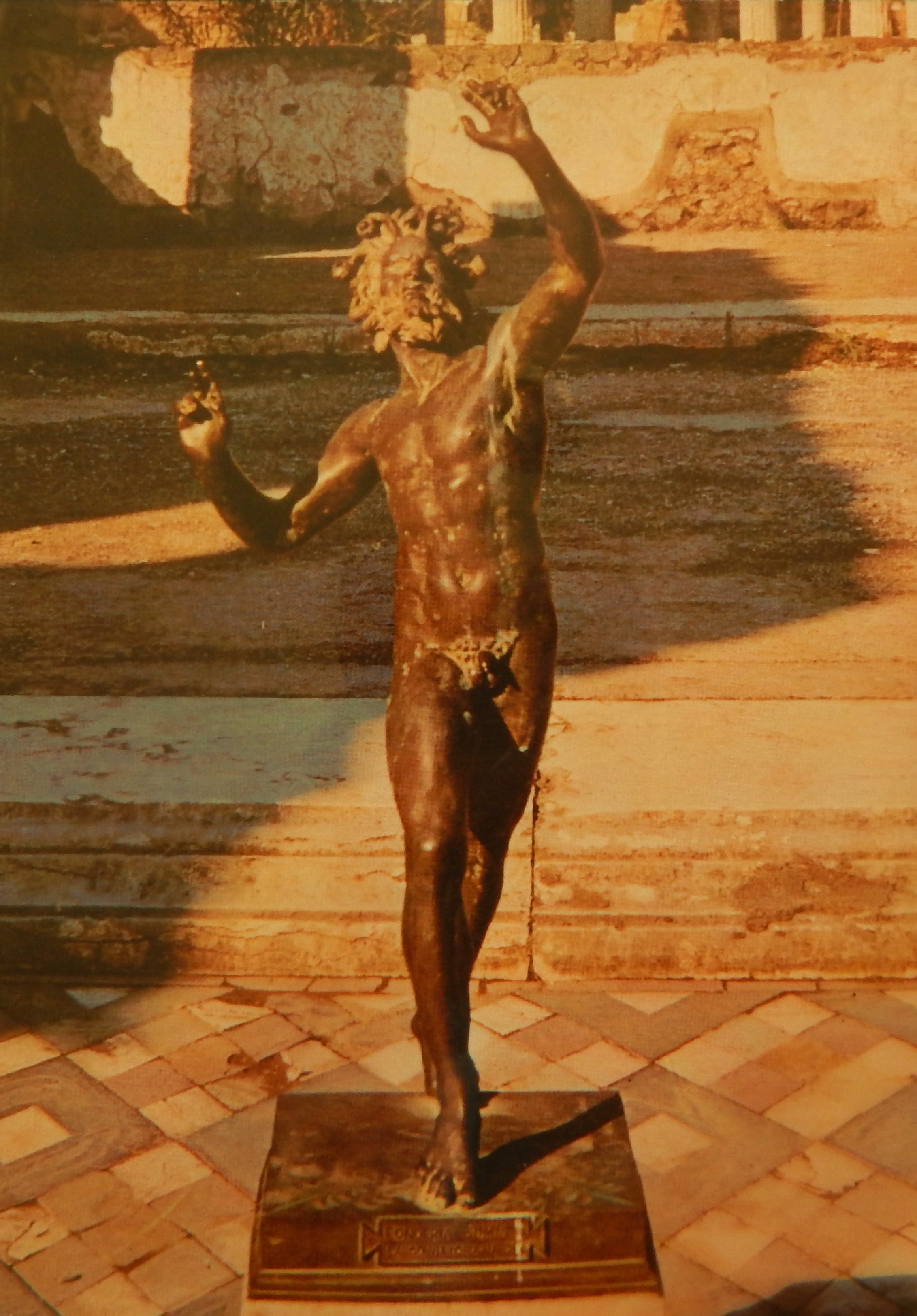
Previous Section

Next Section

References

Table of Contents

Roman Pantomime Aesthetics: Combinations of Aesthetic Variables

Pantomime: The History and Metamorphosis of a Theatrical Ideology: Table of Contents

PDF version of the entire book.

The pantomime scene from Apuleius’s “The Golden Ass,” as illustrated in 1923 by Belgian artist Jean de Bosschère (1878-1953). Photo: from “The Golden Asse of Lucius Apuleius,” translated by William Adlington, London: John Lane/Bodley Head, 1923.

Combinations of Aesthetic Variables

The idea of a “mathematical” awareness governing choreographic choices appears transparent when we simulate the conditions of its application. The performer may execute the pyrrhic step quickly or slowly, and may move the hands, arms, head, torso, or shoulders quickly or slowly. The body may move forward, backward, diagonally, or in profile to the spectator. Speed and direction of movement are only two variables that complicate perception of the pyrrhic step in relation to a single arm movement [Figure 11]. The pyrrhic step itself may be performed in different ways: as an exultant march, as a stealthy circumnavigation, as a funereal procession, or as a voluptuous stride. In combination with turns, spins, sways, or abrupt shifts in rhythm, the step allows for the dramatization of fairly complex emotional conditions. Another set of variables enters when the step operates in tandem with different gestural possibilities for the hands, arms, head, torso, and shoulders. But these movements and combinations of them expand their expressive potential when the performer adds props and costume effects and cause the same movement to signify a different emotional aura. When occasionally the action involved two or more performers together, as is evident from Apuleius’s description of the pantomime in Corinth, movement and pose may interact, and indeed, several bodies may be in movement employing different combinations of gestures. What is impressive about Apuleius’s description of “The Judgment of Paris” pantomime in The Golden Ass (ca. 150 CE) is that he shows how the performance entails a luxurious interaction of props, costume effects, nudity, and elaborate combinations of movements. For example:

[…] And by and by, there approached a faire and comely mayden, not much unlike to Juno, for she had a Diademe of gold upon her head, and in her hand she bare a regall scepter: then followed another resembling Pallas, for she had on her head a shining sallet, whereon was bound a garland of Olive branches, having in one hand a target or shield: and in the other a speare as though she would fight: then came another which passed the other in beauty, and presented the Goddesse Venus, with the color of Ambrosia, when she was a maiden, and to the end she would shew her perfect beauty shee appeared all naked, saving that her fine and dainty skin was covered with a thin smocke, which the wind blew hither and thither to testifie the youth and flowre of the age of the dame. Her colour was of two sorts, for her body was white as descended from heaven, and her smocke was blewish, as arrived from the sea: After every one of the Virgins which seemed goddesses, followed certaine waiting servants, Castor and Pollus went behind Juno, having on their heads helmets covered with starres. This Virgin Juno sounded a Flute, which shee bare in her hand, and mooved her selfe towards the shepheard Paris, shewing by honest signes and tokens, and promising that hee should be Lord of all Asia, if hee would judge her the fairest of the three, and to give her the apple of gold: the other maiden which seemed by her armour to be Pallas, was accompanied with two young men armed, and brandishing their naked swords in their hands, whereof one named Terror, and the other Feare; behind them approached one sounding his trumpet to provoke and stirre men to battell; this maiden began to dance and shake her head, throwing her fierce and terrible eyes upon Paris and promising that if it pleased him to give her the victory of beauty, shee would make him the most strong and victorious man alive. Then came Venus and presented her selfe in the middle of the Theater, with much favour of all the people, for shee was accompanied with a great many of youth, whereby you would have judged them all to be Cupidoes, either to have flowne from heaven or else from the river of the sea, for they had wings, arrowes, and the residue of their habit according in each point, and they bare in their hands torches lighted, as though it had beene a day of marriage. Then came in a great multitude of faire maidens: on the one side were the most comely Graces: on the other side, the most beautifull Houres carrying garlands and loose flowers, and making great honor to the goddesse of pleasure; the flutes and Pipes yeelded out the sweet sound of Lydians, whereby they pleased the minds of the standers by exceedingly, but the more pleasing Venus mooved forward more and more, and shaking her head answered by her motion and gesture, to the sound of the instruments. For sometimes she would winke gently, sometimes threaten and looke aspishly, and sometimes dance onely with her eyes: As soone as she was come before the Judge, she made a signe and token to give him the most fairest spouse of all the world, if he would prefer her above the residue of the goddesses. Then the young Phrygian shepheard Paris with a willing mind delivered the golden Apple to Venus, which was the victory of beauty (Apuleius 1919: 531-537; Apuleius 1972: 257-259).

The narrator treats the performance, not as a predominantly choreographic experience, but as an almost monumental, dynamic mosaic of visual and musical sensations. Bodily movement is important here, not because it is a display of acrobatic virtuosity, but because it amplifies emotional contrasts and complexity. The narrator describes movement in the language of fundamental actions: dancers “show,” “throw” their eyes,” “accompany,” “carry,” “shake” their heads, “wink,” “threaten,” “look aspishly,” and “make signs.” But above all, they “bear” all sorts of glamorous props and physical beauty. The competition between the three goddesses does not unfold as a choreographic contest. Rather, it is more like a contest of processions, structured according to a predictable escalating scale of sensation. Venus wins the contest because her appearance is the most sumptuous. The performance makes no effort to dramatize any conflict within Paris about which goddess to choose. Until the end of the description, he adopts the pose of a transfixed spectator. Suspense lies entirely in the anticipation of an intensifying level of voluptuous imagery, bodies, and tones. If, as seems evident from the description, the audience recognizes the mythic scene, then no one watches the performance to see how the story will end; this was known before the day began. The narrative organization of action depends on the emotional resonance provoked by or correlated with purely formal properties of performance. 

            Yet the performance as a whole is not without serious narrative unpredictability and disruption. The passage merely describes the prelude to the main action of the performance, which is the copulation on stage between the donkey narrator and a woman accused of murder among many other crimes; the bestial act is part of her public humiliation before being eaten by wild beasts. Theatrical machines change the scene and display a luxurious bed “finely and bravely prepared, and covered with silk and other things necessary.” With great anxiety, the narrator describes the anticipated copulation as an action designed for maximum theatrical effect without, however, proposing that the scene is anything other than “reality.” This extravagant blurring of distinction between representation and reality arises out of the same impulse to treat reality astheater that established the appeal of chariot races and gladiatorial combats. The “Judgment of Paris” ballet then seems like a grotesque parody or travesty of glamorous ritual performance efforts to evoke the mythic spirit of Venus on behalf of the ecstasies of carnal desire. 

            The “meaning” of the pantomime performance does not result from some special understanding of character, myth, social relations, history, or people, as is expected of text-driven performances. The “moral” of “The Judgment of Paris” is, for Apuleius, nothing more than an opportunity for extravagant satire. Social order in the performance is merely a sequence of ornamental processions; the concept of “judgment” appears utterly detached from any condition of doubt or internal conflict over the consequences of a decision. Although the performance functions ostensibly as a punishment of a monstrously immoral woman, the narrator makes clear in the complicated passage preceding the description of the performance that a large number of people, practically an entire society, is somehow implicated in her crimes. In other words, escape from intellectuality or insight is not a function of “entertainment” as such; nor is it the basis for a collapse, confusion, transcendence, or discarding of distinctions between representation and reality. Rather, the narrator describes how performance metamorphoses into reality—that is, into a condition when life itself is governed (or at least amplified) above all by aesthetic instead of moral, political, or economic values. Entertainment, as it appears in the passage on the pantomime, is not a matter of escape from reality or even from intellectuality. It is an escape from morality, from a religious or mythic justification for justice and social harmony. The invoking of mythic powers through theatrical performance leads to the staging of a sort of ecstatically obscene reality. At any rate, the narrator refuses to participate in the obscene punishment and runs away from it. But the passage reverberates with a larger implication when set against the other evidence of the pantomime aesthetic. The “meaning” of the pantomime lies in its power to free both performer and spectator from morality as it is encoded in narrative and representation. The pantomime adopts a form of performance that allows the spectator to observe the conditions under which a personality manifests its uniqueness, its freedom, its aloneness, beneath or despite layers of mythic fantasy, character, mask, costume, artifice, ceremonial procession, technical virtuosity, and even language. Personality asserts itself most freely or uniquely through physiognomy and physical movement. That this freedom from being compelled to find one’s place within a story told by others has the potential to create an ecstatic experience is the basis for transforming pantomime performers into stars and for establishing the appeal of pantomime performers around star personalities. The problem with the pantomime described in The Golden Ass is that it descends into monstrous vulgarity: the “unique personalities” revealed by the “reality” of performance, including especially that of the audience, are bestial. The beautiful evocation of myth in “The Judgment of Paris” not only fails to prevent Corinthian society from sinking into bestiality; it justifies the descent. Of course, this grotesque irony is the basis for extravagant comic effect in Apuleius’s narrative, but it also exposes a disconcerting ambiguity of consequence embedded in the freedom of metamorphosis, the freedom to transform representation into reality. 

            Richard Brilliant has explained how, in wall paintings and relief sculptures, Roman artists perfected a “synoptic” or “reduced field” approach to the visual narration of mythic or historical events that was similar to the excerpted compilation aesthetic of the pantomime. Because the narratives were too complex and filled with too many details to be represented completely or efficiently, and because furthermore, it was necessary to interweave two or more narratives into a larger configuration of meaning, artists favored a “reduction of the narrative chain and greater concentration on a primary visual field” so that eventually, “during the course of the second and third centuries, viewers were obliged to change their behavior from reading through the narrative series to reading out from the salient imagery” (1984: 163-164). “Highly concentrated images” or “typological formulations,” he says, were “readily accessible to the eye and mind of the viewer” and thus “could reveal greater content through association” (163). The object of this “synoptic” organization of narrative, which he calls allegoresis, was to “project myths as an allusive presentation” of an “inner truth” or “search for another, higher, form of reality” (164). In this aesthetic, the spectator or “beholder” assumes an increasing responsibility for the meaning of the “visual field,” “manipulating” clarified, reduced forms and extracting “relevant content” in relation to a unique, personal context (164). If we apply Brilliant’s argument to the narrative organization of the pantomime, then it would seem that the performance fulfilled a highly symbolic, ritual function of moving the spectator to a transcendent, elevated reality, “lacking either beginning or end,” in which the viewer was free to encounter, indeed construct, a mysterious relation between myth and reality that a more detailed or complete approach to storytelling prevented him from seeing.  

            Brilliant’s argument is helpful in explaining the increasing tendency toward abstraction in Roman art, wherein mythic imagery becomes obscured by idiosyncratic, cryptic details of an elaborately formal nature, especially in the mosaic paintings from the third century onward. The problem with the argument is that it does not clarify the relation between mythic figures and the “higher reality” signified through abstraction. Why bother with mythic material at all in the face of a decaying belief in the power of myth to “explain” or define reality? In a broad investigation of ancient art before the emergence of Greek civilization, Henriette Groenewegen-Frankfort (1896-1982) described, in 1951, how ancient artists used abstraction and motionless posing to preserve a ritual function for the image. An image assumes a ritual function when it memorializes “the terrifying distance between the human and the transcendent” and serves to prepare the viewer for death and submission to an eternal, immutable power. A lack of dynamism defines temporal-spatial relations between figures. Art that does not pursue a ritual function, she contends, is “unpurposeful,” insofar as it exists only to commemorate the excitement and “movement” of life itself and does “not give substance to the world of the dead through an abstract of the world of the living.” Such art does not “immortalize proud deeds or state a humble claim for divine attention” (Groenewegen-Frankfort 1987: 216). It is art whose guiding objective is to remind the living of the beauties of life and to appreciate the pleasure of movement for its own sake. For Groenewegen-Frankfort, this secular or non-ritual function for art is most evident in Cretan civilization, wherein “the human bid for timelessness was disregarded in the most complete acceptance of the grace of life the world has ever known.” In this art, “the beauty of movement was woven into the intricate web of living forms” and “revealed in human bodies acting their serious games, inspired by a transcendent presence” that nevertheless remained absent from representation itself (216).            

The pantomime, however, does not fit comfortably into either Brilliant’s or Groenewegen-Frankfort’s categories of ritual and non-ritual function. The narrative organization of the action followed abstract, “synoptic” principles that emphasized formal relations between bodies, time, and space without pointing to a “higher reality” for which myth was merely an emblem. The pantomimes subordinated myth to aesthetic objectives; the “higher reality” achieved through abstraction was intellectual, not spiritual, close to Groenewegen-Frankfort’s notion of “serious games.” The pantomime was tragic in the sense that it was a serious engagement with the physical relation between myth and the human body. Whereas literary tragedy attempted, to the extent that anyone in the Empire even bothered with it, to link serious “understanding” of a higher reality to superior storytelling skills, the pantomime linked such understanding to a kind of refined resistance to storytelling in which it was possible for performance to comment on the stories inside a person without actually telling them. On the other hand, the pantomime was not quite the “unpurposeful” art that Groenewegen-Frankfort ascribed to Cretan civilization. The pantomime depended on star performers to sustain its appeal for the public. Performers became stars because they “embodied” various mythic identities to a superior degree, and by becoming stars, they themselves cast an aura of myth, they intimated a “transcendent presence” whose capacity to stir up ecstatic feelings, intoxicating sensations of release and freedom, could seem more real than the gods or immortals they impersonated. Whenever performance moves toward an ecstatic result, it entails, not an “acceptance of the grace of life,” but a release from the mundane world and a powerful sense of coming close to a higher level of being than otherwise seems accessible within “reality.” I would suggest, then, that the pantomime fulfilled neither one function nor the other, nor did it accommodate double, contradictory functions. Rather, it projected an elaborate uncertainty of function that arose from a desire in Roman civilization to permit people to read performance narratives according to different, unstable apprehensions of “reality.”

Previous Section

Next Section

References

Table of Contents

Roman Pantomime Aesthetics: The Pose

Pantomime: The History and Metamorphosis of a Theatrical Ideology: Table of Contents

PDF version of the entire book.

The Pose

However, knowledge of this repertoire of performance devices does not explain the narrative logic of pantomime action. Rather, it amplifies the perception that the purpose of narrative organization of action is to reveal the virtuosity and personality of the performer rather than the psychology of the character impersonated or the authority of the character’s mythic origin. The story was “about” the performer’s ability to assume different identities and manipulate the theatrical devices necessary to achieve satisfactory “metamorphosis.” Pantomimes became more competitive by escalating the sensationalism of stunts and enactments, particularly of lurid female roles, such as Leda, Semele, Pasiphae, and Ariadne. Audiences apparently reveled in the spectacle of male performers impersonating mythic women giving birth to gods and heroes, or such fantastic metamorphoses as Minerva born fully grown and armed out of the head of Jupiter, although how stunts like these were actually performed still remains the subject of speculation. Moreover, according to Plutarch (IX.15.747), a great measure of performance virtuosity lay in the performer’s skill at executing poses. The performer’s movements, which Plutarch calls “phrases,” functioned as transitions between poses (Plutarch 1961: 289). The narrative consisted of a series of moments whose climax was a pose, the “terminating point of the movements” (Plutarch 1961: 289). A pose initiated a movement and then ended it to become the measure of transformation from one condition or identity to another. The audience contemplated the pose as if gazing at an artwork and evaluating it “like figures in a painting” (291). Writing two hundred years later, Libanius (LXIV.118) also mentions the importance of poses: “For [the performers] spin around us as though they have wings, and they finish in a motionless position as if they were fixed with glue. And with the position the picture presents itself. Another greater effort is to come to a stop at the same time as the song” (Malloy 2014: 175). Citing ancient authorities, Athenaeus, in the Deipnosophistae (I.21-22), written around 210-215 CE, suggests that alternating dance movements with poses date back at least to the time of Aeschylus (Athenaeus 1927: 95-96).

Salomon Reinach’s (1858-1932) comprehensive inventory of Greek and Roman statuary, compiled over a span of thirty years (1885-1912), provides an excellent comparative description of pose conventions that pleased audiences of ancient sculpture across several centuries. But Reinach’s endless inventory reveals that while ancient audiences persistently exhibited a taste for dramatic poses in sculpture, they did not pursue a taste for complexity of pose, in the sense of physical contortion or manifestations of intense physical exertion. Pose implied poise or “rest,” as Plutarch called it, an impression of energy and power ready for release or an idealized command of great strength molded within a disciplined body [Figure 17]. Statuary audiences seemed more appreciative of subtle differences in basic heroic poses than of striking originality in a pose. It is difficult to find evidence that the pantomime use of pose contradicted the taste for idealized poise in statuary. A pose, after all, is an opportunity to gaze at a body, a form, rather than an action. Furthermore, we should remember that for ancient audiences, statuary appeared in an architectural or design environment rich in delicate, brilliant color effects and attention to the manipulation of light and shadow. It is doubtful that pantomimes were any less attentive to color effects in the choice of mask, costume, and props to adorn a pose. In other words, even the same pose might cast a different effect if the performer simply wore a different mask and garment [Figure 11]. 

Figure 17: Roman statuary showing the diversity of poses that pantomimes, inspired by the statuary, could introduce into their performances. Photos: from Reinach (1906).

Just as useful for an understanding of pose aesthetics are the numerous Etruscan bronze mirror images catalogued by Eduard Gerhard (1795-1867) over several decades (1843-1897). “Decorated mirrors seem to have been an Etruscan specialty, unmatched in Greek art” (Brendel 1978: 201). These images, produced in the fifth and fourth centuries BCE, not only convey a greater sense of physical intimacy than statuary; they tend to indicate a greater sense of movement as a result of their linear rather than plastic organization of the image. Only occasionally do the mirror images depict solitary figures. The artists obviously favor crowded group tableaux and only occasionally images of pairs [Figure 18]. An exceptional dramatic intensity pervades nearly all the thousands of images recorded by Gerhard: the artists delight in showing mysterious tensions, in producing conflicting perceptions of actions. The mirrored identity of the mirror holder “emanates” from or perhaps just mingles with the mythic identities engraved on the back of the reflective surface. Indeed, what is remarkable about the mirror scenes is the difficulty of differentiating poses from actions, which often coincides with the difficulty of differentiating gods from mortals. The voluptuousness, the erotic glamour of the images, saturated with so much nudity, is perhaps not surprising in objects designed to amplify consciousness of personal beauty. Nevertheless, the images ubiquitously suggest that for the Etruscans, dramatic power arises from the closeness of bodies, from scenes that provoke uncertainty about which body dominates perception. This aesthetic results from a compression of the space containing the bodies, from a pleasure in seeing bodies “revolt,” as Brendel (1978: 66) observes, against the forms that contain them. 

Figure 18: Engraved figures crowded on the back of a bronze Etruscan mirror show an Etruscan in seeing multiple bodies luxuriating within an enclosed, decorative context, in opposition to the Roman enthusiasm for isolating bodies within a “empty” space. But by inscribing the image on the back of a mirror, the Etruscans implied that the image of the person holding the mirror contains “other” identities, anticipating the Roman fascination with the “metamorphosis” of human identity.


I do not mean to imply that the Etruscans displayed no enthusiasm for solitary figures nor that the Romans had no interest in representing intimacy. Rather, in the mirror images, the Etruscans revealed an attitude toward the basis of dramatic action that was unique and not shared by the Romans nor even by the Greeks. For the Etruscans, dramatic action arose from the sensuous power of bodies to compress space and circumscribe it. They perhaps distrusted too much the capacity of language to explain motives for action, and thus they did not invest much faith in literature to create a mythic cosmos through which one could decipher human destinies (see Brendel 1978: 144-145). Dramatic language somehow obfuscated or inhibited perception of the body in action. The Etruscan theater, at least as the Romans apparently understood it, evolved in relation to the perfection of a dance imagination and not in relation to literary innovation. The Romans cultivated a far more confident attitude toward the capacity of language to motivate and organize action, but they shared with the Etruscans the belief that dramatic language obfuscates perception of the body (the performer) by refracting perception toward an abstract imaginary, otherwise known as a “character.” Drama in this sense was not so much the revelation of a mythic level of identity within the body as it was the revelation of the body’s capacity to assume or project multiple identities. Human power did not reside in affirming or authenticating mythic forces; it resided in the body’s capacity to aestheticize reality and make reality (rather than representation) the measure of aesthetic experience. 

But the Romans differed from the Etruscans in their understanding of the body’s aesthetic value. They saw how the body created or expanded space, rather than circumscribed it. In their art, the Romans showed greater enthusiasm than the Etruscans for representing space and incorporating space into representation, which is perhaps why they were slow to adopt painting as an art and then, after the brief, extraordinary period of the Second, Third, and Fourth Styles (late first century BCE to early second century CE), devoted their artistic energies to other media. In any case, they treated painting as an extension of architecture, a scenic backdrop to lived experience, rather than as a self-contained mode of representation. Imaginative painting of buildings and statues, however, preoccupied them until the end of the empire. Even in their wall paintings, the Romans displayed greater interest than the Etruscans in investing space with aesthetic energy and in dramatizing the space between bodies. This pleasure in revealing the “power” of space is a central feature of the imperial aesthetic. It helps explain why the Romans, across several centuries, could build a monumental theater culture throughout the Mediterranean world without feeling any serious urge to compose any literary drama for it. They relegated dramatic language, dialogue, to the lowly street theater of the mimes. They built wide, shallow stages that could accommodate huge, frieze-like throngs of bodies, but these stages never inspired dramatists to write anything for them [Figure 19]. When they bothered with drama at all, which was mostly during the Republic, literary talents wrote for an improvised performance environment and not for the grandiose architectural monuments that emerged throughout the ancient world during the Empire. Indeed, these great and magnificent theaters were more suited to dramatizing the grandeur of a solitary figure in movement than to providing an engaging motive for interactive action between speaking bodies assembled on them. 

Figure 19: The Roman theater at Leptis Magna, Libya, second century CE, showing the wide shallow stage favored by the Romans. Photo: Public domain.


The Roman concept of “spectacle” favored work that blurred distinctions between reality and representation. The aesthetic reality of the theater, as the Romans perfected it, should exceed whatever one could imagine being performed in it. Myth provided a cosmic rationale for action in the world, but myth was credible to the extent that it amplified uncertainty about the difference between reality and representation. Or rather: uncertainty about the difference between reality and representation issued from a deeper uncertainty about the relation between life and death and the degree to which death was somehow an extension of life. To aestheticize reality was to transform fear of death into a powerful aesthetic experience. Roman spectacles, encompassing forms of performance on a much larger scale than could appear on a theatrical stage, often accommodated a pervasive urge to see violent death as a thing determined by a human (rather than divine) aesthetic impulse. But the Romans probably appropriated even this philosophical perspective, if we consider the tomb paintings of gladiators in Paestum and indeed the evidence concerning the origins of the gladiatorial combats in either the Etruscan or Oscan cultures (cf., Pontrandolfo 1992). In addition to gladiatorial combats, violent death contributed to the aesthetic enhancement of reality in chariot races, wild beast shows, naumachia(staged sea battles), or such presumed instances as when in the performance of a play preceding a gladiatorial game, the death of an imaginary character entailed the actual execution by the sword of a prisoner substituted for the actor who until then had impersonated the character. It would appear that actual death was never a component of pantomime performance, insofar as the pantomimes themselves did not find a place for it in their choreographies. The very idea of solo dance performance would seem to preclude any possibility, short of suicide, of seeing death as anything but a representation, an impersonation, which was certainly done often enough. 

But pantomime performance involved a wider domain of activity than the choreographies that appeared in performance spaces designated for them, and this domain of pantomime performance did sometimes include violent death. The Emperor Nero (reigned 54-68 CE) eventually ordered the death of the pantomime Paris (?-67 CE) because the actor had too much knowledge of the Emperor’s crimes, because the actor had become a “dangerous rival” to the Emperor, or because he, the Emperor, had not made sufficient progress in learning the art from the actor (Tacitus, Annales 13. 19-22; Suetonius, Nero54). According to Tacitus, when the Emperor Claudius (reigned 41-54 CE) learned that his wife Messalina was engaged in an affair with the popular pantomime Mnester (?-48 CE), the dancer, a slave earlier compelled by Claudius to obey any command of Messalina, displayed an exceptionally Stoic response to the announcement from the Praetorian guard that they kill him immediately by order of the Emperor; he accepted a sword from a guard and stabbed himself. In 83 CE, the Emperor Domitian (51-96) also had a pantomime executed who had become the lover of the Empress Domitia Longina (Suetonius, Domitian, 3.1). Such scandalous stories, which could hardly have remained concealed from the public, no doubt intensified perception of the pantomime as a dangerous art. Leppin (1992: 190, 227, 247, 259, 267, 290, 295, 296) lists the known gravestone inscriptions that mention pantomimes or flute players who died as children or adolescents. Pliny (De natura, 7.184) remarks that two knights died after they slept with a pantomime named Mysticus. But pantomime performance could prove deadly for spectators as well as performers. Riots provoked by pantomime performances, which receive more detailed discussion later, occasionally became a serious social disorder from reign of Tiberius until the Fifth Century, especially in Antioch during the fourth century, when numerous spectators died as a result of clashes between rival fan clubs. “De funambulo,” Item 112 in the  Anthologia Latina, implies the ominous danger of pantomime performance with the image of a dancer in the hippodrome performing on a tightrope suspended above the audience between the island in the center of the stadium and the seats of the spectators (cf. Kay 2006: 141-145). 

Perhaps, then, the oscillation between dance movement and pose accommodates a pleasure in the culture to see “real” articulations of this fundamental conflict between life and death (immortality). For the audience, the pose was what lingered in memory after the performance; movement was the condition of transformation, metamorphosis. The beauty and power of transformation depended on what it produced. Movement was therefore never an end or value in itself, which means that choreographic art could not develop independently of a central aesthetic objective: to create a memorable pose. Choreographic choices applied to a variety of dramatic scenes and might even seem arbitrary without comment from the interpellator. The beauty of the pyrrhic step provided a tragic, heroic movement that was generic and freed the performer to cultivate an individual style around upper body movements and elaborate mask and costume choices, which, in their heaviness, might seem to oppress the body of a fleet-footed modern dancer. Performance complexity in the pantomime did not reside in fancy footwork or intricate steps, as was the case in the trance-like, endlessly repetitive “feminine” dances of the ritual cults. With the imperial aesthetic, movement functions to appropriate narrative rather than, as with cult dancing, to signify an exhausting submission to it. The pose represents a sort of momentary “conquest” over narrative, in which it is up to the performer, rather than to some external rhythm of narrative, to initiate action whose purpose is to metamorphose the body of the performer into another heroic pose or moment of conquest over narrative or memorable “end” to it.  

At the same time, however, the pose allows the performer to resemble a statue, an image of deathlike immobility. But it is the performer who controls this tension, not the narrative: the mythic narrative material is both deathless and dead, a sort of energy of death, which the performer appropriates to demonstrate his power to metamorphose into new identities, to construct his “rebirth.” The imperial ideology did not encourage the spectator to see movement in itself as a source of ecstatic freedom and power. For when movement is an end in itself, it is a cultic (“feminine”) submission to the authority of mythic narrative, which achieves its authority by its ability to bestow cultic distinction on highly localized contexts. The pantomime inspired confidence in the imperial political system through its power to show bodies projecting a convincing heroic image in all manner of contexts: the theater, the circus, the villa, the temple procession, the army camp, the barge, the garden.  With the pyrrhic step and the pose, the performer appropriated spaces with the same assurance that he appropriated myth.  

Plutarch, however, asserted that the pose was like a painting, not a statue (Plutarch 1961: 291). Painting implies a higher degree of fantasy than the Romans tended to permit sculpture, although it is unlikely that audiences for the pantomime considered this distinction important in their appreciation of the pose. But in devising poses, pantomimes made choices or developed an aesthetic that we can understand by looking at the way in which a Roman spectator looked at a painting. In his Imagines, written around 200 CE, Philostratus (ca. 171-ca. 249) apparently describes many paintings that were on display in some sort of Neapolitan gallery, but these were not anything associated with the glamorous Third or Fourth Styles, which had long since faded as an artistic practice. Philostratus describes a painting almost entirely in terms of how well it depicts a particular mythic scene by employing details that make the scene recognizable to the spectator. Here he describes a painting representing Dionysus and Ariadne (Imagines I.15):

For instance, the ivy clusters forming a crown are the clear mark of Dionysus, even if the workmanship is poor; and a horn just springing from the temples reveals Dionysus, and a leopard, though but just visible, is a symbol of the god; but this Dionysus the painter has characterized by love alone. Flowered garments and thyrsi and fawn-skins have been cast aside as out of place for the moment […] and the Bacchantes are not clashing cymbals now, nor are the satyrs playing the flute, nay, even Pan checks his wild dance that he may not disturb the maiden’s sleep. Having arrayed himself in fine purple and wreathed his head with roses, Dionysus comes to the side of Ariadne, “drunk with love” as the Teian poet says of those overmastered by love (Philostratus 1931: 63). 

The passage is useful in describing how the artist mighthave depicted Dionysus as well as how he actually does. Dionysus mightwear ivy clusters, flowered garments, or fawn-skins; he might carry a thyrsis; he might accompany a leopard or a flute player or cymbal-crashing maenads. Here, however, he wears a purple mantle and a crown of roses. Just so, the pantomime might choose any of these attributes or combination of them to represent Dionysus, depending on the mythic action he wished to enact and on the circumstances under which he had to differentiate his Dionysus from that of competitors. The emphasis in the pantomime is on scenic attributes to make the character recognizable to audiences, not on a movement style or even on a physiognomy ascribed to the character. Even with these scenic attributes, the spectator might not recognize the specific mythic action performed by the character, nor possibly the character itself, and so the interpellator must provide a “caption” for the scene similar to (though probably more perfunctory than) Philostratus’s description of the painting. With the focus on scenic attributes to designate character, it was not necessary for the performer to invent unique movements to identify specific characters. The pyrrhic movement provided a seductive, generic foundation for “transformation,” while freeing the performer from the pressure to devise a peculiar combination of movements to signify a character within a large repertoire of mythic figures shared by other performers. Choreography would then function to reveal a performer’s personal uniqueness rather than a character’s identity. 

Let me recapitulate the aesthetic values guiding the narrative organization of action in the pantomime. 

  1. The performance contrasts mythic characters and moods to show how these identities and moods inhabit the same, solitary body.
  2. The performer depends heavily on costume choices, mask, theatrical props, and “captions” from the interpellator (rather than on movement or gesture) to make the mythic character recognizable to the spectator.
  3. A mythic scene begins and ends with a pose and may contain poses within it. 
  4. Virtuosity of posing is less about discovering a new position for the body than about finding new ways to costume and mask an old, familiar position.
  5. The pyrrhic step is the basic mode of propulsion, which means that performers do not rely on innovative footwork to build innovation into dance movement. 
  6. Virtuosity of movement does not reveal character so much as the personality of the performer. Movement represents a mythic action without being specific to it, for its function is primarily to differentiate moods and to differentiate the performer from rivals. 
  7.  Movement does not conform to a gestural code that catalogues pervasively accepted correspondences between specific gestures and specific emotions. Rather, movement develops according to an almost mathematical awareness of possible combinations for moving different parts of the body in relation to different spatial-temporal variables.

Previous Section

Next Section

References

Table of Contents

Roman Pantomime Aesthetics: Voice and Gesture

Pantomime: The History and Metamorphosis of a Theatrical Ideology: Table of Contents

PDF version of the entire book.

Voice and Gesture

Voice persistently accompanied the performance of the mythic theme, but the voice was always that of an interpellator (narrator) or sometimes of a female chorus, never that of the dancer. The interpellator spoke in response to movements made by the dancer; the dancer did not take cues from the narrator or even from the music: the sonic dimension of performance always responded to actions initiated and often improvised by the body of the dancer. Language and speech in the pantomime was somewhat similar to the use of intertitles in silent films. Just as the scripts for silent films possessed almost no literary value, so did the scenarios for pantomime, occasionally produced by distinguished authors such as Ovid and Statius, lack the literary values that would justify their preservation for readers. Nevertheless, speech added considerable value to the performance, insofar as it dramatized the necessity of detaching speech from the body in establishing the body as the force that awakens language rather than language as the force that awakens the body. In pantomime performance, the solo dancer (or sometimes pairs of dancers) performed selected moments from mythic narratives, changing roles, masks, and even sexes according to an aesthetic strategy that reveals the theatrical, histrionic virtuosity of the dancer rather than the dimensions of a character. The dancer therefore might perform seven mythic characters from seven different mythic narratives, from Clytemnestra to Oedipus to Medea to Jason to Hippolytus to Thyestes to Leda.  Because the interpellator’s speech served primarily to caption or “title” scenes or movements, the audience did not expect originality on the linguistic channel of signification. Performance imagination depended entirely on the power of bodily movement to construct a new way of looking at “the same old stuff.” What, then, was the point of speaking at all during the performance? It seems that even though audiences knew all the mythic narratives, they could not always or readily associate particular movements with the enactment of particular mythic scenes. They needed some sort of captioning to orient their reading of a scene. Such captioning indicates that pantomime movement did not conform to a highly codified system of signification, as occurs in various forms of Asian theater, in which the performance of a particular character entails the mobilization of an intensely specific, tradition-defined signifying practice. The pantomime world placed a higher value on the expressive qualities peculiar to the body of the performer, even if–or precisely because–these qualities came into tension with preconceived images of either the performer or the character. Movement styles unique to the performer (rather than to a character or emotional condition) allowed the performer to achieve a competitive identity in the intensely competitive atmosphere of pantomime culture. The warrior heritage of the pyrrhic dance infused the movement with an inclination to glorify competitiveness, which operated even in the idea that the performer should invite the audience to compare himself in relation to the different masks and impersonations he adopted in succession. The relentlessly comparative mode of performance created intense competition between performers for the favor of audiences. This competitive spirit was already institutionalized in the friendly rivalry between Pylades and Bathyllus and then assumed an explosive, large-scale political dimension when pantomimes started to represent competing factions of the chariot clubs in the circus even more successfully than the chariot racers themselves. The passionate competitive spirit pressured performers toward innovation in performance, and the genre was thus much more dynamic than previous histories suppose. 

The Romans regarded public displays of competitive prowess as central to any understanding of the acquisition and expansion of power. Competitive display of oratorical skills was fundamental in defining the political context of public life. It is therefore useful to examine prized oratorical skills, especially in relation to the communicative significance of physical gestures that might have informed the movement rhetoric or narrative organization of the pantomime. The powerful ancient authority on oratory was and is Cicero (106-43 BC). He wrote prodigiously and probably without equal on oratory, most comprehensively in De oratore (55 BC), but his interest in gesture was almost negligible and he made at best only quite vague references to it. At one point (III. lix. 221), he simply observes: “For delivery is wholly the concern of the feelings, and these are mirrored by the face and expressed by the eyes; for this is the only part of the body capable of producing as many indications and variations as there are emotions […]. Consequently there is a need of constant management of the eyes” (Cicero 1942: 177-179). Locating deeper or even further comment on physical gesture in Cicero is a tedious and unrewarding task. Nevertheless, the absence of commentary on gesture is significant. Cicero did not believe that any “system” of gestural signification or bodily movement was effective in establishing the credibility, authority, or appeal of a speech. A powerful speech apparently did not depend on any gestures for its strength, and the success of a speech in moving its audience depended entirely on the rhetorical logic of the language and the voice and on the coherence of the argument. This does not mean that Cicero regarded physical movement as an unimportant means of communication; rather, he did not perceive any codification of gesture as useful in determining the importance of a speech. Indeed, Cicero’s reluctance to discuss gesture would suggest that movement was a form of communication in conflict with speech and not a supplement to it. Writing almost 120 years later, around 75 CE, Quintilian in his huge Institutio Oratoria devoted a section (XI. iii) to use of gestures in oratory. He describes a variety of commonsense gestures that provide effective support for speech, and some gestures that are always inappropriate. However, “the orator should be as unlike a dancer as possible” (Quintilian 1922: 291). Furthermore, when condemning “the unsightly habit of swaying” while speaking, he makes clear that movements supporting speech should always avoid any resemblance to dance: “Above all we must avoid effeminate movements, such as Cicero ascribes to Titius, a circumstance that led to a certain type of dance being nicknamed Titius” (313). On the whole, Quintilian professes deep skepticism toward the use in oratory of gestures borrowed from the theater; these distract from the power of the speech, even though, like Cicero, he acknowledges that orators can learn much from actors about vocal technique. In relation to an understanding of the pantomime, perhaps his most important comments concern the use of hands: 

As for the hands, without which all action would be crippled and enfeebled, it is scarcely possible to describe the variety of their motions, since they are almost as expressive as words. For other portions of the body merely help the speaker, whereas the hands may almost be said to speak. Do we not use them to demand, promise, summon, dismiss, threaten, supplicate, express aversion or fear, question or deny? Do we not employ them to indicate joy, sorrow, hesitation, confession, penitence, measure, quantity, number and time? Have they not power to excite and prohibit, to express approval, wonder or shame? Do they not take the place of adverbs and adjectives when we point at places and things? (289-291).

Quintilian makes perfunctory reference to a code whereby the hands signify the emotions he names. For example: “Wonder is best expressed as follows: the hand turns slightly upwards and the fingers are brought into the palm, one after the other, beginning with the little finger, the hand is then opened and turned round by a reversal of this motion” (297). He describes several other gestures of equal complexity, implying that study and proficiency of hand gesture is not instinctive or “natural” and must be practiced. He devotes special attention to the movement of the fingers, although he insists that, “the tremulous motion now generally adopted by foreign schools is, however, fit only for the stage” (299). But Aldrete (1999: 67-73) observes that Quintilian contradicts himself in his attitude toward the use of gestures borrowed from the theater, and he argues that oratorical gesture became more elaborate in the time between Cicero and Quintilian as a result of theatrical influences. At the same time, orators could maintain credibility with their audiences only if their speeches did not seem theatrical and decorated with contrived (“mimicking”) gestures that undermined the authority of language. Thus, for example, “instructors in the art of gesture will not permit the hand to be raised above the level of the eyes or lowered beneath that of the breast, since it is thought a grave blemish to lift it to the top of the head or lower it to the lower portions of the belly. It may be moved to the left within the limits of the shoulder, but no further without loss of decorum” (Quintilian 1922: 303-305). Dance at any time was unlikely to abide by such a “rule.” 

Aldrete (1999: 50) contends that public awareness of oratorical gesture was so pervasive that one can speak of a code that informed physical communication in daily life as well as on the stage. But he doesn’t present any evidence to show that the pantomimes relied on some sort of common oratorical gestural rhetoric to construct mythic characters. Instead, he discusses in detail the illustrations (published in Jones and Morey 1931) accompanying an illuminated Terence manuscript from the fifth century CE to establish the idea of a gestural code informing theatrical practice. However, it is difficult to see how these illustrations reveal much about a common gestural code, let alone a code for the pantomime. For one thing, the artist represented neither actions nor movements in sequence. Rather, he depicted a pose that typified a character in the play to produce a visual typology of the archetypal figures in Terence’s plays [Figure 12]. Even so, the poses depicted do almost nothing to differentiate theatrical gestures from the gestures of figures in artworks commemorating historical or mythic events or scenes from daily life. The obvious masks for the figures are what connect the viewer to a theatrical context. Moreover, if we assume that they indeed constitute a “code,” the gestures depicted in this manuscript or described in detail by Quintilian over three hundred years earlier, while viable and perhaps even useful in dance performance, could hardly establish the pantomime as a unique and enduring mode of spectacle. But then the question arises: to what extent did the theater and especially the pantomime borrow gesture from oratory as a way of bestowing dignity or seriousness upon an art so persistently accused of lacking “decorum”?  

Figure 12: Typology of archetypal characters in Terence’s play The Eunuchas depicted in the thirteenth century Terence manuscript, published in Jones and Morey (1931: folios 203, 205).

This question presupposes that pantomime could survive only by achieving decorum, a measure of respectability it never was able to attain in the several centuries of its prosperity. If anything, however, the pantomime followed a code that subverted decorum and glorified freedom from respectability. But it is hardly evident that the pantomime adopted a gestural or choreographic code that preserved some sort of stable, ancient mode of anti-decorum. Yet the idea persists that the pantomime endured for so long because it perpetuated a movement code that performers handed down from one generation to the next. This idea supports the larger belief that the culture favored stability and “tradition” in the appreciation of aesthetic experience. Richard Beacham (1991: 142-143) contends that pantomimes “were expected to learn” movements (“a gestic vocabulary”) “set by firm tradition from which the actor strayed at his peril.” Yet it is extremely doubtful that the pantomime “tradition” entailed a choreographic code that even remotely resembled the complexity and precision of ballet, let alone the encyclopedic codifications of classical Chinese, Japanese, or other Asian theatrical dance cultures. The philosopher and dramatist Seneca (4 BCE-65 CE), in Natura 7.32.3, indicated that the First Century BCE pantomime Bathyllus established a school in Rome. His rival, Pylades, according to Macrobius, writing centuries later, in Saturnalia2.7.12, apparently had several students, including the star Hylas. At least seven other pantomimes took the name Pylades in the following century (Leppin 1992: 284-288), but not because of any formal process for receiving the name. Pylades I did not actually establish a school that codified his unique style of performance, although Athenaeus (1.20) claimed the dancer had composed a theoretical treatise on the pantomime. Most likely, later performers took his name because they wished to evoke the luxurious style associated with him. But the evidence for the conflict between Bathyllus and Pylades is helpful in understanding the degree to which the pantomime conformed to a “firm tradition” requiring mastery of some sort of choreographic code. Bathyllus purportedly represented a comic strand of pantomime, a “satyr pyrrhica,” by which was meant a kind of erotic travesty of mythic themes designed to entertain aristocratic patrons at villa banquets; whereas Pylades cultivated a voluptuous, refined style favored by audiences at the theater. However, in spite of the school he established, the obscene, irreverent, deconstructive style of performance Bathyllus perfected did not survive far into the First Century CE. The luxurious voluptuousness associated with the Pyladian style prevailed because it provided greater opportunities for performers to project the glamour and mystery of personality necessary to achieve stardom. Stardom did not depend on displaying superior command of a conventional movement vocabulary; it depended on superior manipulation of production effects and on the cultivation through performance onstage and off of a unique, seductive, and cosmopolitan personality.  

            Perhaps the most comprehensive authority for the existence of a gestural code in ancient Rome was La mimica degli antichi investigatta nel gestire napoletano, published in 1832 by the priest-archeologist Andrea de Jorio (1769-1851). In this vast work, de Jorio attempted to align the gestural behavior he observed among the Neapolitans with the movement vocabulary found in artifacts of ancient art he had collected from his many excavations and which formed much of the collection preserved in the Naples Museum. His purpose was to show how the ancient civilization still lived in the gestural language of the Neapolitans. He compiled a kind of dictionary of gesture, an “ABC” of gesture, but he used entry categories that defined the emotion or motive of the “speaker” rather than the physical action performed by the speaker, because the same emotion or motive might be signified by different gestures, and the same gesture might be used to evoke different emotions. De Jorio catalogued about 115 emotions or motives. His method was to classify the repertoire of emotions accommodated by the gestural system, identify the gesture that signified the emotion, identify the evidence for the gesture, comment on the cultural context and significance of the gesture, and identify variant or alternative gestures for the emotion. To signify “Avarice,” for example, a “concentric” form of love that urges one to place one’s own interests above anyone else’s, the performer uses the “hands as fists drawn toward the chest” (De Jorio 2000: 104). De Jorio refers to historical works that support his observation, and provides an illustration of contemporary life that describes the gesture, among other gestures discussed elsewhere in the text [Figure 13]. He then describes two other gestures, “snarl,” and “index and middle finger horizontally extended edgewise, the other fingers closed,” that, alone or in combination with the first gesture, may also represent avarice. But de Jorio did more than describe a gestural vocabulary; he described a “power of the speaker to choose” gestures in constructing narratives that revealed not only the uniqueness of the “speaker” but of the culture to which he belonged. He explores this point when he explains the condition of “Periphasis”:

Thus someone lacking a gesture to denote being gravely ill or close to death, will first express “Robustness” and follow this with a gesture for “Past.” Then he will denote the present (See Ora“Now”), adding to it a gesture for “Negative.” This will be followed by a gesture denoting the near future (see Domani“Tomorrow”), and finally he will make the gesture expressing “Death.” Thus, with a necessary periphasis, he will have shown that someone who before was in good health, has passed into a state close to death. He can greatly expand his discourse by indicating the cause, the circumstances, the relations, the effects, and whatever else he believes necessary (De Jorio: 2000: 325). 

Figure 13: Plate XIII from Andrea De Jorio’s Gesture in Naples and Gesture in Classical Antiquity(1832), which depicts a set of gestures by the figures in the image that supposedly communicate a complex range of attitudes or emotions requiring a lengthy caption as a “translation.” De Jorio writes of the plate, titled “The adventuress goes for a walk”: “A woman has taken a walk, not for the sake of health, as would be right, but for the purpose of passing time and chatting with others who also are busy only in killing it. She is reclining on a rustic seat, and she is holding in her left hand a closed fan which she carries with her for chasing away those flies which she finds too importunate […]. With her right hand she is bidding welcome in a graceful, dignified and confident manner to the good-for-nothing who, in passing in front of her for the first time, now approaches her. Our gallant, as soon as he sees her, becomes respectful and reserved and he comes toward her with studied steps. Bowing down before the supposed lady he says to her: Signora Marchesa!at once expressing affection and extreme, though sham surprise. A gardener who is involved in a friendly conversation with the Marchesa’s servant of the moment, cannot stop himself from laughing at what he sees. Therefore, without speaking, he explains himself in gestures, declaring the unfortunate Zerbino to be a fool […] with his hands he adds another very expressive gesture, used by Neapolitans to mean an ass. His companion, who in this scene plays the part of a noble and faithful retainer, fearing his comrade’s gesture might disturb the comedy, not allowing it to play out to the end, commands silence with his right hand while with his left hand he seeks to lower the hands of the imprudent gardener so that they will be behind the lady’s head, and so not be seen by the good-for-nothing.” De Jorio (2000: 359-360).

De Jorio’s treatise showed how a code was not simply a prescribed way of using the body to signify emotions, motives or conditions. Rather, a code consisted of a large set of bodily movements that, when used in various combinations, might signify a particular emotion or condition while at the same time revealing the unique expressive power of the performer. The code does not prescribe rules of signification; it describes conditions under which movement may be understood. However, de Jorio contended that the Neapolitan gestural code was unique to the environment of Naples and not altogether shared by other Italian gestural “dialects,” even if the dialects shared common ancient antecedents (De Jorio 2000: 17). Moreover, he largely excluded evidence from the theater, “because it is extraneous to our particular aims and also because it is a subject that has been widely dealt with by others,” primarily Johann Jakob Engel (1741-1802), to whose Ideen zu einer Mimik (1785) de Jorio makes frequent reference (De Jorio 2000: 13). 

Engel’s treatise described in abundant detail the code for acting on the stage in the eighteenth century. This code derived from the assumption that moral, psychological, and emotional conditions manifested themselves through specific gestures or movements; in other words, movements were correlates of a universal moral code that revealed itself through a universal language of bodily signs. 

Astonishment, which is merely a superior degree of admiration, only differs from it in this respect: the traits which I have just pointed out become more characteristical; the mouth is more opened, the look more fixed, the eyebrows more elevated, and the respiration more difficultly retained […] To throw up the hands to heaven is an expression of admiration, amazement and astonishment, used by those who flatter and excessively praise (Engel 1822: 74).

To lift up the right hand to heaven is the form and ceremony of an oath; an expression first used by the Patriarchs. To extend and raise both hands to heaven implies a double oath. Lauretus says, the lifting up the right and left hand signifies an oath with a communication and a promise (Engel 1822: 130).

The large repertoire of gestures inventoried by Engel probably does constitute a “universal language” of expression, insofar as people from different cultures or historical eras would read in the gestures the emotions or moral qualities Engel ascribed to them, even if people in any culture seldom actually use this “language,” on stage or off, to reveal their emotions. In the eighteenth century cultural milieu, the code revealed above all a moral order that a more “realistic” deployment of gesture would obfuscate. Engel often referred to ancient writers to confirm the universality of the gestural code. But when he devoted a section to the Roman pantomime, he encountered a movement aesthetic that seemed outside the universal code he described. He reflected on the story told by Lucian (1936: 267-269) about a barbarian visitor to the court of Nero, who expressed great admiration for one of the emperor’s pantomimes. When Nero later asked his visitor what gift he might give him, the barbarian replied that he would like to have the dancer. He said that the dancer could use gestures to interpret the ideas of “barbarian neighbors who do not speak the same language.” But Engel disclosed deep skepticism toward the suggestion that ideas from different languages could be understood when translated into a movement code shared by peoples speaking different languages. Movement could communicate emotional conditions but not ideas embedded in particular cultures or localities (Engel 1822: 233-240). “[P]antomimical language will partake the inconvenience of all other languages, of being forced to recur to certain radical signs, and to analogies which, in designing equally a crowd of objects, do not indicate any with exactitude or precision, and of which it is impossible to divine the true signification, without first having gained a groundwork by instruction or by practice” (238). He further concluded that the complexity of the numerous themes Lucian ascribed to pantomime made it “almost impossible to form any idea of them” as performances (236). That is to say, the ideas embedded within the mythological themes could achieve expression through movement only when movement operated according to a code that was unique to the performer rather than to the culture. Saint Augustine reinforced this point when he reported that, “during the establishment of the pantomime at Carthage, an interpreter was necessary to explain them to the people” (239).

            This discussion of de Jorio and Engel reinforces the supposition that the pantomime did not conform to an elaborate, culturally determined movement code that required performers to master a repertoire of rules and conventions established by “tradition” or implicit aesthetic consensus. On the contrary, audiences expected pantomimes to perfect a movement style that was original and unique to the performer, a movement style that sharply differentiated the performer from others in relation to shared subject matter. Only the pyrrhic movement remained a constant, defining feature of this performance mode. The performer was free to develop the expressive power of the upper body. Performers realized that the same movement, no matter how simple, could produce quite different effects when juxtaposed with different masks, costumes, music, or scenic environments. The extreme youth of some pantomimes listed by Leppin (1992), including even children, further suggests that a formal system of training performers, if it existed, was less important in establishing the success of a pantomime performer than the display of a unique performance “aura,” personal physical and kinetic qualities that captivated audiences, as Lucian reminded his readers: “[T]hat the appearance of the dancer is seemly and becoming needs no assertion on my part, for it is patent to all who are not blind” (Lucian 1936: 240-241). 

Indeed, improvisation was apparently a significant charm of pantomime performance. Lucian devotes numerous pages to describing the manifold mythic themes adopted by the pantomimes, but he says hardly anything about the movements used to enact any theme, and he certainly never describes the “best” or “standard” way to display mastery of a theme. Perhaps his clearest statement regarding choreography applies to the genre as a whole: “In general, the dancer should be perfect in every point, so as to be wholly rhythmical, graceful, symmetrical, consistent, unexceptionable, impeccable, not wanting in any way, blent of the highest qualities, keen in his ideas, profound in his culture, and above all, human in his sentiments” (Lucian 1936: 282-283). He includes anecdotes that indicate the pleasure audiences took in contributing to improvised effects. In Antioch, audiences made fun of pantomimes whose physiques did not match their roles; they called out to the performers to adjust their actions in ways that called attention to ludicrous discrepancies between bodies and roles, for it is the audience that “regulates” the “good and bad points” of dancing (Lucian 1936: 276-279). Macrobius (Saturnalia 2.7.12-14), writing in the fourth century CE, describes how in Rome Pylades watched Hylas, his former student and eventual rival, perform a piece that concluded with the theme of “the great Agammenon.” Pylades interrupted the performance when he called out: “You are making him merely tall, not great.” “The populace then made Pylades perform the same dance himself, and, when he came to the point at which he had found fault with the other’s performance, he gave the representation of a man deep in thought, on the ground that nothing became a great commander better than to take thought for all” (Macrobius 1969: 183). On another occasion, Macrobius reports (Saturnalia 2.7.16), Pylades himself provoked calls from the audience while performing Hercules Furensin a manner that seemed inappropriate. Removing his mask, he interrupted the dance to scold his critics: “Fools, my dancing is intended to represent a madman” (Macrobius 1969: 183). However, Lucian describes a performance of the madness of Ajax in which the dancer may have gone too far (“overleaped himself”) with improvisation. This actor tore the clothes off a musician, struck the actor playing Odysseus, and then stepped into the audience to sit with the senators, “between two ex-consuls, who were very much afraid that he would seize one of them and drub him.” “The thing caused some to marvel, some to laugh, and some to suspect that perhaps in consequence of his overdone mimicry he had fallen into the real ailment” (Lucian 1936: 284-287). While the dancer was soon regretful of his performance, Lucian’s description does reinforce the impression that audiences granted performers wide latitude in interpreting the mythic themes. But perhaps the improvisational element in the pantomime manifested itself most vividly in the hardcore pornographic enactments that sometimes occurred in the villa-banquet performance milieu, where audiences were even more likely to comment openly on the performance. When audiences enjoy the privilege of shaping the outcome of performance, as they certainly did in relation to triumphs, gladiatorial games, and chariot races, performers develop their careers through their skill at adjusting performances to the peculiarities and idiosyncracies of different audiences. 
But while the pantomime did not conform to a gestural code, it nevertheless evolved according to aesthetic principles that defined the appeal and distinctiveness of movement within the art form. What did Lucian mean when he said that the dance should be rhythmical, graceful, and symmetrical? But to answer this question, it is useful to consider the “range” Lucian prescribes “for the dancer’s learning,” which entails an inventory of scenes apparently so complex in their physical demands that it is difficult to imagine a solo performer could realize entirely through movement: “the castration of Uranos, the begetting of Aphrodite, the battle of the Titans, the birth of Zeus […] the casting of lots among the three brothers […] the power of the two Erotes […] Then the dismemberment of Iacchus, the trick of Hera, the burning of Semele, the double birth of Dionysus […] the daughters of Pandion, with what they suffered and did in Thrace.” Lucian continues in this vein for several pages, listing “a very few themes that I have selected out of many” (248-265). At first glance, it may seem as if one could enact such themes only by employing almost unimaginable acrobatic agility or fantastic props. Quite possibly such was sometimes the case, although Lucian never pursues this suggestion. Rather, he stresses always the power of movement to reconcile complexity of theme with the manifestation of the elegant, the rhythmical, the symmetrical, and the graceful. So, for example, one might perform “the castration of Uranos” by shifting from an overtly “masculine” style of movement to a “feminine” style. In performing “the dismemberment of Iaachus,” one might plausibly arise from the stage floor wrapped in a large cloth, upon which have been painted arms, legs, and torso; when moving, in the pyrrhic step with the arms draped under the cloth yet manipulating it, one could well convey the impression of limbs detached from the body. Similarly, “the burning of Semele” might transpire when the performer has his assistant drape him with a brilliant, flame-colored robe, which shimmers all the more when he executes writhing, flaming movements that allow the cloth to billow and snap. Alternatively, since “the burning” supposedly results from lightning bolts inflicted by Zeus, the performer, clad in a glittering, filmy chiton, could perform a turbulent spinning while brandishing a pair of shiny rods (lightning bolts) and then spiral downward to the floor to signify the incineration of the character into “ash.” Archeological evidence even more strongly attests to the Roman fascination with props in dance performance. In the first century BCE relief from the Basilica of Porto Maggiore in Rome, the dancer impersonating Agave brandishes a sword and a severed head mask, while her attendant swings a vine [Figure 3]. Rita Paris (1981: 192-193) has described a sarcophagus mural from the first century CE depicting dancing maenads with a nude male who apparently represents Dionysos or Hercules [Figure 14]. In one panel, a maenad clashes cymbals while the nude male swings a cloak or an animal skin. In a second panel, a maenad holds some sort of disk in her outstretched hand, possibly a large tambourine, while the nude male lifts and animal skin above the leopard accompanying him. Reliefs and figurines from the Fifth, Fourth, and Third Centuries BCE indicate a persistent delight in dancers who balance objects on their heads, snap crotali (clappers), or brandish bouquets of flowers [Figure 15]. Tanagra figures, popular throughout the eastern Mediterranean and in Alexandria in the fourth and third centuries BCE, show the exquisite skill with which artists could imagine the expressive possibilities of flowing garments on dancing female bodies (Danz 1962: VI-VIII; cf., Jiammet 2010) [Figure 16]. It is quite likely that dancers in ensuing centuries were aware of these possibilities, and indeed, it is even more likely that the realism and kinetic vitality of these figures results from the artists having carefully observed the performance practices of dancers throughout the Greek cultural domain.

Figure 14: Frieze of maenads with nude man from the end of the first century CE, excavated from the Casabianca district of Rome, now in the Museo Romano in Rome. From Paris (1981: 193-194).  
Figure 15: Friezes depicting dancers performing with props or wearing unusual headdresses. Top: First Century CE marble relief in Louvre, Paris. Center: First century marble relief excavated from the Villa Albani in Rome. Bottom: First century marble relief excavated from the Villa Albani, Rome, showing, in addition to the swirling of the fabric, a dramatic relation between the dancers, with the dancer on the left drawing her arms in and her head down in response to the dancer on the right reaching out to her with head leveled toward her. Photos: from Weege (1926).

Figure 16: Tanagra dancer showing how her dress is part of her dance. Replica of ca. 350 BCE figurine comes from the Metropolitan Museum of Art. Photos: Karl Toepfer.

Previous Section

Next Section

References

Table of Contents

Roman Pantomime Aesthetics: The Pyrrhic Movement

Pantomime: The History and Metamorphosis of a Theatrical Ideology: Table of Contents.

PDF version of the entire book.

The Pyrrhic Movement

As the body and human action become more visible as space dissolves context, the question naturally arises: did the pantomime observe principles of bodily movement that distinctively established and preserved its imperial and tragic identity? But to answer this question, it is perhaps more useful to ask another question: what movements achieve this objective? Plutarch, Lucian, Atheneus, and Libanius refer to the “pyrrhic” movements made by professional dancers; but the earliest description of this movement appears in the Anabasis (VI, 1) by Xenophon (ca. 430-354 BCE), written about 370 BCE. He describes a banquet in which soldiers performed with arms supposedly to honor the glory of dead warriors or to commemorate the heroic qualities of the warrior ideal: “After they had made libations and sung the paean, two Thracians rose up first and began a dance in full armour to the music of a flute, leaping high and lightly and using their sabres; finally, one struck the other, as everybody thought, and the second man fell, in a rather skilful way. And the Paphlagonians set up a cry. Then the first man despoiled the other of his arms and marched out singing the Sitalcas, while other Thracians carried off the fallen dancer, as though he were dead; in fact, he had not been hurt at all” (Xenophon, Anabasis, VI, 5-6; 1922: 183-185). In Book 7 of his dialogue on Laws (ca. 350 BCE), Plato (ca. 425-ca. 347 BCE) described the pyrrhic dance in somewhat more detail: “The warlike division, being distinct from the pacific, one may rightly term “pyrrhiche”; it represents modes of eluding all kinds of blows and shots by swervings and duckings and side-leaps upward or crouching; and also the opposite kinds of motion, which lead to active postures of offence, when it strives to represent the movements involved in shooting with bows or darts, and blows of every description. In all these cases the action and the tension of the sinews are correct when there is a representation of fair bodies and souls in which most of the limbs of the body are extended straight” (Plato 1967: 815-816). Based on ancient literary descriptions, Poursat (1968) catalogued images of the movement in Greek ceramic art up to the first century BCE. Then Delavaud-Roux attempted an even larger inventory of pyrrhic images in 1993, and she presented evidence to suggest that this style of movement existed in Greece and Asia Minor prior to 700 BC. Soldiers sometimes performed the dance nude, but an even more peculiar feature was movement performed wearing helmets and brandishing shields, spears, or swords. Xenophon mentioned that at the banquet, an Arcadian girl, armed with a shield, “danced the Pyrrhic with grace” (Xenophon 1922: 186). Delavaud-Roux (1993) discerned local variations in the intensity with which different Greek communities absorbed the dance. Like others well before her, such as Phillpotts (1877: 151), she suggested a Cretan origin for the dance, with the Spartans regarding it as a regular element of military education, the Athenians treating it as a luxurious entertainment, and the Macedonians moving toward a blend of military education and entertainment. But Athenaeus, writing (XIV.30) in the early third century CE ascribed a Lacedæmonian origin to the dance, it “being a sort of prelude preparatory to war: and all who are more than five years old in Sparta learn to dance the Pyrrhic dance. But the Pyrrhic dance as it exists in our time, appears to be a sort of Bacchic dance, and a little more pacific than the old one; for the dancers carry thyrsi instead of spears, and they point and dart canes at one another, and carry torches. And they dance in figures having reference to Bacchus, and to the Indians, and to the story of Pentheus: and they require for the Pyrrhic dance the most beautiful airs, and what are called the ‘stirring’ tunes” (Athenaeus 1854: 1007). (However, Irena Lexová, in 1935, presented quite archaic iconographic evidence to suggest that the Egyptians may have developed a style of pyrrhic movement well before it appeared in the Minoan or Greek world.) In the early phase of the dance, only Sparta permitted women to perform it, usually in the nude, but Xenophon acknowledged that in his time men outside of Sparta enjoyed seeing women perform the dance at banquets. But Delavaud-Roux was unable to identify local variations in the movement of the dance itself, other than occasional folk dance appropriations or grotesque parodies of it. Even these seemed to result not from distortions of the movement but from distortions of the body performing it, such as dwarf pantomimes or dancers costumed as satyrs or other beasts [Figure 8]. 
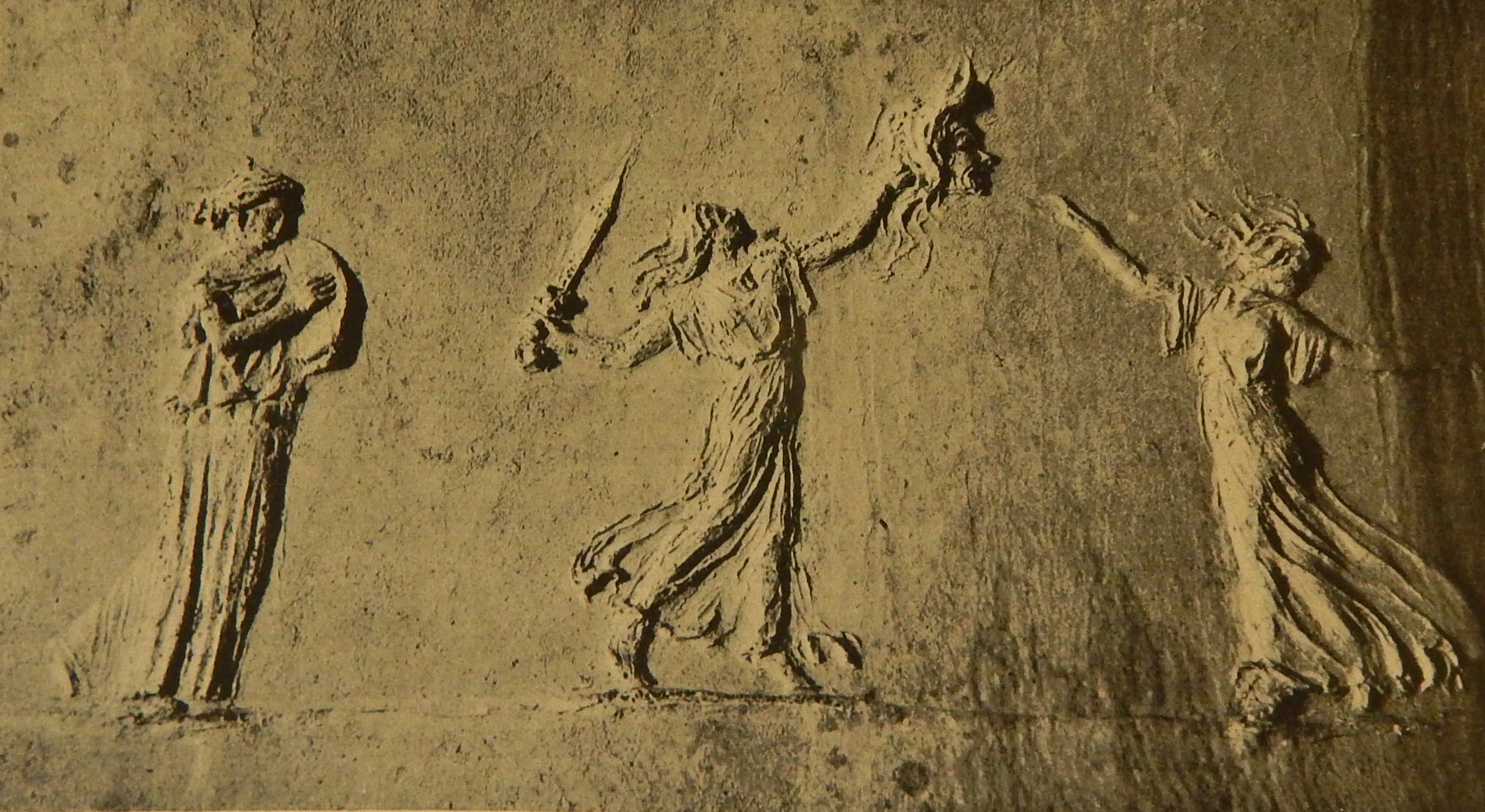
Figure 8: Roman wall painting from Pompeii depicting dwarves performing the Judgment of Solomon. Photo: Museo Nazionale, Naples.

The pyrrhic style therefore migrated easily throughout the fractured Greek world and, unlike other dance forms, offered an image of solemn, heroic, tragic deportment that survived everywhere efforts to parody it or transform the image (rather than the body of the performer) into an object of ridicule. The movement allowing the body to achieve and sustain a heroic, tragic aura follows a rather simple device that appears fairly abundantly in the visual evidence of several centuries. Pyrrhic movement involves placing one foot directly in front of the other, or one foot “challenging” the other, as Anthon (1848: 381) puts it, while the body as a whole maintains an erect, perpendicular axis in relation to the dancing surface. The movement projects a march-like quality, a sense of momentum that embodies stealth, steadfast determination, and commanding elegance. But while the device itself is simple, its execution is not and its expressive potential encourages a heightened competitive spirit that eventually made the style appealing to persons seeking professional careers as performers. It is not a natural way of moving. Yet it is movement that allows the performer to construct a wide repertoire of expressive dynamics.  

            One can move with the soles of the feet flat on the ground to create a mood of stable, assured control over space; or one can move on tip-toes to create a mood of poised, alert, heightened precarious anticipation [Figure 9]. The movement can accommodate a wide range of speeds, tempos, and metrical orders without undermining the martial elegance of the body. The basic step movement also permits the body to accent or amplify rhythms within itself, such as dips, pauses, or curvatures in the vertical axis. The movement is impressive when advancing toward the spectator, when in profile, and even when in reverse (backpedaling). But more significant yet is the power of the movement to develop the expressivity of the upper body. In relation to the vertical axis, the turning or tilting of the head produces a strikingly dramatic tension between the plane of movement and the plane of the performer’s gaze. Such tension further arises with a twisting of the torso at each step or a slinking motion that vaguely contradicts the martial uprightness of the basic position, as in the famous statue of the faun at the House of the Faun in Pompeii [Figure 10]. The pyrrhic step allowed for remarkable flexibility of arm and hand movements, either synchronized with the step or in tension with the rhythm of the step, or with one hand held high and the other held low, and arm and hand movements could shift from exquisite delicacy to startling violence. Another curious feature of the step is its capacity not only to accommodate but to encourage a kind of lilting effect associated with the expression of femininity [Figure 11]. Yet it is a mode of femininity that never seems to prevent the pyrrhic step from maintaining an effect of poised military composure and command over space. It is therefore not altogether bizarre that the pantomimes relied heavily on the pyrrhic step at the same time as they impersonated numerous tragic, mythic women–and the overwhelming majority of star pantomimes were male. Finally, the pyrrhic movement permitted dramatic pivots, smooth transitions to spectacular poses, and an elegant structure for initiating and concluding acrobatic stunts. Indeed, during the Empire, rope dancers fell under the control of the pantomime companies. The rope dance is itself an exaggerated expression of the pyrrhic step, which became thrilling when performed in the circus stadiums, as an interlude between chariot races, without the security of a net. Moreover, the performer danced along a rope that inclined upward from the island in the arena to a higher point in the audience. Item 112, “De funambulo,” in the Anthologia Latina, compiled in Africa around 533 CEdescribes this stunt; and anyone who wants to discover how unnatural the pyrrhic step feels to the balance of the body should try walking uphill, one foot in directly in front of the other.

Figure 9: Frieze depicting the pyrrhic movement: marble relief in the Vatican dating from first century CE. Photo: Weege (1926). 
Figure 10: Bronze statue of Faun performing pyrrhic step, from the House of the Faun, Pompeii, first century CE. Photo: Karl Toepfer.

All these qualities of the pyrrhic step, when used in combination, bestowed upon the body an image of intense dramatic complexity and urged the body toward characterization, toward the disclosure of concealed or conflicting identities within the body. It was a mode of movement that co-existed seductively with the display of masks and gorgeous costumes. In fact, the pantomime was not really about the mythic world; it was always about the multiple, theatrical nature of human identity in an imperial political domain. Audiences wanted to see the pantomimes put on and take off the masks, the lavish costumes, all displayed within the performance space. The pantomimes never performed entire stories; they performed only momentous scenes from stories, in succession, montage fashion, because the point of the performance was to reveal the performer’s virtuosity in moving from character to character, from male to female, from mood to mood, from one fate to another.     

Yet the controlling principle of the pyrrhic step imbued all the spectacle and fantastic sensationalism with an elegance and martial command over body and space. This aura of elegance gave the pantomime a much higher cultural, economic, and political status than that bestowed upon the conventional street performance of farces by mimes, of gladiatorial contests and wild beast extravaganzas, and even of the chariot races and factions for which, eventually, the pantomime functioned primarily as a cheerleading intermezzo entertainment. The pyrrhic orientation of tragic movement was an effort to expand the signification of ecstatic bodily movement beyond the conventional Dionysian association with intoxicated maenadic wildness and “feminine” loss of control over body and space. It was, indeed, an art that could stir audiences to excesses, as indicated by the occasional, stunning outbreaks of rioting and social disturbance (from 15 CE until well into the sixth century) in different parts of the Empire, provoked, according to the state, by the public’s adulation of pantomimes. But this “masculine” form of ecstatic dancing, as Delavaud-Roux called it, invested the body with a greater sense of freedom and power than the maenadic “feminine” forms of ecstatic dance much more closely linked to the Dionysian cult. As Lawler (1927) observed many decades ago, the maenadic dances, which organized movement according to a circular, looping principle of repetition, produced dances that had no beginning, middle, or end, and therefore confined the pleasure value of the spectacle to the performer. The maenadic dances showed bodies possessed rather than in possession; they showed the body consumed and controlled by a force external to it, by a context, by a god. Maenads danced in groups without a driving competitive objective (dancing for the invisible god, not the critical spectator), and so the repetitiveness of their movements did very little to differentiate individual bodies. The body always remained immersed within the circular (rather than advancing) movement of a group, of a peculiar, localized, cultic social context. The competitive impulse defining the pyrrhic organization of movement worked to differentiate bodies and intensify dramatic interest in movement as spectacle for people who watch instead of perform; it emphasized power emanating from the body rather than consuming it. The pyrrhic orientation moved dance toward idealization of the body and professionalization of performance. In the imperial centuries following the Macedonian invasion, the pyrrhic construction of ecstatic movement dominated the theatrical tastes of audiences within the Greek and Roman Empires because it revealed the controlling, transformative power, not of gods, but of the human body.  

However, the major question remains: what was the relation between movement and narrative in the pantomime? The narrative organization of pantomimes differed radically from that of dramatic performances in other cultures almost everywhere else in history, because, in the ancient Roman world, storytelling in itself possessed a value inferior to that of persuasive argumentation or revelation by example. Roman culture did not encourage the telling of original stories, so the idea of stories and imaginative experiences somehow shared by audiences for theatrical performances depended on the assumption that spectators in any part of Roman civilization already knew all the stories that anyone needed to know to “understand” motives for action within a space designated for the impersonation of imaginary identities. These stories derived overwhelming from ancient Greek mythology and sometimes from ancient Roman religion and mythology. Wüst (1949: 847-849) catalogued the titles of about 180 tragic works that could be associated with the pantomime. All the titles bear the names of characters from ancient Greek mythology, such as Ajax or Agammenon. However, it is not always clear from the ancient sources whether the titles refer to literary dramas or to performances in which a dancer impersonated a character. Indeed, in the ancient world, performers “owned” mythic characters to a greater degree than texts or authors. Ancient audiences in the first century BCE or in the fourth century CE did not evaluate a pantomime performance of Oedipus in relation to the character described by Sophocles’ play nor that by any other author concerned with this character; they compared the pantomime’s Oedipus with impersonations of the character by other pantomimes. Performance had nothing to do with affirming the authority of texts nor even of the myths themselves. Performance affirmed the authority of the myth—or more precisely, the ideology—of metamorphosis, the belief that all living things changed their forms as a result of divine energies stored within them. 

Figure 11: Movements and poses with the pyrrhic step from frontal perspective using different masks, gestures, and props. Photos: Karl Toepfer.

Previous Section

Next Section

References

Table of Contents

Roman Pantomime Aesthetics: The Pantomime Performance Scene

Pantomime: The History and Metamorphosis of a Theatrical Ideology: Table of Contents

PDF version of the entire book.

Roman Pantomime Aesthetics

The Pantomime Performance Scene

To grasp the imperial nature of the pantomime aesthetic, one has to gather evidence from a variety of contexts–literature, dance, art, archeology, music, political history, domestic history, religious history–and in doing so, the scholar experiences perhaps the feeling of being an outsider entering foreign territories and staking some sort of claim within them. The pantomime operated in different performance contexts, yet a peculiar feature of the aesthetic was that it detached human action from any precise sense of context. It concentrated theatrical signification in the movement and decoration of the performer’s body, so that performance migrated easily from the theater to the stadium to the villa and to the ceremonial procession. This is not to say that the pantomime did not take advantage of the unique expressive properties of particular performance sites. But rather that the pantomime belonged to a general performance culture that preferred to see the expressive power of human actions as independent of a “scene” or a highly specific, localized physical environment. Such enthusiasm for decontextualizing bodily performance was not unique to the pantomime; in artistic representations of other forms of performance, such as gladiatorial combats, Cybeleian processions, and acrobatic spectacles, one observes a constant effort to foreground the performer’s body against an empty background [Figure 1]. 

Figure 1: Marble relief in the British Museum of a procession depicting a maenad with a tambourine, a tibia player, and a god or Hercules figure with a panther companion, showing the tendency of Roman artists to foreground performing bodies against neutral, “empty,” or undefined backgrounds. Photo: British Museum.

The extravagantly “theatrical” style of the Third and Fourth periods of Pompeian wall painting has led some historians to suggest that it is difficult to differentiate Roman representations of theatrical performances from representations of the myths which were the subject of the performances. But when representing the myths themselves, the artists tend to situate their subjects within a physical context. They at least put in a tree, hills, an architectural structure, some visual reference to a generic physical reality external to the human figures. In the altogether rarer images (in wall paintings and mosaics) of performances themselves, the artists tend to place the human figures against an empty white or colored background and to thematize overtly the tension between the human face and a mask or masks [Figure 2]. Figure 2: Man wearing mask with woman lyre player against an “empty” background in painting from Herculaneum, ca. 60-79 CE. Photo: Mimmo Jodice, from Guillaud (1990). The extravagantly “theatrical” style of the Third and Fourth periods of Pompeian wall painting has led some historians to suggest that it is difficult to differentiate Roman representations of theatrical performances from representations of the myths which were the subject of the performances. But when representing the myths themselves, the artists tend to situate their subjects within a physical context. They at least put in a tree, hills, an architectural structure, some visual reference to a generic physical reality external to the human figures. In the altogether rarer images (in wall paintings and mosaics) of performances themselves, the artists tend to place the human figures against an empty white or colored background and to thematize overtly the tension between the human face and a mask or masks [Figure 2]. 

Figure 2: Man wearing mask with woman lyre player against an “empty” background in painting from Herculaneum, ca. 60-79 CE. Photo: Mimmo Jodice, from Guillaud (1990). 

The Pompeian wall paintings are an important source of evidence concerning the pantomime aesthetic, but not because they represent performance with much accuracy. Rather, the images theatricalize domestic space and articulate a sophisticated, theatrical attitude toward the relation between space and daily human actions performed within it. The image was a metaphor for an attitude toward relations between space and body. The metaphor was not the image of performance; performance was actually another image of a similar attitude. 

Figure 3: Stucco frieze from the underground vault of Porta Maggiore in Rome depicting a pantomimic performance of Agave displaying the head of Pentheus, with musician accompanying the scene. Photo from Weege (1926). 

Figure 3 is perhaps the earliest image of pantomime performance that has survived. It comes from the underground stucco frieze vault in the Basilica of Porta Maggiore in Rome, dates from sometime in the first century CE, and depicts Agave brandishing the severed head of her son Pentheus while a companion maenad dances ecstatically. The severed head bears exaggerated, mask-like features, but it is extremely difficult to tell if Agave herself wears a mask. The female musician to the left emphasizes the idea of performance by tapping her drum in a sober, composed manner that contrasts with the ecstatic movement of the dancers. It is possible that the background contained a painted landscape, but this seems unlikely, because the frieze is not large, and painted objects in the background would make it difficult for the viewer to notice or read at a distance the bodily action with any clarity. And in any case, the whole point of the frieze technique is to foreground the bodies. 

Figures 4 and 5: Wall paintings from Pompeii deposited in Museo Archeological Nazionale, first century CE. Photo: Rito Bacchico.  

Figures 4 and 5 display a somewhat similar aesthetic principle. These are fragments of Pompeian wall paintings from the first century CE now deposited in the Naples Museum and they also depict Dionysian rituals. In Figure 4 especially, the self-consciously theatrical style of the image seems intensified by contrasting the brazen movement of the maenad at the left with the blatantly statuesque poses of the three other human figures and the leopard. A shift from extravagant movement to frozen pose was a feature of the pantomime; movement culminated in a spectacular pose. Both Plutarch and Lucian remarked on the delight of pantomime spectators in observing the details of a complex pose, and that early third century CE connoisseur of the pantomime, Philostratus, in his Imagines, compiled a sort of catalogue of popular and sophisticated poses for paintings inspired by theatrical enactments. The bodies in Figures 4 and 5 glow with an eerie luster that the black background intensifies. Even the doorway in Figure 5 opens into emptiness. But while these images of performance avoid contextualizing human action by giving much in the way of form to the physical environment, they nevertheless ascribe a powerful abstract identity to the space in which the bodies appear. Pantomime movement was partly about the emotional value, not of the objects that fill in space, but of space itself. The colored background sensualized the emotional value of space. This technique, which was not original with the Romans, appeared inevitably when artists wished to extract the performing body from the mythic body, as in Figure 6one of a series of dancers depicted in a Pompeian wall painting of the first century CE. The technique is even more dramatically evident in the famous mural of the Villa of Mysteries depicting the performance of a stunningly enigmatic ritual against a blood-red background [Figure 7]. 

Figure 6: Pompeiian wall painting of a dancer representing “Summer” with black background, from the Villa of Diomedes. Photo: Fausto and Felice Niccolini (1896). 
Figure 7: Wall painting of a mysterious ritual, part of the fresco depicting the ritual at the Villa of Mysteries, Pompeii. Photo: Karl Toepfer. 

At the moment, however, my purpose is merely to identify an enduring, imperial attitude toward the aesthetic performance of the body. It is an attitude governed more by the body’s relation to space than to place. It is an attitude dominated by the belief that the freedom and power of human identity becomes most visible or “real” when human action transcends the constraints or “borders” imposed upon it by a localized notion of place other than the space of performance. The pantomime appropriated spaces for performance; it did not claim a particular place, such as the theater, as its exclusive domain. This imperial attitude toward the relation between body and space controlled the organization and use of other performance elements in the performance culture: theater architecture, costume, musical composition, chorus deployment, and, of course, the treatment of language, speech, and voice. As Bier (1920), Robert (1930), and Weinreich (1948) long ago observed, the idea that the pantomimes Pylades and Bathyllus “invented” the genre in Rome in 22 BCE derives from a misreading of ancient texts, chiefly Atheneus (Deinosophistae, I, 20) and remarks in the Anthologia Palatinae (IX, 248). These imply that the two pantomimes so enchanted the Emperor Augustus that he bestowed state protection on them and thereby accorded the genre the official recognition it needed to become fully institutionalized. It seems logical to assume that Augustus favored the pantomimes for a political reason: their art advanced the imperial objective of being comprehensible to large audiences everywhere in the Empire. But the imperial impulse of the aesthetic preceded Augustus, and the reasons for ascribing a Roman origin for the pantomime on the part of both ancient Greek writers and modern historians are themselves more political than scholarly. Although Greeks assumed some responsibility for shaping the pantomime aesthetic, the cultural identity of the aesthetic was always ambiguous. Alexandria was the major home and training center for pantomimes in the century that Augustus encountered Pylades and Bathyllus, both of whom came from Alexandria, where the dance drama absorbed not only Egyptian but oriental ideas about bodily expressivity. This is not to say, however, that the Romans did not make significant contributions to the art or that archaic performance values cultivated by the Etruscans and Italian tribes did not influence Roman appreciation of the art. The point is merely that, from the ancient perspective, the aesthetic was imperial because its identity was multicultural, insofar as it projected a cultural identity without any clear sense of “context.”

Previous Section

Next Section

References

Table of Contents