Pantomime in the 1920s: Pantomime: a European Emblem of Modernity

Pantomime: The History and Metamorphosis of a Theatrical Ideology: Table of Contents

PDF version of the entire book.

Pantomime: a European Emblem of Modernity

Still, the war definitely had an impact on the cultural landscape of the West, including pantomime. The appetite for wordless performance outside of film was large. The 1920s was an exuberant, immensely innovative period in the history of dance. In Paris, throughout the decade, the famous Ballet Russes (1909-1929) continued its pre-war agenda of producing works that brought together leading modernists in choreography, music, and the visual arts. Under the direction of the impresario Sergei Diaghilev (1872-1929), the Ballet Russes freed ballet from the rigidity of state-subsidized ballet companies and their auxiliary academies. Diaghilev cultivated dance as an extravagant art that not only stirred bodies to spectacular expressions of glamor and dynamism but stimulated composers and visual artists to expand considerably the borders of their imaginations. The Ballet Russes established ballet as a modernist project that made the dancer the catalyst for an exhilarating intersection of the most advanced visual, musical, and choreographic arts. The Ballet Suedois (1920-1925), also in Paris and master-minded by Rolf de Maré (1888-1964), emulated Diaghilev’s strategy of redefining ballet by organizing the collaboration of extremely adventurous dancers with prominent modernist composers and visual artists. This company’s works, choreographed almost entirely by the blazingly and self-destructively brilliant Jean Börlin (1893-1930), were perhaps even more radical in their departure from classical ballet aesthetics than the Ballet Russes, reaching an apex with Relâche (1924), an almost Dadaistic experiment incorporating a nonsensical film (directed by René Clair), super-abstract sets by Francis Picabia, music by Erik Satie, and choreography that produced a complete “rupture, a break, with traditional ballet,” in which the almost total freedom from classical technique—that is, “as rapid and agreeable a movement as that procured by a 300 HP engine on the best road, lined with trees slanting in the illusion created by speed”—was synonymous with freedom from any conventional narrative coherence: instead, “a sensation of newness, of pleasure, the sensation of forgetting that one has to ‘think’ and ‘know’ something in order to like something” (Häger 1990: 252; cf., Claustrat 2012). But in his efforts to release ballet from classical technique, Börlin apparently flirted with pantomime. In 1920, he devised what he called “mimed scenes,” which sought to bring to life numerous figures from a painting of a storm approaching Toledo by the Spanish artist El Greco (1541-1614) and convincingly recreated by the head painter of the Paris Opera, Georges Mouveau (1878-1959). This expressionistic piece, with music composed by Désiré-Émile Inghelbrecht (1880-1965) after Börlin had designed the action/choreography, “contained nothing that was currently understood as dance.” “As with El Greco, the focus of activity lay in the arms, torso and head. There was less emphasis on the legs: the characters, more or less glued to the stage, danced on the spot,” and enacted a wide range of figures from El Greco, defined, so to speak, by the characterizing arm, head, and torso movements that fixed their “places” in the dark image of the city under the storm, including priests, aristocrats, a heretic, a victim of lightning, a girl converting the heretic, and devout pilgrims: “the dynamism of the baroque […] has been liberated and transformed into mimicry of life” (Häger 1990: 18-19, 104-109; De Groote 2002: 34-35). But despite the excitement aroused by El Greco, Börlin quickly moved away from expressionism and any intimation of pantomime: he wanted to embrace a more radiant Parisian-Mediterranean idea of freedom through release from Northern seriousness, with its stress on the dark emotional logic that animates bodies. But Börlin was not the only one in Paris thinking of pantomime as a form of anti-ballet. In 1920, the Swiss composer Arthur Honegger (1892-1955), who soon worked with Börlin, collaborated with the French illustrator and theatrical designer Guy Fauconnet (1882-1920) on what was originally to be a twenty-minute ballet, Horace victorieux, from a scenario by Fauconnet, who based his story on an anecdote in Livy. When Fauconnet died suddenly, the plan to stage the work collapsed; Honegger arranged the music, quite somber and heavy with expressionistic harmonies, as a “symphonic mime,” for indeed the music is far more suited to stark pantomimic action than to sleek balletic movements (Meylen 1982: 31-33). When the premiere of the music with the scenario took place in Essen, Germany in 1928, it was as a semi-pantomime, choreographed by Jens Keith (1898-1958), which preceded a performance of Honegger’s expressionistic opera Antigone (1927). The reception, however, was “frankly hostile,” presumably because the program was too intensely dissonant (Halbreich 1999: 114). But more information about the scenario and the performance is necessary to determine the significance of Horace victorieux, which, unfortunately, has not received any subsequent theatrical performance in spite of its extraordinary, though not “dancey,” music, for ballet companies continue to ignore it. 

In their attempts to redefine ballet, the Ballet Russes and especially the Ballet Suedois revived ancient uncertainties about the distinction between ballet and pantomime (non-dance). Since the eighteenth century, ballet had striven to “free” itself from pantomime and to subordinate narrative to the greater goal of displaying graceful movement. Even when pantomime appeared in ballet, as it does in some of the older masterworks, it had to follow the “rules” of classical ballet technique for pantomime, as articulated by the revered ballet master Carlo Blasis (1797-1878), who explained, in his Code of Terpsichore (1820), that “Every action in pantomime must be regulated by the music” and that pantomime achieves sufficient emotional power only when performed by dancers proficient in ballet technique (Blasis 1830: 122, 127). Familiar with Lucian’s writings on ancient Roman pantomime, Blasis, regarded pantomime as a foundational platform in the evolution of ballet: “Pantomime is, undoubtedly, the very soul and support of the Ballet,” and if in ballet pantomime no longer seems a significant element, it is because composers (not choreographers!) “have not sufficient talent to put Pantomime upon an equality with dancing” (Blasis 1830: 121). But within ballet culture, Blasis’ evolutionary idea of pantomime as a primal or fundamental phase of ballet history meant that ballet could only evolve to the ever-higher phase of its history by diminishing or altogether eliminating pantomime as a goal of performance. At any rate, Blasis inadvertently made pantomime seem like a disorderly or neglected form of dance in need of strict regulation. In reality, however, the regulation of pantomime meant the subordination of narrative to the display of movement. By the end of the nineteenth century, the distinction between ballet and pantomime was clear, which we may summarize as follows. While gestures generally operate within a code or system of signs, a common misunderstanding about pantomime is that it “translates” words into gestures or physical movements. But pantomime is best when it follows its own system of signification rather than translates from one system to another. More precisely, pantomime emphasizes action over movement. Actions, of course, contain movements. But in pantomime, the performer thinks in terms of completing an action and then initiating another one, so that one action follows another. Pantomime shows how the body narrates. The performance of these actions does not follow any “rules” of movement; rather, the performer finds the best, most efficient way to perform the action, usually in a manner unique to the performer. What is important is the relation of one action to the next, how well the performer connects one action to another according to a “feeling” that is signified while performing the actions. In dance, especially ballet, what is important is movement itself, the formal beauty of the body in motion. In pantomime, a performer will pick up a glass of wine, take a sip, then study messages on an iPhone, while also signifying that he is maybe in an exuberant mood … or sad or filled with anxiety or cheerful and then suddenly surprised by a message. This is a set of actions. In dance, the tendency is to use the narrative as a basis for displaying the beauty of a body in motion, an excuse for showing off movements. The dancer picks up a glass of wine off a table, holds it high, then pirouettes with the glass, rises on pointe with the glass, then rushes in a great arc over the stage. The idea is: “Look, I have a glass of wine! See what I can do holding this glass of wine. Behold the beautiful movements I can make holding this glass of wine. Look how my body shows the exhilarating thrill of taking the first sip!” The idea in pantomime is to show how the body alone constructs a narrative by moving from one action to another according to a logic signified physically. It is about the power of the body to narrate. The idea in ballet is that the body disrupts narrative control over it–to a great degree it is about how the body frees itself from narrative and follows its own “rules.” Dance is about movements of the body that are interesting in themselves, and what makes them interesting is often what they reveal about the dancers or dance itself rather than about anything outside of dance. But dance (especially ballet!) is always about “rules,” the regulation of the body by a system external to it, about steps, positions, a vocabulary of movements that determine the beauty or value of the art. These rules do not come from the performers; they come from movement systems, from schools. Dancers are always evaluated in relation to their adherence to the “system” or school to which they belong. Pantomimes are generally evaluated in relation to the characters they represent, their ability to represent identities outside of their own and outside of any system controlling their bodies. 

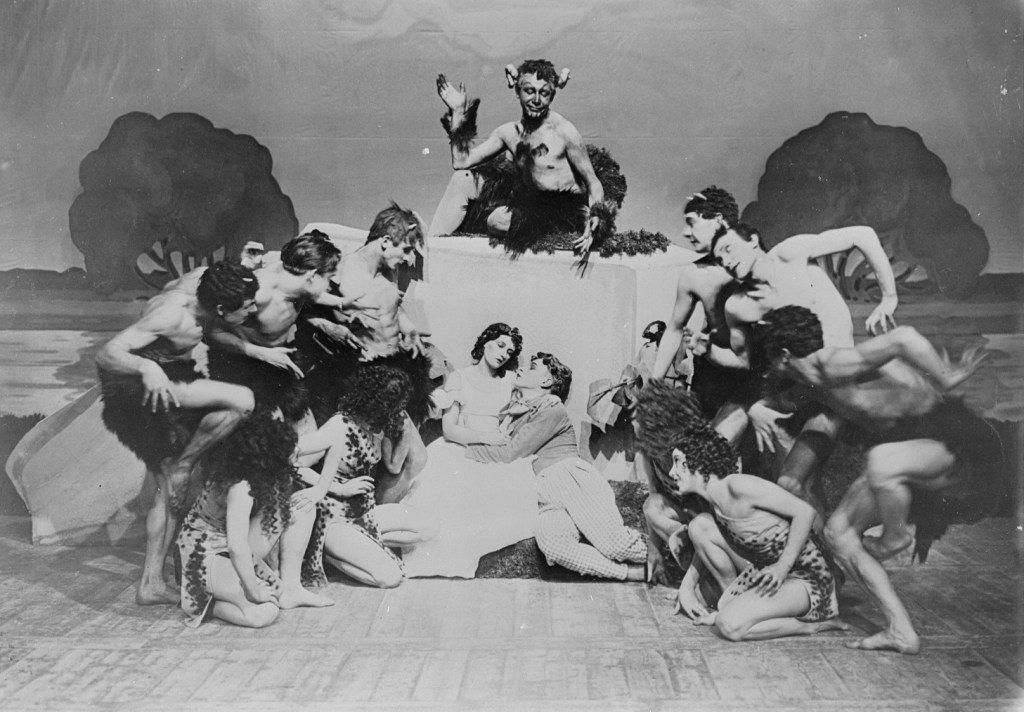
But by 1920, as a result of the Ballet Russes and the Ballet Suedois, the distinction between ballet and pantomime became muddled, even though neither company had a deep interest in pantomime, simply because the companies sought to change the rules of ballet by incorporating modernist visual and sonic dimensions that somehow “compromised” the glorification of movement in itself. In Germany, which had no strong ballet tradition of its own, probably abetted by Wagner’s notorious aversion to dance in opera, the distinction was perhaps even more muddled. In the days before the terms “Ausdruckstanz” and “Freie Tanz” designated modern dance, Germans used a variety of terms to describe the non-balletic artistic theatrical dance for which the country was a major producer: “Tanzpantomime,” “Tanzspiel,” “Tanzdrama,” “Tanzdichtung.” For awhile, Rudolf Laban used the term “Choreodrama,” apparently without knowing that the term had been applied to Viganò’s productions over a hundred years earlier. In 1925, Emil Reznicek (1860-1945) composed a large-scale “Tanz-Sinfonie: Marionetten des Todes,” which had a production at the Dresden Opera in 1927, with choreography and apparently scenario by that connoisseur of luxuriously bizarre dance performance Ellen Petz (1899-1970), who had shifted from ballet to modern dance during the war (cf. Toepfer 1997: 286). The tendency nowadays is to refer to the symphony as “ballet music,” but Reznicek classified the movements of the symphony according to folk dance forms: Polonaise, Csárdás, Ländler, Tarantella, and Petz used the movements to create four “images” of an opulent, aristocratic milieu from the seventeenth century without calling it a ballet, although information about this production, as with all of Petz’s mysterious work, remains maddeningly obscure. Possibly the first to coin a German term for non-balletic art dancing was Otto Julius Bierbaum (1865-1910), with his scenario for Pan im Busch (1899), which he called a “Tanzspiel” or “dance play,” a term used previously, extremely rarely, in an anthropological context to refer to festive dance rituals in folk or non-Western societies. This piece contrasted the amorous adventures of some school children haplessly supervised by a Professor and Governess in a twilight grove with the amorous gamboling of fauns and “panisci” (female fauns) encouraged by the lascivious, flute-playing Pan and his consort Aphrodite. As night falls, the difference between dream and reality dissolves, and a romantic pair who have fallen asleep in the grove become a shepherd and nymph, worshippers of Pan and Aphrodite. But after a storm, the school children return with lanterns: the Professor and Governess forgive the stray students and the piece concludes with a rousing ensemble dance in gallop tempo, with Pan’s head appearing “between the lanterns” (Bierbaum 1900). Pan im Busch combines pantomime with processional movements, poses, and different kinds of dances (round dances, waltzes, polonaise); with its numerous decorative effects, such as the procession of lanterns, an inundation of rose petals, and Aphrodite in white chiton, gold sandals, and gold ornaments, the piece resembles an erotic festival pageant or a hothouse erotic ceremony. It is certainly not a ballet. Bierbaum sought to engage Richard Strauss to write the music, for Strauss was always looking for opportunities to compose for the theater. But he didn’t see one in Bierbaum’s scenario (Heisler 2009: 38-39). So Bierbaum’s friend, the Wagnerian conductor Felix Mottl (1856-1911), wrote the orchestral score, and the work had a production at the Karlsruhe Opera in March 1900 that employed such a densely lush forest setting that it is difficult to see how any kind of dancing could take place on the stage (Bühne und Welt v.2 pt.2 1900: 624; Draheim 2004: 109). But this odd work managed to have another production thirty years later, in Tallinn, Estonia. At the Estonia Theater, Rahel Olbrei (1898-1984), the opera ballet director, staged the piece in December 1929 using both actors and dancers and an expressionist set designed by Aleksander Tuurand (1888-1936) that provided space for dancing, although critics complained that the dances went on too long and with too much “bustle.” Olbrei took a more blatantly erotic approach to the scenario than the Karlsruhe production by stressing voluptuous movements, lifts, and poses. But the acting succeeded more than the dancing, which combined ballet with German modern dance. The ballet company was only three years old, and Olbrei was struggling to build a reliable, distinctive unit with the limited talent and resources available to her. A “Tanzspiel” seemed a way to disguise these limitations, but the critic Henrik Visnapuu (1890-1951) warned that “dance pantomime,” as he called it, required as much talent as ballet and was by implication not a term to which one should attach lowered artistic expectations (Leis 2006: 31; Einasto 2018: 129-131). 
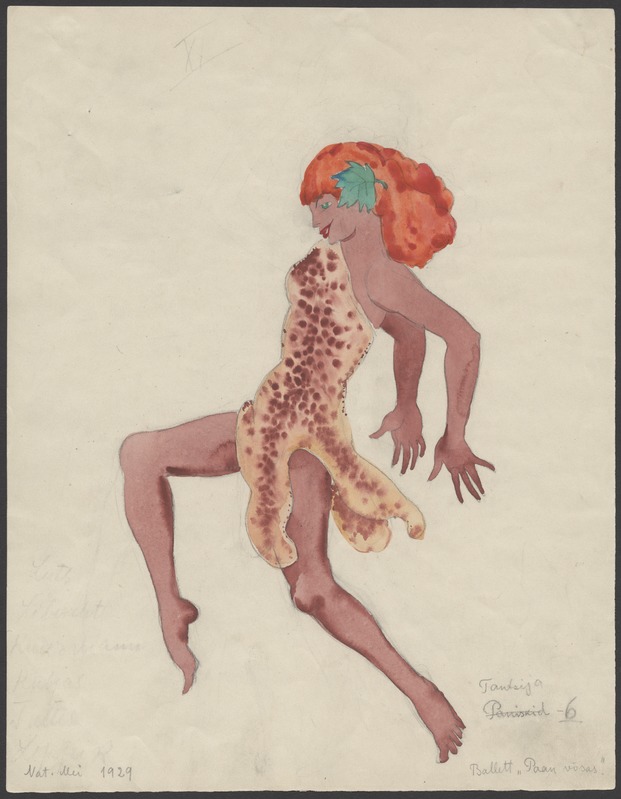
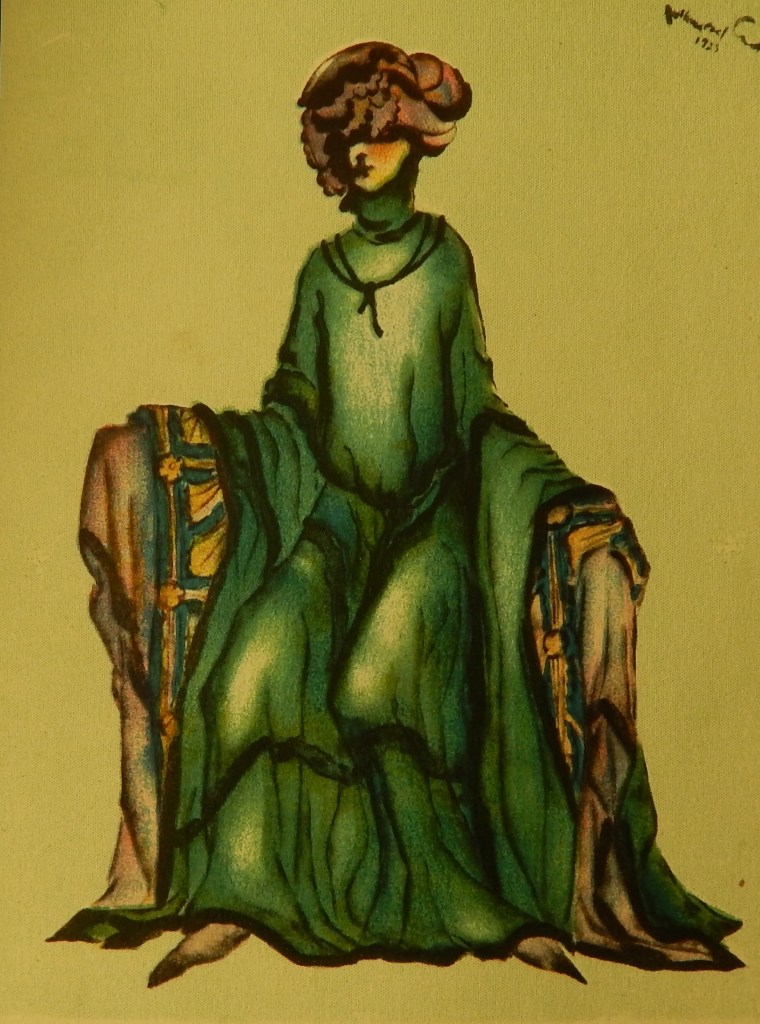
Figure 134: Costume design by Natalie Mei (1900-1975) for Otto Julius Birnbaum’s “Pan im Busch” (“Paan vosas“), directed by Rahel Olbrei, Tallinn, Estonia, 1929. Photo courtesy of the Estonian Theater and Music Museum.
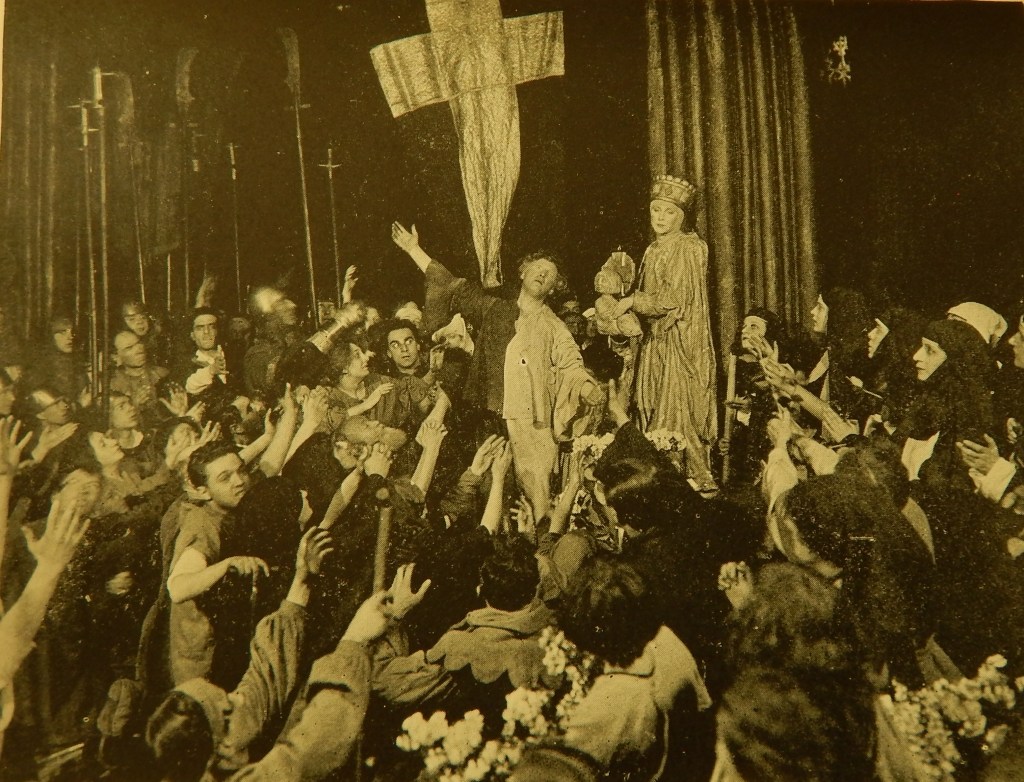
Figure 135: Scene from Otto Julius Birnbaum’s “Pan im Busch” (“Paan vosas“) (1929), directed by Rahel Olbrei, Estonia Theater, Tallinn. Photo by J. & P. Parikas courtesy of the Estonian Theater and Music Museum

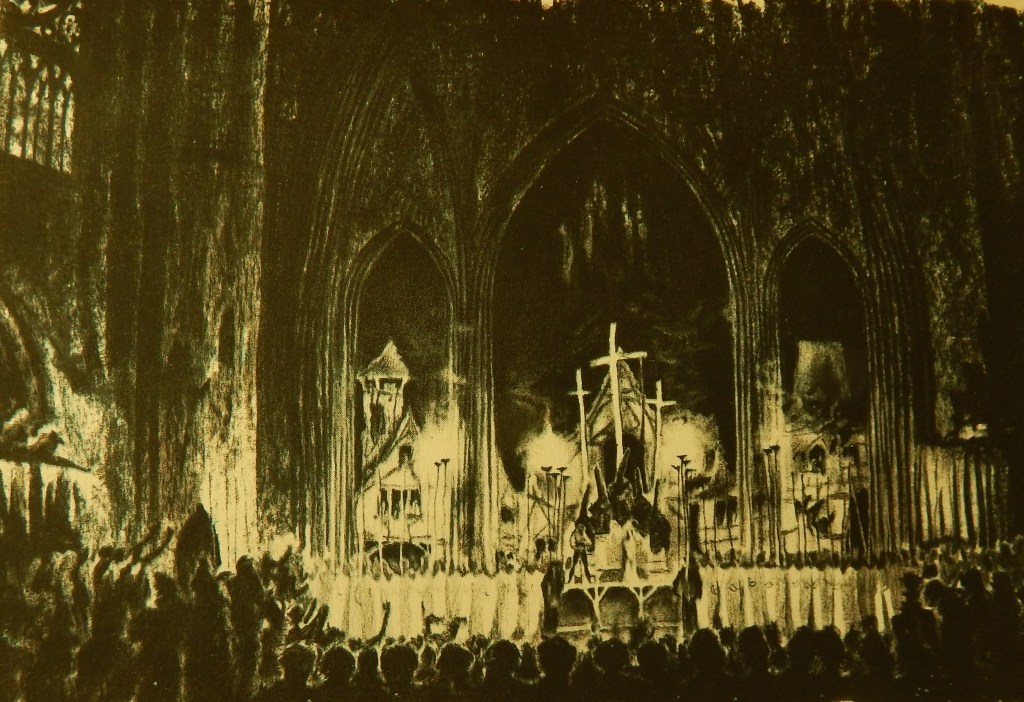
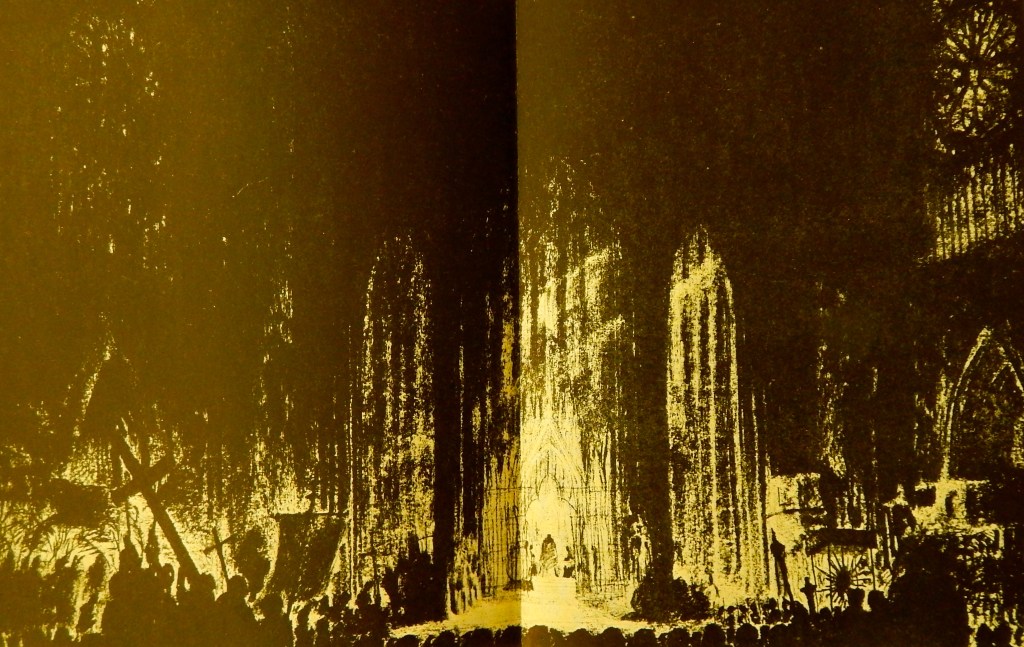
As explained earlier, the modern solo dance concert program resembled the ancient Roman pantomime in its exploration of the metamorphosis of the performer’s body through the combination of pantomimic and dance movements. By 1924, however, the solo modern dance concert was in steep decline: modern dance, with its new schools, favored ensemble pieces that emphasized formal complexity, abstraction, and the power of movement to free bodies from the constraints on identity imposed upon them by too easily decipherable narratives. But pantomime was by no means dead, and perhaps enjoyed a wider range of actual performances than during the period 1900 to 1913, even if fewer people could claim “authorship” of it. The revival of Reinhardt’s Das Mirakel in 1924-1925 achieved great popular success, but for the most part during the 1920s pantomime in the theater appealed to modernist, even avant-garde sensibilities. But of course, sometimes the pantomimic imagination was difficult to manage, even for quite experimental artists in an era famous for experimentation in the arts. For example, in 1920, the Russian composer Sonia Fridman, later known as Sophie-Carmen Eckhardt-Gramatté (1899-1974), met and married the expressionist artist Walter Gramatté (1897-1929) in Berlin. Since 1914, when she had lived in Paris, Fridman had worked on the scenario and music for a pantomime called Ziganka. Her marriage to Gramatté caused her to move the pantomime project into alignment with the dark, eerie mysticism of his paintings. The scenario takes place in a mountainous landscape of the unconscious of a dreaming man—or boy, since the “symphonic pantomime” now bore the title Der träumende Knabe. In its brief three acts, the scenario describes the desire of a Man to unite with an idealized female figure, Ziganka, whom he encounters in a nocturnal mountain pass. Ziganka is actually “the personified thought of the Man,” a feminized version of himself. A tribe of demons, residing in caves filled with red light, tries to persuade the Man to join them and abjure Ziganka. But the Man remains fixated on Ziganka; he performs various gestures to invite her to come close to him, and they perform a dance duet that ends in a kiss. Yet Ziganka remains sad and reteats from him into a deepening darkness. The Man falls asleep in the red cave of the demons, who perform ecstatic actions that emulate the movements of Ziganka. A “red” Ziganka (performed by the same actor who plays the “ideal” Ziganka) appears and dances with the Man, and this dance also ends in a “deep kiss.” The Man realizes the demons have tricked him and he turns against them: the stage fills with screams and red light. As a storm invades the scene, the real Ziganka enters with an entourage of “The Good Ones” and instructs them to dispel the demons, while she herself disappears into the foggy blue horizon. After The Good Ones defeat The Evil Ones, the Man appears and implores The Good Ones to bring him to Ziganka, but The Good Ones block the way. In the final act, the Man wanders alone along a path, at the end of which he encounters the lifeless figure or statue of Ziganka. He is in a forest of “blue trees and black sky.” The stage fills with ecstatic female figures and the sky turns purple. Different female figures attempt to dance with the Man, but he rejects them, while they each mock him and disappear. A scrim falls before the Man to signify that “a world emerges from which the Man remains excluded until the end.” In the background, a mountain rises with a steep stairway. Ziganka and her entourage appear; she shakes her head sadly and gestures to signify: “I live only in your heart, in your imagination; I cannot stay.” After she bows affectionately to him, she and her entourage turn away and ascend the stairs. As the stage becomes darker, Ziganka becomes brighter and brighter. Then, quickly the light fades on her to reveal the upraised arms of the Man, until these, too, go dark with the “dying of the music” (Schulz-Hoffmann 1987: 37-45). The piece makes use of numerous light and color effects, especially a shifting contrast between blue and red. Powerful light shines from stars, from caves, from clouds, from Ziganka. Particularly imaginative is the appearance of three little demons with mirrors attached to their backs. Dancing takes place in all three acts, but most of the action consists of symbolic gestures: imploring, kneeling, summoning, turning away, pointing, trembling, convulsing, reaching, being thrown back, kissing, among others, conveying somewhat the image of bodies moving in a trance. But the piece also includes moments when Ziganka assumes a pose of stillness. As preparation for the production of the pantomime in Berlin, Walter Gramatté drew twenty-two expressionistic pastel images of actions in the piece as a way to visualize the action on stage [Figure 136] (Schulz-Hoffmann 1987). He hoped to direct the production, and in a letter to Sonia, in which he compares her to a hovering angel, he claims that even if he doesn’t direct the piece, their work together will hover similarly above their graves, to be discovered by future generations lamenting the “alien” treatment of the couple’s work by the present society (13-14). But even before she had met Gramatté, Sonia had a sponsor, the economist, venture capitalist, and occasional literary author Robert Friedlaender-Prachtl (1874-1950), who cultivated a multi-faceted passion for theater throughout his life. Sonia envisioned a large-scale symphonic musical accompaniment, but she had limited skill at orchestration. In 1918, Friedlaender-Prachtl contracted with the conductor Hermann Scherchen (1891-1966) to orchestrate Fridman’s music, which Scherchen apparently completed before Fridman met Gramatté. However, Sonia’s life with Walter caused her to make revisions in the scenario. Walter planned to stage the production at the Berlin Staatstheater in 1921 with possibly the solo dancers Niddy Impekoven or Sent M’ahesa playing Ziganka. But the performance never took place, despite the encouragement of such illustrious Berlin theater figures as Ludwig Berger and Paul Wegener, although a performance of the prelude, orchestrated by Sonia’s friend Adam Szpak (1887-1953), occurred at a philharmonic concert in Hamburg in 1923. Her second husband, the art historian Ferdinand Eckhardt (1902-1995), claims that the reason Das träumende Knabe never received a performance was because Sonia kept changing her mind about the piece and never reached a point of deciding it was complete (11-12, 35-36). It may seem, from the scenario and Gramatté’s pictures, that the “symphonic pantomime” dramatizes the failure of the male to unite with the idealized female of his imagination to produce the “work” that allows him to transcend the impure material world. But perhaps for Sonia the piece could never be finished because she kept adding male collaborators, and she could not be sure how to complete herself through any of them. The piece might well be a fascinating critique of male desire, but presumably for Sonia it was not sufficiently autobiographical, not sufficiently “her own.”

Figure 136: Illustration and design concept by Walter Gramatté for Sonia Fridman’s expressionist pantomime and musical composition Der träumende Knabe (1920). Photo: from Schulz-Hoffmann (1987). 

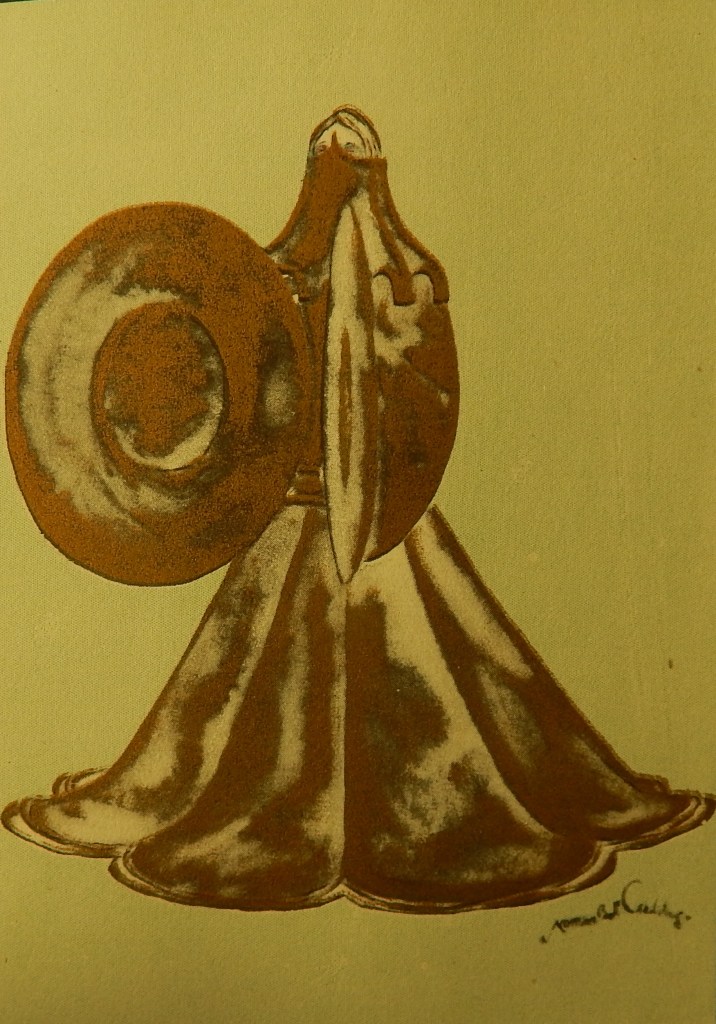
Even so, Sonia Fridman saw expressionist pantomime as a mystical-psychoanalytic convergence of colors, sounds, and movements wherein the body followed a psychic “path” or light that was quite different from the intellectually turbulent, socio-critical expressionism in the pantomime projects of Carl Einstein, Ludwig Rubiner, and Walter Hasenclever. An even more radical expressionist mysticism pervaded the pantomime thinking of the German artist and theater producer Lothar Schreyer (1886-1966). After studying law, Schreyer turned his attention to the theater in Berlin, where he worked as an assistant director in the Deutsches Schauspielhaus. In 1914, he began working with Herwarth Walden (1879-1941), the editor of Der Sturm, the most famous of the expressionist periodicals. In 1916, Walden began publishing in the journal Schreyer’s short, expressionist plays, which consisted largely of dialogue uttered in one, two or three-word phrases, as if the archetypal characters speak primarily to hear the music of the words. By 1918, Walden and Schreyer had founded the Sturm-Bühne, a theater devoted to the production of experimental expressionist plays by Schreyer, Walden, and August Stramm, which all featured somber expressionistic poetic dialogue in the “telegraphic” style spoken by archetypal figures in vague, abstract spaces. Schreyer was supposedly also an instructor at the Sturm-Bühne Schule für Bühnenkunst und Pantomime, but its difficult to determine what this school actually did other than recruit people to work on projects for the Sturm-Bühne. From 1916 on, Schreyer published numerous polemical and promotional essays in which he proposed that expressionism must abandon drama and any conventional idea of theater and instead focus on the creation of “stage artworks” (“Bühnenkunstwerk”). He saw the stage artwork as fundamental to the building of a new society, a new human identity, released from materialsim and transfigured, ecstatically, by a new, modern mode of spirituality. The stage artwork resulted from a highly precise coordination of sound, color, and movement, so that all of these elements unfolded in relation to each other on the stage like notes in a musical score. Indeed, with Kreuzigung (1920), Schreyer composed what he called a “Spielgang,” which was an elaborate pictorial notational system that assigned a cryptic tonality and rhythm to the performance of every word, gesture, sound, image, and color. The “characters” in these stage artworks were allegorical, super-archetypal figures (“Mother,” “Beloved,” “Death,” “Child”), supposedly completely without individuality, which Schreyer regarded as a corrupting phenomenon within modern society. Yet he designed elaborate, highly unique, intensely geometric mask-costumes for these characters so that they looked like fantastically engineered super-dolls or robots. The idea of the stage artwork was not to see a play, but to experience the movement of a very modern image-sculpture in relation to various, intricate permutations of sound, color, and utterance [Figure 137]. 
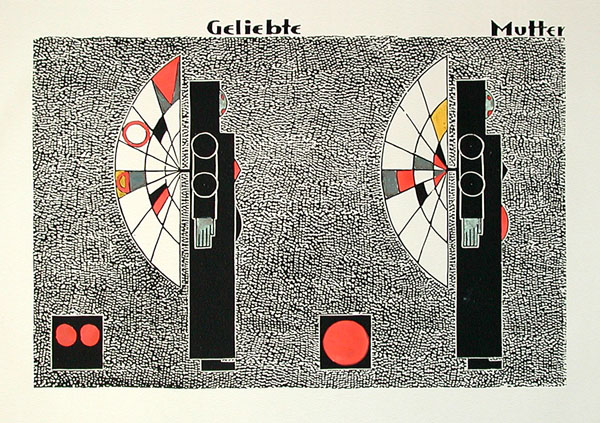
Figure 137: Abstract figures, “Beloved,” and “Mother,” designed by Lothar Schreyer for his “Spielgang” or “play path” Kreuzigung (1920).

Like the Ballet Russes and the Ballet Suedois, Schreyer believed that modernist visual effects changed the way people saw human movement; the path to a new, ecstatic society entailed new rhythmic relations between voice, gesture, color, light, and sound, all of which, in their lunge toward abstraction, turned the performing body itself into something resembling an alien idol. In recollecting his years with the Sturm-Bühne, Schreyer claimed (1948) Scheerbart’s pantomime Kometentanz (1903) had inspired him as had the 1920 Dresden production of William Wauer’s pantomime Die vier Toten der Fiametta (Schreyer 2001: 298, 307). “In every pantomime lies a full and complete action in itself that […] creates a connection between objective and subjective life, in which the objective life bears the subjective and the subjective life discloses the objective. Pantomime is theater. We sought to form it as an expressionistic play of movement” (Schreyer 2001: 297). Yet Schreyer was unable to create any stage artworks without his allegorical robot-characters uttering words, cries, ecstatic telegraphic phrases. He needed a lyricism in performance that he simply could not imagine for the body, which he saw as something requiring completely new engineering, a new geometrical-mathematical relation to color, space, sound, and language. These ideas caused him difficulties. His mysticism provoked tension with Walden, who became fervently attached to socialism. In 1919, Schreyer moved briefly to Hamburg, where he founded the Kampf-Bühne, which, as discussed below, came closer to a mystical expressionist idea of pantomime under the leadership of his protégé Lavinia Schulz (cf. Schreyer 1985: 147-148). His brilliant visual imagination caught the attention of the architect Walter Gropius (1883-1969), who invited him (1921) to teach in the theater section of the newly formed Bauhaus arts academy in Weimar. But when Schreyer staged his two-character (“Man/Moon,” “Woman/Earth/Mother”) Mondspiel at the school in 1923, the students complained about the cultish obscurity of the work, and Gropius himself believed that Schreyer’s expressionism was no longer helpful in designing the products, structures, and forms of modern society. Schreyer resigned. He continued to publish many programmatic articles on theater and performance while pursuing various academic, literary, and religious projects, but he never returned to any creative work in the theater. Yet he understood more clearly than anyone in Paris or in the Bauhaus how a radical image of modernity, including an even more radical image of the body (as an engineered idol), caused even the simplest movements of the body to provoke deeply disconcerting, even violent emotions that obscured the distinction between subjectivity and objectivity, a confusion that, from the expressionist perspective, was necessary to change the subject’s relation to reality and thus move people toward the creation of a new, redemptive society. Schreyer’s ideas probably influenced Oskar Schlemmer (1888-1943) in the development of his Triadic Ballet, the most famous theatrical work of the Bauhaus. Schlemmer began work on this thirty-minute piece in 1915 and he never really finished it when the Bauhaus stopped performing it in 1929. The piece encountered manifold problems related to music, narrative structure, design, and production (cf. Scheper 1988). But perhaps the biggest problem was that Schlemmer invested too much energy into the design of the modernist costumes, many of which were bulbous, heavily geometric, and somewhat clownish. All movement, action, and narrative for the three dancers had to be built around the capability of the costumes to permit anything gestural. The result is like watching a bizarre fashion show: the movement exists to display the costumes. The dancers look like a set of large, animated toys performing mechanically in yellow, pink, and finally dark chessboard spaces. But this image of modernity was obviously much more comforting or soothing than Schreyer’s dark idols or totems for a new religion of modernity. 

In his ambition to make theater a kind of high tech shrine for the convergence of mysticism and modernism, Schreyer cited the 1920 production of William Wauer’s pantomime Die vier Toten der Fiametta as an inspiration for the new theater aesthetic. Yet this pantomime arose from a much different modernist ambition. The piece had its first production at the Kleines Theater, Berlin, in June 1911 as the first theatrical event sponsored by Der Sturm. Herwarth Walden composed and performed the piano accompaniment. The artist historian turned theater director William Wauer (1866-1962) directed the production, but evidently he did not write or need a scenario, for none was ever published, although an advertisement for the production acknowledged that he adapted a one-act play by an obscure writer of operetta libretti, Alexander Pordes-Milo (1878-1931). In a 1909 book on “art in the theater,” Wauer asserted that, “The director is neither the lawyer nor the servant of the poet. He faces the poetry, like the painter nature, the landscape. He uses it as a motive, as a pretext, to produce his art” (Wauer 1909: 13). Wauer soon became a director of silent films, including Richard Wagner (1913), the science fiction drama Der Tunnel(1915), and many others until 1921. The poet Elisabeth Lasker-Schüler (1869-1945), who was at that time married to Walden, became enamored with Wauer’s “anatomical” directing and was eager to have him direct her 1908 drama Die Wupper. She attended a 1910 café lecture by Wauer in which he conducted his audience, mostly students, as if they were instruments of an orchestra, which is how Wauer himself described the role of the theater director in relation to actors (Lasker-Schüler 1914: 115-116; Wauer 1909: 12). Because, however, Die vier Toten der Fiametta lacked a written scenario, it is necessary to rely on the written description of the performance by the novelist Alfred Döblin (1878-1957) in a lengthy review of the piece in Der Sturm (No. 67, 11 July 1911: 531-533). According to Döblin’s scanty description of the story, the pantomime concerns the marriage between a hunchback tailor, Silvio, played by Wauer himself, and his wife, Fiametta, played by the cabaret artist and soon very busy film actress Rosa Valetti (1878-1937). Fiametta feels stifled in her marriage and takes on lovers in succession, three altogether, whom Döblin describes as “harlequins,” each played by a different actor. The jealous Silvio arranges to have each lover killed “accidentally,” thrown out of a window by a drunken beggar, believing that all the lovers are actually one and the same man come back to life. But Fiametta experiences each death as a liberation. In a drunken fury, Silvio, believing himself to be her fourth lover, winds up hurling himself to death. “Fiametta remains triumphant, the symbol of invincibility, the marriage-mocker, alone, if also never abandoned.” It was apparently a dark production. Döblin calls it a “tragedy,” Lasker-Schüler a “Trauerspiel” (sad play); reviewers called it violent, bloody, but not comical, even though on the program it appeared between a performance of Offenbach’s one-act operetta Der verwandelte Katze (1858) and something called Karneval in Nizza with music by Hans Roland (aka Wilhelm Guttmann [1886-1941]). The production elicited numerous reviews, nearly all of which were negative and most of which complained of Walden’s terrible, noisy, “raw,” “childish,” “naïve,” and completely inappropriate music. One critic remarked that the music had completely destroyed his nervous system. Walden devoted two entire huge pages of Der Sturm, with a third page written by the literary critic Josef Adler, to defend his music and quote all the accusations against it (No. 66, 24 June 1911: 523-525). Walden and Adler questioned the competence of the reviewers to assess the music, for the reviewers had praised the trivial music of Offenbach and Roland without seeming to realize that Walden’s music functioned in opposition to the aims of Offenbach and Roland, as if Die vier Toten der Fiametta existed as a drastic contrast rather than complement to the other pieces. The implication is that Walden’s music was a critique or parody of the bourgeois entertainments associated with Offenbach and Roland, but the implication lacks verification, because Walden never published the music, although he published many other compositions. Döblin was more direct in his favorable evaluation of the production as a whole. He treated the pantomime as a critique of marriage insofar as marriage is a “cage,” for “Marriage is perhaps the most sinister production of the human spirit, eerie not for what it is as what it can be.” Fiametta “breaks out of her cage,” although it is not clear if the cage is Döblin’s metaphor or a scenic device-metaphor of the performance. He does, however, refer to the pantomimic action: “it is not necessary that anyone speaks in this piece. The whole expressive dimension of the action can be exhausted in movement; nothing needs to be spoken. This linear expression is artistically best, because it is the narrowest and most concentrated,” an “economic” principle that allows “minimum force to be applied for maximum effect.” In this piece, the “movement of the mute pantomime” showed how a “leaden, rigid scheme” (the narrative? like a cage?) imposes itself on “the flow and abundance of the living process” and “imprints a naked dynamic and energy.” But then, Döblin turns his attention to defending the music of “my friend Herwarth Walden,” which he claims has been misunderstood by those who have criticized it. The music follows the same kind of “economy” as the pantomimic action by not following “the melodic or harmonic leadership of music from the past,” by avoiding ornamentation, and producing a “sculptural impression of a psychic unmasking,” an “essential […] actual dramatic music.” However, Döblin asserts that the pantomimic action follows the music, for it is the task of the director to “form optically what is sculpturally heard.” The music would be even stronger with an orchestra rather than with a solo piano. 

Walden attached another set of negative press commentary to Döblin’s review, before inserting his own column praising Wauer’s direction and acting, which in its economy was like a poem by Lasker-Schüler, as well as the work of other actors. “William Wauer is without doubt the strongest directorial talent of our time,” for Wauer achieves a “sculptural expressiveness […] a monumentality of personality,” whereas Max Reinhardt, in his pantomime production of Sumurun, which had premiered the previous year, trafficked in “salon art” superficialities. With Wauer, “the art of pantomime becomes alive again, after the debris of tradition has been cleared away, and the strong breath of a personality has awakened it” (532-533). All of this commentary in Der Sturm stirred up considerable public curiosity about the production, which reached 25 performances, making it one of the most successful theater productions in all of Germany that year. Yet despite this success, neither Wauer nor Walden ventured further with pantomime in the theater. Wauer started directing films and Walden continued writing his “comitragedies” of unhappy marriages and dysfunctional families, all written entirely as spoken dialogue. But they did revive Die vier Toten der Fiametta in 1920, at the Albert Theater in Dresden on a double bill with a performance of Walden’s one-act, exclusively stichomythic dialogue “bourgeois comitragedy” Trieb (1918). Wauer again played Silvio, alternating with Hans Fritz Köllner (1896-1976), while two women, Maria Neukirchen and Evy Peter, took turns in the role of Fiametta, and four new men performed the three harlequins and the beggar. Walden conducted an orchestral accompaniment. Brian Keith-Smith has published a photo of a scene from the production (Schreyer 2001: 229). The image shows an expressionist interior with windows painted onto the cyclorama and even onto the ceiling like arabesque prison bars; the three lovers and Silvio appear in identical white pajama-like costumes and thus resemble Pierrots more than harlequins. Fiametta wears a tight blouse with a fur collar and a short, three-layered skirt. The production photo does evoke a Caligarian scenic atmosphere that seems unimaginable for the 1911 production, about which no one seems to have commented on the scenic design. The show enjoyed some success, because it ran from October 1920 until January 1921. In the Dresden press, Walden’s music was again a source of bitter complaint. His friend, the film actor and arts commentator Rudolf Blümner (1873-1945), wrote a long letter to Walden defending the music, which Walden published in Der Sturm (Vol. 11, September-October 1920: 132-135). According to Blümner, the critics now objected that the music was not sufficiently modern or expressionistic, that it contributed to turning the piece into a “banal ballet.” He scolded the critics for failing to grasp the difference between ballet and pantomime. Wauer and Walden, he announced, were “the first in Europe” to have “solved the problem” of the relation between music and pantomime, for they have recognized that music and “note-true gesture” do not operate in parallel (synchrony). Unfortunately, he did not elaborate on this point, which seems to suggest that the music comments on the action instead of prescribes it; at any rate, the music did not need to be expressionist to create an expressionist effect in the theater. Blümner then went on to explain that Walden’s “banal” music is similar to that of Beethoven in that it is “timeless” and non-nationalistic, for “your melodies and harmonies are not from yourself, but from the depths of human souls,” and thus the “cosmic banality” of Walden’s music transcended the decline of music that began with Wagner, continued with Debussy and Schönberg, and culminated in the decadent expressionism of Richard Strauss. Of course, it is difficult to take this defense seriously, which was perhaps the point, completely lost by the critics, who merely grumbled that Walden’s music had ruined an otherwise engaging pantomime performance. From Walden’s perspective, the pantomime was not mainly a critique of marriage, though this was an inescapable feature of the progam as a whole. It was a critique of critical values themselves, an attempt to transform negative values into positive—that was the point of publishing so many denunciations of the production, particularly of Walden’s music, next to patient, almost pedantic, explanations of why what was supposedly bad about the production was actually good, so that ultimately it was unclear if the pantomime was good or bad or if it was even relevant to appreciating the significance of the performance. Good or bad according to whom? According to what system of values designed by whom? Schreyer’s theatrical experiments showed how expressionist visual design radically changed perception of the simplest physical actions. Die vier Toten der Fiametta showed how even the most “banal” music radically changed perception of physical action and in doing so dramatized more effectively the murderous absurdity of marriage, a point perhaps obscured by the expressionist stage design. But Dresden was not the final stop for Die vier Toten der Fiametta. Walden’s enthusiasm for the Soviet revolution brought him into contact with the Moscow theater world. In 1928, Vselevod Meyerhold staged or at least planned a production of the pantomime in Moscow, although almost nothing is known about this production outside of Russia (Schreyer 2001: 231). Meyerhold had staged an earlier pantomime production with the same title in St. Petersburg in 1911, but claimed a different source material, “N.N.” (Nikolai Evreinov?), although the characters are the same and the plot almost identical to the Wauer-Walden scenario, except that Meyerhold’s production seems to contain some dialogue, and, to hide her lovers from Silvio, Fiametta stuffs them into a trunk, where they suffocate to death. Fiametta then uses gold coins to bribe a drunken beggar to throw the corpses out the window. He mistakes Silvio for another corpse and accidentally throws him out the window, to Fiametta’s immense pleasure. The relation between the Berlin and the St. Petersburg productions is obscure and tantalizing; of course, it would help to know when in 1911 Meyerhold staged his production. Perhaps both derive from an old commedia scenario. The St. Petersburg production was another of Meyerhold’s “cubist-metatheater” experiments with commedia dell’arte figures during his “Doctor Dapertutto” phase, although Meyerhold tended to treat pantomime and his eventually “biomechanical” idea of it as a component within a play rather than as a separate catgeory of performance (Clayton 1994: 250-253). So the 1928 Moscow project may have incorporated ideas from the 1911 productions in St. Petersburg and Berlin, as well as the 1920 Dresden production. It may be, though, that the evidence simply does not exist to decipher adequately the mysterious relationship between these German and Russian pantomime productions of the same story. But with the Walden-Wauer production of Die vier Toten der Fiametta, the goal was to undermine socially or institutionally constructed distinctions between expressionism and “banality,” between good and bad judgments of performance, between authors within collaboration, between gestural rhythm/tonality and musical rhythm/tonality, between actor and director, between one lover and another, between marriage and prison, between desire and destructiveness, between crime and “accident,” and between pantomimic wordlessness and extravagant critical verbosity.

Meanwhile, Schreyer’s expressionistic theater aesthetic found a foothold outside of Berlin. At the Kampf-Bühne, which he established in 1919 in Hamburg, a city seething with expressionistic activity, where he had accepted a position as dramaturge for the Deutsches Schauspielhaus, Schreyer produced in a separate small, private theater a couple of expressionist plays by August Stramm (1874-1915) and then embarked on productions of his own “stage artworks,” KrippenspielSkirnismol, Empedokles, Kreuzigung. The actress-artist Lavinia Schulz (1896-1924) had followed him to Hamburg, after working with him on a controversial 1918 production of Stramm’s Sancta Susanna (1913) at the Sturm-Bühne in Berlin. But as usual with Schreyer, he ran into conflict with his collaborators. His theory of the stage artwork assigned importance to sound but not to music in constructing the “Spielgang” for production. Or rather, he understood sound or music as coming entirely from the isolated words spoken by the allegorical stage characters, so that actors treated words and syllables of words as musical tropes, “scored,” in the “Spielgang,” in relation to colors, design elements, and movements. Schulz, however, felt that Schreyer’s obsession with full-body mask-costumes inhibited movement and suppressed imaginative use of music. She wanted a performance that eliminated words altogether. Schreyer contended that his work with Schulz came to an end because of her turbulent and sometimes violent relationship with her partner and eventual husband, Walter Holdt (1899-1924), who acted as well as built costumes for the Kampf-Bühne productions (Schreyer 2001: 599).

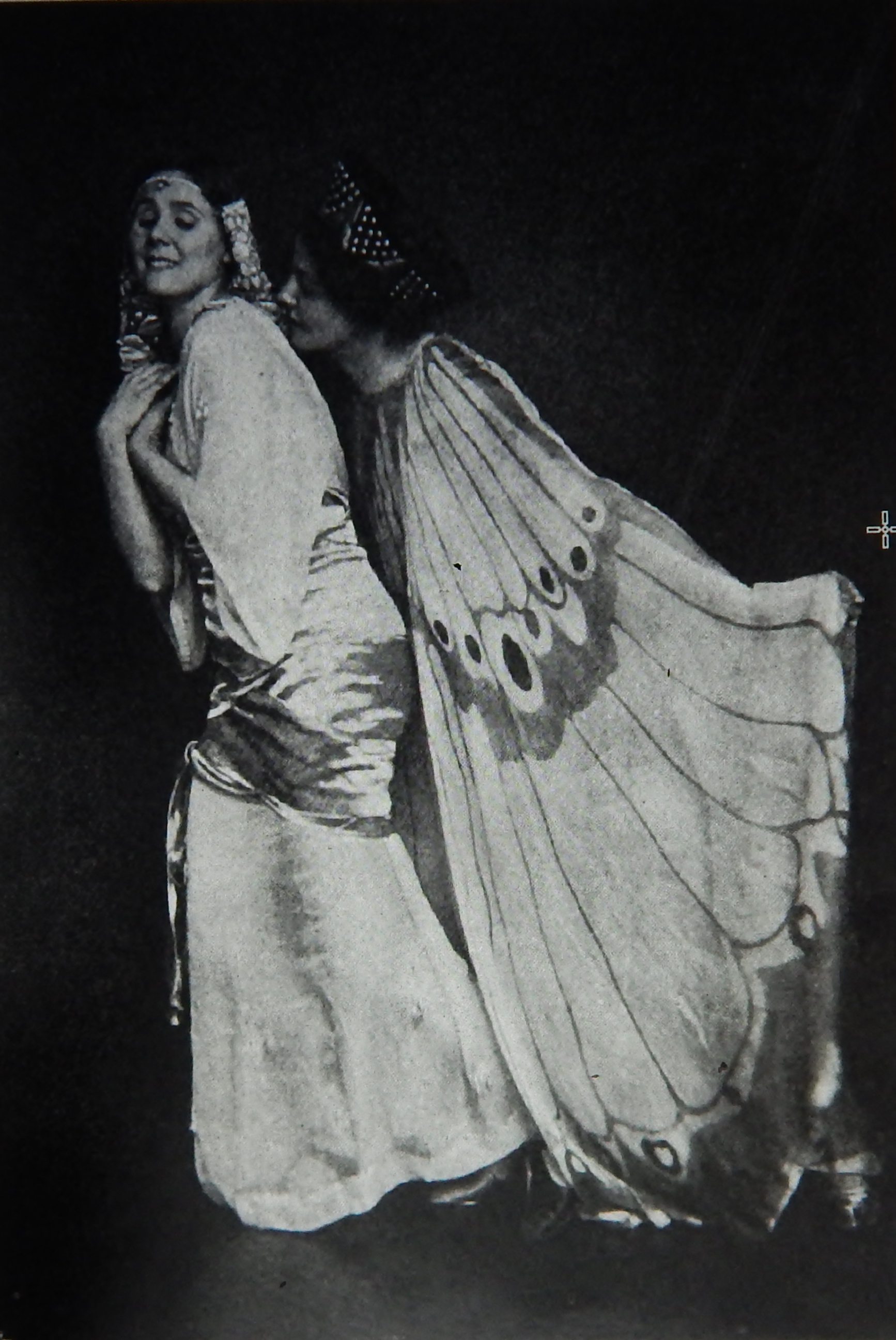
Figure 138: Alien, humanoid pantomime characters “Springvieh” and “Toboggan” created and performed by Lavinia Schulz and Walter Holdt, Hamburg, 1921. Photo: Minya Diez-Dührkoop, Museum für Kunst und Gewerbe, Hamburg. 

But Schulz’s artistic ambitions urged her to choose Holdt over Schreyer in shaping her performance aesthetic. Schreyer left for the Bauhaus, while Schulz and Holdt continued on their own in Hamburg. For Schulz, expressionism was no longer a power to construct an allegorical abstraction of human identity or a mystical “inner” condition; it was the power to transform human identity into an utterly alien form, a bizarre mutation, a grotesque species, sometimes insectoid, sometimes robotic, sometimes as if the performer’s body came from another world altogether. The wild costumes that she designed and Holdt built out of discarded materials certainly formed the strange identities of the creatures they created for the stage (Nuñez 2006: 56-63) [Figure 138]. But unlike Schreyer with his idol-like figures, Schulz was not content to let the expressionist costume design reveal the strangeness of the simplest human movements: she wanted a unique, ideologically informed movement to emerge from the costumes. She and Holdt befriended the young composer and musicologist Hans Heinz Stuckenschmidt (1901-1988), who played in a nightclub trio with Holdt. Stuckenschmidt began composing music for the “masked dancing pair,” and this music consisted mostly of modernistic adaptations of the jazz and vaudeville tunes he performed in the nightclubs. Schulz and Holdt repudiated Schreyer’s Christian mysticism, for they regarded Christianity as a source of ecological degradation and diseased morality; instead, they followed their own, utterly personal ideology derived from Nordic myth, the Edda, an “Aryan” heritage of hardship, struggle against elemental strain on the body, and austere transcendence of physical and economic adversity (Chadzis 1998: 84-86). While they were never as constricting as Schreyer’s costume designs, the costumes constructed by Schulz and Holdt used materials—wood, metal, glass, canvas, heavy cloth—which made the movements of the performer stressful, perhaps even painful. The idea was to dramatize a primal conflict between the body and that which protects it and bestows identity upon what one might call its owner, although Schulz and Holdt approached this struggle with grotesque, perverse humor. They came up with bizarre names for the characters/costumes they invented: Springvieh, Technik, Bertchen, Bibo, Toboggan, Tote Frau. Each character entailed a unique movement style. Schulz and scholars of her work refer to her performance pieces as “dances,” but Schulz did not organize the pieces around steps or around any system of movement that would define the pieces as dances. She devised elaborate, cryptic notation maps for describing the movements of characters in the pieces, which were either solos or duets she performed with Holdt [Figure 139]. She used a different notation map for each piece, which makes it difficult to see how she employed a larger system of movement, even of her own invention, to create dances instead of pantomimes. Each costume/character represented for her a different notion of struggle between the body and the strange identity imposed upon it. She even sketched out plans for a “dance film” involving Springvieh and Toboggan and recognizably human figures (Chadzis 2006: 27). 
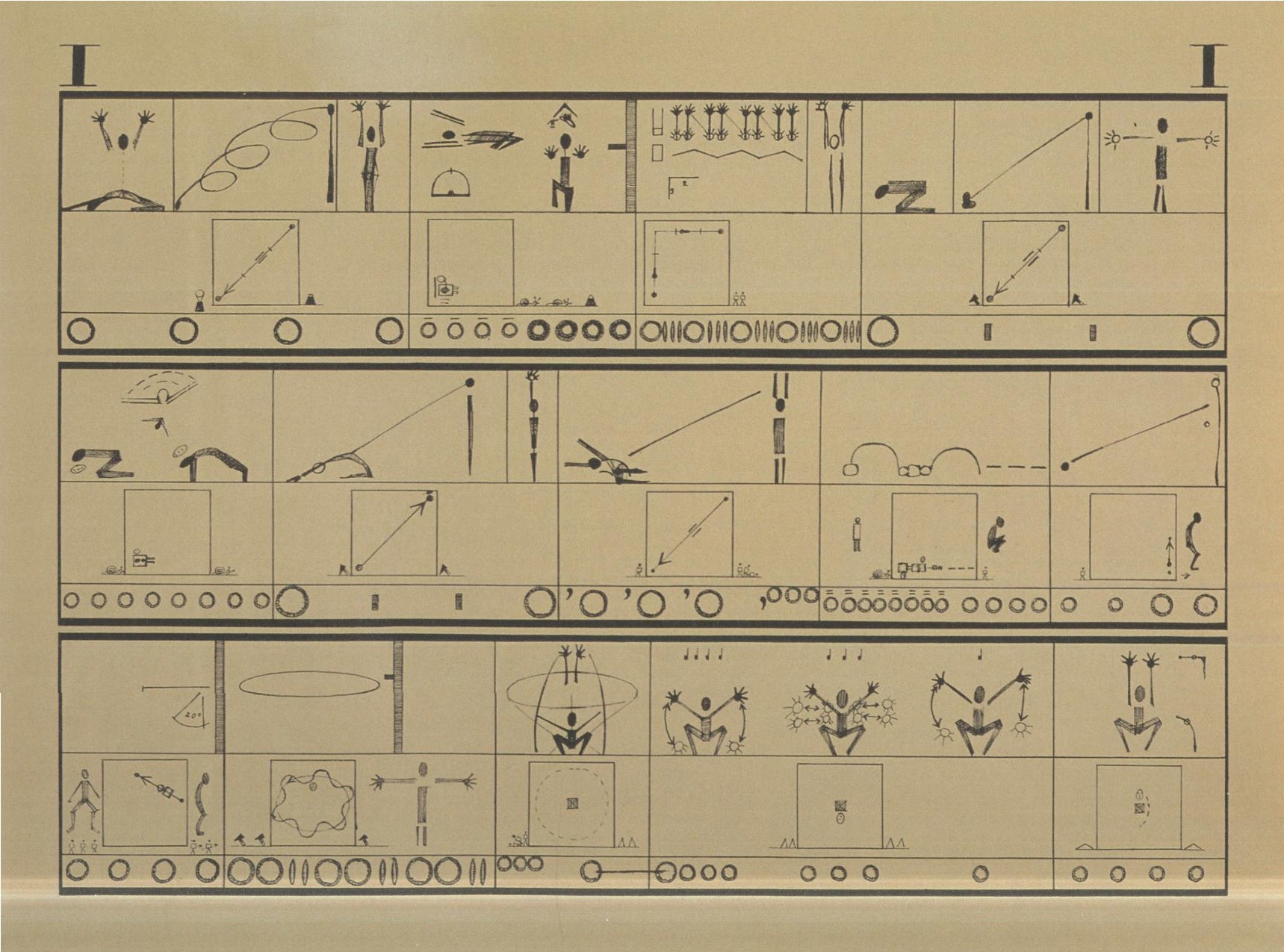
Figure 139: Movement notation by Lavinia Schulz for an unperformed dance/pantomime, Vier Sätze der Toten Frau (Four Sentences of the Dead Woman), Hamburg, 1922. Photo: Museum für Kunst und Gewerbe, Hamburg.

However, because she drew and inscribed the notational maps so enigmatically, it is hard to determine well, if at all, how the performances worked as narratives. Hamburg reviewers tend to emphasize the “visionary” strangeness of the performance as a whole without clarifying its semiotic significance. But the expressionist artist and editor Karl Lorenz (1888-1961) vividly described the movements of Mann und tote Frau (1921), which featured both Schulz and Holdt:

This piece is the gloomiest [of the program], physically the hardest and the most charged. Suffering, heaving, tingling, confusing. A dying, but never an end to dying. Her body whirls, turns, waltzes, folds together. Exhausted?! Yes! But [the body] rises up again out of its exhaustion. She sets the movement again on its axis. She heaves, snorts, tortured, she winds again onto the floor. Dead? She stands up again high. She swells up. Stamping, snorting, grasping, curves, throws herself, hurls herself, pushes herself, torn, and: sinks, breathing in anguish, to the floor of Death?! She lifts herself yet again. Sorrow-whipped, tortured with pain, scattering snorts. She bores again into herself—into the accumulated sorrow, the wounded world-body. A bundel of woe thus surrounds her, a heap of pain, squelched, shattered, burned up in the painful world-view and: nothing dies, cannot die. Here at its darkest is the primordial origin of being (Chadzis 1998: 94). 

Another journalist, the precocius Erich Lüth (1902-1989) in 1924 described Schulz’s movement aesthetic as follows: “Here creeps the body, its own presence lost within little houses of glass and wood, in rattling joints, in sharp edges, broad flat cases, which represent a strange projection of devious souls in dead things, which achieve their own fantastic-monstrous life, a quite ‘abstract organicity’” (Chadzis 1998: 92). With Skirnir (1921), a revision of Schreyer’s Skirnismol, an adaptation of a section from the Edda, Walter Holdt performed a solo pantomime in a dark, heavy, leather-metal costume with an enormous sword that transformed the Nordic-Viking warrior figure into a kind of grotesque robot (Chadzis 1998: 97-99). Schulz and Holdt represented the most extreme zone of expressionist pantomime, but they reached it at a huge cost. They were unable to live outside of their art and mythic vision, and they fell into abject poverty, for their productions never earned them any money on which to live. In 1923, Schulz gave birth to their son, which only exacerbated their financial and marital difficulties. Holdt refused to accept help from his family, who insisted he give up his artistic aspirations. But Schulz became impatient with Holdt’s lack of ambition while also fearing that he might abandon her. In June 1924, she shot him to death while he slept, then shot herself to death as she lay beside him and their one-year old son. Perhaps expressionism in pantomime could go no further than they took it, but no one since has gone so far in moving pantomime into an entirely new vision of the body’s power to metamorphose… into something inhuman, another species. 

Expressionism in the arts exerted much appeal and influence internationally in the early 1920s, even if in Germany expressionist theatrical pantomime reached only a small, cultish audience. Thus in countries outside of Germany, artists could develop an expressionist pantomime aesthetic without experience of actual German expressionist pantomime performance. In Estonia, many artists nurtured an enthusiasm for modernist German culture, for Germans had a long and even dominant presence in the history of the country, and with the independence of the country from the Soviet Union in 1918, Germany seemed like a good friend to have in developing Estonia’s orientation to the West. German films and modern German plays in an expressionist style found a solid audience in Estonia (Epner 2015: 287-291). However, pantomime in the theater had almost no heritage; it remained confined, at best, to feeble employments of it in Russian-style ballet productions. Nevertheless, Estonia became the site of an extraordinary experiment in expressionist theatrical pantomime. August (Aggio) Bachmann (1897-1923), a government clerk, had since adolescence developed a passion for theater. He had no university education, but he studied business and languages at vocational schools. He had attempted to study acting in St. Petersburg (1917) and then in Tallinn (1918), but political circumstances prevented him from achieving this goal. He turned his attention to writing newspaper reviews of theatrical performances in Tallinn, but his interest in theatrical theory and his distaste for “frivolity” in theater (Offenbach) brought an end to his career as a journalist. The theatrical writings of Meyerhold and the German expressionist film The Cabinet of Dr. Caligari (1919) greatly inspired him and urged him to understand that “theater must be the form for new ideas” (Andresen 1966: 22-28). He may also have found inspiration from the Estonia Theater’s 1922 ballet production of Delibes’s Coppelia (1870), choreographed by the Bolshoi ballerina Viktorina Kriger (1893-1978). In this production, Kriger turned much of the ballet into a pantomime by using actors instead of dancers to perform roles, because the new ballet company did not have enough dancers with sufficient ballet technique nor could the dancers perform pantomime proficiently (Andresen 1971: 26). But Bachmann realized he would not have any kind of theatrical career unless he set up his own theater company. This he did in 1921, gathering together a group of young people to produce performances that occurred on Sunday mornings when the German Draamateater was free to him. The theater group therefore bore the name “Hommikteater” or “Morning Theater.” The first production was a staging of Der ewige Mensch (1919), an expressionist drama by Alfred Brust (1880-1938), a somber work on the theme of salvation in a time of religious disillusionment involving over a dozen characters and consisting almost entirely of dialogue. Although German theaters produced some of Brust’s plays with regularity during the 1920s, Der ewige Mensch (Igavene inimene) probably received its only performance through the Hommikteater. Bachmann decided he was better at directing than acting, and for this production he worked out every movement of a character’s action in relation to speech that each actor shaped according to a “melody” and musical dynamics. Each act unfolded according to a musically defined mood: act 1: andante; act 2: agitato; act 3: grotesque; act 4: philosophical (largo-allegro); act 5: andante. The act 3 “grotesque” entailed a rhythmic pantomime of masked city persons designated according to their social class (Andresen 1966: 30-41; Aaslav-Tependi 2012: 46-47). His next production, in 1922, was of the expressionist social drama Masse Mensch (1919) by Ernst Toller (1893-1939), a great but controversial work, in which a woman, Sonja (“The Woman”), sacrifices her marriage to an industrialist to support a strike by industrial workers and then sacrifices herself rather than join a Communist-controlled revolution, led by an alluring Nameless One, that requires the deadly sacrifice of others to achieve the utopian state. After the failure of the 1919 Bavarian Soviet Republic, in which Toller participated, the state of Bavaria banned any performance of Masse Mensch, but theaters elsewhere in Germany staged the play, which became throughout the world one of the most well-known and admired dramas produced by the Weimar Republic. In his production, Mass-inimene, Bachmann turned Toller’s “mass choirs” into movement choirs, who sang many of their lines and moved in a precisely choreographed fashion. He also used performers’ bodies as scenic objects and architectural structures. Hilda Gleser (1893-1932), already a prominent actress in the Estonia Theater, played The Woman in a starkly expressionist manner. (Bachmann was astonished that she desired to perform with the company.) For the dream sequence set in the stock exchange, Bachmann composed a pantomime set to a foxtrot with financiers in top hats accompanied by half-naked girls. The famous poet Marie Under (1883-1980), in an otherwise highly favorable, lengthy review, criticized the weak diction of the actors in some of the non-singing sections (Andresen 1966: 42-59; Under 1922: 151). For his next production, Bachmann drastically reduced speech in performance with his production of Walter Hasenclever’s Die Menschen (1919), translated as Inimesed. This radically expressionist, 5-act “dream play” dramatized the “journey” of a murdered man, Alexander, to understand why he “allowed” himself to be murdered. The very large cast includes the many people Alexander encounters in “the world today” who have in some peculiar, unintentional way contributed to his murder. The dialogue is very spare, mostly one or two-word phrases that characters blurt out without reference to what anyone else says, as if the characters hear only themselves. The play presents a society in which individuals remain so withdrawn into themselves, so isolated from each other, that they remain numb to anyone’s suffering, greed, or lust but their own. Throughout the play, Alexander carries a sack that contains his own head, given to him by his murderer. At one point, the head speaks one and two-word statements to Alexander. The only salvation in this dark, grotesque world is for the murderer to cry out, “I love!” With its many scenes and its montage organization of numerous social types, Die Menschen anticipates Hasenclever’s film scenario Die Pest (1920), discussed earlier. The only German production of the play took place in Prague in 1920, and it was not a success. Critics complained about the obscurity and aesthetic complexity of the work (Spreizer 1999: 82). The Estonian-language production in 1923 was the only other performance until the 1990 staging in Mannheim of Swiss composer Detlef Müller-Siemens’ two-act operatic adaptation. The play abounds in pantomimic scenes, but Bachmann, who played Alexander, treated the entire text as a pantomime to which he added some spoken words from the text. The effect was like watching a silent film punctuated by cries. Bachmann made imaginative use of new spotlights installed in the Estonia Theater, and he divided the stage into three sections to allow for swift shifts from one scene to the next. He individualized each of the socially defined characters by assigning them a distinctive movement, with Alexander making very soft, lilting movements that served as a kind of default kinesis against which the movements of all other characters deviated or contrasted. Under Bachmann, the Hommikteater had become a socialist organization; the programs for the company did not even list the persons involved with the productions. With Inimesed, the company had created a pantomime that was an intense critique of social pathology, a pantomime that depicted all classes of society as implicated in the murder of an individual, in the suppression of love, and in the awakening of murderous impulses. No other pantomime of the era attempted to represent on the stage such a wide range of social types, nor did any other pantomime project such an overt political attitude without sinking into propaganda. Perhaps only an amateur company could adopt such a sophisticated political approach to pantomime. Again, Marie Under wrote a glowing review of the production, and the company seemed poised to become a significant artistic power within the small country (Andresen 1966: 60-68). Unfortunately, Bachmann suffered from heart disease and tuberculosis, and he died shortly after the production of Inimesed at the age of twenty-six. The Hommikteater attempted one more production, in 1924, an adaptation of a 1906 Symbolist play by Valery Bryusov, Maa (Land) directed by Hilda Gleser, who emulated Bachmann’s theory of extravagantly stylized expressionist bodily movement contrasted this time with scenes of the poet’s words spoken in darkness. But with the death of Bachmann, the company lacked a cohesive sense of purpose and ceased to exist after Maa. Alas, the approach to pantomime taken by Bachmann did “not find followers in Estonia or elsewhere” (Andresen 1966: 88). Bachmann was a visionary artist who could create distinctive, politically inflected pantomimic action because he did not really apply any sort of pantomime technique: each production entailed a different working out of pantomimic action. He was not a teacher, for teachers learn a technique that they teach to others. After his death, it was not enough for Bachmann to function as a model of brilliant artistic imagination; to have “followers,” he had to leave behind a pantomimic technique that could be replicated and applied to one production after another. But the problem was not that Bachmann did not live long enough to have “followers”; the problem was that Estonia, like other countries, did not produce more artists with his unique, passionate, self-educated pantomimic imagination. 

Previous Section

Next Section

References

Table of Contents

Germanic Pantomime: Literary Pantomime and German Silent Film

Pantomime: The History and Metamorphosis of a Theatrical Ideology: Table of Contents

PDF version of the entire book.

Literary Pantomime and German Silent Film

By 1920, pantomimic imagination worldwide had become overwhelmingly invested in film, although not entirely. But well before then, figures within German expressionist literary culture had disclosed a keen interest in writing film scenarios without showing any inclination to write pantomime scenarios for the stage. This was evident in 1913 with the publication of Das Kinobuch, edited by the literary journalist Kurt Pinthus (1886-1975). This anthology contained fifteen film scenarios by mostly young authors affiliated with the rising expressionist movement, including, among others, Albert Ehrenstein, Max Brod, Else Lasker-Schüler, Paul Zech, Julia Jolowitz, Elsa Asenijeff, and Pinthus himself. Not one of the scenarios reached the screen, although a couple of the authors, Heinrich Lautensack and Walter Hasenclever, did find work as screenwriters because of their success in writing for the theater. In his introduction to the 1963 edition of the book, Pinthus says that he wanted a collection of texts that was “entertaining” and yet “serious” at a time when the literary world regarded film with deep suspicion and condescension. The idea for the book came to him after he and some of his literary friends saw in Dessau a film adaptation of Otto Pietsch’s novel Das Abenteuer der Lady Glane (1912): Presumably the literary world and the public would take film more seriously if ambitious literary minds wrote for the medium. The anthology represented a mix of film genres: comedy, melodrama, historical drama, fantasy, and some of the scenarios might well have made intriguing movies in 1914. But the scenarios do not read as film scripts, although a few adopt the theatrical convention of breaking up the narrative into scenes. The scenarios do not, however, function to create “filmed pantomimes,” which Franz Blei, in his afterword, described as merely a “weak surrogate” for theatrical pantomime (Pinthus 1983: 149). Most of the scenarios read like short stories or sketches in present tense, as if the mind of the reader were a motion picture screen onto which the author’s language projected the narrative. The writers seem to believe that better stories will make better movies, and although they grasp that film allows for a wider range of scenic locales than the theater and occasionally unique visual effects, they nevertheless see the film medium as subordinate to the narrative. Only Ludwig Rubiner’s Der Aufruhr directly addresses the pantomimic dimension in film performance. Otherwise, the authors, none of whom ever wrote a stage pantomime, do not do what appeals to pantomime scenarists: establish a peculiar semiotic relation between the body of the performer and space, music, color, light, or scenic details. For example, in Die Orchideenbraut, by Elsa Asenijeff (1870-1941), the protagonist, a widowed countess, has a divided personality. In public and for much of the story, she feels no erotic desires, no inclination to do anything but humanitarian deeds. But then, perverse urges overwhelm her; she wears a mask and visits a sinister nightclub, where she dances pornographically and ecstatically. Her inability to reconcile these conflicting aspects of her personality leads to her death (Pinthus 1983: 59-69). Asenijeff describes numerous actions and gestures performed by the countess, but these only construct the idea of a divided character; they don’t construct the sense of a divided body or of the performance of any gesture shaped by the conflict between elegant asceticism and orgiastic sensuality. Even by 1913, film made acute this distinction between character-narrative and body-performance, and the distinction assured that control over pantomime passed before 1920 from literary minds to directors, performers, and composers. The radically leftwing expressionist Ludwig Rubiner (1881-1920) designated his scenario as a “pantomime for the cinema.” In its depiction of a revolt by workers, chamber women, servants, criminals, cripples, and prostitutes against a wealthy factory owner, the scenario anticipates the montage theory of film performance developed in the mid-1920s. The text describes the intensifying storm of violence wreaked by the furious, oppressed members of the crowd, who destroy the factory owner’s castle and burn down the city before troops arrive and begin shooting down the rioters. The mistress of the factory owner, the Beloved, becomes romantically involved with the factory owner’s son, and in the end the son stabs the father to death, while an officer shoots the son to death; the Beloved then offers herself to the Officer. The agitated “movements” of the Hunchback inflame the rioters, but the seductive image of the Beloved also inspires them to unrestrained acts of destruction; she anticipates the incendiary Robot-Maria figure in the monumental science fiction film Metropolis (1927) (Pinthus 1983: 105-113). The scenario describes manifold actions performed by manifold persons to create an image of a society completely out of control: 

From all sides, cripples, beggars, thugs. The whores come with new men from the street. Wild dance of the women with cripples. The women rip their clothing to shreds. The Hunchback seizes a torch, lights its explosively, and swings it as an attack signal. The thugs have knives in their hands and thrust them at the men coming with the girls. They strike them down, plunder them. The bodies are thrown down a hole in the middle of the street, into the deep (Pinthus 1983: 109).

For Rubiner, a “pantomime for the cinema” meant a fragmentation of narrative into a montage of specific pantomimic actions performed by different bodies, as if each sentence of the scenario constituted a “shot” on the screen. He saw film as the medium for the large-scale pantomimic movement of a society in which all persons became expressionistic abstractions representing large categories of identity—the Hunchback, the Beloved, the Son, the Officer, the Rich One, and so forth. He also saw a society’s movement toward freedom as inherently violent, but not only in relation to physical action: the pantomimic action was the basis for a violent fragmentation of narrative into a montage in which all of these abstractions interacted destructively, because the language of narrative construction becomes “free” only by destroying narrative coherence itself as well as the idea of society being “governed” by some narrative rationale for its unity. In this respect, Rubiner’s thinking about cinematic pantomime was far in advance of anyone else in the anthology or indeed of anyone in the film industry of the time. He understood more deeply than anyone else that “pantomime for the cinema” would profoundly disrupt the society that consumed it (cf. Vollmer 2011: 494-497). 

            With Das Kinobuch, the Austro-German literary imagination bestowed an attitude of seriousness toward cinema that encouraged people otherwise deeply suspicious of popular culture to pay closer attention to the medium as an artistic phenomenon. But the book probably had no influence at all on the film industry, and it certainly did not inspire greater confidence in the literary imagination to develop, deepen, or expand pantomimic performance for either the stage or the cinema. On the contrary, the book appeared at the peak moment (1913-1914) when the literary imagination seemed most enthralled with the “drama of silence”; within Pinthus’s expressionistically-oriented literary circle, film, rather than the stage, offered greater “freedom” for the pantomimic imagination. But this was an illusion: the book had no follow up, no movement of nearly all the authors into the film industry, not even a subsequent anthology of imaginary film scenarios that might function as a critique of the cinematic imagination or an exploration of recessed or repressed aspects of it. Like so many of the authors of Austro-German pantomime, the Kinobuch contributors had one, maybe two ideas for film scenarios, and then had no more. A curious class distinction constrained or drained the literary imagination in relation to pantomime. In 1921, the popular novelist Arthur Landsberger (1876-1933), himself a writer and director of films, observed that many people in the cultural media around 1913 believed that films would be better if those who wrote them were authors “like Bierbaum, Hartleben, Scheerbarth, Wedekind, Hauptmann, Eulenberg, and Björnson”—that is, writers esteemed by an audience seeking art that elevated it above popular taste (Keiner 1988: 5). Landsberger wrote in celebration of the fiftieth birthday of Hanns Heinz Ewers (1871-1943), a popular writer of horror and fantasy stories, who had been involved with cabaret productions and written enthusiastically about film as early as 1907 (Keiner 1988: 156-161). In 1913-1914, Ewers wrote screenplays for nine films before embarking on another of his travels to South America, which, at the outbreak of the war, led him to the United States, where, in 1918, the American government incarcerated him until 1921 because of his activities as a German agent (Keiner 1988: 103-104). His most famous screenplay was for Der Student von Prag (1913), a diabolical doppelgänger tale regarded as the first German film to achieve recognition as a work of art. Ewers distilled in his writing a German inclination to believe that pantomimic action exerted greater power over audiences when performed by bodies that were strange, bizarre, uncanny, malformed, supernatural, perverse, homoerotic, grotesque, or phantasmal. Film magnified the beauties and anxieties of physiognomic strangeness or aberration: the stories come from the bodies rather than happen to them. This belief implied that pantomime did not really belong to the literary imagination; Ewers himself never published any of his scenarios, and not until 1985 did his script for Der Student von Prag achieve publication in Helmut Diederich’s scholarly monograph on the film. 

             Yet the first published film scenario, at least in the German language, was Die Pest. Ein Film (1920, but apparently written in 1918-1919), by Walter Hasenclever (1890-1940), who had already achieved much success with his expressionist dramas for the stage. The scenario never became an actual film, and it’s not clear if he regarded the work as “complete” only when materialized as an actual film. The “film” depicts the end of the world in the year 2000. The world is a “paradise,” filled with peaceful people everywhere celebrating civilization, industry, technology, the arts, and racial harmony. But a red star rises in the night. A plague breaks out on a rat-infested ship in the Indian Ocean. When the ship reaches a European city, the rats and the plague spread, killing pleasure-loving people in the theater, a village fair, the stock exchange, the university. A banker finances research on an antidote, but the scientist leading the research group dies of the infection before the vaccine can be formulated. A dancer in an Indian dress appears intermittently, apparently immune to the disease. Desolation pervades the entire world. The banker and some of his friends gather in a castle, but the rats show up, too. Still, the banker’s party continues, with everyone masked. But the dancer dances naked. Fires set by suffering plague victims get out of control. A masked figure enters the castle room, dances with the dancer, then removes his mask to reveal himself as Death. Fire consumes the castle. Edgar Allan Poe’s story “The Masque of the Red Death” (1842) seems like an obvious inspiration for Die Pest, but the Kinobuch film scenario Die Seuche, by the physician-writer Philipp Keller(1891-1973), may have stirred Hasenclever. Die Pest also resembles Rubiner’s Der Aufruhr in its application of an expressionistic montage technique to produce a uniquely cinematic narrative. Hasenclever divides the action into a prelude, five acts and 152 scenes, but even these scenes contain further shots. The author employs a “telegraphic” expressionist language, in which short phrases or single words signify individual “shots” in the film. For example: 

52. Scene

Newspaper article:

300 People in Yesterday’s Performance Are Suddenly Taken Ill

Road. Variety theater poster. People gather around it.

53. Scene

Granary. Grain moves. Rats.

54. Scene

Railway station. Dancer rides in the car. Ticket. Train.

55. Scene

First Class section. Dancer with traveler. Train leaves. Dancer stands up, opens small suitcase. A gentleman helps her. The dress is visible. Dancer takes book, reads. The gentleman touches his forehead, falls into the pillows. Excitement. Dancer pulls emergency brake. Train stops. Gentleman is carried away.

56. Scene

The Minister’s office

Minister at the work table. Servant enters. Telegram.

Minister opens: 

            Unexplained Death of 700 People in the Port City (Hasenclever 1920: 26-27)

The characters have no personal names; they are expressionist abstractions of socio-anthropological categories of identity: the Dancer, the Banker, the Child, the Inventor, the Slender Lady, the Pastor, the Servant, the Daughter, the Captain, and so forth. Some characters recur, such as the Dancer, the Banker, the Student, and the Beloved. The figure of Death appears in several scenes as a chauffeur, taxi driver, a locomotive driver, an animal dealer, a bread distributor, and a surgeon, and this trope suffuses the scenario with an eerie, medieval dumb-show effect within all the imagery of modern technology and refined civilization. Hasenclever regularly inserts one-word close-up “shots” of body parts, such as hands, faces, plague-flecked throats or breasts, which sometimes juxtapose with one-word close-up “shots” of objects like a serum vial, a wine bottle, pieces of bread, a dress floating in a river. The scenario describes the spread of the epidemic by cross-cutting from different “scenes” within the port city, the capital city, and the countryside, all of which are generic and require only a word or two to designate physical context: “Theater,” “Cathedral,” “Train Station,” “Laboratory,” “University,” “Village,” and so forth. These expressionistic devices support Ewers’s belief that physiognomic peculiarities and distinctions drive pantomimic performance in film. The generic or abstract “simplification” of identities in the expressionist aesthetic perhaps implies that performers do not need to display much or even any skill or virtuosity in the performance of physical actions. But it does mean that the performers must have the “right” bodies to perform the actions. Reinhardt constructed pantomimic performances in which actors were interchangeable; different actors could play the same or different roles without seriously changing the production. With the expressionistic film aesthetic, bodily performance relies intensely on the unique casting of bodies that can produce a strange, captivating image. But Hasenclever’s scenario makes such vivid use of “telegraphic” language that one feels in reading it that one is watching the film in a theater, as opposed to watching a story projected onto a screen in one’s mind. It is a kind of estrangement effect; the reader sees “film” as a piecing together of isolated word/images on a page/screen: the story is there, but it is the pieces that one sees, an experience perhaps complete enough that it was not necessary to make an actual film from the scenario. For this reason, though, its relation to both film and literature was ambiguous, even troubling. German-language reviewers of Die Pest felt Hasenclever had betrayed both theater and literature with his cinematic experiment, especially the influential theater critic Bernhard Diebold (1886-1945), who regarded the piece as a literary deformity (Diebold 2012: 54-57). In France and the United States, the scenario inspired quite enthusiastic commentary: “The Pest is a tragic work which is not without a certain philosophical import, and in which the rhythm is […] quite grandiloquent” (Current Opinion Vol. 69, 1920: 691-692). But the German response to the scenario, for which Hasenclever “never forgave his critics,” had the effect of severely weakening his desire to experiment in literature, theater, or film, and his subsequent work for the stage became much more conventional (Spreizer 1999: 149). He became a screenwriter late in 1928, when he adapted his popular stage comedy Ein besserer Herr (1927) into a film (1928), followed by a couple more films, including German-language dialogue for the Greta Garbo film Anna Christie (1930). He collaborated with the journalist and screenwriter Harry Kahn (1883-1970) on a couple of screenplays that were never published or filmed (Hasenclever 1963: 515; Kasties 1994: 284-285). In 1929, he explained that with Die Pest, he realized that cinematic and theatrical actions have nothing to do with each other; Russian film achieved ten years later the kind of film performance he envisioned in 1918 (Hasenclever 1963: 30). He also realized that he was not the only one who had underestimated his achievement. But perhaps the problem was that he linked the montage fragmentation and estrangement of pantomimic action to an apocalyptic ending rather than to an ecstatic beginning. 

            By 1921, the Austro-German literary imagination had exhausted its capacity to produce any major innovation in pantomime and almost ceased entirely to create any pantomime scenarios at all. Revived productions of Reinhardt’s Das Mirakel were immensely popular yet failed to inspire any enthusiasm for pantomime within either the Austro-German literary world or the Austro-German theater world. The only authors who wrote any pantomime scenarios during the 1920s were Richard Beer-Hofmann and Hugo von Hofmannsthal. Throughout the 1920s and into the 1930s, Beer-Hofmann worked on a single pantomime scenario, Das goldene Pferd, which he never published in its entirety, perhaps never even finished and which has never been performed or filmed. But this work deserves discussion after we have finished with the decade in which he struggled to complete it. During the 1920s, Hofmannsthal focused his attention to pantomimic art on the writing of film scenarios. In 1923, in need of money, he nurtured the idea of transforming his libretto for the hugely successful Richard Strauss opera Der Rosenkavalier (1911) into a film. He succeeded in getting the Pan film company in Vienna to offer him a contract for the rights to the libretto, and Pan secured the services of the German film director Robert Wiene (1873-1938), who had directed the famous expressionist film The Cabinet of Dr. Caligari (1919). Strauss’s cooperation was somehow necessary for the film version, and Hofmannsthal persuaded the composer to allow his music to accompany the film. Strauss not only arranged orchestral music from the opera; he also composed some new music and included music from his Couperin Suite (1923). Hofmannsthal worked on various drafts of the film scenario in 1924-1925 and submitted the text to Pan in mid-1925. Wiene and the Austrian actor-screenwriter Ludwig Nerz (1866-1938) subsequently rewrote the entire scenario so that little remained of Hofmannsthal’s text but the basic structure of the libretto, although Hofmannsthal received credit for the screenplay and Wiene apparently did not mind if the press referred to Hofmannsthal as the author of the film (Jung 1994: 79; Jung 1999: 125). Set in the eighteenth century, the scenario describes actions that mostly occur in the suburban castle of the Marschallin, Princess of Werdenberg. The narrative deals with the comic-elegiac amorous adventures of three couples as well as the boorish, libertine behavior of the Marschallin’s cousin, Baron Ochs, the fiancé of the rich bourgeois Sophie. However, upon seeing him at a country party, Sophie falls in love with the young Count Octavian, the Marschallin’s lover and the man, “the cavalier of the rose,” the Marschallin designates to bestow the silver rose on Sophie to symbolize her impending marriage to Baron Ochs. All ends well at a huge garden party when the masked couples collaborate to embarrass the Baron by having Octavian masquerade as a woman whom the Baron attempts to seduce; then the Marschall returns from battle and thinks, correctly, that his wife is deceiving him with Octavian, but when they draw swords the masked woman between them is actually Sophie, and the Marschall and Marschallin become a romantic pair along with Octavian and Sophie, and another couple, Annina and Valzacchi. The ending is quite different from the opera in which the Marschall never appears and the melancholy Marschallin realizes that she is alone and perhaps too old for the love she desires, although in his scenario Hofmannsthal does introduce the Marschall in scenes that Wiene never used (Hofmannsthal 2006: 205-242). 

The opera is a satire on tropes of eighteenth century “refinement” and worldliness, and so, too, is the film. But as presented in the 2006 edition of his Sämtliche Werke, Hofmannsthal’s film scenario is very difficult to read, and it is easy to see why Wiene and Pan felt that another script was necessary. Hofmannsthal made the already complex plot of the opera libretto even more complicated by introducing a prequel scene and scenes that depicted moods, dreams, or memories of the characters. The text and its variants suggest that Hofmannsthal struggled to “see” the story in a uniquely cinematic way. But he winds up describing detailed images—too many of them—and favoring images of moods, poses, characterizations. He does not see the story emerging from a set of visually constructed actions; rather, the story is something embedded in pictorial detail. He described the process of writing the scenario as similar to writing a novel, a literary form, however, in which he never achieved success (Hofmannsthal 2006: 852). By contrast, Hasenclever’s word/image technique in Die Pest creates an intensely vivid, gripping effect narratively, cinematically, and pantomimically. Hofmannsthal could envision pantomimic action economically and powerfully in the theater, where the only image containing action was the stage; indeed, the opera contains a brief pantomime scene in the third act. But he had great difficulty seeing bodily action in relation to multiple perspectives and dynamic spatial configurations. Wiene’s skillful direction shows what Hofmannsthal did not “see” in his scenario. The director uses the camera to reveal manifold physical relations between people and spatial relations between people and their environment; the camera does not simply watch actions—it constructs them, so that the viewer feels the physical actions cannot be contained within a single, complete image like a stage. It is the sense of physical actions driving the image and the camera that is missing from Hofmannsthal’s scenario, which focuses on describing characters through images resembling “portraits” of them. A delightful result of Wiene’s direction is the pantomimic performance driving the cinematic action. The director and his actors developed a performance style that emulates eighteenth century gestural aesthetics: it is artificial, mannered, and calculated without being exaggerated or ostentatiously theatrical, so that it seems as if the viewer watches a cine-documentary performance of numerous actions that were “natural” in another century but not in ours, an effect that one cannot derive at all from Hofmannsthal’s scenario. For example, in one scene, Baron Ochs (Michael Bohnen) intrudes upon the Marschallin (Huguette Duflos) while she enjoys a tryst with Octavian (Jaque Catelain). She hides Octavian behind a curtain, before the Baron makes his entrance making an elaborate bow, kissing her hand, smelling her arm, and kissing her hand again, while she glances over her shoulder to see if Octavian remains properly hidden. She and the Baron sit at a little table, where he proceeds, pressing his hands on the table and smiling, to seek her approval to marry a commoner. A little black boy, Mahomet (unidentified actor), dressed in livery and an elaborate turban, enters carrying a tray with coffee. The boy bows to the Marschallin and then to the Baron before walking backward to the door, while the Marschallin looks over her shoulder to be sure that her lover remains hidden. The Baron genially pours the coffee and offers sugar. The camera views (in iris focus) this table scene as if seen from Octavian’s point of view behind the curtain. Later in the film, the Marschallin, sits alone on a couch in her cavernous drawing room and sadly reflects that Octavian’s affections lie with Sophie and that she, the Princess, has become too old to sustain the desires of a man like Octavian. She sits poised and still, and then she sinks into unconsciousness on the couch. Mahomet opens the door and quietly approaches the Marschallin. Seeing that she is unconscious, he quietly walks backward to the door in the same manner that he did in the coffee scene, as if he must perform the proper way of exiting, even if no one is looking. But the boy’s back stepping exits serve to emphasize, amusingly yet poignantly, the polite receding of male youthfulness from the Marschallin. These are small scenes and details in a lavish film, none of which appear in Hofmannsthal’s scenario, but they do show how film allowed directors and actors to take control of pantomimic performance in the 1920s. Der Rosenkavalier was a spectacular production, with large crowd scenes, many scenes with horses, a brief but huge battle scene (with the Marschall presiding over it on horseback), a sumptuous garden party masque, elaborate costumes, and monumental sets designed by the great theatrical designer Alfred Roller (1864-1935), who had designed the opera premiere, and a few scenes, such as the Marschallin clandestinely observing Octavian and Sophie (Elly Felicie Berger) together in a shadowy garden employ the expressionistic chiaroscuro technique that Wiene employed so memorably in Caligari. At the very least, this elegant film demonstrated that Hofmannsthal’s story did not depend on voices to achieve a “completeness” as satisfying as the opera’s [Figure 87]. In January 1926, the film had its official premiere in Dresden, at the opera house, where the opera had premiered. Strauss conducted the large orchestra. Reviewers were impressed, but some complained that Strauss stopped the projection many times to allow the music to catch up to the appropriate scenes. A week later, for the Berlin premiere, the film composer Willy Schmidt-Gentner (1894-1964) conducted his own arrangement of Strauss’s music, which he expertly synchronized with the film imagery. Reviewers throughout Germany and Austria praised the production almost extravagantly, greatly pleased that it was no longer a symphonic work with visual accompaniment, but a brilliant film with fine musical accompaniment—not a result that Strauss appreciated; in April, he conducted the London premiere, which also inspired high praise (Hofmannsthal 2006: 869-873; Jung 1994: 82). Plans to bring the film to the United States came to an end with the advent of synchronized sound technology in 1927, which led to the collapse of Pan. Der Rosenkavalier subsequently disappeared until 1958, when a research team managed by the Austrian theater historian Josef Gregor (1888-1960), director of the Austrian Film Archive, located the only known copy of the film in Prague, although the print contains only about 75 minutes of the original two-hour film. Since 1961, the film has been shown internationally numerous times with Strauss’s music (and sometimes not) and occasioned an almost grandiose mood of celebration (Jung 1994: 86-87). But while the coupling of Strauss and Hofmannsthal underpinned the justifiable motive for celebration, the movie is excellent because of Wiene. 

Figure 133: Scene from Robert Wiene’s 1925 cinematic adaptation of the opera Der Rosenkavalier, by Richard Strauss and Hugo von Hofmannsthal. The Feldmarschall (Paul Hartmann) faces a delicate but persuasive challenge from his wife, the Marschallin (Huguette Duflos); Sophie (Elly Felicie Berger) and Octavian (Jaque Catelain) benefit from her intervention. 

In private, Hofmannsthal expressed disappointment with the film version of Der Rosenkavalier (Hiebler 2003: 499). But much of his disappointment resulted from the realization that the success of the film did not lead to further opportunities for him to develop a career in the film industry. He saw film as a lucrative source of revenue. But unlike in the period 1901-1914, when he experimented with numerous pantomime and ballet projects for the stage that he never completed (cf. Hofmannsthal 2006: 129-177), after 1920, Hofmannsthal, having abandoned stage pantomime and ballet altogether, focused his pantomimic imagination, such as it was by then, exclusively on three film scenarios, including Der Rosenkavalier. The first of these scenarios, written in 1921-1922, was a biographical drama about the life of the English writer Daniel Defoe (1660-1731). However, Hofmannsthal could not interest film companies in making a film out of the scenario (Hofmannsthal 2006: 837). The text reads like a short story-encyclopedia article on Defoe; the author compiles numerous facts about Defoe’s life and intersperses these with language describing characters’ moods, motives, or moral dilemmas without visual or pantomimic specificity: “But he had little time to dream, because his business required his entire self” (Hofmannsthal 2006: 191). Such language, like the language of an encyclopedia article, will generate vague images in the mind of a reader, but Hofmannsthal seems to think that is all a film scenario has to do. He doesn’t see the life of Defoe unfolding scenically, as a sequence of carefully constructed images that compel the viewer to see Defoe and the world in a uniquely cinematic or pantomimic way. He just sees film as somehow recording Defoe’s life in an “objective,” encyclopedic manner. Defoe’s biography makes a good story of a man divided by commercial, literary, political, and even conjugal ambitions that compelled him to intersect vigorously with all levels of his society. Yet his most famous achievement, the novel Robinson Crusoe (1719), the second most translated work in history (behind the Bible), deals with a man utterly cut off from all forms of society. But Hofmannsthal does not dramatize or visualize any of this conflict or irony. He merely describes Defoe going from one hectic activity to another, perhaps because he was not sure of the relationship between Defoe’s spectacular, controversial successes as an author and the equally spectacular failures of Defoe’s grandiose business ventures. Defoe offered Hofmannsthal the opportunity to explore a pet theme of tensions between great literary fame and the accumulation of huge financial debts or even the tension between honest writing and dishonest business practices. But Hofmannsthal can’t find images or physical actions to articulate these themes. 

Still, even after his disappointments with the Defoe and Rosenkavalier projects, he persisted in pursuing cinematic success with his scenario for a film starring Lillian Gish (1893-1993). The Gish project resulted from Hofmannsthal’s friendship with Max Reinhardt, who had directed impressive productions of several dramas by Hofmannsthal. Reinhardt had hoped to star Gish in his American production of The Miracle in 1923, and when Hollywood considered making a movie of Reinhardt’s production, the director again considered Gish. But newspaper mogul William Randolph Hearst (1863-1951) wanted his girlfriend Marion Davies (1897-1961) to star in the production and offered $100,000 to cast her. Reinhardt therefore demanded $150,000, which put an end to the project. United Artists CEO Joseph Schenck (1878-1961) nevertheless wanted a project with Gish and Reinhardt and agreed to sponsor her trip to Germany to develop a film scripted by Hofmannsthal—until he read a draft of the scenario, which urged him to withdraw support for the project. But Gish went to Europe anyway, in May 1928, and there she was a guest of Reinhardt at his mansion Leopoldskron, near Salzburg, where they worked with Hofmannsthal on the scenario, even though Gish knew no German and Reinhardt no English; presumably Hofmannsthal, who was fluent in English, facilitated communication between the director and the actress, who was amazingly deferential, almost worshipful toward Reinhardt (Affron 2002: 236-238). The scenario had shifting titles,The Stigmata and The Miracle Woman, as Hofmannsthal produced different drafts, all published in the Sämtliche Werke (Hofmannsthal 2006: 243-258). But the drafts are more like prose summaries of the story than film scripts, although Hofmannsthal provides more concrete images and actions than in previous scenarios. Across its different versions, the basic story, set in a rural region near St. Florian, tells of two sisters from a poverty-stricken family. One sister marries an affluent, middle-aged forester or landowner; the other sister, Resi, experiences visions in response to holy statues and icons that mark her body (“stigmata”). These visions and the stigmata awaken hostility toward her from the villagers, while a young farmhand, Jakob, comes to her defense. For her protection, her family sends her to her sister. Resi falls wildly in love with Jakob, but Jakob’s affection is for Resi’s sister (never named in any version). When Jakob, a thief, plans the murder of the brutal landowner-tavern owner, Resi intercedes and urges Jakob to run away with her sister. But Jakob, obsessed with revenge for the injustices inflicted by the landowner on him, Resi, and her sister, murders the landowner anyway. Resi and her sister are arrested as accessories to the crime. At the trial and in prison, Resi experiences more ecstatic visions and stigmata. She sees that Jakob is like Judas, and, in her visionary manner, she accuses him of the murder, for which he confesses and receives the death sentence. Returning to her home, the villagers welcome Resi as a saint. In an early version of the scenario, Resi did not have a sister, Jakob was Hans, a soldier returning from the war in 1918, and instead of an adultery triangle, Hofmannsthal developed a relation between Hans and another, older soldier with Bolshevik sympathies, so that Resi’s religious visions contrast with the older soldier’s political utopianism as a basis for ecstatic experience, with Resi suffering persecution from Bolsheviks. The last version has a much more archaic atmosphere than the earlier, as if the action could happen in any number of centuries before the twentieth. The writing of the film scenario took place during the transition to talking pictures, but Hofmannsthal obviously had in mind a silent film, and Gish believed that talking films were merely a passing fad. Indeed, Hofmannsthal describes Resi as “nearly idiotic with embarrassment when spoken to” and hardly able to speak at all in moments of profound emotion until the end, when she makes her accusation. Gish even visited the illiterate German woman, the mystic stigmatic Therese Neumann (1898-1962), who had inspired Hofmannsthal’s story, and asked her to pray for Gish’s mother (Affron 2002: 240). The American screenwriter Frances Marion (1888-1973) attended the working sessions at Leopoldskron, where Reinhardt himself acted out scenes from the scenario, “with doors and windows sealed against the slightest breath of fresh air.” She described both the working sessions and the scenario as extremely tedious and without hope of being made into a movie, for “how could a Hollywood movie in Protestant America show, as its central event, a woman suffering the stigmata?” (239). Gish seemed to think the project would follow up her successful star performance in Henry King’s epic, sumptuous film The White Sister (1923), which, however, was not a deeply religious or even pro-Catholic production. Hofmannsthal worried that the Catholic Church would disapprove of the film, but he also worried about Reinhardt’s ability to manage the project, while Reinhardt worried that Schenck had lost faith in him. Hofmannsthal diligently tried to accommodate Marion’s suggestions for improving and shortening the scenario, and he and Gish corresponded warmly with each other. Gish proposed that German film star Brigitte Helm (1908-1996) play the role of Resi’s sister, but Schenck lost patience and recalled Gish to fulfill her United Artists contract in America. Gish then launched an unwise and futile legal action against United Artists, which not only destroyed any hope of financing the film but intensely reinforced the impression in Hollywood that Reinhardt did not know how to make movies (Affron 2002: 241-244). Gish’s career went into a sudden decline; Hofmannsthal died the following year. The “crisis of language” that awakened the Austro-German literary imagination to the power of pantomime had, by 1914, given way to an ever more engulfing “crisis” in film technology that, by 1920, bestowed control over pantomimic performance to directors, performers, composers, and entertainment executives rather than to literary authors, who have since then become nearly extinct as creators of pantomime for the stage. 

One should not overestimate the impact of World War I in ending the pantomimic adventures of the Austro-German literary imagination, for these adventures declined precipitously even before the war began. Moreover, only a couple of the authors could produce more than two pantomime scenarios, while still writing prolifically, during and after the war, in other literary genres. Motion pictures awakened and consumed a huge, unexplored realm of pantomimic imagination, but the literary imagination was unable to exploit film technology on behalf of a distinctive “vision” such as motivated the writing of pantomime scenarios for the stage. Overwhelmingly, the writers of screenplays had no literary ambitions: they did not write for readers or spectators; they wrote for directors, actors, and producers. Making a film for audiences depended on the choices, the “vision,” of directors, actors, cinematographers, editors, set designers, costumers, and musicians. Throughout the world, film ostensibly offered a more “liberating,” more accessible way than any other medium to see bodies communicate across different scenes, different angles or perspectives, different spatial contexts, different temporal structures, and different kinds of music. But the literary imagination contented itself with producing works in literary genres—novels, plays, short stories—that filmmakers adapted according to their own philosophies of visual engagement with narrative. Yet even these reasons seem insufficient for explaining why literary authors ceased writing pantomime scenarios for the stage, for film never put an end to theater, and pantomime as an art, having long preceded cinema and even anticipated it, could achieve “liberating” experiences as much on the stage as on the screen, as the Austro-German pantomime scenarios obviously demonstrate (cf. Vollmer 2011: 484-491). Most likely, literary authors discovered that the process of thinking pantomimically, of constructing narratives entirely through bodily actions, of “seriously” seeing the body “freed” from speech, was too hard, too exhausting to sustain, especially when the established theater culture remained hugely indifferent, if not hostile, to the production of even serious pantomimes. It is also possible that the established theater world regarded pantomime as largely a “strange” Jewish phenomenon, and the authors saw no further benefit to pursuing such highly imaginative strangeness when some pantomime scenarios could not receive even a single performance. Writing pantomime scenarios did not strengthen their confidence in the body to explore “invisible” realms of experience considered inaccessible to language, as Hofmannsthal, Bahr, and Hauptmann had theorized. If anything, pantomime strengthened their confidence in speech or at least writing in other genres to build narratives. 

Previous Section

Next Section

References

Table of Contents

Germanic Pantomime: Varieties of the Austro-German Pantomimic Imagination

Pantomime: The History and Metamorphosis of a Theatrical Ideology: Table of Contents

PDF version of the entire book.

Varieties of the Austro-German Pantomimic Imagination

Nearly a decade later, in 1921, Vollmoeller wrote another pantomime scenario in collaboration with the Dutch composer Jaap Kool, Die Schiessbude, but this piece deserves attention later, in the discussion of German experiments with the curious genre of the “dance pantomime” in the 1920s. Here a group of Austro-German pantomimes deserves attention because they reveal the adventurous scope of Germanic pantomimic imagination, even if they received hardly any attention in their time, let alone any realization in the theater. Paul Scheerbart (1863-1915), a German author of visionary and utopian fantasies and experimental narratives, composed a two-act “astral pantomime,” Kometentanz (1902), a kind of science fiction pantomime of astonishing wildness. The piece is difficult to summarize, because it contains a great mass of actions following a logic that is outside of any “earthly” idea of narrative driven by characters whose motives unfold within specific conventions, laws, rules, a society, a “world” that determines the extent to which their motives “make sense” (cf. Vollmer 2011: 222-241). Members of an earthly kingdom find themselves in an astral realm (not a spaceship!). These include a King and his entourage, his two Queens, a Maid, an Executioner, a Magician, a Poet, a Merry Person, among many others. These characters interact with each other without regard to earthly status, need, or consequence. They pursue no erotic desires, no hunger for wealth or possessions, and no desire even to control their circumstances. In the astral realm, their actions are the result of cosmic forces over which they have no control and which no language, not even that of the scenario, can explain. Stars, planets, meteors, comets, and the moon move across or into the astral realm and cause humans to become still or to dance or to perform cryptic actions, but these human actions seem also capable of causing perturbations in the planetary movements. Humans embody the planets, the comets, the sun, and the moon. Scheerbart describes in detail the types of music and even the kinds of instruments that accompany the scenes—“the music of the spheres”—and the sounds of nightingales intermittently join the soundtrack. The movement of spheres causes peculiar dances involving interactions between humans and astral bodies: The Horoscope Minuet, The Maid’s Waltz, the Dance of the Three Great Comets, the Dance of the Three Great Comets and the Seven Little Stars, The Moon Curls Bacchanal. A large globe appears in the middle of the “stage” or however this thing is staged, but it is not clear if this globe represents Earth; various characters touch, ascend, or hide behind it; the Maid and the two Queens dance upon it, although not together. The action flows bizarrely and kaleidoscopically, but not destructively or chaotically. For example:

A great comet appears in the heavens.

And the stars of heaven stand still.

The women flee with bright cries at the sight of the comets approaching; the men attempt to soothe the women.

The King leans forward on his heavenly globe.

Meanwhile the comets swoop down and appear at the rear of the stage.

Everyone stands in fear and dismay like pillars with open mouths.

The Magician appeases their minds by guiding his peacock feathers over the heads of the terrified.

The comet comes forward and bows before the King, who with difficulty recovers his poise.

The poet stands up, bows before the comets and rattles his chains.

The two other comets come behind one another, like the first, to the front of the stage, and the greeting occurs exactly like the previous one.

The music of the spheres sounds very mild, submissive and soft. 

The men and women have gradually relaxed, the Magician indicates to the Servant, to spread out left and right colorful blankets on the tiles.

And the women lie down on the blankets.

The men place themselves behind the women. 

[…]

The music of the spheres assumes a dance melody.

And the comets dance. 

Scheerbart describes numerous lighting and color effects. “Of the other Harem ladies, each has a dress of a special color; the dresses reach to the knee and are garnished with gold and silver stars and spheres […] All the women have on their backs gold or silver moon sickles with masks like wings and except for the Queens no makeup and dark colored stockings.” In a scene called “The Insane,” the action entails this scenic effect: “The new shifting stars no longer have a ball form; they have the form of giant diamonds and many-sided phosphorescent crystal bodies—some consist of unformed tube structures that shimmer like soap bubbles and resemble polyps, others seem like frozen flames […].” In the Moon Gavotte, the Maid steps onto the globe and summons seven female Pierrots, all in white with gold ornaments (“golden moon hats”), and the Pierrots dance a gavotte with seven Ladies in Blue, although each Lady wears a different blue dress “and not like the Maid’s blue dress.” In the Horoscope Minuet, the seven Pierrots become five planets, the sun, and the moon (“The Venus-Pierrot has very blond hair that reaches to her knees, a star on her forehead, and a mirror in each hand)” (Scheerbart 1977: 7-34; Vollmer 2012a: 116-139). Kometentanz presents a narrative structure that does not follow the logic of humans living on Earth; it follows the logic of a cosmic design that only pantomime can simulate, because language cannot explain it. Dance is something that takes hold of both human and astral bodies as a result of enormous cosmic movements whose source is unintelligible and spectacularly enigmatic. The piece ends with the moon rising and all the humans and the comets receding deep into space. The curtain falls as the music grows softer and more distant: “And the voice of the nightingale sounds from far, far away.” As with many of his small, experimental plays, Scheerbart probably never expected his pantomime to achieve actual performance. The piece requires large resources, an inordinately ambitious director, and tremendously imaginative designers, as well as a very adventurous audience, and it is difficult to see how any theater with the resources to produce the show then or even now would risk such a large investment in a cosmic pantomime of Wagnerian scale utterly free of any intimation of a moral order to the universe, any sense of doom, any idea of redemption or salvation, or even any suggestion of universal absurdity. It is a fascinating image of freedom in which human bodies, having no need of speech, become cosmic forms, like comets, no greater and no lesser than stars, meteors, and planets. Nevertheless, in 1900, Scheerbart sent a draft of his scenario to Richard Strauss, who agreed to compose music for it as a ballet. The ballet master in Berlin rejected Strauss’s proposed ballet because the piece was “not serious.” Strauss then asked Gustav Mahler to consider the piece for performance at the Vienna Opera. Mahler agreed contingent upon review of the scenario in relation to the cost, which apparently turned out to be more than Mahler could afford. Strauss only sketched some of the music, then abandoned it, while Scheerbart never sought another collaborator (Heisler 2009: 17-18). But Kometentanz finally did receive a performance, in 2014, at the FullDome Festival held in the Zeiss Planetarium in Jena, Germany. The director of this project was an instructor at the Bauhaus Weimar University, Micky Remann (b. 1951), a multimedia artist, pioneer of the underwater “Liquid Sound” performance technology, and the author of a master’s thesis on Scheerbart, in which he argued that Scheerbart represented a “pre-psychedelic” approach to the “architectural-literary avant-garde” (Remann 2007). Remann assembled a large crew of technicians in video, lighting, editing, animation, mixing, and an ensemble of actors and dancers from the university. Ludger Nowak composed the electronic music soundtrack. The production made extensive use of the planetarium’s lighting and projection capabilities. However, according to the available imagery and not good videos of the production, Remann was not successful in developing the pantomimic aspect of the piece. The comets and planets consisted of video faces projected onto the dome-screen. Much of the human action took place on a small, elevated circular stage that did not permit interesting movement, especially with more than two people on it. The globe was much too small to accommodate all the actions Scheerbart assigns in relation to it. The choreography was interesting only to the extent that dancers wore or brandished lights in darkness. The actors appeared incapable of signifying anything more than awe or wonder at the cosmic imagery, even though Scheerbart doesn’t indicate anywhere that the humans express wonder at the cosmic spectacles engulfing them. The production was not really an “astral pantomime,” but a light show whose purpose was to display the multimedia pleasures offered by technology and the skills of multimedia technicians, whereas Scheerbart’s scenario, though its cosmic scenes do require inventive scenic technology and costuming, does not even suggest that the characters, human or otherwise, rely on any technology to pursue their interactions. This production of Kometentanz signified a considerable lack of confidence in the movement of human bodies to become celestial bodies as strange and fantastic as the movements of stars and spheroids conjured up by digital technologies. 

             Scheerbart himself showed little interest in developing his pantomimic imagination after Kometentanz, although he continued to write many small plays and theoretical pieces about theater. In 1904, he published Sophie, a two-page “marriage pantomime with music and dance,” which quite remarkably describes through spare pantomimic actions the façade of a bourgeois marriage wherein, at the behest of her parents, a woman reluctantly marries a man who becomes violently jealous of her affection for a mutual friend. She steps between the duelers, who stab her, causing her to become catatonic. The duelers embrace; the husband wanders off with the maid; the friend has no money to pay the doctor, so the parents arrive and wearily pay the bill. Scheerbart says he wrote the piece to show that pantomime was just as effective, just as emotionally engaging, and much more efficient than bourgeois marital dramas that tell the same kinds of stories using many, many words (Vollmer 2012a: 160-161). In 1909, Scheerbart wrote a very brief piece for Das Theater, “Riesenpantomime mit Fesselballons,” in which he describes a visit to a garden party given by Prince Saburoff in Finland. Part of the entertainment consists of a pantomime, “Goliath and His Wife,” in which these characters appear as gigantic balloons fastened to an enormous, two-story table; Goliath handles a table knife that is three meters long. Goliath swats his wife with a three-foot spoon, but she merely laughs with a great roar. After consuming “immense tankards of wine,” they perform a farcical minuet. The author suggests that the couple perform a pantomime entirely in the air, “but nobody paid any attention” to him (Scheerbart 1977: 123-124). Gabriele Brandstetter (2015: 325) contends that in this piece Scheerbart parodies Futurist aero-ballets, but it also uncannily anticipates the gigantic, popular puppet spectacles, starting in 1993, of the Theatre Royal de Luxe of Nantes. But Scheerbart’s mind was too happily busy hurriedly jotting down fantastic utopian visions to bother with the practicalities of bringing any of them to life, even on the stage. 

             The deep, gigantic shadows cast by Goethe and Wagner over Germanic culture perhaps inspired the monumentality that infected much of the Austro-German pantomimic imagination. Reinhardt and Scheerbart were contrasting manifestations of this belief that pantomime remained hopelessly obscure unless it operated on a vast, “cosmic” scale. The largest and longest pantomime scenario ever written is Lucifer (1899) by the German poet Richard Dehmel (1863-1920). The text runs over 120 pages and would require an enormous number of performers if anyone ever produced it. Lucifer is a monumental ode translated into the prose describing an immense theatrical celebration performed as pantomime and dance. The piece is devoid of conflict, dramatic action. Rather, each scene functions as a panel in a huge panorama glorifying Lucifer’s dominion on Earth. He encounters no opponent. Always resplendent, he mostly just summons and commands legions of followers: doctors, priests, witches, soldiers, workers, artists, pagans, Christians, bacchantes, scientists, teachers, knights, police officers, nuns, slaves, children, scholars, parents, among others. Various animals and mythic creatures appear to assist and celebrate Lucifer: apes, bats, owls, butterflies, angels, fauns, “amorettes,” a black sheep, and an actual donkey. Lucifer’s immediate court consists of the “seeming blind old man” Saturn, the black-winged boy Thanatos, the white-winged boy Amor, a Mother with Child, and Lucifer’s voluptuous partner Venus. The action takes place in “eternal Rome,” but the action mostly consists of elaborate, often torch-brandishing processions by the various categories of followers, their orgiastic dances, and their cryptic, ritual interactions with Lucifer and his officers. Dehmel describes in fanatically naturalistic detail spectacular, glamorous scenic, lighting, costume, and sound effects, and he occasionally accompanies the text with diagrams of the stage that include coded instructions for the application of different effects. The smallest visual effects consume his attention with even greater obsession than they would for Reinhardt: “The youths are dressed in sulfur yellow and have violet-colored hair, the girls are dressed in orange-red with dark cherry hair; they all wear tea-rose wreaths. The clothes of the young men leave one leg naked to the knee, and the other to the calf, so that they may leave open the center of the lower edge of the sandals reaching to the middle of the under thigh; the girls’ sandals, not yet fully visible, enclose at the ankles” (Dehmel 1899: 10). Dehmel describes scenic and physical actions in similar, maniacal but tediously repetitive detail to create as vivid an image as possible of a paradisiacal society in which manifold sectors of humanity bond together ecstatically through their adoration of Lucifer. A few scenes conclude with adult or children’s mixed choirs singing brief hymns praising Lucifer and Venus as divine figures of Light and Love. However, the piece seems like an elegant pornographic fantasy of a libidinous society in which all bodies are beautiful and bond ecstatically with each other without anyone having to say a word. In 1896, Dehmel had already achieved notoriety as a result of his battle with state censors over the inclusion of his allegedly pornographic poem “Venus Consolatrix” in the collection of poems Weib und WeltLucifer is an allegorical glorification or counter-cultural testament of a mythic, utopian social order in which the redemption of humanity depends on the unifying, erotic-ecstatic power of otherwise suppressed, condemned, and forbidden divinities of Light and Love. The Wagnerian ambition of the piece urged Dehmel to ask Richard Strauss to write the accompanying music, but Strauss thought the scenario was too complex to stage. Dehmel took the project to Gustav Mahler, Eugene d’Albert, and even to Siegfried Wagner (in hope of a production at Bayreuth), but they all passed on the opportunity (Vollmer 2011: 208-209). Reviewers tended to welcome the published book of the scenario as the intimation of a new, elevated, super-aesthetic form of theater, but by 1926, his biographer, the Berlin critic Julius Bab, concluded that the work was a “pedantic” mess, “completely uncreative, completely unoriginal” in its use of dance and physical action and without any “organizational power” (Bab 1926: 229-230; Vollmer 2011: 219-220). Vollmer is the only one to write about the piece with any seriousness since then, but even he accepts that the Lucifer “monstrosity” fails completely as theater and is noteworthy only as “an interesting attempt at a non-verbal sensualization of art” (Vollmer 2011: 207-221, esp. 221). Dehmel’s excessive, even fanatical faith in words to describe his vision was fatal to any pantomimic incarnation in this or another world. 
            But when pantomime writers avoided extravagant experimentation or fantasy and followed a modest, feasible, and even conservative aesthetic, their scenarios risked almost as much obscurity in the theater as Scheerbart’s or Dehmel’s. The Austrian writer Max Mell (1882-1971) was perhaps the most conservative, politically and aesthetically, of all the Austro-German pantomime scenarists. He wrote a pair of pantomime scenarios for Grete Wiesenthal, who seems to have made friends with every artist in Vienna at that time. Wiesenthal was the motive for writing the scenarios; her early (1907) concerts with her sisters had rapturously enchanted Mell (Linhardt 2009: 55-56). It may be that Mell’s mentor and friend, Hugo von Hofmannsthal, assisted in connecting Mell to Wiesenthal. In June 1907, Wiesenthal collaborated with Secession artists Koloman Moser, Alfred Roller, and Josef Hoffmann to produce a summer garden festival in a park in the Meidling district of Vienna, and with the involvement of numerous students from the Kunstbewerbeschule, where Moser, Roller, and Hoffmann taught, she staged an outdoor performance of Mell’s pantomime, Die Tänzerin und die Marionette, with music by Rudolf Braun and decors by the Wiener Werkstätte designer Josef Wimmer (1882-1961) (Wiesenthal 1919: 207-209). The scenario sets the action in a vaguely medieval milieu. A young King enters an undefined space arm-in-arm with the Dancer, whom he kisses and fondles, although she responds reproachfully. The sound of a shepherd’s flute causes her to pause, as if suddenly plunged into a dream. But the King breaks the spell and ushers her before his ministers. She acts in an informal, casual manner that disconcerts the court. She takes the King’s scepter to perform a dance, but returns it to him when finished with her piece, which “expresses awe of the King without devotion.” She wants the King’s cloak, and he gives it to her. At the same time, a crowd of citizens and children has gathered around the clownish figure of Hanswurst, who entertains the group with a marionette. The King becomes entranced by the marionette and asks the clown what he wants for it. After evaluating the court ladies and then the neglected Dancer, Hanswurst decides he wants the Dancer. The King agrees to exchange the Dancer for the marionette, which causes the Dancer to despair. When the King wanders away with his new toy and his court, Hanswurst starts drinking rowdily with the townsfolk. But then the sound of the shepherd’s flute disturbs the party; the four country girls begin dancing and the Dancer stands “radiantly” expectant. When the Shepherd appears, he and the Dancer become immediately and physically drawn to each other. Hanswurst becomes enraged and accuses her of disloyalty to him and the King. But the Shepherd tosses him aside and walks away with the Dancer. The country girls and the townspeople console the furious Hanswurst. The King returns with the marionette and prods the clown to explain why he is depressed. When Hanswurst declares that love has devastated him, he and the King weep together. A gang of peasant men returns with the Shepherd and the Dancer. Hanswurst wants the Shepherd beheaded; the King grants the request, but the Dancer intervenes, asserts that he must kill her as well. The King will free the Shepherd if she will return to him—she might even become ennobled: he orders her release. But she demands that he give her the marionette. He agrees. But as soon as she has the marionette in hand, she leaps onto the drinking table and performs “haughty and scornful movements” indicating her scorn for the “dumbfounded gathering” of citizens (Vollmer 2012: 162-166). 

            Die Tänzerin und die Marionette strives for a genial, folkloric mood. The piece manifests Mell’s inclination, more pronounced in later, stronger works, like the gripping novelette Barbara Naders Viehstand (1914) and the astonishingly popular religious drama Das Apostelspiel (1923), to show the power of marginalized, humble female figures to cause a spiritual crisis or upheaval within a community. The pantomime avoids the religiosity of Mell’s later work, but here the Dancer appears as a foreign or alien figure whose sexuality allows her to ignore behavioral codes associated with different social classes, although her own desires focus on another “outsider,” the Shepherd with his mysterious flute. The Dancer competes for male desire with the marionette, a robotic body controlled entirely by male desire. The ending is startling in that the Dancer does not wind up pairing with the King, the clown, or the Shepherd, but with the marionette. Yet as the partner of the marionette, she actually mocks the society that equates her with the robotic body, because she appears in control of both the real and simulated objects of male desire. Vollmer complains that Mell displays a weak pantomimic imagination insofar as he asks actors to mime spoken utterances that can’t be heard rather than inscribes physical actions that communicate instead of the unheard utterances (Vollmer 2011: 278-279). For example, when the King signals for the guards to behead the Shepherd, the Dancer intervenes and “explains: only over my dead body!” But Mell more likely intends these words as a kind of shorthand to describe a physical action corresponding to the idiomatically phrased sentiment that is left to the actor to formulate, such as thrusting her chest toward the blade of execution. Schnitzler used a similar kind of shorthand in Die Verwandlungen des Pierrot. In this respect, the actors are not themselves marionettes manipulated by the scenario or the author. But Vollmer is correct when he asserts that Mell remained “bound to a narrative and dramatic” way of thinking that did not move pantomimic action in an innovative or adventurous way. The scenario reads like an archaic, folkloric tale in the present tense and without dialogue. The ending may feel modern, but Mell does not introduce a particularly modern way of seeing medieval action: modernity simply and abruptly brings the folkloric world to an end. Yet photographs of the 1907 garden festival production that Vollmer has published show that Wimmer’s costumes for the large cast were quite imaginative and “medieval” or “folkloric” in an art nouveau way that made the characters appear to be members of an old society that was at the same time strange and beautiful. Wiesenthal, for example, wore white shoes with heels and a white peasant dress, from the waist of which streamed dark, thin lines, as if veins or spider strands flowed through the fabric from Wiesenthal’s abdomen. Her husband at the time, the artist Erwin Lang (1885-1961), who played the Shepherd, later did a famous woodcut of Wiesenthal dancing in the dress, though he greatly multiplied the number of black “veins” pouring from her abdomen. Available commentary on the performance describes a poetic, dreamlike atmosphere, a stylized aestheticism that comes more from the design and from Wiesenthal’s “extraordinary performance” than from the scenario, although none of the commentaries provides any details regarding the pantomimic action (Vollmer 2011: 277-278). It is evident that Wiesenthal and her numerous collaborators invested a good amount of money and time in the production of a scenario that had only three performances and has never since received another production. Perhaps the startling ending of the scenario makes the piece too modern for folklore-honoring audiences, for whom a pantomime in which a woman prefers a marionette-robot to any human member of the folkloric community probably seems perverse, if not insulting. Revival of the scenario on the stage therefore most likely depends upon a charismatic woman like Wiesenthal to drive it and suffuse the production with modernist scenic-performance elements that amplify rather than evade gendered tensions between performance and text.

            The following summer, in 1908, Wiesenthal collaborated again with Mell on a pantomime, Der silberne Schleier, which she performed at the garden theater in Meidling, Vienna, with music by Carl Lafite (1872-1944) and directed by the Werkstätte painter and graphic designer Bertold Löffler (1874-1960), who also designed the scenery. The scenario has never been published nor has a manuscript of it ever surfaced. Rudolf Huber-Wiesenthal (1884-1983), the husband of Elsa Wiesenthal, gave a brief description of the performance for his 1934 book about the Wiesenthal sisters. The two-part story told of three female elves, and while these three dance in the moonlight, one of them has a silver veil stolen from her by a male human. She becomes the instrument of his power and turns into a woman. She encounters a seductive poet and becomes a mother (Huber-Wiesenthal 1934: 157). In a program note, Mell says that the action takes place five years later. Her child helps her overcome life’s sorrows, “the ruthlessness of an unloving relative, the unfriendly impatience of her husband, the imprudence of her seducer.” But the poet, a “messenger from the unearthly,” brings light to her life, brings the silver veil, which is only a great longing that allows her to overcome the hostility of daily life. Her child covers her with the silver veil of longing (Vollmer 2011: 281). Huber-Wisesenthal believed that “the production belongs to the strongest performances ever given by the Wiesenthal sisters.” Elsa played the elf-woman, Grete was the young poet, and Erwin Lang performed the role of the veil-snatcher. “Unforgettable for me is the moment in which [Elsa], in silent sorrow, lays her child to bed, upright and simple in movement and all the more gripping.” Grete, as the young, seductive poet, gave such a deeply touching performance of “bright wistfulness that magically invoked the feeling of an entire world, the [waltz] world of [Joseph] Lanner’s Vienna” [Vienna in the 1830s] (Huber-Wiesenthal 1934: 157). A reviewer for Bühne und Welt (1908 X, II: 919), discussing this pantomime along with Die Tänzerin und die Marionette and Der Geburtstag der Infantin, which Wiesenthal had presented on separate days in the garden theater, remarked that “These young Viennese girls, with their pretty, big, and wise eyes, are able to make credible all the scales of the emotional life. They dance poems. As they float, move, sway their hips, that is mimed grace, the poetry of dance.” But the reviewer believed that the Wiesenthal concert performances of Lanner waltzes were superior to their pantomime productions, which suggests some kind of opaque and unfortunately unexamined tension between pantomiming nostalgia or longing for a vanished era using contemporary music and dancing the nostalgia with the music of that era. Mell never wrote another pantomime, and Der silberne Schleier never had another performance. For the theater he wanted to write works that were overtly religious, intensely Catholic, and performable by amateur communities. Pantomime for him was inimical to that goal. Religious communication requires the Word, a voice, as do amateur actors, who always find speech such a relief from anxiety about what to do with their bodies in performance. Das Apostelspiel (1923) became one of the most successful plays in European theater history, in part because of so many amateur productions, and it remains fairly popular. Pantomime for Mell represented a wayward path, a repression of faith in Catholicism. 

            Whereas Mell did not believe that pantomime could reconcile modernity with Catholicism, Reinhardt, with Das Mirakel, soon showed that this was possible to the extent that the reconciliation depended on the “miraculous” use of scenic technology in relation to an otherwise non-modernistic, interchangeable pantomimic performance meant to signify, if anything, the “eternally human” conditions of bodily action. However, the most modernistic treatment of religious themes in any pantomime came from the German art historian Carl Einstein (1885-1940), with his Nuronihar (1913). As a communist and anarchist sympathizer, his perspective on religion was by no means that of a believer. Vollmer contends, after surveying Paul Raabe’s vast, 18-volume Index Expressionismus (1972), that Nuronihar is the only expressionist literary pantomime ever published: in an expressionist mode, pantomime favored film (Vollmer 2011: 432-433). Proto-expressionist effects appeared in earlier pantomimes, such as Scheerbart’s Kometentanz and Hofmannsthal’s Der Schüler, but Vollmer seems to mean that self-consciously expressionist authors avoided pantomime, even though in drama especially they experimented with a highly abbreviated, “telegraphic” language to construct “rich, unusually poetic metaphors for the unsayable, pre- and extra-linguistic” visions of profound estrangement “between subject and object worlds” (432). Yet expressionist writers tended to be skeptical of religious feeling as a domain of experience “beyond words” or as a path to the realm of the unsayable. Einstein was Jewish, but Judaic theology was not a subject on which he cared to write. In Nuronihar, religious themes, the conflict between Islam and Christianity, provided a metaphor or analogy for exploring the power dynamics of erotic desire. Einstein dedicated his pantomime to the Franco-Polish dancer Stacia Napierkowska (1886-1945), who began her career as a dancer for the Paris Opera and music halls before appearing, from 1908, as an actor and dancer in numerous French and Italian silent films. In 1910, she performed an exotic dance before the king in Louis Feuillade’s film Le Festin de Bathazar, which was a reprise of a dance she performed in Andre Capellani’s film Salome(1908) (Shepherd 2013: 102; cf. “Stacia Napierkowska on film” 2016). In 1911, she created in Paris a three-part piece, Pas de l’Abeille, a “dance of the bee,” and then had poses from it photographed and published in a magazine called The Sketch. The piece took place in an Arabian desert oasis, where a captive and bound Moroccan princess begs her sheik captor to release her; he agrees if she will dance for him, which she does by performing a dance of the bee: A girl picking flowers discovers a bee in her dress and writhes and wriggles to free it, discarding some clothing in the process. The sheik makes love to her but refuses to restore her freedom. She seizes a sword and stabs him to death, but realizes she can only be free in death. She then performs a “dance of fire,” in which death engulfs her upon an “altar of fire” (Brandstetter 2015: 172-174). Between 1912 and 1913, Napierkowska toured with the piece, including New York City, where her “Arab pantomime,” there titled The Captive, encountered a failed effort by the city administration to prosecute her for indecency; Ruth St. Denis joined her in the vaudeville program (New York Times April 27, 1913: C5; Slide 2012: 120). In 1911, Einstein published an open letter to Napierkowska in the journal Die Gegenwart, in which he described her movements in a manner very similar to those of the dancer Nuronihar; a French translation of the letter appeared in the January 1912 issue of the Parisian journal La Phalange, but it is not known if he actually knew her. She was clearly the model for the character Nuronihar, and Einstein sought the assistance of the theater producer Jacques Rouché (1862-1957), soon to be the director of the Opera, to bring his pantomime to the stage with Napierkowska in the title role. The pantomime itself first appeared in French translation in La Phalange a month before the German version appeared in the October 1913 edition of the radical expressionist journal Die Aktion (Meffre 2002: 47). But the idea of a Parisian production never materialized, and Nuonihar has never been performed anywhere. To some extent, then, the piece represents expressionistically the turbulent erotic feelings that Napierkowska awakened in the author. 

            But a second inspiration was the fantastic novel Vathek (1786) by the English super-aesthete William Beckford (1760-1844); Einstein published in Die Aktion in 1913, under the pseudonym Sabine Ree, a review of Franz Blei’s 1907 translation of the novel, which he described as a “book of inexhaustible desire […] concluding with infernal boredom and desperate banality,” “a work of stylized rationality that is alien to the organic” and comparable to works by Mallarme, Baudelaire, and Flaubert (Weisstein 1973: 94; Die Aktion 1913: 300). The novel chronicles the adventures of a caliph, Vathek, who encounters a grotesque man bearing swords containing undecipherable inscriptions. As a result of the encounter, Vathek repudiates Islam and begins, with the help of his mother, an extravagant quest to acquire supernatural powers that will give him godlike control over life. This project ends in disaster, as Vathek commits numerous crimes and sins to achieve his goal. He and those with whom he has colluded end up in the domain of Eblis, which is the eternal fire of hell. At one point in his journey to the source of supernatural power, Vathek visits a mountain kingdom populated by dwarves and ruled by the emir Fakreddin, whose beautiful daughter Nouronihar has an intense romantic relationship with her cousin, the beautiful, androgynous Gulchenrouz: “when Gulchenrouz appeared in the dress of his cousin, he seemed to be more feminine than even herself” (Beckford 1966: 155). But Vathek eventually seduces her, and she becomes his partner in his degeneration, while Gulchenrouz “passed whole ages in undisturbed tranquility” (194). The caliph’s success in achieving supernatural powers depends on his contract with the grotesque man who brought him the swords and who becomes the monstrous, demonic Giaour, a derogatory term for “infidel.”

Einstein borrowed much from Vathek, including these characters, but his pantomime placed the focus on Nuronihar and made the female dancer a source of supernatural disturbance. He somewhat follows the three-part structure of Napierkowska’s Pas de l’Abeille. The action unfolds in an “unnatural,” desolate landscape that includes a grassy hill, a great abyss or ravine, and a large red tent inhabited by Vateck. Einstein pays close attention to color effects: Vateck wears a green cloak, his eunuch an orange tunic; his guards wear yellow cloaks and carry blue shields. Nuronihar wears a peacock blue costume. “Vateck’s movements indicate that he has never experienced any resistance, a word or look from him indicates unimpeded actions.” Nuronihar is “completely preoccupied with her own body” and responds to everything she sees with “rhythmic movements”; dancing makes her “forget her environment,” yet she “would do nothing that causes her shame.” No one in the pantomime performs with either mimicking or “realistic gestures,” and Nuronihar provokes the “rhythmization” or “rhythmic excitement” of all others in the piece and even of the scenic environment. In the first part of the pantomime, Vateck remains motionless as he watches a dance performed by a muezzin and two Koran students in sky-blue, purple, and sea-green garments—a “classical” dance, “like a stupid sylph dance.” The caliph and his attendants respond with pantomimic gestures and commands. As the dance becomes more frenetic, Nuronihar appears on top of the hill, watches the dance, then rather shyly begins dancing herself. Her dance disrupts the dance of the Koran students, who become both excited and frightened by Nuronihar. It is a long and complicated dance, and Einstein describes in great detail various movements, responses, and emotions circulating within the performance space, such as: “The dance is in the pantomime the only permitted representation of passion, which cannot be externalized in fragmentary gestures or even facial expressions. The head stays quiet and does not steer the whole body. Nuronihar uses the ornamental advantages of the hill curve, which gives the utmost movement, but Vateck is always calm, though excited, without mimic or tenor gestures. His green coat burns more and more of passion, Nuronihar interests only physically, the folds of her dress order and clarify the movements.” One of the Koran students, dancing wildly toward Nuronihar, falls into the abyss. Nuronihar’s movements keep changing, “the aria after the recitative,” but Vateck remains still as he watches her body become increasingly “free and lascivious”: she does not dance for the caliph, she dances to display the power of her body over others. She dances to the edge of the abyss, then suddenly disappears behind the hill. Vateck finally moves, grabbing a sword and lunging toward the hill. But Nuronihar has vanished. Vateck and his eunuch stand together astounded, then soundlessly leave the stage, with his court retinue lying prostrate on the ground. The second part occurs at night in the same place. A white cloud hovers over the abyss as two stargazers appear, “armed” with immense telescopes, which they swing while dancing. Nuronihar joins them in the dance, although her movements are dreamier and more seductive. As she dances toward the abyss, she casts a great shadow over the white cloud. The dancing awakens the “dark and huge” Giaur from the abyss; he holds a large crystal ball that possesses all the qualities of a constellation. Nuronihar becomes enraptured by the “immense jewel,” tries to embrace it, and the constellation within it transforms her: the young girl disappears and she becomes a “frightfully demanding woman, […] and from now on the caliph has to deal with a woman who is greater than he is.” The glowing jewel hovers above and around Nuronihar in the arms of the Giaur, who never leaves the abyss. As Nuronihar dances more wildly, the jewel rises higher, and she seeks to become engulfed by the radiance of the sphere. The stargazers indicate they have discovered a new constellation; the laughter and thunder of the Giaur draws the constellation into the abyss, as Nuronihar’s shadow grows longer. An intense brightness overwhelms the scene. Nuronihar sleeps on the edge of the abyss, while the stargazers “comically” attempt to imitate her dancing shadow. But then they run off to announce the new constellation. Gulchencruz, described by Einstein as an “elegant, helpless insect,” then appears with “two female playmates,” looking for Nuronihar. They dance in a manner similar to the early movements of Nuronihar, but “sadder, more torn, and fearful.” When Gulchenkruz discovers Nuronihar, he becomes both stormy and delicate in his effort to embrace her, but Nuronihar mocks the trio’s gamboling with “caricatured movements,” and he then acts likes a scolded puppy. Vateck appears, and with a gesture scatters the trio; he grabs Nuronihar, and they stride “in a corresponding dance rhythm” across the landscape. The third and final part takes place at twilight, in Vateck’s tent, illuminated by a warm, subdued, colored light. Vateck remains largely in the shadows, but Nuronihar moves in and out of the glow in a ghostly manner. As night deepens, the tent gradually disappears, replaced by an immense cathedral, the dimensions of which far exceed the capacity of the performance space to contain all of it—this is a gigantic architectural magnification of the crystalline jewel in the previous scene; it glitters with a multitude of reflecting surfaces and “light panes.” The light drives Nuronihar to “ever more passionate unfolding of her powers”; she strives for the “maximum intensification of her entire erotic capacity,” which exceeds all “human constraints.” Her ecstatic dancing awakens the caliph, and he tries to restrain her, but he is no match for her. The huge Giaur lies on the steps of the cathedral, accompanied by guards with “long, dark shields.” Vateck studies her from the shadows until he hears a powerful horn signal, which urges him to perform a sword dance in competition with Nuronihar, who responds by performing a dance-striptease, but she performs the dance “without coquetry,” as if she were alone and completely enraptured by her own body. He drags her into the tent, where her dance becomes even more lascivious yet oblivious. The Giaur glows in the background as pillars of light encircle Nuronihar and swell to form a great ball that vanquishes the tent. Nuronihar dances on the steps of the cathedral before the Giaur, who blocks the entrance to Eblis, the dark hell beyond him. Vateck, blinded, struggles to restrain Nuronihar, but she resists, draws his sword, and stabs him to death. He falls into the arms of the Giaur, while she leaps over them to reach the “always glowing star.” She succeeds in “touching the circle of light, which pours over her and encloses her.” She burns within in it consumed by an “entirely ecstatic, torturous dance” (Vollmer 2012a: 217-227; Die Aktion 1913: 1006-1017).

             The scenario makes seemingly exorbitant demands on scenic technology to produce spectacular visual effects. But none of these effects was beyond the talents of imaginative scenic designers even in the nineteenth century; they’re just expensive. Presumably, in Einstein’s mind at least, the physically exhausting role of Nuronihar was within reach of Stacia Napierkowska’s talents, although she excelled much more in film pantomime than in dance. It is the violent expressionism of the piece that has condemned it to remain a startling literary curiosity rather than a visionary performance. Unlike Beckford’s novel, Nuronihar does not deal with an arrogant, criminal quest for supernatural powers. The spectacular scenic effects do not function to simulate the presence of “magic” or unearthly intimations of secret, inhuman knowledge. Rather, the expressionistic scenic and dance-pantomimic effects represent, allegorically or metaphorically, a male sexual-religious world-view. The uninhibited female dancer brings about the destruction of the caliph, the representative of measureless male power sanctified by Islam. Dance releases Nuronihar from any attachment to men; it drives her to a masturbatory reveling in her own body and its power to destroy all desire for anything other than the “infidel” radiance of a light that causes her to “burn” with pleasure or “passion” for her own being. Dance urges her to become a blazing “star” in the vast firmament that otherwise remains hidden in the afternoon blue sky above the desert. Vateck embodies a static, immobile idea of power that “moves” only to restrain others from falling into the abyss of the infidel, the Giaur. While the monstrous Giaur does not embody qualities specific to any “other” religion, the use of the cathedral imagery links him to Christianity, which, in the scenario’s understanding of Islam, is the “portal” to Eblis, a hell of infinite and absolute darkness. But though she dances at the edge of the abyss, Nuronihar does not fall into it, as do the caliph and the Koran students. Spatially and psychologically, she seems to dance between the caliph and the Giaur, but while the Giaur seduces and excites her with the glowing jewel-sphere, her dancing transfigures her into a fiery cosmic being that no religion, no maleness can possess. Nuronihar embodies the idea of power as transformation and metamorphosis, the discovery of a new star, a new light, a new “passion,” a new realm of ecstasy, a new way of moving from life into death. The pantomime is not so much a critique of Islam or Christianity as it is a critique of male anxiety regarding the female body. Religions function as immense projections of that anxiety. With Nuronihar, pantomime reaches an astonishingly sophisticated level of philosophical discourse that would achieve its greatest authority through wordless performance. It is difficult to imagine any philosophical, theological or even sexual discourse being any “deeper” or perhaps more controversial than a well-produced performance of this violent, cosmic conflict between male pantomime (the commanding gesture) and female dance (the ecstatic movement), although a performance now would probably provoke greater controversy than when Einstein wrote the scenario (cf. Vollmer 2011: 432-446). But as with other Austro-German pantomime authors, the writing of a powerful pantomime scenario seemed to exhaust his imagination in the medium, and he never wrote another one. It is as if Einstein saw pantomime as a way to compress into a single, orgasmic, and final crescendo of insight the relation of the body to sexuality, after which pantomime had done all that it existed to do and did not need to do anything more. But that is the limitation of a writer dominated by the anxiety that motivated him to write his pantomime. Writing Nuronihar probably did not end his anxiety, which might explain further why he felt no desire to write another pantomime: it didn’t free to him to see the body in relation to another theme, to a new insight. 

            Einstein’s extravagant expressionism and aggressive modernism may have seemed too esoteric for many audiences, but it is not correct to assume that a more popular or “audience-friendly” approach to pantomime would have created a more welcoming attitude toward the art on the part of the established theater culture of Western Europe. A few months after Einstein published Nuronihar, the Austrian journalist and dramatist Felix Salten (1869-1945) published his pantomime in four scenes, Das lockende Licht (1914). As an editor for various journals and newspapers in Vienna and Berlin, Salten developed a keen interest in popular or “trivial” forms of culture, which he attempted to integrate into his ambition to build a career as a serious literary author. Like the other Austrian pantomime writers, he belonged to the Jung Wien circle of Jewish writers. By 1914, he had published numerous volumes of short stories, plays, and reportage, although his most enduring effort from that time was the grossly pornographic novel Josephine Mutzenbacher (1906), which he never publically acknowledged writing. In 1923, he published his most famous book, the globally beloved Bambi, the story of a deer’s life in a vast Alpine forest. Josephine Mutzenbacher was the most radical thing Salten ever wrote, and even that became more popular than anyone imagined, due perhaps to repeated attempts by governments to suppress or proscribe it. But while he always kept in mind a feuilleton audience’s theory of entertainment, his spirit was fundamentally modern, and his single pantomime, in trying to accommodate a “popular” audience, introduced modest (non-radical) innovations that, however, did not succeed in making the piece popular. Das lockende Licht reads like a film scenario and probably would have seemed more daring and popular as a film in 1914 than as a stage production, in large part because the scenic environment for the action requires naturalism. Indeed, in 1913, Salten began writing screenplays, which he continued to do until the 1930s. The story, compressed into four scenes, is melodramatic, full of pathos, yet neither sentimental nor cynical. In a Viennese tenement, the young Susanne lives with her brutal, alcoholic father, who steals money from her to pay for liquor and compels her to dance in public accompanied by a hurdy-gurdy. Salten dramatizes these details by showing the father waking up with a severe hangover, searching for a drink, finding his bottle empty, searching through Susanne’s clothes for some money, discovering that she doesn’t have enough to pay for quenching his thirst, looking for something of hers to pawn, and then leaving the apartment in disgust when he finds nothing of sufficient value. Susanne wakes up refreshed and inspired by the sparkling morning. She washes, dresses, discovers her father’s tampering with her clothes, and looks around for something to eat. Her neighbor, the violinist Theodor, knocks, and Susanne, dancing to the door, lets him in. He gives her a violin lesson, and dances while he plays. He is deeply in love with her, while she seems hesitant in her fondness for him. Throughout the piece, Salten occasionally inserts brief pieces of spoken dialogue, somewhat in the manner of silent film intertitles, to construct relations between characters. The father returns suddenly and demands that Susanne go to the park and dance. In the park, crowded with different types of people, the father prods the resistant Susanne to dance on the park stage. At the same time, the impresario Philibert wrangles with the dancer Gobsy, who refuses to dance anymore because she plans to marry the man who accompanies her, Count Willi, who can make her a countess and buy her fine clothes. She tears up her contract with Philibert. The father finally gets Susanne to begin her dance, while he cranks the hurdy-gurdy; children gather around the pair. Philibert sees an opportunity. He gives the astonished Susanne a gold piece, which succeeds in getting the father to leave in search of drink. She decides to go off with Philibert. She sees Theodor, but does not acknowledge him. The father returns, wondering what has happened to Susanne, but when he discovers the money left for him on the hurdy-gurdy, he becomes proud, glad, and relaxed. Theodor, overwhelmed with indecision, is not sure whether to follow the father or follow Susanne. The third scene unfolds in an “elegant” nightclub. The conductor welcomes Theodor as a new member of the orchestra. The impresario gathers together the performers for “The Comedy of Aphrodite” as patrons enter the club. Gobsy and the Count appear, and Gobsy announces that she will not dance; she will marry the Count. The audience would prefer to see her dance, but the impresario announces he has something better. The father shows up, wearing gloves, an overcoat, and a top hat; he announces himself to the impresario, who finds him a seat, where he starts drinking. The curtain parts, the orchestra plays, the nightclub darkens, and a spotlight reveals a bizarre scene: Susanne re-enacts her life as a street dancer accompanied by an old man playing a hurdy-gurdy who prods her to dance. Her real father weeps, but then she disappears behind the curtain as the spotlight dims. Theodor rises from the orchestra and moves to the stage, where he encounters the father, who mocks him. Theodor wants to pursue Susanne, but the impresario and the conductor compel him to return to the orchestra. The scene becomes dark again for the performance of “The Comedy of Aphrodite.” This consists mostly of dialogue: Aphrodite, played by Susanne, dismisses the concern of her husband Hephaistos that she has been unfaithful, but he departs unconvinced. Her son Eros, played by a child, explains that he has been busy shooting arrows of love. Ares appears and swells Aphrodite’s heart. As Eros weaves around the pair, Aphrodite peels away her clothing until she becomes “nearly naked.” She and Ares dance a minuet. Theodor rises from his seat and enters the stage, disrupting the action with his “gestures of tragic jealousy.” While Eros and Ares leave the stage in confusion or dismay, the audience thinks it is watching a good clown act, as Theodor reproaches Susanne and declares his love for her. But Susanne responds scornfully: she has had “enough of your violin”; she wants an audience, success, wealth. She begins dancing, “full of longing, full of lust,” into the audience, which swarms around her, while Theodor, from the stage, watches her disappear from his life. The final scene occurs decades later. Late in the summer evening in a country restaurant, young people waltz to violin music played by the white-haired Theodor. When he finishes playing, the young people gather around him to praise his music, and he sips from all of their drinks. Girls huddle around him, but he dismisses them as false and disloyal. But they insist he play another tune for them. A beggar woman enters, stirred by the violin music: Susanne, utterly exhausted and hungry. The restaurant manager shows compassion, guides her to a seat, instructs a waitress to bring some food, and says she can stay until morning. He begins closing up the restaurant and invites Theodor to stay overnight, but Theodor wants to return to the city, and he asks the beggar woman if she wants to return to the city with him. “Then, with a large gesture, she recognizes him, becomes overwhelmed with dizziness, wants to return to her seat and sinks onto the floor in front of it.” The alarmed Theodor studies her face and, as if seeing Death, pulls back horrified. He recognizes her with an astonished: “You!” She reaches out to him, but he wraps his cloak around himself as if to leave her. But, kneeling, she asks him to forgive her. Theodor raises her and leads her to a couch, where she shivers and he covers her with his cloak. She lifts his violin, kisses it, and asks him to play it. But he says it is “too late, too late. Everything is over!” She wants to explain, but he says: “Quiet! Quiet! I know everything.” He takes the violin from her and plays a bit. Then they simply sit together, without holding hands, gazing at the morning light streaming through the restaurant window and revealing the city in the distance. A child appears and, with upraised arms, dancing lightly toward the rising sun (Vollmer 2012a: 228-244).

            Salten excels at describing pantomimic actions filled with emotion. The actions are simple, familiar, and naturalistic; their emotional weight derives from their peculiar concatenation within a naturalistically presented milieu and the narrative that issues “naturally” from that milieu. For example, when Susanne enters the restaurant: “At some tables, someone gives her a coin; at some she is impatiently dismissed. She bears it quietly; she is used to nothing else. She falters. The violin playing grips her, as if she knows it. She takes a couple of feeble steps; lifts a pained face and feels: where are the times when I, too, was happy. The manager notices her, wants to send her away” (Vollmer 2012a: 242). These actions are moving when performed “naturalistically”—that is, when performed with restraint, as if the body resists some pressure within itself to release a greater feeling than the environment “allows.” Das lockende Licht is pantomime in a naturalistic mode. The carefully described settings for the tenement apartment, the park, the nightclub, and the restaurant prescribe both the narrative and the pantomimic action. The environment overwhelms the main characters, who are too weak or too deprived to overcome given circumstances; they act out of necessity rather than out of desire. The environment is an inescapable fate that prevents love from redeeming or transforming it. But the pantomime is not a critique of the society that inhabits the environment, for it presumes, in melodramatic fashion, that a tragic relation to the environment, to the world, results from a helpless succumbing to a pathological hunger—for drink, for money, or for the love or possession of another. This type of melodramatic naturalism was “popular” especially in pre-war Europe to a degree that audiences today seem reluctant to acknowledge, even though performances in this style, particularly in some Scandinavian, German, and Russian silent films, remain persuasive and moving dramatizations of a fundamental understanding that life is inescapably sad, a crushing failure of love to release people from the deprivation into which they were born. But Salten’s pantomime was not popular. The piece had a single production, in February 1914 at the Dresden Opera, with music composed by the Russian Wladimir Metzl (1882-1938), a cousin of Salten’s wife Ottilie who had attracted attention for his large-scale symphonic works. Frida Hess (1886-1972), a star dancer in the Dresden Opera ballet corps, played Susanne, while Waldemar Staegemann (1879-1958), a baritone in the opera company was Theodor and Josef Pauli (1867-1928), a tenor in the company, took the role of the father. The Dresden ballet master Jan Trojanowski directed the show. Reviewers in Dresden and Berlin praised the production for its “radiant” performances, its “warm-blooded” music, and the emotional, “dreamlike” logic of the narrative, which seemed to open up a “new direction” for pantomime, although they observed that the production resembled a film performance (Vollmer 2011: 452-454). But Das lockende Licht never had another production and Salten did not write another pantomime. The piece requires large resources to achieve the appropriate naturalistic scenic environment, which includes many supernumeraries for the park, nightclub, and restaurant scenes. Only a large, well-funded repertory theater, such as the Dresden Opera, could produce the work with the attention to commanding environmental details required by the scenario. A film production of the scenario was much more likely to recover the costs of creating the familiar, “natural” world that doomed Theodor, Susanne, and her father. Consequently, Salten channeled his distinctive pantomimic imagination into the writing (and occasionally the directing) of scenarios for silent films. None of the silent films he wrote seem to have survived, so it is difficult to know how his approach to pantomime evolved in the medium. However, in 2016, a print of “the last and perhaps most beautiful Austrian silent film” turned up in France. This was Die kleine Veronika (aka Unschuld) (1930), based on a 1902 novel of the same name by Salten and directed by the mysterious Robert Land (1887-1942), with a screenplay by the prolific Austrian screenwriter Max Jungk (1872-1937). The story bears much similarity with Das lockende Licht: “Veronika is a girl from a small mountain village in Tyrol. Since her parents are poor, her aunt pays for her Confirmation and invites her to the vibrant city of Vienna. What no one knows is that the aunt is working in a brothel. For the innocent young girl, the dodgy ambience and the customers turn out to be a great danger” (Film Archiv Austria 2017). The aristocratic Hungarian actress Käthe von Nagy (1904-1973) played Veronika. The film has elicited much praise for its naturalistic settings in Tyrol and Vienna and for the sophistication of its pantomimic acting. But the story of an innocent girl’s corruption by the big city has always seemed “natural” to the popular imagination and often brings out its best qualities.

Figure 132: Scene from “Die kleine Veronika” (1930), directed by Robert Land, with Käthe von Nagy (center) in the title role; based on the 1902 novel of the same name by Felix Salten. Photo: Filmarchiv Austria.

            The few Austro-German pantomimes in Vollmer’s anthology that followed Das lockende Licht bear the imprint of silent film aesthetics. None of them possess the emotional depth or imaginative scope of Salten’s scenario, and each was by a different author who never wrote a second scenario. Still, in their modest ways, these scenarios expanded the scope of the German pantomimic imagination even as it waned. In 1917, the German dramatist Carl Hauptmann (1858-1921) wrote Pantomime, a brief, four-scene scenario for the Berlin actor Fritz Ebers (1884-1941), who never performed it, and Hauptmann waited until 1922 to publish it in the Stuttgart socialist journal Die neue Zeit. He claimed that seeing Parisian pantomimes in 1907 inspired him to write his own (Vollmer 2011: 454). But the piece takes its subject matter from Silesian mythology, namely the figure of Rübezahl, a gnomic spirit, a kind of trickster, who inhabits the Silesian mountains and is responsible for storms, fogs, and other natural disturbances as well as tricks on people who insult him or harm poor people. In the boudoir of a castle in the Silesian mountains, a Duchess, attended to by a hairdresser, displays her boredom with her audience of sycophantic military officers. A knight then tells her about a mountain spirit, and she announces her desire to meet the spirit. In the following scene, the knight returns with the Trickster (Rübezahl), who brings a “deep, anxious silence” to the castle. He tells the Duchess that if he had known he was to meet her, he would have come sooner. “But the knight requested me very badly and crudely.” She invites him to show her his latest farces, but he says he cannot perform them without the help of people around her. The knight plays the mayor of a small mountain village; the maid plays Ethel, the wife of the Trickster. Rübezahl plays a poor farmer, dragging a harvest sack, panting, with a crooked back, weak eyes, and hunger. His wife enters, weeping. She explains that the mayor is pursuing her amorously. The mayor then appears with his subordinates; he puts his arm around the waist of the wife, while the subordinates drag away the helpless farmer, as the mayor’s laugh resonates across the mountains. In the final scene, the anguished farmer counts the days he has not eaten. The laughter of the mayor echoes through the mountains; he appears, snapping a whip, while the farmer, hiding, suddenly, in the form of a wolf, pounces on the mayor, a scene that impresses the Duchess and her companions. The wolf/Rübezahl disappears behind a pillar. But the knight, “he who had robbed so many poor tradesmen, lies strangled on the floor.” The audience cowers, stunned. Wind and laughter shudder through the castle park, “the judgmental voice of the mountain spirit” (Vollmer 2012a: 263-266). Vollmer regards the scenario as an example of Bahr’s assertion that “the home of pantomime is the phantasmal,” achieved here through the dissolution of borders between fiction and reality, theater and life, a dissolution that is fatal. “The unconditional confrontation with irrational action pushes the audience into speechlessness [Sprachlosigkeit]” (Vollmer 2011: 456-457, 459). Hauptmann had already published a collection of Rübezahl short stories in Rübezahlbuch (1915), a leisurely, picaresque exploration, in nine “adventures,” of the manifold facets of the mountain spirit’s simultaneously demonic and benevolent character. Apparently, Hauptmann wrote the pantomime scenario because he wanted to compress a Rübezahl adventure into a performable scene, a theatrical form, that revealed more convincingly than any literary narrative the power of myth to collapse the difference between the imaginary and the real. The piece implies that the achievement of social justice entails a mystical disturbance of nature, which can only be understood through the “fatal” intersection of social, theatrical, and mythic roles. Yet the scenario resembles watching a film largely because the mystical dimension is much more credible if the scenic environment, which includes a view of the Silesian mountains through the windows of the duchess’s boudoir, displays detailed realism rather than expressionistic subjectivity. But the cost of producing realistic scenery for such a brief scenario is too high to justify production of the piece. A film production seems much more feasible, where an economy of scale allows the recovery of high production costs through multiple reproductions of the same performance. A film, however, would undermine the “fatal intersection” of theater and reality in the scenario and reinforce the perception that the mystical basis of social justice is an illusion, a matter of a seductive image. Nevertheless, the scenario exposes the economics of pantomime in relation to the aesthetic tension between naturalistic performance and terse, expressionistic actions. An Austro-German literary imagination freed pantomime from the moribund, stagnant Pierrot paradigm promoted by a decadent theatrical tradition, but the cost of materializing this imagination through performance was exorbitant and explains why, during World War I, pantomimic imagination migrated to film. Pantomimic imagination could not develop or expand without access to a new technology (film) that could establish the authority of naturalistic physical actions in naturalistic settings without the irrecoverable cost imposed by theater. But Hauptmann himself explained the migration of pantomimic imagination differently in an essay on “Film und Theater” he wrote for Die neue Schaubühne in 1919. Here he explained that film was not yet an art because, for commercial reasons, it copied theater and thus produced a stunted, immature form of performance. Film would become a unique art when it built its aesthetic around a “primal realm [Urbereich] of gesture,” in which bodily significations function for the creators of films the way musical tones function for composers and musicians or colors for painters. The gestures of humans will then become integrated with the gestures of plants, animals, stars, rocks, even houses and furniture, for “the realm of gestures is cosmic” and requires a way of seeing that is beyond the capacities of other arts (Hauptmann 1923: 11-20). But while he was exuberantly enthusiastic about the possibilities of what he obviously envisioned as an expressionistic cinema, Hauptmann did not live long enough to make any films, although in 1923, the Berlin studio Decla-Bioscop produced a film version of Hauptmann’s tragic chamber play Die Austreibung (1905), directed by F.W. Murnau (1888-1931) and involving numerous other illustrious figures of German expressionist cinema. This, too, was a story set in the Silesian mountains, but without a mystical dimension, dealing with the family of a woodsman, Steyer, whose second wife deceives him into thinking her lover, a hunter, is amorously involved with Steyer’s daughter; the piece ends with Steyer’s murder of the hunter and the destruction of the Steyer family. The film is “lost,” so it is difficult to say how Murnau and his actors transformed Hauptmann’s quite talky drama into pantomimic action. In a small preface to the published play, Hauptmann contends that his drama is a set of “rhythms,” for “rhythm is the secret division of all our living actions,” controlled by breath, the heartbeat, which is also always the intimation of death. He therefore writes the proto-expressionist dialogue of the play as a peculiar rhythmic concatenation of words, part prose, part verse, part pauses (cf. Seeliger 1905: 320). In his essay on film and theater, Hauptmann returns to the idea of speech as a matter of rhythm, breath, and heartbeat to distinguish theater, which is an “art of words,” from film, which is an art of gesture analogous to tones or colors of the psyche. Here Hauptmann intimated that speech and pantomime did not need to function exclusively from each other but that, in film, they could co-exist, like rhythm and tonality in music (by way of example, he refers to the compositions of Max Reger [1873-1916]), and in Pantomime he did include some brief moments of dialogue, although by no means enough to clarify the aesthetic relation between speech and pantomime. Still, even if “speech” in silent films meant intertitles, Hauptmann seemed to see in film much greater potential to complement the “rhythms and gestures of the soul” than was possible in the theater. 

            Somewhat less convoluted in its relation to cinema is the Galante Pantomime (1918) published by the journalist Arthur Sakheim (1889-1931) in Der Freihafen, the journal of the Hamburg Kammerspiele, where Sakheim worked at the time as a dramaturge. This pantomime, set in Würzburg on a summer day during the rococo period, unfolds in a single scene. The action takes place in the chateau of the Baroness Isabella, which attempts to emulate in many, many scenic details the decorative features of Parisian fashion, including a small library filled with French novels. The Baroness is a naïve provincial who struggles against boredom by immersing herself in the romantic fantasies of French novelists. Her husband, the Baron, devotes himself to hunting and cares nothing about her craving for romantic excitement. While he is away hunting, a traveler, Count Hubert, whose carriage has experienced a mishap, comes to the chateau and the Baroness allows him to stay the night while the carriage undergoes repairs. She realizes that he is a man of great sophistication and refinement returning from Paris, and she is eager to impress him with her knowledge of French culture, even though he makes gestures that indicate he regards her condescendingly as hopelessly provincial. They eat dinner, she shows him her French library, they dance, she is joyful, and then suddenly the clock strikes twelve, and the Baroness realizes, with a great sigh, that the time has come for her to go to bed. They separate graciously, he to his room upstairs and she to her bedroom in the ground floor alcove. The maid Nanette tucks her in bed and gives her a French novel to read by candlelight, while in his room the Count, assisted by his servant Dominique, prepares for bed, with Dominique leaving a copy of the scandalous novel Liaisons dangereuses (1782) for the Count’s nighttime reading. But neither the Baroness nor the Count can sleep. The Baroness churns in bed, a “mixture of restless sensuality and platonic purity.” The Count cannot stay in bed; he paces his room, amazed that such a modestly charming, superficially sophisticated woman can inflame him so passionately, so lustfully. He struggles to overcome his desires, but then decides to approach her room, despite the looming presence of portraits depicting the Baron and Baroness. When he rings the door entering the “shimmering alcove” to the main playing space, she startles, as if awakened from a dream. He sinks to her feet, reaches up to her, and divulges his passion for her. Confused, alarmed, and angered, she strikes him, and he collapses into unconsciousness, perhaps even death. Stunned, she summons Nanette, who takes command of the situation: they carry the Count to the Baroness’s bed, where Nanette shows her how to coax him back to consciousness. When he recovers consciousness, he zealously kisses the Baroness’s hands, bringing to her a “new expansion of knowledge and of pleasure,” while Nanette leaves the alcove “with a coquettish bow.” A morning rooster crows. The Baron returns from his hunting trip; full of energy and oblivious to Nanette, he heads for the alcove. But the “mephistophically amused” Nanette intercepts him and indicates that the Baroness still sleeps. The Baron then turns his attention to Nanette, wraps his arm around her waist. She accepts his attentions, partly to protect her mistress and largely out of “undiminished joy in the thing itself,” the joke, the impish game. The Baron kisses her “cheerfully, crudely, and extravagantly,” and they leave contentedly as the rooster crows again (Vollmer 2012a: 267-273). Like the Baroness herself, the charm of the scenario is greater than the superficiality of its narrative. Sakheim makes imaginative use of simultaneous actions occurring in separate rooms and on separate floors. More significantly, his sense of pantomimic action is delightfully lucid in that he describes actions that give momentum to the narrative, reveal character, indicate markers of socio-historical identity, and carry comic-emotional weight. For example: 

[The Count] puts on a new, select coat, fixes his hair before the dressing table mirror, dusts off his shoes and stockings, and finally richly douses himself with perfume. While this happens, Nanette performs her assignment. The Baroness is gladly surprised, commands the maid to cover the table. Nanette does it. The Baroness adopts the attitude of a concierge toward the impious library, sinks into an armchair, adjusts herself to an austere mood, and composes her hair and profile in the mirror. (This last happens while the Count upstairs straightens his hair.) As the Count perfumes himself, the Baroness sprays lavender water. Then she settles into the armchair at the window in as relaxed a pose as possible and reads, so to speak (Vollmer 2012a: 269).

The writing gives the feeling of watching an elegant silent film comedy, with a variety of small, naturalistic actions strung together to create a mood of expectation, a sense of desires emerging in separate spaces and about to converge. The delicate attention to surfaces makes the piece seem far from turbulent expressionist subjectivity. Yet a modernist spirit suffuses the piece in that it skillfully dramatizes how the “natural” (cine-documentary) performance of commonplace domestic actions both conceals and reveals large, repressed, even subversive (adulterous) desires. The rococo milieu amplifies the surface charms of an idealized domestic sphere and reinforces the impression that history is an illusion hiding repressed desires. But it is not evident that the Hamburg Kammerspiele saw the scenario in this way when it staged the work in March 1920 on a double bill with Wilhelm von Scholz’s “grotesque” marionette play Doppelkopf (1918), a truly bizarre piece in rhymed verse about a theater troupe or freak show whose members possess various physical “abnormalities.” The Kammerspiele staged Galante Pantomime as a dance, not a pantomime, with choreography by the Hamburg modern dancer Laura Oesterreich (1889-1975), who played Count Hubert. Jutta von Collande, the leader of the radical Hamburg dance ensemble Münchner Tanzgruppe, played the Baroness, while dancer Frieda Holst performed the role of Nanette. Yet another woman, the actress Else Kündiger, played the husband and apparently was the only performer who presented her role in pantomime. Orchestral music composed and conducted by the Austrian Arnold Winternitz (1872-1938) accompanied the performance. For reviewers in the Hamburg press, the music was perhaps the strongest element of the production: making a dance of the scenario trivialized the piece or at least obscured the thematic and emotional qualities of the narrative. Vollmer asserts that the production was an example of artists having no idea how to organize pantomimic performance (Vollmer 2011: 468-471). It may be that the theater supported a dance version of the scenario because it did not have the money to invest in the elegant scenic environment required to create the refined domestic “surface” in which the characters should perform their cine-documentary actions. A pantomime approach with an all-female cast most likely would have exposed a homosexual dimension to the performers that a dance approach occluded. A subsequent Hamburg performance of the scenario by the Münchner Tanzgruppe in February 1921 attracted criticism from Wilhelm Ehlers in Allgemeine Künstler-Zeitung (10, 6, March 15, 1921: 11), who complained that dance completely smothered the point of the scenario. For the 1921 performance, under the direction of the expressionist artist Andreas Scheller, Collande played the Count and the dancer Gertrud Falke (1890-1984) the Baroness, while another dancer, Elsbeth Baack, was the Baron, Anita Nessen was Nanette, and Grete Jung was Dominique (Polchinelle) (Fischer 1923: 255). The productions of Galante Pantomime may have served as opportunities for Collande to wrest control of the Tanzgruppe from its male founders, Scheller and Paul Etbauer (1892-1975), and form a completely female ensemble in which she could more freely develop her daring and even wild choreographic ideas (cf. Toepfer 1997: 238-240). A Hamburg journalist, Paul Wittko (1866-1958), claimed that the Kammerspiele production showed how music had greater importance in pantomime than in opera, for music and pantomime gave each other greater power than words or voices, and pantomime allowed the composer to compose more freely and expressively than in opera (Vollmer 2011: 469). Despite the failure of the productions to think pantomimically, audiences apparently responded favorably, which may have diluted Sakheim’s desire to continue in the medium. In 1920, he published his pamphlet Expressionismus, Futurismus, Aktivismus, wherein he proclaimed that Futurism and Expressionism spawned “activism,” which involved the transformation of “an egocentric time of tragic-grotesque high culture,” “the erotic-aesthetic Self,” into a “labor-intense, socialistic love, into a venomous, pain-tested redemption of fellow humans” (Sakheim 1920: 12-13). The back of the pamphlet announced an impending publication by Sakheim, Patmos und Kythera, which, in addition to numerous expressionistic poems, would include three pantomime scenarios: Galante PantomimeDer Prinz und die drei Orangen, and Monna Caterina Connio.  However, when Patmos und Kythera appeared, in 1920 (before the advertisement for it in the pamphlet!), it contained only poems; the other two pantomimes never achieved any publication at all. He continued to write plays, but pantomime was no longer part of the “activism” that motivated him to write. 

            From Vollmer’s perspective, the Austro-German literary pantomime ends in complete obscurity with Countess Louisemarie Schönborn’s Der weisse Papagei, which appeared in her privately printed little book Jussun der Holzkopf (1921). Hardly anything is known about the author. Vollmer does not even discuss her or her pantomime in his monumental treatise on the scenarios in his anthology. Der weisse Papagei has never received a performance, and Schönborn never published anything else. In addition to several prose fairy tales, the book contained 16 fanciful watercolor illustrations by the equally obscure Eleonore in Bayern. Perhaps the aristocratic women saw the book as a gift to their friends. Whatever the ambition behind the book, Der weisse Papagei retains until the end the belief of the Austro-German literary imagination that writing a pantomime is an act of modernist innovation. The piece takes place in a fantasyland of the “Orient,” but with reference to “geishas.” The action takes place between sunset and sunrise on a summer night in a lush garden with the sea in the background and yellow birds on the tree branches. Jim, the Stranger, sleeps at a table under a laburnum bush. A roguish figure in a kimono, Ruko, appears, studies Jim, sips his tea, and then disappears behind a magnolia tree, which is the signal for a group of juvenile geishas to enter bearing lamps. One of them, Cuva, a “sad, melancholy” girl, shows an attraction to Jim, even though she cannot see his face. A white parrot follows her everywhere. Her companions want to wake Jim, but Cuva deters them. She gathers flowers strewn across the stage and lies down under a lilac bush, where she, too, falls asleep. A cloud appears on the horizon, precipitating Jim’s dream, which intersects with Cuva’s dream and reminiscence: in the clown Jim she sees Prince Murko, her childhood love, whom her father has forbidden her to see; her father insists that she marry Kuru, a wealthy ship’s captain. A white light falls on the sleepers. In the background, the geishas enact the childhood romance of Murko and Cuva; Murko then transforms into the harlequin Jim and the geishas become harlequins, as Jim’s dream prevails. A “chaos of fools” ensues, with Jim playing a violin, but when the music turns “serious and sad,” he throws his instrument away and becomes overwhelmed with “horrible world sorrow.” The harlequins gather around Jim and the geishas dance around Cuva. With their fanning and tickling, the geishas and harlequins awaken the sleeping pair. Neither Cuva nor Jim is sure that what they see is a dream or reality. While the parrot squawks, Jim falls to his knees before Cuva and kisses her hands “ecstatically.” Cuva sees in him Prince Murko, to whom she bows deeply while at the same time holding back in terror of loving someone forbidden: Jim, “standing like a beggar,” reminds her of his clown hat and shell shoes. As Jim embraces her, Ruko peers from the bushes and disappears. Kuru’s ship appears on the horizon. Ruko waves Kuru onto the scene, pointing to the lovers. Kuru fires an arrow that kills the parrot. The harlequins attack Kuru with chutes and pebbles, while the geishas sprinkle flowers on the dead parrot and make garlands for the lovers. The sun rises, casting gold rays, but Cuva stills feels pursued by a phantom. Ruko bounces into the scene with a silk robe for Jim and a necklace for Cuva. The harlequins and the geishas gather together and bow before Prince Murko. The orchestra makes bird sounds (Vollmer 2012a: 274-278).  

            The piece abounds in decorative details and contains numerous music cues that continually shift the mood from sweet to melancholic. Neither a comic nor a tragic tone prevails; the difference between dream and reality is unclear, and one reads as if watching a color film of exquisite watercolor figures in an exotic locale. Perhaps the piece dramatizes the fantasy of a woman to whom men appear as strangers, utterly foreign creatures: it is difficult to tell if a man is a clown or a prince, for he is both. Yet Cuva’s father prefers that she marry a sailor rather than a prince, so the prince may simply be someone she has imagined since childhood. Jim, “the stranger,” is an inert, passive figure, asleep when he attracts Cuva, who does not even see his face and does not want her geisha friends to wake him. Ruko is a sort of comic figure who somehow causes things to happen to Jim: the appearance of the geishas and harlequins, the arrival of Kuru, the presentation of the silk robe and necklace. Kuru kills the parrot instead of Jim, as if the pet parrot had greater power over Cuva than any man, but the harlequins easily chase away Kuru. Presumably, however, the silk robe and the necklace are gifts from Kuru, as if these allow him to atone for the death of the parrot. The piece is a decorative dream in which a man never becomes more than a “phantom” who can replace a parrot as a young woman’s pet. Here for the first time pantomime and music collaborate to envision a female subjectivity in which maleness is an alluring phenomenon but utterly strange, “orientally” alien, and beyond the reach of any spoken word. Female subjectivity works to allow this “strange” maleness to fit into a remote, decorative land or dream world of its own making. The Austro-German literary pantomime era may end obscurely, but it ends with what had been missing from the pantomimic literary imagination for centuries: a pantomimic scenario by a woman, a published relation between a text and wordless performance controlled entirely by a woman. 

Previous Section

Next Section

References

Table of Contents

Germanic Pantomime: Max Reinhardt: Pantomimic Grandeur

Pantomime: The History and Metamorphosis of a Theatrical Ideology: Table of Contents

PDF version of the entire book.

Figure 128: Sketch by Norman Bel Geddes for the Inquisition scene of “The Miracle” as staged by Max Reinhardt at the Century Theater in New York City, 1924, from Sayler (1926).

Max Reinhardt: Pantomimic Grandeur

The Austrian director Max Reinhardt (1873-1943) was responsible for staging the pantomimes that have enjoyed the largest theater audiences since the beginning of the twentieth century. His immense skill as a director brought him great success in every genre he attempted: classical drama (Goethe, Sophocles, Shakespeare, Moliere, Schiller, Lessing), contemporary drama (Ibsen, Hauptmann, Hofmannsthal), tragedy, comedy, opera, and operetta. Within the scope of his many acclaimed productions, pantomime at best constituted only an occasional foray into the more recessed regions of theatrical imagination. Pantomime was never central to his success or his aesthetic; he would have become a great director if he had never turned his attention to pantomime. He wrote no pantomimes, and, unlike the literary fashioners of pantomimes, his pantomimic imagination was not innovative at the narrative level. His great strength as a director lay in the construction of spectacle, a powerful integration or Gesamtkunstwerk of scenery, lighting, costume, music, choric movement, scenic effects (like revolving stages, ramps, and bridges), vocal rhythms, geometrically designed movement and positioning of actors, and contrasting pacing of action. For Reinhardt, pantomime offered an excellent opportunity to demonstrate that direction created a superior theatrical experience, not the speech in a text, not the text, not even the narrative, although subject matter was not irrelevant to achieving this goal. 

His first venture into pantomime was Sumurun (1910), with a scenario by Friedrich Freksa (1882-1955), eventually a busy Berlin writer in several genres: plays, journalism, popular novels, biography, poetry, crime novels, film scenarios, and science fiction. But in 1909, when he wrote Sumurun, Freksa was still pretty much of a dilettante, probing various paths to literary success. Sumurun was the only stage pantomime he ever wrote. In nine scenes, the scenario is set in an exotic Arabian land, but it is not so much a fairytale (as asserted by the author: “according to oriental fairytale motifs”) as an ethnographic fantasy in which Freksa embeds a complex drama of sexual passions and jealousy. With a torrent of action, the story tells of a “mistress” (“Herrin”) Sumurun, who awakens and confounds the desires of four men: a hunchback puppeteer, attracted to “a beautiful slave dancing girl”; a cloth dealer in love with Sumurun, who reciprocates his love; a ruling sheik obsessed with possessing both the dancing girl and Sumurun; and the son of the sheik, also desirous of the dancing girl. In addition, an old woman offers to assist a slave dealer in acquiring a dancing girl for sale to the sheik, which motivates the hunchback against her and the slave dealer, while the clothes dealer, Nur al Din, has a servant woman enamored of him, as does the sheik’s son, and the sheik, of course, commands the respect of many subordinates, who frustrate everyone’s intentions. To resolve some of these difficulties, Sumurun agrees to become a member of the sheik’s harem; the sheik, however, is in bed with the dancing girl, much to Sumurun’s dismay, even though she remains drawn to Nur al Din. When the son enters the bedroom and embraces Sumurun, the sheik awakes, stabs his son to death, and prowls his mansion looking for other men. Sumurun tries to dance to prevent the deranged sheik from killing the hunchback or the clothes merchant, but the dance does not calm the sheik, who orders his eunuchs to seize the dancer and prepare her for execution. He draws a dagger against the clothes dealer, but the hunchback draws his own knife and stabs the sheik. Nur al Din embraces Sumurun, and she realizes she has been released from “a wild dream”: “death has moved passed her.” The Inspector of the Bazaar appears and sees the dead bodies, while the hunchback, Nur al Din, and the harem women “proceed down the path of flowers, the path of freedom” (Vollmer 2011: 182-195). The scenario requires large resources to produce: the huge cast includes harem women, guards, eunuchs, “a giant negro,” and entourages of Sumurun, the sheik, and the Bazaar Inspector, and scenes take place in the bazaar, with a fountain, the entrance to the sheik’s palace, the harem, the sheik’s boudoir, and the terrace of his palace. Some characters hide in baskets or behind curtains to avoid discoveries that might harm or embarrass them. The crowd scenes are important because the author wants to show how the crowd itself is made up of people whose desires for others within the crowd otherwise remain invisible. Characters signify their desires or lack of them or their conspiratorial motives to each other through gestures, such as waves or nods, readable to each other but not to the rest of the crowd; the implication is that if the desires became transparent, then the hierarchical social order, controlled by the despotic sheik, would be undermined. Freksa presents the crowd as a great web of thwarted or suppressed sexual desires that exists for the very purpose of covering up the failure of love to find, protect, or “capture” its object, a point magnified by the presence of so many unsupportive or unreliable slaves, harem women, eunuchs, and servants. Society here appears as a theatrical illusion, masking desires, feelings of love, that, when revealed or “discovered” publically, lead to a tragic result. Indeed, for the 1912 production of Sumurun in New York, Reinhardt had actors emerge or disappear into the audience, a novel effect at the time, to encourage the perception that the fantasy society on stage was not so remote from the “real” audience in the theater (Hartley 1924: 89). Reinhardt saw in the scenario the opportunity to create a grand, internationally appealing spectacle free of the linguistic translation subtleties and historical-geographical specificities imposed by stage realism. When Freksa brought his scenario manuscript or concept to Reinhardt, the director agreed “in five minutes” to accept it and told the author not to bother finishing it; “The piece was never written,” according Leopoldine Konstantin (1886-1965), who played the beautiful slave dancer in the New York production, and Reinhardt worked with Freksa to build up the role of the dancer (Dodge 1912: 82; cf. Vollmer 2011: 285-286, which quotes Wiesenthal saying that she wanted to work with Reinhardt on a pantomime about a pair of lovers, and Freksa, with whom Reinhardt was “enchanted,” wanted to work with them). She describes how Reinhardt encouraged the actors to develop their characters, no matter how small in the story, as if the story centered on them; the scenic artist worked with the actors, and the composer played music while the actors rehearsed their parts in rather chaotic fashion. But she seems to describe a rehearsal process that occurred after the premiere production in Berlin, in which she had already appeared. Photographs of the 1910 production do not show an especially elaborate scenic environment with most images depicting actors performing on a carpet floor before a curtain. Images of the 1911 London production, which traveled to New York in 1912, show a much more elaborate scenic milieu (Illustrated London News 25 February 1911: 263). Apparently, then, the scenario evolved in relation to particular circumstances of production, to the involvement of particular actors and designers, and to Reinhardt’s determination to show that the text was subordinate to the production process rather than the thing to which the production process was subordinate. The scenario consequently piles one effect after another, creating an overly busy stage and a rather chaotic, incoherent narrative. The Berlin Kammerspiel cast included many actors who were or became major figures in German theater and film culture: Grete Wiesenthal (Sumurun), Paul Wegener (the sheik), Rudolf Schildkraut (the hunchback), Alexander Moissi (Nur al Din), Leopoldine Konstantin (the slave dancer), Eduard von Winterstein (the sheik’s son), Elsa Wiesenthal (Sumurun’s servant). Cabaret composer Victor Hollaender (1866-1940) wrote the music, and expressionist designer Ernst Stern (1876-1934) designed the settings. Such an abundance of talented artists, especially actors who had no experience as pantomimes, could easily attract much attention from the public. While reviewers could find the show entertaining and engrossing, none seems to have thought it represented a turning point in pantomime history, despite the claims of Reinhardt disciples like Heinz Herald (1890-1964), who contended that pantomime was the antithesis of Naturalism (“Drama”) and thus occupied a realm of performance imagination inaccessible to language (“Sprache”): “Pantomime and drama may not be exchanged with each other. Pantomime would be nothing if it could be made into drama. With pantomimic action, one should not ask, as so often happens: what does that mean? And then expect an answer in a language that is outside of pantomime. […] The human gesture can be of an expressive force that under certain circumstances is infinitely greater than that of the word” (Herald 1918: 110). Herald explained that the “dream world” of pantomime is the creation of a directorial rather than literary imagination, because it is an art made out of a director’s relation to actors, scenic devices, and music rather than a writer’s relation to characters and narrative structures. Maybe so, but critics, the Germanic theater world in general, and perhaps even audiences did not see in Sumurun an impending expansion of pantomime in the theater of the future. 

In May 1910, Reinhardt directed, for Deutsche Bioskop, the filming of the pantomime in the Deutsches Theater; this film has vanished. He apparently simply filmed the stage version as if the film only documented what a theater spectator saw on the stage, but the casting changed: Bertha Wiesenthal played Sumurun, Victor Arnold was the hunchback, Harry Walden was Nur al Din, Eduard von Winterstein played the sheik instead of the sheik’s son, a part performed by Josef Wörz. The film received poor reviews, but not because Reinhardt had changed the cast: the costume colors that made the stage production so vivid were completely lost, the photography was not good, and the imagery featured no close ups or uniquely cinematic views of the action (Jahrbuch für Photographie und Reproduktionstechnik 1911: 334; cf. Vollmer 2011: 304-305). But Reinhardt, focused on preparing the international touring production of Sumurun, probably had little enthusiasm for making a film that competed against his stage version and may have regarded the film as an advertisement for the tour. The touring production of Sumurun opened in London in January 1911, then moved to Budapest. It opened in New York in January 1912, before going to Paris in May. Vienna hosted the production in 1913. During this time, the show played in several German cities, Manchester, and in Boston. In the United States, the payroll for the show was $4,000 per week, an unprecedented amount, which required each performance to bring in at least $1,500 to break even, a goal the production easily exceeded (Variety January 16, 1911: 7). The cast changed from city to city: for example, in London, Clotilde von Derp (1892-1974) was Sumurun; in New York Sumurun was Camilla Eibenschütz (1884–1959), but in Paris Maria Carmi (1880-1957) took over the role, all members of Reinhardt’s company. A reviewer for Variety of the New York production observed that, “The main fault to be found with the impressive spectacular pantomime is that there are no really great artists in the cast” (January 20, 1911: 18). Spectacle elements dominated viewer impressions of the show; for the New York production, Reinhardt introduced a Kabuki-style hanamichi. Theatre Magazine devoted numerous pages to the New York production, and in one lengthy article, Gertrude Lynch explained: “It is sensuous, barbaric and primitive, yet at the same time it is vitally human and, like all other Oriental plays, it is an unconsciously forceful suffrage document for women” (XV, 132, February 1912: 54). The show inspired a popular comic song, “My Sumurun Girl” (1912), by Al Jolson and Louis Hirsch, and a plumbing journal, Modern Sanitation, featured an article by the engineer-theater producer Wendell Phillips Dodge about the special bathtub Leopoldine Konstantin used to immerse her body in the “burnt sienna and yellow ochre” cosmetics that achieved the “beautifully mystic copper colored skin of the Oriental” (IX, 1, January 1912: 189-191). In April, Theatre Magazine published an article that considered whether the “extraordinary” Sumurun “indicated an impending revival of the art of pantomime,” but concluded that silent films most likely would satisfy a large public appetite for pantomime more than a revival of a stage art that had faded long ago because of its childishness (XV, 134 1912: 126). 

Sumurun came to Warsaw in 1916 with an all-Polish cast under the direction of Reinhardt protégé Ryszard Ordynski (1878-1953), who cast the ingénue Pola Negri (1897-1987) in the role of the dancing girl. When Reinhardt saw the Warsaw production, he cast Negri in the same role for the 1917 revival of his production in Berlin, which also featured the future film star Conrad Veidt (1893-1943) as Nur al Din and Ernst Lubitsch as the hunchback. The recently formed Ufa film company invested heavily in another film version of the scenario, released in 1920, in an effort to establish itself as the leading supplier of films in Germany. The director, Ernst Lubitsch (1892-1947), had worked closely with Reinhardt since 1911, and he had already acted in and directed numerous films for a company that Ufa absorbed towards the end of the war. With his longtime screenwriting partner Hanns Kräly (1884-1950), Lubitsch revised Freksa’s scenario to emphasize elements not in the text or in Reinhardt’s production. Already a film star, Negri played the dancing girl, while the Swedish ballet dancer Jenny Hasselqvist (1894-1978) was Sumurun. Paul Wegener (1874-1948), also now a film star, played the sheik, and Lubitsch himself took on the role of the hunchback, as he had in later versions of the stage production, although this was his last performance as an actor. This cast may have enhanced the box office appeal of the film, but it probably brought nothing to the performance of the roles that was not already in the performances on the stage regardless of whichever cast performed them. Before the camera, the acting appears excessively theatrical and further weakened by exaggerated make up. The film uses very few intertitles, and even some of these are unnecessary, though they do not diminish the incoherence of the story, which some American reviewers of the stage production felt was confusing without the synopsis of the action printed in the program. Kräly and Lubitsch expanded the scenario without bestowing greater logic on the action: they added numerous comic bits involving the eunuchs, the servants of Nur al Din, the hunchback and the grotesque procuress who desires him, and between the harem mistress and the harem girls; they put more black people in the bazaar scenes; they created separate interior spaces for the clothes merchant’s store, the hunchback’s theater company, and the slave dealer’s not well-defined place of business. But the film also emphasizes much more than the scenario that the dancing girl has no moral qualms about enjoying sexual relations with both the sheik and his son, and it also presents the harem mistress and the harem girls collaborating to help Sumurun engage in adultery with Nur al Din, details that caused distributors in England and America to make cuts in the film, which there bore the title One Arabian Night. The film presents Sumurun, the dancing girl, the harem mistress, and the procuress as brazen, vigorous women, while the harem girls appear as exuberant, choral acolytes of the proto-feminist harem mistress. The film does not end with the hunchback, Nur al Din, and the women marching down “the flower path of freedom”; instead, Nur al Din and Sumurun walk as a pair along an empty city street toward the camera, and the last shot is of the hunchback, alone, strumming his Arab guitar. The film contains shots of large crowd scenes, but these mostly operate as context or background activities. Lubitsch uses close ups and mid-shots to isolate the main characters from the crowd; unlike the stage productions, the film does not show characters communicating clandestinely within the crowd or through the crowd. Perhaps the most remarkable feature of the film is the scenic architecture, by Kurt Richter and Ernő Metzner (1892-1953), the huge sets incorporating arabesque designs, archways, trellises, terraces, walls, gates, towers, balconies, ornamental curtains, the monumental stairway to the sheik’s palace, giant doors, and columns, the vast atrium of the harem, and even an enormous floral pattern floor on which Sumurun performs a dance for Nur al Din and the harem girls. Lubitsch’s direction is most exciting when placing many people in a long shot to make them seem like kinetic decorative elements within grandiose, looming structures that seem to swallow up humanity. The director shoots these scenes from distinctive angles, and thus shows a kind of monumental, geometrically organized mass movement pantomime that could not possibly occur on stage, although the effect remains far from the power that Griffith had already achieved with mass pantomime and monumental architecture in Birth of a Nation (1915) or Intolerance (1916). When Lubitsch’s camera views the action from a distance and in relation to the monumental architecture, the bodies tend to move less theatrically and more “naturally”; whereas when he places the camera in mid-shot, the actors revert to a theatrical style that indicates the lack of confidence in a mind still dominated by theatrical habits in the pantomime of “natural” movement. Yet occasionally the film introduces an expressionistic pantomimic action that appears innovative to both theater and cinema. For example, when Sumurun visits the shop of the clothes merchant, they sit on a carpet and Nur al Din examines a bracelet around Sumurun’s ankle. The beauty of her foot mesmerizes him; then suddenly he plunges toward it and kisses it passionately, while simultaneously a voluptuous shudder, almost orgasmic, overwhelms Sumurun’s body.

The huge international success of Sumurun encouraged Reinhardt to venture further and bigger with pantomime. He envisioned pantomime functioning as a kind of Wagnerian Festspiel that created a mystical, communal encounter with a hidden, atavistic level of reality concealed rather than revealed by modernity. Lacking a gift for writing, he found an excellent partner for this project in his friend and collaborator Karl Vollmoeller (1878-1948), a German poet-dramatist who for a while (1895-1904) belonged to the circle of super-aesthetes gathered around the mystical, aristocratic poet Stefan George. Vollmoeller had translated and adapted ancient Greek dramas that Reinhardt staged, and Reinhardt had produced (1907) Vollmoeller’s gloomy historical semi-verse tragedy, Catherina – Gräfin von Armagnac (1903), an orgy of burnished word fetishism in a Symbolist vein, which George had sponsored in his cultish but influential arts journal Blätter für die Kunst. Moreover, Vollmoeller was at that time the husband of Maria Carmi, a member of Reinhardt’s company since 1909; she performed the role of Sumurun in the Paris production of the show. Not being Austrian or Jewish, Vollmoeller presumably had access to spiritual affinities in alignment with the Wagnerian audience that Reinhardt hoped to attract. Vollmer composed the scenario for the largest and most popular pantomime ever produced in Germany: Das Mirakel (1911), although he claimed he had worked on the piece since the late 1890s when he began making a second residence in Venice. He sets the story in Münster, Germany at the end of the fourteenth century. He labels it a “grand pantomime in two acts and an interlude,” but the bulk of the action occurs during the interlude. 

In a convent on the Rhine, a 100-year old sacristan decides it is time to turn over responsibility for the care of a beloved Madonna statue to the young, beautiful, and intensely pious Megildis. The new sacristan opens the huge doors to the church to allow the entry of a great procession of pilgrims. When the procession passes through the doors, Megildis remains alone to close the doors and extinguish the candles. She hears a strange music; the player appears accompanied by a throng of children. The music urges her to dance. A knight soon appears, and the player makes a signal that indicates his collaborative relation with the knight, who discloses a desire for the nun. The abbess, however, appears and Megildis recovers herself and closes the doors. The abbess orders Megildis to spend the night praying before the statue. Alone, the young nun kneels and prays ardently to the Virgin, but a knocking at the door distracts her; yet somehow she is not strong enough to turn the key. But once it is clear that the nun wishes to escape the convent, the doors open on their own. The knight and musician are waiting for her, gesturing to her of a much more exciting life ahead. She lays her veil, convent habit, and keys at the foot of the Virgin. The knight embraces her, and they depart for a new life together. The statue of the Virgin comes to life and puts on the garments left by the nun. The abbess and the sisters appear and discover that the statue is missing. The sisters surround the Virgin, whom they mistake for Megildis, and assume an accusatory attitude toward her. But the young nun suddenly elevates and hovers above the sisters—the miracle. The young nun descends and joins her sisters in joyful singing and dancing. The interlude then occurs, a sequence of tragic and even sordid scenes. The knight and Megildis, accompanied by the wooden flute player, wander through a forest, where they encounter a band of hunters, led by the “count of the forest.” This gang kills the knight and abducts Megildis, while the musician, left alone with the corpse of the knight, “shows instead of the smiling, faun-like mask of life the mask of death.” At the castle banquet of the forest count, Megildis captures the attention of the king’s son. The drunken count gambles away his wealth, the nun, and his life to the Prince. Death plays his flute again beside the abandoned corpse. In the bedroom of the Prince, the Musician of Death warns the King of the Prince’s disreputable behavior toward the nun. The Prince and his companions engage in a mock wedding ceremony with Megildis, and the King intervenes to protect the nun while angering the Prince, who soon returns with a gang of masked marauders. Death hands the King a dagger to protect himself, and the King plunges the dagger into his attacker. When he removes the mask of the attacker, he discovers he has killed his own son. A crowd breaks in, seizes the stunned Megildis and paralyzed King, and leaves Death alone to play the over the corpse of the Prince. In the marketplace, the mob organizes a trial involving twelve judges with the Musician presiding as the Inquisitor: Megildis faces accusations of witchcraft, and the Inquisitor summons the now insane King as a witness. He falls to his knees before the nun, as if she is a saint. The crowd releases her from the judges and puts her on a white horse. The musician then plays his flute: “The enchantment of the crowd transforms into wild orgasm.” Everyone attempts to touch the beautiful woman, which sparks a fight of “all against all.” A group of serfs overpowers Megildis and takes her away. In a snow-covered landscape, a caravan of serfs plods past Megildis, who carries a newborn enfant in her arms. The serfs regard her with reproachful gestures. The sound of the convent bells and a distant children’s choir stirs the nun and causes the Musician to appear wearing the Mask of Death, followed by the dead woman’s lovers: the knight, the count, the Prince, and the King—“then all the others, the nameless ones, who possessed her.” Megildis hesitates between the sound of Death and the bells of the convent. But when the portal doors open, the nun resists Death’s effort to restrain her, and she enters the convent. The second act then begins. The altar of the Virgin remains empty, with the garments left by the nun on the floor. The nuns enter and kneel before the altar, praying for the return of the Virgin, although the Virgin remains among them. When the nuns disperse to their duties, the Virgin assumes her position on the altar: “her smile becomes unearthly and without movement.” One hears a knock on the door, and the doors open on their own. Megildis enters carrying her child. She sees the garments on the floor. She lays down the child and puts on the garments. She cradles the child, but discovers that it has died. The abbess and nuns, agitated by the sound of bells, return and gaze with astonishment at the reappearance of the Virgin in the altar. Soon, however, the Musician of Death knocks on the door, his “creepy, mocking laughter” reverberating from every direction in which the nuns attempt to flee it. But when Megildis kneels before the altar, the laughter weakens, choral voices strengthen, “thousands” of red roses ascend from the dark clouds. In the final scene, Megildis kneels alone before the Madonna. The morning sun begins to filter through the stained glass rose window. The young nun seems to awaken, as if from a dream. She goes about her duties, then opens the great doors to let in the morning sun (Vollmer 2011: 205-216).

The scenario contains many spectacular visual effects, some of which I have not included in the summary of the story: the opening and closing of the great doors, the astonishing transfigurations of the Virgin on the altar, the movement of choirs and throngs, the knight silhouetted against the dark blue evening sky, the count’s grandiose castle, the bleak winter landscape and the snow blowing into the convent, the rain of roses, the rose stained glass window bringing in the morning light. The violence of the market place scene seems reminiscent of Cuvelier’s military pantomimes, although it is doubtful that either Vollmoeller or Reinhardt even knew of Cuvelier. Even more imaginative is the use of sound: the tolling of various bells, the knocking on the great doors, the refrains of distant choirs, the singing of a nightingale, thunder, “a tone like a deep sigh echoes through the dark church,” the melancholy tunes of the Musician, the howling of wind, and the demonic laughter of Death. In addition, Reinhardt commissioned the eminent Wagnerian Engelbert Humperdinck (1854-1921) to compose incidental music for a large orchestra. Probably most, if not all, the visual and aural effects in the scenario came from Vollmoeller. From Vollmoeller’s nine-page scenario, Reinhardt constructed a seventy-page director’s book that included an enormous number of scenic, lighting, and costume details not found in the scenario (Sayler 1924: 249-322); indeed, Reinhardt numbered each detail he added to the scenario for a total of 1,196 specific remarks on the performance of actions not always or even mostly indicated in the scenario. The director’s book reads almost like the editing structure for a movie. For example, in the third sentence of the fourth scene of the interlude, the marketplace trial, Vollmoeller writes: “The Musician (Piper), in the guise of a Dominican monk, leads the twelve judges to the tribunal bench. Behind them, between guards and executioners, the accused nun Megildis. The Musician as the Inquisitor displays the accusation document, but one judge after the other, refuses to break the staff over the accused” (Vollmer 2011: 22-213). Reinhardt adds 250 details before the Musician even appears in this vast scene involving interactions between numerous individuals within the great crowd. Here is how the Musician (Piper) appears:

245. At a sign from the chief judge, the rebellious judge is seized and killed at the feet of the Nun.   

246. Silence.

247. The head judge gives the document to the judge who is standing on his left.

248. The latter rises slowly, with the shadow still behind him. He takes the paper, stares at the Nun, tears it into bits, rushes like the others to the Nun, lifts his arms eagerly toward her; turns toward the front of the people in order to speak for her. At a signal he is likewise seized by the soldiers. They hold his mouth closed.

249. He gesticulates vehemently but is also killed at the feet of the Nun. 

250. The Nun lifts her eyes upwards in unspeakable despair. 

251. Louder but still muffled grumblings are heard from all sides and from all ranks.

252. The head judge jumps up, takes the Emperor’s crown, which lies on the table in front of him, and sets it with bold and grand gestures on his head.

253. He throws back his hood and reveals the face of the Piper.

254. Deadly silence.

255. He signals energetically to the executioner who stands to the left, then points to the Nun, lifts his staff on high and breaks it violently.

256. Trombones.

257. He lets his hood sink again and seats himself.

258. The bell for the condemned rings.

259. Drums.

260. The hangman’s assistants unfetter the Nun.

261. The priest steps forward, reads in a whisper some words from his book, gives her absolution and makes the sign of the cross over.

262. She bends her head low, and is led by the executioner’s assistants to the block.

263. The executioner stands at the block and bares the Nun’s neck.

264. A muffled but increasing murmuring is heard from all sides.

265. The Nun lays her head on the block.

266. Stillness (Sayler 1924: 308-309).

None of these actions appear in the scenario, which describes the whole trial scene in about half a page, whereas the director’s book devotes fifteen pages to it. Not only does the director’s book describe numerous visual and sound effects, it characterizes, even if briefly, numerous individuals within the crowd and assigns emotional gestures to them. The performance also includes much more violence than the scenario, which has the effect of greatly magnifying Death’s power over the depicted society. The director’s book thus treats the scenario as an inspiration for a huge proliferation of pantomimic action that lives outside of the language that created the story. The language of the director’s book is the codification of the decisions the director made as a result of using a different, never transcribed language in his interactions with the actors and designers while working out in rehearsal how to bring the story to life on the stage. It is astonishing how much pantomimic action Reinhardt could envision from the sparse language of Vollmoeller’s scenario before he used language to advise the actors of what he envisioned. Yet this envisioning does not mean that pantomime arises from a “pre-linguistic” mode of consciousness, as Hofmannsthal, among others, tended to believe. Rather, pantomime allows one to see actions that construct a narrative and that one does not really see when the narrative relies on speech for its construction or, as with dance, on movements derived from a choreographic vocabulary. In this way, pantomime is about how language itself frees us from language. Das Mirakel is about how this freedom from language leads to salvation, redemption, a transcending of the lure and fear of Death. A miracle is something that doesn’t need language to “explain” it, even though it is actually language that creates it.

            The production premiered as The Miracle at the Olympia Theater in London, December 23, 1911, and the financier of the production, the English showman Charles B. Cochran (1872-1951), promoted it as a grand upgrade of the traditional, vaudeville English Christmas pantomime. The theater, seating 8,000 spectators, normally staged equestrian spectacles, but the scene designer, Ernst Stern, built, at great cost, a large stage with monumental sets and a long ramp that allowed for the performance of some scenes in the arena (cf. Shewring 1987). Maria Carmi played the Madonna, Max Pallenberg (1877-1934) was the Musician, the ballerina Natacha Trouhanowa (1885-1956) played Megildis, and Douglas Payne (1875-1965), soon to be a silent film actor, was the knight. The English journalist Huntly Carter (1862-1942) published a detailed description and critique of the production, including a breakdown of the £40,000 (almost $200,000 in 1914 or about $4,890,400 in 2017) it cost to run the show over eight weeks. The chorus numbered 500, while the orchestra consisted of 200 musicians; a total of 2,000 performers received payment. Scenic effects entailed enormous engineering operations. For example: “The vast Gothic doors at one end were opened, and a huge mound crested with trees was wheeled in. By means of this and another contrivance the characters were enabled to step from actuality to actuality. The second contrivance was a huge sinking stage placed in the centre of the arena. This platform was made to sink, so that each time it rose it could bring a complete change of environment. By this means the action was carried uninterruptedly from banqueting hall to bed-chamber, to inquisition chamber, and so forth” (Carter 1914: 223-240). Audiences filled the giant theater for all performances, and Cochran claimed to have made a fortune from the show. English reviewers generally professed a highly favorable attitude toward the production, apparently because it evoked so vividly the world of the English medieval mystery and morality plays, even though no one in the Middle Ages ever saw a show of this magnitude or splendor (Carter 1914: 150-153). The production next opened in Vienna in September 1912, with some changes in the casting that invariably occurred with subsequent productions along with various refinements to the director’s book, which never achieved any definitive version. 

            But before Reinhardt opened the show in Vienna, he negotiated the licensing of a film version of the spectacle, and the shooting of this film occurred following the end of the Viennese theatrical run in October. Much of the filming, involving 800 performers and a staggering £20,000 budget, took place in two suburbs of Vienna, the church in the village of Perchtoldsdorf and the castle in Kreuzenstein. The producer was Joseph Menchen (1878-1940), an American entrepreneur who had become wealthy through the design and sale of electrical theater lighting equipment, including film projectors. Menchen obtained from Reinhardt exclusive rights to film and distribute The Miracle as Reinhardt had directed it (Slough Observer 26 July 1913: 8). However, in March 1912, the newly formed Continental Kunstfilm company, based in Berlin, financed production of a film, Das Mirakel, and promoted it as similar in content to Reinhardt’s stage production. The director of this film was a Romanian dancer, Mime Misu (1888-1953), who had begun his film career in Paris. For Das Mirakel, he also wrote the screenplay and designed the scenic décor (Wedel 1999: 26-27). Chorin Abbey, outside of Berlin, was the setting for many scenes, but some scenes were apparently shot in the Black Forest. Having interrupted shooting to turn out the first film about the Titanic disaster, In Nacht und Eis (1912), Misu finally finished shooting Das Mirakel in July 1912, which is when Continental Kunstfilm registered the film for exhibition in Germany. In September, Menchen applied for a license to exhibit his production in Germany, but German authorities rejected the application on the grounds that Continental Kunstfilm had “prior right.” Menchen then appealed to a court in London to prohibit exhibition of the German film. But the case ran into legal complexities. The lawyer for Continental Kunstfilm argued that Vollmoeller had based his scenario on the drama Soeur Beatrice (1901) by the Belgian Symbolist Maurice Maeterlinck (1862-1949), which Reinhardt had staged in Berlin in 1904. But Maeterlinck could not file a claim against Continental Kunstfilm because he himself had acknowledged that he had based his story on several versions of the tale dating back to the thirteenth century and the Dutch poem Beatrijs (c. 1375), derived from an even earlier Latin text in a German compilation of miracle tales from around 1225. Vollmoeller declared that Misu’s film copied bodily movements and scenic effects that were unique to the London production of The Miracle. The judge overseeing the case ruled that an English court had no jurisdiction over the exhibition of the film outside of the British Isles, but he would allow the showing of Misu’s film in Britain if Continental Kunstfilm changed the title to Sister Beatrice. Both parties agreed to this solution. Menchen sold the exhibition rights to different distributors in different countries, which meant that these distributors had to assume the costs of legal action against Continental Kunstfilm should that film company attempt to exhibit its film in their countries. In New York, Continental Kunstfilm opened its film, The Miracle, in October 1912, as shooting in Austria on Menchen’s film came to an end. The theatrical producer Albert Woods (1870-1951) purchased, for $10,000, the right to exhibit Menchen’s film in the United States, and he went to court to prevent the showing of Misu’s film, but this action failed because he failed to post $20,000 bond; Woods apparently decided he was not going to fight similar battles in every state in America, although in film trade journals he did launch a protracted advertising war against the “false” German film. Yet the New York Film Company, which handled the U.S. distribution of Misu’s film, ran into legal difficulties of a different kind when censors in Chicago and Boston objected to the orgy-banquet scene. German censors raised similar concerns and approved the film, known as Das Marienwunder: eine alte Legend, for adult audiences only in 1914. Nevertheless, the film found large audiences in numerous American cities, and some performances, as in Cleveland, entailed full orchestral accompaniments. Meanwhile, Menchen’s production opened at the Covent Garden Theatre in London on 21 December 1912, three days after the premiere of Sister Beatrix at the Shaftesbury Pavilion. The Covent Garden presentation of the film, accompanied by a large orchestra and choir performing Professor Humperdinck’s music, signified the elevation of cinema to a cultural status equivalent to opera, a phenomenon not altogether welcomed by a sector of the Royal Opera’s patrons (Moving Picture Age, VI, 1, 6 July 1912: 886). But the Covent Garden exhibition made a deep impact on the public: Menchen’s film completely overwhelmed competition from Misu’s film in England and became enormously successful wherever in the world it was shown. 

The legal issues raised by the competing film versions of The Miracle revealed a great power of theatrical pantomime to bestow commercial and cultural prestige on cinema. The scale of investment by Menchen in a single film was unprecedented, and it’s possible that profits from his film achieved an unsurpassed threshold. With revenue from the film, Menchen was able to purchase a vast estate outside of Paris and build there a large film studio (The Cinema 27 August 1913: 70). In the United States, Woods managed to persuade theater owners to charge as much as $1.50 for a ticket when most theaters were reluctant to charge more than twenty cents to enter. The religious subject matter imposed a grandeur on the action, the image, and the medium. An international public clearly appreciated that no expense had been spared to entertain it. The Miracle inaugurated the concept of the high risk, large-scale prestige film, saturated with historical imagery, that offered huge profits from an international rather than domestic market; Italian producers would almost immediately eclipse The Miracle in scale of risk and artistry with the production of monumental ancient Roman spectacles like Quo Vadis (1913) and Cabiria (1914), which precipitated D.W. Griffith’s even more artistically advanced Assyrian spectacle Judith of Bethulia (1914). The Miracle was also an early example of international film co-production: American financing, a German scenario, Austrian locations and technical support, a principal cast of actors from several countries, a French director and lab processing, and an English premiere. But just as important was the legal precedent established by the competition between the two Miracle films. Misu’s film has disappeared and it is therefore difficult to compare the two films in relation to the claims made in court by the conflicting parties. In his testimony, Vollmoeller claimed that Misu’s film was “a base and degraded version of the famous ancient legend upon which my work was founded. The procession of the Holy Image, the healing of the sick people, the introduction of the eloped Nun and the Evil Spirit, which are all my creation and not contained in any of the same famous legends, are imitated by the film of the defendants” (The Stage Yearbook December 1913: 293-294). But Vollmoeller condemned Misu’s film as “a base and degraded version of the famous ancient legend” rather than of his own scenario, even if Misu adapted Vollmoeller’s scenario, which means that Vollmoeller believed that Misu should have directed his film of the story in a more competent fashion, a claim that was irrelevant from a legal perspective. The implication was that the Menchen production displayed superior direction that should not have to compete for public attention from a “fraudulent,” inferior film. Menchen could not contend that Misu had copied scenes from his production, which no one connected with Misu’s film could have seen, nor could he contend that Misu had copied scenes from the London stage production, for Misu had filmed the scenario in quite different settings, and in any case, Menchen’s film was no closer to the London production in using Austrian locations shot almost entirely outdoors and without any of the numerous, distinctive theatrical effects Reinhardt had introduced in London. Indeed, reviews of Misu’s film are very favorable, and the few extant stills of the production suggest that it might even have been better directed than Menchen’s film: “Sister Beatrix is certainly worthy of designation as one of the best films of the past year,” and detailed description of the film in The Cinema indicates that it was a lavish and spectacular production, full of technical sophistication (Moving Picture Age, Vol. 6, No. 1, 6 July 1912: 886; The Cinema 1 January 1913: 43-45). Lore Giessen played Beatrix and Misu himself took the role of the Evil Spirit (Musician). If the stills accurately document the film imagery, Misu brought the camera closer to the actors than was the case in Menchen’s production, and the unknown costume designer was quite imaginative. Reinhardt had almost nothing to do with the authorized film version of The Miracle, most likely because the film would contain almost none of the elaborate theatrical effects that made the London production so impressive. Menchen hired as the director of his production Michel Carré, who had already directed numerous, mostly comic films in France, including L’enfant prodigue (1907), perhaps the first feature film. Carré filmed the scenario as if the spectator saw the action on a stage; the camera views all the action in long shot, and each scene unfolds within a single shot with no editing within the scene. Many scenes take advantage of Gothic architectural structures. The most successful scenes depict crowds, processions, mass jubilation; these display an almost documentary feel. Misu’s handling of the banquet scene was evidently much more lurid. Carré films the scene in long shot with Megildis compelled by the Count’s gang to dance on the table at a distance while the Count and the Prince dominate the foreground. His direction was old-fashioned even for 1912. Innovative, however, was the highly refined coloring (rather than tinting) of the images, done in France using a process called Lyricscope that allowed for subtle differentiation of colors and thus an unprecedented degree of painterly realism in the image. Maria Carmi again played the Madonna and Ernst Matray played the Musician, but the completely obscure Florence Winston was Megildis in the only role she is known to have played on the screen and perhaps in any medium. The cast was interchangeable with that of the different stage productions, because the pantomimic action was so generic, embodying stage directions rather than a distinctive style of physical action such as would later become manifest in expressionist performances on stage and in film. Both the stage production and the film of The Miracle were triumphs of technological and marketing ingenuity, not of pantomimic imagination. Menchen probably understood that when he went to court against Continental Kunstfilm: the story of the medieval miracle did not depend for its telling on a unique pantomimic style that could be copyrighted. Misu did not even need to see the London production to tell the ancient story pantomimically with different, possibly more talented actors. Pantomimic action could achieve copyright protection only if it was codified and published and therefore capable of being copied as opposed to being merely imitated. Codification was alien to the most powerful manifestations of pantomime since ancient Roman times, and in any case it was not something that would issue from the literary creators of pantomime scenarios or even from the directors of pantomimes. Pantomimic action showed how a body could not be “owned”—by an author, by a publisher, by a language, by a director, by a choreographer, or even by the performer herself. 

Figure 129: Sketch by Norman Bel Geddes for “The Miracle” as staged by Max Reinhardt at the Century Theater in New York City, 1924, from Sayler (1926).

Menchen’s film production of The Miracle attracted enormous audiences in numerous countries throughout 1913 and into 1914, but after that the film fell into great obscurity, hugely superseded by cinematic spectacles of far greater scale and artistry. Reinhardt’s stage production had a much longer life. After the Viennese premiere, the production moved, in 1913 and 1914, to Prague, Leipzig, Dresden, Breslau, Cologne, Frankfurt, Karlsruhe, and finally, in April 1914, to the Zirkus Busch in Berlin. Reinhardt revived the production in 1915-1916 at Zirkus Busch in Berlin, then in 1917 took it to Stockholm. He had hoped to bring the show to New York in 1914, but the war intervened. A New York production did not happen until 1924, at the posh Century Theater on Central Park West; the visionary designer Norman Bel Geddes (1893-1958) designed the costumes and the scenery and transformed the theater into a cathedral. The immense success of the show there enabled Reinhardt to launch a touring production that visited numerous American cities for the rest of the 1920s, finishing in Dallas in 1930. But the show was not done in Europe. Touring productions visited the Salzburg Festival (1925), Dortmund (1927), Amsterdam (1927), Budapest (1927), Prague (1927), Vienna (1927), and finally London (1932) (Vollmer 2011: 399). American reviewers greeted the production with fervent enthusiasm (Bauland 1968: 59-60). In Berlin, some reviewers of the 1914 production disclosed a more skeptical attitude: while they acknowledged the brilliance and technical ingenuity of Reinhardt’s theatrical effects, they found it difficult to see the show as a serious work of art, hobbled as it was by religious naïveté, sentimentality, and pandering to the stereotypes of popular consciousness (Vollmer 2011: 403-405). No pantomime has achieved greater success at least in reaching the large, international audience that Reinhardt intended for it. Yet after the 1932 London revival, the show disappeared entirely from theaters and suddenly seemed like a thing that belonged exclusively to an extravagant but utterly irretrievable era. The only revival of the scenario occurred in 2002, when the Pianopianissimo Theater of Munich staged it with three actors and two musicians under the direction of musicologist Peter Pachl (b. 1953). The performance took place on a long table before white sheets onto which were cast colored lights and projections (Pianopianissimo 2002). Presumably the controlling idea here was that the scenario contained a power whose persuasiveness or revelation did not depend on grandiosity of scale and production values. But it is hard not to see here a vastly diminished sense of the miraculous in theater. Das Mirakel may have achieved astonishing success—and it was certainly the greatest success of Reinhardt’s amazing career—but that success was really not beneficial to pantomime. The show had the effect of imposing on public consciousness and especially on the theater world the idea that pantomime was a large-scale communal project entailing a monumental approach to conceal a fundamental lack of confidence in pantomimic action to sustain audience attention. This effect was similar to Pierrot’s success in stifling pantomimic imagination in France. The Austro-German theatrical pantomime was not yet dead in the minds of a few authors, but after Das Mirakel came to Berlin in 1914, the pantomimes of these authors remained only on the page and never on the stage. Reinhardt himself was not done with pantomime, for the popular Die grüne Flöte (1916), written in 1911, was yet to come. But Reinhardt’s subordination of pantomimic action to technology, to grandiose theatrical effects, shut down the pantomimic imagination of those who saw in pantomime a mode of theater in which language did not “own” the body. 

Figure 130: The Piper (Werner Krauss) healed before the statue of the Virgin Mary (Lady Diana Manners) in “The Miracle” as staged by Max Reinhardt at the Century Theater in New York City, 1924. Photo by White, from Sayler (1926).

Reinhardt and Vollmoeller collaborated on another pantomime at the same time The Miracle opened in London, and the piece, A Venetian Night (Eine venezianische Nacht), opened in London at the Palace Theater in November 1912. But the show almost had no premiere at all. On the day of the scheduled premiere, the Lord Chamberlain, William Mansfield (1855-1921), the censor for the English stage, refused to allow the performance after seeing a rehearsal of the piece. Having no text other than the director’s book and no words, the piece had no form in which Mansfield could preview the show other than a rehearsal. He found the piece morally objectionable, and Reinhardt had to postpone the preview for several days to make the piece suitable for Mansfield’s approval. A Venetian Night was a costly venture. Reinhardt had spent $25,000 on the project and imported 60 actors from Germany (Christian 1912: 659; Carter 1914: 240-241). The piece did not fare well in London, nor did it receive a happy reception when it opened in Berlin in August 1913 (Vollmer 2011: 411-413). Vollmoeller never published the scenario. Vollmer managed to track down the director’s book for the Berlin production, and he describes the scenario in detail (Vollmer 2011: 407-411). As part of a movie deal with Projektions AG Union, Reinhardt made a film of the scenario in 1913 and actually shot it in Venice, for which he was paid 50,000 RM, but according to his son, Gottfried, Reinhardt did not take the project seriously: “He was taking his holidays in Italy at this time and the films were done on the side” (Eyman 2000: 38). The film closely follows the scenario described by Vollmer, except that it contains images of Venetian canals that would not have appeared in the stage production. A scholar, Anselmus (Alfred Abel), arrives in Venice for his vacation. A hustler, Pipistrello (Ernst Matray), offers to guide him around the city in a gondola. He encounters a wedding party: the elegant Marchesina dei Bisgnosi (Maria Carmi) is with her new groom, the corpulent oil dealer Mestre Mangiabene, in tuxedo and top hat. The Marchesina nevertheless directs her seductive gaze to a young military officer (Theodor Rocholl) and tosses him a flower. But the flower lands in Anselmus’s hands, and he imagines that the Marchesina has disclosed her desire for him. Pipistrello takes Anselmus to a hotel, where the wedding couple are also staying. An exuberant wedding party is underway, but Anselmus decides to go to bed, while the Marchesina prefers to rendezvous with the officer in her room. Asleep in his bed, Anselmus dreams of the people he has encountered during the day, and in his dream he rises up and follows them out the window. He finds himself entering the Marchesina’s room while she flirts with the officer. Mestre knocks on the door, so the Marchesina hides the officer behind the curtain in which Anselmus also hides. A struggle behind the curtain ensues, and somehow Anselmus kills the officer. The bride manages to send Mestre away without him noticing the body, then she insists that Anselmus get rid of the body. Laborius comic scenes follow in which Anselmus and Pipistrello finally dump the body into the sea on a Böcklinesque Isle of the Dead. Yet once they dump the body, multiple officers spring up and stand dead before them. Anselmus and Pipistrello run away. Back in the hotel, the drunken Mestre continues to party with the staff. He decides it is time to go to bed, but when he comes to his room, he discovers that the Marchesina has locked the door and does not respond to his knocking. The staff persuade him to sleep in Anselmus’s room. Mestre collapses on top of the sleeping Anselmus. In the morning, Anselmus awakes in bewilderment to discover Mestre sleeping with him. He packs up and leaves Mestre in the bed. The Marchesina wonders where her husband is; the staff inform her. The final scene shows the Marchesina and Mestre stepping into a gondola with the young officer. The gondola floats down the canal, while Anselmus gazes longingly at the Marchesina, pulls the rose from the book he carried when he arrived in Venice, and drops the flower into the canal. Reinhardt seems uncertain whether he is making a comedy or a more serious contemplation of frustrated desires. The comic scenes involving the hotel staff lack good timing by both the performers and the editing. The camera remains too remote from the characters and without a distinctively cinematic view of the action. Aside from a few melancholy shots of the gondola in the Venice canals, the most interesting feature of the film is the extravagantly histrionic performance by Maria Carmi. A great many of her gestures of alarm, pleading, and seduction appear absurdly exaggerated, but she performs them with such voluptuous elasticity, taking advantage of her sleek, elongated body, that the viewer may think she has wandered into this triviality from a wilder and much more experimental film aesthetic. The boldest thing in the scenario is the amoral attitude toward adultery that so disturbed the Lord Chamberlain, “a certain facile sensuousness about most things that come from Berlin which cannot be described as riskiness, but indicates a perfectly different standard from that of either Paris or London” (Christian 1912: 659). Reviewers in the German film press adopted a more favorable attitude toward the film than theater critics toward the Berlin stage production (Filmportal.de Venezianische Nacht Materialien/Kritik 2017). But the film did not resonate with the public, and since then it has been regarded as evidence of Reinhardt’s almost inexplicable lack of seriousness toward the film medium. His other film for Projektions AG Union, the beach comedy Die Insel der Seligen (1913), was even worse, an amateurish romp with friends from his company, but the screenplay, by Reinhardt’s friend, the dramaturge, novelist, and journalist Arthur Kahane (1872-1932), was never the scenario for a stage pantomime and was the only thing that Kahane wrote for the screen (cf. Hanisch 1993: 22-23). The famous film historian Lotte Eisner (1896-1983) claimed that Reinhardt exerted a major influence on the great German expressionist films of the 1920s, but this influence stemmed largely from Reinhardt’s use of chiaroscuro lighting: “He had always been fond of clothing shapes in warm light spilling from innumerable invisible sources, of rounding, melting and hollowing his surface with velvety shadows” (Eisner 1969: 47-48). It’s not clear why his directorial talent never went anywhere in film, although he was typical of many theater directors (his American counterpart, David Belasco [1853-1931], was another) who never succeed in transitioning to film: he lived too much of his life in the theater to see much of life outside of it or to see life as anything other than what a director can make happen on a stage. Film was alien to Reinhardt because it was a technology of the image, not a technology of spatial design. A technology of the image magnified and separated pantomimic action from its spatial environment, whereas the technology of spatial design allowed the director to enfold mediocre or interchangeable pantomimic action within a grander control over life on the stage rather than over the illusion of “another life” on the screen.  

Previous Section

Next Section

References

Table of Contents

Germanic Pantomime: Expressionist Pantomime

Pantomime: The History and Metamorphosis of a Theatrical Ideology: Table of Contents

PDF version of the entire book.

Expressionist Pantomime

But Levetzow’s writings did accurately proclaim a blossoming, if not exactly a Renaissance, of pantomime in the Austro-German theater. What Levetzow did not acknowledge was that the blossoming depended on Austro-German theater abandoning Pierrot and the exhausted French obsession with preserving pantomime within the commedia format. The German Frank Wedekind (1864-1918) was perhaps the first to grasp this point. Pantomime, ballet, and circus inspired him when he visited Paris in 1890, and in the mid-1890s, he composed four pantomimes, all with fantastic fairytale or rococo settings, numerous flamboyantly exaggerated characters, and manifold elaborate costumes, props, and musical effects (cf. Vollmer 2011: 176-206). The production scale of these pantomimes easily exceeded that of any of the Cercle Funambulesque productions, but Wedekind, unlike so many of the Austrians, diligently worked at getting his pantomimes performed. The composer Richard Strauss briefly attempted to write music for a couple of Wedekind’s pantomimes, but when he lost interest, Wedekind devised his own musical arrangements (Daub 2016: 274). The most popular of these pantomimes has been Die Kaiserin von Neufundland (1897, but composed around 1895), which, containing thirteen major roles that cannot be double cast and a great many smaller roles, requires the resources of a quite large theater company. Didi Zedeus, the royal physician to Filissa, Empress of New Foundland, recommends that she marry to improve her health. She reviews suitors: an adoring poet, Napoleon, a scientist-explorer, but she swoons instantly for Eugen Holthoff, “the strongest man in the world.” A long scene involves him lifting increasingly heavy weights and demanding more and more money to lift them, while Filissa and her finance minister extract the money from merchants, workers, and beggars. Filissa becomes so “demonic” with passion for Holthoff that her ministers lock her up in a cage and send her away with the strong man. The final scene unfolds in a dance hall “of the lowest rank.” Eugen gambles with the money he has received from Filissa, but he doesn’t win. He dances with Laura, but another woman, Hulda, enters and succeeds in seducing him. Filissa appears and signifies her disappointment in the dissipated Holthoff, who ignores her. Laura and Hulda struggle, while Filissa attempts to restore the strong Holthoff by urging him to lift a weight. But Holthoff, in an alcoholic daze, ends up dropping the weight on his foot, while Filissa, profoundly disgusted with him and herself, strangles herself with her own hair (Vollmer 2012a: 74-104; cf. Segel 1987: 168-171; Wedekind 1982: 233-267). It is a comic tale of degradation. The intersection of erotic passion and self-destruction was a theme that Wedekind developed more elaborately and intensely in his Lulu plays. “We have in this pantomime a quite broadly drawn caricature of passionate love, in which erotic satisfaction and the elevation of the comic are treated as equal: balanced weights” (Kutscher 1922: 310-311). It is astonishing that Wedekind was able to tell this story entirely through pantomimic action, much of which derives from the assumption that sexual attraction is a kind of circus contest. The most innovative feature of his aesthetic is the idea of building drama around the conflict between “strong” and “weak” pantomimic actions. Characters bow and kneel, summon and dismiss with hand waves, lift, pull, and restrain, rise proudly or sink impotently, crawl or dance wildly, bite and kiss. Holthoff picks up the poet and dangles him out a window; Laura and Hulda engage in a wrestling match; Filissa carelessly stabs a page to death before she herself is thrown into a cage; the dance hall owner throws out a drunken sailor and then grovels on the floor for money that Holthoff contemptuously sweeps off the table. Strong and weak actions co-exist in all of the characters: Holthoff may be the strongest man in the world and Filissa the woman with the greatest passion, but both end up utterly powerless and submissive to an overwhelming, self-destructive masochism. With his Wagnerian use of musical effects, Wedekind achieved a complexity of ensemble pantomimic action that almost no one had managed to imagine since the days of Cuvelier and Viganò. 

But Die Kaiserin von Neufundland found a longer lasting life on stage than any other pantomime from the era. In a truncated form, with music by his song writing partner Hans Richard Weinhöppel (1867-1928) the piece had its premiere in March 1902 at the Munich cabaret Die Elf Scharfrichter, where Wedekind was one of  “the eleven executioners” or directors. The production enjoyed numerous performances before moving, in 1903, to the Überbrettl cabaret in Berlin, where, as in Munich, the enterprise was in a state of financial collapse. The Munich Kammerspiele mounted a full-scale production in 1923, with music by Friedrich Hollaender (1896-1976) and Hollaender’s wife, Blandine Ebinger (1899-1993), playing the Empress and Carola Neher (1900-1942) playing the male role Count Lea Giba, which inaugurated her preference for playing male roles or performing female roles in male attire. The Raimund Theater in Vienna staged the work in 1924, the Leipzig Stadttheater in 1929. Hans Harbeck (1887-1968) turned Wedekind’s scenario into a three-act play in 1926, and Austrian composer Ernst Krenek (1900-1991) wrote an orchestral accompaniment for the scenario in 1927, but the production history for either of these works remains obscure. In 1978, Henning Brauel (b. 1940) composed a much larger orchestral score for a performance of the pantomime at the Bavarian State Opera. Before this, in 1972, the Wroclow Pantomime Theater, under the direction of Henryk Tomaszewski, had produced a version of Wedekind’s scenario under the title The Menagerie of the Empress Phylissa, although when the company brought the production to New York City in 1976, New York Times theater critic Clive Barnes (1927-2008) condemned the show as a boring, sexist “disaster” (NYT 24 Feb 1976: 29). The English experimental writer David Gale (b. 1944) turned the Wedekind scenario into a libretto for an extravagantly grotesque BBC television opera, The Empress (1994), with avant-gardish music by Orlando Gough (b. 1953) and directed by Jane Thorburn, but the singing in this production seems superfluous and even a pointless impediment to physical movement.

Despite his obvious, if expensive, gift for pantomimic narrative, Wedekind wrote no more pantomimes after 1895. He instead devoted himself to the writing of talk-besotted plays and occasionally verse and short stories. He never explained why he abandoned pantomime, but it is possible that he felt his pantomimic imagination had become too pornographic for the censorship-plagued theater of his time. One of his early (1892-1893) pantomimes was Der Mückenprinz, which was never performed. However, in his novella Mine-Haha, written in 1895 but not published until 1903, Wedekind inserted Der Mückenprinz, which the female narrator ascribes to “Ademar,” whom she meets ten years later when she is twenty-two. The narrator describes her experiences at a mysterious school for “the bodily education of girls.” From the age of four, students learn, from strict female instructors, only dancing, pantomime, acrobatics, and singing, with no knowledge of the world outside of the “park” in which the school is located. At the age of eleven or twelve, they perform a pantomime, Der Mückenprinz, in which they play adult characters of both sexes, including an old magician and male and female “mosquitos.” The action takes place in a fairytale world. Prinz Lenore captures a male and a female dancing mosquito and imprisons them in a cage; these actions qualify him to love and then marry Ada, the daughter of the magician Hächi-Bümbüm. Lenore and Ada perform various erotic actions, kissing, lying together, undressing, and marrying, surrounded by court ladies, pages, and farm girls in glamorous costumes. Lenore then imprisons Ada in the cage and releases a winged mosquito, with whom he begin an erotic relation on the golden bed while also pursuing one of the court ladies. The mosquito pierces Lenore as he sleeps, causing his belly to swell as if he is pregnant, while the caged Ada claps her hands. Lenore summons a physician to deal with his swollen belly, but “nothing comes out” of his body. So Lenore beheads him. Hächi-Bümbüm then appears to release his daughter, but Lenore instead imprisons him in the cage with Ada and the other mosquito. While Lenore surrounds himself with more court ladies, the magician manages to break out of the cage, free his daughter, and turn the mosquito into a human. With a signal, Hächi-Bümbüm summons a swarm of mosquitos, who peck Lenore to death. As the court pages and the farm girls perform a bizarre dance, the magician sends his daughter to bed with her new child. The girls perform this pantomime before an audience of cheering men who remain invisible to them, and none of the girls has any awareness of an erotic aspect to the performance. After the girls perform the pantomime 200 times, by which time they have become pubescent, the school releases them into the world without further consideration. Der Mückenprinz is apparently a kind of allegorical satire that uses the fairytale setting to blur distinctions between childhood and adulthood by treating “innocent” erotic actions as simultaneously pornographic. The piece represents the idea of a pantomime that is “unperformable,” not because it asks too much of theater, but because it is performable only within a clandestine, male-controlled moral environment completely isolated from what most people think of as “society.” Yet the pantomime in Mine-Haha seems to have provoked much more abundant scholarly commentary than any other Wedekind pantomime, only partly because, as an element of a literary text, it is more “accessible” than the actual performance of any Wedekind pantomime. Some commentators suggest that the story and the pantomime form a satire on the “education” or indoctrination of girls to become agile, silent, unknowing, “innocent” performers in male sexual fantasies of power over the opposite sex—that is, “unknowingly,” the innocent-pornographic pantomime of sexual domination actually occurs everywhere within “society” (cf. e.g. Kolb 2009: 224-240; Hafemann 2010: 80-85; Gutjahr 2001: 94-97; Boa 1987: 192-195). But with Der Mückenprinz, Wedekind probably reached the limit of his pantomimic imagination as circumscribed by the society in which he lived; to sustain his gift for pantomime, he needed to live in a different society where the “silent” perfection of “bodily education” was not, in his mind, synonymous with powerless wordlessness. 

 The Austro-German abandonment of Pierrot proceeded with Hermann Bahr. Der liebe Augustin (1901) was an ambitious, three-act allegorical extravaganza about the legendary Viennese bagpiper Marx Augustin (1643-1685), who struggles to maintain his dignity, generosity, affability, and then his life in a crass, rapacious, plague-ridden Vienna of 1679, where money controls all motives for action and he must negotiate with the devil to find any relief from his miserable poverty (Bahr 1902). The piece, written for the opening of the Jung-Wiener-Theater zum liebe Augustin, a cabaret launched by Felix Salten, apparently suffered a dismal production and has never been performed since, although Bahr tried unsuccessfully to interest Richard Strauss in composing music to accompany it (Schaller-Presser 2006: 8; Vollmer 2011: 258-260). A cabaret theater probably lacked the resources to stage the scenario. Performance of Der liebe Augustin requires a large cast, big crowd scenes, several dances, intricate musical cues, and spectacular scenographic effects, including the on stage transformation of an old female beggar into a formidable male devil. It was apparently a very costly venture to defeat Pierrot. But in adopting the folk figure of Augustin as his protagonist, Bahr, despite having repudiated his Pierrot of the 1892 Die Pantomime vom braven Mann, seemed to be seeking a distinctly Viennese Pierrot around which to build a uniquely Austrian pantomime aesthetic. This idea sank into complete oblivion. With Das schöne Mädchen (1902), Bahr’s approach to pantomime was overtly modern and devoid of folkloric elements. The one-act scenario unfolds in a highly naturalistic manner, and nearly a fifth of the text describes in great detail the lobby of the grand hotel where the action takes place, which includes scenes occuring on a second storey. The protagonist is a tired “beautiful girl” who works as a servant in the hotel. The action depicts the efforts of several male hotel staff and guests to impose their sexual desires on her and her success in eluding them while performing her duties. At the end, as the church bells strike midnight, she takes a deep breath and steps out into the street, with her arms upraised “longingly” as the moon shines on the roof windows (Vollmer 2012a: 150-155). The piece largely shows how different men, from different positions within the hotel lobby, watch the girl and treat her as an object of discreet but persistent surveillance, even though she scarcely seems aware of them except when called upon to perform a routine hotel service. But the piece also places the spectator in the position of being complicit in the surveillance of the hotel lobby, for the male characters do not seem aware of each other as agents of surveillance of the girl. Although Bahr indicates the use of subtle, Wagnerian musical leitmotivs to differentiate the male characters, Das schöne Mädchen is an exceptionally “quiet” pantomime insofar as all the actions are subdued and without any flamboyance: “The beautiful girl appears in the room of the Englishman, which is on the first floor left of the corridor, fixes the bed and starts to close the window. The Englishman approaches her, taps her on the shoulder, then she turns around, with a questioning look, as he draws from his briefcase a five gulden coin, holds it before her, and when she refuses it, he draws a second, third, and fourth.” Vollmer (2011: 262) does not regard the piece as a “genuine pantomime” because the characters occasionally mime conversation that the spectator cannot hear, as in a silent film. But this assessment underestimates the innovative quality of Bahr’s pantomime, for in this piece Bahr widened the definition of pantomimic action. He grasped that the performance of seemingly ordinary actions or chores turned dramatic when they became objects of surveillance; in this respect, his thinking resembled that of Bess Mensendieck. Das schöne Mädchen requires a documentary style of pantomimic action to show how surveillance is the basis of sexual harassment and how a “beautiful girl” cannot escape it, whether she is aware of it or not, even if her observers are unaware of it, and even if the spectator is aware of it. It is a quite complex and utterly strange piece of theater without requiring the far greater theatrical resources that Wedekind, Schnitzler, or Beer-Hofmann expected for their pantomimes, and far away from the Pierrot model of pantomime, yet it never seems to have received any performance, even though Hugo Felix (1866-1934) composed music for it. The piece was the second in a trilogy of pantomimes, under the title “Existences,” that also included Der liebe Augustin. The scenario for the third pantomime, Der Minister (1903), is extremely difficult to obtain. Vollmer describes the one-act piece as a satiric farce, in which variously caricatured politicians and bureaucrats approach a bored minister with petitions. The action shows that the minister’s approval of petitions depends on the success of petitioners in bestowing on him small gifts of hedonistic pleasure, such as cognac and cigars. “It is not the common good that lies in the minister’s heart and for which he should bear concern, but his own personal well-being […]. The satisfaction of bodily pleasures is for him more important than the burdensome, always repetitive offical responsibilities” (Vollmer 2011: 267). But like Das schöne MädchenDer Minister apparently has never been performed, and even its publication has sunk into oblivion. Yet despite its failure to have any impact on theater history, Bahr’s trilogy remains important for reinforcing the idea that the “existence” of an Austro-German pantomimic imagination resulted from using material that did not depend on Pierrot and the commedia format. After Der Minister, however, Bahr wrote no more pantomime scenarios. No doubt his inability to interest cabarets (for which he claimed he wrote his pantomimes) in staging his trilogy contributed to his reluctance to continue working in the genre. But other projects and opportunities persistently distracted him, and above all he lacked an overriding sense of commitment to pantomime to make a more powerful contribution to the art. 

Perhaps the strongest Austrian commitment to pantomime came from Hugo von Hofmannsthal (1874-1929), a precocious, aristocratic personality whose mandarin approach to pantomime emerged from a cautious, highly intellectual philosophical framework that actually prevented his commitment from being greater. Unlike other pantomime enthusiasts within the almost entirely Jewish Jung Wien group, Hofmannsthal was rigorously skeptical of the capacity of speech and even language to construct semantically or aesthetically significant representations of the world, an attitude he articulated suavely in the famous story “Letter of Lord Chandos” (1902), published in the Berlin newspaper Der Tag. The story masquerades as a 1603 letter of the fictional Lord Chandos to the real Francis Bacon, in which he elegantly explains why, after producing works of literary genius, he no longer wishes to write or even say anything, for “the language in which I might be able not only to write but to think is neither Latin nor English, neither Italian nor Spanish, but a language none of whose words is known to me, a language in which inanimate things speak to me and wherein I may one day have to justify myself before an unknown judge” (Hofmannsthal 2008: 79). Literary critics tend to treat the story as a kind of theory or at least an exalted symptom of the Viennese Sprachkrise at the beginning of the twentieth century. But Hofmannsthal showed less concern with revealing the limits of language to represent a transfigurative beauty than with the power of language to reach a threshold of a bodily reality that was attainable only through performance. Pantomime, rather than dance, enabled language to reach that threshold insofar as pantomime centered on physical actions, rather than movements, and insofar as pantomime was the bodily interpretation of a written scenario. In his 1911 essay “Über die Pantomime,” Hofmannsthal proposed that pantomime retrieved an archaic, repressed image of bodily performance unfiltered or unveiled by language or any gestural vocabulary, as in dance. Hofmannsthal identified in pantomime a “pure gesture” that did not depend on language or a code to communicate the “true personality” of the body and to reveal a religious quality of symbolism (Hofmannsthal 1979a: 502-505). He asserted that pantomimic gestures were unique to the body that performed them, unlike dance, which regulated the movement of the body through steps and positions imposed upon the performer, although he seems, as in a 1910 letter to the dancer Grete Wiesenthal, to have adopted Mallarmé’s idea of pantomimic gesture as an enigmatic “hieroglyph” (Vollmer 2011: 34-35; Hofmannsthal 1979a: 505). On a theoretical level, Hofmannsthal’s ideas about pantomime were neither original nor distinctive in articulating a modern philosophy of bodily performance. Vollmer (2011: 34-36) links Hofmannsthal’s thinking about pantomime to philosophical ruminations on language, silence, and gesture by heavyweight intellectuals like Friedrich Nietzsche and Wilhelm Wundt, but Hofmannsthal was simply too uncertain in his view of pantomime to produce a theoretical statement that was anything more than a cautious, even shy justification for writing pantomime scenarios. He never stopped writing spoken dramas and opera libretti, and his ventures into pantomime depended more on his collaborations with performers like Grete Wiesenthal than on a governing aesthetic theory of bodily performance. 

Inspired by Lucian’s essay on pantomime, Hofmannsthal wrote his first pantomime, the one-act Der Schüler (1901), for performance at Salten’s cabaret Zum lieben Augustin, but the performance never took place there nor at a subsequently scheduled performance, with specially composed music, at Wolzogen’s Berlin Überbrettl cabaret in 1902, and Hofmannsthal even withdrew the scenario from publication, although the piece has nevertheless provoked a great deal of scholarly commentary that Vollmer helpfully summarizes in his own lengthy discussion of it (2011: 111-136; cf. Daviau 1968). Originally Hofmannsthal set the piece in the home of a rabbi living in the mystical realm of the sixteenth century Prague ghetto. But in the revised version, he removed all references to Judaism and made the rabbi a master alchemist, “Der Meister,” although even without the Jewish references, the piece still retains a peculiarly Jewish atmosphere of supernatural scholasticism. In his gloomy, crypt-like home, Der Meister, immersed in the esoteric speculations of his many arcane books, uses the magical power of a ring on his index finger to command his own shadow and make the shadow his servant, who obediently kisses the master’s foot, a very complex scenic effect that perhaps has yet to be achieved in the theater realistically. The Master’s daughter, Taube, appears and interrupts the peculiar séance, but the Master’s relation to his daughter is also peculiar: he asks her to dance for him, which she refuses to do, and he forbids her to see a man who stirs her affections and never appears. The Master’s student desires Taube, but she scorns him, and the Master becomes impatient with him because he does not understand a passage in one of the arcane books. The student plots with an unsavory character, Strolch, to murder the Master: Strolch will obtain the Master’s treasure, and the student will gain the Master’s ring. Taube, however, disguises herself as the Master so that she may rendezvous with her boyfriend. Strolch mistakes Taube for the Master and stabs her to death. When the student realizes the fatal mistake, he grabs the dagger and pursues Strolch. When the Master enters, he sees himself sitting at the desk reading his book, his shadow, to which he bows and dances around. “The phantom seems immersed in the sacred book, paying no attention to him, and he disappears full of awe into the alcove, leaving behind the silent reader” (Vollmer 2011: 105-115). Hofmannsthal writes some sections of the scenario as dialogue, but it is not clear if the actors actually speak the words or find gestures that convey the sense of the words. But the piece evokes a spectral atmosphere of profound misperception, almost hallucinatory, in which the characters, seeking a condition higher or “beyond” their sequestered world, completely misread each other’s intentions, desires, and identities. Even the Master, striving to conjure a self that is obedient to his will, in the end can no longer recognize “himself.” The piece also conveys the idea that a life devoted to reading, to deciphering the secrets embedded in writing, creates a phantom “self” within the reader, an “awesome,” destructive self-perception, for what is “beyond” the magical writing is only death. Despite anticipating the popular German and Jewish preoccupation, during the era of Expressionism, with Jewish mysticism, particularly with the figure of the golem created by Rabbi Loew in sixteenth century Prague, Der Schüler remains unperformed. The technical challenge of the shadow scene is not a sufficient reason for this absence, nor is Hofmannsthal’s ambivalence about the Jewish atmosphere. Hofmannsthal feared the piece too closely resembled Beer-Hofmann’s Pierrot Hypnotiseur and was thus too derivative. As a result, Vollmer traces what he sees as connections between Der Schüler and the commedia tradition (2011: 111). But these connections only obscure the extent to which the pantomime radically deviates from the tradition; Hofmannsthal’s removal of the Jewish references was an attempt to make the piece less radical. This piece, along with so many Austro-German pantomimes, was too radical in its performance aesthetic for the institutionalized theater of the time or subsequently, for that theater culture did not believe in a “crisis of language.” On the contrary, the theater world did not believe the society would take it seriously as a source of great intellectual power without speech, without the utterances of many voices, and without the speaking of far too many words to keep bodies from acting too strangely. Such was the ideology toward which Austro-German pantomime, as a product of a “language crisis,” registered skepticism: the pervasive belief that the strength of nationalist feeling depended on “giving voice” in abundant measure to the unique and diverse elements within the language(s) that defined a nation, and that the chief function of theater was to affirm this belief—with an incredible amount of talk on the stage that would have been almost impossible for anyone in the Roman Empire to imagine. Perhaps by eliminating the Jewish references from Der Schüler, Hofmannsthal felt he was making pantomime more valuable to the affirmation of nationalist sentiment than to the dissemination of skepticism toward nationalism itself (cf., Gilman 2009: 54-73). 

 Suffused with uncertainty about the mission of pantomime, Hofmannsthal took his time attempting his next pantomime, Amor und Psyche, which he wrote a decade later, in 1910. During that time, he achieved distinction within European literary culture for adapting or rewriting (that is, streamlining) classic dramas by Sophocles and Thomas Otway. He also began his famous collaboration with the composer Richard Strauss (1864-1949) by turning his own version of Elektra (1903) into a libretto for Strauss’s violently modernist and hugely popular opera (1908). Hofmannsthal’s return to pantomime, however, was the result of another collaboration with the dancer Grete Wiesenthal (1885-1970), a prominent figure in the upper reaches of Viennese cultural life who befriended nearly all of the most significant artists, authors, journalists, and musicians in the city (Fiedler 2009: 127-128). A member of the Vienna Opera ballet corps since 1902, she achieved distinction by performing waltzes with her two sisters, but her ambitions carried beyond infusing the cozy, decorous nostalgia of Viennese waltz lyricism with a carefree, uncorseted exuberance. She began performing solo dances in 1908, but she lacked the imagination to construct large narratives through dance or pantomime. The same year, she appeared as the tragic Dwarf while her sister Elsa was the beloved Infantin in a Viennese production of Franz Schreker’s ballet-pantomime Der Geburtstag der Infantin, based on a story by Oscar Wilde and set in seventeenth century Spain (Steiert 2009: 168-170). Max Reinhardt recruited her for the Berlin production of the extravagant fantasy pantomime Sumurun in 1910, although he cast her sister Bertha for the role in the film version made the same year. Wiesenthal’s elegant, melancholic physical beauty inspired many artists, including Hofmannsthal, who, having first seen her perform in 1907, wrote a letter, then a poem and then a fictional letter to her that captured her attention. He never developed a closer friendship with any other performer, and she referred to him as her “true spiritual dance partner” (Schmid 2009: 151). She motivated his return to pantomime. Yet they collaborated for only about six years, beginning with Amor und Psyche. In separate accounts, Hofmannsthal and Wiesenthal described how they composed the scenario in a woodland area near Vienna in the summer of 1910: Wiesenthal danced and Hofmannsthal incorporated what he saw into the text or he gave her words and she interpreted them in pantomime (Schmid 2009: 152-153). In effect, Wiesenthal was also an author of Austrian pantomime insofar as certain pantomimes would not have existed without her participation. 

Amor und Psyche unfolds in three brief scenes, all of which take place between a “radiant twilight” and the onset of night in the room of a villa illuminated by mysterious lamps. Amor appears like a veiled statue, “like a god,” on an altar. Psyche prepares for his “coming” by painting her face and waiting anxiously, trembling. She approaches the altar with a mixture of excitement and fear. A flame rising from the altar intimates his presence, but he remains invisible to her, and she searches for him, while he glides behind her. She tries to guide him toward the light of the lamp, but Amor warns with his hand not to move into the light, for gods are “never more powerful than when they command, when they forbid.” Terrified, she glides back into the shadows, throws her arms around him; they kiss and sink into a slumber. When she soon awakes and finds him still sleeping, she moves, “half unconsciously […] like a maenad,” to bring the lamp closer to him. But when the light touches him, a flame springs up, and he disappears, while she becomes “cramped” with the realization of facing an “infinite punishment.” The second scene takes place in an “underworld” of “pale light,” neither day nor night, with shadows swirling about her “like worms,” although these are simply “the shadow of herself.” Psyche dances with these shadows, but it is a “dark torment” against which she struggles, as if she is trying to “throw out a part of herself.” She curls herself on the floor “like a caterpillar” while the shadows grow higher. Then she spreads her arms and lies peacefully, “like one exhausted rather than victorious.” As Psyche lies gloriously radiant, “as if made of glass,” Amor suddenly appears in a golden light, but seems shocked, even terrified by the frozen Psyche. He tries to revive her with his touch, but when she awakens, she looks at him uncertainly, as if she is not sure who he is. She rises, Amor steps away from her, then engulfs her in his arms. Their arms become like wings that carry them away into “eternity,” darkness (Hofmannsthal 1911: 7-14). 

 Amor und Psyche functions as an abstract of the complicated ancient myth described by Apuleius, not a comprehensive retelling of it, yet as such it perhaps more closely resembles the spirit and style of ancient Roman pantomime than anything else produced by Austro-German culture. Gabriele Brandstetter (2007: 299) claims that in performing the piece Grete Wiesenthal developed a unique “body language” that involved a “binding of movement,” a tension between movement and pose, an intoxicated “kinesis” interrupted by a sudden stillness, which implies a further affinity with the ancient Roman model of pantomime performance.

Figure 127: Grete Wiesenthal and Lilly Berger in Hugo von Hofmannsthal’s Amor und Psyche, Berlin, 1911, costumes designed by Erwin Lang. Photo: Becker and Maass, from Wiesenthal (1911: 27). 

The piece feels like a pantomime of a woman’s sexual fantasy, a masturbatory reverie. The dance with the shadows in the second scene seems like an orgasmic exorcism of an imaginary male who “torments” the dancer. The woman wants to give herself to a man she cannot see, whom she can only imagine: he disappears with every effort to shine a light on him, to reveal him. The idea is that she overcomes her guilt about desiring a man she imagines rather than a man she knows and finds salvation in the darkness of her psyche. It is a narrative that was utterly unique in theater, and in constructing this narrative, Hofmannsthal and Wiesenthal displayed exceptional imagination in the sequencing of simple, Mensendieck type actions that carried great symbolic resonance in relation to the sultry environment. As with Der Schüler, the most complex action is actually the “wormlike” movements of the dancing shadows. Though derived from ancient mythology, Amor und Psyche exudes a mood of modernity, a sense of affinity with the emerging Viennese psychoanalytic investigation of psychosexual behavior and release from repression. The performance of the scenario in Berlin in 1911, under Wiesenthal’s supervision, further complicated the sexual dimension by having a woman, the Austrian actress Lilly Berger, play the role of Amor. Moreover, Berger wore a tiara, a long, white dress, and a sort of cape resembling translucent wings, a costume designed by Wiesenthal’s husband, the artist Erwin Lang (1886-1962) [Figure 127]. These casting and costume choices turn the scenario of Amor’s sexual fantasy into a homoerotic fantasy, particularly when one considers that for the second piece on the program, Hofmannsthal’s Das fremde Mädchen, Wiesenthal found a male actor to perform a male role. However, none of the critics who reviewed the production, for the most part negatively, make even the slightest allusion to this implication, as if homosexuality could be represented as long as no one mentioned it (cf. Vollmer 2011: 332-335). Astoundingly, though, neither Schmid in 2009 nor Vollmer in 2011 in discussing the production make any remark on the peculiarity of the casting and the costume for Amor, as if such peculiarity resulted from the application of some sort of “convention” that needed no explanation, even though the evidence for such a convention does not exist. Even if such a convention existed then, why did it exist and why would Wiesenthal have employed it? This recent “overlooking” of such obvious details is hard to explain. Perhaps Grete Wiesenthal has become such a revered historical figure that any implication of her boldly exploring homosexual fantasy is simply too risky to advance within the institutionalized Austro-German discourse about her. The critics of the production complained about the now lost music by the blind Viennese composer Rudolf Braun (1869-1925) or about Wiesenthal’s stylized performance style or mostly about Hofmannsthal’s limitations as a pantomime scenarist, although none of the critics could claim much experience of pantomime. The composer Max Marschalk (1863-1940), not much impressed with Wiesenthal’s performance, remarked that her dance with the shadows resembled her “well-known springtime waltzes,” yet he contended that the audience applauded the performances rather than the piece (Vollmer 2011: 334). In his correspondence, Hofmannsthal himself, despite some reservations about Wiesenthal’s and Berger’s performances, apparently found the production satisfactory, if not powerful or stirring; indeed, he saw it as the “beginning of a great success” (Vollmer 2011: 331). But Amor und Psyche was not a great success insofar as it had any other performances than Wiesenthal’s 1911 production. Of course, hardly any of the few Austro-German pantomimes that actually reached stage had any performance history beyond the first performers who staged them, even though these were and remain among the most imaginative representations of pantomime for the stage in the twentieth century. 

Hofmannsthal’s Das fremdeMädchen was the second piece on the 1911 program. He began work on the seven-page scenario in 1909, but did not complete it until the end of 1910. He collaborated with Wiesenthal on the scenario at the same time they worked on Amor und Psyche, according to Wiesenthal (Schmid 2009: 153). The scenario was unusual for Hofmannsthal in that he set the action in an overtly contemporary setting; he gives none of the characters a proper name and inscribes a heavily expressionist atmosphere. In a luxurious restaurant, a young rich man and his girlfriend eat dinner while a gypsy band plays. The man and woman appear bored and detached from the opulent milieu and from each other. A sinister gang enters, led by an old woman and consisting of a hunchback, a one-armed man, a one-eyed man, and an “insolent youth with a cap.” The gang approaches the couple and brings with it a shrouded “clump”; when they release the shroud, they reveal a beautiful, lean, but pathetic, “half-grown” girl, who rises from her knees and offers the young man a basket of violets. The young man rises and so does his girlfriend, but he seems petrified by the girl, who draws back as if “pulled by a string.” The gang pulls away, “into the darkness,” taking with them the girl, covered again with the shroud. The young man gives the old woman a pair of gold coins, but he remains fixated on the girl. In the next scene, the young man and his girlfriend go slumming in a sleazy bar, where they again encounter the grotesque gang. The old woman makes the girl dance for the young man, but the girl soon becomes “weak and pale,” so the old woman pulls her away and pours alcohol into her, after which she lifts her arms longingly and with “incomprehensible innocence.” But the old woman pulls the girl behind a curtain that conceals a door in the wall through which the gang, except for the old woman, disappears into the night. The girlfriend remains terrified, as the old woman and an unsavory bar employee gaze at her earrings and bracelets. The young man, however, longs to follow the girl, but, tossing a gold coin to the old woman with the bottle, he follows his girlfriend into the fresh night air of the street. At home (it doesn’t matter if it is the young man’s home or the girlfriend’s), the girlfriend, seeing that the young man remains distant from her, tries to fathom why he has fixated on the beggar girl. She acts toward him tenderly, seductively, although she is also scared of him. He seems to see only his vision of the beggar girl. A soft knock on the door precipitates the entrance of a servant, who announces a visitor: the old woman appears and hobbles toward the young man. She hands him a key, which he realizes opens the door to the beggar girl’s room, but he draws a revolver and drives the old woman away. Yet he cannot resist following the old woman, and the girlfriend and the servant understand that he has escaped them. The final scene takes place in an ugly, ruined “corner” of the city, where the old woman knocks on the door of a crumbling tenement, while members of her gang lurk in the windows or shadows. The old woman invites the young man to enter, but he, with the revolver pointing at her, wants the old woman to bring the girl to him. When the beggar girl appears, she freezes when seeing the young man and signals that he should go away. The gang pulls her back inside, but the young man has “lost all caution,” and knocks on the door, which half opens. But before he can raise the revolver the gang jumps on him. After several moments of desolate silence, the gang drags him into a grim alley, robbed, bound, and severely beaten. They disappear as dawn begins to emerge. The strange girl comes out of a cellar door, on hands and knees, “like a fugitive animal.” She approaches the seemingly dead young man, touches him, unbinds him, slowly revives him, and appears more like a woman than a girl. But as he returns to life, she grows weak and pale, then collapses at his feet. She is dead. The street fills with people going to work. They notice the young man beside the dead girl. And when they realize that she is dead, they respond with shock and suspicion toward the young man, who stands against a wall, shaking with an “inner frost,” as the people on the street stare accusingly at him and the girl lies “quietly and beautifully in the middle of the stones and knows nothing more” (Vollmer 2012: 199-204). 

While the story is not especially original, Hofmannsthal introduces innovative scenic effects, such as presenting both interior and exterior places of action in the same stage set, so that interior and exterior pressures never appear mutually exclusive. Hofmannsthal also prescribes expressionistic lighting and costuming effects to create a distorted image of modern urban life. In the final scene, for example, a brightly lit street appears beyond the dark, degenerate alley and “corner” where the young man visits the beggar girl’s abode; at the same time, the door to the abode opens up to reveal an alluring but sordid world. This combination of interior and exterior places of action within scenes bestows a powerful sense of depth to the pantomimic action. Moreover, Hofmannsthal imagines pantomimic actions in complex ways that go well beyond simply driving the narrative: “Here [the girlfriend] feels how firmly the other sits in his thoughts, and she is tender and more snuggly and takes his hand and gently releases the little piece of string from his hand and lays it somewhere, and he lets it happen, but in his thoughts is nothing but the strange girl; there she stands before him quite alive as if she had come out of the wall and turned to him in passing and moved her arms like a piece of thin but strong thread pulled them from behind.” The first scene is especially impressive insofar as the author describes many actions happening almost simultaneously in the restaurant to create a dark, lurid, even depraved emotional environment that the young man and his girlfriend apparently find necessary to sustain their partnership. But the scenario shows that it is an illusion to believe that awareness of an external world, awareness of another social class can strengthen sexual pairing within a class. It is an illusion to believe that one social class can be the salvation of another, because class-defined actions and movements result from an invisible, controlling force, puppet strings pulled by Death, by self-destructive urges. Survival within one class depends on the sacrifice of what is beautiful in another class. In this respect, Hofmannsthal had moved well beyond Bahr’s Das schöne Mädchen in using pantomime to construct a critique of social class relations, although his perspective could be considered politically conservative insofar as he presents class conflict or inequality as the result of an inscrutable, invasive, inescapable Death-puppeteer rather than a cause of it (cf., Schmid 1991). 

At its Berlin performance in 1911 on the same program as Amor und PsycheDas fremde Mädchen did not fare any better with the critics, who almost unanimously regarded the whole program as a failure, for which Hofmannsthal was mostly to blame. Wiesenthal, however, apparently did not regard the Berlin critics as reliable judges of her performances or of the scenario. In 1913, while touring in Sweden, she made the acquaintence of the film director Mauritz Stiller (1883-1928) and persuaded him to make a film of Das fremde Mädchen, presumably because Hofmannsthal’s name added prestige that would help in securing an international audience for the film as part of the “Authorenfilm” strategy for elevating the artistic identity of cinema (Bachmann 2013: 220). The now lost 54-minute film, shot in Stockholm and financed by a consortium of Swedish theaters that bought the rights to the scenario from the Danish film company Nordisk, featured, except for Wiesenthal and the Norwegian Ragnhild Ovenberg (1885-1963) as the girlfriend, a Swedish cast and crew, including the young Gösta Ekman (1890-1938), later to achieve international fame playing the title role in F. W. Murnau’s powerful silent film adaptation of Faust (1926). Stiller followed Hofmannsthal’s scenario very closely and theaters used the music that cabaret composer Hannes Ruch, the pseudonym for Richard Weinhöppel (1867-1928), wrote for the Berlin stage production. In Sweden, where it appeared under the title Den okända (The Unknown), exhibitors advertised the film as “a dream play.” The film seems to have contained only ten intertitles of a largely abstract character, such as: “Life had nothing to offer for the rich, pleasure-satiated man”; “Underworld”; “A beautiful flower grows in the lap of vice”; “Death – Liberation” (cf. Hiebler 2003: 443-454). Comparing photographs of the stage and film versions, Heinz Hiebler (2003: 449) concludes that the film somewhat diminishes Wiesenthal’s “presence” by creating more authentic playing spaces and dynamic imagery. Reviewers in Stockholm and Malmö responded to the film negatively, complaining mostly about Wiesenthal’s unpersuasive performance; one critic asserted that the film was not up to the standard of foreign productions (Svensk Filmdatabas Den okända (1913) Kommentarer 2017). The Swedes sold the film to distributors in Denmark, Germany, Austria, and the United States. In Berlin, reviewers displayed a divided attitude toward the film, with a critic for the Berliner Börsen-Courier (5 September 1913, Nr. 415) observing that Hofmannsthal’s poetic, mystical scenario had been turned into sentimental “kitsch,” and that Wiesenthal’s “stylized, rhythmic art” was completely inappropriate for silent film. But Kinematographische Rundschau (3 August 1913, iv) regarded the film as an “art work,” the “film of a poet,” “a truly poetic work in film,” “engrossing from beginning to end,” which revealed the “incomparable art” of Wiesenthal. Evidently assuming that Hofmannsthal wrote the scenario for film, the cultural journalist Ludwig Klinenberger (1873-?) proposed that Hofmannsthal had not yet mastered the technique of film drama; although many images “are very beautiful” and Wiesenthal “knows how to bind audiences to her great art,” “many scenes are too repetitive and the action does not move forward strongly enough.” “The audience for this drama was not satisfied,” perhaps because the film required too much “literary education” to appreciate. He urged Hofmannsthal to direct his talent toward representing “paths of life” that benefit from the sound of “his wonderful and famous language.” “We prefer to hear him” than “see him dead” on the screen (Kaes 1978: 107-108). In Vienna, the Neue Freie Presse (25 January 1914) was similarly enthusiastic: “tense action with interesting figures” well acted especially by Wiesenthal and Ekman. In the United States, The Moving Picture World (1913: 869) found the film a bit puzzling: “We do not dare commend it without reserve as a first-class offering for public amusement, because it is obscure even in its story, and though filled with scenes that show remarkable stage-craft and skillful acting, it will not be wholly understood, except by a very few”; even so, “the picture is full of art” and “we have had nothing at all like it […] those underworld pictures are truly astonishing.” Audiences for the film proved large enough for the Berlin film company Deutsche Bioscop to enter into a three-picture contract with the dancer to produce a “Wiesenthal series” of films, of which two were completed, though now lost: Kadra Sâfa (1914) and Erlkönigs Tochter (1914).

The success of Das fremde Mädchen may have strengthened Hofmannsthal’s awareness of public and intellectual attraction to pantomime, especially in film, which, in a 1921 essay, he described as “a substitute for dreams” among those people, particularly city workers, for whom language, as “the instrument of a [de-natured] society,” was a thing to fear, an apparatus of repression (Hofmannsthal 1955 IV: 46-50). But he was slow to develop actual pantomime projects and found dance projects somewhat easier to start, although even these he found difficult to complete, despite their intriguing themes or premises. In 1911-1912, he started eight ballets or pantomimes that he never completed, including the pantomime Der dunkle Bruder, based on a story from A Thousand and One Nights, on which, after seven or eight pages, he was still working in 1928. After the release of the film Das fremde Mädchen, however, Hofmannsthal’s ventures into pantomime not only declined in number, even as “fragments,” but became much more oriented toward exotic fantasy and exquisite historicism and much less preoccupied with the dark undercurrents of erotic desire that pervaded Der SchülerAmor und Psyche, and Das fremde Mädchen. His pantomimic imagination for the stage became less innovative on both the thematic and scenic levels, while his work in relation to silent film pantomime was more adventurous. Reinhardt’s great success with the exotic and mystical pantomimes Sumurun (1910) and Das Mirakel (1912) could not urge Hofmannsthal to suppose that the future of stage pantomime lay in the expressionist style of Das fremde Mädchen, which German filmmakers would develop with such startling artistry and popularity after World War I. Yet Wiesenthal favored somber, tragic pantomime in her first two films for Deutsche Bioscop, made before the outbreak of war; indeed, in Erlkönigs Tochter she played a demonic fairy who comes between a man and his fiancée. At any rate, Hofmannsthal collaborated with both Reinhardt and Wiesenthal on his next pantomime, Die Biene, on which he began work in 1914, although he seems to have pondered the idea of bees invading human life for quite some time: in an 1896 poem, “Lebenslied,” he wrote, “The dark swarm of wild bees/Took hold of his soul.” Wiesenthal planned to direct the premiere of the piece in Berlin, but this did not happen, partly because the outbreak of war had upset theatrical production schedules, but also because Wiesenthal wanted more money for her work. Reinhardt and Wiesenthal saw pantomime as a more lucrative international theatrical venture than dance or drama because it did not depend on a commonly understood language or movement vocabulary. They wanted to work on a scale, with orchestral accompaniments, that required the use of opera houses rather than cabaret theaters, yet the subsidized opera houses saw no benefit to themselves in accommodating pantomime productions. To assist Wiesenthal financially, Hofmannsthal allowed her to publish his scenario under her name, and though those familiar with the project understood that Hofmannsthal was the author, it was not until the publication of volume 27 of the Gesammelte Werk in 2006 that his name finally became officially attached to the scenario and even to the concept, despite obvious evidence in his correspondence that he was the guiding hand of the project (cf. Vollmer 2011: 342-345). In thirteen short scenes, Die Biene is a kind of fairy tale set in an exotic China of no specific historical location, but it bears some similarity to Das fremde Mädchen and Erlkönigs Tochter. A scholar works in his library while his wife keeps his children from distracting him. A bee enters the room, and when it nestles in a curtain, it transforms into an enchanting girl, with whom the scholar becomes smitten. The bee-girl appears again in subsequent scenes, urging him away from his wife. In Scene 5, he approaches a tree behind his house, from which he hears the hum of bees echoing from an alluring cavity. He enters and finds himself in a kind of pleasure palace of voluptuous eroticism, presided over by the Queen Bee fairy (Wiesenthal) who has seduced him. Despondent, the wife poisons herself before the enchanted tree. Gradually, however, the scholar becomes estranged from the draining life of the bee harem, and he returns to his home. But his children now see him as a stranger. He returns to the enchanted tree and sets it on fire, and in the flames he sees the ghost of his wife. The bees swarm around him, bringing death to the man who has destroyed their home. The ghost of the wife rises from her coffin to protect him, and the bees disperse onto the flowers that cover the ground. The scholar and his wife become one in death or in some kind of resurrection (it’s not clear how this unity occurs) (Wiesenthal 1917). Wiesenthal invited Franz Schreker to compose music for the scenario, but he did not feel he was right for the project, so Hofmannsthal prevailed upon the German opera composer Clemens von Franckenstein (1875-1942), a longtime friend, although Wiesenthal was not happy with the collaboration. With a planned 1915 Berlin production an impractical proposition, Wiesenthal eventually arranged for a production at the Darmstadt Hoftheater in November 1916, which Vollmer (2011: 360) claims was “successful.” But commentary on the production is quite difficult to locate, as is commentary on a March 1917 guest performance in Zürich. No one has performed the piece since then, although that can be said about almost all of the Austrian pantomimes, which even then the press and the established theater world regarded as a marginal, experimental fringe of a European literary culture that had great difficulty, despite or perhaps because of the expanding appeal of silent film, in seeing any advantage to speechlessness in a society it wished to define through the word. Die Biene presented adultery as a remote, decorative fantasy, a kind of “bewitching” illusion of transcending an otherwise cavernous separation of refined, erudite, domesticated civilization from the purely sensational, instinctive, and amoral realm of nature. It was hardly a daring approach to the theme, even if the piece called for imaginative scenic effects, such as the transformation of bees into humans and a ghost formed of flames, and it is possible that Die Biene did not represent a superior treatment of material that Wiesenthal had already explored in the film of Erlkönigs Tochter. One does get the feeling that Hofmannsthal and Wiesenthal have become aware that stage pantomime now has a strong competitor in film pantomime, and that to compete with film, stage pantomime must become “richer” in visual design.

To achieve this richer visual design, Hofmannsthal and Reinhardt worked with a fairytale Chinese setting for what became Hofmannsthal’s most popular pantomime scenario, Die grüne Flöte (1916), although the process of writing it involved so many collaborators providing input that Hofmannsthal did not want to publish the piece with his name because so many different versions of the text began to circulate (cf. Fiedler 1972). For this three-part scenario, Hofmannsthal amplified fantastic and decorative elements on behalf of a much more conventional story of sexual attraction. In an exotic, “Chinese” kingdom, a river landscape, the Princess Fay Yen is, along with twelve other princesses, the prisoner of the sorceress Ho and her brother, the magician Wu, and these slaves wear gold chains. They perform a dance with a golden net. Ho removes Fay Yen’s chains so that she can perform a dance during the tea ceremony. But the distant sound of a flute interrupts the ceremony and causes restlessness among the slaves. The Prince Sing Ling appears, playing a green (jade) flute, but he is on the other side of the river. Fay Yen dances passionately to the music and, on the branch of a tree, stretches her arms out longingly to the Prince. Ho, however, captures her and clamps her in chains again. Sing Ling throws his flute into the river and considers drowning himself, but the river goddess rises up and holds his flute, signifying that she has bestowed some great power on him or his flute. In the morning, Wu shows alarm as Ho recounts in gesture the incident with the flute using a mysterious mirror. A storm gathers. Sing Ling arrives on the river and engages in a battle with Wu, who ensnares him in the net, precipitating the dance of the brother and sister. Sing Ling draws a sword, but Wu transforms into a bird. The Prince then pursues the sorceress, but Wu returns as a dragon. The river goddess then emerges with the green flute, and the music causes the dragon to flee into a gold grotto, where he bursts into flames. The sorceress then dies and the magical realm “sinks away.” Fay turns into a butterfly and the other princesses become bellflowers. Then the sound of the flute awakens the exhausted Prince and restores the butterfly and flowers to their human forms; he and the Princess embrace. The ensemble performs a “joyful round dance” to reinforce the idea that “music defeats evil” (Hofmannsthal 2006: 591-601). Hofmannsthal emphasized decorative details, such as that the scenery should resemble Chinese lacquer ware and that the princesses should wear gold and black costumes. Reinhardt engaged Ernst Stern (1876-1954), his regular scene designer, famous then and later for his brilliant expressionist decors for both stage and film. The music was by Mozart, heavily arranged by Reinhardt’s Swedish musical director, Einar Nilson (1881-1964), later a musical director for the Warner Brothers film studio, and a Norwegian, Gyda Christensen (1872-1964), the director of Oslo’s National Theater ballet school, did the choreography for the piece, which often was referred to as a “ballet pantomime” because it contained several dances (Kurki 2021). Her daughter, Lillebil Christensen (1899-1989), performed the part of Princess Yen Fay, and film actress Katta Sterna (1897-1984), a former student of Wiesenthal, played the Prince Sing Ling, wearing a satiny, luxuriously decorated tunic and pants that projected at the very least a highly androgynous image of the character in the manner of the male figure in Wiesenthal’s production of Amor und Psyche. The film actor and future film director Ernst Lubitsch (1892-1947) played the sorceress, while the Hungarian Ernst Matray (1891-1978) was Wu. As usual with his productions, Reinhardt stressed spectacle through the conjuration of an “enchanting” atmosphere that relied intensely on the complex interplay of sparkling surfaces, gleaming fabrics and colors, shimmering lighting, dreamlike music, and stylized bodily movement, an “optical poetry,” according to the dance and music critic Oscar Bie (1864-1938), who even saw “in the international decorations the pulsations of an entirely modern soul” through a “mirror of the eighteenth century” (Vollmer 2011: 375; cf. Herald 1918: 113-120). To precede the thirty-minute production, Hofmannsthal wrote Die Lästigen, a one-act adaptation of Moliere’s three-act comedy-ballet, Les Fâcheux (1661). He intended that marionettes would perform the characters of the play, but this idea proved unworkable. At the Deutsches Schauspielhaus in Berlin in 1916, the show provoked considerable popular and critical approval; Vollmer (2011: 373) contends that Die grüne Flöte offered a “fantastic counter-world” to the “nasty reality” of the war, or, as Bie put it, the show reveled in the “ornamental essence of things, the arabesque of being.” Reinhardt took the production on tour, making it the most widely seen of any Hofmannsthal pantomime, although most spectators then did not even know he wrote it. But Die grüne Flöte probably enjoyed even greater popularity after the war when, in 1925, Ernst Matray and Katta Sterna, now a romantic couple, revived Reinhardt’s production of it for the Salzburg Festival, of which Hofmannsthal was a guiding power, this time with Hofmannsthal’s name attached to it and Reinhardt protégé Tilly Losch (1903-1975) playing Princess Fay Yen. The production moved on to Vienna, Berlin, and Prague before the starring cast dispersed to new projects. The Vienna Volksoper obscurely notes that some kind of performance of Hofmannsthal’s scenario took place there in 1943, with choreography by Herbert Freund (1903-1988), but most likely it was a version purged of all the “Jewish” elements associated with Reinhardt’s sumptuous treatment (Volksoper Zeitung 33, 2014: 14). Another production took place at a “Mozart Evening” at the Deutsches Nationaltheater in Weimar in 1964, with choreography by Hermann Rudolph, but otherwise Hofmannsthal’s scenario seems remembered above all by what Reinhardt and his collaborators did to it. In 1928, however, the Estonian choreographer Rahel Olbrei (1898-1984) staged Die grüne Flöte (Roheline flööt) with the ballet corps of the Estonia Theater in Tallinn, although Hofmannsthal seems not to have received any credit for the scenario. Olbrei apparently used expressionistic movement techniques developed by Rudolf Laban (1879-1958) in the choreography for the piece, and she may even have seen the Reinhardt production in Berlin on a possible visit to Germany in 1926. The production, in which a male dancer, Artur Koit (1908-1980), played Prince Sing Ling, inspired generally enthusiastic commentary from the Estonian press, largely because it represented an adventurous and ambitious “turning point” of choreographic imagination for a quite new ballet corps that previously had played only an incidental role in the theater’s operetta productions. Some debate emerged about whether Estonian ballet should adopt such an eclectic mix of pantomime, Labanesque movement, and ballet, and in this sense, the piece seemed to open up discussion about the future rather than to cultivate opulent nostalgia for a fairytale, rococo past (Einasto 2018: 122-128; Postimees, No. 138, 22 May 1928: 4).

For Hofmannsthal, Reinhardt’s production of Die grüne Flöte indicated that the success of pantomime in attracting large audiences depended much more on directors than on writers. He wrote no more pantomimes for the stage, except for a few brief pantomimic moments in his grandiose allegorical drama Das salzburger grosse Weltheater (1922, 1927). Even his interest in dance libretti evaporated after his not especially successful collaboration with Richard Strauss and Count Harry Kessler on the one-act ballet Josephs Legende(1914) for Diaghilev’s Ballets Russes. Only ballet companies have performed this piece despite the immense orchestra the voluptuous score requires and despite the refusal of Strauss or Hofmannsthal to designate the work, based on the Biblical story of Potiphar’s wife, as a ballet or pantomime (the role of Potiphar’s wife was designated as pantomime and played as such at the Paris premiere by the Russian singer Maria Kuznetsova [1886-1966], who had been a ballerina in Russia). The 1922 production in Vienna, in which the soprano Marie Gutheil-Schoder (1874-1935) pantomimed Potiphar’s wife under the direction of choreographer Heinrich Kröller (1880-1930), provoked a remarkable commentary from the socialist music critic David Josef Bach (1874-1947), who speculated that the refusal to identify the piece as ballet or pantomime had to do with preserving the “purity” of Joseph in a work that had “created a richly homosexual situation” and an “abnormal sexual feeling”: “At first, women interwoven with each other, veiled, unveiled, continually in deepest lust, then men among themselves, naked, half-naked, and finally boys with their playmate Joseph, who is an exemplary holy dancer.” The piece was about male fear of women and as such “shows the theater in its function as the nerve whip of modern society. An angel in silver armor frees Joseph and leads him to the bliss of a womanless existence” (Arbeiter-Zeitung, 23. March 1922: 5). The idea that pantomime, as a feminine phenomenon, is the corrupter of the masculine purity achieved through dance may seem odd in relation to the female-dominated history of dance. But in relation to Hofmannsthal’s pantomimic preoccupation with dangerously seductive female figures, and in relation to the homoerotic connotations in the casting for the productions of Die Biene and Die grüne Flöte, the idea perhaps embeds a motive for Hofmannsthal’s reluctance to venture further with stage pantomime. Hofmannsthal’s last complete ballet-pantomime libretto, the one-act Achilles auf Skyros (1914), featured Achilles disguised as a woman among the thirteen daughters of King Lycomedes so that he may pursue his romance with one of the daughters, the Amazonian Deidamia, and which concludes with him performing a sword dance with Odysseus that releases him from the female garments—the sword dance, “completely disciplined and sacral,” “symbol of the mature man, the poetic expression for the feeling of freedom” (Schmid 1991: 252, 255). In Vienna, Egon Wellesz (1885-1974), a resolute modernist closely associated with the Second Viennese School of Music, composed a score for the libretto in 1921 and managed to stage a production of it in Stuttgart in 1926 on a program with his one-act opera Alkestis (1924), also based on a libretto by Hofmannsthal (cf. Schmid 1991: 252-255). But this leap into advanced Viennese modernism, probably unjustly neglected like so many of Wellesz’s intriguing projects during these years, did nothing to restore Hofmannsthal’s willingness to experiment further with stage pantomime. In 1925, Hofmannsthal, Strauss, Reinhardt, Nilson, and Matray formed the Internationale Pantomimen Gesellschaft, but the society collapsed a year later due to financial difficulties, its only significant achievement being sponsorship of the revived Die grüne Flöte (Vollmer 2011: 380-381). Indeed, when Hofmannsthal did return to pantomime, his focus was on silent film, with the scenario for Der Rosenkavalier (1925) and the sketches for the unmade film about Daniel Defoe (1924). But these deserve attention when dealing with the disappearance of literary pantomime in the Austro-German theater of the 1920s. 

Previous Section

Next Section

References

Table of Contents

Germanic Pantomime: Pierrot in Vienna

Pantomime: The History and Metamorphosis of a Theatrical Ideology: Table of Contents

PDF version of the entire book.

Figure 126: Expressionist lithograph by Stefan Eggeler (1895-1969) of Pierrot serenading Colombine from the collection of six lithographs, “Musikalische Minaturen,” Vienna: Frisch, 1921, with a brief forward by Hanns Heinz Ewers (1871-1943), who remarks that Pierrot “sings to his Colombine, his beauty. Her, the beloved, who is both purity and whore. Who to him is a saint and a witch, who formed a pact with the devil out of the pyre. That is the song of love and death that the artist of these pages has brought from the twilight. [. . . ] It is only a dream, but one that to him is life.” Photo: Courtesy of John Hirschhorn-Smith.

Pierrot in Vienna

While Wagnerism failed to leave a significant imprint on French pantomime, in German-speaking lands of the early twentieth century French pantomime encouraged writers for the stage to see pantomime in relation to Wagner’s concept of the Gesamtkunstwerk or total work of art, an opportunity for innovation. Vienna became a hub for modernist pantomime until the end of the Habsburg Empire. But even before modernist ambitions invaded pantomime culture, German-speaking lands had long accommodated—some might even prefer to say tolerated—a taste for pantomime built around the commedia format, although Germanic pantomimes throughout the nineteenth century focused overwhelmingly on Harlequin rather than on Pierrot, with the roguish figure of Harlequin often adopting the German name of Hanswurst, a grotesque carnival character who was perhaps even older than the Italian Arlecchino (cf. Jürs-Munby 2007; Rommel 1952). In German lands, as in Italy, the commedia characters did not always or even mostly appear without speech. Pantomime performances tended to occur in conjunction with marionette plays, Singspiele, or Zauberspiele, in which audiences delighted as much in “magical” scenic effects as in any display of acting. The idea never took hold of pantomime as a unique art that did not require “containment” within some larger structure of entertainment involving speech or singing. Actors who achieved fame playing Harlequin or Hanswurst, such Joseph Anton Straniztky (1676-1726) and Franz Schuch (1716-1763), were not pantomimes, and no pantomime performer in or from German lands ever achieved anything approaching the fame of the Deburaus, Legrand, Rouffe, or Séverin. In France, pantomime evolved out of the determination of state theaters to diminish competition from popular theaters by depriving the foire theaters of speech. In German-speaking lands, literary elites campaigned against the popular Hanswurst theater because they believed that popular theater corrupted public taste and prevented the emergence of a strong, public, state theater capable, by the end of the eighteenth century, of absorbing its prodigious enthusiasm and talent for drama, fuelled to a large extent by awareness of Shakespeare and ancient Greek tragedy among the university-educated class, which was indeed very small. The stage was crucial in establishing the unifying power of the German language and voice, as shaped especially by elevated literary imaginations keen to fashion themselves as aristocratic leaders of culture. In other words, class distinctions probably played a greater role in German lands than in France in the evolution of pantomime culture. By the end of the nineteenth century, theater audiences in German lands, as in England, largely regarded pantomime as an entertainment for childish, naïve spectators, a kind of clown show. But even dance culture lacked distinction in German lands prior to the arrival of Isadora Duncan in 1903. 

Hartmut Vollmer proposes that a “crisis of language” within Viennese literary society precipitated a preoccupation with pantomime, for the modernist pantomime in Vienna and elsewhere within the German-speaking world, was largely the work of literary personalities, whose most lauded achievements, however, were not pantomimes. This “crisis of language” was somewhat similar to the crisis of language already ascribed to the French decadents involved with the Cercle Funambulesque, except that the Viennese authors were less inclined to link their crisis of language with a crisis of male identity. Vollmer’s thesis is that by the 1890s, sectors of the Viennese literary culture had become deeply disillusioned with naturalism and the use of language to create increasingly precise and detailed descriptions of the sensory world. Language seemed unable to reveal “interior” states of being, “invisible” realms of reality that lay hidden within a psychic domain that the Viennese psychoanalyst Sigmund Freud (1856-1939) had begun to theorize through his concept of the unconscious. In the theater, an oppressive fetishization of words and speech prevented any clarifying relation between subject and object. Hugo von Hofmannsthal claimed in an 1895 essay that theater audiences had become weary of talk in the theater: “for as usual words do not build the power of the human but instead the human in the power of the words. Words do not give but instead spin away all life from the speakers” (Vollmer 2011: 26; Hofmannsthal 1979a: 479). 

In 1888-1890, the Austrian author Hermann Bahr (1863-1934) visited Paris to report on political affairs but instead became captivated by the anti-naturalistic literary activities of the Decadents. He attended performances of the Cercle Funambulesque, including L’enfant prodigue, and in 1890 he published in the journal Deutschland a tendentious article on “Pantomime,” in which he asserted that pantomime alone of all theatrical forms escaped the accusation of provoking boredom because it avoided any expectation of accommodating a familiar “sense of reality.” Pantomime, he wrote, was “not about humans but about Pierrot [… and] its only home, which it never abandons for a moment, is the fantastic.” He saw pantomime as a transitional form of theater between the “unbearable” theater of “the old” and a new theater that has “yet to discover itself” (Bahr 1890: 748-749). Bahr then wrote his own Pierrot pantomime, Die Pantomime vom braven Mann (1892), which featured several of the standard commedia characters but applied them to a “decadent” narrative: Pierrot performs good actions on behalf of his friends Scaramouche, Pantalon, Arlequin, and Colombine, but they all betray him, and each of his good deeds winds up punishing him (Vollmer 2012a: 17-22). After Bahr published it in 1893, the piece appears to have had only one performance, in Dessau, in 1905, with music by one Fritz Ritter. Bahr in 1901 confided to his friend Arthur Schnitzler that he thought the piece was “very, very bad” (Vollmer 2011: 55), and the Austrian poet Richard Schaukal (1874-1942), reviewing, in Das litterarische Echo (1902: Vol. 4: 1006), a 1902 anthology containing the pantomime, agreed, sneering that Bahr had created “repulsive-soft non-art,” although he himself the same year had published a luxurious volume of verse exquisitely illustrated by Heinrich Vogeler (1872-1942), Pierrot und Colombine, which depicted the two characters as glamorously decorative creatures inhabiting an elegant world of lush, refined pleasures. In the same year (1892) that Bahr wrote his pantomime, the Viennese author Richard Beer-Hofmann (1866-1945), wrote an exceptionally long, four-act pantomime, Pierrot Hypnotiseur; for reasons that are obscure, Hofmannsthal translated the piece into French, but the author never published any version of the piece, nor has it ever been performed. Yet Beer-Hofmann shared the manuscript with members of his literary circle, which also included Schnitzler and Bahr, and it is likely that Bahr’s ideas about pantomime influenced Beer-Hofmann, while Beer-Hofmann’s pantomime likely had greater influence over the literary circle (cf. Elstun 1968: 7-8; Vollmer 2011: 78; Wende-Hohenberger 1993: 156). Pierrot Hypnotiseur is a more ambitious work than Bahr’s insofar as it dramatizes the transformation of Pierrot and Colombine. Pierrot is a scientist who experiments with hypnosis; he loves his much younger maid Colombine, who loves Arlequino. Pantalon and his wife also work for Pierrot, along with Scaramouche and Smeraldina. To win Colombine’s affections, Pierrot hypnotizes her, which causes her to declare her love for him. But she also becomes a kind of robot or puppet: as Pantalon and his wife observe, where she was once lively and exuberant, now she is sedate and withdrawn. A demonic figure, Nochosch, persuades Pierrot to remove the hypnotic spell, which restores Colombine’s love for Arlequino, who impregnates her. Act III, scene iv is a remarkably detailed description of the actions the solitary and hopelessly wounded Pierrot performs within the rather complex architecture of his house before apparently committing suicide with the assistance of Nochosch. Pierrot bequeaths his estate to Colombine, who marries Arlequino, but Arlequino, drawn to drink and other women, soon abandons her, she sinks into poverty, and her child dies. Shadowed by the mysterious Nochosch, Pierrot reappears and invites Colombine to dance to street music. He pours her a glass of wine into which he also pours poison. She dies from the poison at the moment he stabs himself to death. The scene then fills with sunlight, the sound of bells, and the manifold blossoming of fruit trees, but Arlequino spoils the pretty scene by stumbling into it drunk (Vollmer 2012a: 23-57). Beer-Hofmann included brief, one-word or one-sentence speech utterances (“Bleib stehen!”, “Lass mich, lass mich”, “Was tun?” and so forth), and he introduced numerous imaginative musical and scenic effects. But most importantly, he wrote detailed descriptions of actions performed by the characters in relation to each other, to props, and to scenic elements, so that the reader/spectator experiences the narrative as a series of emotionally laden actions rather than as a sequence of emotions translated into gestures or as a story told through gestures: “Colombine hurries joyfully to the window and throws money to the street musicians […] She accepts their thanks and flinches with pleasure. Pierrot approaches her tenderly; Colombine laughs and runs, gathering up her broom, dustpan, and duster, in an arc across the stage and rushes up the spiral staircase. Pierrot wants to follow her, but Scaramouche announces the arrival of three men” (Vollmer 2012a: 28). It is as if the author has written a highly naturalistic but swift-moving play punctuated by blurts of speech, even with the blatantly symbolic figure of Nochosch (cf. Vollmer 2011: 66-77; Scherer 1993: 11-18). The scenario opens up the possibility of pantomime on a scale similar to what Cuvelier achieved. One can see why members of the Viennese literary circle studied the manuscript with enthusiasm, but it is also puzzling as to why the author never published it or did not return to pantomime until he wrote Das goldene Pferd (1922-1930), which he also never published, although this text reads more like a scenario for an epic silent film fairytale (Scherer 1993: 70). 

But shyness about embracing pantomime was common to the members of the Viennese literary group. In the same year as the Bahr and Beer-Hofmann Pierrot pantomimes, 1892, the Viennese author Arthur Schnitzler (1862-1931) wrote the first version of his three-act Der Schleier der Pierette, which he did not publish until 1910, although he published another pantomime, Die Verwandlungen des Pierrotin 1908, by which time he was already famous as a dramatist. Schnitzler used material from the early version of Der Schleier der Pierrette in the construction of his grandiose five-act drama Der Schleier der Beatrice (1900), set in Bologna in the sixteenth century, with an enormous cast speaking mostly verse for two hundred pages. The play did not inspire an enthusiastic reception, which apparently prompted Schnitzler to reconsider his effectiveness in thinking theatrically (Sabler 2013: 55-58). Der Schleier der Pierrette, set in the Biedermeier period, has a larger cast than Beer-Hofmann’s pantomime, and uses music and scenery in a less innovative way. Pierrot, an artist, despairs because Pierrette will marry the wealthy Arlecchino. She visits him wearing her bridal dress and veil, and while enjoying a final meal together, they decide to kill themselves by drinking poison. Pierrot swallows, and, in his death convulsion, knocks Pierrette’s glass from her hand. The second act unfolds in a hall of Pierrette’s family home, where guests celebrate the impending wedding with waltzes and Arlecchino impatiently awaits the arrival of Pierrette. When she appears, she explains that she was in her room, but Arlecchino says she is lying. They start to dance, but Pierrette sees the dead Pierrot before her, holding the veil she left in his room. She rushes away and Arlecchino follows her to Pierrot’s room, where he discovers the dead Pierrot, whom he thinks is drunk. He wants Pierrot to watch as Arlecchino forces himself upon Pierrette, but she repulses him. He therefore abandons her, locks in her in the room, while she dances about frantically trying to escape. Then she sinks beside Pierrot and dies next to him, as the bridal celebration guests enter to discover the dead lovers (Vollmer 2012a: 58-73). Schnitzler uses spoken dialogue to clarify motives and emotions, but his spoken sentences are longer and more naturalistic than the expressionist cries in Beer-Hofmann’s pantomimes, presumably because only speech could convey the dramatic situation: Gigolo: “Mr. Arlecchino is without his partner, Miss Pierrette is not here. […] Mother: “Pierrette is not here? Oh, yes, I know for sure, she’s up in her room, getting dressed, preparing for the journey.” More interesting perhaps is Schnitzler’s way of inscribing pantomimic actions as if they are dialogic interactions:

Arlecchino grips Pierrette’s hand, pulls her forward and remains standing in the center.

The others astonished.

Some try to move closer.

Arlecchino draws her forward.

Father and Mother try to get closer.

Arlecchino draws her forward.

Arlecchino and Pierrette in the middle of the hall.

The others at a measured distance. 

However, the piece does not overcome the problem that the Viennese critic Paul Goldmann (1865-1935) ascribed to Der Schleier der Beatrice: the suicides of Pierrot and Pierrette lack sufficient motivation to be tragic; they are merely pathetic (cf. Goldmann 1905: 112). Devoid of any satiric objective or even humor, the pantomime simply dramatizes the fatal hopelessness of love in a society fixated on the pursuit of wealth and trivial pleasures—waltzes and exquisite buffets, a theme already extensively explored by the naturalists and the decadents in Paris. Nevertheless, it was a theme that continued to appeal to theater audiences of the time. In 1903, Schnitzler began collaborating with the Hungarian composer Ernst von Dohnányi (1877-1903) on music for the pantomime. By 1908, the Austrian director Max Reinhardt expressed interest in staging the pantomime in Berlin, with the idea of casting Gertrud Eysoldt and Grete Wiesenthal as Pierrot and Pierrette. But Reinhardt and Schnitzler quarreled over production of another Schnitzler play, and Der Schleier der Pierrete, with Dohnányi’s music, opened in Dresden in 1910, under the direction of the Dresden court ballet dancer August Berger (1861-1945), on a double bill with a one-act comic opera, Versiegelt, an adaptation by Leo Blech and Richard Batka of an 1829 farce by Ernst Raupach. Reviewers responded quite favorably to the story, the performers, and the music, but the composer-historian Hugo Daffner (1882-1936) recommended that pantomime performers avoid miming conversation if one could not hear the words they supposedly spoke, although this was already a convention in silent films. The Berger production of Der Schleier der Pierrette received invitations to perform in Vienna (1911), London, Copenhagen (1912), Berlin, and Budapest (1913), but performances there did not provoke entirely enthusiastic evaluations according to sources uncovered by Vollmer (2011: 80-86). 

Schnitzler’s plays already enjoyed considerable success in Russia by 1905 (Heresch 1977: 289-292). In St. Petersburg, Vsevolod Meyerhold directed a production of the pantomime in 1910 under his experimental “Dr. Dapertutto” persona. Meyerhold discarded the Biedermeier context and replaced it with a grotesque atmosphere reminiscent of E.T.A. Hoffmann, in which the waltz party scene became a “bal macabre,” a “terrifying scene”: “The dances, now fast, now slow, turn into an awful nightmare, with strange Hoffmannesque characters whirling to the time of a huge-headed Kapellmeister, who sits on a high stool and conducts four weird musicians” (Sullivan 1995: 269; Braun 1995: 97-103). His student, Alexander Tairov (1885-1950), staged his own production of Der Scheleier der Pierrette at the Free Theater in Moscow in 1913. Tairov collaborated with the choreographer Mikhail Mordkin (1880-1944) on the pantomimic action, and he rejected Meyerhold’s grotesque expressionism, preferring instead to evoke a somber, tragic atmosphere, in which the actors were not bizarre caricatures of Meyerhold or the “nihilistic trivialities” of the “petty bourgeois” Schnitzler: they infused the scenario with their own “creative emotion” that elevated merely literary material to a place “where words cannot go.” “For in moments of maximal emotional strain, silence sets in. […] The pantomime is a production of such scope, such spiritual revelation that words die, and in their stead genuine scenic action is born […]” (Kennedy 2001: 94). Tairov disliked Schnitzler’s idea of dialogic gesturing, insisting that the performance of actions carried more emotional value than any gestural language or attempt to construct a dialogue out of gestures (Posner 2009; Vollmer 2011: 87). Alice Koonen (1889-1974), soon to be Tairov’s wife, played Pierrette, and was always strongest in tragic roles; so it is quite likely that Tairov shaped his “emotional” concept of the scenario and of pantomime out of his desire to amplify the rather smoldering, melancholic theatrical virtues of the woman he loved—that is, Koonen pushed his approach to pantomime in a new direction. Tairov’s production apparently enjoyed an enthusiastic reception, as did Meyerhold’s, and both directors staged the pantomime again in 1916, although Meyerhold’s revival was somewhat less happy, due either to the director’s decision to abandon the grotesque, Hoffmannesque style of the earlier version or to Sergei Sudeikin’s (1882-1946) semi-expressionistic set designs (Sullivan 1995: 271-272). At his own Kamerny Theater in Moscow, Tairov revived his production with costumes designed by Vera Mukhina (1889-1953), which Sullivan (1995: 271) claims were done in a “cubist” style; but a photograph of the production does not confirm this assertion (Posner 2016: 103). Dassia Posner presents evidence of a rather opulent production in a glamorous Biedermeier style, even though the Kamerny struggled to maintain its existence. But the most significant thing about the production was Tairov’s approach to pantomime wherein actors suffused movements with emotion by performing actions unique to the moment rather than according to a gestural code. As Tairov explained: “A gesture should have volume to it; it should be three-dimensional, like a sculpture,” but actor and director have to “discover” the movement rather than treat it as a translation of the scenario language. The movement has an “interdependent” rather than dependent relation to the scenario, just as the music has an interdependent rather than dependent relation to the movement, for neither the pantomime nor the music is an “illustration” of the scenario (Posner 2016: 97-98). Koonen described Tairov’s process of working with her on the final scene of the piece:

The door won’t give. That’s right. You raise your head. Glance at Pierrot. Horror. You freeze. Hold four beats. You hear the change in the rhythm? Rush to the window. Climb onto the windowsill. This is your last hope. A crescendo in the music. You hear it? That is your internal cry. Feel it. Behind your back is the dead Pierrot. Hold on to the frame. With despairingmovements. Try to pull it toward you. Your hands as tense as strings. That’s right.Good (Posner 2016: 99). 

Commentators on the production remarked on its unusual emotional power, even if not all elements of Tairov’s aesthetic worked satisfactorily, and the piece became extraordinarily popular (Posner 2016: 103-105). Tairov revived it again in 1919, and in 1923, the Kamerny Theater visited Berlin with a low-budget version, which also visited Vienna in 1925, where Schniztler saw it and met with Tairov and Koonen, whose “miming and dancing were quite beautiful” (Schnitzler 1995: 257). The Kamerny performed the piece for the last time in Baku in 1930. In 1922, the obscure Russian émigré company, Kikimora, based in Paris, brought a production of Der Schleier der Pierrette to Berlin, where it met with a mixed reception, the chief problem being the performance of the ballerina Sofia Federova (1879-1963) as Pierrette, which, in Elizabeth Anderson’s choreography, unfolded too much like a clumsy ballet rather than a pantomime. But reviewers nevertheless noted numerous virtues in the production, especially in regard to Natalia Goncharova’s (1881-1962) set and costume designs and to the movements of the performers: “The actors altogether have a grandiose realness, pureness of mime; their movements in walking full of tragedy, in dancing full of smoothness […] the smoothness of movement found in animals” (Sullivan 1995: 274). The director, Anatoly Chabrov, “an ingenious actor and mime,” who played Arlecchino, had also played the role in Tairov’s production, and it seems he brought many of Tairov’s ideas about emotion-driven pantomime to Paris, and thus for one Berlin spectator “nothing ever impressed itself upon my memory like ‘Veil’” (Böhmig 1990: 141-142). However, for Tairov, Der Schleier der Pierrette was the starting point for the realization of a larger aesthetic project, the “synthetic theater,” which would combine, in an “orchestral rhythm,” scenography, lighting, costume, music, dance, opera, operetta, tragedy, harlequinade, gestural poetics, and even circus around a new, heroic concept of the actor as the true “author” of the theatrical experience rather than any literary text (Torda 1980: 490). Within the “synthetic theater,” pantomime was only a component. Or rather: “emotional” pantomime was the basis for an expressionistic movement aesthetic that granted the actor greater creative control over speech on the stage, so that speech on the stage came from within the theater rather than from an external literary imagination. In subsequent Tairov productions, actors displayed an intensely rhythmic, “flowing,” contrapuntal, and almost gymnastic use of their bodies in the performance of dialogue and the release of their voices. The “capriccio” production of Princess Brambilla (1920), an adaptation of Hoffmann’s 1820 story, featured a fifteen-minute commedia pantomime in the second act, but a great deal of this spectacular “theatrical phantasmagoria” consisted of speech extrapolated or reconfigured from L. Krasovsky’s 1915 translation of the German story (Torda 1980: 491; Posner 2016: 113-118). In his adaptation of Racine’s Phaedra (1922), Tairov set the tragic action within an abstractly geometrical constructivist set design by Alexander Vesnin (1883-1959), supplemented with costume details inspired by Japanese culture, which, on the inclined stage, made swift, darting movements, as appeared in Princess Brambilla, difficult to execute: the action followed a rhythmic “alteration of moves and static poses,” in this respect somewhat resembling the ancient Roman pantomime. Tairov and his translator Valery Bryusov (1873-1924) basically rewrote Racine’s text to allow the actors to speak a theatrically “archaic” language that, according to one commentator of the time, created the impression of “passing Racine, passing the Sorbonnes and all tombs, you suddenly come face to face with mythos” (Trubotchkin 2002). But Tairov never again directed a production that relied so entirely on pantomimic action as Der Schleier der Pierrette, which was, after all, itself littered with fragments of spoken dialogue. Even in the rarely discussed and under-documented Rosita (1928), an adaptation of a 1923 Ernst Lubitsch-Mary Pickford silent film historical melodrama, Tairov worked with the writer Andrei Globa (1888-1964) to include spoken dialogue, presumably extrapolated from the film’s intertitles; the film itself, about the conflict between a poor street singer and the King of Spain, was an adaptation of an 1872 Massenet opera, but Lubitsch was quite successful in transforming a voice-based story into a visually exciting tale driven by sophisticated pantomimic action. Tairov had launched the project because, as he explained to his company, “melodrama is a revolutionary form of dramaturgy” and a “spectacle […] accessible to large masses of spectators” (Tairov 1974: 18), but the project apparently misfired as the Soviet regime, inaugurating a “massive censorship regime” in 1928, adopted an increasingly skeptical attitude toward melodrama as a revolutionary expression of the proletariat (cf. Senelick 2014: 292ff.). The regime became fixated on a text-controlled theater. Tairov’s idea of a synthetic theater depended on language, speech, voice that came out of the production process, not from a text conceived outside of the theater. The synthetic theater reassigned power over language to directors and actors, a reassignment that compelled the use of speech on the stage. Tairov could not achieve this goal by pursuing a more complex or “complete” aesthetic of pantomime than he did. He could not abandon speech on the stage, not because he didn’t trust the body to be sufficient in itself as a source of action, but because he saw theater as the transformation, the re-writing or re-voicing, of a remotely inscribed language. His approach to theater brought him many difficulties with the Soviet regime after 1928, but it is highly doubtful that a greater focus on pantomime would have blunted accusations against him of “formalism” and excessive “individualism.” For Tairov, pantomime was a foreign mode of performance that Russian theater could transform into a uniquely modern Russian art. But despite the popularity of his productions, by 1928, the transformation, through pantomime, of foreign bodies into Russian bodies, so to speak, was not congruent with the Communist Party ideology of an entirely internal revolutionary transformation of a society that contained within it bodily movements and significations unique to its peculiar historical moment and political destiny. 

Meanwhile, Schnitzler’s dramas Liebelei (1895) and The Affairs of Anatol (1893) had been turned into silent films by Danish and American film companies in 1914 and 1921 respectively. Although his attitudes toward these film adaptations and toward film itself were always ambivalent, from 1911 he nurtured a desire to write film scenarios, composing his first screenplay in 1913 and another in 1920, neither of which got made into films (Wolf 2006: 116-120). In 1919, an actor and a director from the Vienna Volkstheater approached him about making a movie of Der Schleier der Pierrette, but the project remained dormant until 1921, when the Viennese Alliance film company proposed to make a film of the pantomime. Schnitzler wrote—or rather, dictated—the screenplay, but the film was never made (Wolf 2006: 123-125). In the screenplay, Pierrot, Pierrette, and Arlecchino go by the names Hans, Marie, and Melingo, and the story concludes with Marie consciously swallowing the poison from the glass, which Hans does not knock from her hand, creating a suicide rather than a fatal seizure of madness. Schnitzler worked on three more silent film scenarios, one at the invitation of an American film company and another (“Traumnovelle”) in collaboration with the Austrian director G.W. Pabst, but none of these got filmed either, although others succeeded in bringing to the screen several of his literary works. It is evident that Schnitzler in his scenarios attempted to think out these narratives cinematically, but he was perhaps more successful at incorporating cinematic thinking into his literary writing, as in Traumnovelle (1926) and in Schleier, wherein he could probe psychological states that somehow exposed a “crisis” of language: dreams, fantasies, memories. Schnitzler saw pantomime and film as especially suited for representing dream imagery in which people speak but the dreamer does not hear the words or the words are indecipherable. But he also saw dream imagery as a cryptic form of dialogue, which is why he wrote his pantomimes in the form of gestural dialogues and why, too, it was necessary that the pantomime contain some spoken dialogue (or intertitles) to make the dream comprehensible as a story to those who were merely observing the dream and not in it. The technique of gestural dialogue infused with fragments of spoken dialogue was perhaps even more congenial in Schnitzler’s only other pantomime, Die Verwandlungen des Pierrot (1908). In this piece, entailing a prologue and six scenes, Pierrot constantly appears before a woman, Katharina, who is engaged to another man, Eduard, and she consistently expresses displeasure with his appearances. Pierrot quits his job as a nightclub entertainer, although the daughter of his employer, Anna, is in love with him. Wherever Katharina goes, always in the company of Eduard, her mother, and father, she sees Pierrot, disguised as someone else, as Pierrot in a clown act, as a gentleman in a fairground, as a photographer hired to take Katharina’s picture, as a fortuneteller, as a drummer in the Prater amusement park. Katharina becomes so disturbed by these appearances that she attempts to drown herself, but Pierrot shows up and prevents this from happening. Anna and her father enter the scene, and Pierrot attaches himself to her, while Katharina, “smiling bitterly,” extends her hand to Eduard. The two pairs move away from each other, but Katharina and Pierrot turn to look at each other. They see each other “at once still full of memory, in tenderness and bitterness—then in a strange, eternal farewell” (Vollmer 2012a: 167-181). Katherine Arens has observed that the pantomime creates great uncertainty about whether Pierrot pursues Katharina or Katharina imagines Pierrot as someone who can take her beyond “her fixed life, and her assumptions.” “Do we have a stalker or an obsessed woman?” (Arens 2015: 218-219; cf. Vollmer 2011: 100-110). Die Verwandlungen des Pierrotis a sophisticated, subtle, and witty exploration of how desire confuses the distinction between reality and fantasy, and for this reason the text has provoked abundant commentary from literary scholars. The spoken dialogue may seem superfluous and the gestural dialogue overly obligated to a “word drama” concept of action (Vollmer 2011: 106), but Schnitzler does display a gift for elevating pantomimic narration into complex psychological zones. Yet this pantomime lacks a retrievable production history; it is very difficult to locate any evidence of its existence on stage. With its eerie blurring of distinction between reality and fantasy, the scenario perhaps makes too uncertain if the work is tragic or comic for theater artists to feel confident about staging it. Whatever the reason, and in spite of the theatrical success of Der Schleier der Pierrette, Schnitzler wrote no more pantomimes, and with his abandonment of the genre, Pierrot basically disappeared as a figure in Germanic pantomime. 

In 1916, the Munich novelist and playwright Lion Feuchtwanger (1884-1958) published a “pantomime in five scenes,” Pierrots Herrentraum, set in medieval Spain with a much smaller cast than Schnitzler required for either of his pantomimes. His friend, the composer Adolf Hartmann-Trepka (1884-?), wrote music to accompany the performance of the scenario, which seems to have enjoyed only one production, in Munich in 1917. But the piece is only partially a pantomime; much of it consists of spoken monologues, spoken dialogues, and songs interrupted by pantomimic sequences, reinforcing the impression that Feuchtwanger lacked confidence in pantomimic action to drive the narrative (Vollmer 2012a: 245-262). The Munich production failed to impress reviewers, who generally concluded that instead of creating a Gesamtkunstwerk, Feuchtwanger had made something that was confused about what it should be, neither pantomime nor drama nor music theater (Vollmer 2011: 165-167). About the same time, Feuchtwanger completed his three-act drama Jud Süß,which also saw a Munich production in 1917. The play, a monumentally talky piece, full of aria-like speeches for almost all of the many characters, then received productions in several German cities and in Vienna. But in 1919, he withdrew the play from further performances because he felt dramatic form did not allow him to develop sufficient psychological depth in the characters, and transformed the story into a thick and immensely popular novel in 1922, which convinced him not to write any more for the theater, although he did mentor the young Bertolt Brecht and then collaborated with him, rather quarrelsomely, on a couple of theatrical projects—Edward II (1924) and Hastings (1927): he lacked compatibility with the modernist (expressionist) use of theatrical speech as a violent, shattered overcoming of a silence controlling what could or should be spoken. 

Perhaps Austro-German pantomime could not prosper as long as it tried to produce Pierrots that were more “serious” than the decadent Pierrots constructed by the Parisian Parnassians and Symbolists of the 1890s, even if no one could confuse Germanic Pierrots with French. The Austrian journalist Rudolf Holzer (1875-1965) wrote only one small pantomime, Marionettentreue (1899), but, with music by Rudolf Bauer (1869-1925), it managed to enjoy nine performances at the Vienna Opera in 1906-1907. In this decorative, hothouse piece, set in a preposterously elegant Paris and requiring at least twelve performers, Pierrot vacillates between two women, the snobbish, fashion-mad Pierrette and the “rococo shepherdess” Silvette, until he decides he is better off with Silvette. Aside from Holzer’s skill at building an amusing or charming, if not really funny, narrative around purely pantomimic action, the piece is peculiar for its odd references to modernity, such as the setting of one scene in a rail station and the presence of an automobile, in a story that feels as if it has been retrieved from the eighteenth century. But Marionettentreue did not take Pierrot any further than he had already been with the Parisian Decadents. Pierrot found another Austrian sponsor in Karl von Levetzow (1871-1945), whose entirely speechless Die beiden Pierrots (1900) first appeared in 1901 on a program of the newly launched Berlin cabaret Überbrettl, owned by another Austrian, Ernst von Wolzogen (1855-1934). In addition to a fairly large cast, Die beiden Pierrots features an amazingly detailed, naturalistic set representing Pierrot’s opulent bourgeois studio overlooking the harbor of an Italian city “somewhat like Genoa”; complex lighting instructions assist in dramatizing action that unfolds from mid-afternoon to around midnight, and it is startling to suppose that a cabaret theater would have the resources to produce this forty-minute piece within a variety program consisting of several other pieces. But Levetzow was the new program director, replacing Hanns Heinz Ewers, so he probably made things happen for the production that his authorship alone could not. Pierrot labors alone at his desk on a musical composition, oblivious to his family locked outside. When he starts playing on the piano the music he has composed, his son, “little Pierrot,” sneaks behind a door to listen enrapt. He punishes his son harshly for disrupting his reverie, and little Pierrot retreats into the shadows. The rest of the family then invades the studio, three boys dressed as Pierrots and three girls dressed as Pierrettes. Pierrot orders them to get their instruments and form an orchestra, but when he discovers that little Pierrot is missing, he demands that the boy play his violin, but he says he can’t. Pierrot’s wife brings into the scene her friend, “a blue Mephisto,” and Pierrot quickly succeeds in winning an enormous amount of money from the man in a card game, although Mephisto and Pierrot’s wife have initiated an amorous relation. When the ecstatic Pierrot leaves to deliver his music manuscript, the family transforms into a demonic tribe, the boys become blue Mephistos and the girls harlequinettes, while the wife becomes a blue-white Colombinette. They grab “fantastic music instruments” from the wall and create a cacophonous music—“a true pandemonium.” The wife and children decide they want to leave with Mephisto on a ship for America to start a new life. But they must steal the great treasure that Pierrot has stored in a chest, where little Pierrot has hidden.  But little Pierrot will not leave. The family leaves with all the gold. When Pierrot returns, he ignores little Pierrot’s attempts to explain what has happened. Then he becomes aware of the destruction caused by the pandemonium—the family has torn up his musical masterpiece. He realizes that his wife and children have taken all his money and departed for America. Deeply depressed, he contemplates suicide with a revolver. But then he hears the beautiful violin music performed by his son on the terrace. The music releases Pierrot from his despair. Little Pierrot hands his father a hand harp, “like the minnesingers” used, and the two of them, “in a march-like yet lyrical, melancholic manner the two of them step out” into the moonlit city (Vollmer 2012a: 140-149). The piece dramatizes a fundamental incompatibility between artistic creativity and family happiness; Laurence Senelick (1990: 1296) apparently even sees in it a veiled allusion to homosexuality as the artist’s alternative to distracting conventional domesticity. Filled with complicated ensemble pantomime and imaginative use of props, Die beiden Pierrots requires quite sophisticated actors, musicians, and scenic technicians. Though the “pandemonium” scene is demonic, the piece is not funny or even amusing: an intense, sinister melancholy suffuses every moment and amplifies the sense of a fateful passage into darkness. That the piece should find its audience in a cabaret is therefore a bit surprising. Wolzogen’s ambition was to create and control a Berlin cabaret industry that would compete with the cabarets formed in Paris in the 1880s. Berlin audiences, he believed, wanted variety and economical compression of ideas in their entertainments rather than ponderous, expansive dramas that smothered the spectator in elaborate, tiresome talk. At the same time, he claimed he could provide performances that discerning audiences would take seriously as art (Jelavich 1993: 45-46). Hermann Bahr published an encouraging review of Levetzow’s pantomime, claiming that Levetzow made a “serious art” of pantomime, an art that was new to the Germans. In Die beiden Pierrots, Levetzow bestowed a “Dionysian” element on pantomime, “a shudder of ancient tragedy,” which distinguished German pantomime from French models of the art (Bahr 1903: 161-162). But Richard Wendgraf, in Das litterarische Echo (1902 Vol. 4: 206), complained that he could not follow the action of the piece and only the final scene had any clarity or emotional weight. Pantomime, he asserted, was the art of “romantic people,” the French and the Italians, for whom gestural communication was so pervasive in daily life that they could create from it intelligible physical action. The “German races,” however, refrain from gesturing except to signify the “strongest emotions,” and thus a German pantomime “must limit itself to the most extreme affects.” “Die beiden Pierrots brings the death sentence to the project of creating a German pantomime.” But the death sentence fell elsewhere. The Überbrettl closed after only a year of operation. Treating investors and performers unscrupulously, Wolzogen attempted to establish a cabaret syndicate in Berlin, but a multitude of competitors out-maneuvered him, and he retired from the business in 1904. Many commentators complained that Wolzogen’s shows had not improved Berlin theater culture but had debased it. “The police report of February 9 [1901] noted that the well-educated and culture-hungry clientele which Wolzogen had predicted for his enterprise had failed to materialize […] ‘one does not see members of the upper educated classes and literary circles attending the performances in great numbers’” (Jelavich 1993: 47-48). No one could claim that Levetzow’s pantomime wasn’t serious or lacking in artistic ambition. But it seems to have demonstrated that pantomime, serious or otherwise, had no place in the Berlin or even German cabaret, for after Die beiden Pierrots, pantomime completely disappeared from cabaret and found much more hospitable opportunities in the theater and film. 

Levetzow cultivated large ambitions for pantomime, at least at the beginning of the century. In 1902, he published Pierrots Leben, Leiden und Himmelfahrt, a huge pantomime in seven big scenes or acts, which he had written in 1899-1900. This work depicted seven facets or episodes of Pierrot’s varied life: he desires but loses Colombine to a soldier, who deserts her; he obtains advice from the Woman in the Moon; he becomes involved with an adulterous king (Colombine is his mistress) and queen; he is a farm worker; he is the apprentice and rival of an artist; he shovels snow at the castle and attempts to stir his fellow workers against the king; finally, he decides to accept execution from the king, but the king and his entourage merely mock him and tie him to a sled: he freezes to death, and when Colombine and the king come upon his body, they coldly retreat to the palace. The Woman in the Moon appears, her dance awakens him, they embrace, and she leads him to a new life on the moon. Pierrot fails to fulfill any of his desires or ambitions. He loves without ever being loved, his talent as an artist is totally rejected, every action he takes is profoundly misunderstood, and he always ends up alone, redeemed only by a creature of his fantasy, the Woman in the Moon. In performance, this pathetic tale requires spectacular scenic resources. In the farm scene, for example, the text indicates that the spectator see on stage pigs, ducks, chickens, a cow (“with full udder”), “dung heaps,” and a stork nest with storks. But perhaps the most curious aspect of the piece is the use of rhymed verse to accompany the action. The verse acts as a kind of voiceover to describe emotions, passage of time, and narrative circumstances. In this respect, the poetic language is quite similar to the interpellator in ancient Roman pantomime and to Wague’s idea of the “cantomime.” But with some stanzas, the author indicates line by line the gestures or actions that should accompany the speaking of the line: 

The Queen has already been conquered internally; She has fled into the corner and awaits Pierrot; but not anymore Queen, only a woman, she seems to be self-contradictory (1, 2), and as Pierrot now goes after her (2), the Queen grips the curtain (3) to slowly slide down (4, 5); Pierrot rushes at her and throws her without understanding the game (6, 7), so that the Queen tears down the curtain. Moonlight falls brightly (8), Pierrot returns with horrified arms. The queen is, with veiled eyes, partly covered by the fallen curtain, sunken expectantly onto the bed.

1 There, but resisting

2 To submit with dignity,

3 She clasps onto the curtain,

4 In order to keep fighting,

5 And then goes down slowly. 

6 But Pierrot wants to force her,

7 And he throws himself strongly into serious struggle.

8 – Then the tent collapses,

9 Through the window of which bright moonlight falls. (Levetzow 1902: 68-69)

But despite the ambition, innovation, and dramatic power of the piece, it seems never to have received a performance either whole or in part. A favorable reviewer in Das Kunstheater (1902: 121) lamented the lack of German theaters with the technical resources and acting talent to stage the work. The piece, however, anticipates silent film in its scenic and narrative organization, and it reads like a scenario for a pantomime requiring another, larger medium than one that the public has assigned to it. So the piece is important in showing how pantomimic imagination could reach a tragic dimension only by inventing another medium for it. In effect, Pierrots Leben implies either that pantomime needs redefinition or that pantomime of a serious, ambition kind will redefine theater. 

Levetzow elaborated at length on this point in a three-part essay, “Zur Renaissance der Pantomime,” published in the new cultural journal Die Schaubühne in 1905. There he observed that Germans, indoctrinated to believe that pantomime is a form of burlesque, clown show or acrobatic act, had no awareness of pantomime as a powerful, “Dionysian” art invented by the Greeks to create an idealized image of humanity, although he accused the Romans of debasing the art with commercial aims and “Priapism” (Levetzow 1905: 126-128). He proposed that a “Dionysian” Renaissance of pantomime entailed the convergence of three modes of gesture: bodily, scenic, and musical. Bodily gesture was unique to the performer; it was specific to the moment of its performance and in relation to the scenic environment and the music. It was not a translation of words into physical movements according to a gestural code that cultures such as Italy and France have developed and which has resulted in the debased, artistically worthless commedia pantomimes (129, 195). But pantomime, he contended, must avoid contemporary settings and references, for it must exist in a symbolic world outside of historical markers, as an “epic” of an abstract level of human experience. The point of pantomime was to reveal ideas located in the body rather than in language, because words were instruments of deception, the material of lies—an intimation of the “movement never lies” statement that Martha Graham ascribed to her father. Movement was “understandable,” not as a translation, but as an action or as the expression of “a peculiar inner condition” that does not require speech for its disclosure or which speech discloses inadequately or which speech conceals and instead constructs as a veil of lies (Levetzow 1905: 159-161). Nevertheless, pantomimic narrative has its “origin” in a “lyrical” imagination, creates “dramatic” authority through the movements of the actor, and achieves the Dionysian fusion of the three gestural modes through the synthesizing figure of the director (129, 196-197). Although Levetzow develops all these points in much detail, the essay conveys the impression that the author has not so much clarified how “Dionysian” pantomime would work as he has articulated a deep disillusionment with an inundation of speech on the stage that has failed to deliver a mysterious, liberating theatrical experience. Levetzow, however, seemed unable to implement the pantomimic Renaissance. In the Viennese journal Der Merker (Heft 8, 25 January 1910: 329-339), he published a condensed version of his 1905 essay and a one-act “mimic tragedy,” Die Sphinx, set in a late medieval Prague, about a fanatically possessive alchemist who hypnotizes his scholarly apprentice (Pierrot); the scholar and the alchemist’s wife, Miranda, are in love, but under the spell of “the sphinx,” the scholar stabs Miranda to death, and when the scholar realizes what the alchemist has done, he sets fire to the alchemist’s laboratory. The piece resembles the kind of proto-expressionistic horror film that Hanns Heinz Ewers might concoct a few years later, but it never achieved performance. Subsequently, Levetzow abandoned pantomime and devoted himself to the writing of plays and libretti. 

Previous Section

Next Section

References

Table of Contents

Pantomime and Modernism: Parisian Pantomime without Pierrot

Pantomime: The History and Metamorphosis of a Theatrical Ideology: Table of Contents

PDF version of the entire book.

Figure 125: Georges Wague and Colette in “La Chair” (1907), by Wague and Léon Lambert; music by Albert Chantrier (1874-1946). Photo: courtesy of Société des amis de Colette.

Parisian Pantomime without Pierrot

In Paris, as motion picture technology began to exert a public fascination, efforts to develop pantomime in the theater beyond Pierrot and the commedia format remained feeble, if not altogether unthinkable. Georges Wague continued his experiments with female partners, the most notable being perhaps his collaboration with the writer Colette (1873-1954). In her biography of Colette, Patricia Tilburg argues that Wague sought to “democratize” pantomime by externalizing the interior life of ordinary people; he rejected the obscure gestural language of the traditional pantomime culture and instead used “natural movements” that “expressed common emotional truths.” He desired to bestow a high artistic status on the music hall and its plebian audiences. While Wague had many defenders, he also had numerous critics, such as the Marseilles mime Bighetti, who complained that Wague’s motives were entirely commercial, with his glorification of female partners and scenes of brazen eroticism (Tilburg 2009: 166-176). The critic Francis Norgelet claimed that Wague was squandering his talents in the music halls and needed “another milieu” to reach a more serious audience and greater recognition as an artist (Tilburg 2009: 172). The program to “modernize” and “democratize” pantomime was about how to find a way to do pantomime without Pierrot, whose “obscure” gestural language appealed more to plebian than to upscale audiences. Nancy Erber asserts that music hall audiences for Wague’s productions were not entirely or even mostly plebian, but they were looking for liberating aesthetic experiences. Conservative, nationalist critics, upholders of the Pierrot tradition, condemned the “pornographic” content and “degenerate” morality of Wague’s pantomimes and other sensationalistic music hall entertainments (Erber 2008: 185, 190-191). In 1905, Colette, along with her aristocratic lover, Mathilde de Morny (1863-1944), began studying with Wague, who the following year invited the two women to join with him and his wife, Christine Kerf, to perform at the Moulin Rouge nightclub. Their first production was Le Désir, la Chimère et l’Amour (1906), by Francis de Croisset (1877-1937), in which Colette played a faun who replaces a statue in a “delicious garden.” A “gallant world” admires and kisses the statue until one lover abducts her and takes her into the forest. But Colette also performed in plays without Wague, such as Charles Van Leberge’s Pan (1906), Gustaf Collijn’s La tour de silence (1909), and plays she wrote herself, such as Claudine à Paris (1908-1909). Then she and Wague performed the twenty-minute pantomime Rêve d’Égypte, January 3, 1907 at the Moulin Rouge. The police shut down the show after only one performance. In this pantomime, Morny played an Egyptologist who has obtained a mummy, played by Colette. The mummy comes to life, peeling away her bandages, and performs an erotic dance for the scholar, culminating in a long, passionate kiss between the ancient dead woman and her modern excavator. Colette wore “a calf-length gauzy skirt, golden breastplates and a headdress, and bracelets decorated with entwined snakes; her legs, midriff, and feet were bare,” while “Mathilde de Morny wore a brown velvet suit, a tie, and mannishly-styled shoes,” as she was accustomed to wearing off stage (Erber 2008: 187). But no one in the audience presumed that Morny was impersonating a man, which led the police to prosecute the theater for allowing public display of lesbian passion. Colette, her husband Willy, and the theater had promoted the piece in the press by stressing the intimate friendship off stage between Colette and the aristocratic Morny. Wague and Colette continued to collaborate only intermittently. La Chair (1908) was their greatest success, which they performed in many cities throughout France and in Belgium until the end of 1911. This pantomime depicted the violent relationship between a tempestuous woman, Yulka (Colette), and the smuggler who loves her, Hokartz (Wague). When he discovers Yulka with another man (Christine Kerf), Hokartz beats up his rival and drives him away. He demands an explanation from Yulka, who remains silent. He thinks of tearing apart her clothes to reveal the flesh (la chair) that makes him so “savagely enamored” of her. But Yulka turns away from him and leaves him alone. Despair overwhelms him, and, realizing the “impossibility of possessing” her, he kills himself (Colette sur scène 2017). Nudity was apparently a feature of the performance, but evidently not any lesbian theme, even though Christine Kerf played the rival lover dressed as a soldier and later (1912) performed an “Assyrian” and a “Montmarte” dance with Colette at the Cercle de l’Union artistique. At the Bat-Ta-Clan Theater, Aux Bat. d’Af.(1911) was a pantomimic adaptation of a 1906 melodrama by Aristide Bruant and Arthur Bernède, in which Colette played Poliche, an Algerian girl, who is the object of conflict between a loving but unjustly maligned soldier (Kerf) and a resentful sergeant (Wague), who stabs her to death. In L’Oiseau de nuit (1911), she played a mysterious visitor to a Basque farm couple; the husband falls in love with the dark, voluptuous woman, who seeks to invite an accomplice into the household, much to the dismay of the husband. But the wife in a jealous rage kills the ominous “night bird” and restores order to the household. This piece also featured nudity: it was apparently well known that Colette did not wear panties under her tattered dress [Figure 80]. With La Chatte amoureuse (1912), a variation on the Pygmalion story, Colette, in a black body suit with a tail, played a cat enlarged by magic to human size, but then she becomes jealous of love between humans, and only a divine lightning bolt can restore the animal to its natural size. 

Figure 126: Charlotte Wiehe-Berény (1865-1947), a Danish actor-singer, posing with an effigy of herself, 1896. She performed numerous cabaret pantomimes in the 1890s, sometimes in partnership with Georges Wague and sometimes with her husband, the Hungarian composer-dramatist Henri Berény (1871-1932), most notably his one-act Grand Guignol pantomime “Die Hand” (1900). Photo from her autobiography “Fra Gammel Mónt til den store Verden,” Copenhagen: Jespersen og Pios, 1929.

It is difficult to reconcile these pantomimes with Tilburg’s claim that Wague “democratized” pantomime, even if he employed more “natural” and less coded movements than the Pierrot performers. The pantomimes he produced with Colette served to bring an “ultra-elegant audience” to the music halls rather than, as Norgelet wished, to bring music hall audiences to a higher level of pantomime and to a more serious theater milieu (Erber 2008: 189). But Wague and Colette were part of a larger transformation of music hall into an upscale tourist entertainment, of which pantomime was not to become a significant component. By 1912, Wague saw greater opportunities for his art in the silent film, while Colette preferred to concentrate on developing her literary career. Without these two adventurous personalities, French pantomime in the theater seemed incapable of moving beyond Pierrot to achieve a modern identity. They were great friends and continued to confide in each other for many years, but they did not collaborate. Forbidden to explore unusual aspects of sexual desire, such as homosexuality, they built their pantomime aesthetic around stories in which eroticism, nudity, “the flesh” of “strange” women, provoked intense jealousy and undermined the stability of conventional couplehood, and perhaps they themselves did not see how they could move beyond this rather conventional theme or at least develop it with any freshness. The modernity of their relationship to each other and to Christine Kerf and Mathilde de Morny hardly finds a mirror image in the primitive, violent triangle dramas they performed on stage, although one can sense that they nevertheless tried to bring some sort of autobiographical dimension to pantomime through the theme of a woman “impossible to possess.” The idea of pantomime emerging directly out of personal experience rather than out of mythic archetypes or popular avatars may have guided Wague’s conception of a modern pantomime in the theater. But it was not an idea that gained any strength outside of his own productions, and, in spite of their “daring” use of nudity, even these, as Norgelet contended, made too many concessions to conventional morality to impose a powerful notion of modernity upon audiences otherwise subordinate to that morality. For many years, Wague campaigned to introduce a course in pantomime at the Paris Conservatoire, which was under the direction of the composer Gabriel Fauré (1845-1924), who had implemented numerous reforms to release the venerable institution from the suffocating conservatism that prevailed upon his appointment in 1905. But Fauré was not keen on such a course. Colette lobbied her friends in high places, and in 1914, the socialist minister of education, René Viviani (1863-1925), established the course by decree; in 1915, Wague received appointment as the instructor for the course, although he then struggled to build credibility for it in the face of much opposition from the faculty in the Conservatoire, which after 1922 was under the directorship of the right-wing, virulently anti-modernist composer Henri Rabaud (1873-1949) (Remy 1954: 112-116). Rémy and Tilburg contend that the faculty disdained the intrusion of music hall aesthetics into the sacred, elite halls of the Conservatoire (Rémy 1954: 107-108; Tilburg 2009: 175). But whether in the music hall or in the state institution of the Conservatoire, French pantomime in the theater after Wague and Colette ceased to be an art associated with modernism until after World War II. 

Previous Section

Next Section

References

Table of Contents

Pantomime and Modernism: Film Transforms the Partnership of Music and Pantomime

Pantomime: The History and Metamorphosis of a Theatrical Ideology: Table of Contents

PDF version of the entire book.

Figure 124: Film composer Giuseppe Becce as Richard Wagner conducting in the German film “Richard Wagner” (1913), directed by Carl Froelich (1875-1953).

Film Transforms the Partnership of Music and Pantomime

When Japanese theaters screened Crossroads in 1928, they may have used Japanese music played on Japanese instruments such as the shamisen, as was common in movie houses throughout the country during the silent film era. In recent years, some revivals of the film have used shamisen music as accompaniment, although when the Japan Society sponsored a showing in New York in 2014, the shamisen music of Yumiko Tanaka was “experimental” and was in the nature of an “improvised soundscape” rather than any reconstruction of eighteenth century Japanese music or of music contemporary with the film (Japan Society 2014). When the film premiered in Berlin in 1929, the Ufa Palast Theater assembled an orchestra to accompany the film and the ensemble performed Western music. Silent films were silent insofar as they had an unstable relation to the sound that accompanied their exhibition, and this instability also complicated the relation of pantomime to modernism. From the very beginning of motion picture history in the mid-1890s, exhibitors arranged for musical accompaniments to film showings, with the Skladanowsky brothers employing a salon orchestra for screenings of short documentary scenes at the Wintergarten nightclub in Berlin in 1895 (Rügner 1990: 76). Music accompanied films because producers and exhibitors assumed that spectators have great difficulty watching the performance of any human actions detached from sounds—music, noise, or speech—relevant to the performance. Ballets or dance without music or plays without speech are extremely rare, although not without precedent. The German dancer Hilde Strinz (1902-1927), for example, organized in 1925 a group of female dancers to perform entire dance concerts completely devoid of musical accompaniment, for she regarded the ecstasy of dance as a “sleep-like plunge into silence” (Toepfer 1997: 330; Böhme 1928). Overwhelmingly, however, in all the performing arts, silence functions as a very sparingly used dramatic device to amplify or render “suspenseful” a human action or the absence of action; otherwise, spectators who are not deaf pervasively regard silence in performance as unbearable, an unjustifiable suppression of information transmittable through the auditory channel. Pantomime is more comfortable without music than dance, because pantomime uses the logic of physical actions to build narratives and to engage the spectator; whereas dance focuses on movement as a thing worth watching in itself, detached from a larger narrative structure, which is why dancers and choreographers can use the same movement tropes for different narratives or dance pieces. Yet movement has “meaning,” an emotional value, only when supplemented by an equally abstract external source: music. In pantomime, music functions to “explain” performance as much as speech in a play or film. It most commonly provides cues to spectators for how they should respond emotionally to images or actions. But even though musicians and composers developed their own systems or conventions for choosing music to accompany film scenes, the film medium itself remained free of any governing system for connecting music to images. When (1907) some film producers began commissioning composers to write music specifically for their films, they could not expect all theaters showing the films to play the commissioned music. Musicians who had no responsibility for the production of a film nevertheless assumed considerable responsibility for audience responses to the film. Even when films had commissioned scores, the musical accompaniment sometimes achieved a complexity that previously was unimaginable in relation to live performance. For the Birth of a Nation (1915), Joseph Carl Breil (1870-1926) composed a symphonic orchestral score in a late nineteenth century style somewhat reminiscent of the music of Edvard Grieg. But Breil supplemented his score with pieces of music by many other classical composers (Weber, Tchaikovsky, Grieg, Bellini, Wagner), as well as with popular songs, hymn tunes, military fanfares and marches, and folk songs (Marks 1997: 200-212). Yet the stylistic visual unity of the film only increased its power to engage the spectator when accompanied by music that lacked stylistic unity. In some theaters, musicians (chiefly pianists) improvised their musical accompaniments, and sometimes musicians performed accompaniments to films they saw for the first time with the spectators. Thus, when films played in different countries or within different cities of the same country or even within different theaters of the same city, the musical accompaniment differed, although film producers sometimes issued cue sheets and recommended musical selections. The search for formulaic relations between music and film image obsessed the motion picture industry from about 1906, when trade journals began discussing the theme with serious regularity in the hope of discovering formulas that would maximize the profitability of films. Indeed, the failure to identify profit-assuring formulas or even coherent theories of relations between film and music allowed a rather immense, international discourse to flourish on the subject, which continues into our own time (cf. Wulff 2013). 

One of the most prolific film composers ever was the Italian-German Giuseppe Becce (1877-1973), who began his long film music career in 1913 by compiling his own arrangements of symphonic music by earlier composers for the feature length biographical film Richard Wagner, in which he also played Wagner (legal issues prevented the filmmakers from using Wagner’s music) (Simeon 1996: 220-222). Among his many activities on behalf of film music, he catalogued, through his journal Film-Ton-Kunst/Kinomusikblatt (1920-1929), new film music from 1919 to 1929 in relation to different categories of dramatic scene, and the same piece of music could be used for entirely different scenes. He paired a generic scene with an emotional category attached to a musical tempo and then to a specific musical example but not to a specific film, such as: “Battle and Disturbance” (Agitato); “Infatuation” (Andante, Largo), although he was hardly the first to think about film music in this way. By 1927, when he and Hans Erdmann published their two-volume Allgemeines Handbuch der Film-Musik, which contained over 3000 examples of music for use in relation to theoretical categories of dramatic action rather than in relation to specific film scenes, Becce could assert that there was no such thing as “film music” or music that was innately appropriate to film generally or to any particular film. The composer, the musician, and then the spectator assigned music to a theoretical category of emotion rather than to specific actions seen on the screen, for the actions functioned at best as cues to an emotional category. Composers largely composed music for generic dramatic scenes or “moods,” not films, so that different theaters could use their music for different films and thus increase the revenues generated by the scores while providing savings for theaters. Music composed for specific films occurred only occasionally, as with Pizzetti’s music for Cabiria (1913), Mascagni’s for Rapsodia satanica (1915), Hindemith’s for Kampf mit dem Berg (1921), Meisel’s for Eisenstein’s films, and Huppertz’s for Metropolis (1927), although Becce wrote scores for a large number of films, including famous works that continue to provoke serious and detailed discussion without ever mentioning his contribution to their significance. In ballet or pantomime on the stage, the performer either followed the music or the music followed the performer, so that movement and music seemed part of the same action, rhythm, and sometimes harmonic or contrapuntal signification—such was the illusion of synchronicity. With silent film, music gave the impression of a power external to the film that imposed an emotional value on the imagery that otherwise was not inherent to the image or to the action depicted. Neither film nor music had any organic connection to each other, and thus could exist independently of each other and could form completely different relations to each other to stir new emotional experiences. Nevertheless, although Becce catalogued a huge amount of new music composed for German films, the great majority of music that accompanied films was not modernist and was to a considerable extent composed before the advent of motion picture technology. Becce’s own music for the radically expressionistic The Cabinet of Dr. Caligari (1919) was much more daring in its harmonies and orchestral effects than almost any other music used in the silent film era, though perhaps it was not as expressionistic as the imagery it accompanied. To say that musical accompaniments followed “conventions” as catalogued by Becce is mostly to say that musicians and audiences accepted nineteenth century and post-romantic assumptions about the relations between musical structures and emotional invocation. Modernist music currents in film accompaniments tended to occur when composers wrote for specific films, if one regards Pizzetti, Mascagni, and Meisel as modernists. Shostakovich faced much criticism for his score to The New Babylon (1929) because his sardonic music operated in “dialectical” tension with the imagery rather than conformed to the “tragic” dramatic scene categories that the critics ascribed to the screen narrative. Modernist musical innovation found much greater expression in the theater than in the cinema. It’s not clear why this is so. Perhaps film producers and exhibitors regarded modernist musical structures, with their dissonances, unsteady rhythms, and contrapuntal dynamics, as too “confusing” or “distracting” for movie audiences or too complex for musicians to perform. 

In any case, musical accompaniment to silent films did not prove to be an auspicious opportunity for modernist musical innovation. But nothing in the imagery of silent films or in the actions performed by actors in the imagery precluded the use of modernist musical structures. This was evident to composers even if it was not evident to film exhibitors. In 1929, the German music publisher Heinrichshofen, which specialized in scores for movies, commissioned the guru of dodecaphonic music theory, Arnold Schoenberg (1872-1951), to compose a piece of movie music, although neither he nor the publisher had any specific film in mind. Schoenberg had briefly, in 1901, worked as a conductor and arranger for a Berlin cabaret, and he had composed music for cabaret and pantomime: Brettl Lieder (1901), Die glückliche Hand (1913), so he was at least somewhat familiar with musical “conventions” in the theater, even if he was not notable for observing them. Nevertheless, with Accompaniment to a Cinematographic Scene (Begleitmusik zu eine Lichtspielszene) (1930), he wrote a dodecaphonic orchestral work to meet the generic dramatic scene category of “Menacing Danger, Anxiety, Catastrophe.” The music is eerie, tremulous and glimmering, at times ominous, and continuously shadowy, but it could serve as excellent accompaniment to a great variety of films, including comedies, not just films depicting doom. But although the piece has received numerous concert performances and recordings, apparently no one has used it to accompany the screening of a silent film. The only known use of the music in a movie has been in the static documentary Introduction to Arnold Schoenberg’s Accompaniment to a Cinematic Scene (1973), by Jean-Marie Straub (1933-2022) and Danièle Huillet (1936-2006), where the music creeps underneath monotone vocal statements by immobile speakers in a film that one might describe as anti-pantomime, anti-gesture, and anti-movement of any sort. The high cultural pretensions of the film indicate a reason why modernist music did not play a larger role in silent film. The cultural institutions invested in advancing modernist ideology had, even before Schoenberg had composed his piece, established a social environment in which a composer of film music could be taken seriously as a modernist only to the extent that filmmakers created a film around the composer’s music rather than that filmmakers applied the music to a “dramatic scene” in a film conceived and produced completely independently of the music, even though Schoenberg created the music for precisely this generic application. In other words, the lack of a strong modernist current in the musical accompaniments to film pantomime was not due to a failure of movie audiences to appreciate modernist musical structures, because such audiences had hardly any opportunities to experience these structures. Some kind of snobbery seems implicated in this failure to create opportunities, for it is certainly misguided to assume that modernist music is “too modern” to accompany silent film imagery. Schoenberg’s student, Alban Berg (1885-1935), composed turbulent dodecaphonic music to accompany a silent film pantomime montage sequence for his super-modernist opera Lulu (1935). Since the immense revival of interest in silent film beginning in the late 1960s, modernist musical accompaniments have found great favor with audiences internationally. The American composer Carl Davis (b. 1936) has been exceptionally successful in bringing a modernist orchestral sound to the accompaniment of numerous silent films released on video and in digital formats. Perhaps the most dramatic example of the change in thinking about the relation between modernist music and silent film pantomime has involved the accompaniments to public screenings of Carl Dreyer’s (1889-1968) famous film La Passion de Jeanne d’Arc (1928). Leo Pouget and Victor Alix (1890-1968), composers for the Lutetia Wagram movie house in Paris, composed orchestral music for the film’s showing at the theater in 1928. This score, which survives on old recordings, applies the “conventions” for dramatic scenes that defined cinema orchestra music in the late 1920s: the music is rather bland and somewhat operettish. But since at least the 1960s, no one seems to have believed that showings of the tragic film would benefit much, if at all, with Pouget and Alix’s original soundtrack. Instead, the film has inspired an astonishing profusion of modernist and postmodernist musical accompaniments from an internationally diverse variety of composers. The Dane Ole Schmidt (1928-2010) composed a powerfully modernist symphonic score to accompany screenings of the film in Denmark in 1983. The Dutch Jo van den Booren (b. 1935) followed him with a symphonic soundtrack in an equally modernist idiom for screenings in The Netherlands in 1985. Since then at least thirty more composers from Lithuania, Estonia, Canada, Denmark, Australia, Spain, England, the United States, and Norway have composed accompaniments to the film, and some composers, such as the Australian Nick Cave (b. 1957), in 1995, and the English “dark wave” electronica duo In The Nursery, in 2008, created accompaniments that fused modernist harmonies and orchestration with influences from rock and experimental electronic music. On the other hand, a British vocal group, the Orlando Consort, in 2015 created an a capella soundtrack using only music by French composers of the fifteenth century (Orlando Consort 2015). Thus, a marvelous feature of silent film pantomime is that, however bound it was by the cinematic and performance conventions of its own time, it has been remarkably successful at adapting to the musical conventions and idioms of our own time and in finding perhaps even larger audiences than it enjoyed originally. Silent film pantomime has shown that although much pantomime without music is largely too deficient in information to sustain the attention of audiences more than very briefly, it can nevertheless achieve powerful emotional communication in relation to a vast range of musical accompaniments. But this is not an insight that pantomime in the theater since 1920 has been able to appropriate.  

Even before the invention of motion picture technology, the relations between music and pantomime in the theater were pathetically underestimated. While multitudes of writers and composers discussed or contributed to music accompanying silent film pantomime, hardly anyone bothered to theorize or even comment on music in theatrical pantomime. Raoul de Najac and Séverin believed that music should follow the pantomimic performer and synchronize musical sounds with specific gestures or actions, so that music functioned like sound effects or gestural emphasis. Arthur Pougin (1834-1921), a theater composer, conductor, and music critic in Paris, quoted the dramatist Eugene Woestyn (1813-1861) on this use of music: 

At first a heavy tremolo of the basses indicates the wrath of Cassandre, which then sparks a nasal arpeggio of the oboe; response, a quick pizzicato of the violins symbolizes the silent laughter of Pierrot; then, on a rising scale, one could see the foot rising, a blow of a bass drum make the shock, and a shrill note of the flute and the violin translates the cry of pain snatched from the victim, while the horns declares the howl of the winner (Hugounet 1892: 110).

Paul Hugounet published a chatty book on La Musique et la pantomime(1892), in which he compiled anecdotal statements about the use of music in pantomime from musicians and composers associated with the Cercle Funambulesque. Reading the book is like listening to a witty conversation in a café. But the contributors do introduce some serious themes. Hugounet observes that most pantomime music consists of an eclectic “salad” of pieces by different composers adapted to the movements and gestures of the actors, rather like what became the practice with silent film. But this approach has limited ability to elevate the pantomime or move it beyond the realm of the vaudeville revue (11). Pantomime has not inspired significant music the way opera has. A short chapter discusses efforts to persuade the popular opera composer Jules Massenet (1842-1912), a member of the Cercle, to compose a pantomime score, since he had already written a children’s pantomime, Le Roman d’Arlequin (1873) as well as incidental music to plays, such as Théodora (1884), which starred Sarah Bernhardt. The contributors believe that pantomime requires a different and more powerful musical accompaniment than has long been the practice in pantomime performance. Piano accompaniment may work effectively with scenes of delicate gesture, but often the piano cannot convey enough emotion. Orchestral music assumes greater importance. For a production of La Sœur de Pierrot (1892) by the art historian Arsène Alexandre (1859-1937), the Cercle therefore assembled a small orchestra to support the score by the operetta composer Hervé (1825-1892): flute, oboe, clarinet, trumpet, horn, bassoon, trombone, timpani, violins, viola, cello, and double bass (30). Perhaps more impressive, however, was the “heroic and colossal” orchestral score that the great organist Charles-Marie Widor (1844-1937) composed in 1890 for a spectacular Joan of Arc pageant-pantomime in the Hippodrome (58-66). Not only should the sheer scale of pantomime music increase, new musical structures are necessary. Several contributors designate the chromatic music of Richard Wagner (1813-1883) as a model for new pantomime music, so that, according to André Wormser, the “symphonic pantomime” becomes the “voice of the actor,” it “underlines, develops, and comments,” and is “equal to the scenario” (72). Several composers employ the Wagnerian concept of the leitmotiv by assigning a unique melody and sometimes an instrument for each character and for particular emotions, for “the leitmotiv will be as expressive as the mask of Deburau himself […] a translation of the most tender passions and the most terrible” (104). But the use of leitmotivs and Wagnerian chromatic harmonies means the end of using music to punctuate gestures and to establish a synchronized rhythmic relation between music and movement, because Wagnerian music produces an emotional commentary on a movement that exists independently of the music—one reason why ballet has been incapable of doing anything with Wagner’s music. René de Récy (?-1894), the music critic for the Revue bleue and champion of Widor’s Wagnerian symphonic composition in the Hippodrome, asserts that “pantomime will be the music drama of the future,” if it develops the leitmotiv concept for a theater orchestra larger than the one used by Grétry in the eighteenth century, which is what Hervé used for La Sœur de Pierrot. For de Récy and J.-C. Croze, a writer for the journal Art et Critique, the elevation of pantomime through Wagnerian symphonic accompaniments implies “the destruction of opera” and the emergence of a new form of music drama that has no need of words at all (119-124). 

But these prophecies did not come true. French music theater did eventually adopt a Wagnerian aesthetic—with opera: Debussy’s Pelléas and Mélisande (1902), Massenet’s Werther (1892) and Sapho (1897), d’Indy’s Fervaal (1895), Magnard’s Guercœur (1901) and Bérénice (1909), Dukas’ Ariane et Barbe-bleue (1907), Chausson’s Le roi Arthus (1895), and Charpentier’s Louise (1900). Despite the efforts of Wormser, Victorin de Joncières (1839-1903), Adolphe David (1842-1897), and Raoul Pugno (1852-1914) to introduce Wagnerian ideas into pantomime accompaniments, French pantomime music completely failed to achieve anything resembling the recognition granted to any of these operas and did almost nothing to change the content of pantomime. Pougin and Camille Bellaigue (1858-1930) virulently opposed the introduction of Wagnerian ideas into pantomime, claiming that the richness of the French theater heritage, including “Pierrot […] that corner of blue sky above the dark skyline of Paris,” precluded the necessity of importing any ideas from Germany (100). But Pierrot was precisely the problem. Only de Récy, Croz, and Widor could imagine a pantomime free of Pierrot and the commedia format, while Pougin and Bellaigue sensed that Wagnerian musical ideas, when implemented with passion, required a bigger subject than Pierrot and would render him extinct. Wagnerian musical aesthetics inevitably amplified the idea that pantomime might be something other than Pierrot, something “bigger,” and without Pierrot, the French theater, despite the “immense success” of the Widor Joan of Arc production, seemed unable to imagine pantomime with the same level of grandeur achieved through opera (Arc 1894: 929-930). Pierrot was big because he kept pantomime small, and its music very small.

Previous Section

Next Section

References

Table of Contents

Pantomime and Modernism: Silent Film Pantomime

Pantomime: The History and Metamorphosis of a Theatrical Ideology: Table of Contents

PDF version of the entire book.

Figure 119: A scene from the Swedish silent film “The Saga of Gösta Berling” (1924), directed by Mauritz Stiller, Karin Swanström (seated) as Gustafva Sinclaire. Photo: Swedish Film Institute.

Silent Film Pantomime

Motion picture technology allowed pantomime to operate in a medium other than theater, largely because motion picture technology until the late 1920s lacked the capacity to imprint sound to the image. Actors, screenwriters, and directors could not rely on voices to tell cinematic stories; actors therefore had to develop pantomimic actions to communicate emotions or to define the characters they played. In adapting to the new technology, pantomime became less dependent on the qualities that had defined and shaped it in the theater, and as a result, it acquired a modernist aspect defined by the new technology, although, as has been remarked earlier, pantomime actually anticipated the silent cinema, such as in the melodramatic scenarios of Audinot and Cuvelier and in the ancient Roman pantomime, where the interpellator functioned in a manner similar to the use of intertitles in silent films. While many actors with theatrical backgrounds developed careers in silent films, pantomimic actors from the theater hardly ever ventured into the new medium, and those who did were most likely as much dancers as pantomimes: Grete Wiesenthal, Grit Hegesa, Anita Berber, Rita Sacchetto, Leni Riefenstahl, Anna Pavlova, Stacia NapierkowskaCharlotte WiehéGeorges Wague, Séverin. It was therefore largely performers without a background in pantomime as it had evolved in the theater who shaped pantomimic styles of acting in silent film, and many performers did not even have a background in theater. Moreover, it was not only the actors who shaped cinematic pantomimic performance. Film is an image medium, not a contrived reality. As such, pantomimic performance on film unfolded as a close relationship between the performing body and camera placement, photographic lighting, editing, and varieties of scenic environment, with many pantomimic scenes taking place in natural or “real” spaces or in specifically designed studio sets that were impossible to reproduce in a theater. 

            Silent films required pantomimic forms of signification that accommodated the spectator’s peculiar relation to the screen image. This relation evolved rapidly as actors and film directors quickly introduced visual devices for intensifying the spectator’s engagement with the image. In Eloquent Gestures (1992), Roberta Pearson described this evolution in terms of a tension between “histrionic” and “verisimilar” codes of pantomimic signification. Up until 1911-1913, she contends, a histrionic code dominated silent film acting, after which the verisimilar code prevailed. She bases her argument on the evidence of acting in Biograph short films directed between 1908 and 1912 by D.W. Griffith (1875-1948), who spent several years in theatrical touring companies before entering the film production business. The histrionic code refers to a self-consciously theatrical system of gestures, movement conventions, and physical expressions so that the pleasure of theatrical performance resulted from watching performers “ostentatiously playing a role rather than pretending to be another person” (Pearson 1992: 21). To signify a particular emotion, like anger, required the actor to apply the corresponding or “correct” gesture, such as clenched fists and trembling arms and torso. In applying the histrionic code, the actor adhered to a kind of dictionary of gestures—to which Pearson assigns authorship to Delsarte—to be consulted in relation to the particular emotions the character needed to communicate at a particular moment in the performance. The verisimilar code refers to gestures that are similar to what the character would perform in “reality” as it is understood by the audience or society. Gestures in the verisimilar code are unique to the character, not to the emotion signified. Different characters may signify anger differently, and even the same character may signify anger differently: heavy breathing or a fist slammed against a surface or a violent stare or a lunging at the source of anger. Verisimilar acting entails the accumulation of gestural details that are peculiar to the character constructed by the actor rather than to any discrete set of emotions, and often these details produce ambiguity rather than clarity about the emotions signified (28-32). Pearson associates the histrionic code with “non-psychological” narratives in which the story requires characters to act in prescribed ways for the story to be satisfying; the verisimilar code she associates with “psychological” narratives in which the characters motivate the story and cause things to happen (54). The histrionic code, she contends, finds its strongest application in stage melodrama, while the verisimilar code operates most emphatically in naturalistic performances meant to dissolve distinctions between life and representation. Pearson’s explanation of a fundamental shift in pantomimic performance in the early years of silent film is accurate and persuasive. Svend Christiansen introduced similar observations in Klassisk skuespillkunst (1975) regarding the presence of old acting conventions in early Danish silent films from 1910-1911 (341-354). However, in the Danish films he saw in what Pearson calls the verisimilar code in the Biograph films remnants of a histrionic code that was much larger and more complex than the histrionic code Pearson associates with the late nineteenth century melodrama. The verisimilar code from his perspective was not an invention of cinema and even long preceded the advent of the melodrama; one might assign it to the “restrained” and subtly detailed performances of pantomimes like Deburau and Séverin, and, indeed, by the 1880s, the theater of realism and naturalism, adopting the verisimilar code, was in ascent and melodrama in the histrionic mode in steep decline. The “shift” around 1912 from the histrionic to the verisimilar code in film was not altogether decisive: histrionic elements remained in much film acting well into the 1920s, and verisimilar elements appear in conjunction with histrionic elements well before 1908. Georges Méliès’s L’affaire Dreyfus (1899), though it frames each scene as if the camera is watching a play, contains pantomimic actions performed with a kind of documentary accuracy of detail that is remote from the histrionic mode of performance that otherwise prevails entirely within this director’s work. The actors in Edwin S. Porter’s The Great Train Robbery (1903), shot largely outdoors, perform almost completely in the verisimilar code. Attitudes toward theater defined the tension between histrionic and verisimilar codes in cinema. As long as audiences expected theater to create its own reality independent of the world outside of the theater, then the histrionic code prevailed and audiences evaluated the performances of actors according to how well they mastered the code the society had assigned for the communication of emotions so that the audience would not confuse the emotions of the character with those of the actor. Thus: “Audiences and critics condemned as inadequate those who did not demonstrably act: the pleasure derived not from participating in an illusion but from witnessing a virtuoso performance” (Pearson 1992: 21). In effect, the histrionic code prevents actors from intensifying the emotions of the audience, because the purpose of the performance is to stimulate approval of the code, not to stimulate in the spectator the emotions felt by any character or any emotions that arise within the spectator as a result of comparing the simulation of emotion on stage with the signification or experience of that emotion “in reality.” The prevalence of the histrionic code in early silent cinema was most likely due to the unwillingness of filmmakers to present scenes of simulated actions that audiences might confuse with photographed, documentary depictions of “real life.” Such confusion might lead to destabilizing “misunderstandings” about “real life” itself that could precipitate social disorder. For this reason, in France, the government banned the showing of L’affaire Dreyfus, and in 1910, the Danish film Afgrunden, with its unprecedentedly naturalistic acting, particularly in a sadomasochistic dance scene, faced censorship problems in several countries, including the United States. But by 1911, it was obvious that audiences much preferred to compare acting to “reality” than to an insular, self-contained semiotic system designed to clarify emotions that “in reality” could be confused with other emotions.  

            The histrionic code derived from a system of bodily signification formulated in the pre-cinema theater culture of the mid-nineteenth century, which applied the system most overtly in the performance of melodrama and well before Delsarte’s disciples had transmitted his teachings through numerous publications in the latter half of the century. The relation between Delsarte’s system and the histrionic code is muddled. Delsarte intended to develop in students the confidence to present themselves to audiences, to address audiences; theatrical acting as such, the pretending to be another identity, was never a goal of his pedagogy. But many persons who became silent film actors studied Delsartean techniques to develop the expressive powers of their bodies. As a result, the temptation may arise to believe that the “technique” of silent film acting is congruent with Delsartean techniques for signifying emotions. Hilary Hart, for example, has examined scenes in Griffith films from 1915, 1919, and 1921 in which the actress Lillian Gish (1893-1992) applies gestures and facial expressions that Hart says copy gestural exercises found in Delsartean manuals: Genevieve Stebbins, Delsarte System of Expression (1892) and Marion Lowell, Harmonic Gymnastics and Pantomimic Expression (1895). Griffith, according to Suzanne Shelton, required his actresses to attend lessons given by the Denishawn School, founded in 1915 in Hollywood by Ruth St. Denis and her partner Ted Shawn, and where many actresses developed movement skills that supposedly enabled them to “create a language of silent film gesture based solidly on Delsarte” (Shelton 1990: 137). In The Birth of a Nation (1915), Gish plays Elsie, a virginal white woman, who is the object of obsession by a mulatto politician, Silas Lynch, played by George Siegmann (1882-1928). Frustrated by Elsie’s refusal to accept his proposals, Lynch attacks her. “To express the extremity of the situation Gish draws upon the more emphatic Delsartean performance signs. […] Gish has tilted her head back and rolled her eyes skyward with the whites showing beneath the iris. Her mouth is open and gagged and her face is largely slack beneath the eyes.” These significations closely resemble the instruction in Lowell, “the “head thrown back” expresses the mind “in a passional prostration or despair,” and the assertion in Stebbins that “the head thrown back midway between the shoulders” signifies “exaltation, explosion from self as a centre, a lifting to the universal” (Hart 2005: 190; Lowell 1895: 71; Stebbins 1892: 133). Hart sees Gish performing variations on this “head thrown back” gesture in Broken Blossoms (1919) and Orphans of the Storm (1921) (191-193). However, the Delsartean manuals do not say that, to signify horror at a sexual assault, the actress should throw the head back and raise the eyes; they simply say that when performing this gesture, people will likely read it as an expression of despair (Lowell) that can also be confused with exaltation (Stebbins). The manuals exist to make students aware of how people are likely to ascribe emotional values to particular gestures. How else or better could an actress signify that the character “has ceased fighting and certainly appears to have abandoned herself to her fate” than through the head thrown back and the body plunging into a kind of deathly passivity? Well, perhaps she could slump her body downward and hang her head heavily so that she appears as a dull, cumbersome weight in the arms of her attacker. But is this a better or more dramatic choice? In other words, the Delsartean manuals may include significations derived as much from observations of “real life” as from a histrionic code unique to the theater or performance for an audience. 

            Gestures are histrionic because of their intensity, their bigness, and their evident simplicity. Perhaps the most obvious type of histrionic signification is pointing and various types of arm waving, arm folding, arm raising, and arm sweeping: actors, especially on stage, have to make more efficient and expressive use of their arms than people in “real life” if they are to avoid appearing uninteresting. The histrionic code is largely about translating ideas or words into arm and hand signals. “Please, come into my house” may be translated as: hands pressed together (“Please”), a beckoning wave of the left hand toward the respondent (“come”), followed by the right hand placed on the chest (“my”), then a broad sweep of the left arm backwards to indicate a place behind the gesturer (“house”). Much of pantomime in early cinema consists of this kind of gestural signification. The signification of “big” emotions like rage, despair, and joy often involves an exaggerated pressing of the arms and hands into the body to produce a convulsed or upwelling movement of the whole body. These significations are effective when 1) the camera sees the performer’s whole body as if seeing it on a theater stage and without any closer view of it; 2) the film story is no more than ten or twelve minutes long and cannot depend on intertitles to explain any character motivation, as in early Biograph shorts, although one finds examples of the style in a rare long film, Ferdinand Zecca’s La vie et la passion de Jesus (1903); 3) the production time for producing the film is very short (no more than a few days) and actors and directors do not have the time to develop “detailed” physical significations of character; 4) filmmakers cannot rely on actors from the theater to perform in films, because many theater actors prior to 1908 doubt the “legitimacy” of film for their talents, and so filmmakers recruit actors who can be quickly taught “the code” that allows them to perform various brief scenes before the camera. But even by 1908, acting in the cinema was not consistently histrionic, for many scenes showed people communicating verbally, and the actors actually spoke the conversation, even though the audience never heard their words: the actors mimed conversing rather than translated the words they spoke into physical gestures (cf. Griffith’s The Romance of a Jewess [1908]). The histrionic code in early cinema is closer to dance than to conventional stage acting of the time, a choreographed artificiality of signification that prevails in the many fantasy and trick photography films dominating the production of fictional stories up to 1908 especially in France, in the films of Georges Méliès (1861-1938), Ferdinand Zecca (1864-1947), and Albert Capellani (1874-1931) (cf. the delightful mixing of histrionic and dance movement in Capellani’s La légende de Polichinelle [1907]) and continuing grandiosely in Italian historical spectacles like Luigi Magi’s Nero (1909) and, most peculiarly, Giuseppe de Liguoro’s L’Inferno (1911), an adaptation of Dante’s poem (1317), in which a large number of actors consistently signify in an extravagantly histrionic manner that seems quite remote from Delsartean semiotics and more aligned with a self-conscious effort to produce a “medieval” idea of a dignified nobleman surveying bodies living in eternal torment. As filmmakers moved toward fictional stories set in contemporary times, the histrionic code became more subdued or “economical,” due perhaps more to the influence of directors seeking a documentary-like illusion to their storytelling than to the desire of actors to observe actions as they are performed in “real life.” The director Allan Dwan (1885-1981), who worked under Griffith, explained: “What fascinated me about Griffith? Well, I think his lack of long gesture, his simplicity, and his use of facial expression. He developed a strange new pantomime. I like pantomime anyway, but I don’t like extreme pantomime. […] Other actors exaggerated to make up for not having words. His players used short little gestures to get over their point—they were much more realistic. And I saw Griffith was expressing vividly a lot of things with very little effort” (Brownlow 1968: 98). 

            Griffith abandoned the convention of filming the action as if one were seeing it performed on a stage. He brought the camera closer to the actors, so that the actors had to communicate entirely with their faces or upper bodies. Movements had to be small and subtle, not only to fit within the image frame, but to “match” each other when shot from different distances and angles and then edited together. Large or violent gestures had to be performed in relation to a guiding idea of dramatic effect built out of the contrast between small or “detailed” gestures and big, disruptive gestures (strong emotions) that challenged the capacity of the camera to frame them and thus moved the narrative in a different direction. Pantomimic performance included more than the actor’s performance; it also included how the camera saw the performer and the interaction between various views of the performer (long shot, mid-shot, close up). As the camera came closer to the performer, the performance became more “intimate,” and as the performance became more intimate, it strengthened the spectator’s engagement with the image. This technological organization of performance made Delsarte’s system an inadequate basis for a “technique” of silent film acting. Delsartean pedagogy always stresses gestures, not actions; it isolates significations of emotions from each other; it does not deal with the handling of props or the performance of tasks; it detaches the body and gesture from any scenic context or specific dramatic situation; it ascribes no significance to physiognomy, class, or personal circumstances in the “correct” performance of gestures; and it achieved perfection through a set of exercises structured in relation to received ideas about how emotions look when performed rather than in relation to any empirical evidence of how people actually signified their feelings or how they respond to images of actors signifying emotions. But the Delsarte system was eminently teachable, and anyone could learn it easily with diligent practice. However, what was useful for teachers and schools was not especially helpful in understanding the aesthetics of motion picture pantomime. 

            Nevertheless, the idea of a unique technique for silent film acting persisted. In 1901, Charles Aubert (1851-?), a writer and performer of pantomimes in Paris, published L’Art mimique, which applied Delsartean techniques specifically to the learning of “the art of pantomime” and “dramatic movements” of the body. In her introduction to the 1927 English translation, Sybil Baker, Director of the Community Center for Public Schools in the District of Columbia, remarks that, “The moving picture screen may gain much from this treatise with its lavish and illuminating diagrams” (Aubert 1927: x). Aubert did not focus on how to signify particular emotions; rather, he showed how a person may use the body and face to translate specific words or perceptions into gestures and expressions. He discussed gestures in relation to conditions, phrases, verbs (“the life and wealth of pantomime”), adjectives, and sequenced significations: “For the final word, then, let the spectacle of a pantomime be a series of moving pictures which each gesture changes every moment, but not incessantly, for they must contain short moments of immobility when they hold the pose” (201). Aubert used 200 facial and body diagrams to illustrate the relation between words or conditions and movements. Under each illustration he described variations that extended the possible meanings of a template positioning of the body. For example, under Figure 33, “To bend the body, assists the expression of:

            Timidity.               Dissimulation.

            Hypocrisy.            Physical suffering.

            Premeditation.      Humility.

            Old age.                Remorse.

            Self-distrust.         Terror.

            Shame.                 Apprehension.

The abdomen drawn in intensifies the expressions signified by the bowed body” (46) [Figure 120]. Aubert’s book was like a dictionary of facial and bodily movements for performing Parisian pantomime in the 1890s. “To sit, legs apart, chest forward and elbows resting on your knees, gives the picture of a rough person without education” (27). But by 1927, the book was probably more useful to people involved with community theaters than to those seeking to decipher the mysteries of motion picture pantomime. Like Delsarte, Aubert sought to construct a system of bodily signification that integrated speechless performance within a nineteenth century notion of social order, in which the display of emotions had its “correct” place within a larger ideology of self-improvement, whereby a person would perform successfully by following instructions and copying templates. But in 1922, a German actor, Oskar Diehl, published a book on Mimik im Film that resembled Aubert’s approach with far fewer illustrations and somewhat more complex exercises. Like Aubert, he did not describe or analyze any performances he had seen in film or on the stage. Motion picture pantomime, however, undermined the whole idea of a system of bodily signification. This freedom from system, which begins with Pearson’s verisimilar code, is what made pantomime in the movies modern.

Figure 120: Illustration from Charles Aubert, L’Art mimique (1901) showing a gesture that may signify Timidity, Dissimulation, Hypocrisy, Physical suffering, Premeditation, Humility, Old age, Remorse, Self-distrust, Terror, Shame, or Apprehension. From Aubert (1901: 46). 

The concept of a technique or system for motion picture pantomime was completely absent from one of the earliest books on the subject, Motion Picture Acting (1913), by Frances Agnew (1891-1967), herself an actress and screenwriter. The young author instead identified “qualities” requisite for success as a film actor. These include above all: good health (stamina), appearance, determination and ambition, and a photogenic “personality” (Agnew 1913: 29-33). For the good health that actors need to shoot films daily throughout the year, she recommends a disciplined regime of physical exercise, supplemented with breathing exercises. “Physical self-control paves the way for the assertion of [a dormant] personality” (37). Unlike Delsarte, Agnew never refers to any gestural system for signifying emotions, characters, or ideas. Instead, she suggests what none of the Delsarteans or Aubert ever considered: a person wanting to learn motion picture pantomime should imagine a little story and try to perform all the characters in the story, perhaps the most astute advice yet given following the proliferation of exercise-ridden manuals of Delsartean semiotics (41). She also claims that, “The school of observation is among the best one can attend,” by which she means that one should watch often and carefully the performance of actors on the screen. The student actor should try to perform what the actor on the screen has done without copying it, “for in imitation one loses individual touches and personality” (43). The key to success on the screen is the revelation of a unique “personality,” a distinctive way of moving and signifying. For Agnew, personality and physical appearance are closely linked, although physical appearance was by no means synonymous with beauty or gracefulness: it was, rather, a “neat, magnetic presence,” an awareness of how to display oneself to advantage regardless of physiognomy—one of her examples is the corpulent comic actor John Bunny (1863-1915). In addition, persons seeking to become film actors should familiarize themselves with the film industry: agents, working conditions, salaries, and people who manage film companies. Instead of template images of generic figures performing movements or expressions, Agnew inserted photos of actors, including herself, in studio poses or in scenes from films. Her book avoids altogether the moralizing that pervades the Delsartean treatises, because for her, the study of film acting is not about finding one’s place within society; it is about living a life that is separate from the life lived by the rest of society. The film actor Arthur Johnson (1876-1916) espoused a similar view: “Conventional pantomime was first attempted, but it soon gave way to a less artificial style of acting. To-day we aim to make our efforts as nearly approximate [to] real life as we can using few conventional gestures and absolutely none of the old pantomimic modes of expression” (Lusk 1914: 44). 

            Filmen dens midler og maal (1919), by the Danish film director Urban Gad (1879-1947), discussed motion picture pantomime from the perspective of a film director. Gad began his film career directing the famous Danish film Afgrunden (1910) and a couple of other melodramas in Denmark, but he shot most of his many productions in Germany (1911-1922), including nearly thirty starring his much more famous wife, Asta Nielsen (1881-1972). His book covers the entire process of film production, distribution, and exhibition. In the section on film acting, he, like Agnew, concentrates on qualities of an actor that are unique to performance on the screen. The physical appearance of the actor is decisive in the casting of roles for a film, because the “film apparatus” cannot disguise discrepancies of age and physiognomy between character and actor as the theater can. The director evaluates physical appearances in relation to “types” of characters in stories. However, in regard to the actor’s performance of a character, Gad expresses skepticism toward schools and even theatrical training, for film acting is effective, not because of the application of a technique, but because of a keen understanding of the medium (Gad 1919: 151). “A widespread but totally erroneous belief is that the film requires large movements, vivid gestures [and] the use of big movements from the old-fashioned pantomime technique.” Film creates an intensely “intimate” art that requires actors to signify with greater restraint than occurs in the theater without succumbing to “bland immobility.” Because the tempo of films is faster than in the theater, gestures must be swifter and subtler, and actors must be aware of the signifying power of fingers, eyebrows, lips, and head turns. In conversational scenes, actors must indicate how they listen while another character speaks, even though the audience cannot hear the words, and the ineffectiveness of actors in performing as listeners is apparently a persistent problem for directors. Because film production entails different “takes” of brief scenes, actors and directors can correct mistakes and shape scenes with greater freshness than occurs in the theater, where constant rehearsal and repetition of scenes tends to “lengthen” gestures and produce a more artificial atmosphere. Otherwise, “it is of course impossible to give any general advice on acting,” for film does not require any special technique of pantomimic performance (160). What is important is that the actor “feel the situation personally. Is he able to empathize with the character and the action in the given moment he performs? Does he glow and rejoice like it was nobody but himself?” The actor must signify “so strongly and personally […] that he or she must feel as if it were one’s own child who was dying, as if it were one’s own beloved, which was lost, as if it were one’s own future, which was ruined” (155). In other words, the director does not look for the actor to apply a codified signifying practice to the performance of a character; he wants to see gestural choices that are unique to the actor yet persuasive qualities of the character. So: along with Agnew, he implies that motion picture pantomime develops, not in relation to a unified or “universal” mode of signification, but in relation to increasingly individual or “personalized” disclosures of feeling achieved through the convergence of physiognomy, “intimate” awareness of the camera, and an acute sense of the moment of performance (the “take”) rather than its repetition.

            Two years later, a British book appeared, How to Become a Film Artiste: The Art of Photoplay Acting (1921), by Fred Dangerfield, editor of a film magazine, and Norman Howard, a film actor. Like Gad, Dangerfield and Howard present an overview of the film production process, although their description is much less detailed, comprehensive, and thoughtful than Gad’s. The authors devote only a few pages to film acting, and, as expected by now, they discuss qualities rather than performance techniques of the actor, offering common sense but hardly insightful remarks: The actor “must possess a vivid imagination [… and] be a master of deportment, a good dancer, be able to swim, dive, ride, fence, box, motor, and do practically everything that comes to his hand.” “A pair of dark eyes, full of meaning and expression, are absolutely invaluable. […] The eyes are everything” and the key to “personality,” which “counts more in moving picture work than on the stage” (Dangerfield 1921: 33-34). Film acting is an art of “restrained pantomime” requiring exceptional “thought-concentration.” Contradicting Gad, the authors claim, “The action should never be hurried. […] You must act more slowly in film drama, because the camera absorbs action […] Your deportment, or the way you move about, must be perfectly easy and natural, free from jerks and ungainly strides” (39-40). While the actor must be able to “depict” a very wide range emotions, the “depicting of the fine shades of expression is extremely difficult” (43). The authors, however, provide no suggestion about how to “depict” any emotion, nor do they describe how any actor performed a particular emotion on the screen. Perhaps the most interesting section of the book is a collection of statements by film actors and producers from different countries; they present delightful anecdotes about the peculiarities of being a film actor without offering any explanations about film acting as a signifying practice. Motion picture pantomime thus appears as a mysterious, amorphous phenomenon, governed by nebulous concepts like “personality” and seriousness of purpose, without any system, without any network of devices that can be taught, for the system the actor must learn is the system of motion picture production, the mode of industrial production. 

Figure 121: Cover photo of actress Marjorie Daw (1902-1979) for the January 7, 1922 issue of the weekly American film magazine “Pantomime,” based in New York and devoted to short articles about new films, films in production, and biographical details of film stars and film production personnel. Photo: Alfred Cheney Johnston (1885-1971). Photo source: the Internet Archive.

            In the new Soviet Union, however, the idea of a system for film acting retained some appeal during the era of Constructivism (1921-1929). Beginning in 1922, the theater director Vsevolod Meyerhold (1874-1940) developed a system of “biomechanics” for creating a non-realistic performance aesthetic opposed to the psychological realism that prevailed at the Moscow Art Theater under the direction of Konstantin Stanislavski (1863-1938), who, from 1909, had developed his own system of acting, whereby an actor “became” a character by living “as if” he experienced life as his character experienced it. Biomechanics was a system of physical training that treated the body as if it were a machine from which a director could “engineer” an elaborately athletic performance that was neither danced nor infected with “bourgeois” habits of “natural,” stifled movement. It was not a semiotic system in which particular movements signified particular emotions or “attitudes.” Rather, it revealed the body as a “construction” of mechanical parts that a director could juxtapose or set in counterpoint to the spoken language of a text and thus create a modernistic, “scientific,” and “industrial” form of performance for a wide range of plays. Consisting entirely of exercises (“etudes”), biomechanics was not an end in itself and therefore not a form of pantomime. It aided actors in the construction of stunts and the acrobatic speaking of texts, but, unlike dance or pantomime, it was incapable of sustaining audience interest on its own, even with musical accompaniment, although Meyerhold did film a few exercises (cf. Thomas 2013; Meyerhold 2008). 

But the idea of the body as a machine whose parts could be assembled or engineered to produce a performance appealed to Soviet filmmakers of the 1920s. In accordance with Communist ideology, Soviet filmmakers advocated a “revolutionary” form of cinematic narrative that told the stories of categories, classes, or “types” of people in contrast to the capitalist or bourgeois cinema, with its focus on stories of highly individualized characters or “personalities,” epitomized by an industrial cultivation of “star” performers (Pudovkin 1960: 265-268; Eisenstein 1957a: 198-203). In the revolutionary narrative, classes or types of people are in conflict with each other, and an actor plays a character representing an entire class of people, such as the proletarian son, or the ruling class official or the capitalist entrepreneur. To construct the “dialectical” conflict between classes and the characters who represent the classes, filmmakers adopted a “montage” principle for staging action, image composition, and the organization of relations between images. The director Sergei Eisenstein (1898-1948) defined montage as the rhythmic juxtaposition of separate images or “representations” to construct a “complete image” of a theme (Eisenstein 1957b: 69). In Mother (1926), for example, the director, Vsevolod Pudovkin (1893-1953), juxtaposes images of river ice breaking up with images of prisoners rioting to construct the perception that the insurrection arises from natural conditions and is synonymous with an upheaval in nature. The director Lev Kuleshov (1899-1970) demonstrated the theory around 1920 when he presented the so-called “Kuleshov effect,” whereby he juxtaposed the same image of the film actor Ivan Mosjoukine (1889-1939) with the images of a bowl of soup, a woman lying in a coffin, and child playing with a teddy bear, and the audience believed that the actor had changed his expression in response to each image (Sargeant 2000: 6-11). In relation to film acting, montage primarily meant the dialectical editing of manifold shots of the actor to create the perception of a larger point of view or ideological perspective shaping the character’s actions. Camera angle, image composition, camera distance, costume, physiognomy, and scenic details, when emphasized by the rapid editing of shots, theoretically carried more emotional weight than any sequencing of gestures by the actor. In effect, the performance of the character owed more to the director and the editor than to the actor. This way of thinking about film acting required only modest pantomimic skill, because all shots were very brief, and actors were largely biomechanical components of a cinematic machinery supposedly controlled more by “history” than even by the director, who was simply the agent through which history transmitted the dialectical tensions that defined it. With the montage approach, directors like Eisenstein and Pudovkin greatly expanded the range of “types” represented on the screen and were able to present many more scenes involving large numbers of people than tended to occur in the capitalist cinema focused on unique personalities. “Imitating, pretending, playing are unprofitable, since this comes out very poorly on the screen” (Kuleshov 1974: 63; Yampolsky 1996). “The film image of the actor is composed from dozens and hundreds of separate, disintegrated pieces in such a way that sometimes he works at the beginning on something that will later form a part at the end. The film actor is deprived of a consciousness of the uninterrupted development of the action, in his work” (Pudovkin 1960: 137).

 But not all subscribers to the montage theory regarded the actor as simply a mechanical component inserted into “single, unifying image that is determined by its component parts” (Eisenstein 1957b: 69). In 1921, in Petrograd, a group of film and theater artists formed a group called the Factory of the Eccentric Actor (FEKS), which published a wild but little read manifesto the following year (Cavendish 2013: 203-205). The work of several authors, the manifesto emulated the loud, telegraphic, violent typography of Futurist proclamations that were a chaotic montage of screaming headlines and frenzied assertions, for:

Life Requires Art That Is

HYPERBOLICALLY CRUDE, STUPENDOUS, NERVE-WRACKING OPENLY UTLITARIAN, MECHANICALLY-PRECISE MOMENTARY, RAPID.

Otherwise no one will hear, no one will see, no will stop (Eccentric  Manifesto 1992: 3).

The FEKS group, guided by the directors Grigori Kozintsev (1905-1973) and Leonid Trauberg (1902-1990), sought to create a new kind of intermedial theater that integrated “devices” from music hall, film, circus, cabaret, sporting events, poster art, parades, fairgrounds, and amusement parks into a “synthesis of movements: acrobatic, gymnastic, balletic, bio-mechanic” (Eccentric Manifesto 1992: 5). After applying these devices to the production of plays by Gogol and Shakespeare, FEKS transformed into a film studio and school and began producing films, mostly comedies, including, among others, The Devil’s Wheel (1926), The Overcoat (1926), and The New Babylon (1929), all directed by Kozinstev and Trauberg. The FEKS studio developed a pantomimic style of film acting that emphasized the performance of “gags,” devices of signification, “eccentric” gesturing, idiosyncratic bits of movement, and peculiar facial expressions. The actor had to learn how to perform these devices in relation to a particular character and in relation to the unique style the director and designers had constructed for the production as a whole, for the devices and the style—“the acclimatization of gags”—that compiled them functioned, to use the term introduced by the literary theorist, screenwriter, and FEKS enthusiast Viktor Shklovsky (1893-1984), to “estrange” the spectator from the norms of signification that prevailed in highly institutionalized performances. FEKS films required sophisticated actors, in contrast to the films of Pudovkin and Eisenstein, even though Kozinstev and Trauberg shared their conviction that advanced cinematic art entailed montage and innovative image composition. The “eccentric” pantomime style is evident in the extant films that Kozinstev and Trauberg directed, perhaps most obviously in The Overcoat (1926), an adaptation of Nikolai Gogol’s (1809-1852) story from 1842, with a screenplay by the formalist literary scholar Yuri Tynyanov (1894-1943). The story tells of a humble middle-aged civil servant who invests his savings in the purchase of a magnificent overcoat that engulfs him with warmth when he wears it. But when a gang of thieves steals the coat from him and his efforts to recover it fail, he returns to his dismal little apartment and dies. The civil servant encounters many characters, and each actor infuses each character with “eccentric” mannerisms, strange gestural inflections in a walk, a glance, a turn of the head, a lift of the head, a movement of the hand, a sitting posture, or a buttoning of a coat. The actors do not exaggerate their gestures; they make them visible, like an accent. Many of these subtle gestures become visible because of an “accentuation” applied also to costumes, props, lighting, and the powerful, expressionistic cinematography by Andrei Moskvin (1901-1961) (Cavendish 2013: 212-216) [Figure 122]. Andrei Kostrichkin (1901-1973), the actor who played the civil servant, was, amazingly, only twenty-five years old.The Overcoat is a dark film, not really a comedy, and only occasionally grotesque, for a tone of pathos, even foreboding, pervades the entire film. It is said that the film was not a success with audiences (Youngblood 1991: 97). As usual in relation to FEKS productions, representatives of Soviet cultural policy criticized the film for its “formalism” and inadequate construction of a “modern” perspective on the material. With Kozinstev and Trauberg’s The New Babylon (1929), a drama set in Paris during the Franco-Prussian War and subsequent Commune, the accusations of formalism became very intense, with much criticism leveled against the “eccentric” music composed by Dmitri Shostakovich (1906-1975), the stylized pantomime, the tragic resolution, and the expressionist cinematography by Moskvin; the project became the object of much re-editing, mishandling, suppression, and bitter disappointment leading to the dissolution of FEKS. Yet FEKS created a unique style of motion picture pantomime; it was not a pantomime technique, but a way of thinking about gesture in film as a bodily “eccentricity” or inflection that arises out of the character’s peculiar circumstances in both the narrative and the performance environment as defined by the image composition.

Figure 122: Film technology during the silent era allowed for a fragmentation of pantomimic performance that emphasized physiognomic peculiarities and the expressive value of small physical actions. Soviet montage theory of the cinematic image connected this fragmentation to a critique of social and class constructions of identity, as in this scene from Kozinstev and Trauberg’s The Overcoat (1926). 

Internationally, then, motion picture technology freed pantomime from the perception of it imposed by theater, which, to preserve its own hierarchy of performance categories, in the early 1900s continued to subordinate pantomime to the long-decadent image of Pierrot and a heavily institutionalized aesthetic of communication built around the authority of simple, “unambiguous” gestural signification—“the long gesture.” Motion picture technology showed the extraordinary expressive power of the body in performing all manner of gestures, actions, and movements, sometimes with almost imperceptible subtlety. Pantomime in the new medium was without any special technique, without system. Each actor and each director had to develop a unique relationship between gesture and the camera; as the medium matured, it could accommodate an immense, ever expanding diversity of pantomimic styles or “personalities,” without suffering any internal or external pressure to establish its credibility or appeal by adopting a standardized or unifying code of signification. With silent film, pantomime became a technological performance that was as much about the relation of the body to image technology as it was about the relation of characters to each other in a story. The relation of images to each other determined the “meaning” of pantomimic performance more than the performance of the gesture itself, as Kuleshov observed. The technology created the perception that the body could release a vast profusion of “meanings” and could be interpreted “freely,” a situation, of course, that Delsartean semiotics discouraged. Even when theater pantomimes moved into the cinema, they adopted signifying practices that created a new kind of pantomimic performance. Ariane Martinez has analyzed early films featuring Séverin and Charlotte Wiehé, l’Empreinte oula main rouge (1908) and La Main (1909). She argues that before the camera these performers made expressive use of the hands in a way that was unique to the medium—theatrical gestures, dancing gestures, speaking gestures, and pictorial gestures—and she concludes that “what today captures attention” is not the clarity or unity of signification but its “plurivocity”: “Not the ease of their movements, but their manner of closing and tensing the body; not the individual style of their play, but their ability to play resonantly with all the elements inscribed in the frame field. Far from relying on gestural language to replace speech, the interest of mimic art for cinema was based on the ability of mimes to borrow alternately from the theater (whose reversals lead to visible dynamic postures, from dance (which eroticizes bodies by dazzling the eye), and from painting (where the balance of forms prevails)” (Martinez 2008b: 145). Elsewhere, however, Martinez discusses Michel Carré’s efforts to turn his popular 1890 stage pantomime L’enfant prodigue into a film in 1907 and again in 1916. Both films featured Georges Wague, who had played Pere Pierrot in the stage version. The archival material about the stage version shows that both films closely followed the staging, the décor, and gestural qualities “realized by the epoch of the Cercle Funambulesque,” with stereotyped movements and rigid postures. These films were among “numerous” filmed adaptions of stage pantomimes involving Pierrot that, especially during the war years, when French film production operated under much constraint and austerity, enjoyed considerable popularity. But by the end of the war, the “excessive mimicry” of these films lost their appeal, as audiences began to expect cinema to provide a new image of humanity (Martinez 2008a: 166-167). Wague, who appeared in many films, contended that film created a new kind of pantomime in which performance for the camera allowed for the “localization” of gesture, which in effect mostly meant the magnification of small gestures of the hand, the eye, the head, the shoulder, and the lips (171). In so many cases, though, this localization occurred in scenes where characters mimed conversation rather than conversed through mime. But a vast amount of pantomimic action in films consisted of characters performing actions that had nothing to do with people in dialogue with each other: ironing a shirt, bathing a child, firing guns, walking down streets, stepping onto and off of trains, opening doors, looking out windows, lighting cigarettes, smelling flowers, and innumerable other seemingly mundane actions given a magnified expressive power by the performer and the camera. Much of film acting was about the performance of actions, in the Mensendieck sense, than the performance of gestures, and the performance of actions often required, for comic or dramatic effect, an exaggeration that the medium did not encourage for the performance of gestures. For example, a man or woman dancing while ironing a shirt might produce a humorous or delightful effect; a more somber or dramatic effect might result when a man or woman stands perfectly still except for the monotonous movement of the arm pushing the iron back and forth and gazes straightaway at something distant and unseen, as if thinking about something far more important than the task at hand. Cinema was not hostile to physical exaggeration; it was hostile to gestural codes that assumed the spectator understood the “meaning” of particular signs developed for the convenience of audiences in large theater spaces. In 1926, Wague claimed that cinema had killed theatrical pantomime, because of its power to “change scenes” and create the illusion of a much larger or more open space in which bodily performance occurs (175-176). Indeed, after 1920, it feels as if pantomime in the theater has become an irreparably diminished art, flirting with extinction, and utterly incapable of imagining a new aesthetic for itself that might compete with film, even after film had pervasively adopted sound technology by the early 1930s and by the 1940s had become saturated with verbosity and an extravagant addiction to talk. 

            A common way of thinking about silent film pantomime is to evoke the attributes peculiar to performances of a particular film star and see them as descended from the theatrical heritage of pantomime. Perhaps the most representative example of this way of thinking is the collection of insightful statements by silent film actors, entirely comics, like Charlie Chaplin, Buster Keaton, Stan Laurel, Max Linder, and Georges Wague, that appears in Bari Rolfe’s book Mimes on Miming (1979). Rigorous scholars of pantomime history show a fondness for designating Chaplin a summit of pantomimic art in the cinema (Martinez 2008a: 175 [following Deleuze 1983: 170-171]; Bonnet 2014: 71). In Star Acting (1977), Charles Affron describes in immense detail, and with the help of many frame stills, his responses to silent film performances by the dramatic actresses Lillian Gish and Greta Garbo, and he favors the use of a rather metaphorical language to explain the mysterious “raptness” by which these star pantomime actresses hold the spectator, most often through facial expressions. Yet a focus on star performances tends to obscure the large impact of cinematic thinking on pantomime performance. Of course, Charlie Chaplin (1889-1977) created a unique, globally popular film pantomimic style through the character of The Tramp (1914-1931), a vagabond figure rarely seen in close up, because Chaplin, with his music hall background, believed comic effects depended on seeing the whole body. His movements always carried a histrionic quality: delicate, polite, fussy, debonair gestures combined with abrupt swats, kicks, jolts, pivots, or stumbles, along with a carefree yet somewhat march-like strut with his feet pointing away from each other and often one hand behind his back. But as Chaplin himself acknowledged, the idiosyncratic gestures of The Tramp achieved their emotional and comic resonance only because of the costume the actor had devised for the character: “I wanted everything to be a contradiction: the pants baggy, the coat tight, the hat small and the shoes large […] I added a small moustache, which, I reasoned, would add age without hiding my expression. I had no idea of the character. But the moment I was dressed, the clothes and the makeup made me feel the person he was” (Chaplin 1964: 145). Perhaps for some commentators on pantomime, Chaplin’s Tramp fulfills a desire for a Pierrot distinctive to the cinema. In contrast, Greta Garbo (1905-1990) perfected a dramatic style of film pantomime that was especially effective when the camera was close to her, even though she consistently played aloof personalities. Her movements were languid, reserved, calculated, poised, and sultry yet withholding until moments when a powerful emotion surged within her, causing her body to shudder, convulse, or gush exuberantly, with the famous arching or tilting of the head. But the vast majority of spectators saw a far greater range of pantomimic performances than any one star could typify as the “summit” or “essence” of silent film acting. The accumulated consumption of cinematic imagery created an idea of pantomimic performance that was much more complex than any one performer could embody.

Take, for example, the Japanese film Crossroads (Jujiro) (1928), directed by Teinosuke Kinugasa (1896-1982), a former actor who had played female roles (onnagata) in silent films before Japanese movie studios began hiring women for these roles in 1922. The film was not especially popular in Japan, and the magazine Kinema Junpo did not even include it among the ten best Japanese films of 1928, but the film did achieve some success internationally (Matsuda 2003: 183-184; Lewinsky 1995: 56-61). It had no stars even within the Japanese market, but Kinugasa assembled a large group of highly skilled actors, most of whom had no previous experience working in film, although a couple had appeared briefly in Kinugasa’s much more experimental film A Page of Madness (1926). The film was a tragic melodrama, set in the eighteenth century, about a poverty-stricken brother and sister who come to a crisis in their relationship as a result of the brother’s debauchery in the Yoshiwara entertainment district of Tokyo; when the brother becomes blinded as a result of a fight with a rival for the favor of a prostitute, the sister must decide whether to save her brother by becoming a prostitute herself or to abandon him altogether. Kinugasa’s story was somewhat darker than many film melodramas produced by Japanese studios, but it was by no means a deeply innovative example of the genre. What is remarkable about the film is the construction of pantomimic action. The actors perform in a largely verisimilar manner, and the assertion by some viewers that the acting resembles Kabuki is perhaps comprehensible only in relation to the hairstyles and makeup worn by some of the actors. 

Figure 123: Expressionist film pantomime in Teinosuke Kinugasa Jujiro (Crossroads) (1928), with Akiko Chihaya as Okiku (the sister) and Junosuke Bando as Rikiya (the brother). 

While some actors perform scenes of intense violence, suffering, and despair, they never adopt the intensely histrionic style of Kabuki nor do their movements or gestures seem any less realistic than one might expect of a well-made melodrama produced in Europe or America at that time. But Kinugasa integrates the physical performance of the actors with an array of dramatic visual devices: he tracks toward and away from actors, he tracks with actors and between actors; he uses superimpositions with tracking shots; he uses extreme close ups of faces, hands, objects; he views numerous actions from high angles and from oblique angles; he frames actors in relation to dynamic décor designs, such as lanterns, pinwheels, kimonos, sliding screens, and silhouettes; he uses chiaroscuro, expressionistic lighting throughout; and in his editing of the film, he creates a compelling, rhythmic interweaving of long shots, mid shots, and close ups, so that the viewer always feels that the physical performance of an action carries with it more significance than can be seen at once or from any optimum angle [Figure 123]. European and American films probably influenced Kinugasa’s style for Crossroads (cf. Lewinsky 1995: 149-153). But that is the point: by 1928, internationally and in relation to conventional narrative genres, film in manifold cultures had transformed pantomime into a complicated performance that required an elaborate visual apparatus to see. Film made spectators wary of their ability to see live performance “fully” and to see the “completeness” of any gesture or movement. Films such as Crossroads implied that you don’t see movements sufficiently or entirely or accurately when you see them performed live or see them performed without mediation from cinematic technology. This ideology of mediation controlling perception of the body, the seeing of the body, became the insurmountable challenge that sank theatrical pantomime in the twentieth century.

Previous Section

Next Section

References

Table of Contents

Pantomime and Modernism: Blurring of Distinctions between Dance and Pantomime

Pantomime: The History and Metamorphosis of a Theatrical Ideology: Table of Contents

PDF version of the entire book.

Blurring of Distinctions between Dance and Pantomime

Modern dancers nevertheless seemed fixated on solving the problem of Salome as an emblem of modernity. In 1908, Ida Rubinstein (1883-1960), heir to a vast fortune in St. Petersburg, collaborated with the great choreographer Mikhail Fokine (1880-1942) to produce a Salome for private performance in St. Petersburg. Rubinstein had traveled to Palestine and Syria to prepare herself for the role, and she had studied music, acting, and dance from distinguished teachers. Though she lacked talent as a dancer, Fokine recognized that she possessed great skill as a performer and that she knew how to move to amplify her seductive, lean, dark beauty. Originally, she wanted to perform Oscar Wilde’s play, but the Orthodox Church and the government forbade production of the text and allowed performance of the story only as a pantomime. Leon Bakst did the décor, Alexander Glazunov composed the orchestral music, and Vsevolod Meyerhold was in charge of the mise-en-scène. The performance was a triumph; the elite audience, which included the impresario Sergei Diaghilev, responded with “tumultuous applause”; her nearly complete nudity at the end of the “Dance of the Seven Veils” no doubt gave the spectators an intense feeling of being witness to a very “modern” event  (Bentley 2002: 138-140; Coe 2016: 187-202). But Fokine observed her exceptional skill as a pantomime: she was very economical in her movements and applied a restraint to movement that a dancer like Fuller was incapable of exercising. She knew how to make stillness (pose) dramatic by bestowing a precision, discretion, weight, and power to her performance of an action or gesture rather than simply executing a beautiful or difficult movement (Fokine 1961: 245). Rubinstein’s willingness to think of Salome as something more than “the essence of dance” allowed her to see her body as containing other glamorous identities that lacked any clear affinity with dance. Diaghilev invited her and Fokine to join the Ballet Russes in Paris to produce an even more lavish spectacle that exploited her gift for speechless drama, Cléopâtre (1909), followed by Sheherazade (1910). These, too, were triumphs. However, Le Martyre de saint Sébastien (1911), a collaboration with Gabriele d’Annunzio and Claude Debussy, provoked much less enthusiasm. It was an enormous spectacle, five acts and six hours, requiring 600 costumes, 150 actors, 350 extras, a chorus, an orchestra, luxurious scene décor (by Bakst), and condemnation from the Catholic Church. In playing the young Christian Sebastian, the homosexual obsession of the Emperor Diocletian, Rubinstein danced, mimed, and spoke, apparently with some difficulty, d’Annunzio’s gaudy and prolix verse (Levitz 2012: 425-427, 431; Fleischer 2007: 63-75; Bentley 2002: 150-152). In a letter to Natalie Barney, the artist Romaine Brooks wrote: “The sexual ambiguity of the Saint is only increased in Rubinstein’s portrayal of him; she is a masculine female acting as an effeminate man, pursued by a homosexual emperor” (Levitz 2012: 416). But a larger implication can be ascribed to her grandiose productions: to prevent Salome from becoming the Pierrot of modernist female dance and pantomime, Rubinstein saw herself as a kind of funnel for channeling large resources to incarnate different archaic historical figures who were so “big” that they each demanded their own, huge show. For her, modern female identity was an uninhibited expression of extravagance, a condition of freedom that entailed an indifference to the expense of achieving it. And yet she was not done with Salome. Indeed, Toni Bentley regards the characters Rubinstein performed as “sisters of Salome” rather than as alternatives to Salome. In April 1919, as a charity gala, she produced, at the Opera, her own version of La Tragédie de Salomé, which the Ballet Russes had already revived twice with the classically trained ballet stars Natalia Trouhanova (1912) and Tamara Karsavina (1913) as Salome. The choreographer, Nicolai Guerra (1865-1942), got her to dance on pointe, and the piece received enough acclaim to remain in the Opera repertory until 1922, when Rubinstein supposedly granted the role to prima ballerina Yvonne Daunt (1899-1962), the first to dance barefoot on the Opera stage. Rubinstein’s motive in staging the work may have contained more than her appreciation for Schmitt’s luxuriant, powerful music. She had left the Ballet Russes in 1912, ostensibly because Diaghilev believed she was incompetent as a dancer, but perhaps also because he regarded her flamboyant personality and immense wealth as unhealthy distractions. With her own company, she continued to produce large-scale spectacles with famous collaborators. Antoine et Cléopâtre (1920) was a vast, six hour realization of André Gide’s translation of Shakespeare’s play with over an hour of ballet music by Florent Schmitt and sumptuous décor by Bakst, and Rubinstein, as Cleopatra, in a stunning costume, photographs of which, as usual, newspapers and cultural journals around the world were eager to publish. She was Artemis Troublée (1922), with music by Paul Paray, then Istar (1924), using Vincent d’Indy’s music, before hiring Bonislava Nijinska (1890-1972) and later Leonid Massine (1896-1979) to choreograph pieces she had commissioned from major composers (Honegger, Milhaud, Sauget, Ravel, Stravinsky, Auric). In Henri Sauget’s David et Goliath (1928), she performed the part of David as an androgynous creature, and, as might be expected, she provoked complaints from both Massine and journalists about her lack of skill in performing dance arabesques, pas de deux, and elevations (Norton 2004: 125). Leslie Norton adopts an unflattering view of Rubinstein: “the vast majority of her works were dinosaurs, pretentious, old-fashioned, unwieldy, tedious. Rubinstein never got over her infatuation with the fin de siècle, and she never ceased to be a spoiled rich girl” (2004: 130). 

Figure 116: Ida Rubinstein in the film La Nave (1921). Photo: Italian postcard of a film still.

She consistently overestimated the capacity of her sleek, tall body to construct dancelike responses to music, although Lynn Garafola offers a more positive assessment: “She chose her roles with extraordinary care, tailoring them to not only what she perceived as her strengths but also to an exalted vision of heroism that she never abandoned.” Her female heroes were “autonomous, agents of fate rather than its victims, manipulators of desire rather than its objects” (2005: 161). But she was much better off performing pantomime, which none of her choreographers, eager to enhance their ambitions in ballet, considered worthy of their talents. Her pantomime skill is evident in the 1921 movie she made of d’Annunzio’s 1908 play La Nave, directed by d’Annunzio’s son, Gabriellino, and Mario Roncoroni, which had already been made into a huge, Wagnerian opera (1918) by Italo Montmezzi. In the enormous film production, set in Venice in 552 CE, Rubinstein plays Basiliola, a sadistic, pagan femme fatale, who seeks revenge against the two brothers who mutilated her own brothers in their quest to become masters of the emerging, Christian city [Figure 116]. In one scene she performs a “seductive dance” before a vast crowd, and her awkwardness, her stiffness as a dancer are transparent. Yet elsewhere in the film the restrained pantomimic movement that Fokine felt was her strength creates a performance of memorable intensity, because her languid, deliberate movements possess a compelling authority when accompanied by music she did not hear when she performed them. Her great wealth gave her a body that refused to submit well to music or perhaps to any pressure external to it. Composers submitted music to her, but no amount of “study” could get her body to submit wholly to the music or even to dance. She moved in a disciplined (“restrained”), distinctively dramatic style: she could not escape any suggestion that her body seduced rather than submitted in relation to anything or anyone external to it. For this constant role of the great seductress, it was best if the music followed her or, as when you watch La Nave on video and select your own accompanying music, movement and music “fit,” even though either is unaware of the other. In a sense, Rubinstein epitomized the image of the great seductress who embodied female modernity in dance, for this “foreign” seductress, no matter how naked she appeared, constantly moved in relation to signifiers of luxuriousness and great wealth. It was the fantasy of the dance world that the seductress voluptuously submits her body to the music, to the choreography, to a system of body regulation, so that something other than her wealth or beauty allows her movements to become art and redemptive. But Rubinstein undermined this fantasy, and in doing so contributed significantly to the collapse of the seductress image driving so much of early modernist dance. 

            Women coming out of the Delsartean physical education culture contested the “oriental” seductress image and the escalating cost of maintaining it, but it took awhile for them to realize that a new idea of modern female dance did not depend on finding a new image of female power nor on establishing a reputation for creating a “freer” embodiment of the feminine by taking audiences “outside” of the culture they inhabited. The American dancer Ruth St. Denis (1879-1989) was a student of the Delsartean system, and she credited performances (1892) by Genevieve Stebbins with bringing about “the real birth of my art life” (Shelton 1990: 11-13). She spent her early career as a “skirt dancer” in vaudeville shows and as a showgirl in musicals, while seeking spiritual guidance from esoteric, theosophical, Buddhist, and other exotic sources. She wanted to infuse dance with a spirituality that was lacking in the American theater, but she believed that a spiritual dance was possible only if she also incorporated the orientalism that audiences associated with artistic dancing. Stebbins’ notions of “Egyptian” pantomime deeply impressed her, and, applying many of the Delsartean exercises, she rather slowly developed her own idea of an Egyptian dance that eventually (1905) became Egypta, “a pantomime without words […] an epic dance typifying the life of man as revealed by the progress of the Sun in its journey through night and day” (49). As she became more deeply attracted to Eastern philosophies, she revised the piece, so that the twelve hours of Egypta became the five senses of Radha, a Hindu temple maiden, who seeks union with the god Krishna but must overcome the temptations of the senses (51). St. Denis constructed Egypta/Radha as a kind of anti-Salome, a woman who was not a seductress but who nevertheless exuded an erotic aura. Compressing twelve dances into seven was the result of shifting from an intended salon audience to a vaudeville audience. She realized that American audiences favored a “variety” of acts in a show rather than a concentration of resources into the monumental performance of a powerful figure, which anyway would probably entail incarnating a Salome-like seductress. She therefore devised two more dances derived from “serpentine” Delsartean exercises, “The Incense,” and “The Cobras,” in which she “pantomimed the coiling and hissing of two serpents, her arms gliding and darting in sinister foreplay” (57). Radha (1906) consisted of seven dances: each of the five senses had its own dance, followed by “The Delirium of the Senses” and “The Renunciation of the Senses.” Each dance applied specific movement tropes fashioned from Delsartean exercises. For a couple of the dances, she made costume changes, which necessitated the presence on stage of a group of “priests,” whose minimal movements functioned to sustain audience attention long enough to complete the costume change. In effect, each of the dances was self-contained and could be detached for performance within some other larger set, and over many years, St. Denis revised or recycled the choreography, the décor, and the music. As Suzanne Shelton explains: “Essentially she employed the tools of the skirt dancer, a smattering of sentimentalized ballet—tippy-toe turns and waltz steps, simple attitudes and dégagés—embellished with the acrobatic antics of her supple arms and upper back. She combined the steps in brief movement phrases, punctuated by poses. These poses themselves suggested eclectic sources, both oriental icons and popular images of the late Victorian era” (62). Radha showed how the experience of each sense contributed to the metamorphosis of the character from a carnal to a spiritual being. With the addition of “The Incense” and “The Cobras,” St. Denis had a program of dances by which she could dramatize the metamorphosis of the dancer herself, the multiplicity of identities within her body. While Villany, at about the same time, developed perhaps a more imaginative and daring idea of the solo modern dance program, her devotion to nudity prevented her dramatization of her metamorphosis from becoming a model that others could emulate. Still, Radha had difficulty attracting American audiences. St. Denis had helpful friends in New York high society, who facilitated her introduction to cultural elites in Europe. In 1906, she embarked on a long tour of Europe that lasted until 1909. London audiences responded tepidly, but Parisian audiences were enthusiastic. In Berlin and Vienna, however, she inspired an intense excitement that proved contagious throughout Germany. Count Harry Kessler (1868-1937) introduced St. Denis to major writers like Frank Wedekind, Gerhart Hauptmann, and Hugo von Hofmannsthal, in the hope that at least one of them would compose a pantomime for her. In late 1906, Hofmannsthal (1874-1929), deeply preoccupied at the time with dance and pantomime as cultic and ritual manifestations of subconscious states, had published in the newspaper Die Zeit a rapturous and influential review of her debut at the Komische Oper in Berlin. With Kessler’s assistance, she and Hofmannsthal collaborated on producing, for the director Max Reinhardt, a twenty-minute Salome piece that would be “primeval and Hebraic in tone,” not like Wilde’s play, which St. Denis disliked. Her idea was to turn Radha into Salome, with Salome performing a sequence of discrete, increasingly wild dances. But this project soon fell apart, most likely because St. Denis’s concept of the “oriental” female dancer really did not encompass Salome, and she could not imagine a Salome that was much, if at all, different from those that did emerge between 1905 and 1908 (77-78). In Europe, she did, however, construct new dances—“The Yogi” (1908), “The Nautch” (1908)—that enabled her to expand or reconfigure her programs so that audiences might return to see her assume an identity that an earlier program had not included. 

            The immense success of St. Denis’s European tour was a great inspiration for women connected to the German body culture movement, for it established the viability of the solo dance program and the professional potential of Delsartean education. The female solo modern dance program was the closest modernism came to constructing something similar to the ancient Roman pantomime, even if many dancers were not aware of it. The dance program provided a narrative framework by which the solo performer could “metamorphose” from one identity to another, from one “mood” to another, and thus display a range of talents. Many dancers, like Ruth St. Denis, evoked mythic identities inhabiting their bodies, and some showed no hesitation in using pantomimic movements, often compiled from Delsartean exercises and Mensendieckian “simple actions,” to construct the “other” identities. Following St. Denis’s tour, female solo dance concerts proliferated steadily throughout Germany and then beyond, so that by 1918, such concerts were commonplace in Central and Eastern Europe, The Netherlands, Belgium, Finland, Estonia, and Latvia. 

                 It is not clear who produced the first solo dance program after St. Denis returned to America in 1909. In her memoirs, the Finnish dancer Maggie Gripenberg (1881-1976), a student of Dalcrozian rhythmic gymnastics and greatly inspired by Isadora Duncan’s performance in Helsinki (1908), described how in December 1909, she gave her first concert at a high school in Stockholm, with her Swedish Dalcrozian teacher, Anne Behle (1876-1966). The program consisted of eight dances to music by seven different composers. However, the performance was not open to the public, only to friends and relatives (Gripenberg 1952: 57-58), although in November 1910, a Swedish magazine reported on Gripenberg and Behle as representatives of professional “plastic dance” (Hvar 8 dag 1910 Vol. 12, No. 6: 84) . It may well be that other dancers in Europe experimented with solo dance programs within a salon or private performance venue. But tracking the advent of public solo dance programs is probably not a task that one can achieve with complete accuracy. The German dancer Rita Sacchetto (1880-1959) actually preceded St. Denis with a concert in Munich in 1905 in which she used romantic music to accompany her pantomimic resemblance to famous paintings in a manner perhaps similar to the “attitudes” performed by Ida Brun in the early nineteenth century. In 1906, Sacchetto brought this concert to the Galerie Miethke in Vienna. She trained as a ballet dancer, and performed mostly in opera ballet ensembles (DjamilehDie Stumme von Portici), but it was evident she was much more of a pantomime than a dancer (Burbank 1909: 190). She performed in several other German cities, including Berlin in December 1908. Then in 1909, Loie Fuller invited her to join her company for performances in New York at the Metropolitan Opera, which, in its “war” against the rival Manhattan Opera, was staging music and dance concerts in programs along with short operas. Her part of the program, which also included an a cappella choir and Mascagni’s one-act opera Cavalleria Rusticana (1890), consisted of six solo dances accompanied by the Opera orchestra (Met Performance CID: 45470). In May of 1910, she performed The Intellectual Awakening of Woman at the recently built New Theatre in Manhattan. Here she used music from Grieg’s Peer Gynt Suite to dramatize the five “periods of woman’s advancement through the ages,” culminating in the final “struggle between the woman fighting for her liberty and the conventions which try to crush her”; she somehow put into this last pantomime-dance the fight for suffrage, according to The New York Times (May 22, 1910). But this suite was probably part of a program that included another “act,” and it’s difficult to ascertain if any of her concerts before 1912 were without shared billing. At any rate, by December 1910, she was back in Germany, performing a suite of solo dances at the Oldenburg Grossherzogliches Theater on one half of a program that also featured Suppé’s one act operetta Flotte Bursche (1863) (Oldenburg Landesbibliothek 1911). Sacchetto had much ahead of her in relation to pantomimic performance, but her solo dance programs, though innovative, appear not to have exerted much influence, perhaps because they were too theatrical and too “painterly” to awaken the confidence of Delsartean women. Meanwhile, the Latvian-born dancer Sent M’ahesa (Elsa von Carlberg [1883-1970]), formerly a university student of Egyptology, presented her first program of “Egyptian” dances in December 1909 in Munich, although almost nothing is known about the program (Ettlinger 1991 [1910]: 32-34; Matile 2016: 3). 

Figure 117: Lilli Green (left) and Margaret Walker as “black Pierrot,” in “La Valse,” with Chopin’s music, in a 1920 painting by Jacob Merkelbach (1877-1942). Photo: Rijksmuseum, Amsterdam.

In June 1910, the German dancer Gertrud Leistikow (1885-1948) gave a solo program in the Dresden Central Theater of eight dances, Orchestische Tanzspiele, titled after music pieces by Grieg, Liszt, and Beethoven (De Boer 2015: 40). Leistikow had been a student at the physical education school of Hede Kallmeyer (1881-1976) in Berlin (De Boer 2015: 36). Kallmeyer had studied under Genevieve Stebbins in New York, but she had also incorporated into her school the teachings of Bess Mensendieck, so that her school also featured Nacktturnen (nude gymnastics) (Boutan-Laroze 2011; Spitzy 1914: 310). In October 1910, another Delsartean, the Anglo-Dutch dancer Lili Green (1885-1977) produced a solo dance concert in Amsterdam with her life-long partner Margaret Walker (1886-?) accompanying her on the piano, supplemented by violin and occasional songs [Figure 117]. She also performed at least one dance with a male dancer, Andreas Pavley (1892-1931). In a long, 22-page article about the concert in De Beweging (1910 Jaargang 6, Deel 4: 255-277), Maurits Uyldert (1881-1966) mentioned Pavley only once. He never mentioned St. Denis and described Isadora Duncan as the driving inspiration behind Green’s pantomimic aesthetic. But whereas Duncan was a “lyric” dancer, Green was a “dramatic” and “tragic” dancer, whose pantomimic approach did “not diminish her aesthetic” (268). In 1929, Green published Einführung in das Wesen unserer Gesten und Bewegungen, perhaps the most satisfying and persuasive of all treatises on the Delsarte system; it is a kind of photographic demonstration of pantomimic movement understood as a semiotic code or “system.” In any case, all of these solo dance programs took place independently of each other and most likely without knowledge of each other. They did not emerge from any unified institutional apparatus or even from any shared network of professional associates. It therefore took a strong measure of courage for these women to venture on their own into solo dance programs when there was no central point for the dissemination of this aesthetic. 

            In the subsequent years, solo dance programs proliferated, primarily in Germany and Central Europe, and even solo dancers from outside of Germany and Austria felt they could not pursue a career without an audience in Germany. By 1923, the number of dancers who had created solo dance programs was extensive: Rita Aurel, Grit Hegesa, Suse Elsler, Lisa Abt, Ruth Schwarzkopf, Annie Lieser, Ilse Freude, Chari Lindis, Solveig Oderwald, Gusi Viola, Lucie Hertel, Erna Bertini, Macka Nordberg, Hannelore Ziegler, Anita Berber, Hilde Schewior, Beatrice Mariagraete, Hilde Sinoniew, Hedwig Nottebohm, Vera Waldheim, Leni Riefenstahl, Edith Bielefeld, Nina Schelemskaja, Gertrud Zimmermann, Laura Oesterreich, Olga Samsylova, Hilda Hager, Stella Kramrisch, Maria Ley, Charlotte Bara, Clotilde von Derp, Niddy Impekoven, Edith von Schrenck, Ella Ilbak, Lavinia Schulz, Mila Cirul, Olga Desmond, Tilly Losch, Lucy Kieselhausen, Ronny Johansson, Elmerice Pärts, Lo Hesse, Joachim von Seewitz, Grit Hegesa, Lisa Kresse, Alexander Sacharoff—among yet others! Only a few of these dancers could produce solo programs for more than a couple of years; some found their way into cabaret revues or simply disappeared. During the peak of the solo dance program era, competition between performers was intense, and to attract audiences, it was necessary for dancers to possess a distinctive aesthetic that differentiated their performances from those of other otherwise equally attractive dance personalities. Creating such an aesthetic through a program of solo dances was extremely challenging—after all, dancers in our own time and for many decades previously seem incapable of imagining such a program. Some performers favored the inclusion of pantomimic actions into their programs, while others sought to eradicate pantomimic movement altogether to perfect forms of pure dance modeled after the “lyrical” approach of Isadora Duncan, who treated dance as a kinetic response to music or a “music made visible.” Often the lyrical approach entailed naming dances after the music that accompanied them; pantomimic pieces tended to take the names of things or persons the performer presumed to represent. However, the range of movements understood as “lyrical” or purely dance was (and perhaps still is) quite limited, and it was very difficult to build an entire program around them without relying on different kinds of music to establish a varied range of “identities” within the dancer. As might be expected, many dancers combined dance and pantomimic action. Yet the idea of constructing programs consisting entirely of pantomimic actions or pantomimic pieces seems not to have occurred to anyone, even though the Delsartean and Mensendieckian training of many dancers probably prepared them better for such programs than for pure dance. However, public consciousness intensely associated dance and lyrical movement of the body with an articulation of “the feminine,” whereas pantomime, for so long dominated by the image of Pierrot and his male literary propagandists, remained a “masculine” mode of performance that perhaps was not inviting for women—or compromised their femininity too much. A typical dance program consisted of eight to twelve pieces, accompanied most often by piano music. Different pieces required different costumes, so the pianist would perform a brief interlude to allow the dancer to change costumes. Sometimes a solo dancer paired with another solo dancer to create programs in which pieces alternated between the performers, eliminating the need for the interludes and putting less pressure on each performer to produce as many distinctive pieces as a program with only one solo performer (cf. Toepfer 1997: 207-233; Nikolaus 1922; Brandenburg 1921; Thiess 1920). 

A dance program could be reconfigured, shortened, expanded, or renovated (as when different music accompanied an old dance). Consider a Viennese program from February 1924 by the Baltic German dancer Edith von Schrenck (1891-1971), who had a Dalcrozian education in St. Petersburg. A chamber orchestra accompanied her and performed preludes at the beginning of each half. The first part consisted of “pure” dance pieces, while in the second part Schrenck performed much more pantomimic pieces. 

1. Orchestral Prelude (Schubert, Rosamunde Overture)

2. Valse Caprice (Rubinstein)

3. Chaconne (Händel)

4. Scherzo (Bach)

5. Polonaise (Bach)

6. Mazurka (Chopin)

7. Temple Dance (Grieg)

Intermission

8. Orchestral Prelude (Bach, Sarabande)

9. Prayer (Grieg)

10. Bound (Chopin)

11. Gothic Song (Scriabin)

12. Page (Schumann)

13. Menuett (Bach)

14 Bajazzo (Schumann)

“Bound” (“Gefesselt”) dated from 1919 and depicted a woman struggling to free herself from the chains that bind her. But the piece does not appear in subsequent programs performed in 1924 in Berlin, Bremen, Dortmund, and Stuttgart. “Bajazzo” appears in four out of the five programs, always as the last piece, but in Bremen Schrenck did not perform the piece at all. “Chaconne” appeared second, third, fourth, and ninth in five programs, but not at all in the Bremen performance. The “Menuett” appeared in two of the five programs, “Scherzo” in three, “Page” in two, “Mazurka” in two, “Gothic Song” in two, and “Valse Caprice” in two. Schrenck introduced new or alternative dances in the other programs. These included pieces from a “cycle” called Vier Jahreszeiten (The Four Seasons) and from a “dance poem in four parts,” Ein Menschenleben (A Human Life): “Childhood,” “Struggle,” “Aloof,” “Confession.” But in only one of the programs did Schrenck perform either cycle in its entirety. Other pieces: “Wellen” (“Waves”) she performed in three programs, and “Marsch” (“March”) in two, but “Spuk” (“Spook”), “Erde” (“Earth”), “Schmerz” (“Pain”), and “Last” (“Vice”) she performed in only one program (Hübsch-Pfleger 1997: 62-66). It appears, then, that Schrenck had thirty-five or so dances in her repertoire at any one time, and these could fit into different “slots” within a ten or twelve piece program, although she consistently reserved the more pantomimic pieces for the second half of every program. Other than this difference between dances and “dance poems,” the dance programs did not follow a consistent structure or emotional architecture. Each program had its own emotional “mood,” dependent probably on a variety of variables: the audience, the city, the accompanist, the stage, and the performer’s own feeling toward her material. This way of thinking about the narrative organization of solo performance of scenes is close to the ancient Roman way of constructing a pantomimic narrative out of separate scenes. But whereas the Roman pantomimes employed this narrative strategy on behalf of themes and figures from mythology, the female dance modernists tended to employ the strategy in relation to themes and figures derived from history (“Page,” “Gothic Song,” “Bajazzo”), ethnology (“Mazurka,” “Polonaise”), nature (“Winter,” “Waves”), and emotional conditions (“Pain,” “Bound,” “Aloof”). 

            Occasionally a program became exceptionally imaginative. In 1910, Gertrud Leistikow produced a suite of “historical” Orchestische Tanzpiele or “dance plays” on the theme of “women’s love and life in the orient.” This consisted of eight dances occurring in a “women’s harem tent” and then in a temple. Leistikow danced the roles of slaves, brides, harem guards, temple worshippers, mourners, Death, and concluded with a “rapturous” nautch dance. In 1911, she produced Adonisfeier, a program of eight more dances connected to the celebration of Adonis, although the dances varied in mood from “lamentation” to “fury,” to “blessed shadows,” to a grotesque, masked faun. The success of these programs inspired her to expand (1912) the concept of the program to include Ein byzantinischer Blumengarten, in which the Byzantine Empress Theodora invites the women of her court to perform dances in her garden that are expressive of the diverse beauties and sorrows of the Empire—the “fiery” Armenian, the “lotus blossom” of ascetic Christian “longing for the Beyond,” the “volatile” Alraune, among others. By 1912, Leistikow saw the three programs as components of a single mega-program that would unfold on three successive evenings (Leistikow 1912: 7-9). While the separate programs inspired high praise from reviewers, according to the brochure Leistikow published about the project, it is not clear how well, if at all, she was able to carry out the complete mega-program (De Boer 2015: 43-53). Even so, the ambitiousness of the concept is stirring. On the other hand, solo programs with less than eight dances tended to appear within a larger framework, like a variety show, that might include singers, a symphony concert, a piano recital, a short opera, or a play. In other words, dancers showed little, if any, inclination to produce solo programs with fewer but longer works. A dance seldom lasted more than ten minutes, with most pieces lasting between four and six minutes, if pieces were as long as the musical works that accompanied them. Some of Anita Berber’s pieces were probably longer than ten minutes, because of their rather complex narratives, which followed poetic scenarios that she and her partner, Sebastian Droste, composed in a violently expressionist style. However, a long solo dance was much more difficult to choreograph than a series of short, varied dances, especially if the dance did not tell a story or only attempted evoke a “mood” or abstract condition or phenomena, like “Autumn,” or “Longing,” or “Rustling Forest.” Long solos undoubtedly required more pantomimic action to sustain audience interest in them, but because the dance culture tended to value the performance of beautiful movements over the performance of actions that drive narratives, dancers were perhaps reluctant to conceptualize large pieces that exposed too easily the limited range or vocabulary of acceptably “beautiful” movements for a solitary body on stage. 

            As solo dancers proliferated after 1913, dance programs had to be increasingly competitive to attract audiences. Displays of acrobatic virtuosity or excellent movement technique were not enough; the solo program had to reveal a distinctive aesthetic, a unique “personality.” Sent M’ahesa specialized in “Egyptian” dances, even though others also did Egyptian dances and she herself did non-Egyptian dances. With the Egyptian dances, she did more than wear various Egyptian costumes: she moved within a very confined space, and her movements were angular, stressing verticality and a kind of muscularity and tensile coiling and uncoiling of her torso, and she often performed in profile. Edith von Schrenck also liked performing in a confined space, but she brought a deeply melancholy, even tragic mood to her performances, as if dance were the struggle of the body to break free of invisible pressures or constraints, as in her “Kriegertanz” (1919), with music by Rachmaninoff, in which she depicted a wounded Amazon warrior, with shield, helmet, and dagger, battling enemies who surround her. Before she became more closely aligned with pantomime production and silent film acting, the Viennese Grete Wiesenthal (1885-1970), a student of ballet and Dalcrozian rhythmic gymnastics, specialized in performing various kinds of waltzes (cf. Brandstetter 2009). The Belgian-Swiss Charlotte Bara (1901-1986), who studied under a disciple of Isadora Duncan, concentrated on dances of an idiosyncratic religious character, a kind of personal Christianity mixed with references to Asian and Egyptian “mysteries,” even though she did not use religious music or even identifiably religious costumes. “She never moved with urgency, nor did she move […] with a plodding sense of burden. When she swung her arms, she conveyed the lilting, pendulum-like motion of a priestess dispensing incense. She moved through a sequence of obviously ‘pious’ categories of bodily signification—prayer, invocation, supplication, meditation, imploration, annunciation, baptism, anointment, sacrificial offering, reverie, lamentation, adoration, resignation, and ascension”; “her sense of movement seemed dominated by the image of procession” (Toepfer 1997: 173-174). Far more profane were the solo dance programs of Anita Berber (1899-1928), a native of Berlin, who studied under Rita Sacchetto while briefly pursuing a career as a fashion model. Berber performed many of her solo programs in nightclubs that encouraged the exploration of lurid, sensational, and even unsavory themes (KokainMorphine)—a lewd Salome, a morbid Astarte. Varying degrees of nudity featured in her dances, but she was also an inventive designer of iconic costumes, such as for her “Korean Dance” (1919). Her dark subject matter inspired her to produce pantomimic actions rarely, if ever, seen before, as in Morphine (1921), in which, according to the Czech choreographer Joe Jencik, after injecting herself with a syringe while sitting in an armchair, “she thrust her body in an incredible arch, like a morbid rainbow.” Her movements appeared broken, incomplete, as the drug-induced visions arose before her; finally, the drug “stabbed” her, and she contorted into the beautiful arch again and died in the chair (Jenčík 1930: 25-27; Toepfer 1997: 85). In 1919, drawing on scenes from Louis Couperus’s novel De Berg van Licht (1907), she performed the solo role of the transsexual Emperor Heliogabal, “Exquisite, entirely attired in gold, her metallic body lured the sun, while two Moorish boys effectively manipulated the decor. —Another image. A mask interlude during the Saturnalia, with music by Delibes. A silver mask, including a stylish headdress, was pulled back just a little to reveal the mysterious face under it. Roses, red silks and scarves, pants a la Chanteclair. It is plainly a mask ritual. Serious, very worldly, seductive, imperial, full of daring contrasts is this dance” (Elegante Welt, 8/2, 1919, 5). Much more beloved were the programs of another Berliner, Niddy Impekoven (1904-2002), whose dances projected varieties of a sometimes impish, sometimes doll-like, sometimes angelic, sometimes droll, sometimes exuberant, and sometimes quaint girlish innocence and fragility. “It appeared as if she moved in a hostile, treacherous space in which the slightest false gesture could lead to a mishap, a fall, a desecration […] no amount of space or freedom could protect the body from its fragility”  (Toepfer 1997: 185-186). She performed this innocence in a wide range of costumes derived from different historical eras or from her own fertile sense of fantasy. Her dances from 1918 into the late 1920s told little stories, such as “the life of a flower” or “the imprisoned bird” or the dream of a doll—vignettes, shifting glimpses of a fragile girlish pleasure in trying out new identities (cf. Frentz 1930). But perhaps the most pantomimic of all the solo dancers was the German Grit Hegesa (1891-1972), who, in the years 1917 to 1924, delighted in revealing various “Asian” identities within herself; she conjured up scenes of herself as a Javanese, a Japanese, a Chinese, and a Hindu. Such scenes allowed her to cultivate her taste for luxurious or expressionistic costumes, but she often danced in pants and sometimes impersonated male figures, such as a page, a samurai, a Javanese prince, and Pierrot. She had a taste for melodramatic scenes in which her character, betrayed or bereft of love, dies—kissing, for example, poisoned flower petals—in an atmosphere of opulence. She was unique among solo dancers in using music composed especially for her by the Dutch composer Jaap Kool (1891-1959). The music that Kool composed for her cut across musical genres, for in addition to ambitious symphonic works, he wrote commercial pop tunes, jazz pieces, cabaret arrangements, and experimental “sound works” that employed non-Western instruments and musical values. For Hegesa, he composed works using only gongs or gamelans or glass chimes; other pieces were jazzy or suavely urbane, such as the Hegesa Tango (1922), the lilting melody of which derives from the letters of her last name. Yet other pieces were somberly modernist or at any rate supportive of the “tragic” mood Hegesa sought to create (Wendingen 1919 2/3: 15–21). The music rose directly out of the scene and the movements of the performer, presumably freeing the performer to make abrupt adjustments in movement or even the tone of a scene. Though she evidently trained in ballet and made use of some ballet positions, her programs received skeptical responses from German dance critics, who saw too much pantomime in her work, while modernist artists and commentators saw her as emblematic of an exciting new performance scene. Her dance career unfolded at the same time as she pursued a successful career (1917-1922) as an actress in the German film industry, so her performance aesthetic probably appealed much more strongly to audiences who grew up closer to cinematic rather than to ballet or dance entertainments [Figure 118].

Figure 118: Grit Hegesa in 1920, adopting a quasi-Pierrot look with modernist background and intoxicated pose. Photo: Ani Riess. 

Much more can be said about the manifold distinctions between solo dance programs and their numerous performers. The point here is simply to indicate the diversity of aesthetic zones available to the women who adopted, as a sign of their modernity, a narrative architecture that closely resembled the Roman pantomime narrative format. The solo dance program reached the height of its popularity probably around 1923, and then it began to decline precipitously. Competition between so many solo dancers escalated audience expectations; it became harder and harder for dancers to think about movement in ways that were sufficiently innovative or bold to attract audiences seeking some sort of guidance from the arts about how to construct modern identities. Modern dancers sought a more institutionalized environment for their art. Either they wanted positions within official, state, or commercial theaters or they discovered that they could make more money by running schools than by endlessly touring. Solo dance seemed limited in its power to connect the body to larger social themes or to an image of society. The establishment of numerous dance schools in the early 1920s allowed many dancers with choreographic ambitions to build performance ensembles and create choreographed pieces that explored group dynamics and relations between bodies. By 1925, European audiences as a whole had become much more preoccupied than those of the pre-war era with understanding conditions of social unity, disintegration, reformation, and transformation. The concept of a “modern” identity required integration with the concept of a modern society. Solo dance performance could have claimed some territory in this new cultural discourse if it had incorporated a larger range of social identities and social sources of movements. If instead of a constant presentation of mysterious “foreign” or fantasy identities, solo dancers found within themselves the identities or socially observed movements of, say, shopkeepers, mechanics, professors, athletes, scientists, military officers, mothers, office workers, or government officials, then the solo dance program might well have continued to thrive. Indeed, the Germans Valeska Gert (1892-1978) and Julia Marcus (1905-?) did produce (only) comic or satiric solo dances of this type, but they tended to embed their pieces within a cabaret or variety show format. To access, especially in a “serious” way, these other, social identities within themselves, dancers would have to perform movements they believed transgressed the beautiful image of the modern dancer that only movements considered “dance” could create: they would have to perform more pantomimic actions rather than the increasingly abstract and geometric movements that prevailed in group choreography by the late 1920s. But this way of thinking was simply too radical even for the incredibly exciting dance culture of the turbulent Weimar Republic. By 1930, solo dance programs were practically extinct. Niddy Impekoven remained immensely popular, especially after a hugely successful 1928 world tour. With the rise of Nazism, however, she lost interest in performing and in 1934, now very wealthy, she retired to Switzerland for the rest of her long, quiet life. The Estonian Ella Ilbak (1895-1997), who gave her first solo program in Tartu in 1918, continued performing solo programs throughout Europe and even in the Middle East until 1939. Her programs always consisted of eleven or twelve pieces, with her most famous work being The Flame (1924), in which, accompanied by Wagner’s Magic Fire Music, she simulated the sparking, flickering, blazing, and dying out of an ecstatic flame without ever rising from a kneeling position. But other identities in her repertoire included an Odalisque (1924), a Page (1924), a Witch (1924), a Muslim woman (1923), and a sword dancer (1923), although by 1929 her dance style had become less pantomimic or “sculptural,” as one reviewer described it, and more a kinetic response or “submission” (as Duncan or Impekoven might say) to different pieces of music: Valse, Capriccio, Gavotte, Dolce con grazia, Caresse dansée, and so forth (Ilbak Archive 2018). Yet pieces from the earliest part of her career remained in her programs until 1939, suggesting the remarkable tenacity of particular images of female aloneness on stage to survive social upheavals, historical shifts, and cultural boundaries. But Ilbak was utterly alone in clinging to this Roman-modernist narrative aesthetic. Audiences and performers had long since given up on the solo dance program as a stirring format for exploring the “other” identities within the body. With the collapse of the solo dance program, modernist pantomime separated itself from modern dance and in doing so drifted away from the Roman idea of bodily movement as the “metamorphosis” of a body from one identity to another. 

Previous Section

Next Section

References

Table of Contents