The Extinction of the Pantomimic Literary Imagination: The Silence (1963)

Pantomime: The History and Metamorphosis of a Theatrical Ideology: Table of Contents

PDF version of the entire book.

The Silence (1963)

In the postwar era, motion pictures have shown greater propensity than theater to explore the possibilities of pantomimic action, particularly since the 1960s, when the film industry internationally made a concerted effort to free itself from the excessive reliance on talk that dominated filmmaking in the 1940s and 1950s. Movies anyway often contain actions in which characters do not speak, and the screen time for these actions increased considerably from the 1960s onward, although the purpose of these actions was seldom to focus the viewer’s attention on how actors performed them or to make unspeaking actions the subject of cinematic narrative, and the postwar film industry has never believed that the artistic or financial value of films would expand if they contained no voices at all. Even so, films have appeared, largely in a comic vein, that consist almost entirely of pantomimic actions, such as the comedies Mon Oncle (1958) and Playtime (1967), directed by Jacques Tati (1907-1982), the Mr. Bean films (1997, 2007) and television show (2002-2004; 2015-2016) produced by and starring the English comedian Rowan Atkinson (b. 1955), or The Artist (2011), directed by Michel Hazanavicius (b. 1967), a black-and-white film that strives to emulate qualities of silent films in the late 1920s and depicts the relationship between a Hollywood film star and a young actress during the period when movies transitioned to “talkies.” The American independent film Trapped by Mormons (2005), directed by Ian Allen, was another black-and-white effort to reproduce the qualities of a silent film from the 1920s by having the story take place in the 1920s, and Allen modeled his film after the English silent film melodrama Trapped by Mormons (1922), directed by H. B. Parkinson (1884-1970). Both The Artist and Trapped by Mormons associate cinematic pantomime with silent film and not with the time in which the films were made: pantomime signifies an “old” way of acting, it evokes a nostalgic mood, or, as in Trapped by Mormons, it affirms a “camp” pleasure in celebrating unfashionably extravagant, melodramatic action. The Canadian director Guy Maddin (b. 1956) has also appropriated silent film gestural tropes in films like Tales from the Gimli Hospital (1988) and Archangel (1990), always for a comic or “camp” effect, but he tends to integrate bodily actions into montage imagery that relies on many editing and photographic processes: pantomime does not construct the narrative; rather, the narrative consists of complex images that reference silent film poses and gestures in the desire to create a dreamlike, mythic vision that is also “old,” an element of cinematic consciousness whose “kitsch” style still exerts an appeal for “our” time. 

            A more “serious” approach to pantomime in film entails pantomimic action that the filmmakers do not build around the unique skills of a particular actor to perform gags, slapstick, or stunts or around a director’s unique skill at visualizing a narrative. That is, the pantomimic action is unique to the narrative and its characters, and different actors and directors will perform the pantomimic action differently. The pantomimic action constructs a narrative that is larger, so to speak, than any interpretation of it or even the medium of interpretation. The literary imagination is the primary source for such narratives. Directors like Tomaszewski and Mackevičius created powerful pantomimes inspired by literary works their authors never considered as pantomimes. Since the end of the silent film era, however, filmmakers have shown little inclination to construct narratives out of pantomimic action, for this would involve building sequences of physical actions related to the theme of the body’s detachment from speech, to what the body “says” rather than what the performer or director “says” in performing them. The pantomimic imagination is a vision of how bodies signify uniquely in relation to a theme in which speech is an unhelpful distraction, if not an ailment—but rare are the filmmakers with an interest in this theme. That is to say, the pantomimic imagination is the subject of the film—the sequence of physical actions is in the story, not in the screenplay or film, although these may include pantomimic action in their adaptation of the story. Directors, however, may possess literary imaginations insofar as they are authors of stories and think pantomimically in constructing their stories. 

            A good example of this “serious” approach to cinematic pantomime is the 1963 Swedish film The Silence (Tystnaden), directed by Ingmar Bergman (1918-2007), who shot the film in September 1962. Although he is famous as a film and theater director, Bergman also wrote plays, short stories, and novels as well as the screenplays for all the films he directed and screenplays for films directed by others. He possessed a literary imagination in that his way of seeing of the world, his “stories,” entered his mind at a level above their realization in a particular medium. The Silence is not a pantomime film like The Artist. The film contains brief passages of dialogue, but these bear directly on the theme of “silence” accompanying the actions of the characters, and Bergman himself, though proud of the film, later concluded that much of the dialogue was “unnecessary” (Bergman 1994: 109). While making The Silence, Bergman kept a notebook in which he self-consciously described his efforts to make a film that did not rely on speech. He described his own films as suffering from what he called “dialogue disease.” “I have to curb my delight in [writing] dialogues. […] But how… incredibly dependent one has become on talking. Now I work with one arm tied [behind my back]. I really, once and for all, have to get away from dialogues. I’m damned tired of all these meaningless words and discussions. Besides it’s very hard finding oneself mute. Given that all my life I’ve practiced [writing] dialogue, it certainly gives you a sense of loss and anxiety not to be allowed to use it anymore.” Thus, in the film, “the dialogue [should be] only a rattle on the soundtrack without any meaning. Ignoring all that talk will be delightful…[and] cinematographic” (Koskinen 2010: 70-71). The film is important because it makes imaginative use of pantomimic action in relation to narrative and because it makes innovative use of pantomimic action in relation to cinematic devices. The entire story transpires over a period of a little more than 24 hours in an imaginary European country whose language is unintelligible to the main characters: two sisters, Anna and Ester, and Anna’s young son, Johan. Because Ester suffers from a mysterious illness, perhaps tuberculosis, the trio interrupts their train ride to Sweden to stay in the city of Timoka until Ester is able to continue the journey. They stay in a huge, luxurious, but mostly empty hotel. An intense heat wave oppresses the city. While Ester lies in bed, Anna takes a bath and asks Johan to scrub her back. Mother and son then take a nap, as Ester tries to work at her typewriter in bed. But a powerful feeling of loneliness overwhelms her, and she masturbates to alleviate her agitation. When Johan wakes from the nap, he leaves his mother sleeping and wanders alone through the corridors of the hotel and encounters different persons, including a troupe of Spanish dwarves, who invite him into their room, put a dress on him, and entertain him until their leader arrives and puts an end to the revelry. In the hotel room, Anna wakes and changes into a clean dress. She tells Anna she is “going out” and leaves, but Ester again becomes agitated by a feeling of abandonment and collapses with fear that she will die before reaching her homeland. She rings for the elderly hotel servant, who lifts her into bed and calms her through a series of comforting actions. In a café, Anna sits at a table, smokes, orders a beverage, and buys a newspaper written in the language of the country. The waiter performs several actions indicating his sexual attraction to her, but they do not exchange any words. Johan returns to the hotel room, and Ester invites him to eat some of the food the servant has brought. She tells him the good things that will happen to him when he reaches home, but he prefers that she not touch him. He goes into an adjacent room to draw a crude picture of a human face. Anna visits a theater, and from a balcony seat, watches a clown tumbling act performed by the Spanish dwarves. A man and a woman in seats near her engage in sexual acts that horrify her, and she leaves the theater. After some hesitation on the street, she returns to the café and gives a subtle, wordless signal to the waiter. Johan wanders the hotel corridors again and encounters the elderly servant eating his meal. The servant shares a piece of chocolate with Johan and shows him some photographs apparently of his family decades earlier. When Anna returns, Johan leaps to greet her; she enters the room, but Johan remains in the corridor and hides the photographs under the carpet. Anna changes into a bathrobe, washes, as Ester, elegantly dressed, watches her, then returns to her writng desk. Anna approaches her and warns her to mind her own business, which leaves Ester tense. In the evening, Ester, in pajamas, listens to Bach on the radio, while Anna, in another dress, holds Johan in her arms. The servant brings coffee to Ester, and she asks him the word for music. He replies with a word that is similar to music. “Bach” is another word they share. After Johan leaves to wander the corridors, Anna and Ester converse in the shadows of the room. Ester asks where Anna went in the afternoon, and Anna delivers a story that is a lie, an account of a sordidly promiscuous sexual encounter with a man in a movie theater. But after Ester wonders if the story is true, Anna admits she lied. Ester does not want Anna to go, and she physically discloses an erotic, homosexual desire for Anna, who repulses her: “I have to go.” In the corridor, she encounters the waiter. They enter another room, secretly watched by Johan from the shadows of the corridor. Johan returns to his room, where he sees Ester sleeping. He watches a tank rumble through the street below, recalling the scene in the train carriage when he saw another train carrying many tanks. Ester awakes and asks him to read to her, but he instead puts on a Punch and Judy puppet show, in which the characters speak an unintelligible language. In the other hotel room, Anna and the waiter lounge in speechless post-coital anticipation of further sex. Ester works again on her translation and Johan asks why she translates books. He asks also if she knows the language of the country they are in, but she says she only knows a few words. He then asks her to write down the translations of the words. Ester learns from him that Anna is in the other hotel room. Anna complains about Ester to the waiter, who understands nothing and says nothing. She hears Ester calling, weeping. Anna opens the door, Ester sees Anna in the arms of the waiter, and sits at a table in dismay, wondering why Anna torments her. Anna gives an accusatory speech in which she condemns Ester’s “egotistical personality”: “You can’t live without feeling superior.” Ester denies the accusation, and claims that she loves Anna. “Poor Anna.” But Anna can’t stand the patronizing tone and orders Ester out of the room. But Ester repeates: “Poor Anna,” caresses Anna’s hair and leaves. Anna laughs, then starts crying, as the waiter initiates another coital session. In the corridor, the troupe of dwarves returns from the theater in their strange historical costumes; they nod to Ester standing alone in the corridor. In the morning, Ester leaves the waiter sleeping, but when she opens the door, she finds Ester slumped against it. With Ester in bed again, the hotel servant helps her drink some juice. Anna informs her that, after a snack, she and Johan will leave on the next train. Johan and Ester say good-bye. Through gestures, Ester asks the servant for her writing tablet. But she soon begins talking to the uncomprehending servant, explaining that, “It’s all a matter of erectile tissue and secretions. […] I stank like a rotten fish when I was fertilized. […].” With her hand gently resting on the servant’s head, she says “I don’t want to accept my wretched role […], submission to “the horrible forces […] of ghosts and memories. […] All this talk. There’s no need to discuss loneliness. It’s a waste of time.” “Feeling better,” she speaks fondly of her father. But she suddenly becomes wracked by another seizure, gasps desperately for air: “Must I die all alone?” An air raid warning sounds. She calls for her mother. Johan returns and approaches the bed. Ester tells him not to be afraid. “I’m not going to die.” On the train leaving the city, rain pours against the carriage windows. Johan pulls out the “letter” Ester gave him with the words translated from the language of the foreign country (actually a language invented by Bergman). He shows it to Anna. “Nice of her,” she says. She opens the carriage window to let the rain fall on her. The final shot is of Johan’s face reading the words Ester has translated. 

           This account of the story leaves out many actions and details that construct the narrative pantomimically and cinematically. For example, in the opening scene set in the railway carriage, pantomimic action alone reveals a variety of details about the relationship between the three main characters and their status as foreigners. That Anna and Ester are sisters seems communicated by placing the two women next to each other rather than facing each other and having Johan sitting beside Anna, although none of the characters actually looks at any other until quite a bit into the scene. The heat is intense and signified by the listlessness of the two women: Ester, played by Ingrid Thulin (1926-2004), drowses, while Anna, played by Gunnel Lindblom (1931-2021), gazes blankly into space, as if recalling something very remote. The scene also shows that Anna has a very close, loving relation to her son, played by Jörgen Lindström (b. 1951), who is about ten years old: when Anna moves to the other side of the carriage to doze, Johan follows and presses his head against her breast; she strokes him, urges him to curl up and sleep next to her as she places a protective hand on his shoulder while gazing again into space until, for the first time she directs her gaze toward Ester. Ester is sick: she suddenly starts suppressing a cough and breathing heavily; when Anna moves to comfort her, Ester resists and leaves the cabin. Ester brings her back and lays her on the seating bank. Costumes convey some of the upper class status of the women, who, after all, travel in a first class carriage: Ester in a pale business suit; Anna in a sleeveless white dress and a necklace made of thin gold rings. But the two women also disclose an elegant physical composure associated with their class, which, however, does not disguise fundamental differences between them: Anna is more restless and outward looking, shifting from one seat to the other. She likes to display herself, whereas Ester is more withdrawn into herself, turns away when she coughs, and tries to hide herself. Anna is more physically demonstrative, touching herself, touching her son, and touching Ester. Johan is like his mother: restless, but exhibiting a curiosity about the environment that the women do not share. In the only dialogue in the entire train carriage scene, which is seven minutes long, he points to a sign in the train and asks Ester: “What does it mean?” To which she responds: “I don’t know.” He pronounces the unintelligible words. When Anna shuts him out of the cabin to attend to Ester, he wanders down the corridor, gazes out the window as the sun rises over mountains, but when he slumps down to the floor to sleep, the train conductor enters to announce that the train is stopping soon at Timoka, although the viewer cannot understand his short declaration. Johan peers into a carriage cabin and sees military officers awakening, but he does not want them to see him. He finds another place in the corridor to sit and look out the window as the train enters the city. He sees the train carrying the tanks moving in the opposite direction, creating the impression of entering a country facing a conflict that words may not solve. As he gazes out the window at the strange city, his mother comes behind him and they both stare out the window intently, but Gunnel Lindblom gives Anna a wary, hawk-like stare that contrasts with Johan’s wondrous gaze and fixes Anna with a “hardness” lacking in Ester. The entire railway carriage scene presents characters inhabiting a world of “silence,” in which they prefer not to talk, prefer to communicate through subtle bodily gestures, because silence creates greater or enough closeness between people than speaking. 

At the same time, though, silence creates a space between the family members, silence makes them seem alone, solitary. This silence is not oppressive; rather, it fuels a tension, an anticipation, an expectation, a sense of entering a “foreign” domain of the self. Despite the seemingly cramped setting, Bergman creates a powerfully dramatic atmosphere in which speech is “unnecessary” and would merely amplify the oppressive heat. Speech would intensify an oppressive atmosphere of confinement, as indeed it does in the later hotel room scenes. It is words that cause a fatal sickness and apparently contribute to the translator Ester’s illness: she starts coughing after Johan asks her what the railway sign means. The scene invites viewers to look at the characters without spoken “explanations,” without talk that identifies where the characters are coming from, why they are together, why the boy has two “mothers” and no father, or where they are going. The idea is to see the characters free of any language that would frame them within a “motive” that clarifies why the viewer is watching them. The viewer watches them to see how “silence” keeps them together. The camera constructs the viewer’s perspective on the pantomimic action in an innovative way, and the cinematographer, Sven Nykvist (1922-2006), obviously contributed to the innovation. In the cabin of the railway carriage, the camera, in mid-shot, pans from one character to another or characters move toward or away from the camera to emphasize the space between the characters; the camera avoids point-of-view shots or even cuts, except when Anna casts a dark stare at the dozing Ester, who suddenly begins coughing. The viewer sees the action as if sitting where the window is between the two seat banks, which creates a sense of closeness to the characters without being certain whose point-of-view is in control of the narrative. When Johan enters the corridor of the railway carriage, Bergman employs more shots and a great variety of camera angles, including point-of-view shots for Johan when he sees the sun rising over a mountain ridge, looks into the cabin with the awakening officers, and watches the tanks racing by on the opposing train. In a couple of angles, the camera looks at Johan gazing through the window from outside the window. Nykvist uses heavily expressionist lighting to show Johan moving in and out of shifting shadows, but, as always with Bergman, the lighting gives Johan’s face a soft luster against dark backgrounds. Yet these corridor actions do not establish Johan as the protagonist of the narrative nor even that the narrative issues from his point of view. That is clear from the powerful shot outside the window of Anna looming hawk-like behind the rapt Johan as the train arrives in the city: they gaze outward in the same direction, but the image shows that they have quite different points of view that neither “knows.” The film never does settle on a dominant point of view, for the point of view shifts back and forth from Anna to Ester to Johan to show how, despite their closeness, each lives separately and unknowingly from the other. Johan is, so to speak, “between” the sisters: he loves Anna and Ester, and they both love him; Ester feels a deep attachment to Anna, but Anna hates her sister and achieves her freedom from Ester only by abandoning her. No point of view can prevail when neither the boy’s love for the two women nor their love for him makes it possible for them to love each other. Pantomimic action best represents Bergman’s perception that love precariously binds people together through “silence”—that is, a condition of doing things together, of traveling together, of living together, in which it is not “necessary” to speak to signify the presence of love. Words, especially speech, invariably undermine this precarious balance “between” love and hate. Yet Ester’s work as a translator, Johan’s curiosity about the meaning of the words in the foreign country, and Ester’s “letter” to Johan translating the words she has learned from the servant imply that less precarious expressions of love might happen by communicating in another, “foreign” language, although Anna, responding with a tepid “That’s nice” and a dismissive gesture, seems skeptical [Film Series B]. 

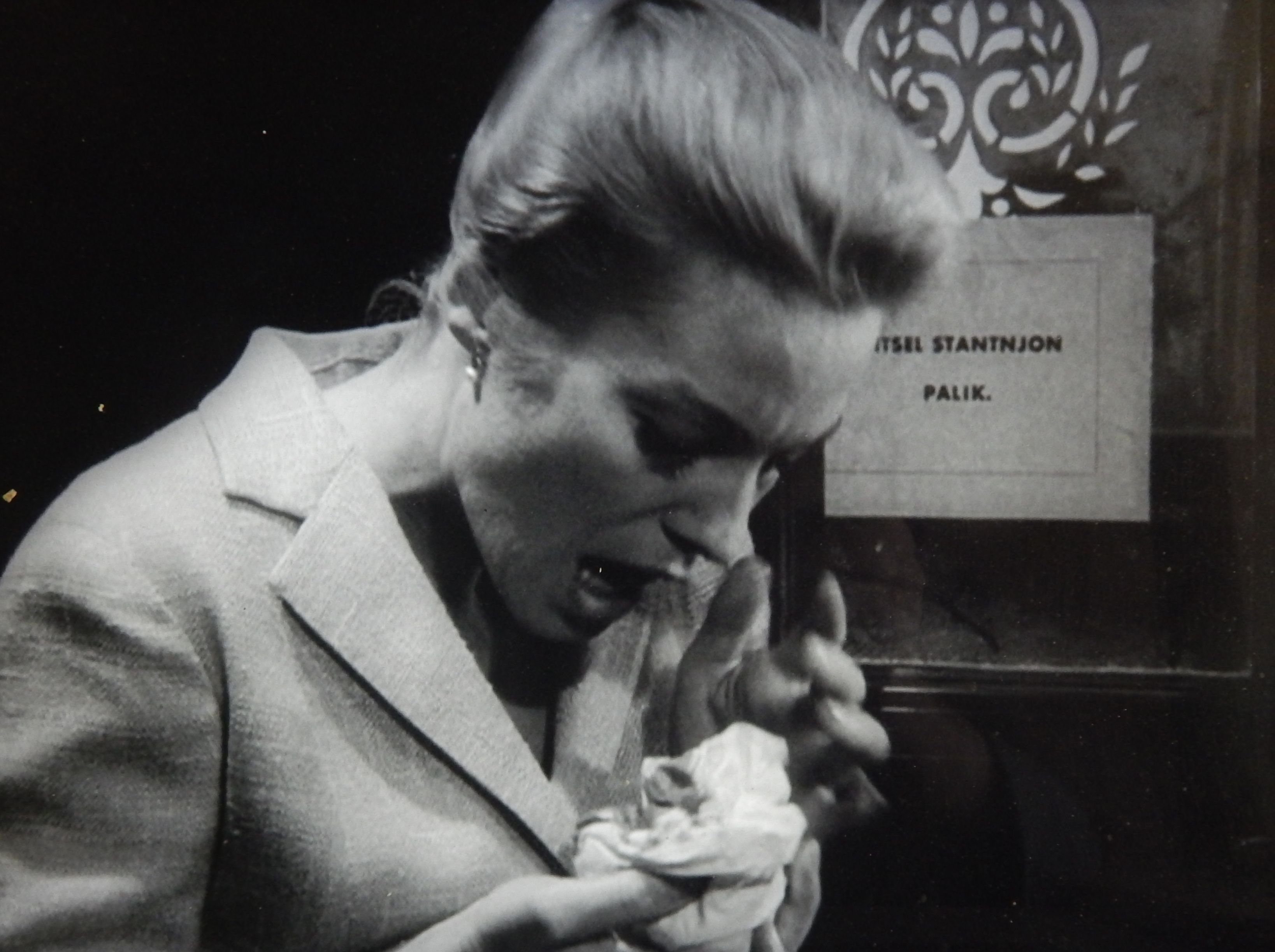
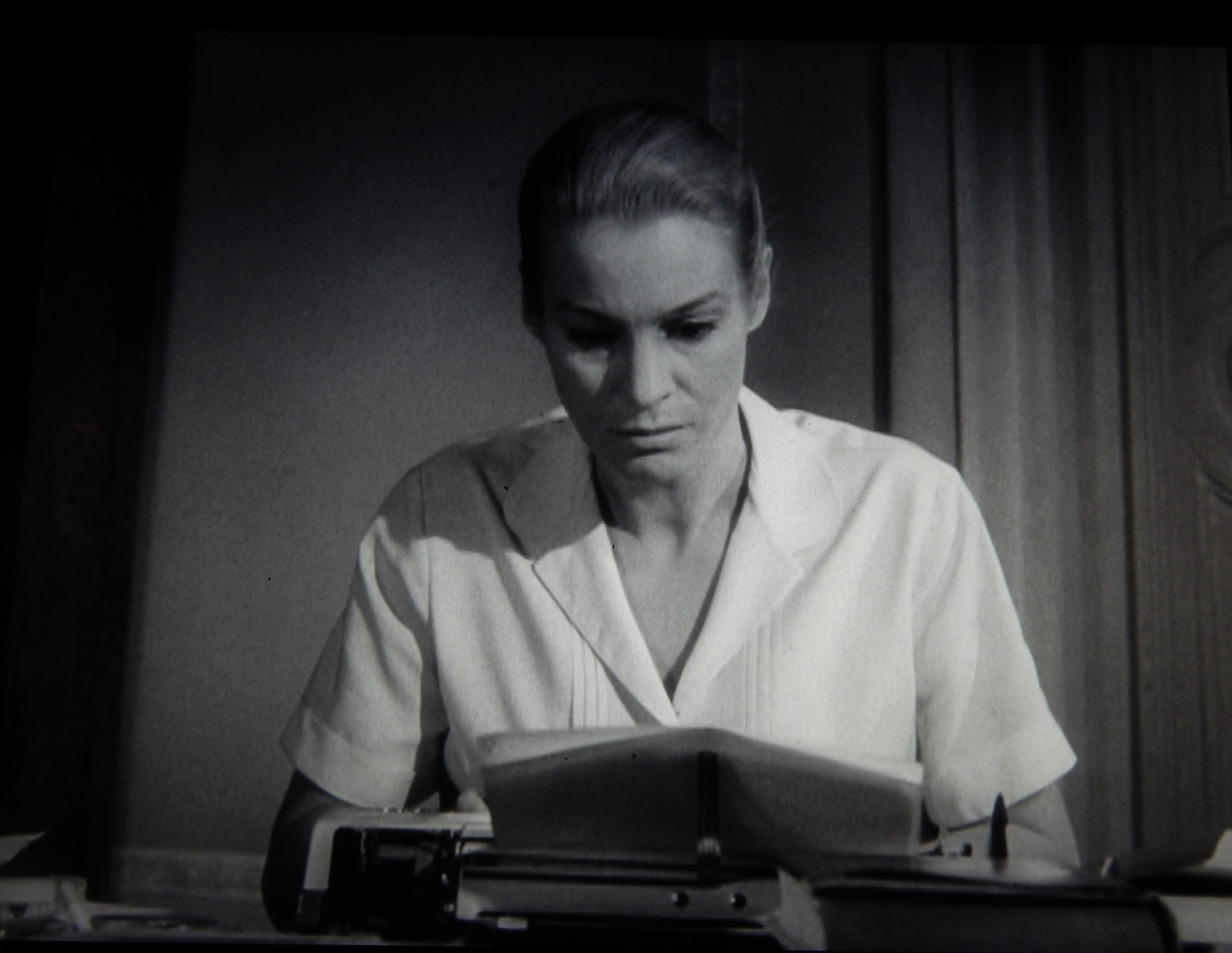
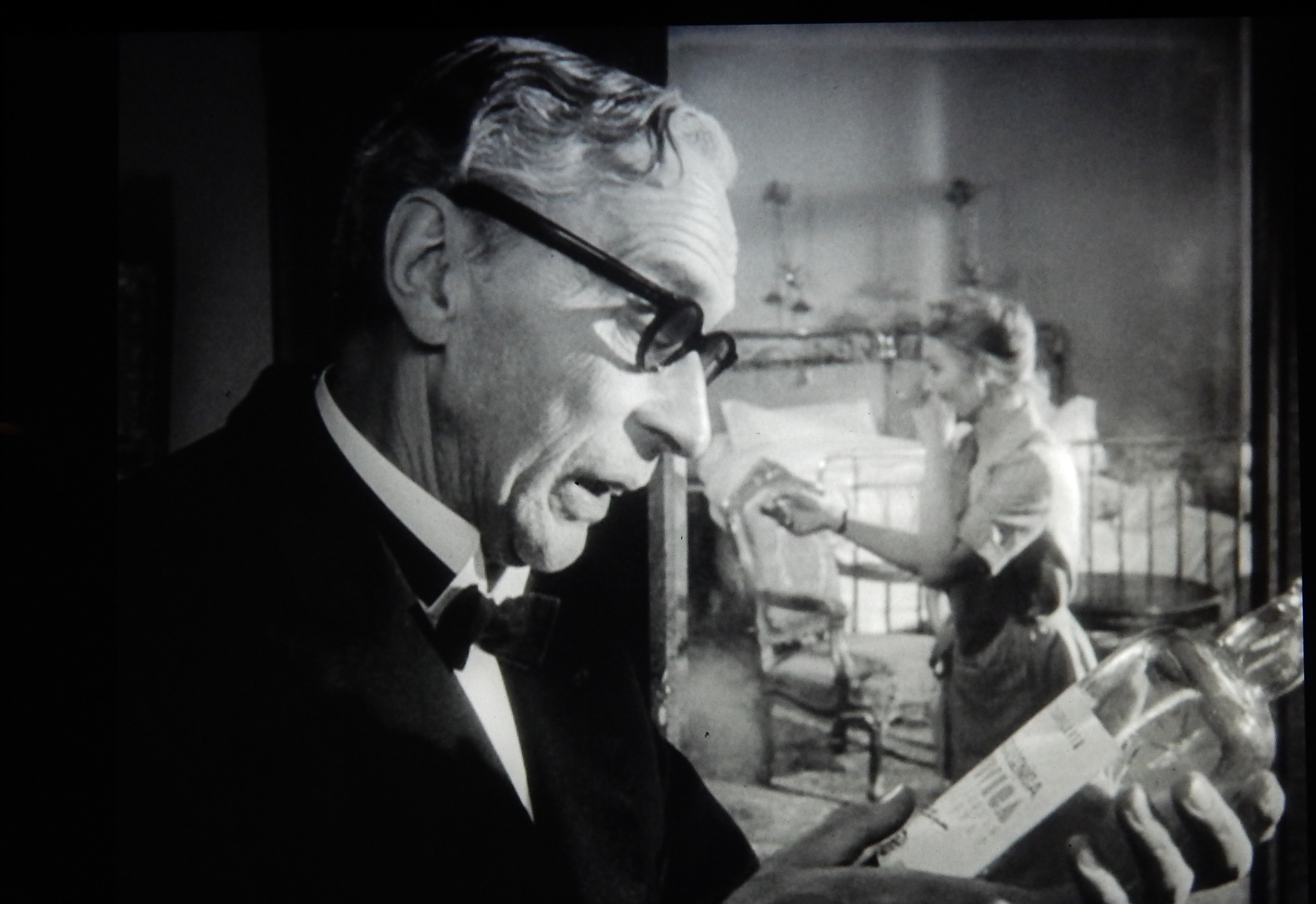
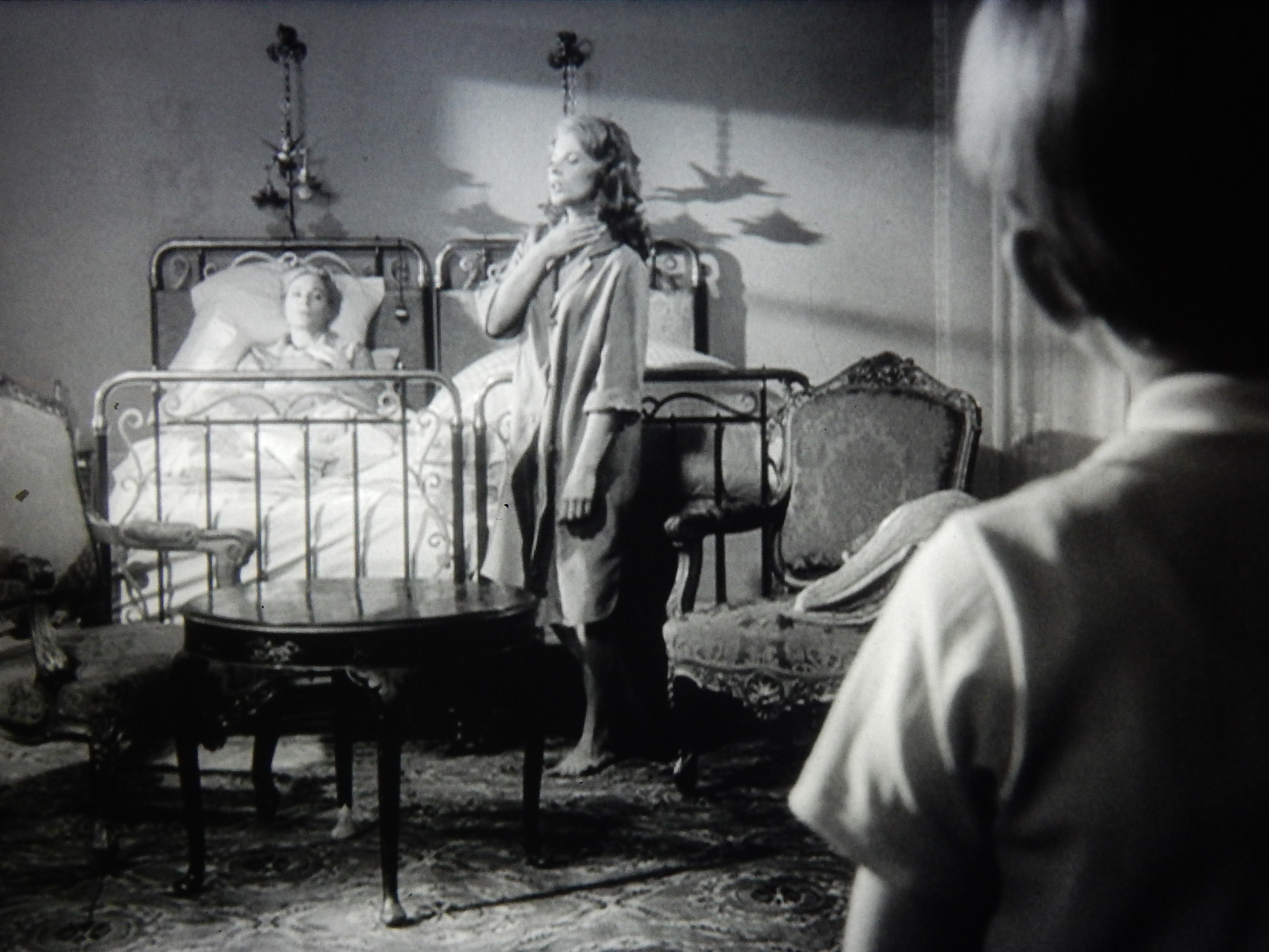
            Of course, the film goes on to present many more scenes of imaginative pantomimic action in combination with innovative, cinematic ways of seeing pantomimic action. After Anna and Johan get into bed to take their nap, the camera focuses on Ester as she works in bed in her pajamas, reading, notating, coughing, gasping, smoking, and drinking. The camera, at low angle, pans from her face to her hand and watches her hand, stub out a cigarette, pour a drink, turn on the radio, tap to the music, and change the channel, as her head comes into view, pressed against her hand on the radio. The camera follows her head as she lifts herself upward and seems to inhale the serene music, causing her to smile, before returning to her book and pen. But she can’t concentrate. She wanders, smoking, toward the doors leading to the room inhabited by Anna and Johan, but the camera does not follow her; it watches her recede and actually tilts down to show her receding figure obscured by the bed covers and the radio. On the other side of the door, the camera watches Ester from a higher angle as she approaches the bed and studies the sleeping pair; she leans against the bedrail, lightly touches Anna’s hair, considers touching Johan but hesitates, then leaves them. It is a pantomime of small, subtle gestures rendered intimate by the camera’s closeness to the performer. When she returns to her room, the camera follows her face in profile as she smokes, deeply melancholy, and moves to the window to gaze down into the busy street, with the film cutting to a view of her from outside the window. She sees a wagon pulled by an emaciated horse roll into view, although buses and cars also crowd the street. An old man in a black derby drives the wagon, stops it, and gets down. The wagon is full of furniture, plants, and strange, unidentifiable objects. Perplexed, Ester returns to her bottle, turns off the radio, pours another drink, which empties the bottle, the camera panning up from the little table to her face. The camera then pans from her face to the servant (Håkan Jahnberg [1903-1970]) entering the room and holds on his profile as Ester, also in profile, appears, full figure, reflected in the full length mirror behind him, so that she seems further away from him than she actually is. She asks him in French, English, and German if he speaks any of those languages, but he politely indicates he does not. She therefore mimes that she would like another bottle of liquor. He understands. She sits down and lights another cigarette, with the camera again studying her profile, her exhalations, her desire for some sort of voluptuous pleasure, as the camera moves closer to her face, while an air-raid warning signal sounds in the distance. The servant places a tray with a glass of brandy and a bottle of it before Ester, who savors the aroma from the glass and examines the bottle. She offers the servant a cigarette, but he refuses, as the camera now shifts to a low angle shot behind her to observe him. She gestures for him to tell him the word for “hand” in his language, and he responds by speaking the word and writing it on a piece of paper. The bell rings summoning him to another room, and he gestures that he must run off. She studies the piece of paper, pronounces the word, then grabs the bottle of brandy as the camera follows her back to the bed, where she drinks and caresses her lips with the paper. She falls back onto the bed, while the camera watches her from above as she unlooses her her pajama top, caresses her breast, opens her legs, and inserts her hand into her pajama pants to masturbate with her eyes closed. The camera moves in on her face; at the moment of orgasm, her eyes open wide as she gasps. She closes her eyes again and turns into the billowing comforter to sleep as the sound of jets suddenly roars overhead. The entire scene is rich in captivating pantomimic action that dramatizes Ester’s loneliness, her gathering anxiety about being excluded from the sleeping pair in the next room, and her sense of being excluded from the strange, foreign culture in the street below her. But the scene also reveals her sensuality, her pleasure in voluptuous sensations, quite in contrast to the image of primness she projected in the opening scene, although these become entangled with self-destructive addictions. She makes the camera look at her from different angles and move toward and around her, as if searching for a way to stabilize its view of her. It is an astonishing sequence of physical gestures and actions that exposes the basis for the woman’s deepest anxiety: that she has not been loved as she has deserved nor has she been allowed to love as fully as she is capable, the most powerful cause of loneliness. Ingrid Thulin performs this melancholy sequence with a confidence that is riveting, as if she felt completely at ease and lilted by the character’s sorrow, utterly fearless at incarnating Ester’s intense vulnerability and intelligence. Bergman himself remarked that making the film was an “enormous amount of fun” because all involved with the production felt “uninhibited,” and the actresses were “always in a good mood” in relation to performing quite daring scenes, although Gunnel Lindblom did insist on some inhibition when she refused to perform a scene with the waiter in the nude (Bergman 1994: 112; Lindblom 1995: 62). Indeed, it is doubtful that pantomime as precise, imaginative, and uninhibited as appears throughout the entire film could happen without a profound sense of trust between the director and the performers: this sort of elegant, “uninhibited” pantomimic action is possible when the performers and film crew know each other so well from their extensive previous work together without necessarily “knowing” the characters well at all. The characters take the performers into an unknown region of humanity that requires a lack of inhibition, but ironically, this lack of inhibition depends on a fundamental condition of trust between people that the film itself neither refutes nor treats as a salvation (cf. Fischer-Kesselmann 1988).

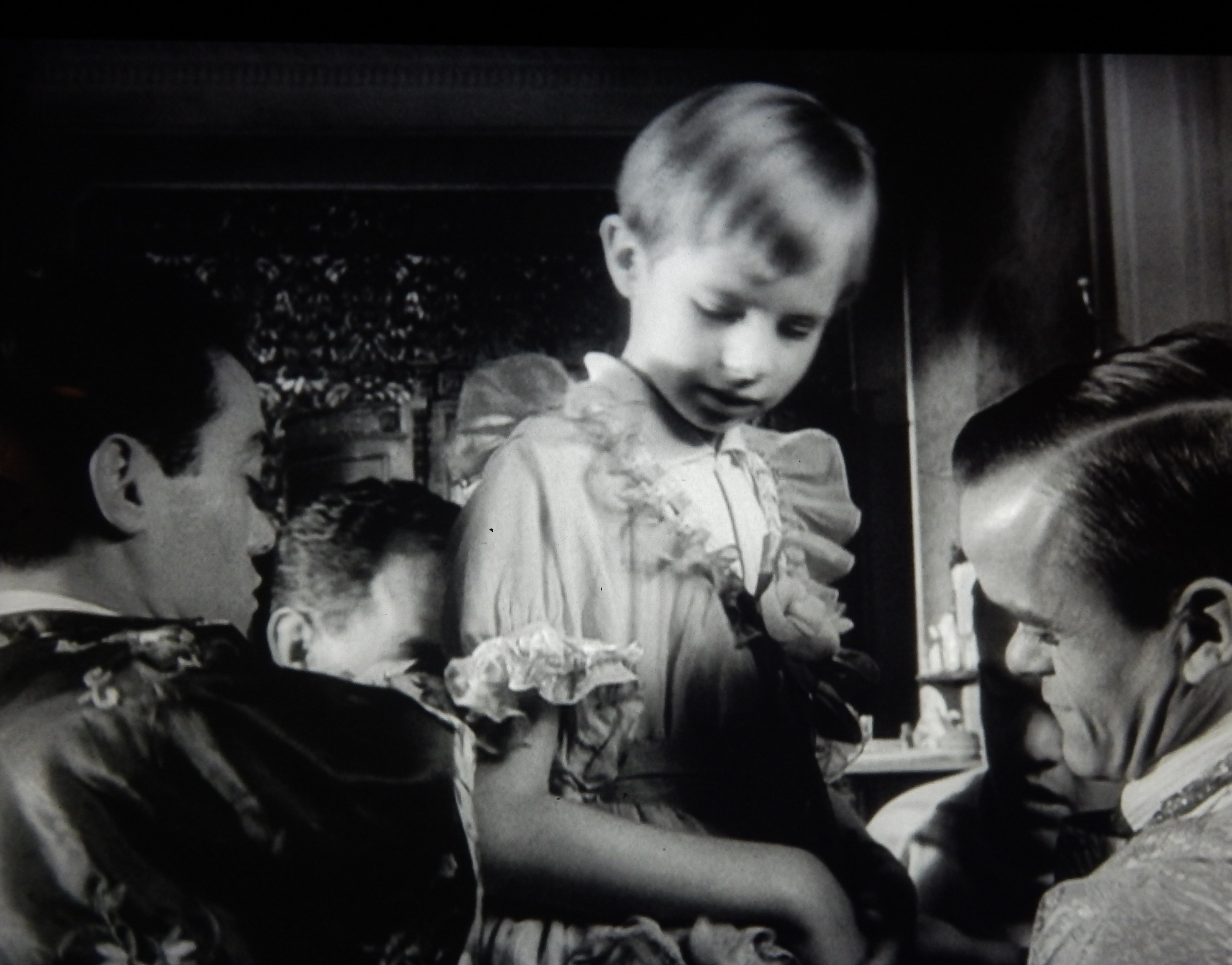
            In subsequent scenes, however, the film explores aloneness from different perspectives: being alone without being lonely. When the jets roar overhead, Johan awakes. He leaves his mother sleeping and, with his toy pistol, he wanders through the cavernous hallways of the hotel, firing his pistol at a service worker changing a lightbulb in a chandelier, watching the elderly servant in his tiny office and running away from him when the man approaches him, observing a huge erotic painting of a centaur grasping a nude woman, running away again from the grasp of the elderly servant, casting his distorted shadow against the wall of a stairway, and coming upon the open door to the room with the troupe of dwarves, all male, who silently play cards, read, drink, smoke, or mend costumes. Johan shoots two of the dwarves and a third wearing a lion’s costume, and they play with him by pantomiming their deaths. The raucous, but wordless dwarves put the dress on him and entertain him with one of them leaping up and down on a bed wearing a clownish gorilla mask until the apparent leader enters and orders them to cease, though he graciously escorts Johan out of the room. In a corner, Johan pisses on the floor, then walks away whistling, as if whistling negates his bad behavior. A homosexual aura pervades the old servant’s affection for the boy and the dwarves’ invitation to him to join their strange, foreign society, dramatized so well by the wonderful close up shot of a dwarf’s hand beckoning Johan to enter the room. Johan clearly enjoys being alone; the hotel offers happy opportunities for adventure, and he finds pleasure in the freedom of speechless wandering. 

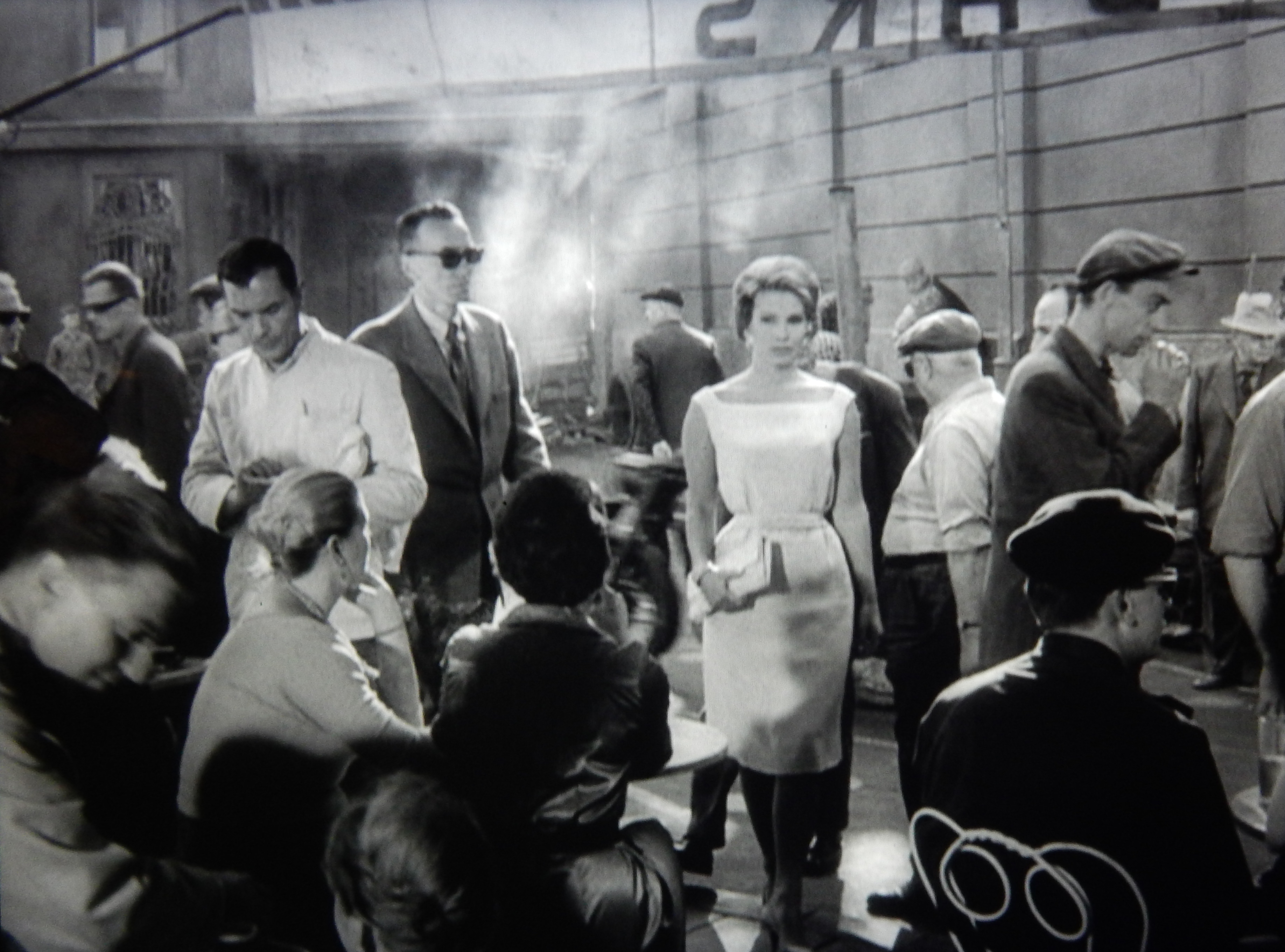
But Bergman intercuts the scenes of Johan exploring the hotel hallways with the scenes of Anna washing and getting dressed to go out and, after Anna leaves, of Ester’s despair, collapse, and return to bed with the kind assistance of the elderly servant. The intercutting implies that the contrasting conditions of solitude experienced by Ester, Johan, and Anna are dependent on each other—that is, on causing Ester’s loneliness, on one person abandoning another, as, in a small, “innocent” way, Johan has abandoned both women. But he returns to Ester, and she shares her dinner with him as she explains his future when he returns home, where his grandparents will take care of him. The film then focuses on Anna’s solitary visit to the café, her silent interaction with the waiter, played by the longtime Bergman actor Birger Malmsten (1920-1991), her entrance (wearing dark glasses) into the Variete Theater, where, smoking in the shadows, she watches the dwarf tumbling act and the couple near her engaging in sexual intercourse partially in the glow cast by a spotlight. The super-expressionist lighting amplifies Anna’s horrified stare at a couple utterly shameless (or “uninhibited”) in succumbing to their lust. She is a person who lives in shadows. Later, when she enters the hotel room with the waiter, she commands him not to turn on the lights. Yet when Ester comes into the room, Anna turns on the lamp, so that Ester feels humiliated by Anna’s shamelessness in cavorting with the nude waiter in bed. When Anna leaves the theater, she enters the sunny street crowded entirely with men—soldiers, workers, students, pensioners, and professionals, although a few women sit outdoors at the café when she returns to give the waiter an almost invisible signal to rendezvous. The camera follows her with a telescopic lens to produce a surveillance mode of viewing and to imply that she is moving in a society that does not encourage speaking. Indeed, in the café, in the theater, on the street no one is seen speaking and no voices are heard, although the street is noisy with activity. Bergman then cuts to Johan wandering through the hotel again holding his pistol. He watches the elderly servant in his office eating and drinking with quietly ritual deliberation. When the servant notices Johan smiling at him, he performs a miniature puppet pantomime using a sausage that he then swallows. Seeing that Johan has not enjoyed this cannibalization of the sausage character, the servant offers to share with him a chocolate bar. Johan sits beside the servant, munching the chocolate as the man pours himself a drink, swallows, and sprinkles Johan’s head with droplets, which causes Johan to smile with amusement, although nothing the man has said is intelligible. The servant then pulls from a large wallet the photographs that apparently depict his parents and what appears to be an outdoor family funeral ceremony long ago. He puts the photos in Johan’s hand and puts his arm around the boy, and with his face conveys a profoundly sorrowful sense of his own loneliness. But Johan hears the sound of his mother entering and runs off to greet her; she fondles him, but they do not speak as she opens the door to the room. Left alone again in the corridor, he studies the photographs before slipping them under the carpet. Perhaps with this mysterious action, Johan hopes to “bury” the memory that binds him emotionally with the old servant, as if loneliness were contagious, an illness, such as already afflicts Ester.

            The Silence contains numerous other scenes of comparably imaginative pantomimic action, which fascinate viewers because of the unusual ways the camera sees the action. It is pantomime designed for a motion picture camera capable of a highly dynamic relation to the performers, capable of observing subtle inflections of gesture, and capable of interweaving separate pantomimic sequences into a larger “view” of the semiotic relations between bodily actions performed by people when they are alone. Bergman showed how film technology widened the meaning of “pantomime” and expanded the expressive power of the body to communicate large ideas when speech has lost its authority to control the narrative. It is an “uninhibited” form of pantomime insofar as Bergman completely trusts his actors to perform “natural” actions and avoids stylized movements that treat the body as an abstract form rather than as an instrument of consciousness in material reality. The film does not even employ any soundtrack music to accompany the pantomimic action. All music in the film comes from sources within the image, such as the radio, the jazz vibraphone in the café, and the pit orchestra in the Variete Theater. In the evening, in the shadowy atmosphere of her room, Ester listens to the radio play a Bach cembalo prelude while Anna holds and embraces Johan on her lap in the room behind Ester. The servant enters bringing coffee, and Ester asks him the word for “music” in his language. He replies with a very similar sounding word. Ester says, “Sebastian Bach,” and the servant repeates the name, nodding his familiarity with the name and the music. A few moments later, after Anna asks to borrow cigarettes from Ester and Ester suggests that Anna and Johan leave this evening, Anna asks what the music is, and Ester replies, “Bach. Sebastian Bach,” to which Anna replies, “It’s nice.” Ester turns off the music, which soon precipitates the quarrel between the sisters over Anna’s appetite for promiscuity and their competitive relation to their father. It is as if music was a translation of a foreign language that otherwise no human understands. But the music is not an accompaniment to pantomimic action; it is a peculiar intrusion upon the “silence” that is the default accompaniment to this “natural” performance of pantomimic action [Film Still Series B]. 

            This “uninhibited” mode of pantomime caused enormous controversy from the moment The Silence premiered in Stockholm in February 1963. Bergman believed that the film would not attract any audience, and Svensk Film Industri, believing the project was too obscure, originally did not want him to make the film, but he went ahead with it anyway, an act of great confidence and courage (Sima 1970: 195). The Silence, however, became the most successful film in the history of the company, and in West Germany it was the most successful film since 1955, with eleven million viewers (Schmitt-Sasse 1988: 17). Of course, the boldness of the sex scenes startled many viewers around the world, but this boldness was perhaps unthinkable without a new way of seeing the body, without seeing the body as a thing in tension with the voice trying to control it, as a thing that made speech “unnecessary” or an encumbrance to knowledge of others. The film precipitated an immense amount of discourse that contended or merely insinuated that the “silence” referred to the absence of God in the modern postwar world, because the narrative contained so many actions “free” of any voice contextualizing them within a morality encoded through language (cf. Theunissen 1964; Schmitt-Sasse 1988). Pantomime elevated the power of film technology to see humanity without much, if any, deference to Christian morality. For this reason, the pantomimic action of The Silence signified for many people a dangerously radical image of the body: with voices largely absent, “naturally” performed actions, rather than stylized movements, appeared intensely mysterious without evoking a religious aura, like translating from a foreign language, producing a disturbing proliferation of “interpretations,” an astonishing upheaval of words. But for probably all audiences The Silence signified a freedom to see that precipitated the immense transformation of cinema in the 1960s and, in subsequent decades, a vast, global investment in expanding and perfecting image technologies (cf. Koskinen 2010: 43-66). Yet The Silence remains unsurpassed in its synthesis of pantomimic action and cinematic seeing. Although Bergman deployed adventurous pantomimic sequences in later films such as Persona (1966), Hour of the Wolf (1968), and Cries and Whispers (1972), he himself never again relied so much on pantomimic action to construct a film narrative as he did in The Silence nor was his pantomimic imagination quite as inventive or complex. His focus shifted more toward exposing the destructive or repressive powers of speech than toward revealing the cryptic varieties of voiceless bodily communication. As Bergman indicated, in the postwar era, the capacity to construct cine-pantomimic narratives of such seductive seriousness depends on a peculiar condition of being “uninhibited,” of feeling on the threshold of a freedom to see the stories that bodily physical actions tell, and it is just incredibly difficult to possess that lack of inhibition or even the circumstances that enable one to possess it. 

            Bergman’s highly imaginative use of pantomime in The Silence owed nothing to a Swedish tradition of pantomime in the theater, for pantomime had a negligible presence in Swedish theater long before and well after the making of the film. It is true that he found much inspiration from the distinctive silent films that Sweden made when he was a boy, especially works directed by Victor Sjöström (1879-1960) and Mauritz Stiller (1883-1928), as well as from German expressionist films directed by F.W. Murnau (1888-1931). But Swedish silent films achieved international distinction in part because of the sophistication with which they applied a verisimilar mode of acting, and this in itself was a break with a traditional (histrionic) mode of acting associated with the stage. Bergman further credited two films by Czech director Gustav Machaty (1901-1963) with deepening his attraction to film narratives “without dialogue”: Ecstasy (1933) and Nocturno (1934), both of which contained almost no speech but complex music and noise soundtracks (Bergman 1994: 291). These films urged Bergman to write and direct a largely pantomimic episode (No. 2) in his anthology film Secrets of Woman (1952), and he included powerful pantomimic scenes in subsequent films, such as Sawdust and Tinsel (1953) and The Virgin Spring (1960). Bergman linked pantomime with inventive film performance, with a way to expand the expressive power of film. Pantomime was “traditional” for him only insofar as he disclosed a pattern of fascination with it in film since boyhood. Despite, however, many years as a major, distinguished director of stage plays, Bergman never showed an interest in pantomime for the theater. He depended on cinematic devices to construct pantomimic performance: editing, expressionist cinematography, close ups, mobile camera. As a director for the theater, he worked almost entirely with dramatic texts by other authors, and these authors avoided pantomime. For Bergman, pantomime signified a radical break with the Swedish “tradition” of a voice-dominated dramatic theater, and he never seems to have considered making such a break, perhaps believing that voiceless performance in the theater belonged more appropriately to the prestigious Royal Swedish Ballet. If Sweden had anything resembling a tradition of pantomime before Bergman, it lay with the Royal Ballet, which between 1786 and 1871 staged or hosted numerous “pantomime-ballets,” “historical pantomimes,” and “pantomime idlylls” in a French style, choreographed by ballet masters: Jean-Rémy Marcadet (1755-?), Louis Deland (1772-1823), Jean-Baptiste Brulo (1746-?), Anders Selinder (1806-1874), August Bournonville (1805-1879) (cf. Klemming 1879: 497-506). By 1871, though, the Ballet had sufficiently “freed” itself from pantomime to dispense altogether with using the word to describe anything it produced. As discussed earlier, Jean Börlin staged his very innovative pantomime El Greco with Rolf de Maré’s Swedish Ballet in Paris in 1920, but he referred to it as a “mimed drama” to diminish association with the somehow less appealing term “pantomime.” Bergman himself never used the term “pantomime” to describe his attraction to scenes “without dialogue” in film, perhaps because during his lifetime the word had become too narrowly defined. More precisely, it had come to mean what ballet wanted it to mean: a codified, stylized way of regulating bodily gesture to support ballet narratives whose artificiality supposedly allowed dance to transcend them. It was a French attitude toward pantomime that assumed a performer could not justify voiceless performance without having experienced a rigorous education or training with teachers in a school that sufficiently respected the stylized code (“tradition”) regulating bodily signification whereby, for the most part, the body created an artificial, abstract world of imaginary objects rather than interacted with a world of material objects. Such a narrow definition of pantomime could account for why Bergman preferred to speak of cinematic scenes “without dialogue” rather than explain how pantomime migrated across performance media instead of remaining imprisoned within a definition of it imposed by theater institutions determined to control it severely if not suppress it altogether. 

Film Still Series B: Ingmar Bergman’s The Silence (1963). Film technology allowed Bergman to produce unprecedentedly imaginative pantomimic performance. His use of the face to construct character and narrative is well known, but the face was never so free of speech as in The Silence (1-6). But in this film Bergman also made dramatic use of hands to create a remarkable and unstable relation between bodies or even between characters and their own bodies (9-13, 15, 21). The film builds much drama out of the performance of simple, yet intensely observed pantomimic actions, such as walking through corridors, reading, typing, combing, washing, smoking, drinking, comforting, serving or sharing food, or looking out windows (5, 7-8, 11, 16-18, 20, 22, 24, 28). However, the great dramatic power of these actions does not diminish the “shock” effect of other, equally “simple” actions, such as Ester’s masturbation, Anna’s horror at witnessing a couple copulate in the theater, the dwarves putting a dress on Johan, and Anna’s sexual rendezvous in a hotel room with a nameless stranger she encountered in a café (14, 25-27). Yet Bergman did not rely entirely on close ups of fragmented pantomimic actions to amplify their dramatic allure; he amplifies numerous “simple” actions by having them performed within complex, precisely detailed scenic contexts that evoke persuasively a country in which the characters do not understand the language of its citizens (19, 21-23), including mirror reflections (19-20). Actors; Ingrid Thulin as Ester, Gunnel Lindblom as Anna, Jörgen Lindström as Johan, Håkan Jahnberg as the hotel servant, Birger Malmsten as Anna’s sexual partner, the dwarves: the Eduardinis. Photos: Bergman (2003). 

Previous Section

Next Section

References

Table of Contents

The Extinction of the Pantomimic Literary Imagination: Peter Handke

Pantomime: The History and Metamorphosis of a Theatrical Ideology: Table of Contents

PDF version of the entire book.

Figure 188: Scene from Peter Handke’s wordless play, “Die Stunde da wir nichts voneinander wußten” (1992), as performed in 2015 at the Thalia Theater, Hamburg, Germany, directed by EneLiis Semper (b. 1969) and Tiit Ojasoo (b. 1977). Photo: Armin Smailovic (b. 1968).

Peter Handke

The only other notable postwar literary dramas that resemble pantomimes are Das Mündel will Vormund sein (1969) and Die Stunde, da wir nichts von einander wußten (1992), by the Austrian novelist and dramatist Peter Handke (b. 1942). Das Mündel will Vormund sein (The Ward Wants to Be the Guardian) belongs to Handke’s youthful period of radically questioning the institutionalized conventions of theater, including the roles that speech and language play in accommodating these repressive conventions, with his most famous work of that time, Kaspar (1967), consisting of a single character on stage, Kaspar, struggling to speak a single sentence with competence, conviction, authority, power, insight, uncertainty, freedom, or other conditions masked by the words. Das Mündel will Vormund sein is a two-person pantomime set in a rural space, a farmhouse before a large beet field. The text prescribes in great detail the physical actions of two men, the ward and the warden, farmers who wear masks and engage in a competition to determine to what extent the warden can control the actions of the ward. A cat is also part of the beginning and ending scenes, and “does what it does.” In the opening scene, the ward eats an apple unself-consciously until the warden appears, holding a pumpkin, and attempts to control the ward through a steady stare, an act of aggressive surveillance that makes the ward increasingly self-conscious and somehow imperfectly “compliant.” The scene becomes dark and “we” can only hear a strange breathing that “is ‘like’ the strongly amplified breathing of an old man, but not quite; on the other hand, it is ‘like’ the strongly amplified breathing of a wild animal that has been cornered, but not quite, either; it is ‘voracious,’ ‘frightened,’ ‘ominous,’ but not quite; at times it seems to signify someone’s “death throes” to us, but somehow it doesn’t either because it appears to change constantly” (Handke 1973: 14; 1970: 65). The breathing vanishes, replaced by music, the chord strumming of “Colors for Susan” (1967), by Country Joe and the Fish. When the stage is bright again, the scene shows the interior of the farmhouse, which the text describes in elaborate detail. While the ward and warden listen “pleasantly” to the music, the warden continually performs small physical actions that apparently test or define the ward’s capacity to respond to them:

The warden folds the newspaper page in half and goes on reading. 

The ward pulls a pencil out of his pants pocket, a carpenter’s pencil like the warden’s, only smaller; he uses it to mark the book while reading. 

The warden goes on folding the paper. 

The ward no longer marks in his book but crosses something out. 

The warden goes on folding as best he can. 

The ward is obviously starting to draw in the little book. 

The warden folds. 

The ward exceeds the margins of the book while drawing and begins to draw on palm of his hand. 

The warden: see above. 

The ward draws on the back of his hand. 

The warden is gradually forced to start crumpling the paper, but we don’t actually notice the transition from folding to crumpling. 

The ward draws on his lower arm; what he draws doesn’t necessarily have to resemble the warden’s tattoos. 

The warden is obviously no longer reading or folding but is vigorously crumpling. 

Both figures are vigorously occupied, one with drawing, the other with crumpling. 

The warden completes the crumpling process and the paper is now a tight ball. 

The ward is still drawing. 

The warden is quiet, the ball of paper in his fist; he looks at his opposite who is drawing (1973: 20-21; 1970: 68).

The scene continues with the warden making different movements at the table, then walking around, then climbing onto the table, elevating himself higher than the ward, who always remains “lower.” But then, the warden lies down and the ward cannot make himself lower than the warden. A profusion of other actions occur. At one point, the warden cuts his toenails and then his fingernails, while the ward picks up the clippings. Later, the warden fills a teakettle with water from a hose and the ward grinds coffee until the teakettle blows. After another dark scene, the ward tosses thistles on the back of the warden, while the warden writes obliviously until he turns around and the ward throws the remaining thistles onto his chest. A while later, the warden physically and “non-violently” adjusts the position of the sitting ward and, after a prolonged stillness, begins tossing bottles at the ward, who displays complete incompetence at catching them, except for the last one: “We are startled.” The warden eventually decides to leave the kitchen, and the ward intends to follow, but the warden insists on closing the door behind him and overcomes the ward’s effort to open the door. The ward nevertheless crawls outside through another door “as if for a dog.” Outside again, rain is imminent. The ward unveils a beet slicing machine and demonstrates the slicing of beets. The ward, however, has difficulty operating the machine. The warden watches him fail repeatedly as the stage grows dark and the ominous breathing returns. In the final scene, the ward enters the place before the house carrying a small tub and rubber hose. “He is no longer wearing his coveralls.” He sets the tub down, places one end of the hose into it, and “we hear running water into the tub.” The ward returns with a sack, from which he draws a handful of sand. He lets the sand fall through his fingers into the tub and repeats this action until the stage goes dark (Handke 1973: 7-38; 1970: 62-83). 

            Handke expects the actors to perform the many actions naturalistically, with the idea of showing how a person controls another person through physical actions alone, and how the other person responds to this control entirely with physical actions that reveal a condition of dependence, incompetent compliance, resistance, provocation, submission, defeat, or (at the end) conquest. The piece is a theatrical allegory of male competitiveness, a sobering demonstration of how assertions of power operate outside of language, in simple, minute physical actions that have no motive other than to cause another person to act “accordingly,” to acknowledge a dependent relation, to accept control by another, even if acceptance means resistance or imperfect obedience. Handke explores how bodies construct power relations, struggles for power without resorting to physical violence, without reliance on the “civilizing” oppressions embedded in language. The final scene suggests that the ward has become independent, free of his guardian. Some commentators read the ending as a triumph of the ward over his oppressor, an allegory of revolutionary overthrow. But the ward never indicates that the warden oppresses or abuses him; rather, the ward responds variously to the warden’s physical assertions of power—the ward assumes he must respond in a “submissive” manner without the warden having even to give a commanding gesture. After all, the ward picks up the fingernail and toenail clippings without the warden signifying that he should do so. The text does not indicate the conditions under which the ward has obtained his independence, nor does the play, in spite of its title, show that the ward and warden have reversed roles. The ward is independent insofar as his guardian is absent and he is able to perform the inscrutable actions of filling a tub with water and pouring sand through his hand into the water: a state of independence, of being “free” of responding to someone more powerful, of having no dependent relation to a guardian, is something the text implies “we” cannot understand, because it happens in darkness. The performance of the play’s actions may at moments seem tedious, but manifestations of power probably do depend on tedious bodily actions or actions that have no greater purpose than to provoke the response of another body. This point seems connected to the “we” invoked by the text, the “we” who are named as spectators of the performance. Bonnie Marranca considers this “we” as “a kind of literary authoritarianism,” a “coercion” of the reader/spectator to respond to the action the same way as the person employing the “we.” The play is thus a “confrontation with the audience in which the dialectic is played out, not on the stage, but in the relationship between stage and audience” (Marranca 1977: 275). In other words, pantomime itself is the revelation of a power dynamic insofar as it provokes the audience to respond to it “accordingly” and pantomimically: “We are startled.” Claus Peymann (b. 1937), whose own distinguished career began with directing premieres of Handke’s early plays, directed the premiere of Das Mündel will Vormund sein at Frankfurt in January 1969. The production attracted much attention, as any work by Handke did and still does, but although the piece has occasionally been revived on the stage, it has not enjoyed as much popularity in the theater as other Handke plays. A production in New York in 1971, under the title, My Foot, My Tutor, provoked some intellectual discussion without provoking much acclaim. The piece did nothing to motivate other writers for the stage to compose pantomime scenarios, and Das Mündel will Vormund sein effectively represented a unique experiment in speechless theater of which Handke had somehow earned exclusive ownership: it was as if, having written a pantomime, Handke had exhausted the possibility of anyone else writing another one.  

Nevertheless, Handke himself wrote another one twenty-three years later, Die Stunde, da wir nichts von einander wußten (1992). As a performance, however, “the hour we knew nothing of each other” lasts at least a hundred minutes. Although no one speaks a word during the entire performance, Handke calls his piece a play, not a pantomime. He instructs “a dozen actors and lovers” to perform hundreds of roles during the performance, but in practice, theaters have required more than two dozen actors to handle all the roles. Handke claims that the idea for the play came from sitting all day in an outdoor café in Muggia, Italy and watching people pass by. The action of the play unfolds in a brightly lit town square, for which Handke provides no further contextual details other than mentioning in his dedication “to S” the square before the Centre Commerciale du Mail in Vélizy, France, which is actually now a mall. Handke here applies a strategy that is the exact opposite of his strategy in Das Mündel will Vormund sein. In the earlier play, he prescribed a great profusion of minutely detailed actions performed by single, interacting characters. In Die Stunde, da wir nichts von einander wußten, he presents single actions performed by a great profusion of characters. The piece begins with a single person of unspecified sex rushing across the stage followed by another rushing in the opposite direction. A third and fourth person cross the stage. Subsequently hundreds of characters appear on the stage, some defined only by the actions they perform, some by their actions and the clothes they wear. Only a few characters appear more than once, so that the performance resembles a grand procession of “types” of people who appear momentarily, hardly more than thirty seconds, and then disappear. Handke strives to provide a constant processional variety of characters and actions:

A woman in a headscarf and rubber boots crosses the square, she drags a watering can and carries a wilted, rotting flower bouquet that she in a high wave throws behind the scene.

In the next moment comes from somewhere else an equally well-dressed type of Old Woman, with a sickle, a travel bag, and a handbasket overflowing with forest mushrooms. 

A third woman, undefinable, dressed almost the same, moves in a different direction, with nothing in her hands, the back and neck deeply bent, the face directed to the ground, steady, hardly moving from the spot, and behind her succeeds another wanderer, clogging the path, bit by bit, as if the path was too narrow for overtaking with a long-distance vision, without eyes for the thing before the wandering peaks (Handke 1992: 21-22)

Occasionally characters briefly interact with each other or appear as a group: an ensemble of refugees, a circus troupe, “two or three in winter clothes” meeting “two or three in summer clothes.” Pairs appear once in a while: a man dressed as a woman with a woman dressed as a man; “a man and a woman place their hands on each other’s genitals,” a man follows a woman. Otherwise unrelated individuals perform the hundreds of actions, such as a person whizzing by on roller skates, another reading a book, or a man pulling a wagon full of masks. The actions do not seem related to each other and could happen in a different order, but the second half of the play creates a more hallucinatory panorama than the first half as characters from different historical eras or cultural contexts appear: 

[…] a youth blows out the old one’s candle; the lighthouse keeper marches through; a patrol [passes] with dangling hand shells and talons; a wanderer goes audibly through a deep pile of leaves; the grandfather carries a winding snake from the floor; the Portuguese woman leaps up; the girl from Marseille steps onto the harbor dock; the Jewess of Herzliya throws gas masks into the alley, the Mongolian woman strides through with a falcon; the patroness of Toledo pulls a lion’s skin over herself (62).

Chaplin and Moses also appear momentarily. It is clear that the piece does not represent continuous real-time actions but a theatrical abstract of many actions that occur in a generic space over long periods of time. Handke indicates numerous pauses when the stage is empty before a new set of actions resumes. Although no one speaks a word or even intimates they are speaking, some characters make sighs or cries. Dogs bark, bells toll, storm thunder resounds, but Handke indicates no musical accompaniment. The piece ends with a First Spectator leaving his seat to join the throng on stage, but he becomes disoriented and flees; a Second Spectator tries to intervene, but two women hanging wash hinder him. A Third Spectator “threads himself into the scene and meanders, obviously of course, with the undisturbed procession. Coming and going, coming and going. Then the square becomes dark” (64). The piece therefore is not a project to see with documentary precision the actions of people as one might see them from a detached vantage point, such as a table in an outdoor café. Such a project would require a degree of naturalism and anthropological observation of actual persons that is nowhere evident in the play. Rather, the aim is to show how a generic public space hosts an immense variety of actions or types of actions whose “meanings” remain opaque or indecipherable to anyone but those who perform them. The theater spectator may consume the spectacle of multitudinous actions performed by hundreds of people, but the spectacle is only an accumulating phantasmagoria of unknowing. “We do not know each other” by presuming that the crowd, the public, or the community “we” observe is somehow “us,” even if the actions people perform are familiar. In reality, as revealed theatrically rather than anthropologically, the public is nothing more than a procession of individuals who know nothing of each other any more than they know of its “audience” and can only be known as momentary figures who have imprinted themselves in memory because of some inscrutable peculiarity in their performance of a fleeting action. As usual, Claus Peymann directed the premiere of Die Stunde, da wir nichts von einander wußten, in 1992, at the Burgtheater in Vienna. The production and the play received abundant acclaim, as did subsequent productions in Bochum (1993), directed by Jürgen Gosch (1943-2009), and in Berlin (1994), directed by Luc Bondy (1948-2015) (cf. Meurer 2007: 159-197). Since then the piece has enjoyed numerous productions internationally, occasionally outdoors, with directors varying widely in their organization of the action, so that some productions seem like civic pageants while others resemble stylized critiques of “modern” society. Despite the cost of acquiring so many actors and costumes to produce it, Die Stunde, da wir nichts von einander wußten remains one of Handke’s most popular works for the theater. Again, though, his venture into pantomime has failed to motivate any other dramatic author to work in the genre, and he himself has made no further attempt. The international postwar literary imagination evidently believes that only one literary writer in the whole world should or needs to write pantomimes, and having written one, it is almost impossible to write another without it becoming a singular, monumental project to overcome, however briefly (100 minutes), an overpowering doubt about the capacity of a “play” to sustain the attention of a theater audience without the performers speaking. 

Previous Section

Next Section

References

Table of Contents

The Extinction of the Pantomimic Literary Imagination: Beckett’s Acts without Words

Pantomime: The History and Metamorphosis of a Theatrical Ideology: Table of Contents

PDF version of the entire book.

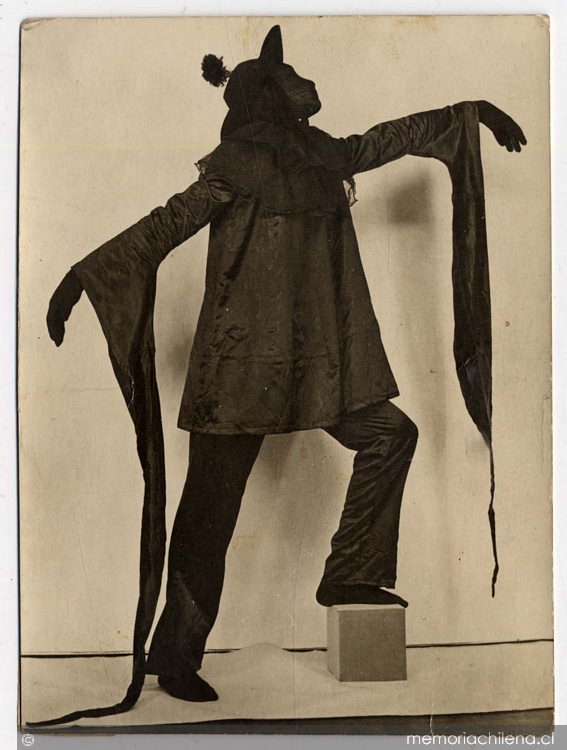
Figure 187: “Pierrot with Jumping Jacks” (1923) by Estonian artist Ado Vabbe (1892-1961); Tartu Museum, Tartu, Estonia

Beckett’s Acts without Words

Performers and directors completely defined pantomime culture after World War II, even if literary works sometimes inspired them. Pantomime came from performers and directors who wanted to control the imaginary lives they lived on stage rather than perform the lives assigned to them by the authors of dramatic texts. The literary imagination, which exerted so much influence over pantomime at the beginning of the twentieth century, has been completely absent from pantomime culture since Herzmanowsky-Orlando wrote scenarios in 1941 that he never even published, although by then he realized that theater implacably regarded pantomime as an obsolete genre. Since then, writers have seemed incapable of thinking pantomimically, incapable of imagining theatrical performance without speech, without assuming that spoken language causes and resolves all conflicts. In the early decades of the twentieth century, a sector of the Austro-German literary imagination turned to pantomime as a response to a perceived “crisis” in language. Pantomime allowed them to represent “invisible” zones of reality that eluded the power of language to reveal. Since World War II, however, dramatic writers generally have perceived a different sense of crisis in language: if anything, they have tried to restore credibility to language, which otherwise seemed to lack “authority” unless backed by incredible, unprecedented levels of physical violence. In reality, the dramatic literary imagination was afraid of performing bodies that did not speak, could not imagine life without voices, whereas actors and directors could.

In 1956, an English dancer and actor, Deryk Mendel (1920-2013), performed in a Paris cabaret a clown act based on the character of Frollo in Hugo’s Notre Dame de Paris. The management asked him to come up with a new Frollo piece for the next program. Mendel contacted several French absurdist dramatists in Paris, including Samuel Beckett (1906-1989), inviting them to write a piece for him. Beckett agreed, after his companion Suzanne Déchevaux-Dumesnil (1900-1989) reported enthusiastically about Mendel’s performance. He wrote Act without Words, a pantomime for one actor, but the cabaret could not stage it because the text requires the suspension of scenic objects over the stage and the theater had no flyweight system (Knowlson 1996: 377-378). Eventually Mendel staged the piece in April 1957 at the Royal Court Theatre in London, following the premiere performance of Beckett’s drama Endgame. Beckett saw the pantomime as an opportunity to commission his cousin John Stewart Beckett (1927-2007) to write incidental music for it. He claimed to have written the piece out of his affection for comic silent film performers like Buster Keaton (1895-1966), Ben Turpin (1869-1940), and Harry Langdon (1884-1944), but he probably would never have written a pantomime if Mendel had not invited him to and if Suzanne Déchevaux-Dumesnil had not encouraged him to do it as a way of breaking out of a creative “impasse.” Act without Words takes place in the “dazzling light” of a desert. It begins with a man “flung” backwards on to the stage. He responds to the sound of a whistle to the right and to the left, but gets flung back each time. After performing each action, he “reflects,” but all of his actions fail to alleviate his lonely, isolated situation. Objects descend from the sky: a palm tree, a pair of tailor’s scissors, a carafe labeled “water,” a big cube, and then a smaller cube, but he does not notice the objects until the whistle calls his attention to them. He looks at his hands while “reflecting.” He tries to pile the cubes to reach the carafe, but falls instead. The carafe pulls away from his reach. A rope descends; he tries to climb it to reach the carafe, and when this fails, he cuts the rope to make a lasso by which he can capture the carafe, but this strategy also fails, as does his effort to hang himself. Another whistle beckons him from the right wing, but when he tries to exit, he gets flung back. When, however, a whistle sounds from the left wing, he does not move, but merely “reflects” and trims his nails with the scissors. The objects fly upward. When he sits on the big cube, it pulls upwards and dislodges the man. He lies on the ground. The carafe drops down to a few feet from him. The whistle sounds. But the man doesn’t move. The palm tree disappears, the whistle sounds, but the man doesn’t move. “He looks at his hands” (Beckett 1984: 37-40). In Act without Words, Beckett uses pantomime to construct an existential parable of human existence: a human body gets thrown into a deserted, inhospitable place from which no escape is possible. Life in this space offers temptations, rewards, hopes, opportunities, but these are all beyond man’s capacity to realize, they are illusions that leave man in a space he longs to escape. After much “reflection,” he realizes that he must refuse to obey the whistle calls of illusion, that he must find purpose within himself, in his hands, in his powerlessness, his non-response to external distractions. 

Beckett apparently wrote Act without Words II around the same time that he wrote Act without Words, but this second short pantomime did not have its premiere performance until 1960, in London. In this piece, the spectator sees a “neat pile of clothes” beside which, in “frieze effect,” are two sacks, B and A, and each contains a man. A long pole, called a “goad,” enters horizontally from the right. The goad patiently succeeds in prodding the man in sack A to move. “A, wearing shirt, crawls out of sack, halts, broods, prays, broods, gets to his feet, broods, takes a little bottle of pills from his shirt pocket, broods, swallows a pill, puts bottle back, broods, goes to clothes, broods, puts on clothes, broods, takes a large partly eaten carrot from coat pocket, bites off a piece, chews an instant, spits it out with disgust, puts carrot back, broods, picks up two sacks, carries them bowed and staggering half-way to left wing, sets them down, broods, takes off clothes (except shirt), lets them fall in an untidy heap, broods, takes another pill, broods, kneels, prays, crawls into sack and lies still, sack A being now to left of sack B.” The goad enters again, this time on a wheel, and prods B, who crawls out of the sack and performs a variety of different actions, among others: “he consults a large watch, puts watch back, does exercises, consults watch, takes a tooth brush from shirt pocket and brushes teeth vigorously, puts brush back, rubs scalp vigorously, takes a comb from shirt pocket and combs hair, puts comb back, consults watch, goes to clothes, puts them on, consults watch, takes a brush from coat pocket and brushes clothes vigorously, brushes hair vigorously, puts brush back, takes a little mirror from coat pocket and inspects appearance, puts mirror back, takes carrot from coat pocket […].” He takes off his clothes and puts them in a pile and moves the sacks to their original position and crawls into his sack to the left of A. The goad enters again now on two wheels and prods A to repeat the action all over again (Beckett 1984: 41-43). The pantomime dramatizes a mechanistic condition of human existence. “Life” is dormant, “sacked away,” until prodded or goaded awake by an abstract, inhuman mechanical power. Existence consists of performing and repeating a series of mundane actions until a moment of “brooding” or “consulting” compels the performer to return to a state of dormancy after arranging the sacks so that he will not be “goaded” awake too soon. Theaters around the world continue to perform either of the two pantomimes fairly often, both were part of the Beckett on Film (2001) project, a Hollywood animation company made a 1960 cartoon film of Act without Words, and the pieces have inspired some complex scholarly commentary (cf. Lamont 1987; Zilliacus 1993; Zhghenti 2014). But after 1956, Beckett never returned to pantomime. With these two little pieces, he prescribed all the actions a voiceless body could perform to represent his existentialist view of humanity.

Previous Section

Next Section

References

Table of Contents

Gendered Perspectives on Modernist Pantomime: Lindsay Kemp

Pantomime: The History and Metamorphosis of a Theatrical Ideology: Table of Contents

PDF version of the entire book.

Figure 186: Lindsay Kemp (left) performing “Flowers” in Turin, Italy, 1985. Photo: Danielle Fazio.

Lindsay Kemp

In England, pantomime in the postwar era departed from the imperturbable Christmas pantomime format through the figure of Lindsay Kemp (1938-2018). Though he studied under Marceau, most of his education was in dance, in London, from the Marie Rambert Company and Hilde Holger (1905-2001), a Viennese expatriate and exponent of expressionist dance. He claimed that, from infancy, “I never walked, I always danced. For me dancing is so much more pleasurable than walking” (Lewis 2016). Yet he was never important as a dancer or choreographer. It was his skill in pantomime that enabled him to enjoy a very long career as a performer. After struggling for several years to discover his own unique performance style, he formed a three-person company in 1964, which staged a mime revue in London, Clowns (1966). The show impressed the rock musician David Bowie (1947-2016), who became Kemp’s student at the Covent Garden Dance Centre, and then invited Kemp to collaborate with him on music productions. Through Kemp, Bowie, whose career as a singer kept stalling, learned how to construct a more effective, theatrical performance persona, for Kemp displayed a powerfully liberating fearlessness in cultivating a flamboyantly theatrical personality. Bowie and Kemp produced a pantomime, Pierrot in Turquoise (1967), for which Bowie wrote the songs and played the character Cloud; Kemp played Pierrot, whom Colombine discards in favor of Harlequin; Pierrot kills Harlequin and maybe Colombine as well when she resists his attempt to rape her (Pierrot in Turquoise 2015 [1970]; cf. Waldrep 2015: 25). The show was peculiar for several reasons: Cloud (Bowie), in whiteface and white gown, was a melancholy, singing commentator on the pantomimic action. Harlequin (Jack Birkett [1934-2010]) was a bald, nearly nude, muscular black man who wore large earrings and mascara and knitted. Birkett, who had worked with Kemp since 1956, was also blind. Pierrot wore a sixteenth century tunic while Colombine (Annie Stainer) wore a complementary period dress and extravagant blonde wig, but she bared her breasts for Harlequin. Pierrot inhabited a cluttered room stuffed with Victorian bric-a-brac, and when, after dressing, he looks into a full-length mirror, he sees Colombine. When he steps through the mirror toward her, he enters an abstract space, filled with ladders and manikins, where sexual scenes and the murders take place. Pierrot in Turquoise was not a comic piece, but a bizarre evocation of pathos stimulated less by the conventional tragic love triangle story than by a “fatal” atmosphere of sexual ambiguity. Kemp worked with Bowie on fashioning the singer’s alien, androgynous “Space Oddity/Ziggy Stardust” persona of the early 1970s, and in the late 1970s, he worked with English rock singer Kate Bush (b. 1958) in developing an energetic movement style for her concert performances and music videos: “I had no qualifications in ballet. I had almost given up the idea of using dance as an extension of my music, until I met Lindsay Kemp, and that really did change so many of my ideas. He was the first person to actually give me some lessons in movement […] it’s more like mime” (Bush 1982). In 1973, Kemp produced in London Flowers, a Pantomime for Jean Genet, which became perhaps his most successful production and which Kemp himself regarded as his “most fabulous” achievement. He based the piece on the novel Notre Dame de les Fleurs (1943) by Jean Genet (1910-1986), who wrote the book clandestinely while imprisoned for theft. Initially, Kemp wanted to stage Genet’s one-act play The Maids (1947), with men playing the maids and their female employer in drag, as Genet intended, but another London theater forbade him because it had already scheduled its own production starring Susannah York, Vivien Merchant, and Glenda Jackson. He responded by putting together Flowers in a hastily improvised manner.

Genet’s novel poetically inventories the various sordid, underworld characters who inspire the incarcerated narrator’s masturbatory sexual fantasies. The chief criminal character is the transvestite prostitute Divine, whose death the narrator announces at the beginning of the book, which therefore describes his memories of Divine and her interactions with different criminals, including her masochistic love for the murderous pimp Darling Daintyfoot. In Flowers, Kemp plays Divine in whiteface and whitened body and in several different costumes. As in nearly every one of his subsequent productions, he removes his wig to display his bald head. Much of the action consists of showing Divine’s attraction to men in a gay nightclub setting and the men leaving her for other men to emphasize Genet’s theme of betrayal as the basis for the redemptive “abjection” he regards as proof of love. Divine performs a couple of slow solo dances, makes sweeping and delicate movements with a fan, makes voluptuous movements with a veil, and, powdered entirely in white and wearing only a jockstrap and a veil, metamorphoses into Our Lady of the Flowers, a saintly figure who hovers affectionately over the the nearly nude body of a symbolically crucified criminal. The music accompanying the action consists of recorded excerpts of classical music, religious music, ballet music, and old music hall tunes. Lush and sometimes lurid colored light bathes the stage. While Kemp likes to sprint about when he dances, most of his movements are slow, deliberate, protracted, and the pace of the show (and in all subsequent productions) is leisurely, for, as he explained, “I always take my time, because I love to make the audience wait, and the audience loves that.” The slowness, he believed, contributes to a mood of “intoxication” that is the goal of performance: “I’m terribly into intoxication—that’s the only thing that counts” (Brown 1974). Before Flowers, pantomime had perhaps never represented male homosexuality—and certainly male masturbation—so explicitly. His audience was—and remained—primarily gay, but that audience was large enough to sustain him and his company for decades. The extravagantly theatrical “camp” aesthetic ascribed to him signified an art openly designed for the pleasure of homosexuals without, however, becoming confused with the parodies and comic travesties of nightclub drag acts. Kemp brought a sweet pathos, an “intoxicating” self-indulgence, and a seriousness of purpose to his flamboyant productions that released camp from the need to be laughable. With him, pantomime signified a rapturous freedom of being that entailed a daring, necessary shamelessness. Occasionally he appeared as a bizarre character in films, perhaps most memorably in Sebastiane (1976), directed by Derek Jarman (1942-1994). Here he was an ancient Roman dancer performing for “decadent” aristocrats at a villa party. His dance is lewd: he is nude except for an ornamental codpiece, his entire body is powdered white and his eyes heavily mascared. As he undulates lasciviously, he excites a group of six otherwise nude men who wear giant paper mache penises. These men circle around him with increasing frenzy, prodding him with their penises, until they lift him up, glorify him, lower him to the marble floor, and ejaculate onto him. It is a scene of “intoxicating” excess that tests the film viewer’s capacity for shamelessness. 

After Flowers, he produced numerous pantomimes that toured internationally: Salomé (1975), Mr. Punch’s Pantomime (1975), A Midsummer Night’s Dream (1979), Duende (1980), Façade (1982), Nijinsky (1982), The Big Parade (1985), Alice (1988), Onnagata (1990), Cinderella (1993), Variété (1996), Rêves de Lumière (1997), Dreamdances (1998), Elizabeth’s Last Dance (2005) and Kemp Dances (2015), with many of these shows employing music written for them by the Chilean composer Carlos Miranda (b. 1945) (cf. Wilms 1987). But none of these productions achieved nearly the impact of Flowers; while his literary and historical inspirations changed over the years, he relied almost entirely on the pantomimic tropes, devices, movements, and images that he introduced in Flowers. Nevertheless, as Margaret Willis has remarked, “he possesses a magnetic personality onstage that draws the onlooker into his make-believe world. His skin is painted white, his eyes panda-black, and his lips ruby-red; his puckish features are topped by his shiny bald head. And he likes to wear dresses. His drag performances are reminiscent of a beloved granny getting up to do an impromptu party piece with an endearing abandon, beaming with a self-satisfaction that cuts through any embarrassment” (Willis 2002). In 1979, he moved his company to Spain, where his shows were very popular; in 1991, he moved the company to Rome and to a former monastery. But in Britain, despite the proliferation of mime courses and the prestigious annual London International Mime Festival, established in 1977, no one has come close to matching Kemp’s success in pantomime, perhaps because it requires an intimidating level of courage (cf., Senelick 2000, 409-411).

Previous Section

Next Section

References

Table of Contents

Gendered Perspectives on Modernist Pantomime: Chilean Pantomime

Pantomime: The History and Metamorphosis of a Theatrical Ideology: Table of Contents

PDF version of the entire book.

Chilean Pantomime

It is tempting, then, to consider a gendered rift in pantomime culture arising at the end of the twentieth century, for the French approach and indeed nearly the whole of pantomime history has been the project of men to free the body from the voice and to free voiceless performance from dance. But a gendered understanding of pantomime history in the late twentieth century inevitably becomes complicated by the shear scale of male investment in pantomime compared to female, and by the diversity of male perspectives on pantomime. The male investment is not as stable as a constant focus on the French model indicates. In Chile, for example, pantomime began as a male enterprise, as one might suppose anyway. A university student, Alejandro Jodorowsky (b. 1929) dropped out (“I don’t think you need to study art to become an artist”) to become (1947) a clown in a circus (Barton-Fumo 2012). When he saw the film Les enfants du paradis, he decided to form a pantomime troupe in 1948. But the group did not present its first program of scenes until 1951 at the university in Santiago, where Jodorowsky had recruited the members of the five-person ensemble. The program contained five pieces: PierrotLa Bañista (The Bather), El Buey Sobre el Techo (The Ox on the Roof), El Viejo, el Amor y la Muerte (The Old Man, Love, and Death), El Prestidigitator, and El Joven Suicida (The Young Suicide). Jodorowsky promoted the production as “experimental pantomime,” with no music and no scenography: the actors “play the role of houses, windows, clocks, lanterns, benches, doors, beds” to create “pure pantomime” not “mixed with theater or ballet.” His program owed much to the commedia format, but he infused it with a seriousness of tone reminiscent of productions by the Cercle Funambulesque. El Buey Sobre el Techo derived from a 1920 ballet by Jean Cocteau and Darius Milhaud, whose music compiled numerous Brazilian popular songs. A story by Marcel Marceau was the basis for El Joven Suicida, which told “the story of a very miserly father, who jealously watches both his daughter and the valuable art objects he collects at home. A poor young man falls in love with the girl, and is reciprocated. The father surprises this idyll and, confronting the couple, frees his daughter frenetically. In the absence of the girl, the young man and the antiquarian engage in a fight, in which—accidentally—the father dies. The daughter accuses the boy, and he—desperate—from injustice and incomprehension–commits suicide” (Biblioteca Nacional Chilena: NOIFD-0002). Images from the production show a deeply melancholy Pierrot, sailors wearing goggle masks, and a woman wearing fashions from early decades of the twentieth century. An especially striking image from an unidentified piece shows an entirely black Pierrot, including black mask, black hat, and black gloves (Biblioteca Nacional Chilena: FB-0452) [Figure 184]. But despite this promising beginning, Jodorowsky, a perpetually restless man, did not continue with the company, although he announced plans for productions of Stravinsky’s The Soldier’s Tale and an adaptation of Gogol’s The Overcoat

Figure 184: Alejandro Jodorowsky in his black Pierrot costume (1951). Photo: Biblioteca Nacional de Chile. 

In 1953, he moved to Paris to study with Decroux for three months. Unfortunately, his time spent with Decroux was profoundly unpleasant, as he explained in his autobiography:

I never imagined that this mythical creator of the modern mime language […] had such cruelty, such bitterness, such envy of another’s success. I knew that that year he had presented himself with his students in London, at the same time as Marceau. The show of Marceau was declared the best of the year, and that of Decroux the worst of the year. What happened was that with a relentless, inhuman technique that demanded incredible efforts to carry out each movement, it bored the spectators. On the other hand Marceau’s finesse, his naivety, his aerial gestures that suggested everything without any effort, delighted the public. Decroux shuffled my photos with ostentatious contempt, asked me to undress and, taking as a witness his son Pepe, proceeded to examine my body, classifying its defects with medical coldness (Jodorowsky 2009195).

He described Decroux’s exercises as excruciatingly boring, punctuated by cryptic, “paradoxical” aphorisms (“The greatest force is the force that is not used”; “If the mime is not weak, he is not a mime”), cruel criticisms, and gross displays of sexism: “Decroux, with an old man’s lubricity, had the women placed in front of him […] and would display his testicles” (196). Jodorowsky found a place in Marceau’s early ensemble and traveled widely with the group, and he designed Marceau’s sketch, The Cage (1962). In the Louis Mouchet (b. 1957) documentary on Jodorowsky, La constellation Jodorowsky (1994), Marceau described in detail Jodorowsky’s contribution to the making of The Cage, which in pantomime depicted a man struggling to break through a wall only to find himself imprisoned in another cage. Marceau said that the communication between him and Jodorowsky was “like osmosis.” Sandra Rudman, a scholar at the Universität Konstanz who informed me of this relationship, translates Marceau’s words in the documentary as follows: “(a man) walks, finds a cage, and he begins (makes arm movements that suggest probing a wall) – he didn’t even show me (…) that concept, that I created at this very moment… this pressure point within space, and Alexandre felt it, he knew it, we found each other through osmosis, and then, he is prisoned in a square cage that shrinks. He finds to get out of this cage, he sticks a hand outside the cage, he feels, the fluid, the space, the air, freedom. He gets out of the cage, only to enter in a bigger cage, that shrinks again, and this time, he stays within the cage” (Rudman 2019; Mouchet 1994). In 1957, Jodorowsky finished his short color film La Cravate, which he had been working on in his Paris apartment since 1953. It was a surrealistic adaptation of Thomas Mann’s story Transposed Heads (1940): a young man (Jodorowsky) believes he is unattractive to a woman he courts, so he visits a store where men can transpose their heads for new ones on display. The young man keeps transposing heads because the woman he courts still remains cold to him. Different actors play the heads and the revised young man. The shop girl, however, keeps the young man’s original head on her fireplace mantel and falls in love with it. The young man realizes the futility of his quest and goes back to reclaim his original head. When the shopgirl transposes the heads, he realizes he belongs with her rather than with the other women. They embrace. The action, accompanied by the fairground music of Edgar Bischoff (1926-1999), is in the verisimilar mode, so that the acting somewhat resembles that of a silent film from around 1926. La Cravate launched Jodorowsky on an incredibly prodigious career in France and Mexico as a filmmaker, theater director, dramatist, novelist, philosopher, psychoanalytic theorist, “psychomagician,” journalist, television celebrity, comic book author, and visual artist. But he did not return to the Chilean theater company he founded, nor did he return to pantomime. 

            However, one of Jodorowsky’s recruits to the Santiago ensemble, Enrique Noisvander (1928-1989), assumed leadership of it. The ensemble gathered in rooms at the university until finding a place on Mosqueto Street. It was primarily a meeting place, a club, for bohemians, and Noisvander set up a mime school to help fund the place, which also received support from a member of the prominent Gandarillas family. The ensemble did not start offering public shows until 1957, when it presented Recuerdos de mi niñez, in which Noisvander presented a pantomimic montage of scenes from his childhood. The production attracted much attention from the international diplomatic community, which sponsored tours to Europe (including Moscow) and to several cities in Latin America. But the ensemble remained an amateur enterprise, which led to difficulties. The touring prevented the ensemble from developing new pieces or experimental exploration of performance possibilities. The group disintegrated when it returned to Chile in 1958. Noisvander then encountered Jaime Schneider (1940-2010), who, having attended a performance by Marceau in Chile that year, had resolved to become a mime. For a few years, the Teatro de Mimos consisted only of Noisvander and Schneider, until they added a couple more performers, including the dancer Rocío Rovira and the actor Oscar Figueroa. With Historias de Amor (1961), the ensemble toured Southern Chile for the first time, performing in the remote town of Punta Arenas, where the audience consisted largely of workers and peasants. This experience caused the company to reconsider its ambitions, which subsequently became more socially conscious, as exemplified by Crónicas de una Familia (1964) and Cataplúm, o de cómo aprendí a reírme de la historia y a no tenerle miedo a los bandidos (1966), a big success. The company also became professional in the sense that it toured commercially in Europe and Latin America. In 1968, the ensemble, enlarged to fourteen persons, performed weekly on a television show, while Noisvander managed the pantomime academy and merged it with the formation of an Experimental Theater. In Adiós Papá (1971), the company began to introduce spoken dialogue, which continued with the production of a play, La Kermesse (1974), by the generally somber dramatist José Pineda (b. 1937), and the very popular Educación Seximental (1972). As Noisvander explained: “We realized that we had started to be actors when we premiered Educación Seximental. […] The dialogue proposals were coming out where necessary. But if you measure the dialogues with the length of the work, you realize that the spoken part is about a third of the piece: everything else is action. That is not pure mime, it is not pure pantomime, but a pantomime we could call theatrical” (Piña 2014). But the turn to dialogue was in part a result of the political situation in Chile. In 1973, the ensemble was on tour in Venezuela when rightwing leaders of the Chilean armed forces, backed by the CIA, staged a violent coup against the socialist government of Salvador Allende (1908-1973) and established a military dictatorship under the control of General Augusto Pinochet (1915-2006) that lasted until 1990. The Pinochet regime regarded the Teatro de Mimos as a leftwing organization and had murdered the popular Communist folk singer Victor Jara (1932-1973), who had performed with the company. In Venezuela, some members did not want to return to Chile, and the ensemble broke up. Noisvander returned because he had to make payments on the loan he taken on to secure the company’s theater, Petropol, which was across the street from one of the military offices. The incorporation of speech into performance helped to discourage the perception that the company had not adjusted to political realities and continued to perform the “pure pantomime” formerly associated with a leftwing activism. But by 1978, the company had resumed entirely pantomimic productions with Cinehistorias Caupolicán (1978). However, the company struggled to find an audience within a society whose government was not keen to invest in the arts. Noisvander revived the pantomimes Mimes, mimitos y mimotes and Mimomanías from the 1970 children’s television show, and he produced the musical revue Petropol (1979). But financial difficulties persisted. In 1981, he produced another pantomime “for adults”: Picardías de Fausto y Mefisto (1981) with support from the German Goethe Institute. This production met with much success as far as attracting audiences, but these audiences could not generate enough revenue to prevent the demise of the Teatro de Mimos by 1984. Afflicted with alcoholism, Noisvander suffered further ailments and retreated to a nursing home, where he died in 1989 (Biblioteca Nacional Chilena 2017; Teatro Nescafé de los Artes 2015).  

Yet it is difficult to ascertain the performance attributes of Noisvander’s productions. Press coverage tends to publicize productions rather than to report what happened on stage. Realizing that Chilean pantomime history was in danger of evaporating altogether without scholarly intervention, in 2009, Francisca Infante Mott, a dance professor at the Catholic University in Santiago, collaborated with the Biblioteca Nacional to mount an exhibition on Noisvander and to identify archive materials related to the Teatro de Mimos, which included oral testimonies from surviving alumni of the ensemble. But the available oral histories consist largely of anecdotes that recount personal interactions, work habits, general aspirations, and appreciations. Descriptions of pantomime content remain frustratingly vague. Nevertheless, the digital archives provided by the library allow for some description of Noisvander’s aesthetic. Influenced perhaps by Soviet film theory, Noisvander conceived of a pantomime production as “montage” of discrete scenes related to a governing theme rather than as program of unique, unrelated scenes designed to display the diversity or skill of the performers. Recuerdos de mi niñez, for example, presented various childhood “memories” with the ensemble wearing costumes from the 1930s and adults playing the children; Historias de Amor was a series of different love stories; Crónicas de una Familia depicted several generations of a family in a series of scenes from different decades. One of the most popular pantomimes was Cataplúm o de cómo aprendí a reirme de la historia y a no tener miedo a los bandidos (Catapult or how I learned to laugh at history and not be afraid of bandits): “The pantomime tells how God, when feeling a great uproar on the Earth, sent an angel to investigate what happened [and who became] the victim of the betrayals and traps of man. The angel returns to heaven and tells God of cruelty, lust, excessive ambition, greed, the systematic destruction of nature, pollution, etc. God sends a message of salvation to men, but they misuse the new possibility and destroy themselves; then God decides to make a second creation” (Archivo Fotográfico 2017: AF0012772). The popular musical revue Educación Seximental (1972) inspired by far the most press commentary, for it was revived and toured several times into the early 1980s. The production satirized the concept of sex education by presenting a kind of humorous alternative history of sex education showing the knowledge of sexual life from the time one is a child to subsequent “sexological” episodes at different stages of life, such as playing doctor as a child, the overprotective mother, the evasive but macho father, the first teenage parties, the first birth, the first encounter with a prostitute, marriage “by Law, by the Church, and by force,” and revealing the hypocrisy of parents and elders in controlling knowledge of sexuality in young people. The production featured both male and female nudity (La Estrella Valparaiso 23, V 1973: 19; cf. Piña 1973). Another unusual “montage” project, about which, however, far less is known, was Cinehistorias Caupolicán, apparently a revised “film history” of Chile from the perspective of Caupolicán, the leader of the failed war of the indigenous Mapuche people against the Conquistadores in Southern Chile. Noisvander’s great ambition was to produce a montage pantomime on the history of the world, but this project never happened. Yet the concept of a pantomime production as a series of historical scenes linked to a governing theme was unique to Chilean pantomime, and Noisvander’s ensemble realized this when they toured Europe and saw pantomimes (including Tomaszewski’s) that did not attempt narratives covering broad expanses of time. 

Moreover, much of Noisvander’s choreographic approach to bodily signification derived from his and his actors’ observations of how people from different sectors of society moved and interacted on streets, in homes, and in various places of work. Some small pieces were abstract in the French style, such as Catedral Gótica (1962), in which two men and a woman in black body stockings construct with their bodies a Gothic cathedral as if seen from different perspectives. Noisvander also inserted occasional dances, although these tended to follow the show dance model of building the special theme of a scene rather than providing an interlude to display skill at dancing. After the first tour of Europe in 1958, Noisvander decided to dispense altogether with constructing a scenic context for the action. He concentrated on costumes, movement, and music to evoke different milieux and historical eras. The whiteface, French Pierrot look was a constant feature of his productions until 1966, with Cataplúm, which contrasted human whiteface characters with angels whose faces appear more “natural”; after this production, whiteface disappeared entirely, although Noisvander had combined whiteface and “natural” faces as early as 1956. He does not seem to have made any use of masks. The black body stocking was for many years the basic costume supplemented with accessories like hats, tunics, robes, skirts, or jackets that evoked a historical period or a profession: this convention allowed for quick costume changes [Figure 185]. Indeed, the most elaborate costumes appeared in his last production, Picardías de Fausto y Mefisto (1981), based on the seventeenth century German puppet play dramatizing Faust’s bargain with Mephistopheles. Here Noisvander not only clad his eight actors (for fourteen characters) in quite detailed and elaborate costumes of the era; four of them wore huge paper mache heads with crowns to caricature the grotesquely distorted “humanness” ascribed to “heads of state.” As for musical accompaniments, he favored recordings of popular songs (including non-Chilean pieces) or pieces evocative of an era, although in Fausto y Mefisto a speaker accompanied the action by reading from the old German text [Figure 185]. 

Figure 185: Top: Scene from Cataplúm (1966), directed by Enrique Noisvander, Santiago Chile. Bottom: Scene from Noisvander’s production of Picardías de Fausto y Mefisto (1981), Santiago, Chile. Photos: Biblioteca Nacional de Chile. 

The Teatro de Mimos drew inspiration and some ideas from the French pantomime tradition without professing a strong allegiance to it. Noisvander allowed his actors to bring their own experiences of Chilean history and culture to the shaping of performances with the aim of creating a distinctly Chilean mode of pantomime. Jodorowsky’s carefree, bohemian spirit found an appropriate heir with Noisvander, for although he directed a pantomime academy, the school emphasized experimentation as the path to performance rather than disciplined mastery of the body. A crudeness or lack of elegance seems therefore to have afflicted his productions and was on occasion a source of conflict within the group, which to survive toured so relentlessly that it lacked enough time to perfect ideas or develop new ones sufficiently. But the political atmosphere of the dictatorship, which had no desire to extend public resources to the group, contributed to the “poverty” of the productions. Pantomime disappeared in Chile when Noisvander dissolved the Teatro de Mimos. 

However, in 1989, one of Noisvander’s actors, Mauricio Celedon (b. 1957) formed the Teatro del Silencio in Valparaiso. After performing street theater in Madrid in the early 1980s, he studied mime under Decroux and then Marceau. He started producing street performances in Toulouse and for a few years he acted in productions directed by Ariane Mnouchkine at the Théâtre du Soleil in Paris. In Paris, he met the daughter of a diplomat, Claire Joinet (b. 1968), who became his wife, his partner in the Teatro del Silencio, and a lead actor in the productions. They wanted a theater “without borders” that combined pantomime, dance, music, and acrobatics. Their productions unfolded in streets and outdoor venues, beginning with Transfusión (1990), the theme of which was the migration of different peoples to the Americas. Subsequent productions included Ocho Horas (1991), which compiled images of labor struggles in Chicago in 1891; Malasangre (1991; revised 2010), “a show inspired by the life of the French poet Arthur Rimbaud [1854-1891]”; Taca Taca, mon amour (1993), which presented major icons and figures responsible for World War II interacting on a soccer field; Nanaqui- Dossier N° 262 602 (1997), in which theatrical spectacle is a metaphor for the madness that afflicted the poet Antonin Artaud during the final years of his hospitalization; Alice Underground (1999), a kind of psychedelic circus inspired by Lewis Carroll’s Alice in Wonderland (1865) wherein several actors played Alice to create a “kaleidoscopic figure [who is] perceived from different angles and speeds”; O Divina la Commedia (2003-2008) depicted all three parts of Dante’s 1320 epic poem; Emma Darwin (2010), an “occult poem” on the life of scientist Charles Darwin (1809-1882), as seen by his wife Emma (1808-1896); Doctor Dapertutto (2014) a street theater spectacle “inspired by the life and works of Russian theater director Vsevolod Meyerhold” and staging various scenes from Soviet history; Oh! Secours et Cap au cimetière (2017), an arena spectacle on the theme of Samuel Beckett’s “nightmarish, comic, absurd, and poetic” relationship to Godot (cf. Teatro del Silencio 2017). The company moved from Valparaiso to Aurillac, France in the mid-1990s and remained there until 2009, when it moved to Paris. 

The Teatro del Silencio has not constructed a distinctly Chilean world-view or performance aesthetic. Productions take their themes from European literature and history, and Celedon has worked steadfastly to integrate the company into the French cultural apparatus, beginning in 1993, with Taca Taca, mon amour, which received funding from the French Foreign Ministry as well as from the Chilean Ministry of Education, although members of the company remained largely Chilean until Alice Underground in 1999; Jodorowsky’s son Cristobal (b. 1965) performed with the group for several years in the 1990s. But after 1997, support has come overwhelmingly from various French cultural agencies. As a result, the company has obtained resources that were unimaginable to Noisvander or perhaps to anyone working in pantomime since him. But Celedon’s connection to pantomime is tenuous. Teatro del Silencio has more closely resembled the “new circus” model pioneered by the Canadian Cirque du Soleil, now an enormous corporate entertainment conglomerate that also began as street theater. However, Celedon began his company at about the same time that Cirque du Soleil achieved its first big success in North America and was yet to recover from its considerable financial difficulties. Early on, Celedon saw the possibilities of a circus that appealed to a well-educated audience familiar with allusions, images, and emblems attached to literary works and historical events, whereas Cirque du Soleil built its productions around myths and fantasies supposedly shared by a global audience that did not have to “read into” the performance narrative anything more than wonderment at the mysterious, amazing nimbleness of human beings in completing seemingly dangerous but beautiful feats of bodily and mental agility. Teatro del Silencio bestowed a cultural “seriousness” on circus performance, which entailed a diminishment of pantomime in the construction of the performance, further intensified by the company’s appropriation of elements from German Tanztheater and maybe even from Butoh. Pantomime functions primarily to transition from one dance or acrobatic act to another, while the dances and acrobatic acts embody the “ideas” advanced by a production. For example, in Taca, Taca, mon amour, a performer dressed up as Hitler in a military uniform struts up and down a soccer field while a team of synchronized dancers responds to his commands and manipulates poles that impale naked dummies. Since Nanaqui, the company has featured rope climbers and trapeze artists to create the impression of a major character, in this case Antonin Artaud, dangling perilously in a nightmarish mental landscape. A reviewer for La Montagne (August 19, 1999) described Alice Underground as Celedon’s effort to “go to the other side of the mirror to meet Alice’s nightmares. Her white silhouette runs along a pit from which the symbolic characters of Carroll will rise up against those of our ‘History.’ Alice’s visions, as we know, distort reality, but how can we not recognize under their grotesque appearance the stars of the great tyrants of this century? [The figures of Karl Marx, Lenin, Che Guevera, and Salvador Allende appear in the piece.] Very physical, the play of the actors skillfully expresses all the suffering, the pain, of an amputated people, and some day, of their freedom. Beautiful aerial scenes alternate with the ‘underground,’ provoking with the same force and each time a multitude of emotions. At the heart of this choreography of a world in agony, the smell of the earth is tenacious” (Teatro del Silencio 2017). Casts are fairly large and the costumes elaborate, perhaps most successfully in Malasangre, which contains a spectacular ethnographic imagining of Rimbaud’s encounter with a luxuriously garbed Arab entourage, but with O Divina la Commedia, Celedon began including copious amounts of nudity in his productions (while including the presence of Nazis and concentration camp inmates in Purgatory, among other anachronisms in the style of director-driven opera productions). Technological effects became more complex: in Emma Darwin, simultaneous actions (dances, acrobatics) occur on two stages, with one stage elevated above the main stage, while behind both stages six large video screens continuously project imagery. Unusual stunts abound, such as, in Emma Darwin, a woman in white singing while standing on top of a rolling grand piano pushed by the man playing it; men push a woman in a rolling cage that also contains actual birds; “colonialists” drag boxes containing the bodies of naked “indigenous” people. In Oh! Secours, a woman in a hospital gown sings while writhing in a hospital bed pushed by an attendant. In Cap au cimetière, a seemingly pregnant woman in a pale body stocking opens her belly and black coal dust pours out. Many scenes in the company’s productions contain mass movement and processional tropes inspired apparently by agit-prop theater techniques from the 1920s. The title of the company appears ironic, for its productions are generally quite loud and full of dissonant or hectoring, haranguing sounds, music, or shouted speeches. The original music by numerous composers is always aggressively contemporary; for example, Rimbaud and his Parisian pals in evening clothes perform a sitting dance to the accompaniment of an industrial rock beat (Teatro del Silencio Archive). 

Yet as political theater, the Teatro del Silencio has not been particularly adventurous, oriented as it is toward a bourgeois, state-institutionalized, slightly left of center political and historical consciousness honoring the weight of the past rather than envisioning the future. As Claire Joinet remarked in relation to Alice Underground, memory is what drives the company’s work (El Mercurio de Valparaíso 21 January 2001). The company’s shows strive to reach large audiences in public squares and arenas with the aim of presenting a shared, tragic historical heritage that is the presumed basis for social unity against tyrannical emblems or assertions of power. Yet Celedon’s concept of an interdisciplinary “theater without borders” subordinates pantomime to acrobatics and elaborate techno-stunts because the concept also subordinates the body to the principle of political “memory” as the rationale for performance: bodies within this philosophy are perpetually “victims” of history, of the crushing power of memory and dominating images of the past, and, unlike the mythic, aspirational fantasy message of Cirque du Soleil, no amount of suave pantomime, indeed, no awesome frenzied dancing, militant mass movement, contortionism, gymnastics, acrobatics, or stunning balancing acts allows the body to escape its “tragic” subordination to a communal idea of the public gathered in the streets. Here interdisciplinarity signifies democratic inclusiveness. Pantomime perhaps signifies too much of an “imperial” perception of the body to fit into the “serious” circus mode of interdisciplinary theater. Noisvander saw pantomime as a way to represent history as a montage of “silent” images guiding the body, whereas Celedon sees large-scale, interdisciplinary street theater as a way to represent history as a kind of great force that dissolves borders between the arts but at the same time somehow makes the body seem smaller, less triumphant, less in control of reality than basic pantomimic action. 

Previous Section

Next Section

References

Table of Contents

Gendered Perspectives on Modernist Pantomime: Other Women from the Stuttgart Performing Arts Academy

Pantomime: The History and Metamorphosis of a Theatrical Ideology: Table of Contents

PDF version of the entire book.

Other Women from the Stuttgart Performing Arts Academy

Another German performer who has displayed a fascination with the relation between pantomime and puppetry is Antje Töpfer (b. 1978). Born in Chemnitz, she moved to Stuttgart to study at the Hochschule für Musik und Darstellende Kunst but was not sure if she wanted to concentrate on visual arts or puppetry (Figurenspiel). She decided to pursue an interdisciplinary approach to performance. Her first solo performance was in collaboration with Iris Meinhardt (b. 1977), a marioneteer, who directed Töpfer in …des Glückes Unterpfand (2005), although this piece was not a pantomime: Töpfer, with loudspeakers attached to her body, lay and squirmed on the stage as she spoke into a microphone texts written in prison by the German terrorist Ulrike Meinhof (1934-1976). In 2006, she collaborated with marionetteer Florian Feisel (b. 1972), who directed her solo production Pandora Frequenz, which was a postmodern commentary on or “appropriation” of the doll photographs taken by Hans Bellmer (1902-1975) between 1934 and 1937. In Berlin, Bellmer had constructed an eerie, slightly less than life-sized doll of a pubescent girl. He used ball joints to connect the legs and torso to each other. Then he photographed the doll indoors and outdoors in various poses to convey his idea that the girl’s body is an “anagram” of organs: body parts may be reconfigured to reveal the fetishization of a body part that is the basis for sexual attraction to “a girl.” For example, some photographs show four legs sprouting from a torso with no head, while others show a torso with a head and only one thigh (cf. Bellmer 1983). In Pandora Frequenz, Töpfer, barefoot and wearing a sleeveless black dress, manipulates a series of white boxes that she can fit all into one big box. She reconfigures the boxes many times to create platforms, shelves, walls, chairs, niches, and abstract cubical structures. She climbs over the boxes, hides behind them, pushes them around, covers parts of her body with them, and releases from them a large number of black metal balls of varying size; these roll onto the floor until she gathers them up and puts them in a box. She also pulls prosthetic parts from different boxes. These body parts resemble those in Bellmer’s photographs, except that they approximate a woman’s rather than a girl’s body. Töpfer fragments her own body by revealing only parts of it—an arm, a leg, a hand, her head—and concealing the rest of her body behind or within a box. She manipulates the different body parts by wearing them in place of her body parts, by acting as if a body part, such as an arm, belonged to another body and was touching her, by acting as if she had an additional body part (three arms instead of two), and by treating a body part as an “unnatural” extension of herself, such as a leg sprouting from her head. She then retrieves the different body parts from the different boxes and tries to assemble a complete body after selecting the appropriate balls to connect the body parts. After partially assembling the doll, she returns to the boxes and constructs a platform on which she can lounge and balance the doll’s head on her foot and elsewhere. She then dismantles the doll and places different body parts in the different boxes now stacked as a tower. She slips the balls into her dress. After turning the tower of boxes so that the viewer can no longer see the compartments containing the body parts, she walks away, pauses, and then lets all the balls fall from under her dress onto the floor. In 2009, Töpfer and Feisel revised the piece to include a scene in which ropes descend and Töpfer attaches the balls to the ropes. She then attaches the body parts to the balls, with the pendulum movement of the ropes creating a sense of body parts swaying rhythmically without connecting. She places the large torso ball under her dress to convey the impression of being pregnant and then draws together the different ropes to bring the body parts to the torso and connect them through the act of giving birth to the connected body by transferring the torso ball from her body to the torso. The doll body overwhelms or smothers her, and she begins dismantling it, then simply crawls away from the dismemberment. In the revised version, she does not walk away at the end, but faces the audience, performs a little dance that releases the balls from under dress, and then leaps toward the audience (Feisel 2008; Feisel 2010). In the 2006 version, flutist Wiebke Holm (b. 1977) composed the accompaniment, while for the 2009 version Christoph Hamann (b. 1975) provided a more somber electronic soundscape. 

Figure 182: Antje Töpfer performing Pandora Frequenz (2009). Photo: Florian Feisel

            Pandora Frequenz lacks the potent erotic aura of Bellmer’s photographs, for Töpfer’s purpose apparently is to demystify the “anagramic” fetishization of female body parts in Bellmer’s project. The piece suggests that a woman cannot find or assemble her identity from a male fantasy of it. She cannot create a female identity or body out of parts stored in separate, malleable compartments of her own mind (cf. Werckmeister 2011). However, in 2007, Töpfer and Feisel did a similar production, Cranko: Reflection, with a male performer (Tomas Danhel) manipulating body parts that descend from above on ropes; instead of boxes, the man deals with a folding screen that rises up from beneath the stage, and he succeeds in building a complete male manikin replica of himself, but when he cannot suspend himself in space like the doll, he dismantles it and attaches the body parts to himself in the “wrong” places to fashion a new body for himself before sinking down the trap door (Feisel 2011). Here the inspiration was not Bellmer, but the ballet piece Reflection (1952) by the Stuttgart-based choreographer John Cranko (1927-1973), who had explored the theme of Narcissus. But in the Töpfer-Feisel piece, the male performer treats the manikin, not as a beautiful reflection of himself, but as a beautiful fantasy of himself that proves to be a deathly illusion, which he transforms into a grotesque debasement of himself. The duo revised Pandora Frequenz to become an installation at the Kunstsammlung Hoffmann in Berlin in 2008 and included an erotic girl-doll on a bed in addition to the woman body parts. The piece toured widely and internationally. Feisel has then gone on to direct experimental “performances with objects” apart from Töpfer, who has continued to explore a postmodern pantomime aesthetic imbued more with an interdisciplinary idea of “performance” than with any rigorous concept of pantomime as a “discipline.” In 2012, she collaborated with the experimental theater director Anna Peschke (b. 1978) and (again) the FITZ! Zentrum für Figurentheater Stuttgart on Titania tanzt für einen Esel, in which two women, Töpfer and Peschke, enacted a transformation of each other. The Princess (Töpfer) is so ashamed of her ugliness and disappointment to her father (an image in the background) that she wraps herself up in layers of furs and rugs. When she unbinds the ropes that seal her within the furs, she appears in a flesh-colored body stocking, but her hair covers her face. She puts over her head a garment that contains multiple layers of veils. She lifts each veil until she reveals her face, which is the black mask of a male face. Silhouetted male cut out heads pop up from the stage, and she tries to press them down, but they keep popping up. Titania (Peschke) appears in an orange body stocking and flaming wig. Her husband, Oberon (Martin Christensen), is also a menacing presence. She performs aerobics movements until she becomes obsessed with diminishing a little bit of tummy fat. She starts taping down her stomach, and then tapes down her thighs; she makes a corset with the tape. Soon she has taped her entire body, with legs and hands bound together. Yet she keeps on exercising until, exhausted, she falls asleep. The Princess discovers her and with scissors cuts the tape off her. The pair huddles together under the furs. Titania removes the black mask from the Princess and the Princess removes the wig from Titania (Peschke 2013a). The controlling idea is that the more they look at each other, the more they become like each other, and the more they become like each other, the freer they are from the tyranny of how they were supposed to look. Peschke provided a feminist theoretical framework for the piece in an article for the German puppet journal double

Can dolls and doll body fragments provide a different approach to nudity? Is not one more “shamefully undressed” when a doll is a substitute for nakedness? The doll allows a distanced view of one’s own body through the constructed body of the figure. If you look silently and naked in the mirror, feel ribs, folds and fat rolls, the disbelief increases, really fills this picture there in the mirror with soul and flesh. As a puppeteer, however, the question of the “authenticity” of one’s own body, after disbelief, can be turned around and turned into the absurd. Yes, one is this body, which one sees mirrored there, but one is also the sewn, built, deformed, oversized doll body, which one holds in the hand, on which one looks. You can express the varying perceptions of your own body, you can translate the moments where you feel thin-skinned, small, spongy or stiff, in a (figural) body. Through this process of figurative building, an examination of the construction of one’s own femininity can take place (Peschke 2011).

Töpfer and Peschke collaborated on a short video, Eselei (2012), with Peschke directing, in which Töpfer clad in a grey overcoat and wearing the huge donkey skull from Titania tanzt für einen Esel wanders through the corridors and rooms, upstairs and downstairs, of what appears to be an opulent, elegant hunting lodge. At the end, Töpfer lifts the skull to reveal her smiling face (Peschke 2013b). The video is bizarre, grotesque, and charming, conveying the sense of some animal-monster Death poking around the old beautiful building when actually it is a woman masked as Death. Töpfer and Peschke display a gift for constructing pantomime in an unusual space and for seeing video as an advantageous performance medium for pantomime. Yet they did not continue their collaboration. Instead, in 2014, Töpfer collaborated with the Stuttgart performance group O-Team on the “noise theater” production of Lichtung, which took inspiration from cryptic writings on technology by the philosopher Martin Heidegger (1889-1976). This was “a music-based performance for two people and one machine: the search for two actors for our existence between nature and technology; the meeting of an actor and a puppeteer with the microphones and sensors of a modular synthesizer; a non-verbal scenic dialogue using musique concrète; an acoustic journey on the winding paths of Heidegger’s thinking and speaking” (Hof 2014). The action takes place in a banal kitchen; Töpfer played the female role and Folkert Dücker (b. 1980) played the male role. Samuel Hof (b. 1980), an experimental director fond of incorporating electronic technologies into productions invading unusual spaces, directed Lichtung. The man and woman extract the wiring infrastructure for the kitchen and its appliances and communicate with each other by transforming the kitchen into a kind of digital laboratory of light and sound effects involving also the use of microphones and synthesizers while supertitles display words written by Heidegger. After touring with this production for nearly two years, Töpfer returned to solo performance in 2016 with 3 Akte—Das stumme Lied vom Eigensinn, directed by Stefanie Oberhoff (b. 1967), an artist who has designed many puppets. In this piece, Töpfer has devised scenes involving the donkey skull and coat, although in this case separately, and a final scene in which she interacts with large masses of paper, including a sort of vast wedding dress made of white paper and an enormous origami accordion. (In 2015, she received a grant to study paper art in Japan, where she performed Pandora Frequenz.) The object of performance here is apparently to dramatize the sensual, even erotic relation between the female body and supposedly “dead” materials and thus to expand the concepts of “puppet” and “body.” Unlike Schönbein, who treats the puppet as an integral part of her body, Töpfer treats materials as if they possessed an alien life that she can awaken through silent, pantomimic interactions with them. She could not build the doll in Pandora Frequenz because a more powerful experience of intimacy arises from interaction with objects, from “bodies” utterly unlike one’s own. 

            Anna Peschke, however, disclosed a different perspective on female intimacy with materials in her dark pantomime Ilsas Garten, which premiered in Mannheim in 2011, with dark electronic music by Christoph Wirth (b. 1985) underlying some old recordings of popular songs by Friedrich Hollaender (1896-1976). In this piece, she first appears wearing a white lab coat and gloves as she plucks with tweezers the soft stuffing from a dilapidated armchair and inserts the specimens in bottles. She strips the chair of its fabrics. The setting is a laboratory for the making of wigs mounted on numerous manikin heads. She gently, lovingly caresses the hair on one of the heads. But she begins removing long braided pieces of hair from a basket and draping them over the chair. When she sits in the chair, listening to an opera aria, she seems in a trance. A subsequent scene shows her performing drill exercises with her arms, which leads to her flipping her right arm upward in the Hitler salute over and over again with increasing speed. She puts on a shiny black fur cloak and sings a German song, wandering in and out of shadows and smiling. She then begins dressing up, quietly, almost ritualistically, putting on a black corset and the uniform, boots, and cap of an SS officer, while an old, melancholy song in English accompanies her. She appears sleek and glamorous in the sinister uniform. From atop a ladder throne, she cracks a whip. When she returns to one of the blonde wigs, she carefully combs it with her black-gloved hand, then begins shredding it. 

Figure 115: Anna Peschke in Ilsas Garten (2011). Photo: Kai Kremser. 

Evidently it is hair from concentration camp victims. She balls the hair up, inserts it into a soft blue cloth, and places it on her ladder throne, where she sits tapping her boot to an old German song. Later she discards the uniform so that she wears only a white T-shirt and blue shorts while she braids strands of the blond wig hair into her own dark hair. She looks like an athletic member of the Nazi League of German Girls. She stands in a blue spotlight breathing heavily (Peschke 2012) [Figure 115]. Here a woman’s rapturously sensual interaction with objects, materials, and sounds is the basis for an inhuman will to power. The seductive glamor of the piece is disturbing, but the most impressive feature of the piece is how Peschke turns simple, ordinary, “feminine” actions such as plucking, combing, sitting on a softened surface, brushing a garment, taking a dainty sip of water, or adjusting her cap into emblems of totalitarian mastery of reality. Ilsas Garten traveled widely in Europe and provoked considerable fascination from audiences. But Peschke has not returned to this quite imaginative vein of pantomime. After working with Töpfer, she has turned her attention largely to productions that fuse Western dramatic texts like Woyzeck (2012) and Faust (2013) with the techniques, costumes, and stagecraft of Beijing Opera; later (2014) she became involved in the direction of experimental eco-theater productions in natural surroundings.

            In the postwar era, pantomime descended from the French tradition became preoccupied with the sense that modern dance could eclipse pantomime altogether as a modernist form of bodily performance and make pantomime even more marginal than it was in the 1930s. French-oriented pantomime blurred distinctions between the two modes of performance. Like modern dance, pantomime descended from Decroux stressed the body as an autonomous, abstract form that needed hardly anything more than itself to produce performances or “demonstrations” of artistic value. The body of the pantomime became a sign of an existential crisis resolved, from Decroux’s perspective, by finding a transcendent mode of movement that rendered distinctions between dance and pantomime irrelevant, just as performance itself was irrelevant. But the French tradition contended that the body cannot achieve this abstract, transcendent, existential identity without a systematic education, without a school dedicated to freeing the body from the constraints imposed upon it by social anxiety toward it, without a compelling pedagogic philosophy, without teachers, who to a large extent supplanted the performing artist as the goal of bodily education. One achieved this “modern” pantomime body through the performance of innumerable exercises, a constant state of training, a life devoted to the sacred space of the school studio. French pedagogy created an international community of pantomimes built around a shared existential ethos established to preserve the autonomy and humanist charm of the art. But an insistence that the art exude a hygienic or therapeutic charm, which was never Decroux’s intention, kept French pantomime from pursuing larger ambitions, from becoming “too serious,” from exceeding the dimensions of the sequestered studio-world. Perhaps for this reason Pinok and Matho, in their history of French pantomime, saw the art as exhausted by the 1970s: its survival depended upon an interdisciplinary relation to other arts, but they could not identify what that relation might be, even if many in the “mime culture” had no sense at all of a stagnation within their art, which is, however, a sad feature of artistic practice dependent above all on exercises. 

            Angna Enters and the post-1970s German female pantomimes coming out of Stuttgart represent a strand of pantomime outside of the French tradition. For them, pantomime has less of an interdisciplinary affiliation with dance than with the visual arts. They did not see performance as a way of dramatizing an existential crisis to discover a presumed authentically human identity, for they saw the human body as fragmented into multiple identities and in a constant search for some “other” identity. They became preoccupied with the body’s attachment to other bodies, to objects, to materials, to images, to masks, to costumes, to theater, to life observed outside of the theater, to history. They avoided stylized movements meant to display the self-sufficiency of the body and the “disciplined” virtuosity of the body that performed them. They preferred to perform actions as they had seen others perform them in the world outside of the theater, and they focused on the narrative significance of sequencing otherwise “untrained” physical actions to reveal what was perhaps invisible to the audience outside of the theater, in the society. Their movements may appear more restrained and less exaggerated than in the French model, but they showed much greater inclination to drift into less “charming” aesthetic regions that were grotesque, tragic, bizarre, eerie, morbid, or erotic. Comedy was not taboo, but neither was it compulsory. These women did not build schools or construct pedagogic systems, because they regarded performance as the best way to embed their ideological programs. Nor therefore did these women create an international community of like-minded adepts; rather, they appealed to a diverse, international audience drawn to “the arts,” to experimental aesthetic experiences, to innovative modes of performance. It is a much less stable model of pantomime culture than the French model and entails a much more uncertain process of identifying and developing ideas worth watching in performance. The change expected from one production to the next is much greater. 

Previous Section

Next Section

References

Table of Contents

Gendered Perspectives on Modernist Pantomime: Ilka Schönbein

Pantomime: The History and Metamorphosis of a Theatrical Ideology: Table of Contents

PDF version of the entire book.

Ilka Schönbein

Since the 1970s, some members of a younger generation of female pantomimes received their educations outside of the mime culture defined by Decroux and his disciples. As a result, these women have produced a different understanding of the body’s relation to narrative, although they may, as Pinok and Matho contend, represent the postmodern trend toward blurring distinctions between pantomime and other arts. A good example of a female pantomime who evolved from a different heritage is the German performer Ilka Schönbein, born in Darmstadt in 1958. She studied eurythmic movement at the Eurythmeum School established in Stuttgart in 1921 by the anthroposophic educator and philosopher Rudolf Steiner (1861-1925), who advocated a “spiritual” relation of bodily movement to light, color, space, and music according to a mystical system or “language” of gesture affiliated with natural and geometric forms (cf. Veit 1985). Schönbein then studied with the famous Stuttgart marionetteer Albrecht Roser (1922-2011), who was a protégé of the Swabian marionetteer Fritz Herbert Bross (1910-1976), a mechanical engineer descended from a woodcarving family; he developed a successful process for manufacturing string puppets. A major inspiration for both Bross and Roser was the theoretical story-essay “Über das Marionettentheater” (1810), by Heinrich von Kleist (1777-1811). In the story, the narrator describes his encounter with a dancer who explains that marionettes achieve a superior level of graceful movement because, without consciousness, their movements always submit to a center of gravity, which is “either no consciousness or consciousness without limit: either the jointed doll or the god,” whereas human dancers, with only limited consciousness (or excessive self-consciousness), struggle constantly to escape gravity and in their struggle they impair their gracefulness (Kleist 2014: 4). Roser achieved immense popularity with his Clown Gustaf marionette, and Schönbein worked with him for several years, touring widely with his marionette production of Don Juan (1988). But in the early 1990s, she broke away from the marionette heritage and perhaps also from the eurythmic concept of bodily movement to form her Theater Meschugge, a word derived from Yiddish, meaning “crazy” or “wild.” She gave her first performances in streets and in market squares, often in France.

In the marionette theater, the marionette dominates perception of the performance, which results from the movements of the “invisible” human body pulling the strings of the figure seen by the spectator. Schönbein wanted a more intimate, physical connection with the puppet, so that the puppet became an extension of her own body. Her first production was Metamorphosen (1994), which she revised several times in the ensuing years. The production consisted of several scenes in which Schönbein incarnated female figures from pre-war Eastern European villages. The scenes were bizarre, eerie, grotesque, expressionistic, and suffused with an intense melancholy. One of the most powerful scenes showed a thin, pallid, pregnant woman wearing a brown slip who suddenly goes into labor, sinking to the floor with her mouth wide open, lifting her legs straight up, and holding the position until the tiny arm of the enfant begins flipping out from between her legs. A haunting Jewish lullaby accompanies the entire scene. Eventually the entire baby crawls out; the woman sits up, her mouth still open, as if she is in shock. The baby twitches beside her, and the baby is really grotesque. But the mother studies it carefully and then gently lifts it toward her, rolling it along her arm, as her open mouth morphs into a smile of awe. She lovingly cradles the twitching baby in her hands, then brings it to her breasts. The music stops, and the spectator hears only the sound of the baby clawing at the mother’s breast. She lowers her slip so that the baby can suck her breast (Lipus 2008). The puppet baby is an amazing creation in that Schönbein is able to manipulate, with one hand, all its legs and arms and to open the mouth of its oversized head to form an image of wailing. The baby seems like a monstrosity, and the mother’s loving gestures are disconcerting, perverse, even demonic, for the piece is not a glorification of a mother’s transcendent love for her baby in spite of its grotesqueness. It is about a mother who loves her baby because it is grotesque, because it is the monster it needs to be to survive in a dark, loveless world without mother. Schönbein’s movements are bold, clear, suffused with tenderness without being exaggerated. She first performed the piece on the street, but in the best video performance of it, the action takes place in some kind of dingy washroom with a suitcase, which amplifies the sense that the woman is utterly alone in giving birth. Another scene from Metamorphosen presents a little blonde girl in a yellow dress sitting on the lap of an ominous woman whose face is a silver mask and whose body is enshrouded in a dark wimple-dress. The little girl moves her bare feet, which are the feet of the performer. Music begins: an old Yiddish tune song by a child. The little girl moves her feet to the rhythm of the song, as if dancing on the woman’s lap. When the child becomes too restless, the mother clenches the girl, who turns her head upward, and shakes her head, warning the child not to become so agitated. The child sulks and smolders, then begins to move her feet again. But she resists following her impulse, becomes alert and turns to her mother, who whispers into her ear. The child slumps, the mother stands. The girl straightens her dress and again starts tapping her feet to the song. She swings her entire body energetically, but when the song comes to an end, sinks back into her mother’s lap. Mother and daughter turn and pick up a metal pot and shake it to produce the sound of coins rattling in it. They walk slowly forward and away (Heike 2011). The mask and the puppet possess a gripping vividness without being altogether realistic, just as the movements, again, are bold without being exaggerated—indeed, the piece focuses on the necessity of restraining the body. The theme of the piece may be that the mother must restrain the daughter’s kinetic impulses to preserve a kind of humble, austere dignity that will improve their success at begging. A third scene depicts a young, unmasked woman in a worn, faded bridal veil and dark dress holding a bouquet of roses as she sways to a gentle klezmer waltz. She gazes at herself in a mirror. She lifts from behind the roses the mask of a young man with a black hat and hides her own face behind it. The man’s eyes seem closed, as if he is in a deep trance. He inhales the fragrance of the roses. Then he drops the roses, and he and the woman sway to the music. The woman embraces him with her left hand while he embraces her with his right. They sway as if in a deep rapture. The man pulls from his pocket a ring, slips it onto her left hand, and brings her hand reverently to his cheek. Then he pushes her hand away and sinks his head, revealing hers again, as she cradles him protectively (Heike 2011). The piece seems to be a woman’s fantasy of inspiring the love of a man who does not actually see her, who lives only within her. The video was shot in what looks like a theater dressing room, yet the action evokes a remote time and place—somewhere in a poverty-stricken Eastern Europe before the war—and it is as if these eerie figures from some “other” land haunt, not the stage of the theater, but spaces backstage, the place where actors don their costumes and masks, the institution itself, as well as the body of the performer. 

Metamorphosen opened up opportunities for Schönbein, almost entirely in the form of invitations to perform at various festivals and small theaters. She met the French marionettist and theater director Alexandre Haslé (b. 1965) while working on Metamorphosen, and they collaborated on her next production, Le Roi Grenouille (1998), based on the 1810 Grimm fairy tale of a sad princess, rather grotesque herself, who encounters a frog but treats him with disdain. However, she allows him to sleep on her pillow, where he transforms into a handsome man. Haslé and Schönbein toured with this production for three years; he then departed to form in Paris his own theater company involving puppets and a more comic world-view. Schönbein’s next production was Winterreise (2003), an enactment of the gloomy 1827 poem-cycle of the same name by Wilhelm Müller (1794-1827), set to the songs of the poems composed by Franz Schubert (1797-1828), except that Schönbein used accordion rather than piano accompaniment for the singer, who was a counter tenor rather than tenor. The song cycle describes the bleak, nocturnal winter wandering of a young man who has lost his beloved to another man. Snow, silence, and darkness are everywhere. Death pervades his mind. Lights and radiant memories are mere illusions. He encounters a crow, a snowstorm, a cemetery, and in the end he meets a sinister organ grinder, whom even dogs fear. But Schönbein made the protagonist a pregnant woman and employed many more masks, prostheses, and puppet effects than in Metamorphosen. Despite the extraordinary inventiveness of the production, she could not find a “home” for her art. Germany had no “place” for her, and she lived for the most part out of a camper truck (Tanzfilminstitut 2007). In France, she received support through complicated co-productions involving different theaters and municipal-national grants (Ksamka 2016: 3). In 2006, she produced Chair de ma chair, an adaptation of the autobiographical novel Why Is the Child Cooking in the Polenta? (1999) by the Swiss-Romanian writer Aglaja Veteranyi (1962-2002). The book describes the severely dysfunctional life of an émigré Romanian circus family as seen by an illiterate daughter, Olinka. The production presented nine scenes of sordid family life as circus acts. A “clown angel” (Nathalie Pagnac) sitting at a typewriter spoke words from the book that accompanied Schönbein’s pantomimic embodiment of the thoughts and fears being spoken. These include the alcoholic father’s incestuous violation of Olinka, Olinka’s fear that her mother will have a terrible accident as a trapeze performer, and the mother’s prostitution of her daughter. Schönbein concentrated on the tormented mother-daughter relationship, but she attached to her body a variety of masks and prostheses to create the impression of a body inhabited by multiple demons and monstrosities or, as Marion Girard-Laterre (2011: n.p.) puts it, a “teratogenic process attacks the body.” For this production, Schönbein made masks resembling her own face and prostheses molded from her own very thin body in an effort to dissolve the distinction between her body and the puppets, for as she had already proposed: “Little by little, I cut all the threads of my puppets and allowed them to come closer and closer to me. Since that time, there is no longer any thread or stick between the puppet and me; in their place I always experiment with new handling techniques using my own body, I play with the hands, with the feet, with the head or the buttocks” (Girard-Laterre 2011: n.p). With Chair de ma chair, she used more than one mask at the same time on her body, and she manipulated prosthetic arms and torsos to show how multiple identities feed off of her body or, as Prost (2012) suggests, to show how Schönbein’s body feeds off of the puppets she creates—or rather, her body produces a profusion of “monstrous parasites” (Girard-Laterre 2011: n.p). In some moments, the nudity of her body was difficult to distinguish from that of the puppet. Schönbein herself claims that, “the border between the puppet and my body is occult” (Girard-Laterre 2012: n.p). Indeed, the piece concludes with a grotesque baby puppet devouring the mother figure and the mother devouring the baby. But Schönbein’s obsession with the “demolition” and “reconstruction” of her own body goes beyond her ingenious puppet simulation of her body through masks and prostheses. Chair de ma chair feeds off of Veteranyi’s characters with the same morbid intensity with which Veteranyi fed off of her own deranged family members to write her book and thus creates a frightening exploration of women’s inability to identify the boundaries of their own bodies, of their possession by other bodies [Figure 181] (cf. Burger 2017; Maëlle 2013). 

Following the horror show of Chair de ma chair, Schönbein turned again to fairy tales with La vieille et la bête (2009), a series of four scenes partially inspired by stories in Grimm and also by the death of her father, which occurred when she started work on the project. She collaborated with the Italian mezzo-soprano and composer Alexandra Lupidi, who wrote the incidental, cabaret music for guitar, double bass, and percussion and spoke the voiceover. The first scene related the story of a queen who prays to give birth. When she does give birth, her child is a donkey. But she transforms her horror into love by teaching the donkey to play the lute, and by playing the lute, the donkey transforms into a human. For this scene, Schönbein devised a donkey head puppet while the rest of the donkey’s body consisted of appropriately costumed parts of her own body. The second scene, “La Ballerine,” resembled the mother-daughter beggars in Metamorphosen: a puppet in a white blouse, pink tutu, and ballet slippers sits on the lap of a stoic woman wearing a crown. The ballet dancer performs ballet movements without rising from the woman’s lap, but the ballerine transforms from imagining herself a “ballet queen” (ballereine) to becoming a “ballet ruin” (balleruine). In the third scene, God invites an old woman to make a wish. She requests that children who climb her apple tree and take apples should remain stuck there. Death then visits her, so she asks him to climb the tree and pick an apple for her. But Death becomes stuck there, hanging in the air. The old woman confesses to Death that she is “almost ready,” but she delays the fatal moment: “it is not me who is old and ugly, it is him, the animal which is called my body!” (Collège au théâtre 2010: n.p.). The final scene showed Schönbein in the Pieta pose of holding an old dying woman in her arms, her mother, who becomes transformed into a child. In this piece, however, Schönbein seemed preoccupied less with revealing the “monstrosity” of her body than with showing how she could embody inhuman identities—an animal, Death—amplified by the emaciated thinness of her body (cf. Impe 2014). 

Her interest in animal puppets had begun with Metamorphosen, which contained a scene wherein a deathlike puppet figure behind her runs its hand (which is her hand) over her body and that hand is a gigantic black spider. In 2006, she directed and designed the puppets for a show by another German puppeteer, Kerstin Wiese (b.1971), Le loup et les sept chevreaux, based on the Grimm tale of the wolf and the seven young goats, and in 2010 she directed and designed puppets for Faim de Loup, an adaptation of the Little Red Riding Hood story, a tale of “a child transformed into an adult,” with Laurie Cannac performing all the roles. The collaboration with Cannac (and Lupidi) continued with Queue de poissonne (2013), an adaptation of “The Little Mermaid” story (1837) by Hans Christian Andersen (1805-1875): a creature who is half-woman, half fish discovers through sinister sorcery that becoming wholly human means a life of pain and unfulfilled love. In 2014, Schönbein performed her own incarnation of the wolf and seven goats tale, Sinon, je te mange… with herself dressed in black like a veiled widow from an earlier century as she manipulated the various puppet animal heads. But while she toured with this production, she suffered “a complete physical and psychological crisis.” She delayed work on her next production, which included Eh bien, dansez maintenant, about a grasshopper dancing for an ant in the hope of receiving food. Schönbein would perform this piece, while the other piece in the production, Ricdin-Ricdin, an adaptation of the Rumpelstilskin story, had Stuttgart-based puppeteer Pauline Drünert performing with Schönbein’s puppets, while Lupidi and Suska Kanzler composed the music. The production eventually went on tour in September 2017. However, Schönbein’s productions based on fairy tales and involving animals lack the visceral power and daring emotional intimacy of Metamorphosen, Winterreise, and Chair de ma chair, and it is as if she has had to compromise her aesthetic to accommodate a more childlike audience that is necessary for the Theatre Meschugge to receive the grants by which it survives. As she said of her personal crisis: 

Is there life after puppets? I’ve been searching for it, this life without puppets, and I still search for it – so I can live, survive. Something alive is dearer to me than all the puppets in the world. 

Why do I want to tell this fairy tale? 

Why am I telling you this very personal story? 

The tale talks about art. […] Because every true artist feels like she or he is in the same situation as the miller’s daughter, imprisoned in a room full of straw that absolutely needs to be transformed into gold. […] And nobody will convince the true artist that there is a real life outside her golden cage (Ksamka 2017).

The problem with Schönbein’s aesthetic may be that while her puppets have evolved, as has her relationship to the puppets, her relation to pantomimic action has not evolved so effectively. The positions she assumes in manipulating the puppets, which are so often those of a woman struggling to bestow affection, love on a strange creature or even “monster” she has created, remain stable, so that Schönbein’s body functions like the center of gravity for the marionette figure in Kleist’s story. The puppets change, but the movements animating the puppets remain fairly constant. In a sense, the puppets determine the movements of the performer, who cannot seem to live as an artist without puppets attached to her body. Schönbein’s efforts to build puppets for other performers and direct their productions may be part of a strategy to detach puppets from her own body and affix them to the bodies of others. But this strategy does not seem to include so far an expansive or innovative construction of pantomimic action, which may be fundamental to understanding the “physical and psychological crisis” troubling the artist. At the same time, her later reliance on fairly tales to motivate identities and actions evokes a need to link puppetry and pantomime to a primordial childhood experience of the body’s frailty, its vulnerability to “metamorphosis,” to usurpation by “others,” and this obsession with preserving that childhood experience functions as a grotesquely poetic defense against time, against the aging of the body, against Death (cf. Gérard 2017).

Figure 181: Ilka Schönbein in the birth scene of Metamorphosen (1993) and Le roi grenouille (1998), showing the fusion of human and puppet identities. Photos: Ilka Schönbein, Marinette Delanné (2017).

Previous Section

Next Section

References

Table of Contents

Gendered Perspectives on Modernist Pantomime: Women Students of Decroux

Pantomime: The History and Metamorphosis of a Theatrical Ideology: Table of Contents

PDF version of the entire book.

Women Students of Decroux

The French mime culture that displaced the concept of pantomime in the Cold War era attracted numerous women to study under Decroux, Marceau or Lecoq, but many of the women who subsequently achieved distinction in the performing arts did not work in pantomime, such as stage director Ariane Mnouchkine (b. 1939), movie star Jessica Lange (b. 1949), or German dancer Karin Waehner (1924-1999), who decided that neither Decroux nor Marceau provided the right path for her and decided to return to the expressionist dance aesthetic encouraged by her first teacher, Mary Wigman (Waehner 1997: 313-314). Female alumni from the Parisian schools have achieved distinction primarily as mime educators rather than as pantomime artists, such as Corrine Soum (b. 1956), who, with Steve Wasson (b. 1950), another student of Decroux, established in 1984 the Theatre de la Ange Fou, which moved from Paris to London in 1995 and then in 2010 to Spring Green, Wisconsin, where the company has transformed a 1902 church into a school and theater (The White Church Theatre Project). Soum has reconstructed (1994) several of Decroux’s pieces, and she and Wasson have directed numerous productions with their students, although some of these productions, inspired by fairy tales or European literary works, are not pantomimes, but examples of the exaggerated “physical theater” that has become entangled with the concept of  “postdramatic theater” as Hans-Thiess Lehmann (2006) has defined it, such as A Strange Day for Mr. K (2015), “a playful collision of Franz Kafka and Buster Keaton.” But the Theatre de la Ange Fou and the White Church Theatre Project constitute above all a school whose main business is the provision of workshops and training programs on corporeal mime (White Church Theatre Project 2016). 

Figure 179: Claire Heggen and Yves Marc in Les mutants (1975). Photos: Heggen (1978)

Similarly, Claire Heggen, a student of Decroux, formed with Yves Marc the Théâtre du Mouvement in 1975 based in the Parisian suburb of Montreuil. They proclaim that, “Etienne Decroux’s approach towards a corporeal and dramatic actor occupies the highest place in our affective references. He opened the way for a theatrical genre beyond the verb where poetic formalization has as much if not more importance than narration,” for as Decroux said: “It is not a question of movement conveying poetry, but of movement itself being poetic” (Théâtre du Mouvement 2018). Heggen and Marc constantly give workshops and “conferences” on corporeal mime both in Montreuil and at many academic institutions. But Théâtre du Mouvement is also a production company that attracts artists from a variety of backgrounds (as well as Decroux adepts) to give performances of almost annual regularity of what the company regards as “research projects” to demonstrate some principle of poetic movement. In the 1970s and early 1980s, their productions consisted entirely of solos and duos of an abstract nature; as a duo they wore identical costumes and often performed the same movements in synchrony or created a symmetrical bodily architecture, as in Mutants (1975), in which, wearing body stockings that cover their heads, they perform “a fiction reinventing the creation of man and woman from primordial chaos. Starting from an amorphous ball, they intersect and show through the poetics of the movement different animal, aquatic, aerial and terrestrial body states up to standing human” (Théâtre du Mouvement Archive). The body stocking was a default costume in the early years, but from the beginning Heggen had an attachment to masks and puppets that she never abandoned. She and Marc came up with the idea, in La Récréation (1972), of attaching several masks to the body and then moving the body to convey the impression of several alien characters living off of a dark, ectoplasmic blob that the viewer will, eerily and disconcertingly, perceive is a human body. The body stockings disappeared in favor of a kind of eccentric street-clothes image, but the masks changed from aliens to recognizable animals, perhaps to appeal to the children who were their prime audience in the 1990s. Since 2000, Théâtre du Mouvement productions have emphasized the “evocation” of existential themes that Decroux advocated, with performers interacting with abstract forms, such as balls, cubes, swathes of fabric, or a chair in a space with almost no material context, a kind of dark Everywhere/Nowhere. In Things Being as They Are, Everything Is Right as Can Be (2009), Heggen, interacting with a puppet, embodied an old man “caught between his constant desire to rise up and the promise of an unavoidable decline, he notices the dwindling of his vital space. He puts up with it the best he can, he gets used to restrictions, reductions, the senseless restraints which will eventually bring up his vanishing” (Théâtre du Mouvement Archive). But the corporeal movement in the company’s pieces is “poetic” insofar as it is largely abstract, derived from viewing the body as a form that requires no context other than the studio in which the performer created the movement, as if the studio is the metaphor for the universe. The pieces seem like exercises, things one creates when the studio has become the world or a refuge from the world rather than an engagement with it. Heggen makes this point herself: “Another aphorism that is important for us is ‘Theatre must be played before it is written.’ This means that you don’t start with a story and then look for forms with which to express it. Instead you begin by working with forms, and little by little things appear and you can compose your story from the things that result from this exploration. That is how we always work” (McCaw 2007: 15). Dick McCaw reinforces the point by describing Heggen’s pedagogic techniques without any reference to her mime productions or her artistic achievements: “Heggen demonstrates a physical process whereby ideas or images come through acts of movements. First the actor works at the level of physical sensation, then, hopefully, come the images and ideas by association. […] The training she proposes is a ‘tuning’ by means of which the actor can listen to the emotional and imaginal ‘resonances’ created by movements” (McCaw 2007: 15). This physical process, however, is an entirely pedagogic goal that requires no artistic outcome as proof of its efficacy, and it hardly moves beyond Decroux’s thinking in the 1940s. In France, though, the idea of “educating” the voiceless body seems synonymous with institutionalizing the body within a “poetic” system of signification that comes from teachers, lessons, and plenty of exercises rather than from artists, rather than from the poetry of performance meant for audiences other than actors. Théâtre du Mouvement has for several decades honored the teachings of Etienne Decroux, which has inspired in 2017 an exposition celebrating the company/school and the publication of a monumental book compiling documents of Heggen’s and Marc’s pedagogic philosophy.

The tone of this huge book, Théâtre du mouvement (2017), is indeed relentlessly pedagogical. The authors pay constant and effusive tribute to their many teachers, including of course Decroux, despite his repudiation of them in 1975 for performing Mutants professionally while they were still his students. For Heggen and Marc, teachers, not performances, are the decisive forces in shaping the identities of mimes. Nearly all the essays in the book feel like notes, reflections, and lesson plans for the organization of studio classroom activities. Yet, as is almost invariably the case with French discourse on the arts, the writing is always and inescapably “philosophical,” pervaded with abstractions, metaphors, and “theoretical” suppositions. The writers imply that the purpose of mime education is the re-education of “the body” to reach a metaphysical core of being that is otherwise hidden from perception by language and a preoccupation with material values. As Ariane Martinez explains, Heggen and Marc seek “to redesign the contours of the body, in phase with the projections and anxieties of their time” (Heggen 2017: 15). But “the body” within this pedagogy is entirely hypothetical. The authors treat “the body” as an entirely abstract phenomenon, not something they have actually observed, either in performance or in life outside of the studio. Occasionally the authors make reference to famous performers like Marilyn Monroe, Marcel Marceau, or Charlie Chaplin, but they evoke these names as if the reader already knows what or how these artists signify, and the book provides no analysis of their distinctive signifying practices or anyone else’s. Within the “theater of movement” pedagogy, “the body” is an entirely theoretical construct, a hypothetical emblem of liberating neutrality that transcends physiognomic, gender, age, or health distinctions between bodies: all bodies are, so to speak, “the same” in relation to the pedagogical mission of “redesigning” the body of the mime. This abstract idea of “the body” is helpful in producing a rhetoric or vocabulary, a “cor-texte” (“body text”), of signifying practices defining mime education (77-80). The book is far more comprehensive in its articulation of mime technique than anything Decroux or anyone else has published. But, as Decroux implied by his absence of publication, mime attracted adherents because of the “silence” of its “secrets,” which could only be learned through direct contact with teachers and not from mediated sources like books or performances. The “cor-texte” refers to the categories of body parts that “move” and form the gestural vocabulary that defines the “research” guiding the mime toward the achievement of a transcendent, neutral body. Much of the book consists of lecture-essays theorizing the movement of individual body parts or combinations of them. However, the operation of these movements remains entirely hypothetical. For example, in discussing the semiotic significance of the eyes, Marc attributes cultural variables to the “axial” movement of the eyes to the left or the right:

 If one asks: “And tomorrow at eleven o’clock, do you have a project?” one may observe that [the eyes] move to the left. 

Thus, the past is to the left and the future to the right.

And here, one sees a cultural dimension: what is it that makes one move [the eyes] left or right? One writes, one reads. The axis of the look between the right and the left is eminently cultural because, for Arabic and Hebrew civilizations, which write right to left, the axis of the look is reversed.

[]And if one asks: “In this place, are your emotions sad or gay?” the eyes move to the left, because that question concerns the past, but they lower a little. It is as if the memory of the [sad] emotion pushes the eyes downward (85).

Marc applies the same generalizing semiotic assumptions to numerous other categories of axial body part movement, such as the eyelids, the lips, jaws, the head, hands, and torso. He inserts little generic photos of these body parts to support his argument, but these merely illustrate his points rather than verify them. Then he and Heggen introduce larger categories of movement, like respiration, walking, musicality, and animality. Discussion of props (mostly “neutral” masks and marionettes [330-351]), scenic architecture, lighting, and costumes is very perfunctory, a mere set of small lists of props they have used in various performances over several decades (328-330). But the discussion remains abstractly theoretical, without reference to the observation of movements in performance or by persons seen in the world outside the studio. The hypothetical organization of movement categories is necessary to standardize the education of the mime; it is the necessary basis for building exercises that all students in a class learn and that establish the “standard” by which a teacher can evaluate a student’s progress in a course. Exercises are essential to teaching, but they are not essential to artistic development. If learning derives from observed rather than hypothetical movement, then you open up a vast domain of subjectivity in the “interpretation” of the “meaning” ascribed to movement that is inimical to the goal of standardization. To standardize movement is to construct a vocabulary or grammar of movement that regulates bodily signification in relation to an institutional and societal ideal of control over the body and its otherwise destabilizing capacity to intensify the “chaos” of subjectivity. Heggen and Marc’s book clarifies that mime education is above all concerned with the preparation of teachers, not artists. This preoccupation with the teacher as the focus of power in the formation of mime identity leads to a pedagogy that emphasizes the student/performer’s process of achieving a transcendently neutral body; it is indeed a kind of therapeutic experience that pays little, if any, attention to what movements “mean” to audiences or to any aspect of the public outside of the sacred, sequestered studio-classroom, because the transcendently neutral body cannot exist anywhere else. It is the creation of exercises assigned by a teacher. 

Nevertheless, since 1975, Heggen and Marc have produced a large repertoire of performances, and they devote the last third of their book to brief descriptions of their performances, although it is not always clear where these performances took place, other than their school or at performing arts schools elsewhere in Europe. Access to the performances is therefore primarily through videos of them, but even these are difficult to see in their entirety. A 1978 video of Les mutants (1975) is perhaps the clearest available documentation of their ambition to embody transcendent neutrality. In this work, Heggen and Marc emerge, almost like huge insects, from a white shroud wearing identical green body suits that mask even their faces. For a little more than half an hour, they perform, together and solo, a series of contortions, gyrations, mirror movements, convulsions, lurches, lunges, crawls, tumbles, sliding nudges, intertwining limbs, and mutual enfoldings, all performed at different speeds and interrupted periodically with moments of stillness. The piece ends when the pair, after stripping off their body suits, wrap themselves in the white shroud from which they emerged. The performance takes place in a completely white space accompanied by the hyper-modernistic music of Didier Lavellet (b. 1944) and Yves Erwan-Chotard. Apparently the object of the piece is to show how, detached from any recognizable context other than the studio, the body “mutates” into alien forms of life: “the body” contains within it “other” life forms than any we can see “in the world.” But the movements constructing these mutations do seem as if they are the product of studio exercises that operate independently of any narrative structure that subordinates movement to a larger concept of action. A movement grammar (“cor-texte”) allows for the recombination and reconfiguration of movements without regard to narrative specificity. Mime, like dance, focuses on movements defined by an autonomous semiotic system; pantomime focuses on actions relative to a performer and relative to a specific narrative involving a specific context. Pantomime works best in relation to a specific set of narrative actions(not movements) that every actor will perform differently, subjectively, and not in a standardized manner: He enters the store to buy a book for scientific research, but when a woman enters the store, he becomes distracted and intensely curious about what sort of book she wants to read. As they each browse through books around each other, they “mutate” into strange, insect-like creatures burrowing into books either to get close to each other or to escape the scope of desire. Every actor who performs this little narrative will perform each action differently, because the action is more than any standardized regulation of movement yet always specific to the performer and the context. The mime studio space does not encourage the concept of action, because action requires linking “the body” to some context external to the studio and to “alien” domains of subjectivity that motivate action “in the world.”

 In more recent video performances, Heggen and Marc appear to have acknowledged some of the limitations of studio sequestration and adopted grand narrative structures. Blancs . . . sous le masque (2005) is a nearly two-hour long “big and little history of mime” involving six actors. The piece is neither mime nor pantomime, but an example of physical theater. The actors use huge chunks of speech in various languages and in nonsense languages to narrate the history of mime from primeval cave performance through Roman and medieval times to the era of the Paris foire theaters, the Pierrot period, the silent film era, Decroux, Marceau, and up to the present, with allusions to Asian theater, German expressionist dance (Mary Wigman), and Jacques Lecoq. The piece is a loud, frenetic, clamorous, and rowdy romp through pantomime history in which pantomime appears as a sequence of clown acts performed by the same set of “recurring archetypal” figures. That is, the show is not so much history as it is a staging of popular myths associated with pantomime and mime at linearly arranged points in time. But a problem with physical theater is its inability to sustain a serious tone toward anything. Advocates of physical theater insist on a comic attitude toward all subjects, and they pervasively embody a comic attitude that relies entirely on a gestural grammar or “physicality” that invariably produces caricatures. This caricaturization of the body becomes aligned with assumed “archetypes” of human identity, although to the caricaturing mind archetypes are synonymous with clowns. In Blancs . . . sous le masque, mime and pantomime caricatures manifest entirely through the commedia and Pierrot archetypes. Brief video clips of Méliès silent films, Marceau’s Bip, and Decroux exercises do not dispel the sense of archetypal reductionism; they merely introduce a glaring tension between history as documented by film and myth as incarnated by “recurring” caricatures of “eternally human” types on the stage (Heggen 2005a).

The very short film,  Le chemin se fait en marchant (2005) offers a much narrower and more distinctive venture into the theatrical performance of history. It is a solo performance, about one and a half hours long, directed by and starring Claire Heggen. The piece chronicles her life story as a “path” followed through a variety of enacted metaphors for “walking.” While the show contains plenty of skillfully performed physical “demonstrations” or “evocations,” as Decroux would call them, Heggen relies heavily on her voice, either in voiceover or in monologue, to tell her story from birth, to childhood play, to ballet studies, to Decroux, to the formation of Théâtre du Mouvement, and to her deepening understanding of mime’s transformation of her identity. It is an extraordinary story of personal evolution that nevertheless seems of limited relevance here other than to indicate that her evolution entails a lack of confidence in voiceless performance to tell her story (or maybe any story or any history) effectively. Yet the piece contains an astonishing scene, a video clip from a film that Heggen and Marc shot in 1990, but the film derived from scenes in an earlier work for the stage, En ce temps-la ils passient (1983) (Heggen 2017: 235). They shot the short (five minutes) film, Tezirzek: Les animaux, in the Tezirzek gorge of the very remote Ténéré desert in Niger. The film shows a tribe or family of five mysterious creatures embodied by humans with torsos wrapped with a kind of reptilian netting and their heads masked to resemble a combination of lizard’s head and hawk’s head. A human hand emerges out of the desert sand, but the body that follows belongs to a primordial species that inhabited the world millions of years ago. The eerie family slithers up and down huge sand dunes like monstrous snakes and salamanders, creeps and crawls across the blazing Sahara like baboons or anteaters, and climbs giant rocks and explores caves like panthers or iguanas. The filmmakers do not identify the source of the accompanying music: dark, haunting electronic or horn tones embellished with gong strokes, whirring hums, a tingling triangle, and deep, murky drones. The film makes effective use of cinematic devices, such as telephoto shots, tracking shots, striking camera angles, dissolves, and wide-angle lens closeups, to capture the pantomimic performance. The human performers impressively “evoke” a pre-human, pre-primate, pre-linguistic evolutionary phase of “walking.” But the goal here seems the reverse of Les mutants. Whereas Les mutants shows how alien forms of life lie hidden within the human body, Tezirzek shows how “families” of various species contain within them an intensely alien form of life: the human. It is a powerful pantomime performance, in part because it communicates an idea that only pantomime can achieve persuasively. But the performance achieves this persuasiveness because it focuses on actionsperformed within a specific, overwhelmingly daunting context, the Sahara desert, and the viewer sees this performance through the advanced, cinematic technology of the “alien” species. The film provides a wonderful glimpse of how the mime philosophy of Decroux, when freed from studio sequestration, placed instead in imaginative contexts, and seen through advanced image technologies, can build a distinctive, mysterious “path” to the pantomime of the future. But the film is only and merely a glimpse, not a promise fulfilled by any of Decroux’s disciples (Heggen 2005b; Heggen 2020).

Figure 180: Tezirzek: Les animaux (1990), directed by Claire Heggen and Yves Marc. Photos: from Heggen 2020.

Yet another interesting French duo that has spent decades nurturing Decroux’s legacy is Pinok and Matho, the professional names of Monique Bertrand and Mathilde Dumont. They met as students at the former L’école normale d’éducation physique in 1959 and then studied together under Étienne and Maximilien Decroux. But they also became “impregnated” with the ideas of Mireille André-Fromantel, a modern dancer unique in France for having worked with German dance leaders such as Mary Wigman, Kurt Jooss, and Rosalia Chladek as well as with the American modern dance pioneers José Limón (1908-1972) and Martha Graham (1894-1991). Pinok and Matho introduced a “different pedagogy” that blurred distinctions between dance, pantomime, gymnastics, and acrobatics and created “an art of movement” or “bodily theater” (théâtre corporel). The purpose of this “decompartmentalization of techniques” was to bring “creativity” to voiceless performance, because “in the 1960s, the notion of creativity had little presence in dance or mime.” In 1962, the duo formed the Théâtre école movement et pensée (TEMP) that sought to educate students of various ages according to an eclectic curriculum built more around games than on exercises (Pinok 2016: 563-566; cf. Robinson 1990: 333-335). But Pinok and Matho pursued an extensive performance career that occurred primarily in nightclubs, cabarets, and small theaters, such as, from 1990, the fifty-seat Le Tremplin Théâtre in Montmartre. Unlike many mime performers, the duo did not involve their students in their productions: they performed always only as a duo. Maximilien Decroux endorsed their performance aesthetic, and the writer of bizarre, dreamlike tales Marcel Béalu (1908-1993) praised them because, “refusing to enclose themselves in a system, refusing the traditional image of the whiteface mime, Pinok et Mathot, with great independence, explore the relations between two persons, relations dynamic and dramatic, exploiting and opposing their differences [… and creating] a distortion of reality, an introduction to a fantastic or surrealistic dimension. […] Their bodies, which an intensive physical education has transformed, muscled, and planed, have become more doe-like, more leopard or cat or panther than bearers of breasts.” Another commentator described the pair as “androgynes dancing before Caesar as dreamed by Fellini,” while yet another observed that they were “androgynous beings who evade the sexes with ferocity and trepidation at the same time” (Pinok 2016: 442-443). 

Video or even written documentation of their performances, however, remains feeble. Pinok and Matho describe their performances in several pages but do not even provide dates for their productions. They identified five categories of duo performance: 1) a conflict or opposition between two persons; 2) two persons who complement or mirror each other; 3) one person succeeds another in performing solo; 4) one person who remains the same while the other incarnates multiple persons; 5) two persons identically clothed and masked give the impression that they are a single person (445). Some of their pieces are comic, a kind of absurdist clownery, such as Les Reines (1968), in which the duo appear as chessboard queens in black and white costumes and attempt to upstage each other entirely through exaggerated formal movements, or Cadeau de Noël (1971), in which a little girl receives a Christmas gift of a doll but casts it aside when a bigger gift appears: when she removes the big box, a human being stands before her, and she proceeds to play with the lifeless human as if it is a doll. But other duos are melancholic, eerie, or austere, such as Toc Toc Toc! (1979), where a woman in a silver mask and a brown medieval dress stitches an imaginary garment in a dark space until a figure in a suit, bow tie, bowler, and white mask knocks; he speaks somber, unintelligible words, then leaves, while she performs a standing dance out of weaving movements to the accompaniment of a ticking sound. Temps distillé (1971) showed two silver-masked women in white medieval robes performing complementary stitching movements, one standing, the other crouching: “our hand gestures suggest the actions of sewing, spinning, threading without really imitating them, gestures close to the artisan’s gestures, precise, meticulous, or close to the movements of certain insects” (Pinok 1976: 9). In Où sont tous mes amants (1974) they appeared in Greek chitons made of the same piece of cloth and adopted different histrionically “emotional” poses while hearing a 1935 tune (“Where are all my lovers?”) by music hall singer Fréhel (Marguerite Boulc’h [1891-1951]). In Totem (1982), they created a living totem pole in which their arms, heads and legs continuously reconfigured the image of a double-bodied idol (Dumont 2016; Pinok 2016: 449-459). One of the duo’s most ambitious works was the program Tango avec la mort ou Hamlet et Hamlet (1976), a five-act “opera-reverie” inspired by Hamlet’s monologue and containing seventeen discrete scenes or pieces, both comic and serious, depicting either moments in the play or physical “meditations” on themes of the play. “The theme of death is recurrent” in their work, they explain, “even in the more comic pieces, not through complacency with a climate of morbidity, but with the intention of tracking down the slightest signs that announce or report violence, destruction, the dangers of totalitarianism and the death of arbitration, the crushing of innocence, and denouncing the will to power” (Pinok 2016: 444). In 1978, the duo began collaborating with the experimental composer Dominique Laurent on the program Les pays de tout en tout and then again with Ténèbres et Azur (1982), eleven sketches built around the duality of light and shadow: “after a nocturnal journey that unmasks the avid impulses of humanity comes the slow path into obscurity, then the supreme quest or spirit triumphs over materiality” (447). Laurent’s music added an alien, haunting, electronic pathos to the duo’s basically existential vision of a desolate, death-saturated world where love is very hard to find and never more than two people struggling to do something together in an otherwise dark, empty space. 

But the duo’s productions seem like supplements to their pedagogic activity, if indeed French mime as envisioned by Decroux is above all an intellectual rather than an artistic project, the enactment of a philosophy or theory. Pinok and Matho published several books in the 1970s: L’expression corporelle à l’école (1973), Écrits sur pantomime, mime, expression corporelle (1975), Expression corporelle: mouvement et pensée (1976), and Le fabuleux voyage aux pays de tout en tout (1979). These books introduced, developed, modified, and reiterated their ideas for implementing a “different pedagogy” to intensify creativity in “bodily expression.” But perhaps the most provocative of their 1970s publications is Dynamique de la creation: le mot et l’expression corporelle (1976), in which they assert that enhanced creativity in bodily expression depends on a “creative pedagogy.” A basic tenet of a creative pedagogy is a devaluing of exercises, for these lead to habitual and routine ways of thinking and performing. Instead, creative pedagogy emphasizes game playing as the foundation of “movement thinking.” Games, however, involve improvisations in which rules of play change to produce a “dynamic” understanding of the body’s capacity to respond to internal and external stimuli (20-24). Most salient in the improvisational process is the idea that words are the “detonators of movement,” for “the isolation of words or their random proximity disconnects us from the coherent sentence or a more literary formulation, and achieves the value of novelty, of strangeness” (32). According to Pinok and Matho, words in isolation trigger unconscious associations, a “reverie” of images that “escape the determinative sentence,” and the body moves in response to these images or “stimuli” that are unique to the performer. “For one person, the word moto [motorcycle] signifies an intolerable noise, for another a muscular sensation, for yet another a homosexual symbol or a beautiful, glittering new object or a feeling of power and freedom” (32). Improvisations arise out of allowing the body to move as an “expression” of the image “detonated” by the word. The authors discuss colors as a fruitful basis for bodily improvisation; particular colors, “for me,” contain particular “reveries” of association:

Violet: shade, Holy Thursday, covered statues, devil…

Black: raven, obscurity, shadows, trout, death…

Green: herbs, oxygen, mountain, non-pollution…

Red: blood, trepidation, excitation, ardor…

White: washing, slowness, immobility, calm, virginity…(43)

The improvised movements that arise in response to each set of associations attached to each color-word are the basis of “thinking in movement,” “a mysterious game of association born of chance.” Like a relational database, different movements from different sets of association may be combined to produce a new kind of corporeal narrative that reveals the “metamorphosis” of the body into an emblem of a hidden self, a manifestation of an otherwise invisible realm of the unconscious (Pinok and Matho quote Baudelaire, Proust, and Symbolist poets). Isolated word associations prepare the student’s body to respond to other stimuli, such as music, noise, light, objects, touches. The authors supplement their text with images of their duo performances. But their theory of pantomime as an image of the unconscious, of a dream world, though seemingly influenced by the French psychoanalytic discourse of the 1970s, is a modernized renovation of the nineteenth century romantic rhetoric about Pierrot as a dream figure: Pinok and Matho have given this rhetoric a pedagogic logic, a basis for treating pantomime, not as an end in itself, but as an instrument for achieving another goal—the liberation of a repressed self, the release of a “creativity” that words in their “determinative” structures have smothered. Here pantomime becomes a supreme sign of subjectivity, a thing evaluated almost entirely by the performer’s experience of performing it. The relation to an audience or to a world external to the performer’s unconscious is almost irrelevant.

            But Pinok and Matho themselves seem to have come to the conclusion that the French pantomime tradition has reached some kind of end. In 2016, they published a huge history of pantomime, Une saga du mime: des origins aux années 1970, a rich, montage compilation of quotations, biographies, images, “reflections,” and epochal summaries. The book provides a brief account of the “origins” of pantomime in ancient Greece and various features of pantomime under the Romans. Another chapter, also comparatively brief, with the title “German Expressionism 1905-1920,” discusses Frank Wedekind, Mary Wigman, Harald Kreutzberg, and Kurt Jooss as important figures who somehow influenced mime, although Wigman, Kreutzberg, and Jooss achieved prominence only after 1920. Otherwise, the immense book presents mime and pantomime as entirely French phenomena, without reference to pantomime anywhere else or even reference to important examples of French pantomime outside of the commedia format, such as Angiolini, Noverre, Cuvelier, or Richepin. Pinok and Matho situate themselves within this history as a culminating expression of French pantomime, for they do not refer to anyone after them or contemporary with them. The implication is that pantomime came to an end in the 1970s with the emergence of “corporeal expression” and the blurring of distinctions between dance, mime, and performance art, which is synonymous with a postmodern collapse of faith in the body to construct narratives other than the “mysterious games” of the unconscious. The story of pantomime thus comes to an end when those writing it can no longer find stories to tell in pantomime and must rely on chance relations between the body and word associations to allow the body to “express” something without words. 

Previous Section

Next Section

References

Table of Contents

Gendered Perspectives on Modernist Pantomime: Angna Enters

Pantomime: The History and Metamorphosis of a Theatrical Ideology: Table of Contents

PDF version of the entire book.

Angna Enters

Another woman, however, American Angna Enters (1897-1989), fashioned a pre-World War II pantomime aesthetic that did survive well into the postwar era. She was born and grew up in Milwaukee and New Berlin, Wisconsin. An only child, she spent much of her time reading history and art books, and she studied design at Milwaukee Teachers College; she designed sets for the Wisconsin Players. In 1919, she moved to New York City to study at the Art Students League, where she was a student of John Sloan (1871-1951), who subsequently did several portraits of her and numerous sketches of her mime characters. An ardent student of art history, she believed that the greatest art was figurative, and she began to study dance because she thought that movement would give greater life to the figures she wished to draw and paint. She briefly (1921-1922) studied and performed with the Japanese dancer Michio Ito (1892-1961), who was friendly with the Irish poet W. B. Yeats (1865-1939), but Ito’s efforts to fuse elements of Japanese Noh drama with dance evocations of Yeats’ symbolic-mystical poetry were remote from her own ambitions, and she realized that Ito was not able to teach her pantomime (Enters 1944: 107-119). For a while she lived in poverty and had to pawn heirlooms to fund her first public performances of pantomime, in 1924, in a Greenwich Village revue including ballet pieces and comic scenes by other performers (158-160). Enters found work as a commercial illustrator, but she quit the job, when in 1926, she produced her own evening program of solo pantomimes. The success of the program led to an invitation to perform in London and then to tour the United States. Until the 1960s, she performed programs entirely of solo pantomimes, touring the United States fourteen times, visiting not only all major American cities, but many small and medium-sized towns, such as Albuquerque, Grand Rapids, and El Centro; colleges, women’s social clubs, and civic community centers invited her to perform. President Roosevelt invited her to perform at the White House in 1940. She performed in Paris in 1929, but although she spent much of the 1930s traveling throughout Europe after receiving Guggenheim grants, she did not perform again in Europe until 1950, when she appeared in London, and 1951, when the State Department sponsored her visits to Paris and West Berlin. She constantly created new scenes inspired by her relentless traveling, and over forty years, she constructed, she claimed, at least 250 pantomime characters. 

But her artistic energies extended well beyond pantomime. Her drawings and paintings also attracted a large audience. She had regular gallery exhibitions in New York, and the Metropolitan Museum of Art, the Museum of Modern Art, and the Los Angeles County Art Museum acquired works by her. But she was herself the subject of many artworks by others, including John Sloan, Walt Kuhn (1877-1949), photographer Francis Bruguière (1879-1945), photographer Doris Ulmann (1882-1934), and sculptor Gutzon Borglum (1867-1941), the designer of the Mount Rushmore monument. Enters was also a prodigious writer: she published (1937, 1944, 1958) three volumes of autobiography drawn from her enormous diary-journal. Her memoir The Silly Girl (1944) was a bestseller, which the MGM movie studio planned to turn into a film, with Enters as one of the screenwriters. The film was never made, but she worked on the screenplays for two other films and supervised the commedia scene in the movie Scaramouche (1952). She published a monumental play, Love Possessed Juana (1939), about political intrigue in the early sixteenth century Royal Court of Spain, for which she wrote the music and designed the projections for its performance, in 1946, at the Houston Little Theater, which then staged her next play, The Unknown Lover (1947) (Enters 1958: 297-300; 321). In 1955, she published a long novel about an artistic girl growing up in a mid-western city, Among the Daughters. In the early days of television, she performed some of her mime pieces, but the single recording of any of her performances is a 1959 half-hour film, Drawn from Life, which presents her in only three humorous scenes and is in any case extremely difficult to access. When she began teaching at various colleges in the 1960s, she published her lectures On Mime (1965), an insightful book that further revealed her gift for pedagogic innovation. In addition to her fame as a stage performer, Enters knew a great many famous artists and people in the entertainment industry, which made her an appealing guest on radio talk shows, and her image appeared in popular magazines like Vogue and Life. Yet she was a solitary person. In her profuse autobiographical writings, she did not disclose any romantic attachments nor even a sense of close, intense friendship with anyone. In 1921, she met the arts journalist Louis Kalonyme (?-1961), but did not begin dating him until 1924. He wrote a favorable review of her first solo performance evening in The Arts magazine (Kalonyme 1926: 278-279), and around 1930 he gave up his own career to become her concert manager and publicist. They apparently married in Spain in 1936, but he did not want it known that they were married to make it easier for them to live largely separate lives (Cocuzza 1980: 94). After Kalonyme’s death, Enters became the live-in companion of the widowed and invalid film director and producer Albert Lewin (1894-1968), a longtime friend, who asked her to marry him, but she refused. After his death, she lived alone in New York City. 

Enters performed only programs of solo pantomimes that displayed the diversity of her characterizations. For her first set of pantomimes in 1924, she had wanted to collaborate with the black bass singer Paul Robeson (1898-1976), much against the advice of her friends, but Robeson himself bowed out because of throat irritation (Enters 1944: 219-220). Subsequently, she did not interact with anyone else in the performance of her pantomimes. A program usually consisted of eleven to thirteen pantomimes lasting an hour to an hour and a half, with each “episode” lasting four to seven minutes. Even by 1930, she had so many pieces in her repertoire that she could perform different programs in different places or even in the same place without difficulty, and audiences were always aware that she had “characters” that they had not seen. She described many of her “compositions” in some detail in First Person Plural (1937) and An Artist’s Life (1958). Distinctive and often elaborate costumes were essential to her characterizations, and she designed them all herself. Because she could not afford a fulltime “maid,” she hired assistants at each hotel in which she stayed to assist her with the numerous quick costume changes she had to make with each performance. She employed different kinds of props and furniture pieces like small tables, chairs, a couch, or a stepladder, but otherwise the scenic context consisted mostly of a spotlight focused on her. Music was always piano accompaniment, which she modified to accommodate her actions or movements; she did not move to the music, which brought criticism from dancers that she was not a dancer (Enters 1944: 233-234). She used a wide range of music, including popular music, which was very rare in dance concerts of the 1920s and 1930s, and was utterly unique in using in performance by a white woman music by a black composer, Nathaniel Dett (1882-1943). Her piece Dance of Death (1924), however, had no musical accompaniment at all. But while the musical accompaniment was a major component of the performance and required extensive collaboration and rehearsal, Enters avoided discussing her accompanists in any detail. Early in her career, Madeleine Marshall (1900-1993), who started teaching at Juilliard in 1935, was Enters’ accompanist beginning in 1926, but her own ambitions as an accompanist compelled Enters to rely on other accompanists for her prodigious tours, and Marshall’s “loyal association” to Enters “endured to this day rather as a collaboration of friendship than of performers” (Enters 1958: 22). Yet Enters never described this collaboration or friendship beyond these words. All but a few of her characterizations were of women. One of her most popular characters was The Boy Cardinal (1924), a “fantasy,” a “commentary on the politics, casuistries, manners, and oppressions of such a cardinal-premier as Richelieu.” The music was a song from the historical era, “and this was the only time in my theatre career that I worked with a second person on the stage, a singer who stood off toward the wings” (the scene that she wanted Robeson to perform with her). “As the words were sung, the figure of my composition enacted the gruesome story with hands, shoulders, and eyes” (30-31). But in subsequent performances, Enters used a piano arrangement of paso doble [Figure 178]. In Le Petit Berger (1924), with music by Debussy, she played a shepherd boy aroused from drowsing by something speeding by him. “The flow of pose into movement was a ‘natural’ abstraction of expression and gesture into a rhythmic pattern, without dance steps” (24). David Dances before the Ark (1934), a “vision of David in his grave dance of exultation” and a project that “persisted” with her, was difficult to realize because she couldn’t find the right musical accompaniment, a combination of Byzantine and Hebraic chants. In Mr. Mozart Has Breakfast (1938), she impersonated Mozart, in nightgown and nightcap, composing music “between bites of roll and sips of coffee,” accompanied by his own music, but she did not keep the piece in the repertoire because concert houses provided her only with an anachronistic modern grand piano for Mozart to play (183). The Grand Inquisitor (1939) showed her as a sixteenth century Spanish official tormenting a figure bound to a stake, but this piece, too, did not remain long in her repertoire because it required that she hire a union stage worker to assist her (183). She also did a composition called The Effeminate Young Man (1934), depicting a seventeenth century French courtier, “feminine in dress and behavior,” one of “the most dangerous rivals the ladies had for masculine affections.” The costume was elaborate: “gray velvet trimmed with silver and loops of variegated velvet ribbons in rose, mauve, several shades of blue, and green. The full lace-trimmed blouse is white and the sleeves are tied with cerise and golden bows. The white frilled trousers over pink calves—and the slippers almond green” (109). A Modern Totalitarian Hero (1937) “is a gas-masked, strutting and preening figure in a fantastically over-decorated uniform.” She used a “rose as a symbol of the arts and the decencies of human existence. It is against the rose that [the] totalitarian, somehow effeminate, hero wreaks his vengeance, after pricking himself during an oversentimental orgy of appreciation in the best Wagnerian yo-ho-to-ho ecstatics in celebration of the flower’s beauty” (156-157). Otherwise, her vast repertoire of characterizations was female.

Enters created her characters by reading history books and magazine articles, by looking at paintings, by observing people as she saw them on the street, in cafes, or in various abodes, and by fantasizing about herself. Unlike many mimes, she did not depend on literary works, musical compositions, or theatrical performances to feed her imagination. Her pantomime programs combined serious and comic compositions. Many characterizations were imaginary historical figures, not figures who actually lived or whose portraits artists had painted, but she herself as she might have lived in an earlier time. One of her most famous and enduring works in this vein was Moyen Age (1924), with music by Girolamo Frescobaldi (1583-1643), in which “the problem I set for myself was to tell of the Crucifixion, Adoration and Annunciation in a stylized union of movement, costume, lighting, and music—an attempt to convey the spirit of the life celebrated by Giotto, Fra Angelico and other primitives […]” (Enters 1958: 24). The costume changed over the years from a stone-chiseled, gray-white look to a more pliant vermillion wool gown with a gilt crown. Enters constructed several other religious characters: Queen of Heaven (1926), depicting “a woman of the time of Thomas Aquinas, in whose worship of Mary would be mirrored the worship of the age.” “She sat—her knees wide apart—as though holding the world in her lap.” The music was a piano arrangement of a song by Gautier de Coincy (1177-1236); Flemish Saint (1931), with hymn music from the fifteenth century, presented the saint as “she passes delicately and almost impersonally on her way to martyrdom.” “Her gown is of Vermeer green and navy blue velvet,” along with a white veil (84); Auto-da-fé (1931), “a composition of the pursuit and persecution until her death at the stake of one whose heresy is that she is Jewish.” Costume: a dark gray gown, with a red circle on her breast, “the symbol of Jewishness.” Music: a Spanish tune with an intensifying drumbeat that ceases when she falls from the stake (84); Flesh-Possessed Saint—Red Malaga (1936), accompanied by the Malaguena tune, depicted a lust-tormented nun at the time of the Spanish Civil War; Ikon Byzantine (1932) with music by Mussorgsky, showed the movement of a female figure in a costume of dark red, fresco blue, and gold, “carefully spaced as though in self-explanatory symbols” (86); Inquisition Virgin (1929), with Mozarabic chant, was “a constant reminder that the Queens of Spain ‘have no legs’.” Her scepter was “a symbol of judgment rather than compassion” (64). But many historical scenes were secular: Pavana (1929), a medieval fresco with drumbeat requiring a complex costume—black velvet, gold embroidery, wine-colored shoes with aquamarine jewels, black gloves, jeweled and “studded with nailheads to resemble armor”; Heptameron (1927) depicted a femme galante from the sixteenth century and the “freedom of the women of the court [of Francis I], their participation in dueling, the hunt, and the excessive dances […] deplored by the less worldly” (38); Mme. Pompadour—Solitaire 1900 (1936) was “a kind of reverse strip-tease,” showing a “woman of the gas-lit early 1900s, discovered just after she has stepped from a tub preparatory to a long toilette.” “It is characteristic of the woman of this composition that, at last, ready, but with nothing to do, she should play solitaire—and cheat herself” (142). Some compositions evoked ancient Greece: Sapphic (1926) “revealed a Greek woman occupied in the sunlight with the movement suggested to her by a Sapphic strophe. […] She walked in counterpoint to [the] strophe” (33-34); Cassandra (1935) presented the doomed prophetess; Pagan Greece (1933), an “experimental cycle” of nine scenes, depicted various female figures from Greek mythology, comic and tragic, and culminating with the glorification of Athena, the Goddess of Wisdom (99-101). Some compositions explored exoticism: Ishtar (1936), who, luxuriously dressed, “fans away flies with the horsetail”; Isis-Mary (1936), an “Egypto-Greco-Roman fantasy,” in which “Isis merges into Mary” (130); Odalisque (1926), one of her “most frequently requested compositions,” “disclosed an odalisque […] awakening from sleep with languorous animal stretchings and amorous rehearsals of a few half-awakened moments. She then relaxes into a drowsy state of a hot Oriental afternoon. The general motif was one of remembered pleasure.” Enters performed the entire scene on a bed (Enters 1958: 36; Enters 1965: 76-78). Second Empire. Entr’acte 1860—Rendezvous (1927) was “a dance of the eyes,” showing how a woman greeted different persons on the street and culminating with her “picking her way through the dark side streets of Paris, her face concealed, on the way to an intimate meeting. Her walk epitomized the furtiveness ladies had to show” (Enters 1958: 34). Enters regarded Harlot’s Progress (1943) as one of her best compositions but was unable to perform it more than once because of the high cost of scene changes. The piece, another cycle, dramatized “the evolution of a young ‘Lorette’—or street girl—of the 1830s through successive stages as courtesan to haute monde marriage and social position” (245). 

Figure 178: Left: Angna Enters as “The Boy Cardinal” (1924). Right: Angna Enters wearing one of her Renaissance costumes in “Heptameran” as photographed by Edward Steichen (1879-1973) in 1927. Photos: Enters (1937).

Enters presented some scenes drawn from contemporary life: Société Anonyme (1932) satirized the intellectual cult that formed around Man Ray, Katherine Dreier, and Marcel Duchamp in New York during the 1920s with their celebration of “the neoclassical fads of the moment in interior decoration, ‘health’ movements, sun worship, and the ‘Pure Dance,’ then still modernistic-machine-abstract,” embodied by a “kind of Artemis clad in white pajamas” riding on a merry-go-round hobby horse. The accompaniment consisted of “movie ‘Indian’ music,” Arthur Honegger’s Pacific 231 (1923), and carousel tunes played on a phonograph (85). Hollywood Horror Story (1942) “presented a study of what could happen to a girl, susceptible to glib encouragement [from “I’ll make you a star” scoundrels in the movie industry], in the space of morning, noon, and night” (244). Her liberal, intensely anti-fascist political views, violently stirred by her dismay at the damage done by the Spanish Civil War to a country she obviously loved, led her to infuse some of her 1930s compositions with political attitudes that went beyond the anti-clericalism of her religious pieces. A Modern Totalitarian Hero has already been mentioned, but it was the first of a three-part cycle that included Japan—“Defends”—Itself! (which showed a defenseless Chinese peasant hiding from bombs dropped on a field) and London Bridge Is Falling Down (1937), which showed Britannia, “in peerage robes,” placating “warring factions” that parade before her. In Wiener Blut (1939), accompanied by a Strauss waltz, “a German student, summoned by an ominous knocking at the door, which she knows is the Gestapo come to take her to a Concentration Camp, burns the thesis on which she has been working” (196-197). Crackpot Americana (1940) satirized the “cults of Ku Klux Klan in all forms, [and the] oversentimentalization of ‘back home on the farm,’ Mom, etc.” (197), while Deutschland Ueber Alles (1936) satirized the “ardor with which masses of women regard Der Fuehrer,” which “is in itself an extraordinary display of physical release” (143). 

Her comic compositions often satirized the vanity and carelessness of young artistic women. In her “piano music” scenes, she sat at the piano and performed pieces that revealed “all those little human things which illuminate her as imprisoned in her restlessness […] overdramatizing herself into a foreordained climax” (33). In Pursuit of Art (1926) depicted a woman trying to find “self-expression” by playing avant-garde music but ends up sinking into “self-pity” by playing Beethoven’s “Pathetique” sonata. Tristan (1928) presented a woman, a music student, attending a Wagner opera with a man, another music student. The man is seen entirely through the woman, “her arrival with the music score, her excitement in being with him, and in her doing the wrong things in an effort to please him,” and her realization at the end that “she is not the ideal Isolde” (46). Narcissism (1930) showed a female city worker “returning from her daily work” and playing a phonograph record of “Dream Lover” (1929), sung by Rudy Vallee (1901-1986). “Through his singing she takes on a new beauty in her own eyes, which carries the composition to a macabre end,” for “only by the slight exaggeration of an impulse, human character will swerve from normal to abnormal” (72). Enters disliked modernist abstract painting, and she made fun of it in several compositions, such as Dilly Dally—Ah Sweet Mystery of Life!(1942), in which a painter, dressed in a ballet tutu, paints her canvas as if it were a violin resting on her arm and the brush in her other hand is like a violin bow. The artist, “inspired by her face in the mirror,” paints her own portrait, which, “when unveiled to the audience is that ultimate of abstraction—nothing.” Yet Enters became disconcerted when audience members asked to purchase the paintings she made during the performance. Figures in Moonlight—Danse Macabre No. 2 (1935) displayed Enters’ taste for the grotesque. Harlequin, on top of a stepladder, strums a guitar to his beloved Colombine, represented by a dressmaker’s dummy, who remains utterly indifferent to him. “He stabs her, and from her dress-form heart come ribbons of blood, with which he strangles himself” (130). Darker still, though popular at women’s colleges, was Aphrodisiac—Green Hour (1929), inspired by Enters’ observations of women on the Friedrichstrasse in Berlin, which “dealt with the moments of a prostitute [in black velvet dress and black, ostrich feather hat with “poisonous” green gloves] at a café, during business hours, and was designed to communicate that death which is contrived in life”—thus, “a composition based on the movement, the expressionless expressions, the sentimentality, the dance in the life of […] unsuccessful women” (45-46). 

Enters produced many other compositions as well as humorous dances, but after 1943, she ceased to create any new compositions. Her popular programs from the 1940s to the early 1960s contained mostly pieces she had first performed in the late 1920s and early 1930s. She was the most distinctive pantomimist in the United States until the vogue for French mime culture took hold in the 1970s. She herself believed that the commedia format had stunted the development of French pantomime and created characters that existed only in the theater (53), whereas she created her characters by looking outside the theater, by finding herself in history, by enacting the behavior of people as she witnessed it. Her pedagogy, as inscribed in On Mime, emphasized to students this need to observe and to imagine movements rather than to encode them through relentless exercise. She stressed the importance of narrating through action rather than identifying movements that displayed the student’s control over her body: action was subordinate to characterization, whereas in dance characterization was subordinate to movement, a distinction that caused dancers to regard her as something like a freak, although she herself did not always make a clear distinction between dance and pantomime. She was the modern incarnation of an ancient Roman pantomime, a solo performer metamorphosing into the multitude of historic and contemporary identities inhabiting her body. “Mime is a lonely art,” she wrote, “for the mime works in a solitary world inhabited by phantoms which take only transient physical form through him” (Enters: 1965: 125). The mime “is a lonely figure in whom neither the audience nor the figures of their imagination have any interest. […] To me, the realization of this loneliness is an asset, for it provides a sense of that isolation in which one is free to abandon oneself to the expression of those images with which one is obsessed” (129). But neither her performances nor her itinerant teachings produced any significant efforts to compete with her. She remains alone in the history of American pantomime, because she was not afraid to be alone. In the postwar era, mimes were afraid to be alone. They needed to belong to a community built out of a shared image of pantomime; they needed to belong to a school, to a system, to a shared set of practices and disciplined training, to the mime culture, to the French idea of mime as the discovery within oneself of a fundamental, existential, or “absolute” Pierrot, who is the antithesis of the metamorphosing body. 

Previous Section

Next Section

References

Table of Contents

Gendered Perspectives on Modernist Pantomime: Irene Mawer

Pantomime: The History and Metamorphosis of a Theatrical Ideology: Table of Contents

PDF version of the entire book.

Figure 177: Group Expression of Forces in Nature,” performed by Ruby Ginner and Company (school performance) in the late 1920s. Unidentified photographer. Photo source: Ruby Ginner, “The Revived Greek Dance,” London: Methuen, 1933.

Irene Mawer

Ever since the eighteenth century, women in Western civilization were far less likely than men to pursue artistic ambitions through pantomime, even though the silent film era and the early modern solo dance programs showed all the same that pantomime was no less “female” than it was “male.” Nevertheless, assumptions about fundamental differences between the sexes synonymous with childish superstitions pervaded Western consciousness and encouraged a kind of gendering of the arts whereby, in the realm of voiceless performance, women overwhelmingly preferred to dance while men, if they must be “silent” in performance, perceived that they encountered much less risk of becoming “feminized” if they ventured instead into pantomime. Pierrot and the teachings of Decroux reinforced rather than challenged these peculiar assumptions in the twentieth century. As is evident by now, women rarely controlled the production and content of pantomime, in contrast to the situation in modern dance, where women largely shaped the history of the art. Annette Lust (1924-2013), herself a mime, devoted a chapter to “Women’s Voices [sic!] in Mime” in her book From Greek Mimes to Marcel Marceau and Beyond (2000), but mostly she only identified women she knew who were in the mime business. The chapter gives the impression that women, too, can be clowns in the Pierrot/Marcel Marceau tradition, and Lust does not situate women in any larger context for pantomime than the small scale, usually solo, comic-clown sketches promoted by the postwar mime culture descended from Marceau (Lust 2000: 237-259). However, the history of pantomime includes a few women with ambitions for the art that have gone beyond finding a place within the clown paradigm. 

In 1932, an English poet-actor, Irene Mawer (?-1963) published The Art of Mime, a book written primarily for teachers responsible for high school theatricals. Mawer had performed professionally in vaudeville pantomimes from the early 1910s. She appeared in a commedia pantomime, Et puis bonsoir, written by Ruby Ginner (1886-1978), which had an all-female cast, with Ginner playing Pierrot and Mawer as Harlequin. Ginner’s great passion was reviving what she understood, on the basis of archeological and literary evidence, as ancient Greek dance, and she published a book on this subject in 1933, The Revived Greek Dance, which had the same publisher as Mawer’s book a year earlier. In 1915, the two women formed a school, The Ginner-Mawer School of Drama and Dance, the purpose of which was to affirm “that a system of normal, sanely-balanced movement is necessary, as a counter-influence to the neurotic tendencies of the present age” (Ginner 1933: 14). Ginner and Mawer had studied elocution under the prominent voice specialist Elsie Fogerty (1865-1945) and had appeared in the chorus for Fogerty’s productions of ancient Greek tragedies in 1902 and 1904. Through Fogerty, Ginner and Mawer became (1918) involved in the Stratford Summer Season run by the actor-manager Frank Benson (1858-1939), and, in 1919, Mawer choreographed the chorus for Benson’s production of Euripides The Trojan Women, in which she and Ginner also performed; the production later moved to the West End (Macintosh 2010a: 200-203; Macintosh 2011: 50). Ginner’s pedagogy focused primarily on choral movement in the Greek style. The aim of Greek choric movement was to produce an idealized image of the female body that would protect women, mentally, emotionally, and physically, from the manifold “harms” of twentieth century life, although Ginner’s rhetoric resembled that of the “Grecian dance” advocate Genevieve Stebbins back in the 1890s. But Mawer declared in 1960 that, “I was not then, and never have been, a dancer” (Purkis 2011: 78). Her focus was pantomime; she and Ginner performed the three-act L’Enfant prodigue (1890) repeatedly (1922, 1929, 1934), with Ginner playing Father Pierrot and Mawer constructing a very androgynous-looking Pierrot (Mawer 1932: 152, 162). In 1925, she published a book of poems on ancient Greek themes, The Dance of Words, which also contained numerous photographs of ancient Greco-Roman monuments and artworks and of young women in palli performing movements inspired by the poems or the artworks. The book asserted that the unique “word-rhythms” of the poems, when spoken aloud, would urge the pantomimic performers to move in unique ways, and she provided notes that indicated how specific poems implied particular movements of the body (Mawer 1925: 87-101). But Mawer did not mean that the performer “translated” the words of the poem into an “equivalent” movement; rather, unique word-rhythms awakened in the body movement rhythms that were otherwise inaccessible. The idea was to tap an archaic, buried source of poetic rhythm that informed both the writing of poetry and the movement of the body. As Charlotte Purkis explains: “Combining dance and words seemed to be for her part of that Dionysian state of perpetual becoming which she thought was the essence of an artist. The meaning and purpose of poetry for Mawer was not merely utilitarian. Poetry is not just to be danced to or a reflection of the dance in words. Rather, poetry becomes a form of inscription: writing ‘on’, and ‘as’, dance” (2011: 80). 

Yet in The Art of Mime, Mawer described pantomime largely as a matter of translating words into movements. She devotes the first half of the book mostly to an overview of pantomime history, which she integrates with the histories of various Asian theaters, commedia dell’arte, lithurgical drama, and clowns. In the second half, she discusses various techniques and numerous exercises by which a teacher of pantomime can guide students to achieve expressive control over their bodies. The use of the hands is of primary importance, for the “mime must use […] gesture, not as some strange language, learnt with difficutly and delivered with care, but as if he knew no other way to speak the urgent message of his mind and heart” (Mawer 1932: 132-133). Yet Mawer does treat pantomime as mostly a “language” that one must learn by practicing repeatedly the many exercises that fill the second half of the book. She includes numerous examples of “phrases” that the mime must perfect in developing a gestural vocabularly: “I beseech you”; “I refuse you”; “I love you”; “Will you marry me?”; “You and I”; You go over there”; “You come here” (145). Mawer moves on to discuss the vocabularization of other body parts and the exercises appropriate to achieving mastery in the use of the parts. But she saw pantomime as the performance of actions, not the performance of specific movements. Each student had to develop her own “vocabulary” of gestures, her own way of signifying with her hands, “I beseech you.” Mawer provided sensible exercises for getting the student to think about how to use a part of the body to signify an emotion, an idea, or a character trait. The hands, for example, should reveal the social class, occupation, moral quality, and age of the character. Even so, the exercises served to place pantomimic action within an implicit anti-modernist cultural code that Mawer never questioned and with which she assumed pantomime was complicit. Like most teachers of mime, she avoided theorizing relations between action and narrative: she regarded actions as discrete “phrases” one learned by heart so that they could be inserted into a narrative conceived by someone other than the teacher or student. But her notions about pantomimic vocabulary applied to ideas about pantomimic narrative that she had inherited at the beginning of the twentieth century. Indeed, in 1933, when she published her anthology of Twelve Mime Plays, all of the scenarios dated from the eighteenth and nineteenth centuries. Into the 1930s Ginner and Mawer presented productions of revived Greek dancing and pantomimes in London’s Hyde Park, Regents Park, and Royal Albert Hall (1936) as part of their public campaign to present an ideal of young womanhood that resisted the corrupting influence of modernism. In 1936, Mawer designed costumes for a program of comic pantomimes on mythological themes, performed by an all-female cast, at the Vaudeville Theater, and she wrote one of the four pieces, The Flood, in which she played Noah (Wearing 2014: 536). But these were pantomimes that might have appeared in a Parisian salon of the 1890s. Although Ginner and Mawer were radical feminists at the time of World War I, Fiona Macintosh (2010b: 25) has observed that “Ginner’s idealized, physically perfect dancing Greek, who lived in harmony with nature, was dangerously close to the Aryan ideal of Nazi ideology,” and something similar could be said about Mawer’s claims regarding the racial-ethnic origins of pantomime and pantomime semiotics. Her pantomime aesthetic, old-fashioned long before the 1930s, could not survive in the postwar cultural scene, and in the 1950s she could not find a publisher for her book on the relation between poetry and dance, for her understanding of the poetic never outgrew her youthful infatuation with an art nouveau idealization of the decorative. For her, pantomime was the sign of a reverence for a mythic past, for the ancient world as glamorized by the refined milieu she inhabited as a girl. 

Previous Section

Next Section

References

Table of Contents